

What Toys Do Border Collies Love?
Border collies love toys that move unpredictably, require problem-solving, or tap into their herding instinct — fetch toys, flirt poles, puzzle feeders, tug toys, and anything that rewards sustained engagement over simple chewing. What they do not love, despite what toy packaging implies, is passive chewing of a stationary object while their brain sits idle. A border collie with a chew toy and nothing else to think about will be destructive within an hour. The toy category matters far less than whether the toy delivers cognitive and physical challenge simultaneously.
Why Border Collies Need More Than Standard Dog Toys
Border collies are the highest-intelligence dog breed by most behavioral assessments — consistently capable of learning new commands in under five repetitions and retaining them with 95% reliability. They were bred to make independent herding decisions for hours at a stretch without handler input. That cognitive capacity does not switch off in a home environment.
A toy that satisfies a golden retriever or lab — a squeaky ball, a rope toy, a chew bone — typically holds a border collie’s attention for a short period before they solve whatever puzzle it presented (or determine there is no puzzle) and move on. Boredom in a border collie leads to behavioral problems: compulsive behaviors, excessive barking, destructive chewing, and the fixation behaviors the breed is known for (staring at shadows, chasing light reflections, obsessively herding family members).
Toy Categories Border Collies Consistently Love
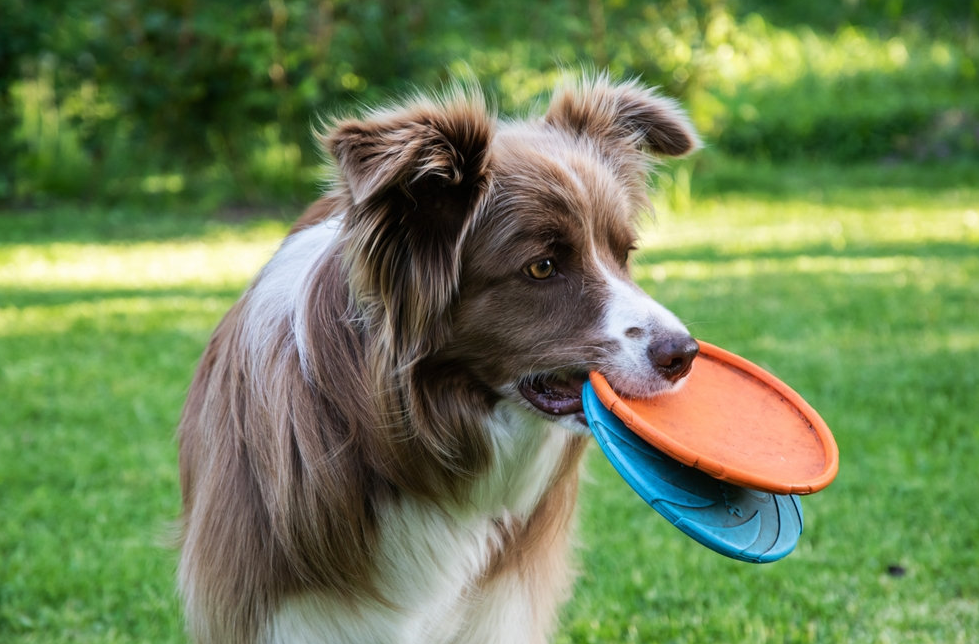
Fetch toys with unpredictable movement:Standard round balls are quickly mastered — the trajectory is predictable. Border collies respond better to fetch toys that bounce erratically: rubber toys with irregular shapes, Chuckit Erratic balls, or Jolly Balls that deflect unexpectedly on bounce. Unpredictable movement mimics prey and herding subjects, keeping the dog engaged longer per session.
Puzzle feeders:Feeding meals through a puzzle feeder rather than a bowl is one of the highest-value enrichment tools for border collies. LickiMats, Nina Ottosson puzzle boards at Level 3 and 4 difficulty, snuffle mats, and Kong-style toys packed with frozen food all extend mealtime into a cognitive session. For a border collie, working for food engages the same problem-solving circuits that herding work does — it is not a replacement for exercise, but it is a meaningful mental supplement. For reviewed options, see our best toys for border collie mental stimulation buying guide.
Flirt poles:A flirt pole is essentially a giant cat wand for dogs — a pole with a rope and a lure at the end that the owner controls. Border collies respond intensely to flirt poles because the lure moves in ways that trigger the herding chase response, and the movement is controlled by the owner rather than the dog, maintaining novelty. Ten minutes of focused flirt pole play provides more mental and physical exercise than 30 minutes of unsupervised ball access for most border collies.
Scent work toys:Nose work — hiding treats or scent targets for the dog to find — engages a different cognitive system than herding-drive toys. It is also lower-intensity physically, making it valuable for days when outdoor exercise is limited. Start with simple hide-and-find games with high-value treats before progressing to formal nose work training. This is particularly valuable when combined with indoor exercise — see our guide on how to exercise a border collie indoors.
Toy Categories Border Collies Lose Interest in Quickly
Rotation Strategy: The Key to Sustained Engagement
Even the best border collie toy loses its value through repeated exposure. The most effective approach is a rotation system: keep 8 to 12 toys total and make only 2 to 3 available at any given time, rotating every two to three days. A toy that has been out of sight for a week regains novelty when reintroduced. This prevents the “bored by Tuesday” pattern that happens when all toys are always accessible.
New toys can be introduced as high-value rewards during training sessions rather than simply given — this builds positive association and extends the novelty period.
Safety Considerations for Border Collie Toys
Border collies are typically not power chewers — they are precision workers who tend to carry and interact with toys rather than systematically destroy them. However, individual variation exists, and any toy that can be broken into pieces large enough to swallow should be supervised. Rope toys in particular fray into strands that can cause intestinal obstruction if swallowed in quantity — inspect regularly and discard when significantly frayed.
Frequently Asked Questions
How often should you replace a border collie’s toys?
Replace toys when structurally compromised — frayed, cracked, or small enough to be swallowed — rather than on a fixed schedule. Rotation prevents premature boredom, so “replacing” with a temporarily absent toy you already own is often more effective than buying new ones.
Do border collies do well with self-play toys?
Moderately — most border collies will engage with self-play toys for limited periods, but they reach peak engagement in handler-directed activities. A border collie playing with a puzzle toy alone is supplementary enrichment. A border collie doing agility, fetch, or tug with their owner is the real target for the breed’s needs.
What toy is best for a border collie left alone?
A frozen Kong or Toppl stuffed with their regular food and a small amount of peanut butter or wet food provides 20 to 40 minutes of engagement for most border collies. This should supplement — not replace — a pre-departure exercise session that tires the dog before solo time begins.
More FurlyHome Breed Guides
- Best Toys for Border Collie Mental Stimulation
- How to Exercise a Border Collie Indoors
- Best Interactive Puzzle Feeder for Dogs
- Best Under Desk Dog Beds (Home Office Breeds)
| Toy Type | Border Collie Response | Why It Fails |
| Squeaky plush toys | Initial interest, then destroyed | Puzzle solved immediately (kill the squeaker) |
| Standard rope toys | Brief chewing, then ignored | No cognitive demand, no movement |
| Simple rubber chews | 10–20 min engagement | Passive, no problem-solving |
| Basic round balls (self-play) | Short fetch sessions only | Predictable bounce removes challenge |
| Electronic toys (random movement) | Variable — some love, some ignore | Pattern recognition is fast; loses novelty |
Verdict
Border collies love toys that deliver cognitive challenge alongside physical engagement — fetch toys with unpredictable movement, puzzle feeders, flirt poles, structured tug, and scent games consistently outperform passive toys like chew bones or standard squeaky toys. The rotation principle matters as much as the toy choice: even excellent toys lose novelty when always available. Plan a rotation system and treat handler-directed play as the primary enrichment category — toys support it, not replace it.






Write Your Review
No reviews yet. Be the first to share your experience!