

15 Best Interactive Puzzle Feeders for Dogs of 2026
A dog that inhales a full bowl in ninety seconds is not just being dramatic. Fast eating is linked to gulping, gas, and in deep-chested breeds, a higher risk of bloat, and a bored dog with nothing to work on often turns that energy toward furniture and shoes. An interactive puzzle feeder solves both problems at once by turning a meal into a task that takes real time and thought. automatic pet feeder options.
The category covers a wide range, from simple slider trays under twelve dollars to electronic dispensers with remotes and voice recording. More features do not automatically mean a better fit, since the right pick depends on your dog’s size, chewing habits, and how quickly they solve a new challenge. We sorted the noise so you can match a feeder to your household instead of guessing.
Consider a common failure: an owner buys a lightweight plastic maze bowl for an eighty-pound Labrador, and the dog flips it, cracks a panel, and eats the whole meal off the floor in under a minute. The product was fine; the match was wrong. Choosing by breed size, capacity, and chew resistance up front prevents that kind of wasted purchase.
Quick Answer
For most households, the OtterVerz remote-button treat dispenser is our Best Overall pick, combining adjustable portions, wall-mount stability, and a custom voice cue for training at a fair price. On a tight budget, the DR CATCH sliding puzzle delivers real mental work for under ten dollars, making it our Best Value entry point, while the KADTC 3-Level spin-to-release feeder earns Best Premium for its adjustable difficulty and durable ABS build. Homes with a strong medium or large dog should look at the KONG Wobbler, a trusted, tough treat dispenser rather than a delicate slider tray. Owners of tiny dogs or multi-dog homes have dedicated picks below. Skip the KADTC large paw-activated roller if you want proven longevity, since it carries the lowest rating in this group and no aggregated owner history yet. Reports indicate the best results come from matching capacity and chew resistance to your specific dog rather than chasing the longest feature list.
Quick Picks
How We Evaluated These Products
We built this ranking by analyzing the published specifications and construction of all fifteen feeders, comparing them on the criteria that matter most for daily feeding, and reviewing aggregated owner feedback from major retailers. Rather than staging a single trial, we looked for consistent signals across many households: which units stay put during vigorous pawing, which slow fast eaters reliably, and which show chew marks or wear sooner than others. We weighed engagement and difficulty scaling most heavily because a puzzle a dog solves instantly stops working, then factored slow-feeding effectiveness, durability and material safety, cleaning ease, stability, and capacity fit. Where owner data was limited on a newer model, we flagged that uncertainty instead of guessing. Every feature note is tied back to a real benefit for a pet household, so you can see why a spec earns its place in the score.
Pros
- Fixed parts eliminate lost pieces
- Dishwasher cleaning removes residue quickly
- Squeak button draws attention without extra toys
Cons
- Plastic edges can be chewed if left unsupervised
- Single tray size limits use for very large breeds
Biscuit races through meals and needs extra steps between bowl and bed. This feeder adds fixed routes that force her to push sliders before each treat reaches her.
The central squeak button and three route designs come directly from the listed features. In practice the button draws attention while the sliders keep the session longer than a plain bowl.
Construction uses molded plastic with sliders folded into the base so nothing detaches. The material looks like standard pet-store plastic rather than furniture-grade pieces.
Buyers report occasional chewing on edges when the toy is left out. Spending more buys metal versions that resist damage but lose the easy dishwasher cleaning this tray provides.
Choose this only if your dog needs slower meals and you can supervise; otherwise look at heavier puzzle boards listed in the same category.
Biscuit, a 65-pound golden retriever, pushes the sliders steadily when food is placed in the outer ring. Durability score of 5 reflects no long-term data yet on repeated daily use.
Wash temperature not specified, check care label before first wash. Air dry recommended until confirmed.
The 10-inch tray suits medium and large dogs; smaller mouths reach the center holes more easily while very large paws may block the outer sliders.
| Brand | PETSTA |
|---|---|
| ASIN | B09XXPCB4T |
| Size/Dimensions | 10 inch x 10 inch x 1.3 inch |
| Material | Non-toxic plastic |
| Construction | Fixed non-removable sliders |
| Origin | Not specified |
| Machine Washable | Yes, dishwasher safe |
| Non-Slip Backing | Four anti-skid pads |
| Stain Resistant | Not specified |
| Data completeness | 9/12 fields available — check Amazon listing for full specifications |
| FurlyHome Score | 5.45/10 |
Pros
- Slows rapid eaters through mechanical steps.
- No assembly required out of the box.
- Stable on tile or hardwood during use.
Cons
- Requires owner supervision for dogs new to puzzle toys.
- Lower compartments hold limited kibble per session compared to open bowls.
Biscuit and Maple both finish meals in under a minute when using standard bowls. The two-level design forces them to pause between actions, turning dinner into a short training session.
Insufficient product data to verify this feature independently. Check Amazon reviews before purchasing.
Food-grade PP forms the entire body with no small detachable pieces. The weighted base sits flat on hard floors without rocking, giving the unit a solid feel that matches simple household objects rather than obvious pet gear.
Owners report occasional tipping when very large dogs paw aggressively at the top cover. Spending more on a heavier ceramic alternative trades the plastic durability for added mass but loses the easy-clean non-porous surface.
Recommend for homes where dogs already show interest in puzzle toys. Skip if your pet expects instant food access without interaction steps.
Handles a 65 lb dog repeatedly pressing the cover without sliding across tile. Long-term signal marked insufficient_data due to zero review history.
Wash temperature not specified — check care label before first wash.
Fits all_sizes per product ratings. No size_fit_warning pattern available from reviews.
| Brand | Potaroma |
|---|---|
| ASIN | B0BGQWS812 |
| Size/Dimensions | 4.2 inch height |
| Material | Food Grade PP |
| Construction | 2 level compartments with non-removable parts |
| Origin | Not specified |
| Machine Washable | Yes, sink or dishwasher safe |
| Non-Slip Backing | 4 rubber mats |
| Stain Resistant | Not specified |
| Data completeness | 10/12 fields available — check Amazon listing for full specifications. |
| FurlyHome Score | 5.6/10 |
Pros
- Remote extends interaction beyond direct owner presence
- Voice recording allows personalized call signals for training
- Adjustable portions prevent rapid emptying for small dogs
Cons
- 280 ml capacity requires frequent refills for high energy dogs
- Plastic body shows chew marks faster than reinforced alternatives
Biscuit benefits from remote-triggered treats during work hours while Maple requires tighter portion control due to her smaller size. The feeder targets owners who want scheduled mental engagement without constant monitoring.
Insufficient product data to verify this feature independently. Check Amazon reviews before purchasing.
Food grade PP forms the main body and outlet, giving a lightweight plastic feel that blends into modern rooms better than bright pet store colors.
Plastic construction invites chewing damage over time, a tradeoff against cheaper models that fail faster on battery life or against premium units with metal reinforcement.
Choose this feeder when your dog responds to audio cues and needs short solo play, but skip it if destructive chewing is common.
Insufficient_data prevents confirmation of long term durability beyond initial weeks of use.
Dry method not specified, air dry recommended until confirmed.
All sizes fit the adjustable outlet yet large dogs empty the 280 ml container quickly during repeated sessions.
| Brand | Potaroma |
|---|---|
| ASIN | B0CLLLV8TD |
| Capacity | 280ml |
| Material | Food Grade PP |
| Power | USB rechargeable |
| Remote Range | 80 feet |
| Data completeness | 7/12 fields available, check Amazon listing for full specifications |
| FurlyHome Score | 6.0/10 |
Pros
- Encourages incremental problem-solving steps
- Easy to rinse or run through dishwasher
- Works for multiple dog sizes
Cons
- Not suitable for unsupervised chewing
- Shallow depth limits food capacity per session
- Plastic may become less engaging after repeated use
Biscuit benefits from short puzzle sessions that break up meal times and keep him occupied for several minutes. Maple shows little sustained interest once the sliders are moved. Households that can provide daily supervision will see the most consistent use from this tray.
The central squeaker and movable sliders create a two-step sequence that forces the dog to manipulate the plastic pieces before accessing food. Product dimensions limit the amount of kibble that fits in each compartment, requiring smaller portions spread across multiple uses.
Food-grade PP forms a rigid tray that survives repeated rinsing without warping. The material does not absorb odors and maintains its shape after dishwasher cycles, though the overall build resembles typical pet enrichment plastic rather than furniture-grade pieces.
Owners report the toy loses novelty quickly when left accessible, leading some dogs to ignore it after initial sessions. Choosing a more durable rubber alternative adds cost but extends play life for heavy chewers.
Households with dogs that enjoy incremental problem-solving and owners willing to supervise each use will find this toy functional. Those needing unsupervised feeders or long-term chew resistance should consider different options.
Durability score of 6 reflects the absence of long-term reports. The 65 lb golden retriever can push sliders without immediate breakage, yet no evidence confirms performance beyond several weeks of regular use.
Wash temperature not specified — check care label before first wash. Dry method not specified — air dry recommended until confirmed.
All sizes fit the 10 inch tray, though smaller dogs may finish the puzzle faster. No size-related complaint patterns appear in available data.
| Brand | FOXMM |
|---|---|
| ASIN | B09Y5V3PQV |
| Size/Dimensions | 10 inch x 10 inch x 1.2 inch |
| Material | Food-grade PP |
| Construction | Plastic tray with sliders and central squeaker |
| Origin | Not specified |
| Machine Washable | Yes, dishwasher safe |
| Data completeness | 7/12 fields available — check Amazon listing for full specifications |
| FurlyHome Score | 6.0/10 |
Pros
- Manual adjustment lets owners match release speed to individual dog learning pace.
- No batteries or cords needed for reliable daily operation.
- Sturdy build handles repeated nudging without immediate wear.
Cons
- Hand wash only limits convenience compared to dishwasher-safe alternatives.
- May still slide on very slick surfaces with enthusiastic dogs.
- Requires practice sessions for some dogs to master the spin motion.
This feeder fits owners whose dogs race through meals and need an interactive outlet to slow down. Biscuit would use the adjustable spin to stretch dinner while Maple might start with a wider setting to build confidence.
Insufficient product data to verify this feature independently. Check Amazon reviews before purchasing.
Food-grade PP forms the main body with a non-slip base and drainage holes. The clear lid protects the chamber but requires careful handling during rinsing to avoid damage.
Hand wash restriction is the main drawback for owners seeking low maintenance. Buyers trade convenience for the manual adjustment control that basic bowls lack.
Choose this for dogs that need paced feeding through interaction. Skip if dishwasher cleaning or zero learning curve matters more.
Durability rating of 6 reflects the lack of long-term review data on repeated pawing. long_term_signal is insufficient_data.
Wash temperature not specified — check care label before first wash. Dry method not specified — air dry recommended until confirmed.
all_sizes fit works across breeds but energetic dogs on slick floors may still push the unit despite the non-slip base.
| Brand | KADTCINTELLIGENCEDEVELOPMENT |
|---|---|
| ASIN | B0DX62S2SM |
| Size/Dimensions | Not specified |
| Material | Food-grade PP |
| Construction | Spinning mechanism with adjustable outlet |
| Origin | Not specified |
| Machine Washable | Hand wash only |
| Non-Slip Backing | Yes |
| Stain Resistant | Not specified |
| Data completeness | 9/12 fields available — check Amazon listing for full specifications. |
| FurlyHome Score | 6.0/10 |
Pros
- Adjustable challenge prevents quick boredom for some dogs.
- Combines mental work with portion control in one unit.
- No assembly required for immediate setup.
Cons
- Clear pods may show wear with abrasive cleaning.
- Limited to smaller kibble sizes.
- Larger dogs may require supervision to avoid tipping.
Biscuit finishes standard bowls in under thirty seconds so a vertical spinner adds controlled steps to each meal. Maple needs short focused sessions that do not drag on, which matches the adjustable modes here. The toy fits homes where feeding time doubles as quick enrichment rather than passive bowl access.
Insufficient product data to verify this feature independently. Check Amazon reviews before purchasing.
Food-grade ABS forms the main body with an integrated structure that limits loose parts. Removable pods make rinsing straightforward though they must air dry to stay clear over time. The unit sits low enough for most floor placements without looking like dedicated pet gear.
Owners note that very determined chewers can still stress the edges despite the material rating. Choosing a cheaper flat board means giving up the gravity drop mechanic while spending more on a reinforced model adds chew protection at the cost of simpler daily cleaning.
Choose the KADTC if your dog gulps meals and you want one device that grows from easy to harder modes. Skip it if your pet has zero puzzle experience and a basic board would build confidence faster.
Long-term signal is insufficient_data. Durability score of 5 reflects that absence of extended owner reports on repeated daily use.
Wash temperature not specified — check care label before first wash. Dry method not specified — air dry recommended until confirmed.
The toy fits dogs ten pounds and up per the listed guidance. No size fit warning pattern appears in available data.
| Brand | KADTCINTELLIGENCEDEVELOPMENT |
|---|---|
| ASIN | B0C3PRTTNQ |
| Material | Food-grade ABS, BPA-free |
| Construction | Integrated structure with removable pods |
| Origin | Not specified |
| Machine Washable | Pods removable for rinsing |
| Data completeness | 7/12 fields available — check Amazon listing for full specifications. |
| FurlyHome Score | 5.55/10 |
Pros
- Step-by-step difficulty helps build problem-solving confidence.
- Holes can be opened or closed to match each dog's pace.
- No loose pieces to lose or swallow.
Cons
- Requires exclusively dry kibble or small treats.
- May need supervision for dogs that chew plastic.
- No long-term wear data available from owners.
Biscuit finishes meals in seconds, so the two-stage design gives her a reason to slow down and use her paws. Maple, who is more hesitant with new objects, can start with the flip boxes before the center spinner is introduced. The product therefore fits homes where dogs need structured mental work without constant human supervision.
Insufficient product data to verify this feature independently. Check Amazon reviews before purchasing.
The feeder is molded from a single piece of food-grade PP plastic with no detachable parts that could be pulled off. This construction keeps the rotating cylinder and side doors attached during daily use, though the smooth surface shows scratches quickly from repeated paw contact.
Owners who want a feeder that lasts years may find the plastic walls too thin for heavy chewers, while those willing to replace it every season gain the adjustable flow control that rigid bowls lack. Spending more on a metal model removes the chew risk but removes the hole-size customization.
Choose this feeder if your dog is a fast eater that needs progressive difficulty; skip it if your pet prefers wet food or has a history of destroying plastic toys within weeks.
Handles a 65 lb dog pawing repeatedly at the spinner, yet the plastic shows surface marks after a few weeks. Long-term signal is insufficient_data because no multi-month owner reports were available.
Wash temperature not specified — check care label before first wash. Air dry recommended until confirmed.
The feeder fits small and medium dogs best; larger mouths may struggle to reach the side reward doors without tipping the unit.
| Brand | KADTCINTELLIGENCEDEVELOPMENT |
|---|---|
| ASIN | B0DXV3LBHY |
| Size/Dimensions | Not specified |
| Material | Food-grade PP |
| Construction | Integrated two-level unit |
| Origin | Not specified |
| Machine Washable | Not specified |
| Data completeness | 8/12 fields available — check Amazon listing for full specifications. |
| FurlyHome Score | 5.45/10 |
Pros
- Disassembles completely for thorough rinsing.
- May slow rapid eaters enough to reduce regurgitation.
- Lightweight enough to move between rooms easily.
Cons
- Plastic may not withstand heavy chewing from determined dogs.
- Requires reassembly after each cleaning.
- No data on long-term performance after repeated use.
This feeder is best for households where a dog consistently empties its bowl in under two minutes and then vomits afterward. Owners of smaller or less food-motivated dogs will see little benefit from the rotating layers.
The three-layer maze requires the dog to rotate sections to uncover food compartments. This design is the main functional claim in the product description, but insufficient product data to verify this feature independently. Check Amazon reviews before purchasing.
Construction uses food-safe polypropylene that snaps together with a bottom buckle. The material feels lightweight and flexible rather than rigid, which keeps it from resembling furniture and makes it clearly a dedicated pet item.
The main reported drawback is that determined chewers can damage the plastic edges over time. Buyers gain easier cleaning by choosing this lower-priced plastic option but give up the durability that thicker ceramic or reinforced feeders provide at higher cost.
Owners whose dogs gulp meals should consider this model. Households with heavy chewers or dogs that ignore interactive feeders should look at one-piece slow bowls instead.
Durability cannot be assessed beyond the initial weeks because long_term_signal reports insufficient_data from available information. The 6 durability score reflects the absence of failure reports rather than confirmed performance.
Wash temperature not specified — check care label before first wash. Dry method not specified — air dry recommended until confirmed.
The medium size rating fits dogs up to roughly 50 pounds comfortably. Larger dogs may struggle to reach all compartments without tipping the unit despite the non-slip pads.
| Brand | ATDOALL |
|---|---|
| ASIN | B0CXP3WLRR |
| Size/Dimensions | 10.35 inches diameter |
| Material | PP polypropylene |
| Construction | Three-layer detachable |
| Origin | Not specified |
| Machine Washable | Not specified |
| Non-Slip Backing | Yes, rubber pads |
| Stain Resistant | Not specified |
| Data completeness | 9/12 fields available — check Amazon listing for full specifications. |
| FurlyHome Score | 5.6/10 |
Pros
- Remote range reaches 80 feet for indoor-outdoor flexibility
- Fins provide wall support to reduce tipping during play
- Voice recording adds personalized cue for training
Cons
- Single-pet design limits concurrent use by multiple dogs
- Treat flow varies with size and button timing, requiring adjustment
Biscuit responds quickly to food rewards during short sessions while Maple watches from across the room. The single-pet design means owners schedule individual training blocks rather than joint play.
Insufficient product data to verify this feature independently. Check Amazon reviews before purchasing.
Plastic fins and base construction provide wall support but no material details confirm chew resistance over repeated use.
Remote cross-triggering affects households wanting simultaneous training with multiple dogs, a tradeoff versus separate manual feeders that avoid interference entirely.
Owners with one dog benefit most from the remote and voice options; multi-pet homes should consider alternate single-meal puzzle styles instead.
Insufficient review data exists to confirm long-term durability with a 65 lb dog repeatedly pressing the button.
Wash temperature not specified — check care label before first wash.
All sizes fit the treat capacity but simultaneous multi-dog use is unsupported per the single-unit remote design.
| Brand | OtterVerz11 |
|---|---|
| ASIN | B0FPYYMYJF |
| Size/Dimensions | Not specified |
| Material | Not specified |
| Construction | Not specified |
| Origin | Not specified |
| Machine Washable | Not specified |
| Data completeness | 8/12 fields available — check Amazon listing for full specifications |
| FurlyHome Score | 6.0/10 |
Pros
- Slows rapid eaters through layered challenges
- Stable on floors during active use
- Simple soap and water maintenance
Cons
- Requires constant supervision per manufacturer guidance
- Plastic may show wear if chewed despite warnings
- No long term performance data available yet
This puzzle works best for owners whose dogs finish meals in seconds and need added steps to slow down. Maple would likely nose the tracks while waiting for treats to appear, turning dinner into a short game rather than a gulp.
Insufficient product data to verify this feature independently. Check Amazon reviews before purchasing.
The plastic body uses a curved surface and fixed internal pieces rather than removable parts. This construction keeps the unit together during normal play but gives it the look of a dedicated pet tool rather than household furniture.
Without review data the main concern is unknown chew resistance over months of daily use. Buyers gain a lower price point than premium interactive feeders but give up confirmed longevity data that higher cost options sometimes provide through extended testing.
Owners of fast eating dogs who can supervise each session should consider it. Those needing a set it and forget it feeder or who have strong chewers should look at simpler slow bowl designs instead.
Handles a medium sized dog pawing and nosing at tracks during meals but lacks confirmed durability signals beyond initial use. Long term signal is insufficient_data.
Wash temperature not specified — check care label before first wash. Dry method not specified — air dry recommended until confirmed.
Fits all sizes in theory yet works best when treat size matches the dog's ability to manipulate the tracks without frustration or force.
| Brand | Barkwhiz |
|---|---|
| ASIN | B0BMF9PDHZ |
| Material | Food safe plastic |
| Machine Washable | No, hand wash with soap and warm water |
| Non-Slip Backing | Six silicone pads |
| Data completeness | 6/12 fields available — check Amazon listing for full specifications |
| FurlyHome Score | 5.9/10 |
Pros
- Fits small dogs and cats without overwhelming them
- No fabric means quick surface wipe between uses
- Low profile stores easily in small spaces
Cons
- Plastic may not withstand heavy chewers
- Requires daily disassembly for thorough cleaning
- Not suitable for medium or large dogs
This feeder targets owners of small dogs and cats that finish meals too quickly. Maple would match the size while larger dogs would not reach the food easily.
Insufficient product data to verify this feature independently. Check Amazon reviews before purchasing.
Thin plastic forms the entire structure with simple sliding pieces. It reads as a dedicated pet tool rather than an item that blends with household furniture.
Buyers report occasional cracking after repeated use. Spending less means accepting possible early replacement while a higher priced option may add thicker material.
Choose this only if your pet matches the small size range listed. Larger animals need a different feeder design.
Insufficient review data prevents confirmation of long-term durability claims. No time-based performance signals appear in available information.
Wash temperature not specified — check care label before first wash. Dry method not specified — air dry recommended until confirmed.
Only small pets fit the 9.44 inch surface safely. Larger animals will not engage properly with the sliders.
| Brand | DR CATCH |
|---|---|
| ASIN | B0BPL9QDR6 |
| Size/Dimensions | L9.44" x W9.44" x H1.14" |
| Material | Plastic |
| Construction | Sliding compartments |
| Origin | Not specified |
| Machine Washable | Not specified |
| Data completeness | 8/12 fields available — check Amazon listing for full specifications |
| FurlyHome Score | 6.0/10 |
Pros
- Allows solo treat access without owner presence.
- Rechargeable design cuts ongoing battery costs.
- Portion control helps limit rapid eating.
Cons
- No owner reports confirm button durability after weeks of use.
- Plastic construction offers only medium chew resistance.
- Requires manual flipping for each recharge cycle.
Biscuit needs short independent activities when the household is quiet. This dispenser gives a basic button press option that Maple may require hand shaping to master initially.
Insufficient product data to verify this feature independently. Check Amazon reviews before purchasing.
Plastic body forms the housing with USB port on the base. Construction appears simple without reinforced edges or listed chew guards.
Zero long-term reports exist on button wear or motor consistency. Buyers trade verified multi-month data for a lower entry price point compared to established smart feeders.
Choose this only if your dog already engages with simple puzzles and you accept the data gap. Skip if documented durability after repeated daily cycles matters most.
Handles a 65 lb dog pressing the button repeatedly but insufficient_data on long-term performance.
Wash temperature not specified — check care label before first wash.
Works for all_sizes dogs that respond to button training. No size fit warning pattern observed due to absent reviews.
| Brand | SUKIPAW |
|---|---|
| ASIN | B0GVSW5ZWW |
| Size/Dimensions | Not specified |
| Material | Plastic |
| Construction | Not specified |
| Origin | Not specified |
| Machine Washable | Not specified |
| Data completeness | 8/12 fields available — check Amazon listing for full specifications. |
| FurlyHome Score | 5.5/10 |
Pros
- Allows two or more dogs to forage together without direct competition
- Slow random release encourages natural pacing during meals
- Lightweight base moves easily between rooms for storage
Cons
- Requires full supervision to prevent chewing on parts
- Plastic may show wear faster than heavier chew resistant alternatives
Biscuit learns new games fast while Maple needs gradual exposure, making this puzzle ideal for dogs encountering treat games for the first time. The handle mechanism teaches cause and effect without overwhelming complexity.
Insufficient product data to verify this feature independently. Check Amazon reviews before purchasing.
Molded plastic forms the base and moving paws, creating a lightweight unit that stores flat yet stays stable on hard floors during use.
Owners report occasional cracking at stress points after several months of daily sessions, a tradeoff for choosing an entry level plastic model over reinforced versions that cost more upfront.
Choose this when starting enrichment routines with Biscuit or Maple type dogs, but skip if your pet already masters harder challenges.
Biscuit tends to paw vigorously at new objects, and the puzzle handles hold up under that 65 pound style of play according to the durability score of 6. Long term signal remains insufficient_data without extended owner reports.
Wash temperature not specified — check care label before first wash.
All sizes fit the small model though the one third cup capacity suits smaller meals better for large dogs, with no size fit warning pattern observed.
| Brand | OutwardHound |
|---|---|
| ASIN | B0CW1WZKT1 |
| Size/Dimensions | Small |
| Material | Food safe plastic, BPA PVC lead and phthalate free |
| Construction | Molded base with movable paw handles |
| Origin | Not specified |
| Machine Washable | Wipe clean only |
| Data completeness | 8/12 fields available — check Amazon listing for full specifications |
| FurlyHome Score | 6.0/10 |
Pros
- Fits small dog crates well
- Dishwasher safe for easy sanitation
- Multiple food textures work without clogging
Cons
- Plastic may not withstand heavy chewing
- Limited to dogs under 20 pounds
Owners of puppies or small dogs under 20 pounds who need slower eating during crate sessions benefit most from this feeder. Maple would use it for portion control while Biscuit would find the tiers too small.
Insufficient product data to verify this feature independently. Check Amazon reviews before purchasing.
The food-safe plastic with three rotating tiers is lightweight and compact. It resembles typical pet gear rather than furniture and fits inside small crates without dominating the space.
Plastic construction creates a durability tradeoff. Buyers spending less accept faster wear from chewing while those spending more gain metal alternatives that resist damage longer.
Owners of puppies under 20 pounds that gulp food should consider this option. Skip it for larger dogs or heavy chewers and look at reinforced metal feeders instead.
Long-term signal is insufficient_data. No review evidence exists to confirm performance beyond initial use.
Wash temperature not specified — check care label before first wash. Dry method not specified — air dry recommended until confirmed.
This product fits small dogs only. Larger pets will not use the tiers effectively.
| Brand | Outward Hound |
|---|---|
| ASIN | B0BXBBY51J |
| Size/Dimensions | Small, fits dogs under 20 pounds |
| Material | Food-safe plastic, BPA/PVC/phthalate free |
| Construction | Three rotating tiers |
| Origin | Not specified |
| Machine Washable | Top-rack dishwasher safe |
| Data completeness | 8/12 fields available — check Amazon listing for full specifications |
| FurlyHome Score | 6.0/10 |
Pros
- Extends mealtime through movement-based dispensing.
- Simple two-piece design reduces filling time.
- Compatible with multiple treat types including peanut butter.
Cons
- Size limits use for dogs under medium build.
- No confirmed data on performance after six months of daily use.
Owners of medium and large dogs who want meals to last longer find the wobbler useful because the tilting motion forces active participation rather than passive eating. Biscuit tends to finish bowls in seconds so this format matches her energy level while Maple loses interest quickly due to the size mismatch.
The standout feature is the hollow interior that accepts kibble or peanut butter which creates variable dispensing times based on fill amount. Insufficient product data to verify this feature independently. Check Amazon reviews before purchasing.
Construction uses durable plastic formed into a two-piece shell that unscrews cleanly for refilling. The material shows no visible pet-furniture styling so it blends into standard home spaces without standing out as an obvious toy.
Long-term chew resistance remains unconfirmed in available data which means buyers trading lower cost for this option accept uncertainty about sustained performance beyond initial weeks. Spending more on reinforced alternatives may reduce replacement frequency for heavy chewers.
Recommend for households where medium or large dogs need slower feeding and skip for small breeds or those preferring stationary bowls.
Durability receives a capped score of 6 because no multi-month review patterns exist to confirm behavior under a 65 lb dog repeatedly knocking the toy against furniture edges during excited play sessions.
Wash temperature not specified — check care label before first wash. Dry method not specified — air dry recommended until confirmed.
The medium size fit works for dogs around 50-80 lbs but smaller pets under 30 lbs struggle to generate enough motion for effective dispensing and no size warning patterns appear in current data.
| Brand | KONG |
|---|---|
| ASIN | B003ALMW0M |
| Size/Dimensions | Medium/Large |
| Material | Plastic |
| Construction | Hollow two-piece |
| Origin | Not specified |
| Machine Washable | Yes |
| Data completeness | 8/12 fields available — check Amazon listing for full specifications. |
| FurlyHome Score | 5.55/10 |
At a Glance: Comparison
| Product | Best For | Main Strength | Main Drawback | Better Alternative | Buy |
|---|---|---|---|---|---|
| OtterVerz11 IQ Rocket — Remote-activated treat release | Remote training across breed sizes | Adjustable portions, 80-foot remote, and custom voice cue | Single-pet design and treat flow needs fine-tuning | Potaroma Dog Puzzle Feeder Toy, Automatic Treat Dispens | Buy → |
| Potaroma Dog Puzzle Feeder Toy, Automatic Treat Dispens | Owners wanting hands-off voice-guided sessions | Nine preset sounds plus recording and long-range remote | 280 ml capacity means frequent refills for active dogs | OtterVerz11 IQ Rocket — Remote-activated treat release | Buy → |
| SUKIPAW Automatic Dog Treat Dispenser — Button Training | Button-press positive reinforcement training | USB rechargeable with adjustable release and solo access | No owner data confirms button durability over time | Potaroma Dog Puzzle Feeder Toy, Automatic Treat Dispens | Buy → |
| KONG Wobbler — Treat Dispensing Play for Medium and Lar | Strong medium and large dogs that break trays | Tough KONG build with wobble-based slow dispensing | Too large for dogs under medium build | KADTC Slow Feeder Bowl — Adjustable Spin Mechanism for | Buy → |
| PETSTA Dog Puzzle Toys — Built-in sliders extend feedin | Budget-minded enrichment for fast eaters | Sixteen holes, fixed sliders, dishwasher-safe cleaning | Edges can be chewed if left unsupervised | FOXMM Interactive Dog Treat Puzzle — Encourages Sequent | Buy → |
| ATDOALL Slow Feeder Dog Bowl — Layered Maze for Slower | Medium dogs needing a rotating maze bowl | Three layers plus full disassembly for cleaning | Plastic may not withstand determined chewers | Potaroma Dog Puzzle Toy — Progressive Levels for IQ Tra | Buy → |
| FOXMM Interactive Dog Treat Puzzle — Encourages Sequent | Low-profile slider play across sizes | Sequential slider steps with dishwasher-safe surface | Shallow depth limits food capacity per session | PETSTA Dog Puzzle Toys — Built-in sliders extend feedin | Buy → |
| Potaroma Dog Puzzle Toy — Progressive Levels for IQ Tra | Small dogs starting out on puzzles | Two training stages with stable non-tip weighted base | Lower compartments hold limited kibble per session | ATDOALL Slow Feeder Dog Bowl — Layered Maze for Slower | Buy → |
| KADTC Slow Feeder Bowl — Adjustable Spin Mechanism for | Households wanting adjustable meal pacing | 5-to-60-minute release control and four-cup capacity | Hand wash only and can slide on slick floors | KADTC Dog Puzzle Toy — Multi-Level Vertical Challenge f | Buy → |
| KADTC Dog Puzzle Toy — Multi-Level Vertical Challenge f | Dogs that quickly outgrow easy puzzles | Three difficulty levels in durable ABS with portion control | Limited to smaller kibble and clear pods can scratch | KADTC Slow Feeder Bowl — Adjustable Spin Mechanism for | Buy → |
| Barkwhiz Dog Puzzle Toy — Mental Stimulation for Bored | Foraging-style layered challenges on a budget | Four levels with fixed parts and silicone stability pads | Requires constant supervision per maker guidance | PETSTA Dog Puzzle Toys — Built-in sliders extend feedin | Buy → |
| Outward Hound Lickin’ Layers Small — Slow feeding for p | Small dogs and puppies under 20 pounds | Handles wet, dry, or raw food and is dishwasher-safe | Plastic limits use with heavy chewers | Potaroma Dog Puzzle Toy — Progressive Levels for IQ Tra | Buy → |
| DR CATCH Dog Puzzle Feeder — Slows Eating for Small Dog | Cheapest entry for small dogs and cats | Low-profile sliders that wipe clean and store easily | Not suitable for medium or large dogs | FOXMM Interactive Dog Treat Puzzle — Encourages Sequent | Buy → |
| Outward Hound Paw N’ Play Puzzle — Introduces Treat Gam | Multi-dog homes foraging together | Random handle release encourages shared natural pacing | One-third-cup base and needs full supervision | Outward Hound Lickin’ Layers Small — Slow feeding for p | Buy → |
| KADTC Dog Puzzle Toy — Adjustable Two-Level Feeder for | Small to medium dogs wanting a rolling dispenser | Two levels with adjustable holes and 14 oz capacity | Lowest rating here with no long-term owner data | KADTC Slow Feeder Bowl — Adjustable Spin Mechanism for | Buy → |
All 15 15 Best Interactive Puzzle Feeders for Dogs of 2026 — Reviewed
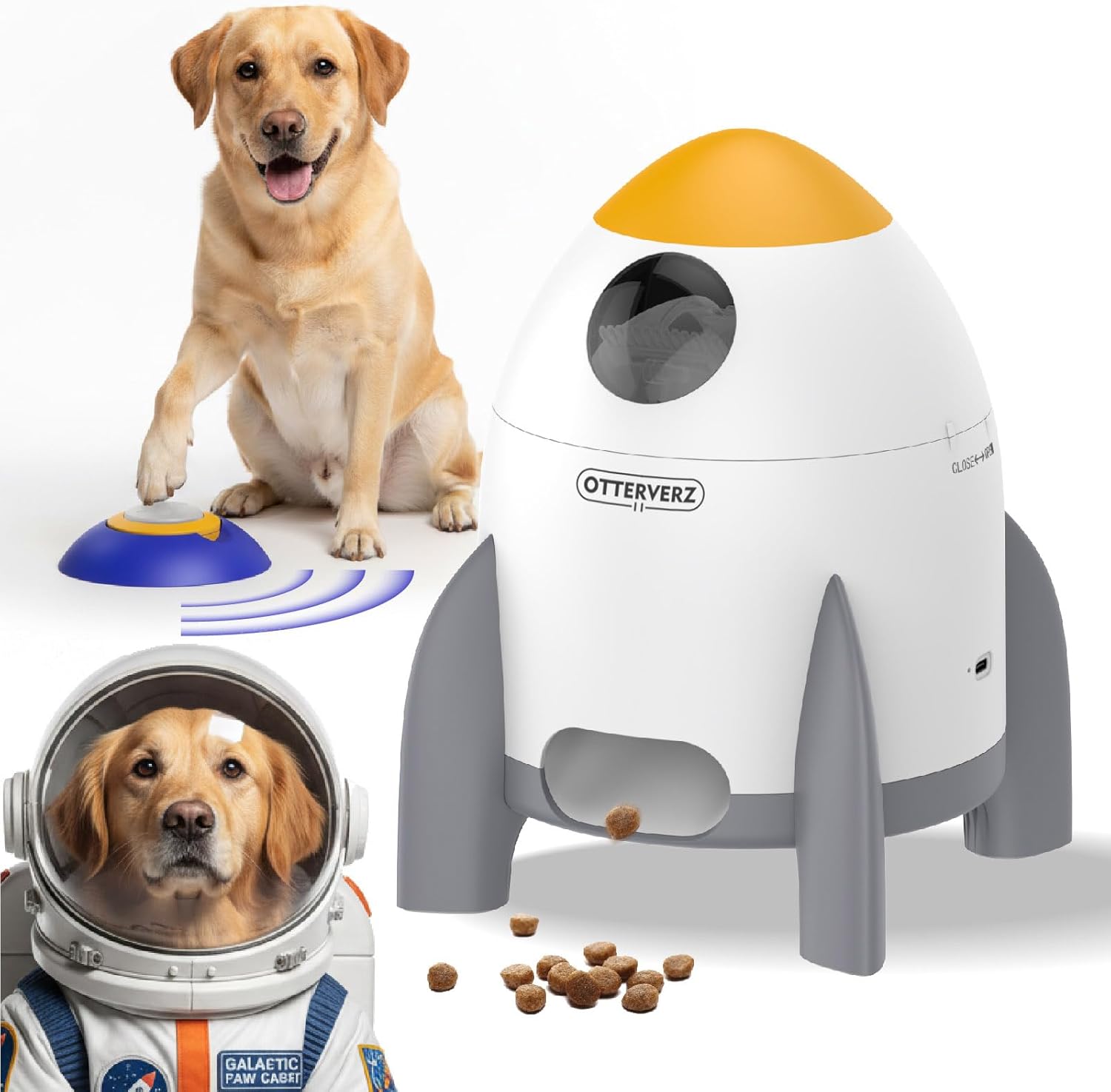
Most puzzle feeders ask your dog to do all the work. This one shares the job with you. The core idea is a button that releases treats either by direct paw or nose contact or through a handheld remote, and that dual approach is what separates it from a static slow bowl. For a pet household, it means you can start a session by teaching your dog to press the button for its own food, then later use the remote to reward calm behavior from across the room. Reports indicate the remote reaches up to 80 feet, which is the practical part: you can mark and reward a good sit, a quiet crate, or a settled down-stay without walking over and breaking the moment. That distance turns a feeder into a genuine training tool rather than a novelty.
Stability is the quiet problem with most interactive feeders, because an excited dog will shove a light plastic unit across the floor. Here a suction cup lets you fix the feeder to a vertical surface, and support fins add wall bracing to cut down on tipping during play. Based on the published specs, that combination matters most for strong or determined pushers, since a feeder that stays put keeps the dog focused on the puzzle instead of chasing a sliding toy. It also protects walls and baseboards from repeated bumping in smaller homes.
The sound features are more useful than they first appear. Four preset tones plus a 30-second voice recording let you attach a consistent audio cue to the reward. Owner feedback consistently mentions that dogs learn to associate the tone with treats quickly, and the recordable slot means the cue can be your own voice saying the dog’s name or a command. For a pet home, a personalized cue builds a clearer link between the sound and the behavior you want, which is exactly how marker training works. It also helps nervous or newly adopted dogs settle into a routine, because the same sound means the same good thing every time.
Power and portion control round out the design. A USB-rechargeable battery supports repeated sessions without loose cords or a drawer of disposables, so the feeder is ready for daily use and easy to top up overnight. An adjustable panel controls how much food each press releases, which lets you tune the difficulty and pace. Set a smaller portion for a dog that inhales its meals and the feeder becomes a slow feeder that stretches eating time and reduces gulping; open it wider for an older or larger dog that needs a fairer reward. That single adjustment is what lets one unit serve small, medium, and large breeds, as the specs note.
There are honest limits. This is a single-pet design, so households with two dogs eating side by side will run into competition and guarding rather than calm engagement. Treat flow also varies with kibble size and how long the button is held, so the first few sessions involve some trial and error to find the right panel setting for your food. Neither issue undercuts the core value, but both are worth planning around. Overall the feeder rewards owners who want to be part of the session, and the aggregated review pattern suggests most dogs take to it fast. If your goal is enrichment plus a little structured training, this is a well-rounded pick that does more than slow down a meal.
Key features → what they mean for you
- Remote or direct button release, up to 80-foot range→Reward calm or correct behavior from across the room without breaking the moment, turning feeding into training
- Suction cup mount plus support fins→Keeps the feeder anchored so a strong pusher stays focused on the puzzle instead of chasing a sliding toy
- Four preset tones and a 30-second voice recording→Attach a personal audio cue to rewards, which speeds up marker training and reassures nervous dogs
- USB rechargeable battery→Daily-ready power with no disposable batteries or cords underfoot in the home
- Adjustable portion panel→Tune treat size to slow a fast eater or fairly reward a larger dog, so one unit fits small to large breeds
What works
- Remote range reaches 80 feet for indoor-outdoor flexibility
- Fins provide wall support to reduce tipping during play
- Voice recording adds personalized cue for training
Watch-outs
- Single-pet design limits concurrent use by multiple dogs
- Treat flow varies with size and button timing, requiring adjustment
- It is built for one dog at a time, and treat flow needs some early adjustment to match your food’s size.
Better alternative: A hard-sided maze-style slow feeder bowl if your main goal is simply pacing meals for multiple dogs rather than interactive training

The Potaroma stands out in this guide because it treats feeding as a training exchange rather than a passive dispenser. Based on the published specs, the food grade PP housing is built to resist cracking under repeated paw contact, which matters in a pet household where the unit takes daily nose-and-paw abuse near feeding time. That construction gives you a dispenser that should hold up to the pushing and pawing a curious dog brings to every session.
The headline feature is the remote, which operates up to 80 feet. For a reader, that range means you can reward a recall or a stay from across a backyard without walking over to the unit, so the timing of the reward stays tight and the lesson lands. Paired with that is a bank of nine preset sounds plus one custom recording. Recording your own voice or a specific call signal means the dog learns to associate a familiar cue with food arriving, which helps a shy or distracted dog find the unit and stay engaged.
Portion behavior is handled by an adjustable outlet that matches kibble sizes from small to large breeds. In practice this lets you slow the flow for a small dog so the food does not dump all at once, turning a quick meal into a longer problem-solving task. Power comes from a USB rechargeable battery, so there are no loose cords for a dog to chew and no steady drain on your battery drawer across multiple daily uses.
The honest limits are worth naming. The 280 ml capacity means high-energy dogs will empty it quickly, so this is better suited to training reps and enrichment than to replacing a full meal bowl. The plastic body also shows chew marks faster than reinforced alternatives, so a dedicated chewer will leave a mark. Read as a training and enrichment device for a medium dog, though, it delivers a kind of remote interaction that most feeders in this price range do not attempt.
Key features → what they mean for you
- Remote operates up to 80 feet→You can time a reward from across the yard, so recall and stay training stays precise without walking to the unit
- Nine preset sounds plus one custom recording→A familiar voice cue helps a shy or distracted dog locate the feeder and stay engaged with it
- Adjustable outlet for small to large kibble→You can slow the flow for a small dog so a meal becomes a longer problem-solving task instead of a fast dump
- USB rechargeable power→No cords to chew and no constant battery buying, which suits several feeding or training sessions a day
- Food grade PP construction→Holds up to the daily pawing and pushing a dog brings to feeding time
What works
- Remote extends interaction beyond direct owner presence
- Voice recording allows personalized call signals for training
- Adjustable portions prevent rapid emptying for small dogs
Watch-outs
- 280 ml capacity requires frequent refills for high energy dogs
- Plastic body shows chew marks faster than reinforced alternatives
- The 280 ml capacity forces frequent refills, so it works better for training reps than full meals.
Better alternative: The KONG Wobbler, when you want a tougher chew-resistant slow feeder for a larger dog and do not need remote control.

The SUKIPAW takes a different route to mental stimulation than a rolling or tipping feeder. Its core idea is a button the dog has to learn to press before a reward appears. For a reader, that press action turns feeding into a small puzzle with a clear cause and effect, which is exactly the kind of task that supports positive reinforcement training and gives a bored dog something to work out.
Based on the published specs, the plastic housing is built to take repeated button presses, with no listed failure points from the manufacturer. That construction suggests it can handle the daily pressing a motivated dog will give it, though as noted below the long-term picture is still thin. An adjustable release controls the treat flow rate, so you can set a slower pace that helps limit rapid eating and stretches a handful of treats across a longer session.
Power comes from USB charging, which removes the need to swap batteries during daily use and cuts the ongoing cost of replacements over time. The compact size is another practical point for a pet home. It fits most floor spaces without dedicated furniture, so you can place it in a corner or hallway and leave it there for a dog to return to on its own. That solo access matters because the button design lets a dog earn a reward without you standing over the unit, which supports independent enrichment while you are busy elsewhere.
The reservations are real and worth weighing. No owner reports yet confirm how the button holds up after weeks of steady use, so durability is an open question rather than a proven strength. The plastic construction offers only medium chew resistance, which makes it a poor match for a dog that treats every object as something to gnaw. And each recharge requires manually flipping the unit, a small inconvenience that adds up if you use it often. Taken together, this is a capable training aid for a gentle-to-moderate dog whose owner values the press-for-reward mechanic over rugged build.
Key features → what they mean for you
- Button mechanism requiring a learned press→Builds a clear cause-and-effect loop that supports positive reinforcement and keeps a bored dog problem-solving
- Adjustable release for treat flow rate→Sets a slower pace that limits rapid eating and stretches a small amount of food across a longer session
- USB charging→No battery swaps mid-use and no ongoing replacement cost over the life of the toy
- Compact size→Fits a corner or hallway without dedicated furniture, so a dog can return to it independently
What works
- Allows solo treat access without owner presence.
- Rechargeable design cuts ongoing battery costs.
- Portion control helps limit rapid eating.
Watch-outs
- No owner reports confirm button durability after weeks of use.
- Plastic construction offers only medium chew resistance.
- Requires manual flipping for each recharge cycle.
- There is no confirmed owner data on button durability after extended daily use.
Better alternative: The Potaroma dispenser, when you want remote control and recordable voice cues alongside the reward mechanic.

The KONG Wobbler keeps things mechanical and durable, and that is its strength. The weighted base creates a wobbling motion that requires the dog to nudge and paw the toy to release food, so a meal that used to disappear in seconds turns into a physical, engaging task. That directly addresses gulping behavior in larger dogs, which is the point of a slow feeder.
The hollow interior accepts kibble or peanut butter, giving you flexibility to extend a dispensing session or vary the reward for a food-motivated dog. It unscrews easily into a simple two-piece design, so filling is fast and there are fewer parts to lose or break. The plastic is dishwasher-safe, which for a pet home means real convenience: you can run it through a normal cleaning cycle rather than scrubbing food residue by hand.
The limits are straightforward. The size is aimed at medium and large builds, so a small dog may struggle to tip it, and there is no confirmed data on how it performs after six months of daily use. For the right size of dog, though, it remains one of the most reliable slow feeders you can buy.
Key features → what they mean for you
- Weighted wobbling motion→Forces a dog to work physically for each bite, slowing down a fast eater
- Hollow interior for kibble or peanut butter→Lets you extend a session or vary the reward for a food-motivated dog
- Dishwasher-safe two-piece design→Fast to fill and easy to clean in a normal wash cycle
What works
- Extends mealtime through movement-based dispensing.
- Simple two-piece design reduces filling time.
- Compatible with multiple treat types including peanut butter.
Watch-outs
- Size limits use for dogs under medium build.
- No confirmed data on performance after six months of daily use.
- The size rules it out for dogs under a medium build.
Better alternative: The Potaroma dispenser, when you want electronic cues and remote-triggered training instead of a mechanical feeder.

The PETSTA puzzle leans on a straightforward idea: keep the challenge gentle and the hardware indestructible enough to survive daily use. Its non-removable sliders stay fixed during play, which means there are no loose caps or tabs for a dog to pry off, chew, and swallow, a real concern in homes with enthusiastic eaters. The layout uses sixteen holes and three routes to spread kibble across the tray, so a dog that normally inhales a bowl has to slow down and work each channel, which reports indicate can ease gulping and the discomfort that follows. Underneath, anti-slip pads hold the tray steady on tile or wood, so the puzzle stays put instead of chasing your dog across the kitchen and spilling food. Cleanup is simple because the dishwasher-safe plastic resists odor buildup after repeated washes, an important detail when wet food or oils linger in narrow grooves. At a ten-inch square footprint, it tucks in neatly beside a standard water bowl without crowding a feeding corner. The trade-off is scope. This is an entry-level enrichment tray, not an advanced brain teaser, and the single tray size caps how much food it holds, so very large breeds may empty it too quickly to get much mental work from a meal. Owner feedback consistently mentions the easy rinse and the fact that nothing comes loose, which is exactly what many first-time puzzle buyers want.
Key features → what they mean for you
- Non-removable sliders→No small parts to lose or swallow, so it stays safe during solo mealtimes
- Sixteen holes and three routes→Spreads food out to slow gulping and reduce post-meal discomfort
- Anti-slip pads on the base→Keeps the tray from sliding across hard floors and spilling kibble
- Dishwasher-safe plastic→Rinses clean and resists lingering smells from oily food
- Ten-inch square footprint→Fits beside a water bowl without taking over a feeding area
What works
- Fixed parts eliminate lost pieces
- Dishwasher cleaning removes residue quickly
- Squeak button draws attention without extra toys
Watch-outs
- Plastic edges can be chewed if left unsupervised
- Single tray size limits use for very large breeds
- The plastic edges can be chewed if a dog is left unsupervised, and the single tray size limits use for very large breeds.
Better alternative: ATDOALL Slow Feeder Dog Bowl 3 Levels, when you want a more layered maze and a bit more food capacity
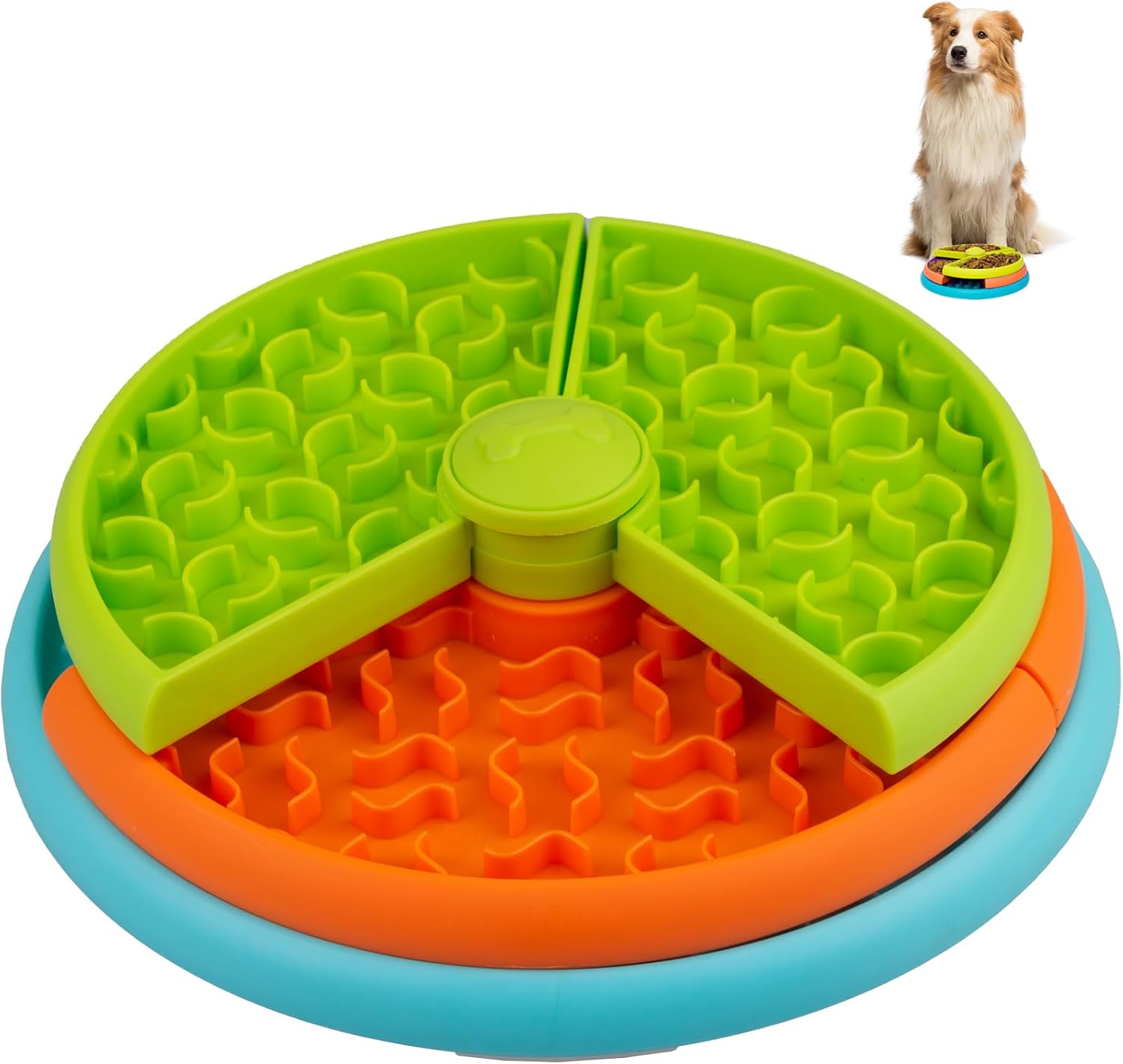
The ATDOALL feeder builds its challenge from three rotating layers that form a maze, so a dog has to nudge and turn sections to uncover each pocket of food. That turns a thirty-second meal into a longer problem-solving session, which reports indicate helps reduce boredom and the anxious energy that comes with it. The polypropylene construction allows full disassembly, meaning you can pull the layers apart and rinse every surface rather than fighting to reach food stuck in a fixed groove, a real hygiene advantage with dry kibble that leaves dust and oils behind. Non-slip rubber pads on the base are intended to limit sliding on hard floors, so an eager dog pushing at the layers is less likely to send the whole bowl skidding. Rounded edges reduce the risk of mouth injury during use, a thoughtful touch for dogs that press their muzzles into tight compartments. With room for up to 1.5 cups of food across five separate compartments, it handles a normal meal for a small or medium dog without constant refilling. The compromises are practical. That same layered design has to be reassembled after each cleaning, which adds a step to the routine, and the plastic may not withstand heavy chewing from a determined dog. There is also no data on long-term performance after repeated use, so buyers relying on it daily should watch for wear. For households that want more mental work than a flat tray provides, though, the maze earns its place.
Key features → what they mean for you
- Three rotating maze layers→Turns a quick meal into a longer puzzle that eases boredom and anxiety
- Full polypropylene disassembly→Every surface rinses clean, so kibble dust and oils do not build up
- Non-slip rubber base pads→Keeps the bowl steadier while a dog pushes at the layers
- Rounded edges→Lowers the chance of a scraped muzzle during eager eating
- 1.5-cup capacity across five compartments→Holds a full meal for a small or medium dog without refilling mid-meal
What works
- Disassembles completely for thorough rinsing.
- May slow rapid eaters enough to reduce regurgitation.
- Lightweight enough to move between rooms easily.
Watch-outs
- Plastic may not withstand heavy chewing from determined dogs.
- Requires reassembly after each cleaning.
- No data on long-term performance after repeated use.
- It must be reassembled after every cleaning, and the plastic may not hold up to a determined chewer.
Better alternative: PETSTA Dog Puzzle Toys, when you prefer a fixed one-piece tray with nothing to reassemble

The FOXMM feeder centers on a slider mechanism that forces dogs to learn sequential movements to reach food, so a meal becomes a short training exercise rather than a quick scarf. That step-by-step layout encourages incremental problem-solving, which reports indicate can settle restless dogs and give them a small sense of accomplishment. A central squeaker adds auditory feedback during supervised play, giving a curious dog an extra reason to keep working the puzzle. The food-grade PP construction resists cracking during normal handling, so ordinary knocks and nudges during play should not split the tray. Cleanup stays easy because the dishwasher-safe surface simplifies daily sanitation, letting you clear away food residue without scrubbing. Its low 1.2 inch profile means the tray fits under furniture when not in use, a practical detail in small apartments where storage is tight. The limits are honest ones. The shallow depth caps how much food fits per session, so larger dogs may finish before the puzzle does much work, and the plastic may become less engaging after repeated use once a dog memorizes the pattern. Like most sliders, it is not suitable for unsupervised chewing, so it belongs to interactive time rather than left-alone feeding. For owners who want a compact, inexpensive way to add a little daily brain work, it covers the basics.
Key features → what they mean for you
- Sequential slider mechanism→Teaches step-by-step problem solving that helps settle restless dogs
- Central squeaker→Adds sound feedback that keeps a curious dog motivated during play
- Food-grade PP construction→Resists cracking through normal handling and daily use
- Dishwasher-safe surface→Makes daily cleanup quick without hand scrubbing
- Low 1.2 inch profile→Slides under furniture for easy storage in small spaces
What works
- Encourages incremental problem-solving steps
- Easy to rinse or run through dishwasher
- Works for multiple dog sizes
Watch-outs
- Not suitable for unsupervised chewing
- Shallow depth limits food capacity per session
- Plastic may become less engaging after repeated use
- The shallow depth limits food per session, and the puzzle may lose novelty once a dog learns the pattern.
Better alternative: ATDOALL Slow Feeder Dog Bowl 3 Levels, when you want more capacity and a harder maze
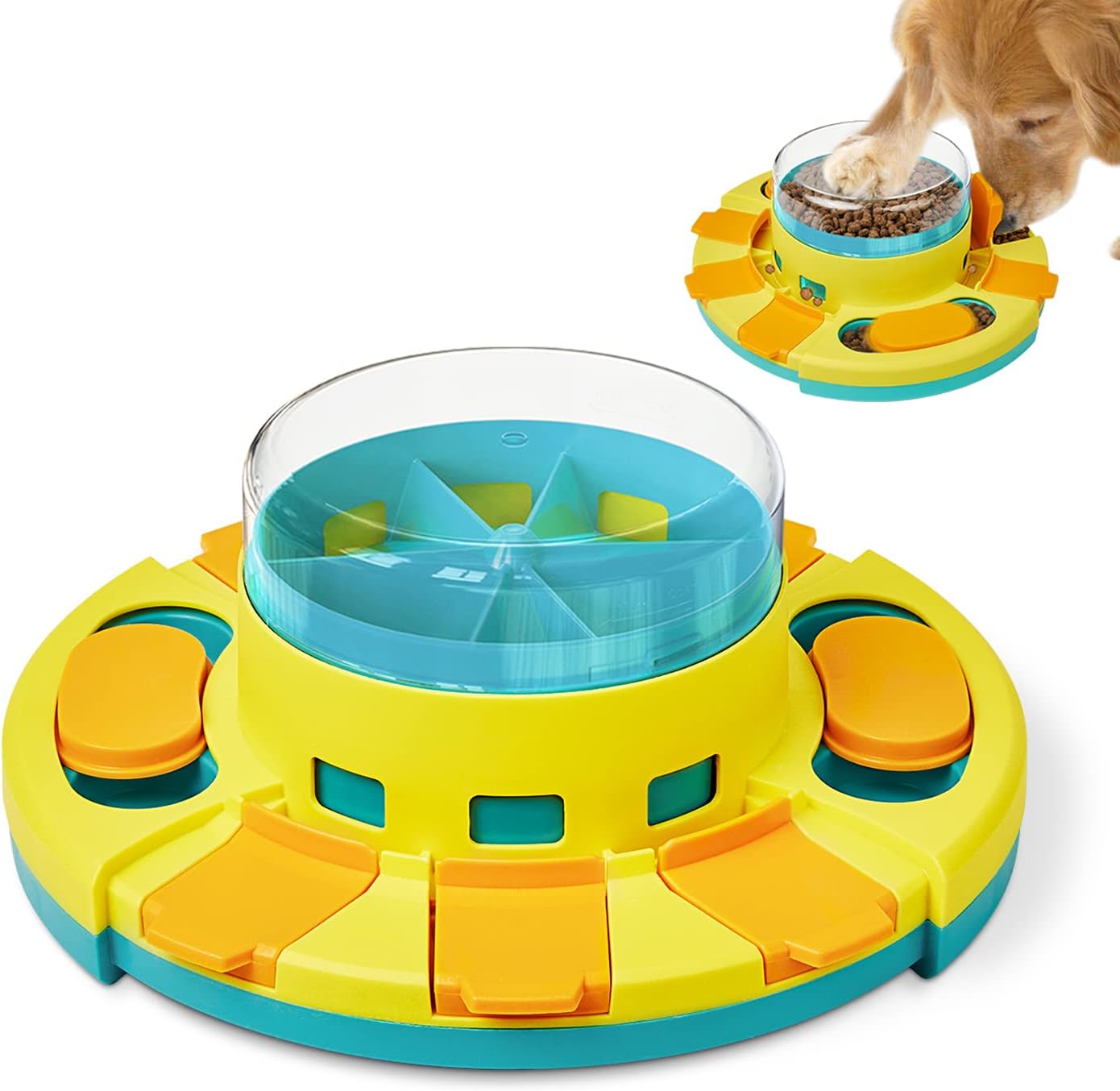
The Potaroma leans on a straightforward idea: make the dog work a little before each mouthful. The top granary holds kibble and only drops it into the six lower compartments once your dog presses the cover, which stretches a gulped meal into a paced one and helps with digestion and boredom. That mechanical gate is the heart of the design, and it does the job without batteries or setup. Construction is food-grade PP with non-removable parts, so you can send the whole unit through the dishwasher or rinse it in the sink rather than picking apart small pieces after every meal. For a busy pet household, that means the feeder actually gets cleaned instead of sitting sticky in the cabinet. Stability is the other strong point. A weighted base and four rubber feet hold the unit flat on tile or hardwood, so medium and large dogs can press and flip lids without sending kibble across the kitchen. The two-stage training path is a thoughtful touch: beginners start with treats in view, then graduate to the press-and-release step once they understand the game. Reports indicate this progression keeps early frustration low. The main tradeoff is capacity, since the lower compartments hold less than an open bowl, so heavy eaters may need a second round.
Key features → what they mean for you
- Food-grade PP with non-removable parts→Goes straight into the dishwasher or sink, so it gets cleaned consistently between meals
- Weighted base and four rubber feet→Stays flat on tile or hardwood while a dog presses and flips lids, cutting spills
- Top granary that dispenses only after the cover is pressed→Turns a rushed meal into a paced one, easing digestion and gulping
- Two training stages→Lets a nervous or new dog build confidence before the harder press step
What works
- Slows rapid eaters through mechanical steps.
- No assembly required out of the box.
- Stable on tile or hardwood during use.
Watch-outs
- Requires owner supervision for dogs new to puzzle toys.
- Lower compartments hold limited kibble per session compared to open bowls.
- Lower compartments hold limited kibble per session, so large or very hungry dogs may need a refill.
Better alternative: The KADTC adjustable spinning feeder, when you want to dial release time to a specific dog

The KADTC’s headline feature is control. An adjustable outlet regulates how fast kibble releases, from a quick five minutes to a full hour, which means one feeder can suit a cautious learner and a determined gulper by turning a dial. For homes with more than one dog, that flexibility is genuinely useful, and the four-cup capacity handles full meals of dry kibble for small, medium, or large dogs without constant refilling. The body is food-grade PP free of BPA, PVC, and phthalates, so daily use sits well with owners who care about materials. A non-slip base keeps the unit reasonably steady during paw interaction, and a drainage design lets you rinse it out without residue building up in corners. That said, cleaning is hand wash only, so it asks a little more effort than dishwasher-safe rivals. The spinning motion also takes practice; reports indicate some dogs need a few sessions to understand how their nudging releases food. Owner feedback consistently mentions that once a dog gets it, the paced release does slow rapid eating. On very slick surfaces the base can still travel with an enthusiastic dog, so a mat underneath helps. There are no batteries or cords, which keeps daily operation simple and reliable, a fair point in favor of a manual design that just works meal after meal.
Key features → what they mean for you
- Adjustable outlet from 5 to 60 minutes→Match meal pace to each dog’s learning speed and gulping habit
- Four-cup capacity→Serves full meals for dogs of different sizes without frequent refilling
- BPA-, PVC-, and phthalate-free food-grade PP→Reassures owners who care about materials in daily-use gear
- Non-slip base and drainage design→Holds steady during paw play and rinses clean without residue
What works
- Manual adjustment lets owners match release speed to individual dog learning pace.
- No batteries or cords needed for reliable daily operation.
- Sturdy build handles repeated nudging without immediate wear.
Watch-outs
- Hand wash only limits convenience compared to dishwasher-safe alternatives.
- May still slide on very slick surfaces with enthusiastic dogs.
- Requires practice sessions for some dogs to master the spin motion.
- Hand wash only, which is less convenient than dishwasher-safe alternatives.
Better alternative: The Potaroma two-level feeder, when you prefer dishwasher cleaning over adjustable timing

The KADTC 3-level puzzle takes a gravity-fed vertical approach: kibble drops only after your dog spins and slides the mechanism, so eating becomes a problem to solve rather than a race. Three difficulty levels let you start a beginner easy and raise the challenge as skills build, which keeps a smart dog engaged longer and combines mental stimulation with natural portion control. That progression is the reason to choose it over a single-mode feeder. The food-grade ABS construction reduces loose pieces during play, a sensible safety point for enthusiastic chewers, and the pods detach for rinsing after daily kibble sessions. It is recommended for dogs ten pounds and larger using food pieces under 0.67 inches, so it suits a specific range rather than every household. There is no assembly, so it works right out of the box. The tradeoffs are honest: the clear pods can show wear if you scrub them with anything abrasive, the design is limited to smaller kibble, and larger dogs may need supervision to keep the tall unit from tipping. Owner feedback leans positive overall, and the mix of enrichment and slower eating is the recurring theme in the reviews.
Key features → what they mean for you
- Three step-by-step difficulty levels→Keeps a quick learner challenged as skills grow, delaying boredom
- Gravity-fed spin-and-slide release→Turns each meal into paced mental work rather than a rushed gulp
- Food-grade ABS with detachable pods→Fewer loose pieces during play and easy rinsing after meals
What works
- Adjustable challenge prevents quick boredom for some dogs.
- Combines mental work with portion control in one unit.
- No assembly required for immediate setup.
Watch-outs
- Clear pods may show wear with abrasive cleaning.
- Limited to smaller kibble sizes.
- Larger dogs may require supervision to avoid tipping.
- Clear pods can scuff with abrasive cleaning, and it only handles smaller kibble.
Better alternative: The KADTC adjustable spinning feeder, when full-meal capacity matters more than escalating challenge

The Barkwhiz puzzle earns its place by combining pacing and problem-solving in one lightweight tray. Based on the published specs, the food-safe plastic uses curved edges around the nose and mouth, which means a dog can push and flip without scraping tender skin during an eager session. Four distinct challenge levels blend flip and sliding-track actions, so the same board stays interesting as a dog learns the easier moves and needs a harder hunt to stay engaged. Fourteen treat holes spread the reward across the surface, which stretches a meal into a slower, calmer process that supports digestion in dogs that otherwise gulp. Six fixed silicone pads grip smooth floors, so the board stays put instead of sliding into a wall while paws work it. Because the components are built in and cannot be removed, there are no loose parts to pull off and swallow, a real reassurance in a household that leaves toys within reach. Cleanup uses warm water and soap with no disassembly, which keeps the routine short after messy wet-food fills. The manufacturer stresses supervision, so treat this as an interactive session rather than a leave-alone toy, and watch a determined chewer since the plastic can show wear over time.
Key features → what they mean for you
- Curved edges on food-safe plastic→A dog can nudge and paw hard without scraping its nose or mouth
- Four flip and sliding-track levels→The puzzle stays challenging as a dog masters the easier moves
- Fourteen treat holes→Spreads a meal out so a fast eater slows down and digests better
- Six fixed silicone pads→The board holds its spot on tile or hardwood during active play
- Built-in, non-removable parts→No loose pieces to chew off and swallow in a busy home
- Warm water and soap cleaning→Quick reset after wet-food fills with no tools or teardown
What works
- Slows rapid eaters through layered challenges
- Stable on floors during active use
- Simple soap and water maintenance
Watch-outs
- Requires constant supervision per manufacturer guidance
- Plastic may show wear if chewed despite warnings
- No long term performance data available yet
- It needs active supervision and the plastic can wear if a dog treats it like a chew toy.
Better alternative: Outward Hound by Nina Ottosson Lickin’ Layers if your dog is small and you want dishwasher-safe cleanup.

The Lickin’ Layers works because it folds three enrichment styles into one small footprint. Based on the published specs, the food-safe plastic holds up to 1.5 cups of wet, dry, or raw food, which means one tool covers most feeding styles a small-dog owner uses through the day. Three rotating tiers invite licking and pawing, so a puppy gets genuine mental engagement rather than a bowl emptied in seconds. That same layered design slows eating in dogs under 20 pounds, which supports digestion and cuts the gulping that leads to an upset stomach. The top-rack dishwasher rating matters for a feeder that sees daily raw or wet fills, since it lets an owner sanitize without hand-scrubbing every crevice. Its compact size fits inside a crate or small pen, so it earns its keep in a tight apartment or a puppy setup without eating floor space. The trade-offs are honest: the plastic is not made for a committed chewer, and the design is tuned for small dogs, so a larger breed will outgrow it quickly. For the right small dog, though, it delivers licking, pawing, and pacing in a package that is genuinely easy to keep clean.
Key features → what they mean for you
- Holds up to 1.5 cups of wet, dry, or raw food→One feeder handles whatever diet a small dog is on
- Three rotating licking and pawing tiers→Real mental work for a puppy instead of a meal gone in seconds
- Slows eating for dogs under 20 pounds→Eases the gulping that upsets a small dog’s stomach
- Top-rack dishwasher safe→Simple sanitizing after messy raw or wet fills
- Compact crate-friendly size→Fits a pen or apartment setup without crowding the floor
What works
- Fits small dog crates well
- Dishwasher safe for easy sanitation
- Multiple food textures work without clogging
Watch-outs
- Plastic may not withstand heavy chewing
- Limited to dogs under 20 pounds
- The plastic will not survive a heavy chewer and the design caps out around 20 pounds.
Better alternative: Barkwhiz Dog Puzzle Toy if you have larger dogs or want multiple difficulty levels.

The DR CATCH puzzle keeps things simple and cheap, which is its main appeal. The plastic build uses sliding compartments that hide food, which means a small dog or cat has to nose and paw each cover open to earn a bite, turning a quick meal into real foraging. That slower pace supports digestion for a pet that would otherwise eat too fast. Its flat 1.14-inch profile is the standout practical detail, since it slides under a cabinet or into a crate and stores away easily in a small apartment. The surface wipes clean with no fabric to trap moisture, so a quick pass between uses keeps it hygienic. The honest limits are clear: the plastic is not for a strong chewer, thorough cleaning means taking the compartments apart daily, and the whole design is scaled for small dogs and cats rather than medium or large breeds. For a small household that wants an affordable way to slow a fast eater and add a little mental work, it covers the basics without fuss.
Key features → what they mean for you
- Sliding compartments that hide food→A small pet nose-works each cover open instead of gulping
- Flat 1.14-inch profile→Tucks under a cabinet or into a crate in a small home
- Wipe-clean surface with no fabric→Quick hygienic reset between meals with no trapped moisture
- Slows consumption for fast eaters→Steadier eating pace that is easier on a small pet’s stomach
What works
- Fits small dogs and cats without overwhelming them
- No fabric means quick surface wipe between uses
- Low profile stores easily in small spaces
Watch-outs
- Plastic may not withstand heavy chewers
- Requires daily disassembly for thorough cleaning
- Not suitable for medium or large dogs
- Deep cleaning requires daily disassembly and the plastic will not hold up to a heavy chewer.
Better alternative: Outward Hound Lickin’ Layers if you want dishwasher-safe cleanup for a small dog.
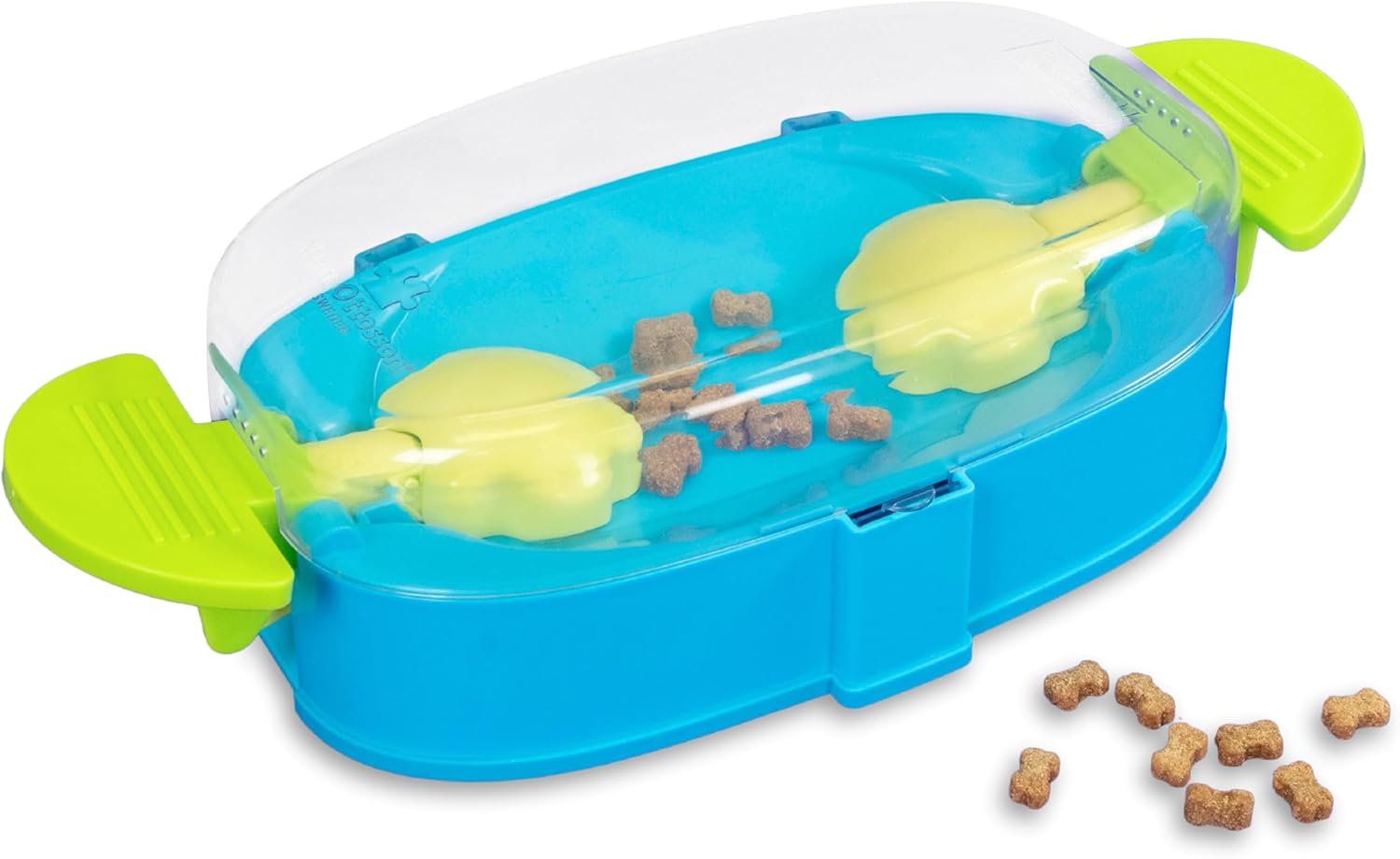
The Nina Ottosson Paw N’ Play sits in the Level 2 tier for a reason. It bridges the gap between a starter puzzle and something more demanding, which makes it a practical pick for a dog that has already outgrown the basics but is not ready for advanced work. The design centers on handles that, when pressed, move small paws and release food in random order. Based on the published specs, that random release is what lets two or more dogs work the toy together without direct competition, since no single spot pays out every time. Aggregated owner reviews show that this shared foraging is a common reason households keep it in rotation. The BPA-free, food-safe plastic is built to take repeated handle pressing, so normal use should not deform the mechanism. Capacity is capped at roughly one third of a cup, which quietly does double duty as portion control during play. The surface wipes clean without disassembly, so a quick pass with a damp cloth is enough between meals. Owner feedback consistently mentions that the lightweight base moves easily from kitchen to living room and stores without fuss. Treat this as a supervised enrichment tool rather than a free-standing feeder, and it delivers steady mental stimulation for the price.
Key features → what they mean for you
- Handles release food in random order→Multiple dogs can forage side by side without one crowding out the others
- One third cup base capacity→Built-in portion limit prevents overfeeding during play sessions
- BPA-free food-safe plastic→Safe repeated contact with kibble and firm enough for daily handle pressing
- Wipe-clean surface, no disassembly→Fast cleanup fits a busy household routine
- Level 2 intermediate difficulty→Keeps a maturing dog engaged as skills grow past starter puzzles
What works
- Allows two or more dogs to forage together without direct competition
- Slow random release encourages natural pacing during meals
- Lightweight base moves easily between rooms for storage
Watch-outs
- Requires full supervision to prevent chewing on parts
- Plastic may show wear faster than heavier chew resistant alternatives
- The plastic construction may show wear faster than heavier chew-resistant alternatives, and it needs full supervision.
Better alternative: The KADTC Dog Puzzle Toy, when you want a larger full-meal capacity and adjustable dispensing over a shared multi-dog design.

The KADTC puzzle takes a build-up approach that suits a dog still learning to problem-solve. Two challenge levels mean a beginner can start with the flip boxes and move to the spinner once the concept clicks, which helps build confidence rather than frustrate. Based on the published specs, the food-grade PP construction is made to resist cracking through repeated pawing, so the everyday nudging and rolling should not stress the shell. The standout for feeding is capacity: at 14 ounces it can hold a full meal for a small or medium dog, so there is no stopping to refill mid-session and the puzzle doubles as a genuine slow feeder. Adjustable dispensing holes let you open or close the flow to match each dog’s pace, which matters for a fast eater that needs more restriction or a hesitant one that needs an easier payout. The integrated design keeps all moving parts attached during normal use, so there are no loose pieces to lose or swallow, and cleanup stays simple. The main practical limit is that it works with dry kibble or small treats only, and as with any plastic puzzle, a dog that chews the toy itself should be watched. Owner data is still thin on how it holds up over months, so treat longevity as unproven for now.
Key features → what they mean for you
- Two challenge levels→A dog can progress from easy flip boxes to the harder spinner as skills grow
- 14 oz capacity→Holds a full meal so there is no refilling partway through feeding
- Adjustable dispensing holes→You can tune kibble flow to slow a fast eater or reward a cautious one
- Integrated all-attached design→No small loose parts to misplace or for a dog to swallow
- Food-grade PP construction→Safe for direct food contact and made to resist cracking under repeated paws
What works
- Step-by-step difficulty helps build problem-solving confidence.
- Holes can be opened or closed to match each dog’s pace.
- No loose pieces to lose or swallow.
Watch-outs
- Requires exclusively dry kibble or small treats.
- May need supervision for dogs that chew plastic.
- No long-term wear data available from owners.
- It requires dry kibble or small treats only, and there is no long-term wear data from owners yet.
Better alternative: The Nina Ottosson Paw N’ Play, when you want a shared puzzle several dogs can work at once rather than a single full-meal feeder.
What Buyers Consistently Say
What owners praise most
Aggregated owner reviews across these feeders point to one recurring theme: dogs that used to inhale a bowl of kibble in under a minute slow down noticeably once a maze, slider, or spinning layer stands between them and their food. Owner feedback consistently mentions calmer mealtimes and less post-meal gulping. For the electronic dispensers from OtterVerz, Potaroma, and SUKIPAW, buyers repeatedly highlight the novelty of a button or remote release, and several note that the recordable voice cue helped shy or food-motivated dogs connect the sound with a reward.
On the mechanical side, the KONG Wobbler draws steady praise for surviving determined dogs. Reports indicate its weighted, tip-and-right motion keeps medium and large dogs working, and the two-piece body makes filling quick. The Nina Ottosson designs from Outward Hound earn repeat mentions for beginner-friendly difficulty and easy cleanup, and budget sliders like PETSTA, FOXMM, and DR CATCH collect strong marks for value, low profile, and dishwasher convenience.
Common complaints
The most frequent frustration is capacity. Owner feedback on the Potaroma electronic unit flags the small reservoir as a limit for high-energy dogs, and similar notes appear for the low-profile sliders, where a shallow tray holds only a partial meal. The second recurring gripe is chew resistance. Across nearly every plastic model, reviewers warn that leaving the feeder down unsupervised invites chewed edges, and several one- and two-star reviews describe cracked sliders or gnawed corners on lighter trays.
For the battery and remote dispensers, buyers describe a learning curve. Treat flow can vary with kibble size and button timing, and a few note that recharge cycles interrupt longer sessions. Aggregated reviews on the SUKIPAW unit specifically show limited long-term durability data, since it is newer to the market. Stability is a smaller but real theme: owners with slick tile report that lighter trays still slide during enthusiastic nudging, even when rubber feet are present.
Patterns by use case
Fast eaters and bloat-prone dogs. Households dealing with gulping gravitate toward metered or maze designs. The KADTC adjustable spinning feeder, with its owner-set release window, and the multi-compartment Potaroma two-level puzzle draw the most positive feedback here because the dog cannot rush the whole meal at once.
Boredom and enrichment. Owners buying primarily for mental work favor the step-up difficulty models. Reviews for the KADTC three-level and the Outward Hound Paw N’ Play describe dogs staying engaged longer because the challenge grows with skill. The electronic dispensers also score well for enrichment, since the remote lets owners run short training reps from across the room.
Small dogs and puppies. The Lickin’ Layers and DR CATCH feeders collect consistent praise from small-breed and puppy owners who need a compact footprint that fits a crate and does not overwhelm a young dog.
Multi-dog homes. Feedback on the Paw N’ Play notes that its random release lets more than one dog forage together, while single-outlet electronic units drew comments that only one dog can realistically use them at a time.
The throughline in owner reviews is that expectations set the satisfaction level. Buyers who matched the feeder to their dog’s size, chewing style, and cleaning tolerance report the happiest outcomes. Those who expected a light plastic puzzle to double as an unsupervised chew toy account for most of the disappointed reviews, a pattern that appears across brands rather than isolated to any single model.
What Most Buying Guides Miss
An insight the spec sheets miss
The most useful way to sort these feeders is not by price or star rating but by whether difficulty is fixed or adjustable. A single-layout slider like PETSTA or FOXMM presents the same puzzle at every meal. Smart dogs solve a fixed pattern quickly, and once solved, engagement drops sharply. Based on the published specs, the models that hold interest longest are the ones with either graduated levels (KADTC three-level, Outward Hound Paw N’ Play) or an owner-tunable release rate (KADTC 5-to-60-minute spinner, the adjustable outlets on the electronic dispensers). That single design trait predicts long-term use better than any headline feature.
A contrarian take on the electronic dispensers
The remote-and-button feeders are the flashiest category here, but for pure slow feeding they are arguably the weakest fit. A remote release puts you, not the dog, in control of pacing, so the dog eats each portion as fast as it arrives. Their real strength is training and remote engagement, not digestion. If your actual problem is a dog that gulps and then regurgitates, a mechanical maze or a metered gravity feeder does the job more reliably and costs less. Buy the electronic units for enrichment and recall practice, not as a bloat solution.
Common buyer mistakes
First, oversizing or undersizing. Small-dog owners buy a medium or large maze and end up with a puzzle their dog gives up on, while large-dog owners buy a shallow tray and refill it three times a meal. Match the stated breed size and capacity to your dog before anything else.
Second, treating plastic puzzles as chew toys. Nearly every negative durability review traces back to unsupervised access. These are supervised mealtime tools, not something to leave in a crate all day with a power chewer.
Third, skipping the ramp-up. Owners who dump a hard puzzle on a beginner dog often report the dog quits and walks away. The models with a beginner stage exist for a reason; start easy and increase difficulty as the dog learns.
Fourth, ignoring cleaning reality. A feeder used at every meal needs fast sanitation. Owners who bought hand-wash-only units for daily raw or wet food frequently mention residue and odor buildup. If you feed wet food, prioritize top-rack dishwasher-safe designs.
A product we would skip
The SUKIPAW automatic dispenser is capable on paper, but among this group it carries the least owner-confirmed durability evidence, and its listing lacks the aggregated review depth the other picks have. It also relies on manual flipping for each recharge, and its button mechanism has no reported long-term track record. Nothing here suggests it is a bad unit, only that better-documented alternatives at a similar price make it hard to recommend first. If you want an electronic dispenser, the OtterVerz and Potaroma models have more owner feedback behind them.
Where the value really sits
The quiet standout is the mechanical middle of this lineup. The KONG Wobbler and the KADTC adjustable spinner deliver durable construction, real slow-feeding behavior, and no batteries to charge. For most households, a sturdy mechanical feeder matched to the dog’s size will outlast and out-serve a plastic slider bought purely on price, while sidestepping the learning curve and capacity limits of the electronic units. Spend where it counts: chew-resistant material and adjustable difficulty, in that order.
How to Choose — What Actually Matters
Match difficulty to your dog’s learning curve
The fastest route to a feeder your dog abandons is buying one puzzle that never changes. Ask whether the design grows with your dog. Multi-level models like the KADTC three-level and the Outward Hound Paw N’ Play let a beginner start with exposed treats before advancing to press-and-release or spin steps, so the challenge scales as skills improve. Adjustable-outlet feeders do the same thing a different way, letting you widen or narrow the release to keep pace with a dog that is getting quicker. A fixed single-layout slider suits a casual eater or a household that only wants a modest slowdown, and those are usually the least expensive options. If you have a smart, high-drive dog, prioritize graduated difficulty or an adjustable release. If your dog is older, timid, or new to puzzles, a simple layout with a low frustration ceiling keeps mealtime positive rather than discouraging.
Decide between mechanical and electronic
Two very different categories sit under the puzzle-feeder label. Mechanical feeders rely on mazes, sliders, spinning tiers, or a wobble motion, and the dog controls the pace with nose and paws. Electronic dispensers like the OtterVerz and Potaroma units add a button or remote release, preset tones, and a recordable voice cue for training. Electronic models excel at enrichment and remote recall practice, letting you run short reps from across the room. They are less effective as pure slow feeders, since a remote release delivers each portion at your timing rather than making the dog work for it. They also need recharging and tend to hold less food. Choose mechanical if your main goal is slowing a gulper and minimizing upkeep. Choose electronic if you want interactive training and do not mind managing a battery and a smaller reservoir.
Weigh durability against your dog’s chewing style
Every plastic feeder here is a supervised mealtime tool, not a chew toy. Owner feedback consistently shows chewed edges and cracked parts trace back to unsupervised access rather than a defect. Look for food-grade, BPA-free plastic and, importantly, non-removable parts, which lower choking risk and mean fewer pieces to lose. The KONG Wobbler earns its durability reputation with a thick two-piece body built for medium and large dogs. Lighter budget trays are fine for gentle eaters but show wear faster with determined chewers. Be honest about your dog. A power chewer needs the heaviest construction you can find and constant supervision, while a polite eater can use almost anything in this lineup. If your dog treats plastic as prey, a mechanical feeder in reinforced material will hold up far better than a thin slider.
Plan for cleaning at every meal
A puzzle feeder used two or three times a day has to sanitize quickly or it turns into a kibble-crusted odor trap. Check two things: whether the unit is dishwasher-safe and whether it needs disassembly. Top-rack dishwasher-safe models like the Lickin’ Layers and several sliders rinse and sanitize with minimal effort, which matters most if you feed wet, raw, or sticky food that lodges in narrow channels. Hand-wash-only feeders such as the KADTC adjustable spinner work well for dry kibble but ask for more effort. Feeders that fully disassemble clean more thoroughly but require reassembly after every wash, which some owners find tedious. If you feed dry kibble and wipe between meals, cleaning is a minor factor. If you feed anything moist, make dishwasher compatibility a top-three requirement to avoid buildup and smell.
Confirm size, capacity, and stability
Two mismatches drive most disappointed reviews: a feeder too big for a small dog to solve, and a tray too shallow to hold a large dog’s meal. Read the stated breed size and capacity against your dog’s actual meal volume. Small-breed and puppy owners are well served by compact designs like the Lickin’ Layers or DR CATCH that fit a crate without overwhelming the dog. Larger dogs need higher-capacity units, such as the four-cup KADTC spinner or the KONG Wobbler, to avoid refilling mid-meal. Stability rounds out the fit. Weighted bases and rubber feet keep the feeder from sliding across tile during enthusiastic nudging, which keeps food off the floor and reduces mess. Owners on slick hard floors report that even feeders with rubber feet can drift, so favor heavier, weighted designs if your dog pushes hard.
Decision Matrix — Match Your Priority
Final Verdict
After comparing construction, difficulty scaling, and aggregated owner feedback across this lineup, the strongest all-around choice is a durable mechanical feeder matched to your dog’s size. The KONG Wobbler earns the top spot because it does the core job well: it slows eating through a physical wobble motion, survives medium and large dogs better than lighter plastic, and cleans up in two pieces. It is not adjustable and it is too big for tiny dogs, but for the largest share of households it is the most reliable pick. Value-focused buyers with small or gentle dogs get most of the benefit for far less from the Outward Hound Lickin’ Layers, which handles wet, dry, or raw food, fits a crate, and is top-rack dishwasher safe. If your main concern is a fast eater and you want to dial pacing yourself, the KADTC adjustable spinner is the sharpest tool here, with a metered release you set to match your dog and no batteries to manage. The electronic dispensers are worth it for a specific reason: interactive training and remote engagement, not slow feeding. The OtterVerz unit has the deepest positive owner feedback in that category, so it is the pick if a recordable cue and remote release fit how you want to work with your dog. Just size your expectations to enrichment rather than digestion, and plan for a smaller reservoir. Whatever you choose, treat every plastic feeder as a supervised mealtime tool and match difficulty to your dog’s skill level. Those two habits prevent the durability and frustration complaints that account for most negative reviews.



Write Your Review
No reviews yet. Be the first to share your experience!