

A balcony feels like the perfect window on the world for a curious cat — fresh air, sunshine, and birds to watch. It is also one of the most dangerous spots in the home, because an open railing does nothing to stop a cat who lunges at a pigeon or slips while dozing on the ledge. The good news is that you can turn a risky balcony into a safe one, and this guide walks you through it hazard by hazard.
Quick answer
Make a balcony safe for cats by turning it into a complete physical enclosure — fit cat-rated netting or mesh across the whole railing opening, or build a screened “catio,” so there is no way out. Seal every gap along the bottom, sides, and drainage points, remove toxic plants such as lilies, and move any furniture your cat could use as a launch pad. Never rely on railing height or a calm temperament to keep a cat in, and supervise closely until the space is proven escape-proof. Cats fall from balconies and get seriously hurt, so if your cat ever falls, treat it as an emergency and go straight to the vet.
Safety first: the fall risk comes before everything else
The single biggest danger of a balcony is a fall. Veterinarians describe a pattern called high-rise syndrome — the common set of injuries cats sustain when they fall from high places. These falls happen from the second floor and up, and they cause serious, sometimes life-threatening trauma. A cat does not need to be reckless for this to happen: a bird, an insect, a sudden noise, or simply losing balance while asleep on a ledge is enough.
Please ignore the myth that cats “always land safely.” A cat’s righting reflex lets her twist and land on her feet most of the time, but that reflex has limits, and she still may get badly hurt. Landing feet-first does not prevent broken bones, chest and lung injuries, shattered jaws, or internal bleeding. Never let the phrase “cats always land on their feet” talk you into leaving a balcony open.
Because of that, the only reliable fix is a physical barrier — full netting or mesh across the railing, or a screened enclosure — not a taller rail and not trust. Keep cats off open, unenclosed balconies, and supervise every minute until the space is fully enclosed. This article is about prevention and home setup; it is not medical advice. If your cat does fall, even a short distance and even if she seems fine afterward, treat it as an emergency and see a veterinarian immediately, because serious internal injuries are not always visible.
Who this is for (and when to get help first)
This guide is for anyone who wants to give an indoor cat safe access to a balcony, terrace, or Juliet balcony — whether you are on the second floor or the twentieth. The steps are home-setup measures, not veterinary care.
- This is for you if: you have an open or partly railed balcony and you want to enclose it properly before your cat spends any time out there, supervised or not.
- Do this before you let the cat out if: your balcony is above the ground floor, has railings with gaps, sits near climbable furniture, or holds plants you have not checked for toxicity.
- Stop and get help first if: your cat has already fallen or taken a hard tumble — that is an emergency vet visit, not a DIY moment. Enclosure work can wait until your cat has been checked over.
Why balconies are more dangerous than they look
A balcony combines everything a cat is drawn to — height, movement, and a clear view — with nothing to stop a fall. Understanding exactly how cats end up going over the edge makes the fixes below obvious.
Cats are built to climb and to chase. A railing is a perch, and the pigeon on the ledge, the fly on the glass, or the leaf drifting past is a target worth leaping for. In the moment of a lunge, a cat is not calculating the drop. High-rise syndrome is well documented precisely because these falls are common, not freak events, and they occur from the second floor upward.
Height is not the safeguard people assume it is either. Falls from mid-level floors can be just as injurious as very high ones, and a cat who looks calm and cautious can still slip while asleep on a narrow ledge or bolt after prey without warning. That is why railing height and a mellow personality are never enough on their own. The fix is to remove the possibility of a fall altogether with a barrier the cat physically cannot get through, over, or around.

What you need before you start
You do not need much, but the barrier is the part worth doing well. Gather your materials before the cat gets anywhere near the balcony.
- Required: cat-rated netting or sturdy mesh sized to cover the entire railing opening, plus a way to anchor it top, bottom, and sides (tension rods, a wood or PVC frame, cable ties, or eye bolts depending on your surface).
- Required: a tape measure and a way to check gap sizes, so nothing is left wide enough for your cat’s head and shoulders to pass through.
- Optional: a prefab screened “catio” or freestanding mesh panels if you rent and cannot drill, or if you want the sturdiest possible enclosure.
- Optional: a well-fitted cat harness and leash for supervised time while you finish the enclosure — a backup layer, never the main safeguard.
- Safety note: choose netting or mesh rated to hold an animal’s weight and rated for outdoor use; flimsy garden netting can sag, tear, or let a determined cat push through.
Step by step: build a cat-safe balcony
Work through these five steps in order. Each one closes a specific gap between “looks fine” and “actually escape-proof,” and the barrier steps come before you ever let the cat out.
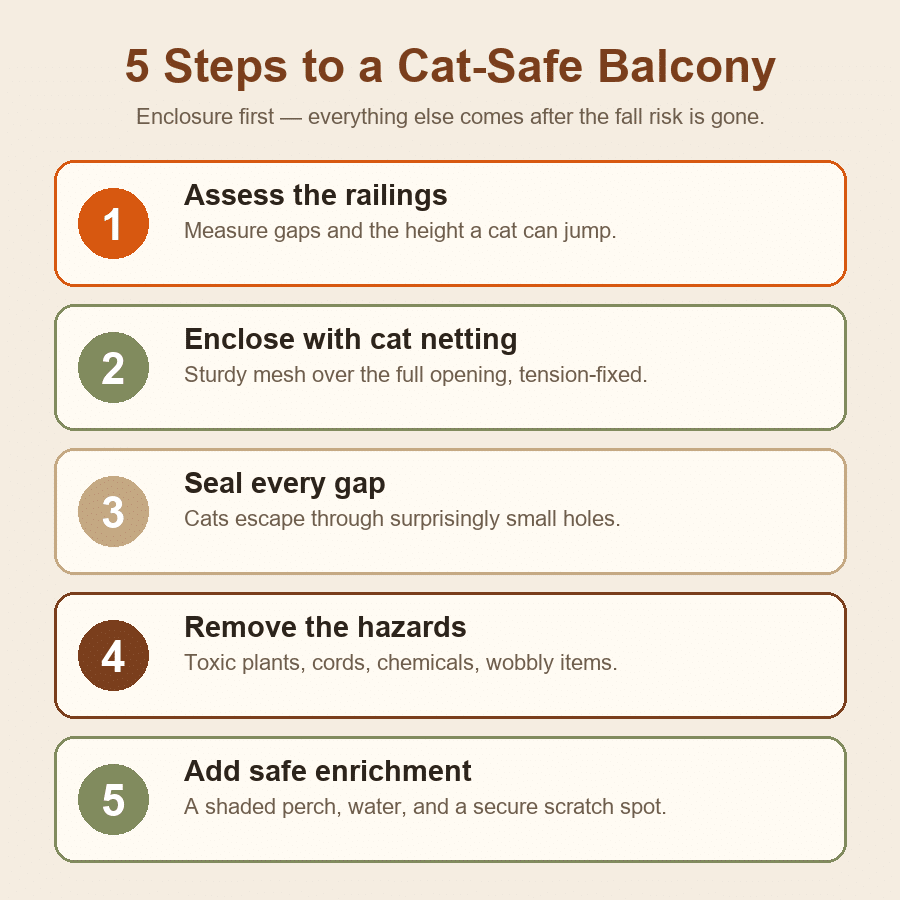
1 Assess the railings and map every escape route
What to do: Stand on the balcony and look at it the way a cat would. Measure the gaps between and beneath the railings, note any horizontal bars that work like a ladder, and find the highest surface a cat could jump from. Why: Cats can squeeze through any gap their head fits through and can leap far higher than most people expect, so the real question is not “how tall is the rail” but “where could a cat get through, over, or around it.” Success cue: You can point to every possible exit — wide bars, bottom gaps, side gaps, and launch points. Adjust: Do not let this step reassure you into thinking a high or solid-looking rail is enough. Height is never the safeguard; the assessment simply tells you where the barrier in Step 2 has to cover.
2 Enclose the whole balcony with netting, mesh, or a catio
What to do: Fit cat-rated netting or mesh across the entire railing opening, from floor to the top of the barrier and wall to wall, or install a screened enclosure. Pull it taut and anchor it firmly at the top, bottom, and both sides so a cat cannot push under or behind it. Why: A complete physical barrier is the only reliable way to prevent a fall — veterinary guidance points to screened enclosures and keeping cats off open balconies, precisely because nothing else consistently works. Success cue: You can lean on the netting and it holds; there is no slack a cat could slip behind and no section left open. Adjust: If a Juliet balcony or an odd-shaped railing makes netting awkward, a rigid mesh panel or a freestanding catio frame often fits better. The standard to meet is the same either way: no gap a cat can get through. When you compare options, a screened “catio” is the sturdiest choice, while well-anchored cat netting is the most flexible for rentals.
3 Seal every gap — especially the ones near the floor
What to do: Walk the perimeter and close every remaining opening: the gap under the bottom rail, the corners where the netting meets the wall, drainage slots, and the seam at any balcony gate or door. Why: Cats explore low and push into small spaces, so an enclosure fails at its weakest gap, not its strongest panel. A single unsealed corner near the floor undoes all the work above it. Success cue: You cannot slide a fist through any point around the entire edge, top to bottom. Adjust: Use additional cable ties, a bottom rail of wood or PVC, or weatherproof edging to close stubborn gaps. Recheck after wind or weather, since netting can shift and clips can loosen over time.
4 Remove toxic plants and other hazards
What to do: Clear the balcony of anything that could poison or injure a cat. Remove lilies first — take out true lilies and daylilies entirely — then move any climbable furniture back from the barrier and put away string, small objects, and garden chemicals. Why: Lilies are extremely dangerous to cats: every part of the plant is toxic, and even small amounts can cause severe kidney injury, so a nibble on a leaf or petal is a genuine emergency. Furniture pushed against the railing also becomes a launch pad that defeats the barrier. Success cue: No lilies remain, every plant left out there has been checked against a trusted toxic-plant list, and nothing sits close enough to the edge to boost a cat over it. Adjust: If you are not sure a plant is safe, take it inside until you have verified it; when in doubt, leave it out. Keep the enrichment plants (like cat grass) and lose the risky ones.
5 Add safe enrichment — and supervise until it is proven
What to do: Once the space is enclosed and cleared, make it comfortable: a stable perch or cat tree set back from the edge, shade, and fresh water. Then supervise the first several visits closely before trusting the space unattended. Why: Enrichment set away from the barrier gives your cat a reason to lounge in the middle rather than test the edges, and supervision lets you catch a loose clip or a missed gap before it matters. Supervision is a safety check, not a substitute for the enclosure. Success cue: Your cat settles on the perch, ignores the barrier, and you have watched enough calm visits to trust the setup. Adjust: Anchor perches so they cannot tip toward the rail. A sturdy indoor perch works well here — browse modern cat trees that look like furniture for a stable option that looks at home indoors or on a covered balcony. If your cat is a climber who targets furniture, giving her better outlets indoors reduces the drive to test the barrier; our guide on how to keep a cat from scratching the headboard covers redirecting that energy.
Match the fix to your balcony
Balconies differ, but the safety standard does not. Use these branches to choose the right approach for your situation — every path still ends in a complete barrier.
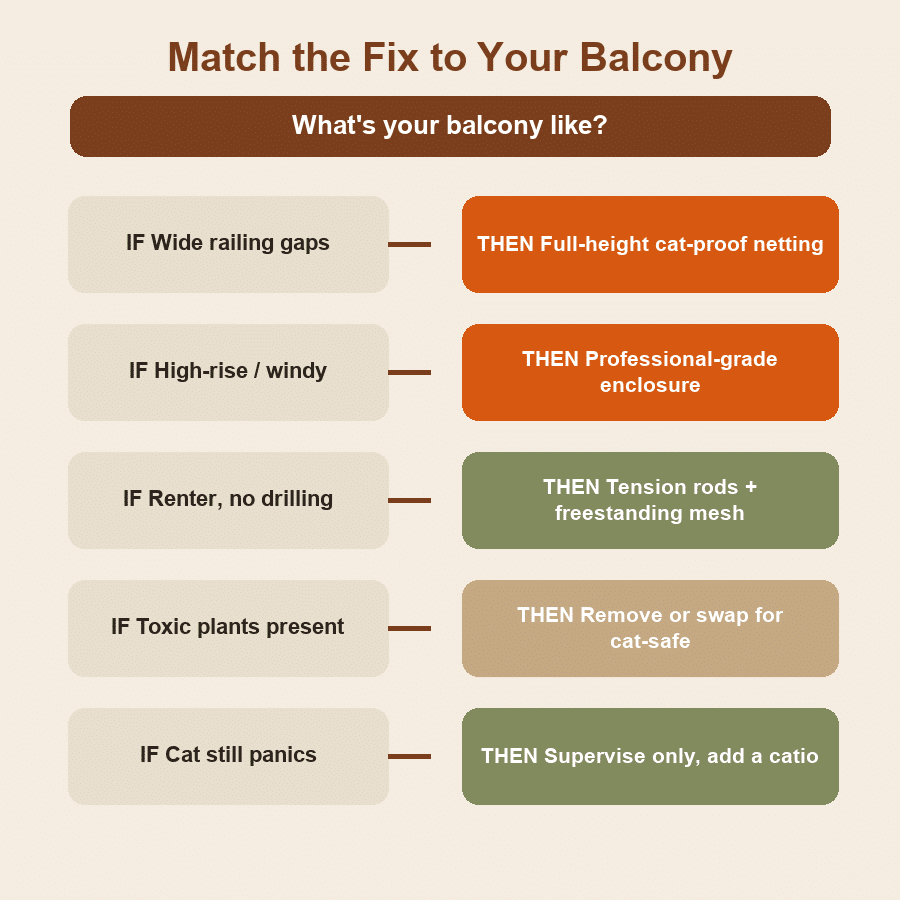
- If your balcony is on the second floor or higher, then treat a full enclosure as mandatory before any unsupervised time — height alone is never a safeguard.
- If the railings have wide bars or gaps, then cover the entire railing with netting or mesh, not just a patch over the widest spot.
- If you rent or cannot drill, then use tension-mounted netting, freestanding mesh panels, or a prefab catio, and check your lease or HOA rules first.
- If you cannot fully enclose the balcony right now, then keep it off-limits and allow only supervised, harnessed time — never leave your cat out there alone.
- If your cat has already fallen or you cannot make the space escape-proof, then keep the balcony closed to her; and if a fall has happened, go to the vet immediately even if she seems unhurt.
Do and don’t at a glance
If you remember nothing else, remember these. The left column is what actually keeps a cat safe; the right column is what quietly puts her at risk.
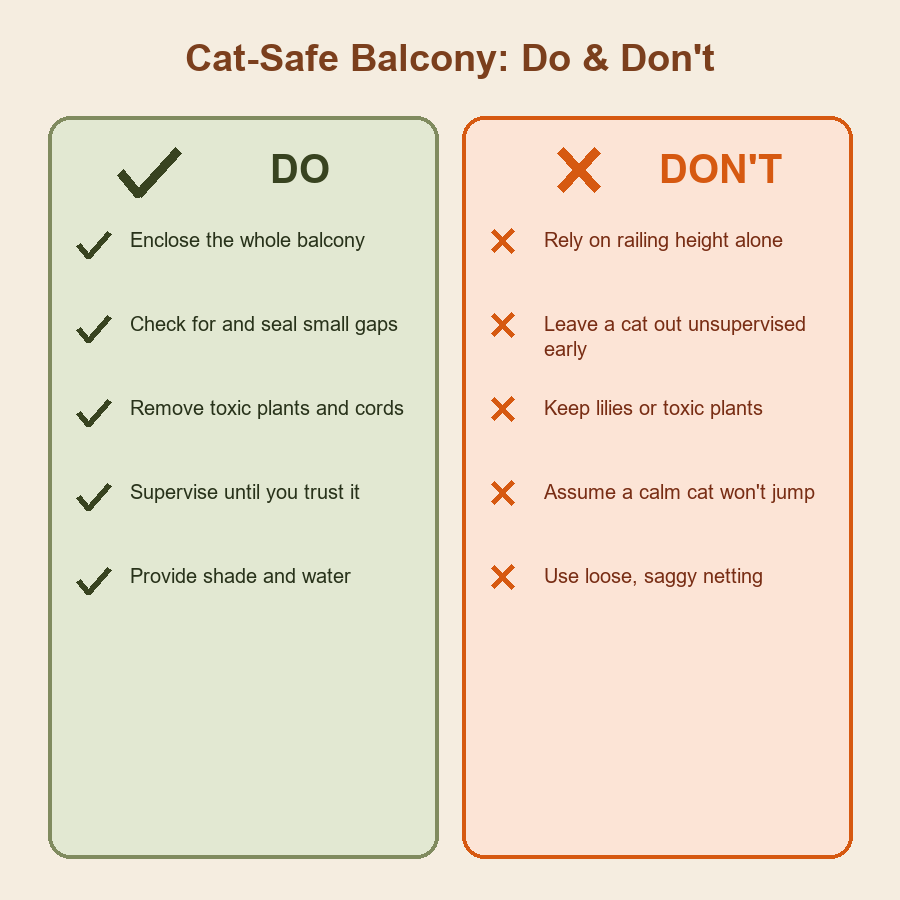
- Do enclose the whole balcony with cat-rated netting, mesh, or a screened catio. Don’t rely on railing height or a “calm” cat to stay put.
- Do supervise every minute until the space is proven escape-proof. Don’t leave a cat alone on an open, unenclosed balcony.
- Do remove lilies and any unverified plants completely. Don’t assume a small nibble is harmless — tiny amounts of lily can injure a cat’s kidneys.
- Do move chairs, planters, and shelving back from the railing. Don’t leave launch pads a cat can use to clear the barrier.
- Do treat any fall as an emergency and go straight to the vet. Don’t wait to see if your cat “walks it off.”
Common mistakes to avoid
Most balcony accidents trace back to a handful of avoidable gaps — in the setup and in the thinking. Watch for these.
- Trusting the railing height. Sign: a tall or solid-looking rail with no barrier across it. Fix: add full netting or mesh anyway — cats climb, squeeze, and leap, and height is not protection.
- Leaving a gap near the floor. Sign: daylight under the bottom rail or at a corner. Fix: seal every low opening; cats push into small spaces and escape through the weakest point, not the strongest.
- Furniture as a launch pad. Sign: a chair, table, or planter within a cat’s jump of the top of the barrier. Fix: move it well back from the edge.
- Toxic plants within reach. Sign: lilies or unidentified plants on the balcony. Fix: remove lilies entirely and verify every remaining plant, because even small amounts of lily can cause kidney injury.
- Leaving the cat out “just for a minute.” Sign: an unenclosed balcony and an unsupervised cat. Fix: never leave a cat alone out there until it is fully enclosed — a lunge takes a second.
- Flimsy or loose netting. Sign: sagging mesh, popped clips, or netting a cat can push behind. Fix: use weight-rated, outdoor netting, anchor it on all sides, and recheck it after wind and weather.
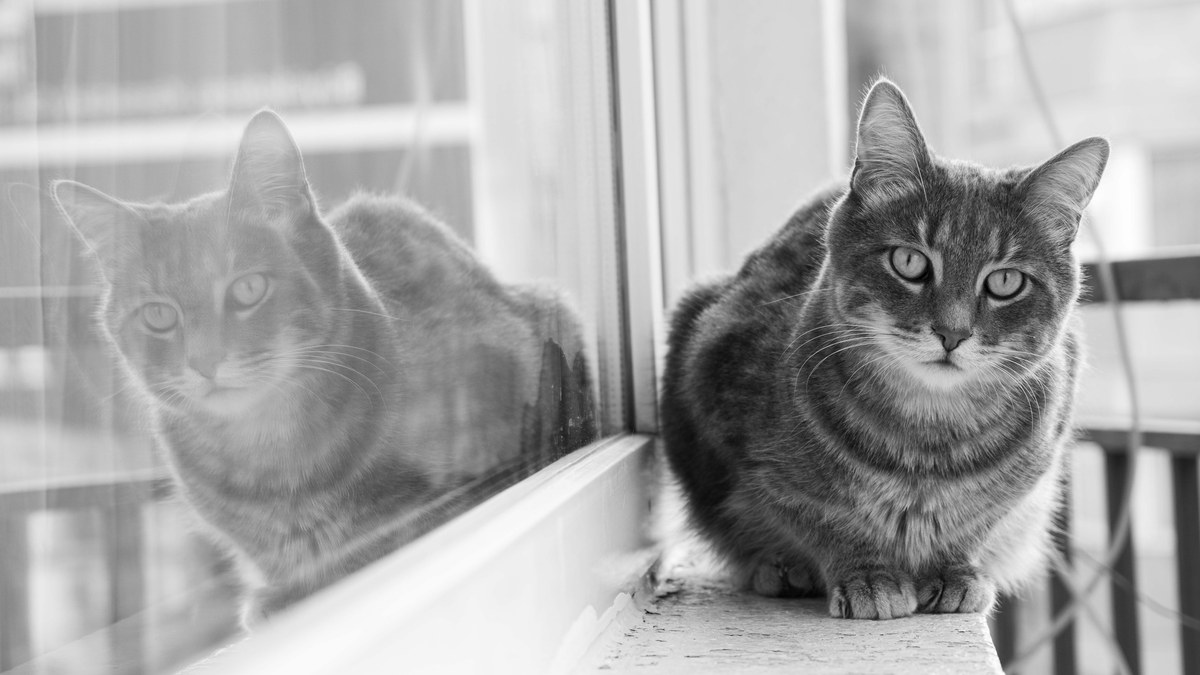
What most guides get wrong
Plenty of balcony-safety advice sounds reasonable and still leaves a cat at risk. Here is where the common wisdom falls short.
- They treat railing height as safety. A high rail is not a barrier — a cat can climb a horizontal bar, squeeze through a gap, or leap from a nearby surface. The only thing that reliably prevents a fall is a physical barrier the cat cannot get through, which is why veterinary guidance points to screened enclosures rather than taller rails.
- They repeat the “cats always land on their feet” myth. The righting reflex helps a cat land feet-first most of the time, but it has limits and she can still be badly hurt. This is the reality behind high-rise syndrome, and falls from mid-level floors can be surprisingly severe — feet-first is not injury-free.
- They forget the hazards already on the balcony. A lot of guides focus entirely on the fall and skip the balcony garden. Lilies are one of the most dangerous plants for cats: all parts are toxic and small amounts can injure the kidneys. A safe balcony has to be free of them, not just enclosed.
- They stop at “supervise your cat.” Supervision is a stopgap while you build the enclosure, not the finished solution. People get distracted, and a cat only needs one unwatched second. The goal is a space that stays safe even when your attention slips — which means an enclosure, not just an attentive owner.
Gear that makes a cat-safe balcony easier
The barrier does the safety work; a few well-chosen extras make the enclosed space comfortable and help manage access to it. Match any purchase to your balcony and your cat, not to the flashiest listing.
- A stable perch or cat tree set back from the barrier gives your cat a reason to relax in the middle of the space rather than testing the edges. Look for a wide, tip-resistant base — see modern cat trees that look like furniture.
- A pet gate at the balcony door creates an airlock, so your cat cannot bolt outside the moment you slide the door open, and lets you keep the balcony off-limits while you finish enclosing it. Our guide to the best pet gates for the living room covers sturdy, easy-to-use options.
No product replaces the enclosure itself. Think of these as comfort and access aids that sit behind a barrier your cat physically cannot get through — the perch and gate help only once the netting or catio is already in place.
Final recommendation
Start with the barrier, because it is the one change that actually prevents a fall. Net or screen the entire balcony, seal every gap from the floor up, and only then think about perches and plants. Remove lilies and anything you cannot verify as cat-safe, move furniture back from the edge, and supervise closely until you have watched enough calm visits to trust the space. Above all, never let railing height or a mellow cat stand in for a real enclosure — and if your cat ever falls, go straight to the vet, even if she seems unharmed.
For more room-by-room and outdoor setups in one place, visit our outdoor & balcony ideas hub.
FAQ
Do cats really fall off balconies if they seem careful?
Yes. Veterinarians see a recognized pattern of fall injuries called high-rise syndrome, and it happens from the second floor and up. A careful, calm cat can still lunge after a bird, slip while dozing on a ledge, or startle at a noise. The behavior is normal; the open edge is the danger. That is why a physical barrier, not trust, is what keeps a cat safe.
Don’t cats always land on their feet?
No. A cat’s righting reflex lets her twist and land feet-first most of the time, but it has limits and she can still be seriously injured. Landing on all fours does not prevent broken bones, chest injuries, or internal damage. Please never use “cats land on their feet” as a reason to leave a balcony open.
Is cat netting enough, or do I need a full catio?
Either can work, as long as it is a complete physical barrier with no gaps a cat can get through, over, or around. A screened catio is the sturdiest option and the easiest to trust long-term. Well-anchored, weight-rated cat netting is more flexible for rentals but must be pulled taut and sealed on all sides, then rechecked after wind and weather.
My balcony is only on the second floor — is it safe?
Not without enclosing it. High-rise injuries occur from the second floor upward, and falls from lower and mid-level floors can be just as damaging as those from higher up. Treat a second-floor balcony with the same barrier standard as a high-rise: full netting or a screened enclosure before any unsupervised access.
Which plants do I need to remove?
Remove lilies first. True lilies and daylilies are especially dangerous to cats: all parts of the plant are toxic, and even small amounts can cause severe kidney injury. Beyond lilies, check every plant on the balcony against a trusted toxic-plant list before you leave it within a cat’s reach, and take anything you cannot verify indoors.
What should I do if my cat falls from the balcony?
Treat it as an emergency and get to a veterinarian right away, even if your cat gets up and seems fine. Falls can cause internal injuries, chest trauma, or fractures that are not obvious at first. This guide is about preventing falls, not treating them — a fall needs professional veterinary care, not home first aid.
Can I let my cat out if I supervise instead of enclosing it?
Supervised, harnessed time is safer than leaving a cat alone on an open balcony, but supervision is a stopgap, not a substitute for a barrier. Attention slips, and a cat only needs one unwatched second to go over the edge. Use supervision while you build the enclosure, and aim for a space that stays safe even when you look away.
Sources
- The Animal Medical Center — High-Rise Syndrome in Cats — supports the description of high-rise syndrome and falls from the second floor and up, the limits of the righting reflex (cats still may get hurt), and the recommendation to use a screened enclosure “catio” and keep cats off open balconies.
- PetMD — Balcony Safety and Pets: How to Avoid High-Rise Risks — supports supervising cats on balconies and the point that screened-in enclosures are the safest setup.
- ASPCA — Which Lilies Are Toxic to Pets? — supports that lilies are highly toxic to cats, that all parts of the plant are toxic, and that small amounts can cause severe kidney injury.
Last reviewed July 2026.








Write Your Review
No reviews yet. Be the first to share your experience!