

Artificial grass can be a genuinely good balcony surface for a dog — but whether it is safe depends almost entirely on how you set it up and maintain it. The biggest issue is heat, followed by drainage, cleaning, and the material itself.
Quick answer
Generally, yes — artificial grass is safe for dogs on a balcony if you manage four things: heat, drainage, cleaning, and material. Heat is the main real risk, because synthetic turf gets much hotter than natural grass in direct sun, and a hot surface can burn a dog’s paw pads — so add shade and check the surface with the back of your hand before letting your dog out. Make sure water drains, rinse and clean on a schedule so urine and odor don’t build up, and choose non-toxic turf with a safe infill (skip crumb rubber). Do that, and a balcony lawn is a comfortable, low-fuss option.
Safety first: heat is the real risk
The most important safety point is heat, and it comes from two facts that stack together. First, in direct sun synthetic turf gets far hotter than natural grass: a Penn State turf-research center measured traditional synthetic turf surfaces 35-60 °C (roughly 63-108 °F) hotter than natural turfgrass, and recorded surface temperatures as high as 93 °C (about 199 °F) on a day when the air was only 37 °C (about 99 °F). Second, veterinary first-aid guidance notes that a dog’s foot pads, though tough, can burn on a scorching surface in summer. Put those together and the takeaway is simple: on a hot, sunny balcony, artificial grass can reach temperatures that could burn your dog’s paws.
You do not have to give up the idea — you have to manage the heat. Shade the balcony with an awning, umbrella, or shade sail during peak sun, and always test the surface yourself first: press the back of your hand flat on the turf for about seven seconds. If it is too hot for your hand, it is too hot for paws, so wait for it to cool or keep your dog indoors until it does. Give your dog a shaded spot and fresh water whenever they are out there.
Two smaller risks round out the picture. If your dog is a chewer, loose infill granules or torn pieces of turf are a swallowing hazard — keep edges secured and supervise. And artificial grass is not a substitute for veterinary care: if your dog shows signs of overheating such as heavy panting, drooling, or weakness, or an injured paw, stop and see your vet.
Who a balcony turf lawn suits (and who should think twice)
Artificial grass on a balcony works well in some situations and poorly in others. Use this to place yourself before you buy anything.
- Good fit if: your balcony is shaded or gets sun only part of the day, you have a way for water to drain, and you are willing to rinse and deep-clean on a schedule.
- Workable with extra care if: your balcony bakes in full afternoon sun — you will need shade and the hand-test habit every hot day — or your dog is a determined chewer, in which case edges must be locked down and supervised.
- Think twice if: there is no drainage path at all, the balcony is tiny and airless so heat and odor concentrate, or you cannot commit to regular cleaning. In those cases a washable pee pad or a real potty tray may serve you better.
The five things that decide whether it’s safe
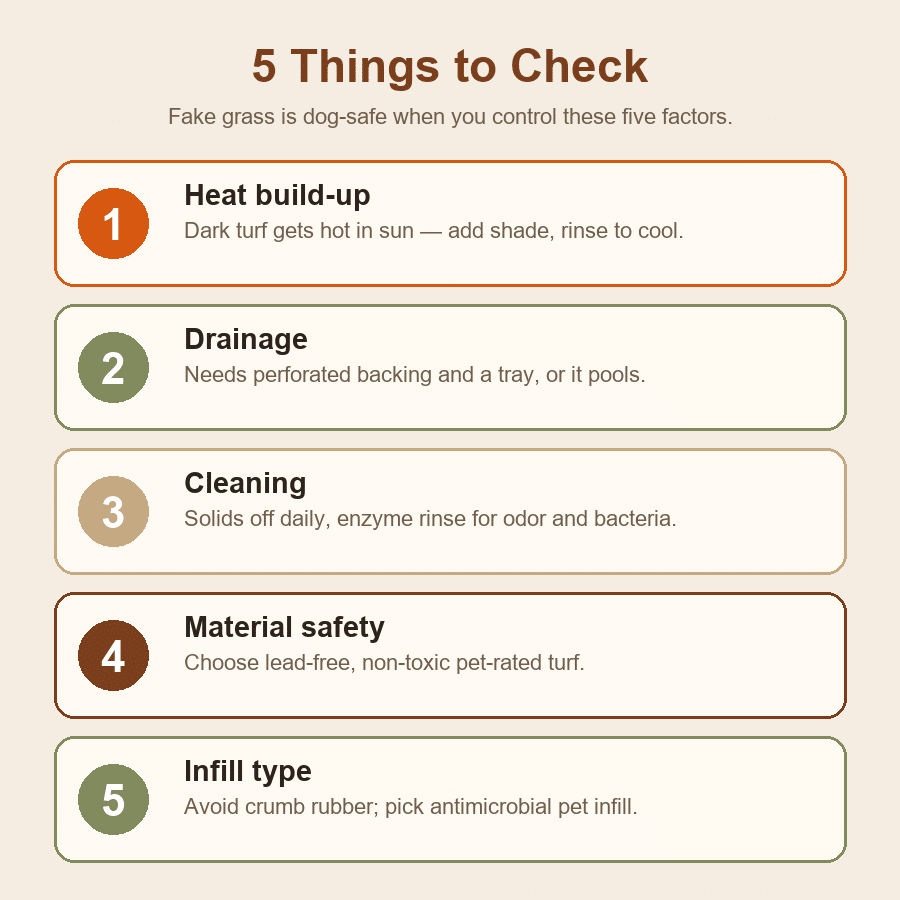
“Safe” is not really a property of the grass itself — it comes from how you handle these five factors. Work through them in order; heat comes first because it carries the most risk.
1 Heat build-up (the big one)
What it is: Synthetic turf absorbs and holds solar heat far more than living grass does. Why it matters: Penn State turf researchers measured synthetic turf 35-60 °C (about 63-108 °F) hotter than natural grass, and as high as 93 °C (about 199 °F) on a 37 °C (99 °F) day — and veterinary guidance warns that a hot surface can burn a dog’s pads. What to do: Add shade over at least part of the turf, avoid peak-sun potty trips, and use the seven-second hand test before every hot-weather visit. A lighter-colored turf and a quick rinse with cool water also take the edge off a warm surface. What good looks like: the surface is comfortable to your bare hand, and your dog will happily lie on it.
2 Drainage that actually works
What it is: A path for urine and rain to leave the surface instead of pooling. Why it matters: A balcony has no soil to soak up liquid, so a non-draining mat traps urine against the deck, where odor grows and can reach a downstairs neighbor. What to do: Choose turf with a permeable, perforated backing, raise it on drainage tiles or a mesh sub-layer so liquid can flow to the balcony’s existing drain, and protect the waterproof membrane underneath. What good looks like: after a rinse, water disappears in seconds and the surface dries without a lingering puddle or smell.
3 A real cleaning routine
What it is: Rinsing and periodically deep-cleaning the turf to control urine and odor. Why it matters: Urine does not simply wash away on its own; cleaning specialists note that as residue accumulates in artificial grass, the urine smell only intensifies. What to do: Hose or rinse the potty zone daily, and deep-clean on a schedule with an enzyme-based cleaner made for pet urine, which breaks down the odor-causing residue rather than masking it. Our comparison of an enzyme cleaner vs. regular cleaner for pet urine explains why the enzyme type is the right tool on turf. What good looks like: no ammonia smell on a warm day, even up close.
4 Non-toxic, chew-safe material
What it is: The turf fibers and backing your dog walks on, lies on, and sometimes chews. Why it matters: Swallowed non-food objects — including chewed-off turf pieces — are a common cause of intestinal blockages in dogs, which the American Kennel Club describes as a serious, sometimes surgical problem. What to do: Pick turf labeled non-toxic and lead-free, secure every edge and seam so nothing peels up to be nibbled, and supervise dogs that chew. What good looks like: flat, firmly anchored turf with no loose strands, tufts, or lifting corners.
5 The right infill (or none)
What it is: The granular material brushed between turf fibers to help them stand up and drain. Why it matters: Loose infill can be swallowed by a dog that licks or chews the grass, and crumb-rubber infill in particular tends to run hotter and is best avoided around pets. What to do: Choose a no-infill pet turf or a rounded, non-toxic mineral infill such as silica sand, and skip recycled crumb rubber. Brush it in properly so it stays put. What good looks like: the turf feels firm and stable, with no gritty granules tracking indoors on your dog’s feet.
Is it right for your balcony? A quick decision guide
Match your situation to the sensible next move. Most balconies fall into one of these branches.
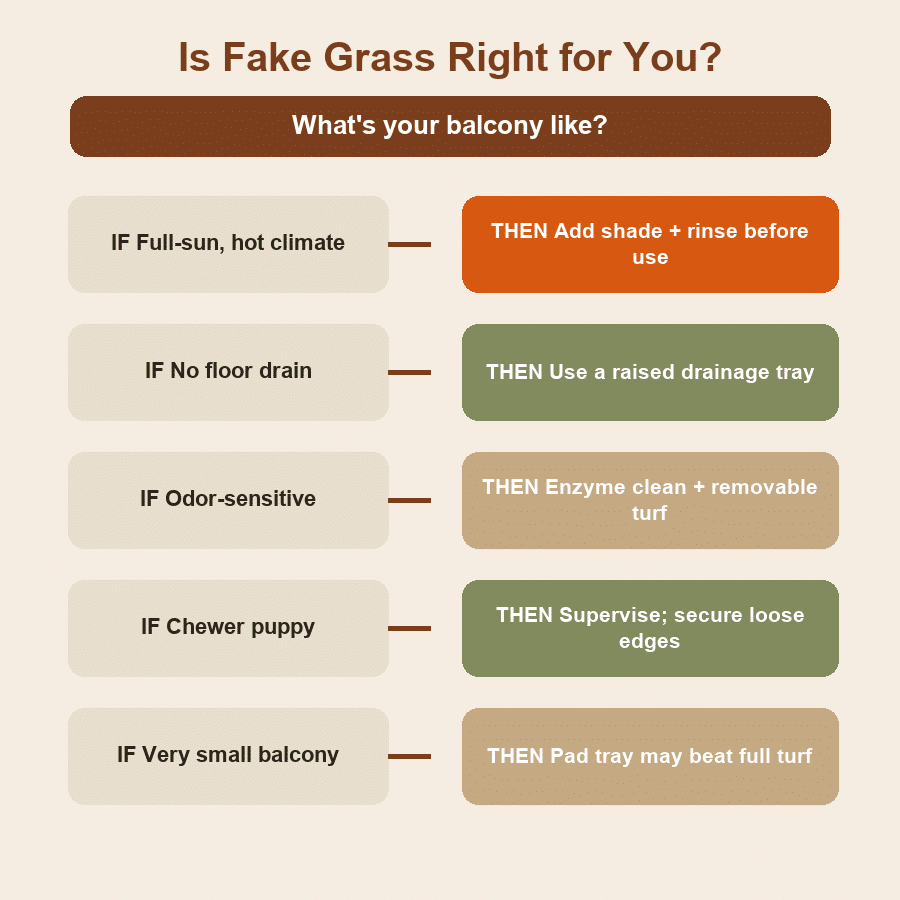
- If your balcony gets full, direct sun, then add shade and commit to the hand test before every hot-day trip — or hold off on turf until you can shade it.
- If your balcony is shaded or covered, then it is a strong candidate; put your effort into drainage and cleaning.
- If there is no clear drainage path, then solve drainage first — permeable turf on raised tiles — before anything else.
- If your dog is a heavy chewer, then lock down the edges, choose no-infill turf, and supervise, or use a removable potty tray instead.
- If the space is tiny and poorly ventilated, then expect heat and odor to concentrate, and lean toward a small washable pad you can swap out daily.
Do and don’t at a glance
The habits that make balcony turf safe, and the shortcuts that make it risky.
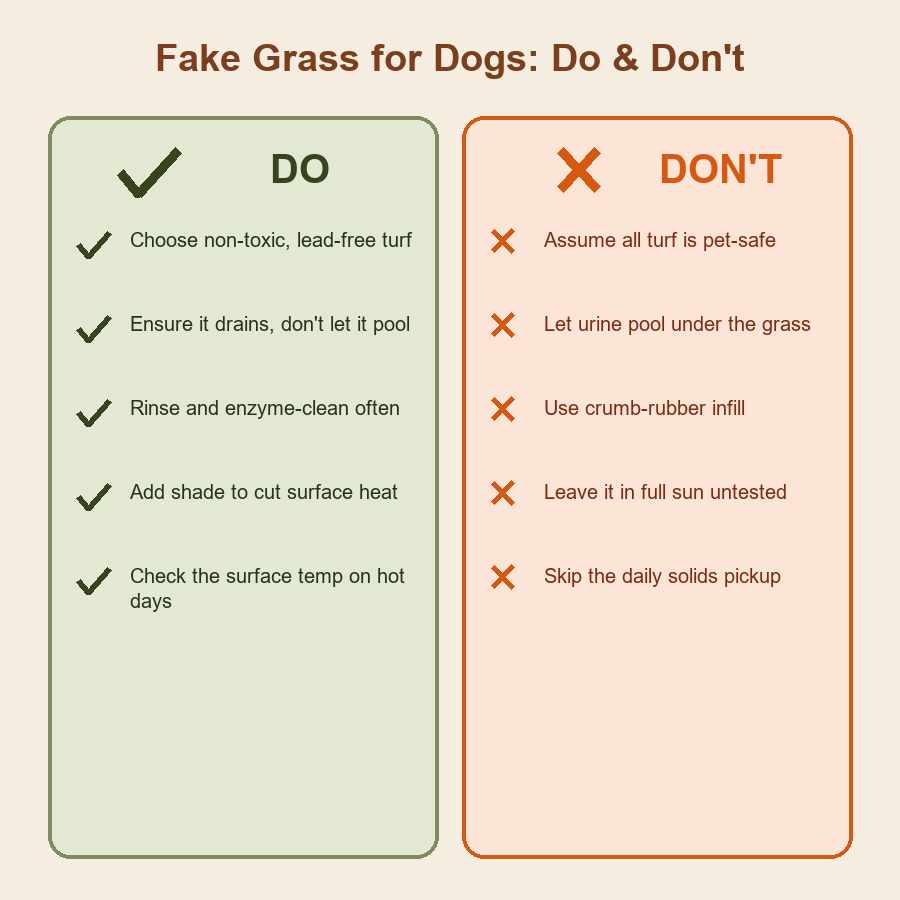
- Do shade the turf and hand-test it on hot days. Don’t assume synthetic grass stays as cool as real grass in the sun.
- Do build in drainage and rinse the potty zone daily. Don’t lay a non-draining mat that traps urine on the deck.
- Do deep-clean on a schedule with an enzyme cleaner. Don’t wait until the odor is obvious — buildup only gets worse.
- Do choose non-toxic turf and secure the edges. Don’t leave loose strands or infill a chewer could swallow.
- Do use no-infill turf or a non-toxic sand. Don’t use recycled crumb-rubber granules around pets.
Common mistakes to avoid
- Treating turf like real grass in the heat. Sign: your dog hops, lifts its paws, or won’t step onto sun-baked turf. Fix: shade it, rinse with cool water, and use the hand test before every hot-day trip.
- Skipping drainage. Sign: puddles linger and the deck smells after rain or urine. Fix: switch to permeable turf on raised drainage tiles that feed the balcony drain.
- No cleaning schedule. Sign: an ammonia smell that gets stronger in warm weather. Fix: rinse the potty zone daily and deep-clean with an enzyme cleaner made for pet urine.
- Using crumb-rubber infill. Sign: black granules tracking indoors and a hotter surface. Fix: switch to no-infill pet turf or a non-toxic sand infill.
- Leaving edges loose. Sign: lifting corners or chewed strands. Fix: anchor every seam and supervise chewers — loose pieces can cause a blockage if swallowed.
- Buying on price alone. Sign: thin, non-permeable turf with no safety labeling. Fix: choose non-toxic, lead-free, permeable pet turf instead.
What most guides get wrong
Most “pet turf” articles sell artificial grass as cool, clean, and maintenance-free. For a balcony with a dog, all three claims need caveats.
- “It stays comfortable in the sun.” It doesn’t. University turf research puts synthetic surfaces tens of degrees hotter than natural grass, hot enough that a hot surface can burn paws. On an exposed balcony with heat reflecting off walls and glass, that is the first thing to plan around, not a footnote.
- “It’s basically self-cleaning.” It isn’t. Without a rinse-and-deep-clean routine, urine residue builds and the smell intensifies — and a balcony’s small, enclosed air makes odor far more noticeable than a big open yard would.
- “Any turf will do.” Balconies are a special case. No soil means drainage is entirely on you, and a leak becomes your downstairs neighbor’s problem. The backing, the sub-layer, and the waterproofing under the turf matter as much as the blades on top.
- “Infill is harmless.” Not for every dog. For a dog that chews, loose granules are a swallowing hazard, and crumb rubber adds heat and material you don’t want a pet ingesting. The safer default is no-infill pet turf or a non-toxic sand.
What helps most: a real cleaning routine
The things that make balcony turf genuinely safe are unglamorous: shade, good drainage, and a cleaning routine that actually neutralizes urine. Odor control is where most owners struggle, because ordinary cleaners mask the smell instead of breaking down the residue that causes it.
- Start with the cleaner type. Our guide to an enzyme cleaner vs. regular cleaner for pet urine explains why an enzyme formula is the right tool for turf, where residue soaks into the backing.
- For routines, schedules, and odor troubleshooting, browse our pet cleaning & odor control guides.
Choose products by how well they suit turf and your dog’s size and habits — not by the loudest label. No cleaner replaces daily rinsing and good drainage.
The bottom line
Artificial grass is a reasonable, dog-safe balcony surface when you respect four things: keep it cool with shade and the hand test, make sure it drains, clean it on a schedule so odor never builds, and choose non-toxic turf with a safe (or no) infill. Heat is the risk to plan around first; the rest is routine. For more balcony and outdoor setups for pets, visit our FurlyHome outdoor & balcony ideas hub.
FAQ
Can artificial grass burn my dog’s paws?
It can get hot enough to be a risk. Synthetic turf runs much hotter than natural grass in direct sun — measured tens of degrees hotter in university testing — and veterinary guidance notes that a hot surface can burn a dog’s pads. It is not that turf is dangerous by nature; it is that a sun-baked surface needs managing. Shade it, and press the back of your hand to it for about seven seconds before letting your dog out.
Is fake grass toxic to dogs?
Quality pet turf labeled non-toxic and lead-free is considered safe to walk and lie on. The real material risk is chewing and swallowing: loose infill or torn turf pieces can cause an intestinal blockage, so secure the edges, skip crumb-rubber infill, and supervise dogs that chew.
How do I stop the balcony turf from smelling like urine?
Rinse the potty area daily and deep-clean on a schedule with an enzyme cleaner made for pet urine; residue builds and the smell intensifies if you let it sit. Good drainage matters just as much — if liquid can’t leave the surface, odor will linger no matter how you clean.
What infill is safe for dogs?
Favor a no-infill pet turf or a rounded, non-toxic mineral infill such as silica sand. Avoid recycled crumb-rubber infill around pets: it tends to run hotter and is material you don’t want a chewer swallowing.
Does a balcony need special drainage for pet turf?
Yes. Unlike a yard, a balcony has no soil, so you must give liquid a path off the surface — permeable turf on raised drainage tiles that feed the existing balcony drain — and protect the waterproofing underneath so nothing leaks to the unit below.
Is real grass or artificial grass better for a dog on a balcony?
Each has trade-offs. A natural-grass pad stays cooler and is easy on paws but needs replacing and can rot or leak if it doesn’t drain. Artificial turf is durable and low-effort but runs hot in sun and needs a cleaning routine. On a shaded balcony with good drainage, artificial grass is usually the more practical choice.
Sources
- Penn State Center for Sports Surface Research — Synthetic Turf Infill: Temperature and Color — supports that synthetic turf runs far hotter than natural grass, measured 35-60 °C higher and as high as 93 °C on a day when air temperatures were 37 °C.
- VCA Animal Hospitals — First Aid for Torn or Injured Foot Pads in Dogs — supports that a hot surface, like a scorching summer sidewalk, can burn a dog’s foot pads.
- Simple Green — How to Clean Artificial Grass (Dog Urine) — supports that dog-urine residue builds up in turf and the odor intensifies unless it is cleaned regularly.
- American Kennel Club — Intestinal Blockage in Dogs — supports that swallowing non-food foreign objects is a common cause of serious intestinal blockage in dogs.
Last reviewed July 2026.



Write Your Review
No reviews yet. Be the first to share your experience!