

A balcony can double as a reliable potty spot for a dog who can’t always get outside on demand — you just need the right surface, a way to contain the mess, and a routine your dog can count on. Set up well, it keeps your floors clean and your downstairs neighbor happy.
Quick answer
To create a dog potty area on your balcony, pick a surface your dog will actually use — real sod, artificial turf, or an absorbent pee-pad tray — and set it inside a shallow tray that catches urine so it can’t sit on the floor or drain over the edge. Plan simple drainage that empties into a container you control, never onto a neighbor below, and check your building or HOA rules first. Then train your dog to the spot on a consistent schedule, and clean it on a regular schedule to keep odor down. Never leave your dog unattended out there.
Safety first
A balcony potty area is convenient, but the balcony itself is the real hazard, and it deserves your attention before anything else. Dogs, not just cats, are at risk of falling from balconies, so the railing matters more than the turf. Never leave your dog unattended on the balcony — the American Kennel Club warns that any pet can get into mischief in mere seconds. Before your dog uses the space, block any gap a dog could squeeze through, and add a barrier if the railing is low enough to jump or has openings a small dog could slip between.
Supervision is not optional here. Puppies and small dogs are especially quick to scramble onto furniture and up toward the railing, so keep chairs, planters, and anything climbable well away from the edge. If you can’t watch your dog, bring them inside. A potty area makes the balcony useful; it does not make it safe on its own.
Who this is for (and who it isn’t)
A balcony potty area solves a specific problem: your dog needs somewhere to go and a quick trip to ground level isn’t always possible. It is a supplement to outdoor time, not a replacement for it.
- This is for you if: you live in an apartment or high-rise, your dog is home alone for long stretches, you’re potty-training a puppy with limited outdoor access, or bad weather regularly keeps you off the street.
- This helps a senior or recovering dog who can’t manage stairs or hold it as long as they used to, giving them a safe, close spot to relieve themselves.
- This is not a full substitute for walks: your dog still needs the exercise, stimulation, and outdoor time a balcony can’t provide. Use the balcony spot for the in-between moments, not instead of getting out.
- This may not suit every dog: some dogs are reluctant to use a synthetic surface, so be ready to switch materials rather than force the issue.
Why a balcony potty area works
A balcony potty area works because it gives your dog a consistent, designated place to go that you can contain and clean. The whole thing succeeds or fails on that word: consistent. A dog who knows exactly where the spot is, and finds it the same every time, forms the habit quickly.
The trick is to treat it as a system rather than a single product. A patch of turf on its own is just a wet patch of turf; it becomes a potty area only once it sits in a tray that catches the mess, drains somewhere you control, and gets cleaned on a rhythm. Skip any one of those and the setup turns into an odor problem or a neighbor problem fast. The steps below build the system in the right order, from the surface up.
What you need
You don’t need much, and most of it is one-time. Gather these before you start so the setup goes in all at once.
- A surface (required): a real sod patch, an artificial turf pad, or absorbent pee pads — you’ll choose in Step 1.
- A tray or containment base (required): a shallow tray with a raised lip that the surface sits inside, so urine is caught instead of spreading.
- A drainage plan (required): either a tray you tip and empty, or one that drains into a sealed jug or reservoir you control.
- Cleaning supplies (required): a hose or watering can for rinsing, and an enzyme-based cleaner for urine odor.
- Optional extras: a non-slip mat under the tray, and a backup surface so you can rotate while one is drying.
Step by step: build the potty area from the surface up
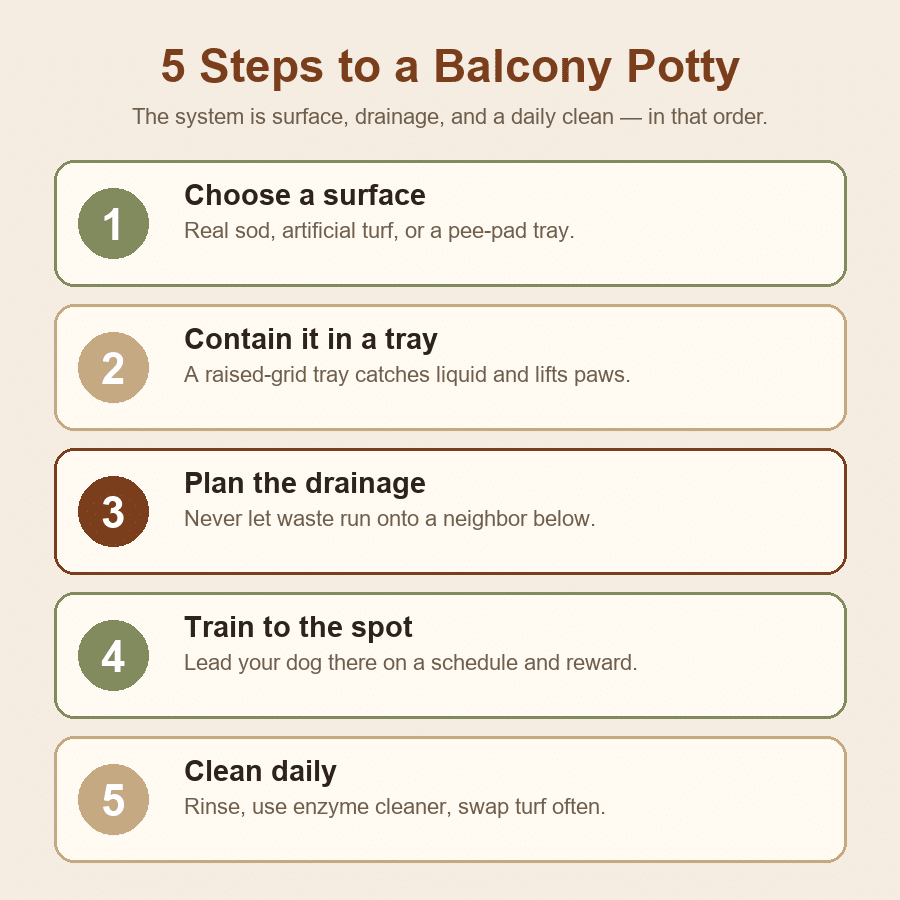
1 Choose a surface your dog will actually use
What to do: Pick one of three surfaces — a real sod (grass) patch, an artificial turf pad, or an absorbent pee-pad tray — based on your dog’s preferences and how much upkeep you want. Why: The surface is the foundation of the whole system, and if your dog won’t step onto it, nothing else matters. Real sod feels natural and many dogs take to it right away, but it wears out and needs replacing. Artificial turf is durable and rinses clean, but The Dog Clinic points out that the main downside of synthetic pads is that some dogs are reluctant to toilet on synthetic grass. Pee-pad trays are the simplest option for a small space and very absorbent, though the pads are an ongoing cost. Success cue: Your dog steps onto the surface and eliminates without hesitation within the first few sessions. Adjust: If your dog sniffs the turf and walks away again and again, switch to real sod — for some dogs the natural texture and smell are the deciding factor.
2 Contain the surface in a tray
What to do: Set your chosen surface inside a shallow tray or containment base with a raised lip on all sides. Why: This is the step that protects your floor and your neighbors. The Dog Clinic recommends a tray precisely because it catches urine, so it doesn’t sit on your balcony’s floor or drain over the edge. A bare pad or a loose patch of turf lets urine spread across the concrete and seep toward the railing, which is exactly what you’re trying to prevent. Success cue: After your dog goes, liquid collects in the tray rather than spreading across the balcony floor. Adjust: If the tray overflows or urine escapes at the corners, size up to a deeper tray with a higher lip, or empty it more often so it never fills.
3 Plan drainage that never reaches the neighbor below
What to do: Give urine somewhere to go that you control — a tray you tip and empty, or one that drains into a sealed jug or reservoir. Never let runoff sheet across the floor and over the edge. Why: Runoff that drips onto the balcony or patio below is the fastest way to turn a convenience into a neighbor dispute. Containing the liquid keeps it off other people’s space and keeps the problem yours to manage. Rules about balcony runoff vary from building to building, so check your lease, building management, or HOA guidelines rather than assuming what’s allowed — don’t assume the same rule applies everywhere. Success cue: All liquid ends up in a container you can lift and empty, and nothing reaches the edge of the balcony. Adjust: If your tray has no drain, commit to tipping and emptying it on a set schedule; if it does drain, route the outlet into a jug you empty, never off the side.
4 Train your dog to the spot on a consistent schedule
What to do: Take your dog to the balcony spot at predictable times — after waking, after meals, and before bed — reward success the moment it happens, and use the same cue word every time. Why: Consistency is what builds the habit. The American Kennel Club’s potty-training guidance is blunt about it: keeping a consistent housetraining schedule is critical to success. Random timing teaches your dog nothing, while a steady rhythm teaches them where and when to go. Success cue: Your dog starts heading to the balcony spot on their own around the usual times. Adjust: If accidents continue indoors, tighten the schedule and increase supervision, and go back to rewarding every single success until the habit is solid.
5 Clean on a schedule to keep odor down
What to do: Spot-clean daily, rinse or replace the surface regularly, and set a recurring deep-clean. Why: Odor is a maintenance problem, not a one-time fix. Simple Green recommends a weekly cleaning schedule to prevent heavy buildup of urine and odors on artificial grass, and the same logic applies to trays and pads. For urine specifically, the type of cleaner matters: our comparison of enzyme cleaner vs. regular cleaner for pet urine explains why enzyme-based products break down the compounds that ordinary cleaners tend to leave behind. Success cue: The area stays fresh between deep cleans and doesn’t announce itself when you open the door. Adjust: If odor returns quickly, clean more often, replace pads or sod sooner, and switch to an enzyme cleaner made for pet urine.
Choose the right setup for your balcony
Not every balcony or every dog needs the same setup. Match the choice to what matters most to you and what you’re seeing from your dog.
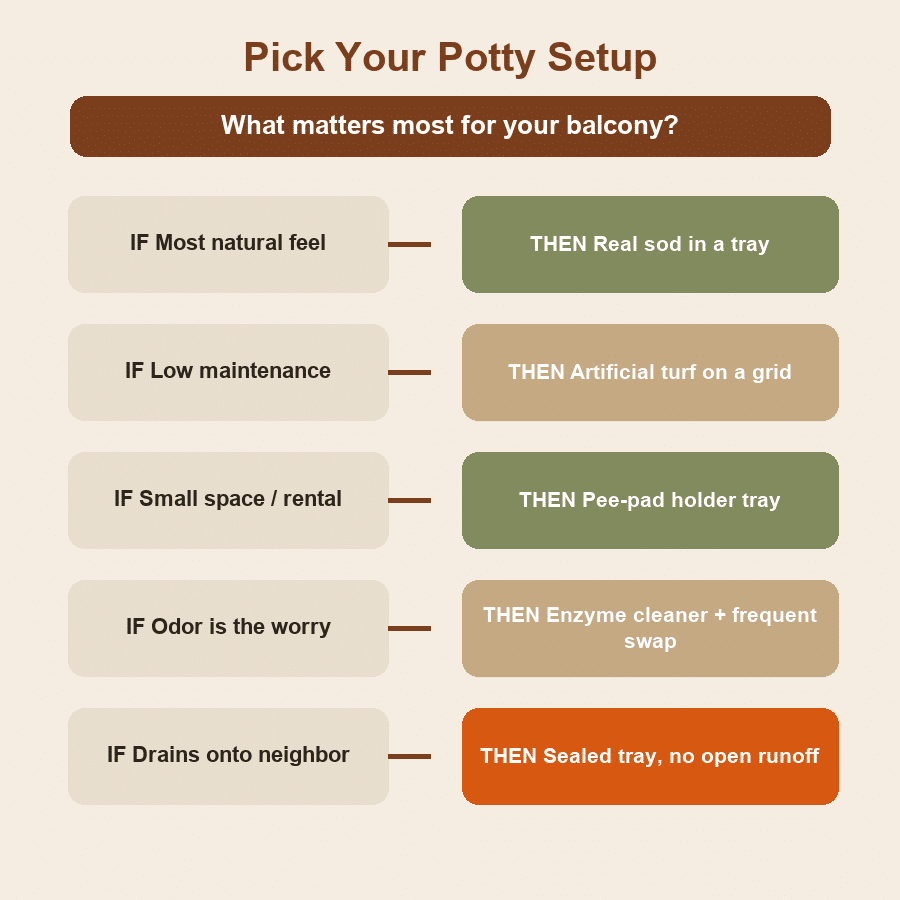
- If a natural feel matters most and your dog is picky, then choose a real sod patch and plan to replace it as it wears.
- If low maintenance and durability matter most, then choose artificial turf and commit to a regular rinse schedule.
- If you have a very small space or a small dog, then a pee-pad tray is the simplest to contain and swap out.
- If your dog sniffs synthetic turf and refuses it, then switch to real grass — some dogs simply won’t use fake grass.
- If odor control is your top worry, then prioritize tight containment and a strict cleaning schedule over the surface type.
- If your balcony sits directly above a neighbor, then a fully contained, drain-to-container setup matters more than any other feature.
Do and don’t at a glance
If you remember nothing else, remember these. The left column is what a clean, neighbor-friendly setup looks like; the right column is what quietly creates odor, mess, or a complaint.
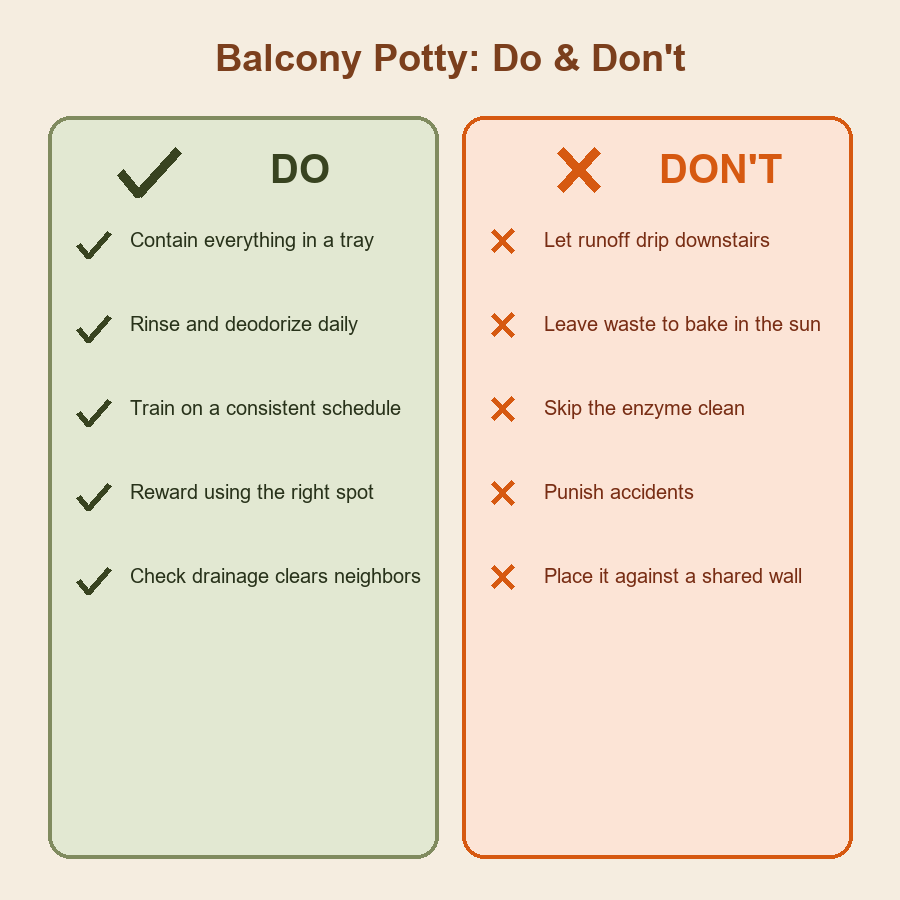
- Do set your surface inside a tray with a raised lip. Don’t lay a pad or turf straight on the bare concrete.
- Do contain runoff and empty it yourself. Don’t let urine drain over the edge onto the space below.
- Do check your building or HOA rules first. Don’t assume what’s allowed on one balcony applies to yours.
- Do keep a consistent potty schedule and reward success. Don’t expect the habit to form with random timing.
- Do supervise your dog the whole time they’re out there. Don’t leave your dog unattended on the balcony.
- Do clean on a set schedule. Don’t wait until you can smell it.
Common mistakes to avoid
- Skipping the tray. Sign: urine spreads across the concrete or creeps toward the railing. Fix: set the surface inside a tray with a raised lip so liquid is caught, not spread.
- Letting runoff go over the edge. Sign: a neighbor mentions drips, or you see liquid reaching the balcony edge. Fix: drain into a container you empty, and check your building or HOA rules.
- Treating turf as odor-proof. Sign: a lingering smell within a week. Fix: adopt a cleaning schedule and rinse or replace the surface regularly.
- Forcing synthetic turf on a dog that refuses it. Sign: your dog sniffs the turf and holds it, or goes somewhere else. Fix: switch to real sod, which picky dogs are more likely to use.
- Training with no routine. Sign: accidents keep happening indoors. Fix: take your dog out at fixed times and reward every success until the habit sticks.
- Leaving the dog unattended. Sign: you step inside “just for a minute” while your dog is out there. Fix: never leave your dog alone on the balcony; bring them in if you can’t watch.
What most guides get wrong
Most balcony-potty guides stop at “buy a grass pad” and skip the parts that decide whether the setup actually lasts. Here’s where the generic advice falls short.
- They sell the surface as the whole solution. The surface is only step one. Containment, drainage, training, and cleaning are what make a balcony potty work day after day, and a pad on its own does none of them.
- They ignore the neighbor below. Few guides mention where the urine actually goes. On a stacked balcony, runoff onto someone else’s space is the problem that ends the whole setup — contain it and check your building’s rules before it becomes a dispute.
- They promise odor-free turf. No surface is self-cleaning. Simple Green’s own guidance calls for a weekly cleaning schedule to keep buildup of urine and odors down, so any guide that skips maintenance leaves you with a smell you can’t explain.
- They assume every dog loves fake grass. Some dogs flatly refuse synthetic turf, as The Dog Clinic notes, and a guide that only sells turf sets those owners up to fail. Real sod is the fix, not more training.
- They forget the balcony is a fall risk. The potty is the easy part; the railing is the dangerous part. Dogs fall from balconies too, and the best setup is worthless if the space itself isn’t secured and supervised.
The one supply that decides odor
Once the surface, tray, and drainage are sorted, odor control comes down to how you clean — and dog urine is a special case. Regular all-purpose cleaners can mask the smell without breaking down the compounds in urine, which is why the odor keeps coming back a day later.
Enzyme-based cleaners target those compounds directly, which is why they tend to win on urine odor specifically. If you’re deciding what to keep by the balcony door, our comparison of enzyme cleaner vs. regular cleaner for pet urine walks through when each one makes sense and why enzyme formulas usually come out ahead for this job.
Buy for your surface and your schedule, not for the label on the bottle. The best cleaner is simply the one you’ll actually use on a regular rhythm.
Final recommendation
Start with the surface your dog will actually use, then never skip the two steps most guides do: contain the mess in a tray, and keep runoff off the neighbor below. Train on a consistent schedule, clean on a consistent schedule, and supervise every visit — the balcony is only as safe as your attention. If your dog refuses synthetic turf, switch to real sod rather than fighting it, and if you share a wall or a floor with neighbors, check your building or HOA rules before you commit to a drainage plan.
For more balcony and outdoor setups in one place, visit our FurlyHome outdoor & balcony ideas hub. And because a balcony potty routine works best alongside a dog-friendly indoor space, our guide to how to pet-proof your living room is a natural next step.
FAQ
Can a balcony potty area replace daily walks?
No. A balcony spot is a backup for the times your dog can’t get outside — long workdays, bad weather, high-rise living, or recovery from an injury. It doesn’t replace the exercise, stimulation, and outdoor time your dog still needs, so use it for the in-between moments rather than instead of getting out.
Real grass or artificial turf — which is better?
It depends on your dog. Artificial turf is durable and easy to rinse, but some dogs are reluctant to toilet on synthetic grass, as The Dog Clinic notes. Real sod feels natural and picky dogs often prefer it, though it needs replacing as it wears. If your dog won’t use turf, switch to sod before trying anything else.
How do I keep the balcony from smelling?
Contain urine in a tray so it can’t spread, then clean on a schedule. Simple Green recommends a weekly cleaning routine to prevent heavy buildup of urine and odors. For urine odor specifically, an enzyme cleaner breaks down the compounds that a regular cleaner tends to leave behind.
Will the runoff bother my downstairs neighbor?
It will if you let it drain over the edge. Keep the setup fully contained so liquid empties into a container you control, never off the side. Because rules differ from building to building, check your lease, building management, or HOA guidelines rather than assuming what’s allowed where you live.
Is a balcony safe for my dog?
Only with supervision. Dogs, like cats, can fall from balconies, so block any gaps, keep climbable furniture away from the railing, and never leave your dog unattended out there. The potty area makes the balcony useful, but your attention is what makes it safe.
How long does it take to train my dog to the spot?
It varies by dog, but consistency is what speeds it up. The American Kennel Club emphasizes that a consistent housetraining schedule is critical to success, so take your dog to the same spot at the same times and reward every success until the habit forms.
Sources
- The Dog Clinic — Best Balcony Dog Potty: Fake & Real Grass Patches — supports containing the surface in a tray so urine doesn’t sit on the balcony floor or drain over the edge, and that some dogs are reluctant to toilet on synthetic grass.
- Simple Green — How to Clean Artificial Grass (Dog Urine) — supports a weekly cleaning schedule to prevent heavy buildup of urine and odors.
- PetMD — Balcony Safety and Pets: How to Avoid High-Rise Risks — supports that dogs, as well as cats, are at risk of falling from balconies.
- American Kennel Club — How to Make Your Balcony Safe and Dog-Friendly — supports never leaving a dog unattended on the balcony and blocking gaps a dog could squeeze through or jump.
- American Kennel Club — How to Potty Train a Puppy — supports that a consistent housetraining schedule is critical to success.
Last reviewed July 2026.





Write Your Review
No reviews yet. Be the first to share your experience!