

Golden Retriever vs Labrador: Quick Verdict
Both golden retrievers and Labrador retrievers are outstanding family dogs — patient, gentle with children, eager to please, and highly trainable. The choice between them comes down to coat maintenance preference, energy level differences, and specific household circumstances. Goldens require more grooming; Labs are slightly higher energy and more orally-fixated as puppies. Neither is dramatically more difficult than the other — but the differences are real and worth understanding before deciding.
| Factor | Golden Retriever | Labrador Retriever |
| Coat type | Long, double coat | Short, dense double coat |
| Grooming need | High — brushing 3x/week min | Moderate — brushing 2x/week |
| Shedding | Heavy, year-round + 2 blowouts | Heavy, year-round + 2 blowouts |
| Fur on furniture | Longer, more visible fur | Short fur embeds more stubbornly |
| Adult male weight | 65–75 lbs | 65–80 lbs |
| Energy level | High (matures around 3 yrs) | Very high (matures around 2-3 yrs) |
| With children | Excellent — gentle and patient | Excellent — very playful and robust |
| With other dogs | Excellent | Excellent |
| Trainability | Very high | Very high |
| Chewing tendency | Moderate as adults | Higher — Labs are orally fixated longer |
| Water/swimming | Loves water | Loves water (more intensely) |
| Average lifespan | 10–12 years | 10–12 years |
| Cancer risk | Higher than average (60%+ by age 10) | Moderate |
| Weight management | Moderate obesity risk | High obesity risk |
Side-by-Side Comparison
| Situation | Better Choice | Why |
| Families with toddlers | Slight edge to Golden | More attuned to gentle handling cues |
| Active families who run or hike | Either / slight edge Lab | Labs sustain high-intensity activity longer |
| Limited grooming time | Labrador | Significantly lower coat maintenance |
| First-time dog owners | Either — both highly trainable | Labs slightly more forgiving of inconsistency |
| Families concerned about chewing damage | Slight edge Golden | Labs are more orally fixated as puppies |
| Apartment or smaller home | Either — same size/energy | Both need substantial daily exercise regardless |
| Allergies to pet dander | Neither — both heavy shedders | No meaningful difference in dander production |
Coat and Grooming: The Most Practical Difference
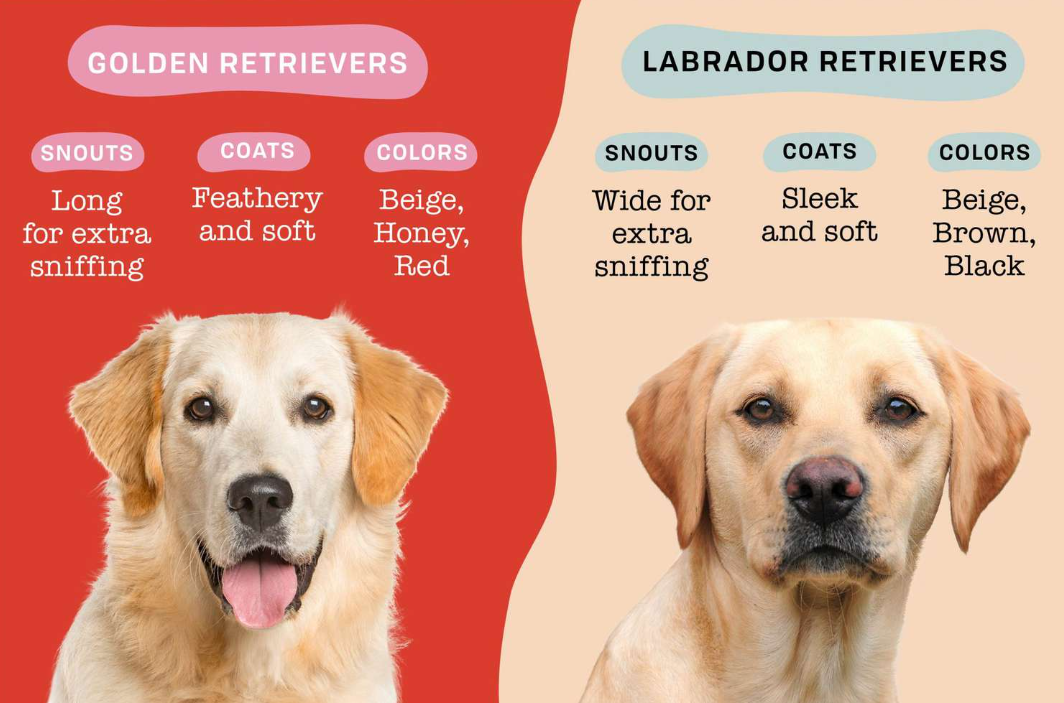
This is where the real daily difference lives for most families. Golden retrievers require brushing at least three times a week to prevent matting in the feathering around the ears, chest, legs, and tail — these longer fur areas mat without regular attention. The grooming commitment during blowout season is daily. Professional grooming every six to eight weeks is standard for most goldens.
Labradors require less grooming — twice-weekly brushing is typically sufficient outside of blowout season, and their short coat does not mat. However, Lab fur is shorter and stiffer and embeds into upholstery and fabric more stubbornly than golden fur. Both breeds leave significant fur on furniture and clothing — they just feel different in practice.
If grooming time is a real constraint, a Labrador is the more manageable choice. If you enjoy grooming and appreciate the longer, more striking golden coat, the extra commitment is worth it. See our breed-specific shedding guides for detail: how much does a golden retriever shed and do Labradors shed a lot.
Temperament and Energy: Subtle but Real Differences
Both breeds are famously gentle, patient, and friendly — but there are temperament differences worth understanding. Golden retrievers tend to be slightly more sensitive and emotionally attuned — they pick up on household stress more readily and are more likely to become anxious when family dynamics are tense. They also tend to stay “puppy-like” in enthusiasm and play style longer than Labs, which some families love and others find exhausting in a large dog.
Labradors are typically more resilient and less emotionally reactive — they tend to be physically robust, bounce-back quickly from correction, and maintain a consistent cheerful baseline regardless of household mood. Labs as puppies are often described as more intensely oral — they chew more, carry objects constantly, and investigate the world more through their mouths than goldens typically do. This settles by 18 to 24 months in most Labs but can be destructive without adequate management during that period.
Health Differences That Matter for Families
Cancer risk:Golden retrievers have one of the highest cancer rates of any dog breed — studies suggest 60% or more of goldens develop cancer by age 10. This is not a reason to avoid the breed, but it is something families should understand going in. The Morris Animal Foundation Golden Retriever Lifetime Study is an ongoing effort to identify cancer risk factors in the breed.
Hip and joint health:Both breeds are prone to hip and elbow dysplasia. Buying from breeders who screen parent dogs for joint health (OFA certification) significantly reduces the risk. For supplement support for joint health in both breeds, see our best glucosamine supplement for senior dogs guide.
Obesity:Labs have a genetic mutation in the POMC gene that affects hunger signaling — many Labs genuinely do not feel full in the way other dogs do. This makes Labs significantly more food-motivated (which aids training) but also much more prone to obesity if free-fed or overfed. Golden retrievers have moderate obesity risk; Labs have high obesity risk that requires active management. See how to tell if your dog is overweight for the body condition assessment method.
Which Breed Is Better for Specific Family Situations
Home Setup for Either Breed
Both golden retrievers and Labradors are large, active dogs that require meaningful investment in home setup: XL-sized beds and crates, washable furniture covers, a vacuum appropriate for dense pet hair, and either a fenced yard or a consistent outdoor exercise commitment. For golden-specific setup, see ourgolden retriever home setup guide. For Labradors, see the labrador retriever home setup checklist. For bed options for both breeds, see our best dog bed for golden retriever and best dog bed for labrador retriever guides.
Frequently Asked Questions
Are golden retrievers calmer than Labradors?
Marginally — both breeds are high-energy through their first two to three years. Goldens tend to be slightly more emotionally sensitive and somewhat less physically boisterous than Labs as puppies. By adulthood, energy levels converge significantly. Neither breed is a calm dog by any objective standard until age 3 or beyond.
Which breed sheds more — golden or Lab?
Both shed heavily and at comparable volumes. The experience differs: golden fur is longer and more visible on surfaces but easier to remove; Lab fur is shorter and embeds more stubbornly in fabric. Neither is the “easier” choice for shedding management.
Which breed is easier to train?
Both are among the easiest breeds to train — consistently ranking in the top five for trainability across assessments. Labs are often described as slightly more forgiving of inconsistent training because they are less sensitive to handler tone. Goldens respond more keenly to positive reinforcement and handler emotional cues.
More FurlyHome Breed Guides
- How Much Does a Golden Retriever Shed?
- Do Labrador Retrievers Shed a Lot?
- Golden Retriever Home Setup Guide
- Labrador Retriever Home Setup Checklist
- How Big Do Golden Retrievers Get?
- Best Pet-Friendly Sofa Covers
Verdict
For most families, either breed will be an excellent choice — the differences are real but not dramatic. Choose a Labrador if grooming time is limited, you have young children who play rough, or you want a highly food-motivated training partner. Choose a golden retriever if you value the emotional attunement and longer coat, are prepared for the grooming commitment, and are aware of the breed’s elevated cancer risk. Both are exceptional family dogs when their exercise and mental stimulation needs are met consistently.







Write Your Review
No reviews yet. Be the first to share your experience!