

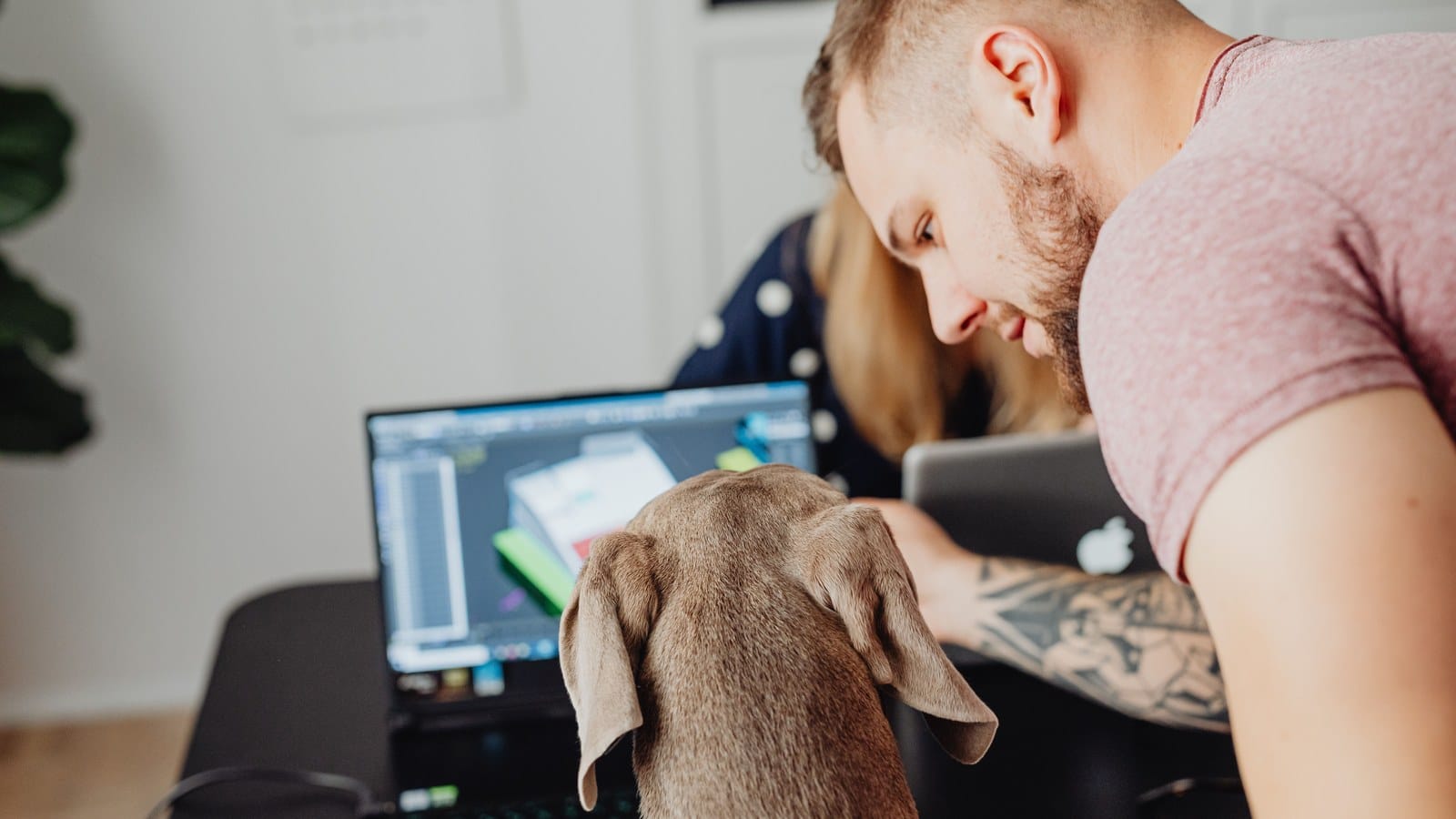
A dog doesn’t have to hijack your workday. The trick is to meet your dog’s needs before you hit “join” — not to shush them once the camera is on.
Quick answer
To keep your dog calm during work calls, meet the need before the meeting: give a real walk or play session right before you start, then set up a comfortable den near you with a long-lasting chew or food puzzle so your dog has something better to do than bark. Reward the quiet moments, and soften the triggers that set your dog off. Build the settle spot as a positive choice, never a punishment. If your dog truly panics the moment your attention turns away — pacing, drooling, or frantic — that points to separation anxiety, and a qualified behaviorist should guide you rather than a quick training fix.
Safety first: boredom is not separation anxiety
The steps here are for a healthy, restless, or under-stimulated dog who barks, whines, or pesters you because a work call is boring — not because they are in genuine distress. Many dogs are disruptive when left to their own devices simply because they are bored and looking for something to do, and these dogs usually don’t look anxious. Exercise, a cozy den, and a good chew solve that kind of fussing.
True separation anxiety is different and more serious. If your dog genuinely panics the moment your focus shifts to the screen — pacing, drooling, trembling, nonstop howling, house-soiling, or desperately trying to reach you — that is not a training quick-fix, and a puzzle toy alone will not resolve it. Official guidance from the ASPCA recommends consulting a Certified Applied Animal Behaviorist (CAAB or ACAAB) or a board-certified veterinary behaviorist (Dip ACVB) for a real behavior-change plan.
Two ground rules apply throughout. Never punish your dog for barking — punishment adds stress and usually makes the noise worse. And treat any warm, cozy resting spot as comfort, not medical care; if your dog is barking from pain or sudden distress rather than boredom, talk to your veterinarian first.
Who this is for (and who needs a behaviorist)
This guide is for people who work from home with a dog that gets bored, bouncy, or attention-seeking during calls. The plan is management and gentle training, not treatment for a diagnosed behavior disorder.
- This is for you if: your dog barks, whines, drops toys in your lap, or paces during calls but is otherwise relaxed when you’re simply working nearby — the fussing looks like “I’m bored, entertain me,” not panic.
- Try this alongside a professional if: your dog settles some days but unravels on others, or the noise is getting worse despite exercise and enrichment. A trainer or behaviorist can help you read what’s really happening.
- Skip the DIY fixes and get help first if: your dog panics whenever you become unavailable — frantic pacing, drooling, destruction, or house-soiling. That pattern points to separation anxiety, and the ASPCA advises working with a qualified behaviorist rather than training it away yourself.
Why calls set dogs off in the first place
From your dog’s point of view, a work call is a strange event: you’re home and talking, but you’ve suddenly stopped paying attention to them. Barking, nudging, and toy-dropping are usually just a dog trying to restart the interaction that seems to have paused.
Most dogs also have energy to burn, so a dog who rested all morning hits your first meeting fully charged and finds its own entertainment — often the noisy kind. Add an outside trigger like a doorbell, and a quiet home office turns loud fast. The fix isn’t to suppress the noise; it’s to remove the reasons for it before the call starts, which is what the steps below do, in order.
Before you start: read your dog’s schedule
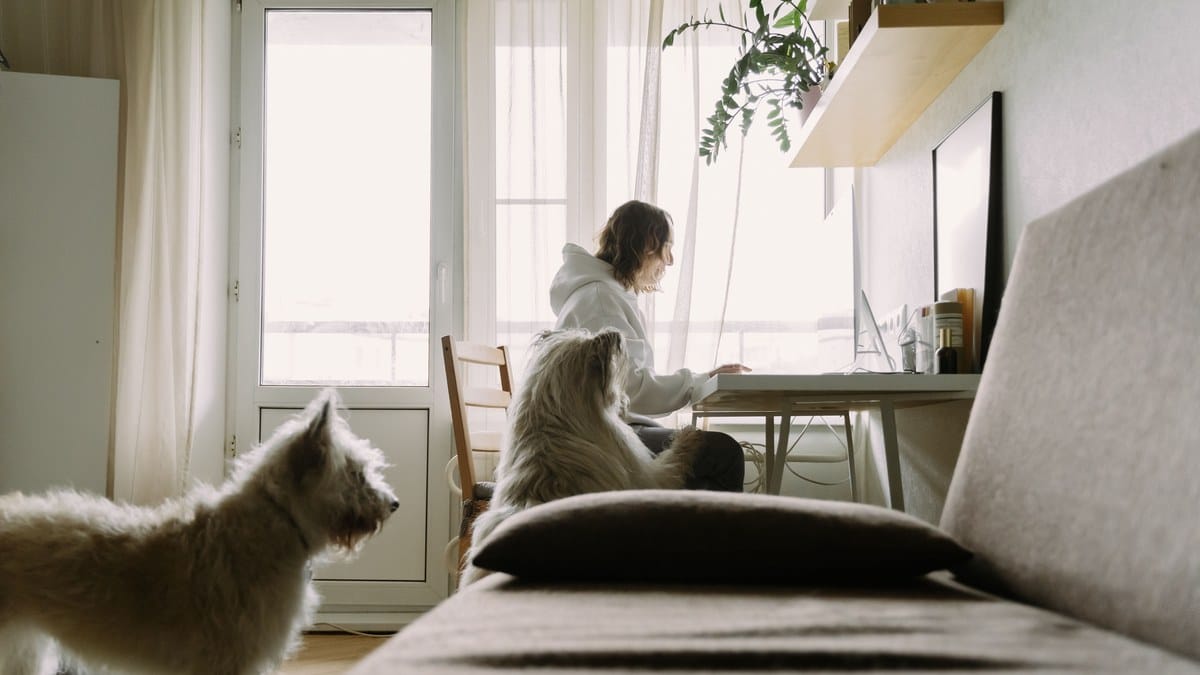
Before you change anything, look at when the barking actually happens. The pattern tells you which step to lean on hardest.
- Does the noise come early in the day, right after your dog wakes up with unspent energy?
- Does it start about 20 minutes in, once the novelty of you sitting down wears off and boredom sets in?
- Is it tied to a sound — the doorbell, a delivery, a neighbor’s dog — more than to the call itself?
- Does your dog follow you to the desk and refuse to settle anywhere except on you?
- Does your dog seem frantic or distressed the instant you stop interacting, even with a chew available?
Early-day energy points to exercise; mid-call boredom points to enrichment; sound-triggered barking points to softening triggers; can’t-settle clinginess points to den training and rewarding calm. Genuine panic points away from this article and toward a behaviorist. Most dogs need a mix, so build the whole routine and adjust the emphasis to fit what you see.
Step by step: a calm-dog call routine
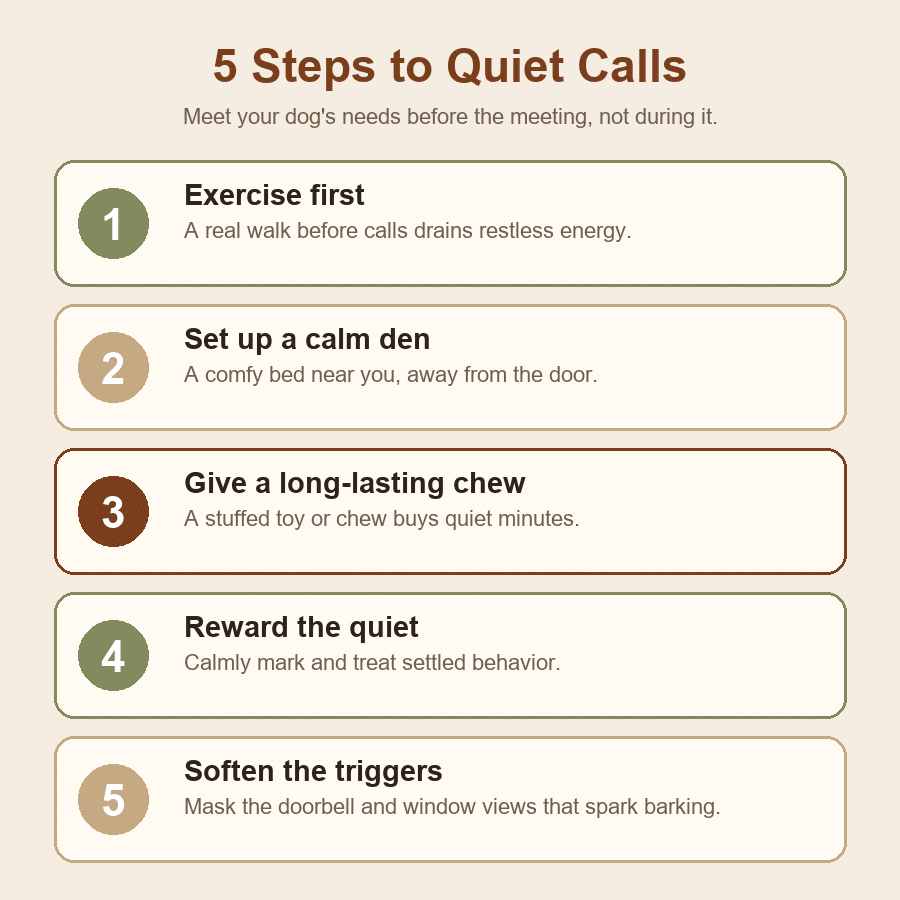
1 Exercise your dog right before the call block
What to do: Give your dog a real walk, a game of fetch, or a short training-and-play session in the half hour before you’ll be tied up on calls. Aim to take the edge off, not to exhaust them. Why: A dog with unspent energy will find a way to spend it, usually loudly. The ASPCA recommends exercising your dog right before you have to leave them on their own, because it helps them relax and rest while you’re unavailable — a call block works the same way. Success cue: Your dog comes back panting a little, laps up some water, and looks ready to flop down rather than pace. Adjust: If your dog is still wired, the session was too short or too stimulating; add a few minutes, or swap high-arousal fetch for a sniffy walk, which tires many dogs more calmly. Stack this with the enrichment in Step 3 so the pre-call wind-down flows straight into a settle.
2 Set up a calm den near your desk
What to do: Give your dog a defined spot to settle within sight of you — a bed, mat, or open crate a few feet from your chair. Leave a couple of favorite toys and a treat or two there so it becomes a place your dog wants to be. Why: Dogs settle more easily with a clear place to go, and keeping the spot near you means your dog isn’t fighting to close the distance. The American Kennel Club notes that leaving toys and treats near the bed gives your dog a place to settle, and that teaching a “place” cue and rewarding your dog for staying there builds the habit. Success cue: Your dog goes to the spot on cue, lies down, and relaxes rather than popping up every few seconds. Adjust: If a crate is part of the plan, make it a positive, choice-based space. Fear Free guidance suggests keeping the door open at first so your dog can move in and out freely, then closing it for only a couple of seconds at a time and building up as your dog stays relaxed — never latching a stressed dog in and walking away. A warm resting spot helps too; our cozy dog corner ideas cover comfort options (comfort, not a calming treatment).
3 Hand over a long-lasting chew or food puzzle
What to do: Right as the call starts, give your dog something absorbing that takes a while to finish — a stuffed and frozen rubber toy, a food puzzle, a snuffle mat, or a durable chew — delivered to the den from Step 2. Why: A busy dog is a quiet dog. The VCA notes that foraging toys can decrease boredom and improve a dog’s enjoyment, and the San Diego Humane Society explains that enrichment tires a dog out and promotes relaxation because it burns energy and relieves stress — adding that after a food-puzzle session, most dogs are tired mentally and physically, and more likely to stay calm for a while longer. Success cue: Your dog works the toy through the meeting, then dozes off near the den. Adjust: If the chew is gone in two minutes, make it harder — freeze the stuffing, use a tougher puzzle, or scatter kibble in a snuffle mat. Rotate a few options so the novelty doesn’t wear off, and match the chew to your dog’s size and chewing style to keep it safe.
4 Reward the quiet, don’t punish the noise
What to do: Catch your dog being calm and quietly mark it — a soft “good,” a calmly delivered treat to the den, or a bit of attention — during the natural pauses in your call. Reward settling on the mat, not demanding behavior. Why: Dogs repeat what pays off. The American Kennel Club suggests giving your dog attention for remaining on the dog bed, which teaches that lying quietly in their spot is what earns good things. Success cue: Over days, your dog offers the settle on its own because quiet has become the behavior that works. Adjust: Deliver the reward while your dog is calm, not right after a bark, or you’ll accidentally pay for the noise. Never yell, spray, or use a shock or “anti-bark” device — punishment raises stress and usually makes barking worse.
5 Soften the triggers around your calls
What to do: Cut down the things that spark barking in the first place. Play low white noise to mask hallway sounds, close blinds if your dog window-watches, silence a loud doorbell, and leave a note so nobody knocks during meetings. Why: Even a well-exercised dog will erupt at a doorbell or a passing dog. Muffling those cues means your dog never gets triggered mid-call, so the calm you built in the other steps actually holds. Success cue: The predictable set-offs — the mail, the neighbor’s dog, the buzzer — stop producing their usual outburst. Adjust: Schedule demanding calls for after a walk and a meal, when your dog is naturally sleepiest. Tidying the space helps too; our guide on how to pet-proof your living room covers removing the odds and ends that invite trouble while your back is turned.
Match the fix to why your dog is noisy
Not every dog is loud for the same reason. Use what you actually see to decide where to put your effort first.
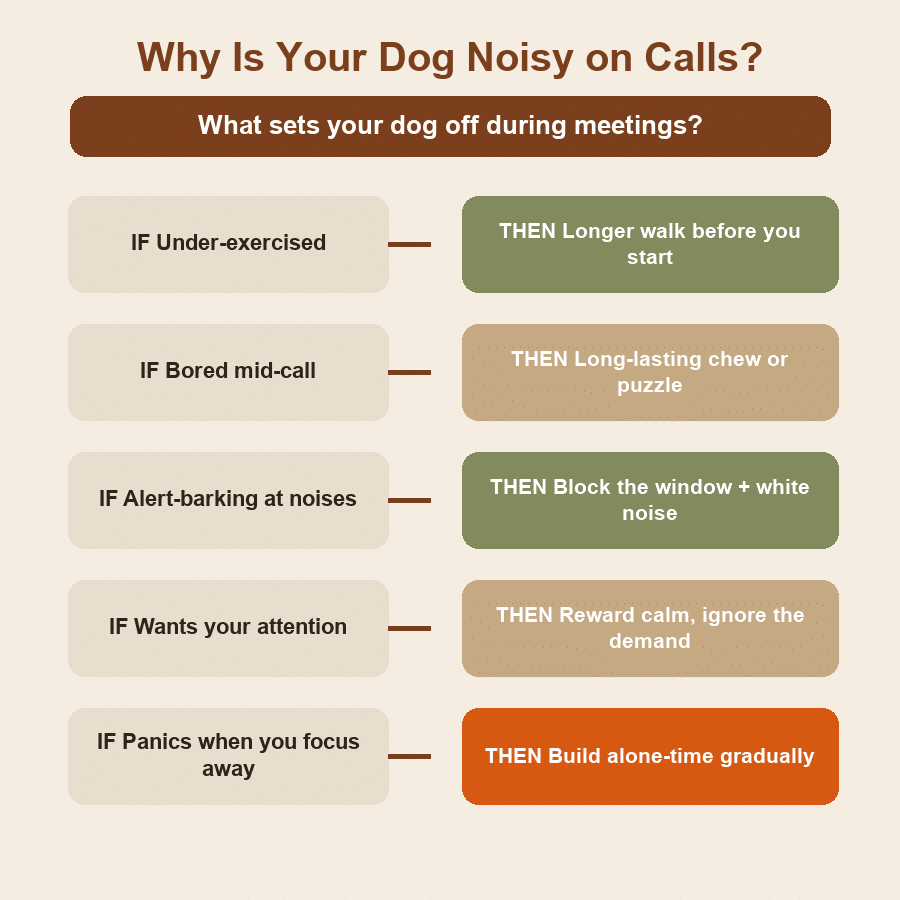
- If your dog is bouncy and vocal early in the day, then front-load exercise before your first call and save the hardest meetings for after a walk.
- If your dog goes quiet at first but starts fussing once bored, then lead with a long-lasting chew or food puzzle in the den at the start of each call.
- If your dog barks at doorbells, deliveries, or outside noise, then focus on softening triggers — white noise, closed blinds, a muted buzzer.
- If your dog follows you and won’t settle anywhere but on you, then build the den as a positive place and reward calm there until settling becomes the habit.
- If your dog truly panics the moment you stop paying attention, then stop the DIY approach and consult a CAAB, ACAAB, or Dip ACVB — that is separation anxiety, not boredom.
Do and don’t during work calls
If you remember nothing else, remember these. The left column is what builds lasting calm; the right column is what quietly makes call time harder.
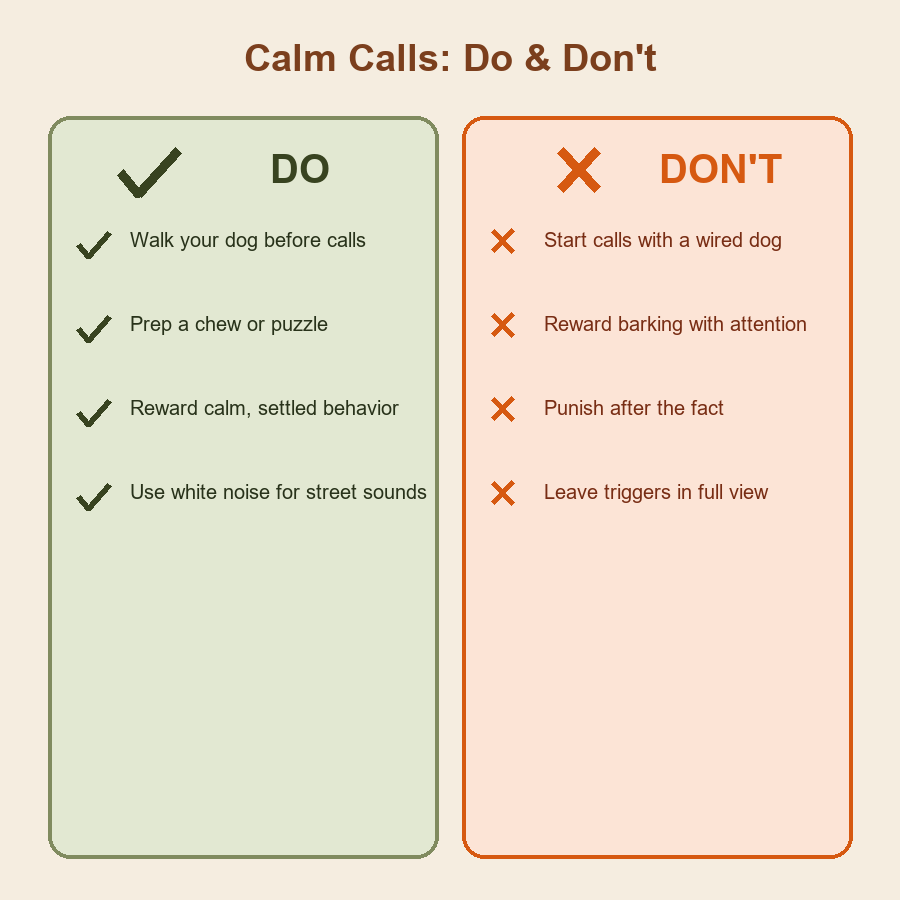
- Do exercise your dog before a call block. Don’t expect a dog who has rested all morning to lie quietly through back-to-back meetings.
- Do give a long-lasting chew or puzzle at the start of the call. Don’t wait until your dog is already barking to hand it over — that rewards the noise.
- Do reward calm settling in the den. Don’t yell, spray, or use a shock or anti-bark collar to punish barking.
- Do introduce a crate as an open, positive choice and build up slowly. Don’t latch a stressed dog in and leave the desk.
- Do get professional help if your dog panics when you’re unavailable. Don’t treat genuine separation anxiety as a training or willpower problem.
Common mistakes to avoid
- Skipping the pre-call walk. Sign: your dog is wired and vocal from the very first meeting. Fix: build in real exercise before your call block so your dog is ready to rest, not run.
- Handing over the chew too late. Sign: you only reach for the puzzle toy after the barking starts. Fix: deliver enrichment as the call begins, while your dog is still quiet, so calm is what gets rewarded.
- Punishing the barking. Sign: you’re shushing, spraying, or reaching for an anti-bark device. Fix: reward the quiet instead — punishment adds stress and usually makes the noise worse.
- Forcing the crate. Sign: your dog scratches, whines, or panics when shut in. Fix: go back to an open door and short, relaxed sessions, letting your dog choose to go in before you ever close it.
- Ignoring the triggers. Sign: your dog is calm until the doorbell or a delivery sets off a chain reaction. Fix: mask sounds, close blinds, and mute the buzzer so the set-offs never fire mid-call.
- Mistaking panic for boredom. Sign: your dog is frantic — drooling, destructive, or soiling — the instant you turn away. Fix: stop troubleshooting alone and consult a qualified behaviorist; this is separation anxiety, not a bad habit.
What most guides get wrong
Most “stop the barking” advice reaches for the wrong tools. Here’s where the usual guidance falls short.
- They treat the symptom, not the cause. Anti-bark collars, spray bottles, and stern “no” commands aim at the noise while ignoring why it’s happening. Meeting the need first — exercise, a den, and enrichment — removes the reason to bark, which no correction device does.
- They lump boredom and separation anxiety together. A bored dog looking for something to do is a very different case from a dog in real distress, and the ASPCA draws that line clearly. Enrichment fixes boredom; genuine anxiety needs a behaviorist.
- They oversell gadgets as calming cures. A cozy bed, a warm spot, or a fancy toy can make a dog more comfortable, but comfort is not treatment. No product calms a truly anxious dog on its own, and framing it that way delays the help that dog needs.
- They stop at the first quiet call. One good meeting isn’t the finish line. Calm during calls is a habit you build by rewarding it consistently, and it holds only when the routine — walk, den, chew, reward, softened triggers — runs every day, not just the loud ones.
Set up a den your dog actually wants
The routine works best when your dog has one comfortable, defined place to settle near your desk — a supportive bed or mat, a couple of rotating chews, and a spot that’s warm and out of the traffic path. When you’re planning that corner, these guides help:
- Cozy dog corner ideas — for laying out an inviting settle spot your dog chooses on its own.
- A heated dog bed vs. a heating pad — for comparing gentle warmth options in the resting spot (comfort, not a calming or medical treatment).
The best den is simply the one your dog uses. Gear supports the routine; it doesn’t replace the exercise, enrichment, and rewarded calm that do the real work.
Final recommendation
Start with the two changes that pay off fastest: walk or play with your dog right before your call block, and hand over a long-lasting chew in a comfortable den the moment the meeting begins. Add rewarded calm and softened triggers, and introduce any crate as a positive, choice-based space with the door open first. Keep the routine consistent, and most bored, restless dogs learn to sleep through your meetings. Above all, know the line: if your dog panics when you become unavailable rather than simply getting bored, that’s separation anxiety, and a qualified behaviorist should guide you.
For more setups that make working from home with a pet easier, visit our FurlyHome home-office ideas hub.
FAQ
How do I stop my dog barking during video meetings specifically?
Set your dog up before you join: a walk or play session to burn energy, then a long-lasting chew in a settle spot near your desk. Mute background triggers like the doorbell, and reward your dog for lying quietly during the natural pauses. The goal is a dog with nothing better to do than nap, not a dog you’re trying to silence mid-sentence.
How long can I expect a chew or puzzle to keep my dog busy?
It varies by dog and difficulty, but the aim is to outlast the call. If a toy is gone in a couple of minutes, make it harder — freeze the stuffing, use a tougher puzzle, or scatter kibble in a snuffle mat so foraging takes longer. Enrichment tires a dog mentally as well as physically, which is what helps them settle afterward.
Should I use a crate to keep my dog calm during calls?
A crate can be a helpful, protected settle space, but only if your dog sees it as a good place. Fear Free guidance suggests starting with the door open so your dog can come and go, then closing it for just a few seconds at a time and building up while your dog stays relaxed. Never shut a stressed dog in and walk away.
Is it okay to use an anti-bark or spray collar for work calls?
It’s better to skip them. Punishing the bark adds stress and often makes the noise worse rather than teaching your dog what to do instead. Rewarding calm behavior in a comfortable den, paired with exercise and enrichment, is more effective and keeps the whole experience positive for your dog.
How do I know if it’s boredom or separation anxiety?
A bored dog wants something to do and usually calms down once given a chew, a walk, or a settle spot; they don’t look truly anxious. A dog with separation anxiety panics when you’re unavailable — pacing, drooling, destruction, or house-soiling — and a puzzle toy won’t fix it. If that’s what you see, the ASPCA recommends consulting a CAAB, ACAAB, or Dip ACVB rather than trying to train it away yourself.
Sources
- ASPCA — Separation Anxiety — supports exercising your dog right before they are left on their own to help them relax, the distinction between boredom and true separation anxiety, and consulting a Certified Applied Animal Behaviorist (CAAB or ACAAB) or board-certified veterinary behaviorist (Dip ACVB).
- VCA Animal Hospitals — Behavior Management: Enrichment and Activity Toys — supports using foraging and food toys to decrease boredom and keep a dog occupied and settled.
- San Diego Humane Society — Training Tips: Calm Behavior at Home — supports enrichment and food puzzles to tire a dog out and promote relaxation, and that a dog is more likely to stay calm after a food-puzzle session.
- Fear Free Happy Homes — Keep Calm and Kennel On — supports the crate as a protected, choice-based safe space, keeping the door open at first and building up closed time only as the dog stays relaxed.
- American Kennel Club — Why Does My Dog Follow Me Everywhere? — supports leaving toys and treats near the dog’s bed as a place to settle and giving attention for remaining on the bed.
Last reviewed July 2026.




Write Your Review
No reviews yet. Be the first to share your experience!