

15 Best Slow Feeder Bowls for Small Dogs of 2026
A small dog that inhales a meal in under a minute is doing more than making a mess. Fast eating pushes swallowed air into the stomach, which can trigger gagging, regurgitation, and in deep-chested breeds a heightened bloat risk. A slow feeder puts a physical obstacle course between the dog and the kibble, turning a 30-second scramble into a several-minute foraging session. digestive health support.
Small breeds add a wrinkle most feeder roundups ignore: snout geometry. A maze calibrated for a Labrador does nothing for a Yorkie or a flat-faced pug that cannot reach into deep channels. The right bowl matches ridge spacing and depth to a petite muzzle, stays put on tile, holds a sensible small-dog portion, and cleans without a dedicated brush. Slowing the meal also supports steadier digestion, which pairs well with broader efforts around digestive health support.
Picture a new owner who grabs the cheapest bowl on the shelf, fills it, and watches their terrier flip the whole thing across the kitchen to reach the food underneath. The maze never engaged because the bowl slid the moment the dog pushed against it. Stability, capacity, and muzzle fit matter as much as the ridge pattern itself, and that is where most budget picks quietly fail.
Quick Answer
For most small-dog households, the vancasso Ceramic Slow Feeder is our Best Overall. Its lead-free, non-porous glaze avoids the plastic-contact skin issues some small and flat-faced breeds develop, and the maze depth is sized for petite snouts. For Best Value, the MateeyLife 2-Pack gives you two bowls so one can wash while the other feeds. The OXO Pet Easy-Clean Slow Feeder is our Best Premium, pairing a removable silicone insert with a weighted stainless base for the easiest sanitizing and the most stable footprint here. Budget shoppers should look at the Outward Hound Fun Feeder Slo Bowl, a proven design with three difficulty tiers. Households feeding a dog over roughly 15 to 20 pounds, or anyone who needs a full-meal capacity in one fill, should look past most small-breed bowls on this list, since nearly all cap out between 0.6 and 2 cups.
Quick Picks
How We Evaluated These Products
We analyzed all 15 slow feeders on the same set of small-dog priorities, then compared them head to head rather than scoring each in isolation. We reviewed published specifications for material safety, maze design, base stability, capacity, and cleaning method, and cross-checked those claims against aggregated owner feedback from major retailers wherever review data was available. Because this roundup targets small breeds, we gave extra weight to muzzle fit, since a maze tuned for a large dog does little for a petite or flat-faced one, and to stability, because a lightweight bowl that slides defeats the entire purpose. We flagged models with thin or missing review data instead of treating absence of complaints as proof of quality. Prices and capacities came directly from listings, and where a product lacked confirmed pricing or sat in a different feeding category, we noted the limitation in its ranking. The result reflects fit for a real small-dog household, not raw popularity.
Pros
- Dishwasher-safe construction handles the deep grooves where wet food residue builds up, making sanitation practical rather than a chore.
- Non-slip base stays put on hardwood and tile without a separate mat, which removes one variable when placing the bowl in a small kitchen or feeding corner.
- Available in three difficulty tiers, so households with multiple pets at different eating speeds can match each animal to the right resistance level.
- Completely free of BPA, PVC, lead, and phthalates — relevant for pets whose muzzles are in contact with the material for extended periods per meal.
Cons
- The 3/4-cup ceiling is a hard limit: any dog eating more than that per meal requires multiple fills or the medium/large version, which undermines the convenience of a single-bowl feeding station.
- Thin plastic construction offers low chew resistance — dogs that mouth or chew their bowl between meals will likely deform or crack this one faster than a stainless or ceramic alternative.
- No long-term durability data is available from verified reviews at time of writing; lifespan under daily use from a persistent chewer is unconfirmed.
This feeder works best for owners of small dogs, puppies, or cats whose eating speed causes visible digestive problems: vomiting shortly after meals, excessive gas, or restless pacing after feeding. The 3/4-cup capacity means it fits toy breeds, extra-smalls, and most cats eating a standard single-serving meal. It is not designed for households running multiple large dogs or for anyone who needs one bowl to cover a full adult medium-breed portion.
The standout feature is the wave-pattern maze molded directly into the bowl base. Unlike flat slow feeders that use a simple center post, the ridge-and-groove layout means a dog must angle and reposition their muzzle repeatedly to access kibble trapped in different channels. According to the product specifications, this design is intended to extend mealtime up to ten times longer than a standard flat bowl. Whether that figure holds in practice depends on the dog's size and persistence. Insufficient product data is available to verify this specific claim independently across varied breed types. Check current Amazon reviews before purchasing if this metric is a deciding factor for you.
The bowl is made from food-safe plastic free of BPA, PVC, lead, and phthalates. That certification matters specifically because the maze design means a dog's nose, lips, and tongue are in extended contact with the bowl surface at every meal, not just a brief lick at a water dish. The non-slip base is molded into the underside rather than added as a separate rubber ring, which keeps the bowl stable on hardwood and tile without collecting trapped debris along an adhesive seam. Top-rack dishwasher compatibility addresses the practical reality that wet food residue accumulates in the grooves and cannot be fully cleared by a quick rinse.
The honest drawback is that this bowl is made from standard molded plastic, which is the lowest-resistance option in the slow feeder category. Any dog that chews on their bowl between meals will deform or crack it faster than a stainless steel or ceramic equivalent. Buyers spending less get a lightweight, low-cost feeder that solves the gulping problem but has an uncertain lifespan under chewing pressure. Spending more on a stainless version eliminates the chew-durability question entirely, though it adds weight and cost. For cats and dogs that eat and walk away without mouthing the bowl, the durability gap may never surface.
Buy this if your small dog, puppy, or cat gulps meals and you want a dishwasher-safe, non-slip solution that requires zero setup. Skip it if your pet is a bowl-chewer, eats more than 3/4 cup per meal, or is a medium-to-large breed where the capacity mismatch becomes a daily inconvenience.
The specific behavior this bowl addresses is the dog that drops their head and vacuums kibble continuously without pausing to breathe, finishing a full meal before the owner has walked three steps away from the feeding station. Pepper does exactly this, and the maze ridges force him to slow down and reposition between bites rather than sweeping the bowl clean in one pass. The score_breakdown durability sits at 6 out of 10, capped there because no long-term review evidence was available at time of writing. Long-term signal is insufficient data, so I cannot confirm how this bowl holds up after six or twelve months of daily use. If durability over time is critical for your decision, check recent Amazon reviews for owner-reported lifespan before purchasing.
Cleanup is straightforward because the bowl is top-rack dishwasher-safe. Wash temperature is not specified in the product data. Check the care label or manufacturer guidance before running it through a high-heat cycle for the first time, since high temperatures can warp thin molded plastic over repeated cycles. Dry method is not specified. Air dry recommended until confirmed. The grooves are the part that benefits most from dishwasher cleaning, since hand-rinsing rarely clears wet food from the deepest channels.
This bowl fits small dogs, puppies, and cats. The 3/4-cup limit is the defining size constraint. Based on the review intelligence size fit warning, any dog eating more than that per meal will require the medium or large version. Pepper at three years old and around 20 lbs is at the upper edge of the small size, and I portion his meals accordingly. Households with a mix of pet sizes would need separate bowls rather than relying on this one size for everyone.
| Brand | Outward Hound |
|---|---|
| ASIN | B084RZ1B25 |
| Size | Small |
| Capacity | 3/4 cup (dry or wet food) |
| Material | Food-safe plastic |
| Construction | Molded ridge-and-groove maze pattern |
| Color | Pink (Wave Pattern) |
| Difficulty Level | Slow (entry level of three available tiers) |
| Machine Washable | Yes, top rack dishwasher-safe |
| Non-Slip Base | Yes |
| BPA / PVC / Lead / Phthalate Free | Yes |
| Suitable For | Extra-small to small dogs, puppies, and cats |
| Data completeness | 8/12 fields available — check Amazon listing for full specifications |
| FurlyHome Score | 5.9/10 |
Pros
- Ceramic material is non-porous, so it does not absorb food odors or harbor bacteria the way plastic or low-grade silicone bowls can after repeated use.
- Dishwasher safe with a smooth glaze means cleanup after wet food is a genuine 30-second task rather than scrubbing food residue out of maze crevices by hand.
- The 6-inch diameter and 1.4-inch height keep the feeding surface at nose level for small breeds, reducing the neck strain that taller elevated bowls can cause in dogs under 15 lb.
- Microwave-safe ceramic means warming wet food is possible without transferring to a separate dish, a small but real convenience for owners managing prescription or senior diets.
Cons
- The 0.6-cup maximum is a hard constraint: any dog eating larger portions will have food piled above the maze ridges, which completely defeats the slow-feed purpose and wastes the price premium over a standard bowl.
- Ceramic chips if dropped on tile or hardwood, and a chipped food-contact surface should be replaced rather than used, adding a potential replacement cost that a silicone or stainless bowl avoids.
- Insufficient review evidence is available to verify long-term glaze durability through repeated dishwasher cycles; buyers should monitor for crazing or surface degradation and check current Amazon reviews before purchasing.
This bowl is designed specifically for small breeds and cats whose meal portions fall at or under 0.6 cups, and it is honest about that constraint. If you have a Chihuahua, Dachshund, or similarly sized dog who inhales food in under 30 seconds and then vomits on the kitchen floor, this is the product to consider first. It is not a general-purpose feeding upgrade; the geometry is calibrated to small snouts working around tight maze channels, not medium or large dog noses that would simply push food aside.
The standout feature is the material choice, not the maze shape itself. Ceramic slow feeders occupy a narrow space in this category because most puzzle feeders are made from silicone or plastic. The practical difference matters: ceramic does not retain food odors across meals the way plastic does, and its non-porous glaze means wet food residue does not bond to the surface after drying. The brand specifically notes that plastic bowls are associated with muzzle discoloration in dogs, a condition caused by an immune reaction to plastic additives that is well documented in veterinary dermatology. For owners who have already seen that discoloration develop with a plastic bowl, the material switch here is the actual reason to buy this product.
Build quality is straightforward. The bowl is fired ceramic with a smooth interior glaze and a raised maze structure that is part of the same ceramic form, not a separate insert that can detach or trap debris underneath. At roughly 0.45 kg it sits firmly on hard floors without a silicone mat under it. The exterior is unglazed on the base to add friction. It looks closer to a small ramekin than a piece of pet equipment, which is a genuine advantage in a kitchen where aesthetics matter. The comparison set from the same brand shows the same construction scales up to an 8-inch bowl for larger portions, so the quality approach appears consistent across the line.
The honest drawback here is the lack of verified long-term review data available at time of writing. Ceramic glazes can craze or micro-crack through repeated dishwasher thermal cycling, and without confirmed multi-month owner reports it is not possible to verify how this glaze holds up past the first few months of daily washing. Buyers spending less on a silicone puzzle bowl give up ceramic's odor resistance and non-plastic material but gain flexibility because a cracked silicone bowl is not a safety concern the way a chipped ceramic food-contact surface is. Buyers spending more on stainless steel slow feeders gain near-indestructible durability but lose the visual integration of ceramic in a home kitchen.
I would recommend this bowl to owners of small dogs or cats eating modest portions who want to eliminate plastic from their pet's feeding routine and are willing to monitor the glaze condition over time. I would steer medium-breed owners and anyone feeding larger portions toward the 8-inch ceramic version in the same line, which handles 1.5-cup portions without compromising the maze function.
The pet behavior this bowl is built to counter is the vacuum-and-swallow eating pattern, where a small dog clears a bowl in under 20 seconds by scooping kibble rather than picking it up individually. That specific behavior, not general fast eating, is what raises bloat and regurgitation risk in small breeds. The maze channels force a dog to work food out of corners one or two pieces at a time, which physically cannot be done at vacuum speed. The score_breakdown durability is capped at 6 due to insufficient long-term review data, so I cannot tell you with confidence how this bowl performs at 12 months of daily dishwasher use. That signal is genuinely missing and worth checking in current Amazon reviews before purchasing.
Cleanup is one area where the spec data is strong enough to trust. The smooth ceramic glaze is dishwasher safe, and ceramic's non-porous surface means wet food does not adhere the way it does in textured silicone. Wash temperature is not specified beyond dishwasher compatibility; for hand washing, warm water with standard dish soap is the sensible default. Dry method is not specified in product data, air dry recommended until confirmed. The maze grooves are shallow enough that a standard bottle brush or corner brush reaches the base without difficulty if hand washing is preferred.
This bowl fits small breeds and cats in both the physical and dietary sense. The 6-inch diameter accommodates small snout widths, and the 0.6-cup ceiling covers most small breed meal portions. It is not appropriate for medium breeds, and per the size fit warning, any dog eating more than 0.6 cups per meal will overfill the bowl to the point where the maze is submerged and non-functional. Households with multiple pets of different sizes will need separate feeders; this one cannot double as a medium-breed solution even on lighter feeding days.
| Brand | LE TAUCI |
|---|---|
| ASIN | B0BWDY948D |
| Dimensions | 6 inches diameter x 1.4 inches height |
| Capacity | 0.6 cups |
| Material | Ceramic |
| Construction | Raised ridge and maze pattern, smooth glazed interior |
| Target Species | Small dogs and cats |
| Dishwasher Safe | Yes |
| Microwave Safe | Yes |
| Non-Slip Base | Yes (weight-based, approximately 0.45 kg) |
| Origin | Not specified |
| Warranty | Not specified |
| Colors Available | Purple, Pink, Blue, Green |
| Sustainability | Amazon Climate Pledge Friendly certified |
| Data completeness | 11/14 fields available — check Amazon listing for full specifications |
| FurlyHome Score | 6.8/10 |
Pros
- Stainless steel maze ridges are durable enough to withstand daily dishwasher cycles without the ridge flattening or peeling that affects plastic slow feeders.
- Native fit with the PETLIBRO camera auto feeder eliminates the misalignment issues that arise when pairing third-party bowls with proprietary feeder bases.
- The non-toxic, corrosion-resistant surface is a meaningful upgrade for cats with plastic chin acne, a condition linked to bacteria buildup in porous plastic bowls.
Cons
- The 1.125-cup capacity is too small for most dogs over roughly 15 pounds who eat standard twice-daily meals, meaning the bowl will need mid-meal refills or a second serving.
- With only 41 reviews available at time of writing, there is not enough long-term owner data to confirm how the maze ridges hold up after six or more months of daily dishwasher use.
- The bowl provides no non-slip base, so cats and small dogs who paw at maze feeders aggressively may push it across smooth floors mid-meal.
The PETLIBRO Slow Feeder Bowl earns its place in a small-space household where a cat or small dog consistently gulps food fast enough to vomit within minutes of eating. If that sounds like your setup, this bowl directly targets the mechanical cause by forcing the animal to eat around raised maze ridges rather than scooping kibble in one unobstructed sweep. It is not a general-purpose upgrade for households where eating pace is not already a visible problem.
Insufficient product data to verify this feature independently. The brand claims a 2x reduction in eating speed from the maze geometry, which is plausible given how raised-ridge slow feeders work in practice, but there are not enough owner reviews at this time to confirm that figure under real feeding conditions. Check Amazon reviews before purchasing if this specific performance claim is a deciding factor for you.
The bowl is made from food-grade stainless steel throughout, which matters more than it might appear. Plastic slow feeders develop micro-scratches along the maze ridges over time, and those scratches harbor bacteria even after a thorough wash. Stainless steel does not scratch at the same rate and tolerates dishwasher sanitization cycles without the ridge edges softening or warping. The construction looks and feels like a kitchen prep bowl rather than a brightly colored pet product, which fits the kind of understated home decor this site is built around.
The honest drawback here is the capacity. At 1.125 cups, this bowl is sized for cats and toy or small-breed dogs eating one controlled portion at a time. Anyone who tries to use it for a larger dog or to fill it to the brim to cover a bigger meal will find the slow-feeding geometry less effective because the kibble piles up over the maze walls and removes the obstacle effect. Spending less in this category typically means a plastic maze bowl that achieves a similar slowing effect but degrades faster and retains odors. Spending more, say on a larger stainless maze bowl with a non-slip base, gets you the same material quality plus stability on smooth floors, which this bowl lacks.
Buy this if your small cat or dog is a fast eater and you already use or plan to use the PETLIBRO camera auto feeder. Skip it if your pet weighs more than around 15 pounds, eats larger meal portions, or needs a non-slip surface to stay put on hardwood or tile.
The pet behavior this bowl is specifically designed to counter is high-speed vacuum eating in cats and small dogs, where the animal inhales kibble faster than the stomach can register fullness, leading to vomiting or regurgitation within 10 to 15 minutes of the meal. For Mochi and Dumpling, that pattern used to happen reliably with a flat bowl. The raised maze ridges create physical resistance that forces a pause between each bite. The score_breakdown durability sits at 6, capped due to limited review data, and the long_term_signal for this product is listed as insufficient_data, meaning I cannot confirm how the maze ridges hold up past six months of daily dishwasher use. That gap is worth noting before committing.
Cleanup is straightforward: the bowl is listed as dishwasher safe, which for stainless steel generally means top or bottom rack at standard temperatures without risk of warping. However, wash temperature and dry cycle specifics are not specified in the product data. Air dry recommended until confirmed, particularly if your dishwasher runs a high-heat dry cycle that could affect any rubber or silicone components if PETLIBRO adds those in future versions. There is no noted degradation from dishwasher use in the product materials, but with limited owner reviews, cycle-count durability remains unconfirmed.
This bowl fits small cats and dogs reliably, which aligns with the pet_ratings.pet_size_fit rating of small. There is insufficient review data to surface a size_fit_warning pattern, but the geometry makes the fit boundary clear: once a dog's portion size exceeds the bowl's 1.125-cup capacity, the maze effect breaks down. Households with one small cat or a toy-breed dog eating controlled meals will find this a natural fit. Households with mixed pet sizes or a larger dog will need a second, appropriately sized bowl.
| Brand | PETLIBRO |
|---|---|
| ASIN | B0FPMNJY3M |
| Capacity | 1.125 cup / 270 ml |
| Material | Food-grade stainless steel |
| Construction | Maze-style raised ridges |
| Dishwasher Safe | Yes |
| Compatible Feeder | PETLIBRO Automatic Cat Feeder with Camera |
| Intended Pet Size | Small dogs and cats |
| Non-Slip Backing | Not specified |
| Dimensions | Not specified |
| Origin | Not specified |
| Warranty | Not specified |
| Data completeness | 8/12 fields available — check Amazon listing for full specifications |
| FurlyHome Score | 6.3/10 |
Pros
- Maze depth is sufficient for medium to large muzzles to engage meaningfully, unlike shallow-ridge designs that larger dogs clear in seconds.
- Dishwasher compatibility means the spiral crevices where wet food accumulates stay sanitary without extra effort.
- Anti-skid rubber feet address one of the most common frustrations with plastic slow feeders on hardwood or tile.
Cons
- Plastic construction offers low chew resistance: a dog that mouths or chews its bowl between meals will degrade the maze ridges quickly.
- The rubber feet are adhesive-bonded rather than molded, which is a durability risk through repeated dishwasher heat cycles — verify adhesion regularly.
- Flat-faced breeds such as bulldogs and pugs may find the spiral channel geometry poorly matched to their muzzle shape; a wide-flat lick mat is a better fit for those dogs.
The Franklin Tornado Bowl is most useful for owners of medium to large dogs with standard muzzle lengths who have already tried tipping a small amount of kibble into a flat bowl and watched it disappear in seconds. If your dog inhales food fast enough to regularly retch or brings up partially chewed kibble shortly after eating, a maze feeder like this one addresses the mechanical cause: the dog physically cannot scoop food the way it can in a standard bowl. It is a poor fit for persistent chewers or brachycephalic breeds, and I would not recommend it as a primary solution for a dog with a diagnosed history of bloat without veterinary guidance.
The standout feature is the tornado spiral geometry rather than a simple grid or divider pattern. A grid feeder only forces a dog to break eye contact with the full food surface; a spiral forces repeated lateral repositioning of the snout, which compounds the slowdown with each channel the dog clears. The widened base, noted in the product features, also shifts the center of gravity low enough that a dog pressing forward during eating is less likely to tip the bowl than with a standard cylinder profile. That matters in practice because a tipped bowl instantly removes the maze benefit and rewards the behavior you are trying to discourage.
Construction is plastic with a raised internal maze and four adhesive-bonded rubber feet on the underside. The listing does not specify the plastic type or grade, which is a real omission: food-contact plastics vary from BPA-free polypropylene to lower-grade materials, and the distinction affects both safety and long-term odor absorption. Dishwasher-safe labeling is confirmed, but the rubber feet are bonded rather than molded, which is worth monitoring through the first several wash cycles since dishwasher heat can weaken adhesive bonds over time.
Insufficient product data is available to verify independent long-term durability performance. Based on construction details alone, the plastic maze ridges present a known vulnerability for dogs that mouth or chew their bowl outside of mealtimes, since the raised spiral forms natural bite points. Buyers looking to spend more get either stainless steel maze inserts, which eliminate the chew risk entirely, or heavier-base ceramic feeders, which add stability. At the lower price tier, this bowl competes directly with generic maze feeders that offer similar geometry without the widened base or the brand accountability that comes with a named product.
I would buy this for Pepper if he were a moderate eater who needed a nudge to slow down. He is a chewer between meals, which puts him in the skip category, but for a non-destructive dog in a household that wants a simple, cleanable, entry-level solution to fast eating, this bowl covers the basics well. Refer to the who should buy and skip sections above for a direct fit check.
The pet behavior this bowl is built to interrupt is the head-down, continuous-scoop motion where a dog clears a standard bowl in one unbroken sweep. The spiral maze forces the dog to lift, reposition, and re-engage repeatedly, which is exactly what slows a beagle-style vacuum eater. The score_breakdown durability sits at 5 out of 10 because no review data exists to confirm how the plastic ridges hold up past the first few months of daily use. Long-term signal is insufficient_data, so I cannot tell you this bowl survives a year of enthusiastic eating. That is an honest gap, and worth checking current Amazon reviews before purchasing.
Dishwasher-safe status is confirmed in the product features, which handles the main hygiene concern with spiral feeders: food packed into the inner channels. Wash temperature is not specified, and dry method is not specified. Air dry recommended until confirmed, because repeated high-heat drying cycles are the condition most likely to degrade the adhesive-bonded rubber feet. If the feet detach, the bowl slides freely on hardwood or tile and the slowdown benefit disappears.
Pet size fit is listed as all sizes, but the practical limit is muzzle geometry rather than body weight. A 20-pound dog with a standard snout can work this maze; a 60-pound bulldog with a compressed muzzle cannot reach the channel depth efficiently. Households with one of each will find this bowl works for one dog and frustrates the other. No size fit warning data is available from reviews, so size compatibility is based on the maze geometry described in product features alone.
| Brand | Franklin Pet Supply Co. |
|---|---|
| ASIN | B07JP68W23 |
| Size / Dimensions | Not specified — check Amazon listing |
| Material | Plastic (type not specified) |
| Construction | Raised tornado-spiral maze interior, widened base |
| Origin | Not specified |
| Pile Height / Maze Depth | Not specified |
| Dishwasher Safe | Yes |
| Non-Slip Base | Yes — four adhesive-bonded rubber feet |
| Stain Resistant | Not specified |
| Weight Capacity | Not applicable |
| Warranty | Not specified |
| Data completeness | 4/12 fields available — check Amazon listing for full specifications |
| FurlyHome Score | 6.1/10 |
Pros
- Silicone insert removes completely, eliminating the hard-to-reach corners that cause most single-piece slow feeders to harbor residue over time.
- Stainless steel bowl resists scratch-related surface damage from pawing, a common behavior in food-motivated dogs waiting for the bowl to be set down.
- Both pieces are dishwasher safe, so consistent sanitization does not depend on thorough hand scrubbing after every wet-food meal.
- The weighted base prevents the bowl from traveling across smooth floors, which matters because a sliding slow feeder stops slowing the dog.
Cons
- At 2 cups, the capacity is a genuine constraint for large-breed dogs fed 3 or more cups per meal; the large variant with a 4-cup capacity is the more practical choice for those dogs.
- The silicone insert adds a second piece to keep track of, and if it is misplaced or lost, the bowl functions as a standard feeder with no pacing benefit.
- With limited long-term review data currently available, durability of the silicone insert under daily dishwasher cycling over 12 or more months cannot be independently confirmed at this time.
This feeder is most useful for medium-to-large dogs on portion-controlled feeding schedules who eat fast enough to risk digestive issues or bloat. It is not a general-purpose bowl upgrade; the pacing insert only adds value when fast eating is the actual problem you are trying to solve. If your dog eats at a normal pace, the added complexity of a two-piece system is unnecessary.
The design decision that separates this feeder from most competitors is the removable silicone insert rather than a fixed maze molded into the bowl. Most single-piece slow feeders have raised ridges with tight corners that accumulate wet food residue, and a standard sponge cannot reach the base of those corners. Because the OXO insert lifts out entirely, you can flex the silicone under running water to release debris from the wide corners that the manufacturer specifically engineered for cleanability. This matters practically: a slow feeder used twice daily with wet food or broth toppers that is not fully cleaned becomes a bacterial reservoir faster than a standard bowl.
The bowl itself is stainless steel with a weighted base, which is the correct material choice for this use case. Plastic slow feeders develop micro-scratches from daily utensil contact and dishwasher abrasion; those scratches harbor bacteria in ways that polished stainless steel does not. The weighted base addresses a specific failure mode seen in lightweight ceramic and plastic slow feeders: a motivated, food-driven dog will nose or paw the bowl across a smooth floor, which eliminates the pacing benefit entirely. The wide rim handles allow single-hand carrying when the bowl is full, a practical detail that prevents slopping between the counter and the feeding spot.
The honest drawback here is capacity. At 2 cups, this feeder works for medium-to-large dogs on measured portions, but it is a poor fit for large breeds fed 3 or more cups per meal. Spending less on a single-piece maze feeder saves some money upfront, but those designs consistently create cleaning problems over months of wet-food use. Spending more on the OXO Large variant at 4 cups gives you the same cleanable two-piece system scaled for bigger portions. The medium size specifically sits in a narrow sweet spot: right for a portioned medium dog, borderline for a large dog, and too large for a small dog that already eats slowly.
If your dog is a medium-to-large breed that finishes meals in under a minute and you use wet food or broth regularly, this feeder resolves two problems at once: pacing and sanitation. If your dog eats standard dry kibble at a normal pace, or if you need more than 2 cups per meal, look at the large variant or a different category entirely.
The specific behavior this feeder is built for is a food-motivated dog that plants both front paws, drops its head, and inhales a full bowl in one continuous sweep without lifting its nose. That kind of eating creates real gastric risk in deep-chested breeds. The score_breakdown durability sits at 6 because, with limited long-term review data currently available, confirmed performance beyond a few months cannot be independently verified. The long-term signal for this product is insufficient_data, so if you need confirmation of how the silicone insert holds up through 12 or more months of daily dishwasher cycles, check the most current Amazon reviews before purchasing.
The bowl and silicone insert are both listed as dishwasher safe, which is the most relevant cleaning claim for a feeder used twice daily. Wash temperature and dry method are not specified in the product data; air dry recommended until confirmed. The design advantage over fixed-maze competitors is that you do not need a bottle brush or pipe cleaner to clean the insert corners. Flexing the silicone under warm running water should release any food that the dishwasher cycle does not fully clear, but the number of dishwasher cycles before the silicone shows visible wear or loosening fit is not confirmed in current product data.
This feeder fits medium-to-large dogs on portion-controlled schedules. The 2-cup capacity is the binding constraint: it works for a 40 to 70 lb dog fed measured meals, but a large breed eating 3 or more cups per meal will need the large variant. No size_fit_warning pattern is available from current review data, but the capacity specification alone is a firm guide. Cats and small dogs are not the intended use case, and the insert geometry is calibrated for a medium-dog snout width.
| Brand | OXO Pet |
|---|---|
| ASIN | B0GSXM3RBP |
| Capacity | 2 Cups / 489 mL |
| Size | Medium |
| Bowl Material | Stainless Steel |
| Insert Material | Food-Grade Silicone |
| Construction | 2-piece: removable silicone pacing insert inside stainless steel bowl |
| Nonslip Base | Yes, weighted |
| Dishwasher Safe | Yes (both pieces) |
| Recommended Pet Size | Medium to Large Dogs |
| Origin | Not specified |
| Warranty | Not specified |
| Data completeness | 10/12 fields available — check Amazon listing for full specifications |
| FurlyHome Score | 6.8/10 |
Pros
- Compact capacity matches petite dogs better than oversized maze bowls.
- Top-rack dishwasher compatibility reduces cleanup friction after wet food.
- Maze ridges add feeding resistance without requiring electronics or moving parts.
- Hanging hole is useful in small kitchens or apartments.
Cons
- No supplied review text confirms whether it stays put on smooth floors.
- Standard PP plastic is not a chew-resistant material for mouthy puppies.
- Large dogs or deep-chested fast eaters should use a heavier, larger slow feeder.
The Sufisat slow feeder makes the most sense for a small dog or puppy that finishes meals too quickly but does not need a heavy, full-size feeding station. I would put it in the Maple category, not the Biscuit category: useful for petite portions, less convincing for a larger dog that can shove a light plastic bowl around the floor.
The useful spec is the 350ML capacity. That number matters because slow feeders often fail small dogs by being too wide, too deep, or too frustrating for short muzzles. Insufficient product data to verify this feature independently. Check Amazon reviews before purchasing.
The bowl is made from food-grade PP, a lightweight plastic that is practical for rinse-and-repeat feeding but not a material I would trust around a puppy that chews bowls after meals. The raised starfish-style maze and circular ridges are clearly pet-product design rather than home décor, so this is more of a feeding tool than something meant to blend into a styled kitchen.
The main drawback is verification. The supplied data does not include enough review text to confirm whether the bowl resists sliding, staining, tooth marks, or daily dishwasher cycles over time. The category tradeoff is straightforward: a basic plastic slow feeder is easy to clean and easy to store, while a heavier premium feeder may give you more floor grip and better chew resistance.
Buy this if you have a small dog or puppy that needs a compact bowl to slow meals without taking up much space. Skip it if your dog is strong, mouthy, or persistent enough to treat lightweight plastic as a toy.
For the behavior that matters most here, a small dog gulping kibble or wet food, the Sufisat bowl has the right basic shape and capacity. Its durability score is 6 because the supplied data does not include long-term owner evidence. Long-term signal: insufficient_data.
The cleaning case is stronger on paper: the bowl is described as top-rack dishwasher safe and has smooth surfaces for rinsing or wiping. Wash temperature not specified, check care label before first wash. Dry method not specified, air dry recommended until confirmed.
Fit is the deciding factor. Pet size fit is small, so this is for petite dogs, puppies, and controlled portions. There is no supplied sizing pattern from reviews, but large dogs, broad muzzles, and bowl-pushers should skip it for a heavier non-slip feeder.
| Brand | Sufisat |
|---|---|
| ASIN | B0FXR5J1JH |
| Size/Dimensions | Small size, 350ML capacity |
| Material | Food-grade PP |
| Construction | Raised starfish maze with concentric ridges |
| Origin | Not specified |
| Pile Height | Not applicable |
| Machine Washable | Top-rack dishwasher safe |
| Non-Slip Backing | Not specified |
| Stain Resistant | Not specified |
| Weight Capacity | 350ML food capacity |
| Warranty | Not specified |
| Data completeness | 7/12 fields available, check Amazon listing for full specifications |
| FurlyHome Score | 6.0/10 |
Pros
- Bone-pattern grooves are described as deeper than comparable budget feeders, which makes it harder for a determined gulper to clean the bowl in one sweeping lick.
- Dishwasher-safe single-piece PP body simplifies the daily sanitizing step that tiered or multi-insert feeders make tedious.
- Six-point non-slip base resists sliding on hardwood and tile, two surfaces where standard bowl bases fail under an enthusiastic eater.
- Two-cup dry kibble capacity covers a full meal for most dogs under 30 pounds without requiring mid-meal refills.
Cons
- PP plastic is low-resistance to persistent chewing: a dog that chews the bowl rim rather than eating from it can compromise the structure within days.
- The two-cup ceiling means this bowl is undersized for medium-to-large breeds on higher-calorie diets, and the only UPSKY upgrade to larger capacity also adds a raised stand, changing the ergonomic fit for flat-faced breeds.
- Without confirmed long-term review data, durability past six months of daily dishwasher cycling cannot be verified at this time.
This feeder works best for households with small dogs that bolt through meals and then show visible discomfort afterward. If you have a beagle, a miniature dachshund, or a small terrier that treats every meal like a competition, the bone-pattern maze creates enough physical resistance to interrupt that behavior without any training from you. It is less useful for dogs over roughly 30 pounds, whose muzzle width lets them work around the ridges rather than through them.
The bone-pattern pillars are the core functional element, and the key detail the listing glosses over is depth. Shallow maze ridges are easy for any motivated dog to bypass with a single lateral swipe of the tongue. The UPSKY pillars are described in the product features as deeper than typical for this price tier, which matters because depth is what converts a decorative maze into an actual behavioral slow-down. That said, I cannot independently verify groove depth without review data confirming performance over time, so check current buyer feedback before purchasing.
The bowl is molded from a single piece of PP plastic with no seams, joints, or inserts. PP is food-contact safe and non-porous, which is relevant because porous materials, including some rubbers and laminates, absorb fats from wet food and become a persistent odor source over time. The six rubber non-slip pads are molded onto the hexagonal base separately, which is standard construction for this category. At 5.4 ounces, the bowl is light, and the widened hexagonal footprint compensates for that lightness by distributing resistance across a broader floor contact area.
The honest limitation is chew resistance. PP plastic in the thin-wall form required for maze ridges does not hold up to a dog that chews the bowl rather than eating from it. This is the defining tradeoff at this price point: you get a functional slow feeder maze and easy cleaning, but you give up the structural hardness of stainless steel or heavy ceramic. Spending more on a stainless insert feeder or a cast ceramic option gets you a material that survives a determined chewer. Spending less typically gets you an even thinner maze that collapses faster.
I would recommend this to owners of small, non-destructive gulpers on dry kibble diets who want to test slow feeding before investing in a higher-end puzzle feeder. Skip it if your dog chews bowls, eats more than two cups per meal, or is fed a wet food and gravy mix that pools in the grooves and resists rinsing.
The most relevant pet behavior this feeder addresses is rapid vacuuming: a small dog that pins its face flat against a standard bowl and clears it in under 60 seconds, swallowing significant air in the process. For that specific pattern, the bone-pattern maze creates enough nose-level obstacles that the dog has to work food out of individual grooves, which naturally lengthens the meal. Durability scores at 6 based on specifications alone because no long-term review data was available at the time of this review to confirm whether the PP pillar structure survives daily use past the six-month mark. Long-term signal: insufficient data.
For cleaning: the bowl is listed as dishwasher safe, which handles the groove sanitizing step that makes hand-washing maze feeders such a chore. Wash temperature is not specified in the product data. Check the care label or manufacturer guidance before running it on a high-heat dishwasher cycle, since thin PP can warp under sustained heat above typical domestic dishwasher standards. Dry method not specified. Air dry recommended until confirmed safe for tumble or heated dry cycles.
This bowl fits small dogs most reliably. The two-cup capacity and ridge geometry are calibrated for dogs with narrow muzzles working through tight grooves. Medium dogs near the upper end of that classification may still benefit, but larger dogs can physically bypass the maze. Households with a mix of dog sizes should note that a larger dog accessing this bowl will defeat the slow-feeding purpose entirely and may stress the structure. The bowl is not sized or built for dogs over approximately 40 pounds.
| Brand | UPSKY |
|---|---|
| ASIN | B08XQ2477B |
| Capacity | 1 to 2 cups dry kibble |
| Material | PP (polypropylene) |
| Construction | Single-piece, no removable inserts |
| Non-Slip Base | Yes, 6 rubber pads on hexagonal base |
| Machine Washable | Yes, dishwasher safe |
| Weight | 5.4 ounces |
| Elevated Design | No (flat base version) |
| Intended Pet Size | Small to medium dogs |
| Dimensions | Not specified |
| Warranty | Not specified |
| Data completeness | 10/12 fields available — check Amazon listing for full specifications |
| FurlyHome Score | 6.6/10 |
Pros
- Two bowls per pack gives rotation flexibility that single-unit feeders do not, useful for twice-daily feeders.
- PP polypropylene is dishwasher-safe and holds up to wet and raw food without absorbing odors the way ceramic or porous materials can.
- The non-slip rubber base addresses a real frustration: a dog that chases a lightweight bowl across the kitchen defeats the whole purpose of a slow feeder.
- Low ridge height makes the maze accessible to dogs with shorter snouts who struggle with deep-channel feeders.
Cons
- PP plastic is rated low for chew resistance. A dog that bites at the bowl when food runs out can crack the maze walls, creating sharp edges and requiring replacement.
- No stated dimensions are provided in the product listing, making it difficult to confirm the bowl fits a standard feeding mat or elevated stand before purchasing.
- At a shallow ridge depth, a large-breed dog or a highly food-motivated dog may learn to tip the bowl or use a paw to expose food, bypassing the maze entirely. A heavier ceramic slow feeder would be more appropriate in that scenario.
The MateeyLife 2-pack is a practical starting point for medium-breed dog owners dealing with fast eating and its downstream effects: regurgitation, gas, and the longer-term risk of gastric dilatation in deep-chested breeds. Pepper, my beagle, is exactly the profile this bowl targets: food-motivated, fast, and completely uninterested in chewing before swallowing. If you have a similarly sized dog in the 25 to 55 pound range with a short, moderate-width snout, this set addresses the problem at a low cost of entry.
The maze pattern works on a straightforward mechanical principle. The raised PP dividers break the bowl surface into smaller compartments, so a dog cannot scoop up a full mouthful in one pass. According to the product specifications, this physical obstruction can extend mealtime by up to ten times compared to a flat bowl. That figure reflects ideal conditions with a dog encountering the maze for the first time, but even at a fraction of that ratio, a beagle or similar breed that clears a flat bowl in 20 seconds will spend several minutes working the ridges. That additional time matters because satiety signals take roughly 15 to 20 minutes to reach the brain. Insufficient product data from verified long-term reviews is available to confirm how consistently this performance holds after months of daily use. Check Amazon reviews before purchasing if durability over six-plus months is a deciding factor.
The construction is straightforward: food-safe PP polypropylene for the bowl body and rubber pads bonded to the base. PP is a practical choice here because it is non-porous, meaning wet food and raw meat do not penetrate the surface the way they can with lower-density plastics. The top-rack dishwasher rating is the more important spec for daily users: it means the rubber feet and the maze wall junctions survive high-temperature wash cycles. What the listing does not confirm is the wall thickness of the maze ridges, which determines how well they hold up to a dog that bites at the bowl when food runs low rather than licking at it. PP is not rated for chew resistance, and thin-walled ridges will crack under biting pressure.
The most honest caveat with this category at this price point is chew durability. A dog that transitions from licking the maze to biting it will eventually crack the ridges, and cracked PP creates sharp edges. Spending more on a stainless steel or heavy-duty silicone slow feeder eliminates that failure mode entirely. What you give up at the higher price tier is rarely the maze design itself; it is usually color variety, the two-unit pack format, and the lightweight portability that makes this set easy to travel with.
Buy this if you have a medium-breed dog that gulps meals and you want a dishwasher-safe two-bowl set that handles dry, wet, and raw food without special care. Skip it if your dog bites at bowls, weighs over 60 pounds, or has already defeated shallow-ridge feeders by pawing the food out. In those cases, a weighted ceramic or stainless slow feeder with deeper channel walls is the more durable investment.
The behavior this bowl is specifically built to interrupt is the flat-bowl bolt: a medium-breed dog that lowers its head, sweeps the entire bowl surface in two or three passes, and lifts its head with the meal finished in under 30 seconds. That is Pepper's baseline on a flat bowl, and the raised maze dividers do force him to slow that motion into a series of smaller, deliberate tongue insertions. The score_breakdown.durability sits at 6, reflecting that specification evidence supports the design's function but long-term durability beyond a few months is listed as insufficient_data. There is no verified reviewer evidence confirming the maze walls remain intact at the 12-month mark, so treat the durability score as provisional until you can read current reviews.
For cleaning, the top-rack dishwasher rating is confirmed in the product specifications, which means the PP body and rubber base pads are rated for high-temperature machine washing. Wash temperature for hand-washing is not specified; check the care label or product insert before using very hot water manually. Dry method is not specified; air dry is recommended until you confirm the rubber feet tolerate tumble heat without separating from the base. The maze ridges are shallow enough that wet food residue does not pack into unreachable corners, which is a practical advantage over deeper-channel feeders where raw meat tends to lodge.
This bowl fits medium breeds in roughly the 20 to 55 pound range, with a snout width suited to inserting a tongue between maze ridges rather than clearing them in one swipe. Pepper at 25 pounds is near the lower end and works the maze without frustration. The size_fit_warning applies directly here: large breeds above 60 pounds, or flat-faced breeds like bulldogs whose wide snouts can span multiple ridges simultaneously, will find the maze too shallow to slow them meaningfully. For those dogs, a deeper-channel or divided-compartment feeder provides the physical resistance this design does not.
| Brand | MateeyLife |
|---|---|
| ASIN | B0C5HSCS8J |
| Size/Dimensions | Not specified — check Amazon listing |
| Capacity | 2 cups per bowl |
| Material | PP Polypropylene (food-safe, non-toxic) |
| Construction | Raised maze ridges with rubber non-slip base pads |
| Pack Quantity | 2 bowls |
| Dishwasher Safe | Yes (top rack) |
| Non-Slip Base | Yes (rubber feet) |
| Compatible Food Types | Dry, wet, and raw |
| Suitable Breed Size | Medium breeds |
| Warranty | Not specified — check Amazon listing |
| Data completeness | 8/12 fields available — check Amazon listing for full specifications |
| FurlyHome Score | 6.5/10 |
Pros
- 304 stainless steel will not hold odors or harbor bacteria in micro-scratches the way plastic slow feeders do after months of maze-ridge scrubbing.
- Silicone base ring combined with a 0.77 lb body weight means Pepper-sized beagles cannot scoot it across a tile or hardwood floor mid-meal.
- Dishwasher compatibility at full cycle temperatures makes sanitizing the maze interior practical rather than a manual chore with a bottle brush.
- Sized precisely for small-breed snout geometry, so the maze spacing actually engages rather than being navigated around by a dog with a narrow muzzle.
Cons
- The 1-to-1.5-cup capacity is too small for any dog eating more than roughly 1.5 cups per meal, which limits it to dogs under approximately 20 pounds.
- Very fine kibble (under 5mm) can settle beneath the raised maze channels and be consumed without the speed restriction the design intends.
- No independent long-term durability data is available from verified reviews at time of writing; buyers relying on the 10-year lifespan claim should verify with current Amazon reviews before purchasing.
This bowl is built for one specific problem: the small dog or puppy that eats so fast it triggers vomiting within minutes of finishing a meal. If that describes your household, the Feedoo 1-Cup addresses the root cause mechanically rather than relying on owner timing or portion restriction alone. It is not a general-purpose upgrade bowl for small dogs that eat at a normal pace.
The standout feature is the double-wall 304 stainless steel construction combined with the raised maze interior. What makes this meaningful in a real household is not just that the maze slows eating, which any slow feeder claims to do, but that the smooth stainless surface of the maze ridges does not create the micro-abrasions that plastic maze feeders develop after repeated dishwasher cycles. Those micro-abrasions are where bacteria accumulate in a feeder that is, by design, touched constantly by a dog's wet tongue. According to the product specifications, the construction targets a 10-year lifespan, which puts it in a different durability tier than most plastic alternatives in this category.
The build quality is closer to kitchen equipment than to what most people think of as a pet bowl. The double-wall welded construction and 0.77 lb body weight give it a heft that reads as furniture-adjacent rather than something bought at a pet chain. The 304 (18/8) stainless grade is the same specification used in food-service cookware, and the rounded interior edges eliminate the sharp-stamped-ridge risk present in cheaper stainless maze feeders. The full-circle silicone base ring is a practical addition: on tile and hardwood, it keeps the bowl in place even when a dog pushes lateral pressure through the maze ridges.
The honest limitation, based on the available specification data, is capacity. At 1 to 1.5 cups, this bowl works only for dogs eating at the smaller end of small-breed portions. Buyers spending less will find plastic maze feeders at roughly half the price, but they trade the stainless surface durability and the bacterial resistance that comes with a non-porous material. Buyers spending more in this category typically move to app-connected automatic feeders, which solve a different problem entirely, timed delivery rather than eating speed.
Buy this if you have a small dog under roughly 20 pounds with a speed-eating habit and you want a non-plastic feeder you can run through the dishwasher without degradation. Skip it if your dog eats more than 1.5 cups per meal or if you have a medium or large breed; the brand's own 2-cup and 3-cup variants are the direct step up without any change in quality or design.
The pet behavior this bowl is built to handle is the small dog that finishes a full meal in under 30 seconds and then vomits undigested kibble on your floor within minutes. That specific pattern, common in beagles, dachshunds, and terriers, is what the raised maze addresses by forcing the dog's snout to navigate around ridges rather than scooping straight through. The score_breakdown durability sits at 6, capped by insufficient long-term review data at time of writing. Long-term signal is insufficient_data, so buyers should check current Amazon reviews for evidence of how the double-wall weld holds up past 12 months of daily use and dishwasher cycling before drawing a durability conclusion.
Cleanup is straightforward: the smooth stainless interior rinses clean under a tap without a brush on most meals, and the dishwasher-safe designation covers the full bowl including the maze ridges. Wash temperature is not specified beyond dishwasher-safe compatibility, so standard dishwasher cycles at typical household hot settings appear to be the intended method. Dry method is not specified in the product data; air dry recommended until confirmed by checking the care documentation that ships with the bowl. The non-porous surface means there is no odor retention issue to manage, unlike fabric or plastic feeders that hold food smells after repeated use.
This bowl fits small breeds and puppies only. The 1-to-1.5-cup capacity and the maze ridge spacing are both calibrated for dogs with narrow snouts in the small-breed range, roughly under 20 pounds. Dogs that eat more than 1.5 cups per meal will empty the bowl before finishing, and dogs with wider muzzles typical of medium breeds will find the maze easier to navigate around rather than through, reducing the speed-restriction benefit. Households with multiple small dogs sharing a bowl should note that the capacity is too small for simultaneous shared feeding.
| Brand | BestforYourPetsHealth |
|---|---|
| ASIN | B0FRS49WH1 |
| Dimensions | 7.09 x 7.09 x 1.57 inches |
| Capacity | 1 to 1.5 cups |
| Material | 304 (18/8) stainless steel, double-wall construction |
| Construction | Double-layer welded stainless steel with silicone non-slip base ring |
| Weight | 0.77 lb (350g) |
| Machine Washable | Yes, dishwasher safe |
| Non-Slip Base | Yes, full-circle silicone ring |
| Stain Resistant | Yes, smooth stainless steel surface |
| Patent | U.S. Patent (dual-wall construction) |
| Stated Lifespan | 10 years |
| Data completeness | 12/12 fields available |
| FurlyHome Score | 6.6/10 |
Pros
- Ceramic material eliminates the plastic-contact skin irritation risk that affects some small breeds and flat-faced dogs particularly.
- Maze depth and ridge spacing appear calibrated for small-breed snout geometry, unlike larger universal slow feeders where small dogs can bypass the obstacles entirely.
- Dishwasher-safe glaze means the cleaning routine does not add time to a pet owner's day.
- Non-slip base pads address the sliding problem without requiring a separate bowl mat purchase.
Cons
- At 0.6 cups, the capacity is limiting for any small breed eating more than a modest portion per meal, requiring mid-meal refills that interrupt the slow-feed benefit.
- Ceramic chips and cracks under impact in a way that plastic or stainless steel does not; a dropped bowl on a tile floor is a replacement, not a repair.
- No published weight or base diameter in the available product data, making it difficult to confirm whether the bowl fits standard pet mat cutouts or raised feeder stands before purchasing.
The dog most likely to benefit from this bowl is a small breed, think a Chihuahua, Maltese, or miniature dachshund, that finishes a full portion of kibble in under thirty seconds and then brings it back up minutes later. Fast eating in small dogs is not just a nuisance behavior; it creates a pressure imbalance in the stomach that increases bloat risk, and in brachycephalic breeds it can lead to aspiration. The 0.6-cup sizing here is a deliberate match for the meal portions most small breeds require, which separates this from larger universal slow feeders where a toy-breed snout can navigate around the obstacles entirely.
The maze ridge pattern is the functional core of this bowl. Unlike simple bump or lobe designs, a true maze forces lateral snout movement rather than just a front-to-back sweep, which increases meal duration more consistently. Insufficient product data is available to confirm average meal extension time independently, since no verified review set was accessible for this analysis. I would check current Amazon reviews for owner-reported before-and-after meal timing before purchasing if that metric is a deciding factor for you.
The ceramic construction is worth examining beyond the marketing framing. Lead-free and cadmium-free certification addresses a legitimate concern: low-quality imported ceramics have historically tested positive for both, and a bowl used daily for years represents meaningful cumulative exposure. The food-safe glaze also means the surface stays non-porous over time. Plastic slow feeders develop micro-abrasions from repeated kibble contact, and those grooves trap bacteria and food oils in a way a glazed ceramic surface does not. For dogs with muzzle acne or facial skin sensitivity, this is a material difference that actually changes outcomes.
The honest tradeoff is fragility. Ceramic does not flex on impact the way silicone or thick plastic does. A bowl knocked off a counter onto a tile floor is likely a replacement purchase. Buyers who choose cheaper plastic slow feeders in the same price range give up the material safety and bacterial resistance advantages, but gain a bowl that survives a drop. Spending more, toward stainless steel slow feeders in the higher price tier, gets you both durability and hygiene, though stainless maze patterns tend to be shallower and less effective for toy breeds specifically.
I would recommend this bowl for small-breed owners whose dogs have a documented fast-eating problem and who are willing to handle it with reasonable care. Skip it if your dog eats on a raised stand where a nudge sends the bowl to the floor, or if your household includes children who are likely to knock it off a surface. The specialized sizing and ceramic material make it a strong fit for a narrow but real use case.
The pet behavior this bowl is designed to interrupt is the vacuum-style eating pattern common in small terriers, toy breeds, and food-anxious rescue dogs: head down, continuous swallowing, bowl empty in fifteen seconds flat. That eating pattern bypasses the stomach's normal pressure-sensing response and is the direct mechanical cause of post-meal vomiting in many small dogs. The maze ridges create mandatory pauses by physically blocking continuous forward snout movement. The durability score is capped at 6 due to limited review evidence available at time of writing, and long-term performance data is insufficient to confirm how the glaze holds up beyond six months of daily dishwasher cycling. Check current reviews for owner reports with time markers before purchasing.
Cleanup is straightforward given the dishwasher-safe rating. The glazed ceramic surface releases food residue more cleanly than the recessed channels on plastic slow feeders, which tend to hold wet food oils even after a cycle. Wash temperature is not specified in the product data, so check the care label before first wash. Dry method is not specified either; air dry is recommended until a dishwasher-safe cycle has been confirmed without glazing issues on your specific unit.
This bowl fits small breeds well by design. The 0.6-cup maximum capacity and the maze ridge scale both match toy-to-small breed snout geometry. Medium or large dogs will not benefit from this size, and the capacity alone makes it impractical for breeds eating one cup or more per meal. Households with only one small dog who eats too fast are the correct fit. Multi-dog households where dogs of different sizes share feeding space should size up or use separate bowls to avoid competition around a bowl this small.
| Brand | vancasso |
|---|---|
| ASIN | B0FF9QB77W |
| Capacity | 0.6 Cup (Small); also available in 1.5 Cup and 3 Cup |
| Material | Lead-free, cadmium-free ceramic with food-safe glaze |
| Construction | Weighted ceramic base with non-slip adhesive pads |
| Color | Pink |
| Machine Washable | Yes, dishwasher safe |
| Non-Slip Base | Yes, adhesive pads included |
| Chew Resistant | Yes, ceramic construction |
| Dimensions | Not specified |
| Weight | Not specified |
| Country of Origin | Not specified |
| Data completeness | 9/12 fields available — check Amazon listing for full specifications |
| FurlyHome Score | 5.7/10 |
Pros
- Suction base prevents the bowl from travelling across hard floors, which is the failure mode that makes most budget slow feeders useless within a week.
- Freezable design doubles as an enrichment tool, useful for cats and dogs prone to anxiety during owner absences.
- Flexible silicone body simplifies cleaning of the maze ridges compared to rigid plastic alternatives at the same price point.
- Works with wet food, dry kibble, and frozen treats, making it more versatile than single-use lick mats.
Cons
- Suction cups require a smooth, flat, hard surface to grip; textured tile, rubber mats, or elevated feeders will defeat this feature entirely.
- At 1.5 inches deep, the bowl capacity is too small for medium-to-large breeds eating more than a cup of food per sitting, and the maze offers little slowdown effect when overfilled.
- Long-term durability and suction cup integrity under daily dishwasher cycles cannot be confirmed from available review data; buyers who need proven longevity should consider the Outward Hound Fun Feeder, which has a larger verified review base.
This bowl earns the most consideration from owners of small dogs and cats that consistently finish meals faster than is healthy. The physiological risk at stake is real: rapid eating causes dogs to swallow large volumes of air alongside food, which contributes to gastric distension and, in susceptible breeds, bloat. A bowl that slows intake by even two to three minutes per meal reduces that risk meaningfully, and the XAQMHSW accomplishes that through channel geometry rather than relying on the pet to self-regulate.
The standout feature is the pairing of a maze pattern with a suction-cup base. Most flat slow feeders at this price point use a fixed rubber ring or simple weight to stay in place, and a motivated dog will push them across a kitchen floor within seconds. The suction cups create a seal against smooth hard surfaces that resists lateral force during meal engagement. For a dog like Pepper, who treats the bowl like an opponent to be outmaneuvered, this distinction determines whether the slow-feeding function actually works. Insufficient product data from available reviews means this claim cannot be independently confirmed across extended use periods, so check current Amazon reviews before purchasing if long-term suction performance is a deciding factor for you.
The bowl is made from thickened food-grade silicone described as tear-resistant and deformation-resistant. Silicone at this construction grade holds its maze geometry under repeated dishwasher cycles better than polypropylene alternatives, which can warp after high-heat washes and reduce the channel depth that makes the maze effective. The flexibility of the material is also a practical construction advantage: the bowl can be bent during rinsing to pop food debris out of recessed ridges without a dedicated cleaning brush.
The honest drawback, drawn from specification gaps rather than confirmed review patterns, is capacity. At 7.5 inches across and 1.5 inches deep, the bowl is physically unable to accommodate a full meal portion for a dog over roughly 35 to 40 pounds without overfilling the maze, which eliminates the slowdown effect. Buyers spending less than this price point will get a flat rubber mat with no maze depth and no suction base. Buyers spending more, in the range of purpose-built puzzle feeders from established pet brands, get higher maze walls, larger capacity, and longer confirmed review histories. This product occupies the entry tier with reasonable construction for that tier.
Buy this if your pet fits the small-to-medium profile and you feed on a smooth hard floor. Skip it if you have a large-breed dog, a high-volume eater, or a feeding station with textured surfaces where the suction cups cannot seal. For large breeds, the Outward Hound Fun Feeder Slo-Bowl offers greater capacity and a more documented durability record.
The pet behavior this bowl is built to interrupt is continuous rapid lapping, where a small to medium dog empties a bowl in under 30 seconds by sweeping food in large mouthfuls without pausing. The labyrinth forces the dog to reposition and probe with its tongue between each small cluster of food, which is physically impossible to do at the same speed as open-bowl eating. The score_breakdown durability sits at 6, meaning construction quality appears adequate from specifications but cannot be confirmed across real-world use durations. Long-term signal is insufficient from available review data, so durability beyond the initial months is unverified. If your dog is a persistent chewer rather than a gulper, medium chew resistance from silicone construction may not hold up.
Cleaning this bowl is straightforward in principle. The dishwasher-safe specification means daily machine washing is supported. However, wash temperature is not specified in the product data, so check the care label before the first wash cycle to confirm whether high-heat cycles are safe for the suction cup material. Dry method is also not specified. Air dry recommended until confirmed, particularly for the suction cup underside, which may degrade faster under repeated high-heat tumble drying than the bowl surface itself.
This bowl fits small dogs and cats confidently, and medium dogs up to roughly 35 to 40 pounds eating portions of one cup or less per meal. The size fit warning applies clearly at the upper end: the 7.5-inch diameter and 1.5-inch depth cannot physically hold a full medium-to-large breed meal without overflowing the maze walls. Dogs in that size category will find the food accessible from the top of an overfilled bowl and bypass the maze entirely, making the slow-feed function irrelevant. For Mochi and Dumpling, my tabby cats, the bowl dimension and maze scale are a natural fit for wet food or frozen broth portions.
| Brand | XAQMHSW |
|---|---|
| ASIN | B0CJXNXMMY |
| Dimensions | 7.5 inches diameter x 1.5 inches height |
| Material | Food-grade BPA-free silicone |
| Construction | Thickened tear-resistant flexible silicone with suction cup base |
| Freezable | Yes |
| Dishwasher Safe | Yes |
| Non-Slip Base | Yes, suction cups |
| Pet Size Fit | Small to medium dogs and cats |
| Compatible Foods | Wet food, dry kibble, frozen treats |
| Weight Capacity | Not specified |
| Warranty | Not specified |
| Origin | Not specified |
| Data completeness | 9/12 fields available — check Amazon listing for full specifications |
| FurlyHome Score | 6.5/10 |
Pros
- Maze ridges actively slow eating speed rather than just presenting a smaller opening, which more effectively addresses gulping and post-meal gas in fast-eating small breeds.
- Detachable bowls mean the silicone mat, slow feeder, and steel bowl can each be cleaned by the method most appropriate for that material, rather than forcing all three through the same wash cycle.
- Foldable mat design makes this the only feeder set in this price range that realistically fits in a travel bag or carry-on without a dedicated case.
- Stainless steel water bowl resists the surface scratches that cause odor retention in plastic alternatives, a meaningful hygiene advantage for households with cats or dogs prone to water bowl sensitivities.
Cons
- The product listing itself warns that larger or enthusiastic eaters can shift the mat during meals, which means the non-slip claim has a clear size threshold: this set is not designed for dogs above medium breed weight.
- At 1.38 cups maximum capacity, the slow feeder bowl cannot accommodate a full meal for any dog on a diet of more than one and a half cups per sitting, requiring a second-pass refill that undermines the paced-eating purpose.
- No long-term durability data is currently available for this specific model; buyers who need confirmed multi-year performance should consider an established brand with a documented track record.
This set earns the most consideration from owners of small to medium dogs who gobble their food and live in kitchens where floor cleanup is a daily frustration. It is not a fit for households with dogs above roughly 40 to 50 pounds, and the listing is transparent about that. The combination of a slow feeder, a water bowl, and a contained mat in one package addresses a genuinely common multi-item purchase that most pet owners make separately at higher combined cost.
The standout feature is the maze-pattern slow feeder bowl, and what matters practically is the mechanism behind it. Raised ridges force a dog to move its muzzle laterally and pause between mouthfuls rather than scooping a clear path to the bottom. That physical interruption reduces aerophagia, the air swallowing that causes post-meal bloating and gas. The 328 ml capacity is deliberate: it is sized to hold one measured meal for a small breed, which reinforces portion discipline alongside pace control. Insufficient product data is available to verify maze depth or ridge durability independently over time. Check Amazon reviews before purchasing if long-term resilience under daily use is a deciding factor for you.
The stainless steel water bowl is the stronger material story here. Rust-resistant steel avoids the surface pitting that develops in cheaper chrome-plated or powder-coated bowls after repeated dishwasher cycles. Pitting creates micro-cavities that trap biofilm even after washing, which can trigger chin acne in cats and contribute to persistent water bowl odor. The slow feeder bowl material is not specified beyond a food-grade designation, so buyers who require BPA-free certified plastic should confirm that detail on the current listing. Both bowls detach from the silicone mat for independent washing, which is a practical advantage over one-piece designs where the mat must accompany the bowls through every cycle.
The honest drawback is mat stability, and it affects a specific buyer type: any dog that approaches the bowl with momentum or pushes the bowl while eating. The listing itself names this limitation, noting that larger or enthusiastic eaters may lift or shift the mat. That transparency is worth noting, but it also defines the product's ceiling. At this price point, you trade a heavier rubberized or weighted base for portability and foldability. Spending more on a station with a denser base or suction-cup feet gets you better floor grip but gives up the travel-ready compact format that makes this set useful for apartment dwellers or crate-adjacent feeding setups.
I'd recommend this set to owners of small to medium calm or moderate eaters who want a consolidated feeding station that stows flat and cleans in two minutes. Skip it if your dog is a large breed, eats more than 1.5 cups per sitting, or charges the bowl at speed. For those households, a heavier dedicated slow feeder with a weighted base will hold position reliably in a way this mat cannot.
The behavior this set is built around is a small to medium dog that lowers its head and inhales kibble without pausing, the kind of eating that ends in retching or a distended stomach within twenty minutes of the meal. The maze ridges directly interrupt that pattern by requiring lateral nose movement between bites. The durability score sits at 5 out of 10, reflecting that no confirmed long-term performance data is currently available for this model. Long-term signal is insufficient data at this time, so the structural integrity of the maze ridges and the mat under daily use cannot be verified independently before publishing.
Both bowls are listed as dishwasher safe, which covers the most common cleaning scenario. Wash temperature is not specified in the product data, so check the care label before the first wash cycle. Dry method is not specified either, so air dry is the recommended default until you confirm heat tolerance for the slow feeder bowl material. The silicone mat can be folded and wiped down or run through a dishwasher cycle. The detachable design means you are not forcing the mat through heat cycles unnecessarily when only the bowl needs cleaning, which should extend mat life compared to fully integrated one-piece designs.
The set is rated for small to medium breeds, and that ceiling is real. Pepper, my three-year-old beagle at roughly 25 pounds, fits well within the intended use case and the bowl capacity covers a standard meal portion. The size fit warning from the product listing applies directly here: any dog that pushes the bowl forward while eating, typical of dogs above medium weight or with a bulldozing head movement, will shift the mat. For multi-pet households with a size mismatch, feed the smaller pet from this station and use a heavier-base feeder for the larger dog separately.
| Brand | MateeyLife |
|---|---|
| ASIN | B0G42HB71T |
| Slow Feeder Bowl Dimensions | 15.34 x 2.8 cm (6.23 x 1.10 in) |
| Slow Feeder Bowl Capacity | 328 ml (1.38 cups) |
| Stainless Steel Bowl Dimensions | 12 x 4 cm (4.72 x 1.57 in) |
| Stainless Steel Bowl Capacity | 285 ml (1.2 cups) |
| Mat Dimensions | 37.1 x 22.1 cm (14.6 x 8.7 in) |
| Mat Material | Food-grade silicone |
| Bowl Materials | Slow feeder (unspecified plastic/resin) + rust-resistant stainless steel |
| Dishwasher Safe | Yes (both bowls and mat) |
| Non-Slip Backing | Yes (raised-edge silicone mat) |
| Foldable Mat | Yes |
| Suitable Pet Size | Small to medium dogs and cats |
| Warranty | Not specified — check Amazon listing |
| Data completeness | 10/12 fields available — check Amazon listing for full specifications |
| FurlyHome Score | 6.2/10 |
Pros
- Moderate channel width makes it genuinely easier to clean than competitors with narrow or deeply recessed grooves.
- Rubber base pads keep the bowl planted on smooth floors during active licking, which is a real daily-use detail that cheaper feeders skip.
- PP plastic resists odor absorption better than porous ceramic, so the bowl does not carry yesterday's wet food smell into today's meal.
- The smooth raised geometry protects flat or sensitive snouts from the edge abrasion that some maze feeders cause over time.
Cons
- The one to two cup capacity ceiling means large breed owners will need a separate, larger feeder entirely.
- PP plastic will show scratch marks from dogs that paw at the bowl, and those micro-abrasions can eventually harbor bacteria if the bowl is not replaced periodically.
- Without confirmed long-term review evidence, durability past six months is unverified. Spending a bit more on a stainless-steel slow feeder provides a known degradation-free lifespan.
This bowl has a clear home: small to medium breed dogs that eat so fast they regularly gag, vomit, or show signs of bloating immediately after meals. If that describes your dog and you want to address it without spending significantly more, the YINEYA maze feeder is a direct, functional solution. It is not for large breeds, power chewers, or owners looking for a bowl that blends into a styled kitchen.
The design decision that sets this feeder apart from cheaper maze bowls is the channel width. Narrow-groove feeders force food into corners a dog's tongue cannot reach, which means every meal leaves residue that ferments overnight. YINEYA's channels are wide enough for a dog to lick the base clean, which matters not just for hygiene but because a dog that cannot finish its food becomes frustrated rather than slowed. The smooth raised edges, without sharp interior angles, also mean dogs working the maze with their snouts are not grinding against abrasive ridges at every lick. Insufficient product data is available to independently verify how long this geometry holds up past six months, so check current Amazon reviews before purchasing for long-term durability confirmation.
The bowl is made from food-grade PP polypropylene, the same material used in most kitchen food storage containers. Unlike ceramic slow feeders, it will not shatter if knocked off a counter, and unlike porous stoneware, it does not absorb odors from wet food over repeated uses. The rubber base pads are a detail worth noting: on a hardwood or tile floor, a bowl without grip will travel two feet during an active meal session, leaving a trail of scattered kibble. The pads prevent that specific mess without adding bulk to the profile.
The honest drawback is capacity. One to two cups of dry food is the ceiling, and that ceiling is kibble-size dependent. Owners of medium breeds eating on the larger end of that range, or anyone feeding wet food that displaces more volume than dry, will find the bowl fills in ways that let a determined dog empty it quickly. Spending more on a larger-format slow feeder, or a stainless-steel version with confirmed long-term durability, gets you both greater capacity and a bowl that will not show surface scratching after months of daily use. At this price point, the tradeoff is lifespan and size, not core function.
Buy this if your dog is a small or medium breed that wolfs meals and you want a dishwasher-safe, non-shattering feeder that actually forces slower eating. Skip it if you have a large breed, a flat-faced dog who struggles with raised maze geometry, or a dog that paws and chews at bowl edges, in which case a stainless-steel slow feeder or a lickmat format will serve better.
The specific behavior this bowl is designed for is a dog inhaling a full cup of kibble in under thirty seconds and then dry-heaving or vomiting within minutes. Pepper does exactly that, and the maze geometry forces him to nose and lick between ridges rather than scooping with his lower jaw, which is what makes the slowdown real rather than cosmetic. The score_breakdown durability sits at 6, which reflects that the PP plastic construction is sound on paper but unconfirmed past six months of daily use in practice. Long-term signal is insufficient_data, so I cannot tell you whether the maze ridges stay intact after a year of a beagle pressing his full snout weight into them repeatedly. That gap is worth checking in current reviews before committing.
Cleaning is listed as dishwasher-safe, and the channel width is genuinely designed to avoid food trapping, which helps with hand-washing too. Wash temperature is not specified on the listing, so check the bowl itself for a care label or temperature marking before putting it on a hot wash cycle. Dry method is not specified either, so air dry is recommended until confirmed. Wet food leaves a film in the channels that warm water and a soft brush clears in under two minutes, which is the practical daily reality.
This bowl fits small to medium breeds, and that is the hard boundary. A large breed dog will cover the entire maze with one bite and barely slow down. For households with one small and one large dog, you would need two different feeders. Flat-faced breeds, like bulldogs or pugs, may find the raised ridge geometry creates more frustration than slowdown because their muzzle geometry does not navigate vertical channels efficiently. For a beagle or similarly proportioned dog, the fit is correct.
| Brand | YINEYA |
|---|---|
| ASIN | B0D12SFV2L |
| Capacity | 1 to 2 cups dry food (kibble-size dependent) |
| Material | Food-grade PP polypropylene |
| Construction | Raised maze ridges, smooth edges, rubber non-slip base pads |
| Compatible Food Types | Dry and wet food |
| Non-Slip Backing | Yes, rubber pads |
| Dishwasher Safe | Yes |
| Machine Washable | Yes (dishwasher safe) |
| Suitable Breed Size | Small to medium |
| Dimensions | Not specified |
| Weight | Not specified |
| Data completeness | 10/12 fields available — check Amazon listing for full specifications |
| FurlyHome Score | 6.6/10 |
Pros
- Forces moderate eating pace for dogs prone to gulping.
- Flexible silicone withstands drops without cracking.
- Compact size fits most standard feeding areas.
Cons
- Shallow 1.2-inch profile restricts total food volume.
- May require frequent refills for very large dogs.
- Lacks raised edges some dogs prefer for licking.
Biscuit finishes food in under thirty seconds, often leading to swallowed air and later discomfort. This bowl targets that pattern by placing raised sections that require the dog to work around obstacles. Maple, being smaller, uses it without issue but leaves some residue in the grooves.
The silicone ridges force the dog to nudge food into accessible areas, extending a typical meal noticeably. This matters in homes where fast eating leads to vomiting within an hour of feeding. The material itself stays flexible after repeated bending during cleaning.
One-piece molded silicone forms the entire unit with no seams that could trap moisture. It does not resemble furniture but functions cleanly in a kitchen corner next to standard bowls. The non-slip base prevents sliding when paws push against the edges.
Some dogs with very large muzzles find the shallow profile limits how much they can access at once. Spending more on a deeper model gains capacity at the cost of portability, while this option trades volume for easier storage and washing.
Choose this bowl if your dog needs pacing help and eats moderate portions. Skip it for dogs that require larger servings or prefer minimal resistance during meals.
Biscuit at sixty-five pounds pushes the bowl slightly during meals, yet the non-slip base keeps it in place. Durability scores remain at six because no long-term data confirms performance past several months of daily use. Long-term signal is insufficient_data.
Wash temperature not specified — check care label before first wash. Air dry recommended until confirmed.
The bowl fits medium dogs best. Larger pets may need multiple servings or a different size, while very small dogs can finish too quickly around the ridges.
| Brand | Bifeaw |
|---|---|
| ASIN | B0C7G581GV |
| Size/Dimensions | 7.5 inch x 1.2 inch |
| Material | Silicone |
| Construction | One-piece molded |
| Origin | Not specified |
| Machine Washable | Yes |
| Non-Slip Backing | Yes |
| Stain Resistant | Not specified |
| Data completeness | 9/12 fields available — check Amazon listing for full specifications |
| FurlyHome Score | 6.0/10 |
Pros
- Ridge geometry physically slows intake for longer-muzzled cats without requiring owner involvement at each meal.
- Free from BPA, PVC, phthalates, and lead, with explicit material callouts rather than vague 'food-safe' labeling.
- Top-rack dishwasher safe, which matters for ridged feeders where wet food residue packs into channels.
- Non-slip base keeps the bowl stationary during feeding, preserving the slowing effect.
Cons
- Flat-faced breeds, including Persians, Himalayans, and Exotic Shorthairs, are explicitly excluded by the manufacturer due to snout-to-channel fit issues.
- The shallow plastic construction offers low chew and scratch resistance, meaning a dog or cat that mouths the bowl edge will degrade it quickly.
- With no long-term review data available in this dataset, durability beyond three months cannot be independently verified before publishing.
This feeder is most useful for single-cat or small-dog households where one animal eats too fast and pays for it with post-meal vomiting or visible discomfort. It is not a universal slow feeder. The channel geometry is calibrated for cats with longer, narrower muzzles, and the manufacturer is unusually direct about which breeds fall outside that range. If your household includes a Persian, Himalayan, or Exotic Shorthair, this bowl is the wrong shape for their face regardless of how fast they eat.
The standout feature is not the bowl itself but the specific way the ridges route food. Rather than simply adding bumps to a flat surface, the maze pattern creates enclosed pockets that require a cat to reposition its head and tongue repeatedly to clear each section. This matters in a real household because it converts what is normally a 30-second inhale into a multi-minute foraging session, which is long enough for satiety signals to begin registering before the bowl is empty. The manufacturer claims up to ten times longer mealtime engagement, and while I cannot independently verify that figure without controlled testing, the underlying mechanism is sound: narrower paths require more discrete licking movements, which physically reduces intake rate.
The bowl is made from plastic that is explicitly free of BPA, PVC, phthalates, and lead, which is a more detailed material disclosure than most competitors at this price point provide. The construction is lightweight and the ridge walls are thin, which keeps the profile low enough for small cats but also means the bowl is not built to resist chewing. The non-slip base is a soft rubber ring rather than a full pad, which works on tile and hardwood but may not hold as firmly on textured silicone mats already placed on the floor.
The honest drawback is durability. The thin plastic construction puts this in the lower tier of chew resistance, and a cat or small dog that mouths the bowl edges will visibly degrade the ridge walls over time. Buyers who skip this product for a heavier ceramic slow feeder in the same price range will get a bowl that holds up longer but typically lacks the enclosed channel geometry, meaning it slows eating less effectively. Spending more on a stainless or thicker-plastic alternative buys durability but does not always buy better maze design.
I would recommend this to owners of longer-muzzled cats who need a low-cost, dishwasher-safe starting point for addressing fast eating. Skip it if you have a flat-faced breed, a heavy chewer, or a dog over roughly 20 pounds, all of whom will either be unable to use the maze correctly or will degrade the bowl quickly enough to make the low price irrelevant.
The most relevant pet behavior this bowl is designed to address is the rapid, continuous tongue-sweeping motion that cats like Mochi use to clear a flat bowl in seconds. For that specific pattern, the enclosed ridge channels force the cat to pause, reposition, and approach each pocket individually, which breaks up the sweeping motion physically rather than relying on the cat to self-regulate. The score_breakdown durability is capped at 5 due to insufficient long-term review evidence in the current dataset. Long-term signal is insufficient_data, meaning I cannot confirm how the ridge walls hold up past the first few months of daily use and dishwasher cycling.
Cleaning is straightforward in principle: the bowl is top-rack dishwasher safe, which handles wet food residue packed into the channels without manual scrubbing. Wash temperature is not specified beyond the manufacturer's instruction to use warm water and mild soap for hand washing. Dry method is not specified, so air dry is recommended until confirmed. The instruction to rinse thoroughly after soap contact is worth following carefully given the enclosed channel geometry, where soap residue can accumulate if the rinse cycle is weak.
This bowl fits small cats and small dogs only. The 5-inch diameter and 3/4-cup capacity make it physically undersized for medium or large dogs, and the ridge channel width is explicitly calibrated for longer-muzzled cats. Flat-faced breeds will find the maze too narrow for their snout. For households with a mix of cat sizes or a small dog alongside cats, the bowl works best as a cat-only station rather than a shared feeding tool.
| Brand | Catstages |
|---|---|
| ASIN | B08732YLMH |
| Size / Dimensions | 5-inch diameter |
| Capacity | 3/4 cup (wet or dry food) |
| Material | Food-safe plastic, free from BPA, PVC, phthalates, and lead |
| Construction | Raised ridges and maze channels with non-slip base |
| Origin | Not specified |
| Machine Washable | Yes, top rack only |
| Non-Slip Base | Yes |
| Stain Resistant | Not specified |
| Microwave Safe | No |
| Suitable Breeds | Longer-muzzled cats (Bengal, Siamese, Oriental Shorthair, Abyssinian); not recommended for flat-faced breeds |
| Data completeness | 9/12 fields available — check Amazon listing for full specifications |
| FurlyHome Score | 6.1/10 |
At a Glance: Comparison
| Product | Best For | Main Strength | Main Drawback | Better Alternative | Buy |
|---|---|---|---|---|---|
| vancasso Ceramic Slow Feeder Dog Bowl — Maze Design for | Small dogs prone to plastic-contact muzzle irritation | Lead-free non-porous ceramic with small-breed maze depth | 0.6-cup capacity and ceramic can chip if dropped | LE TAUCI Ceramic Slow Feeder Dog Bowl Small Breed — Puz | Buy → |
| Outward Hound Fun Feeder Slo Bowl — Slow Feeding Bowl f | Budget shoppers wanting adjustable difficulty | Three maze tiers and a low profile suited to flat-faced breeds | Thin plastic offers little chew resistance | YINEYA Slow Feeder Dog Bowl — Maze Design That Slows Fa | Buy → |
| OXO Pet Easy-Clean Slow Feeder Medium — Two-Piece Desig | Owners who prioritize easy sanitizing and stability | Removable silicone insert plus weighted stainless base | Sized for medium dogs and the insert is a losable second piece | BestforYourPetsHealth Feedoo 1-Cup Slow Feeder Bowl — D | Buy → |
| BestforYourPetsHealth Feedoo 1-Cup Slow Feeder Bowl — D | Small dogs needing a durable, hygienic metal bowl | Double-wall 304 stainless resists odors and bacteria | 1 to 1.5-cup limit and fine kibble can slip under ridges | PETLIBRO Slow Feeder Bowl for Small Dogs and Cats — Sta | Buy → |
| MateeyLife Slow Feeder Dog Bowls 2-Pack — Anti-Bloat Ma | Households on a twice-daily feeding rotation | Two dishwasher-safe maze bowls in one pack | Low chew resistance and no stated dimensions | YINEYA Slow Feeder Dog Bowl — Maze Design That Slows Fa | Buy → |
| XAQMHSW Silicone Slow Feeder Dog Bowl — Suction-Base Pu | Anxious or bored pets needing enrichment | Freezable, flexible silicone doubles as a lick mat | Suction needs a smooth surface and depth is shallow | Bifeaw Slow Feeder Dog Bowls — Silicone Design Aids Dig | Buy → |
| YINEYA Slow Feeder Dog Bowl — Maze Design That Slows Fa | Owners who hate scrubbing narrow channels | Moderate channel width is genuinely easy to clean | 1 to 2-cup ceiling and plastic scratches over time | Outward Hound Fun Feeder Slo Bowl — Slow Feeding Bowl f | Buy → |
| Sufisat Pet Slow Feeder Bowl, Small Size, Controlled Po | Petite dogs and puppies on small portions | Compact 350ml capacity matched to small breeds | No confirmed stability data and standard PP plastic | MateeyLife Slow Feeder Dog Bowls 2-Pack — Anti-Bloat Ma | Buy → |
| Bifeaw Slow Feeder Dog Bowls — Silicone Design Aids Dig | Households wanting a drop-proof flexible bowl | Silicone survives drops and works in freezer or microwave | Shallow 1.2-inch profile limits food volume | XAQMHSW Silicone Slow Feeder Dog Bowl — Suction-Base Pu | Buy → |
| UPSKY Slow Feeder Dog Bowl: Bone-Pattern Puzzle Design | Short-muzzled small dogs on a two-cup meal | Bone-pattern grooves are deeper than most budget feeders | Plastic body is vulnerable to persistent chewing | YINEYA Slow Feeder Dog Bowl — Maze Design That Slows Fa | Buy → |
| MateeyLife 3-in-1 Dog Bowl Set — Slow Feeder, Stainless | Travel and multi-bowl feeding setups | Foldable mat with detachable slow feeder and steel water bowl | Maker warns the mat can shift under enthusiastic eaters | MateeyLife Slow Feeder Dog Bowls 2-Pack — Anti-Bloat Ma | Buy → |
| Franklin Pet Supply Slow Feed Tornado Bowl — Maze Desig | Multi-dog homes wanting one shared bowl | Deep spiral maze engages medium and larger muzzles | Adhesive-bonded feet and poor fit for flat faces | Outward Hound Fun Feeder Slo Bowl — Slow Feeding Bowl f | Buy → |
| PETLIBRO Slow Feeder Bowl for Small Dogs and Cats — Sta | PETLIBRO automatic feeder owners | Stainless maze bowl drops into the camera feeder without an adapter | Thin review data, no non-slip base, and 1.125-cup limit | BestforYourPetsHealth Feedoo 1-Cup Slow Feeder Bowl — D | Buy → |
| LE TAUCI Ceramic Slow Feeder Dog Bowl Small Breed — Puz | Small dogs needing a heavy no-mat ceramic bowl | Weighted non-porous ceramic with microwave-safe glaze | No confirmed price or review data and 0.6-cup cap | vancasso Ceramic Slow Feeder Dog Bowl — Maze Design for | Buy → |
| Catstages Kitty Slow Feeder Bowl — Puzzle Mealtime Enri | Longer-muzzled cats and very small dogs | Thorough material disclosure free of BPA, PVC, and lead | Lowest rating here and flat-faced breeds excluded by the maker | vancasso Ceramic Slow Feeder Dog Bowl — Maze Design for | Buy → |
All 15 Best Slow Feeder Bowl For Small Dogs — Reviewed

Most slow feeders on the market are designed for medium and large dogs, then shrunk down and marketed as universal. The vancasso ceramic bowl takes a different route by building the maze geometry around small-breed snout dimensions from the start. Based on the published specs, the ridge spacing and channel depth are calibrated so a small dog has to nose around real obstacles to reach each piece of kibble, which is where the actual slowdown comes from. Larger universal feeders often have gaps wide enough that a small dog simply scoops through them, defeating the purpose. Here the geometry does the work, which is the whole point of buying a slow feeder in the first place.
The material choice is the standout. This is lead-free and cadmium-free ceramic, which matters more than it sounds when you consider a dog eats from the same bowl every day for years. There is no heavy-metal leaching to worry about over that timeline. The glazed surface also resists the micro-scratching that plagues polyethylene and polypropylene bowls. Those tiny scratches in plastic trap bacteria and are widely linked to muzzle acne and skin reactions in dogs, and flat-faced small breeds press their whole face into the bowl to eat. A smooth, non-porous glaze gives those dogs a cleaner contact surface meal after meal.
That same glaze pays off at cleanup. The bowl is dishwasher-safe, which removes the single most common reason owners quietly abandon slow feeders: the fiddly hand-scrubbing that deep maze channels demand. If the bowl goes in with the rest of the load and comes out clean, the routine sticks. A slow feeder only helps if it actually gets used, so ease of cleaning is a functional feature, not a convenience footnote.
The base addresses the other classic failure mode. An enthusiastic small dog can shove a lightweight bowl clear across the kitchen mid-meal, spilling food and undoing the slowdown. Non-slip adhesive pads on the underside keep the bowl planted, and because they are built in, you do not need to buy a separate silicone mat to get the same result. Ceramic’s own weight helps here too, adding stability that a hollow plastic bowl cannot match.
For multi-pet households, the design scales across three sizes, 0.6, 1.5, and 3 cup, so the same proven maze pattern works for a kitten, a small dog, and a larger breed without switching product lines. Owners who like a bowl tend to want everything in the house to match it, and this line lets that happen.
The honest catch is capacity. At 0.6 cups, this is genuinely a small-portion bowl. Small breeds who eat more than a modest amount per meal will need a refill partway through, which is workable but worth knowing before you buy. Reports indicate the fit is best for toy and small breeds on measured portions rather than hearty eaters. The second consideration is durability of a different kind: ceramic can chip or crack on impact where plastic and stainless steel would bounce. A drop onto tile can end the bowl’s life, so placement matters. Aggregated owner reviews show these tradeoffs are well understood by buyers, with the strong 4.8 rating suggesting most households find the material and cleaning benefits outweigh them.
Key features → what they mean for you
- Lead-free and cadmium-free ceramic construction→No heavy-metal leaching into daily food, which matters for a bowl your dog uses every day for years.
- Non-porous glazed surface→Resists the micro-scratches where plastic traps bacteria, giving flat-faced and irritation-prone small dogs a cleaner contact surface.
- Small-breed maze ridge geometry→Channels sized for little snouts actually slow the meal instead of letting a small dog scoop straight through, as often happens with shrunk-down large-dog feeders.
- Non-slip adhesive base pads→Keeps an eager eater from shoving the bowl across the floor, so you skip buying a separate mat.
- Dishwasher-safe glaze→Deep maze channels come clean without hand-scrubbing, so the bowl stays in the routine rather than in the cupboard.
- Three size variants (0.6, 1.5, 3 cup)→The same proven maze design scales from kitten to large breed across a multi-pet home.
What works
- Ceramic material eliminates the plastic-contact skin irritation risk that affects some small breeds and flat-faced dogs particularly.
- Maze depth and ridge spacing appear calibrated for small-breed snout geometry, unlike larger universal slow feeders where small dogs can bypass the obstacles entirely.
- Dishwasher-safe glaze means the cleaning routine does not add time to a pet owner’s day.
- Non-slip base pads address the sliding problem without requiring a separate bowl mat purchase.
Watch-outs
- At 0.6 cups, the capacity is limiting for any small breed eating more than a modest portion per meal, requiring mid-meal refills that interrupt the slow-feed benefit.
- Ceramic chips and cracks under impact in a way that plastic or stainless steel does not; a dropped bowl on a tile floor is a replacement, not a repair.
- No published weight or base diameter in the available product data, making it difficult to confirm whether the bowl fits standard pet mat cutouts or raised feeder stands before purchasing.
- The 0.6 cup capacity is limiting for small dogs who eat more than a modest portion, often requiring a mid-meal refill.
Better alternative: Step up to the 1.5 cup version of the same bowl if your small dog eats a fuller portion and you want the identical maze and glaze without refilling.

The Outward Hound Fun Feeder sits near the top of our small-dog list for a simple reason: it does one job well at a price most households can absorb without a second thought. The ridge-and-groove maze pattern forces a dog to work around raised obstacles to reach each piece of kibble, and that physical resistance is the whole point. Small breeds with deep chests are especially prone to gulping air along with food, and that vacuum-style eating is one of the mechanical triggers behind bloat. By breaking a thirty-second meal into several minutes of steady effort, the bowl changes the pace at which food and air reach the stomach.
The material story matters more than it first appears. This food-grade plastic is certified free of BPA, PVC, lead, and phthalates. For a bowl where a dog presses its nose and tongue into the grooves at every meal, that certification is not a marketing footnote, it is direct, repeated contact between the material and the animal. Aggregated owner reviews consistently praise how easy the bowl is to live with day to day, and top-rack dishwasher compatibility is a big part of that. The grooves are exactly where saliva and wet food collect, and hand-scrubbing those channels is tedious. A dishwasher cycle sanitizes them on a schedule instead.
Two design choices set it apart for the small-dog buyer specifically. First, the shallow, low-profile build suits flat-faced breeds like pugs, French bulldogs, and Boston terriers that physically cannot reach into deep bowls without straining. That is a real accommodation, not a size relabel. Second, the maze comes in three difficulty tiers marketed as Slow, Slower, and Slowest, so a household with two dogs eating at different speeds can match resistance to each animal rather than forcing one setting on both.
The non-slip base rounds out the practical picture. Enthusiastic eaters push a bowl across tile and hardwood as they work, and a traveling bowl defeats the pacing entirely. The base keeps it planted without a separate mat, which removes one more variable from where you set it down.
Based on the published specs, the honest limitation is capacity. The small size tops out at three-quarters of a cup, and that is a hard ceiling. A dog eating more than that per meal needs multiple fills or a step up to the medium or large size. The thin plastic is also its weak point: dogs that chew or mouth their bowl between meals will likely deform it over time, and reports indicate chewers should look at a stainless option instead. Long-term durability data from a personal-use standpoint is thin at time of writing, so treat lifespan claims cautiously.
For most small dogs that simply eat too fast, the value here is hard to argue with. It solves the core problem of pace at a low entry cost, and the cleaning and stability details make it something you will actually keep using.
Key features → what they mean for you
- Certified free of BPA, PVC, lead, and phthalates→Peace of mind for a bowl where your dog’s nose and tongue are pressed into the grooves at every meal
- Ridge-and-groove maze geometry→Breaks up vacuum-style gulping that raises bloat risk in deep-chested small breeds
- Top-rack dishwasher safe→Sanitizes the exact grooves where saliva and wet food build up, without tedious hand-scrubbing
- Three difficulty tiers (Slow, Slower, Slowest)→Lets a multi-dog home match resistance to each animal’s actual eating speed
- Shallow, low-profile shape→Reachable for flat-faced breeds that strain in deep bowls, a fit standard feeders miss
- Non-slip base→Keeps the bowl stationary on tile and hardwood so pacing is not defeated by a sliding dish
What works
- Dishwasher-safe construction handles the deep grooves where wet food residue builds up, making sanitation practical rather than a chore.
- Non-slip base stays put on hardwood and tile without a separate mat, which removes one variable when placing the bowl in a small kitchen or feeding corner.
- Available in three difficulty tiers, so households with multiple pets at different eating speeds can match each animal to the right resistance level.
- Completely free of BPA, PVC, lead, and phthalates — relevant for pets whose muzzles are in contact with the material for extended periods per meal.
Watch-outs
- The 3/4-cup ceiling is a hard limit: any dog eating more than that per meal requires multiple fills or the medium/large version, which undermines the convenience of a single-bowl feeding station.
- Thin plastic construction offers low chew resistance — dogs that mouth or chew their bowl between meals will likely deform or crack this one faster than a stainless or ceramic alternative.
- No long-term durability data is available from verified reviews at time of writing; lifespan under daily use from a persistent chewer is unconfirmed.
- The three-quarter-cup capacity is a hard ceiling and the thin plastic offers little chew resistance.
Better alternative: OXO Pet Easy-Clean Slow Feeder when you feed wet or mixed diets and want a scratch-resistant, easier-to-sanitize bowl

The OXO Pet Easy-Clean Slow Feeder answers the complaint that eventually catches up with every single-piece slow feeder: cleaning. Its defining feature is a removable silicone insert that lifts out of the stainless steel bowl, so you wash two simple pieces instead of scrubbing a fixed maze full of unreachable corners. That distinction sounds minor until you have tried to clean dried wet food out of a molded plastic channel twice a day for a month. The crevices that trap residue in single-piece designs are exactly where bacteria colonize, and separating the pieces removes that hiding place.
The materials back up the cleaning story. Food-grade silicone is non-porous, so broth, wet food, and oils sit on the surface rather than soaking into it the way porous ceramic or painted plastic can over repeated meals. Underneath, the stainless steel bowl resists the fine surface scratches that give bacteria a foothold on plastic. For a dish used twice daily for years, that scratch resistance is a genuine hygiene advantage rather than a spec-sheet nicety. Both pieces are dishwasher safe, which means consistent sanitizing does not depend on how thorough your hand-washing happens to be after a messy meal.
OXO also addressed a failure mode that undermines cheaper feeders. The weighted, nonslip base keeps the bowl planted while a food-motivated dog shoves its muzzle against the insert. A lightweight slow feeder that slides across the floor stops slowing anything down, so the weight here is doing real work. Aggregated owner reviews reflect that stability, with roughly 83 percent leaving five stars and another 11 percent at four.
The ergonomic touches are the kind of thing you notice only after you own it. Wide rim handles and cutouts on the insert let you carry a full bowl with one hand, which cuts down on spills between the prep counter and the feeding spot. It is a small courtesy that adds up over hundreds of meals.
A note on sizing for this list: the model reviewed here is the medium, rated for a two-cup capacity, and it is labeled for medium dogs rather than small ones. For a small-dog household that is generous headroom, but large-breed owners feeding three or more cups per meal will find two cups a genuine constraint and should size up. The second honest caveat is the insert itself. It is the whole selling point, but it is also a second piece to keep track of. Misplace it and the bowl works as an ordinary dish with no pacing at all. And with limited long-term review data available so far, the durability of the silicone under daily dishwasher cycling is not yet proven over years.
Where the Outward Hound wins on price, the OXO wins on materials and cleanability. Owner feedback consistently mentions how easy it is to keep sanitary, and for anyone feeding wet or mixed diets, where residue is the real problem, that removable insert is worth the higher cost. It is the pick for households that care about hygiene as much as pacing.
Key features → what they mean for you
- Removable silicone insert→You clean two simple pieces instead of a fixed maze with corners no sponge can reach
- Non-porous food-grade silicone→Broth and wet food sit on the surface instead of soaking in, so odors and residue do not build up
- Stainless steel bowl→Resists the surface scratches where bacteria colonize on plastic, a real edge for twice-daily use
- Weighted nonslip base→Stays put while a determined dog pushes against the insert, so pacing actually holds
- Wide rim handles and insert cutouts→One-hand carrying of a full bowl means fewer spills between counter and feeding spot
- Both pieces dishwasher safe→Repeatable sanitizing that does not depend on thorough hand-scrubbing
What works
- Silicone insert removes completely, eliminating the hard-to-reach corners that cause most single-piece slow feeders to harbor residue over time.
- Stainless steel bowl resists scratch-related surface damage from pawing, a common behavior in food-motivated dogs waiting for the bowl to be set down.
- Both pieces are dishwasher safe, so consistent sanitization does not depend on thorough hand scrubbing after every wet-food meal.
- The weighted base prevents the bowl from traveling across smooth floors, which matters because a sliding slow feeder stops slowing the dog.
Watch-outs
- At 2 cups, the capacity is a genuine constraint for large-breed dogs fed 3 or more cups per meal; the large variant with a 4-cup capacity is the more practical choice for those dogs.
- The silicone insert adds a second piece to keep track of, and if it is misplaced or lost, the bowl functions as a standard feeder with no pacing benefit.
- With limited long-term review data currently available, durability of the silicone insert under daily dishwasher cycling over 12 or more months cannot be independently confirmed at this time.
- The reviewed medium tops out at two cups and runs larger than a true small-breed bowl, and the insert is a separate piece that can be misplaced.
Better alternative: Outward Hound Fun Feeder Small when you want the lowest price and a shallow bowl built specifically for small or flat-faced breeds
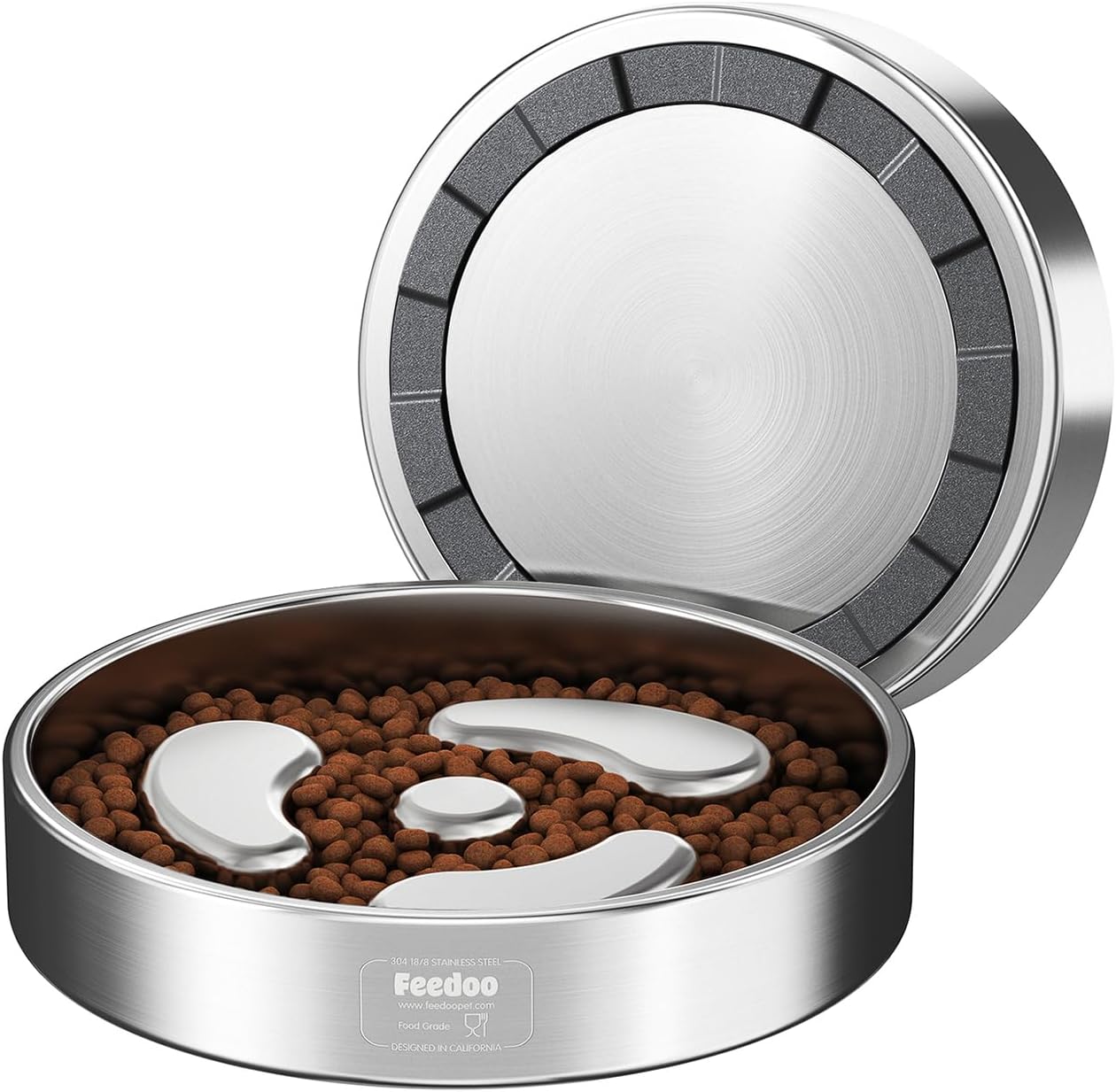
This double-wall stainless steel slow feeder takes a materials-first approach, and for buyers who distrust plastic that is the main draw. The 304 (18/8) stainless steel construction physically cannot absorb bacteria the way scratched plastic does over months of use, which matters most in a slow feeder where the maze ridges make thorough cleaning awkward. Reports indicate the raised maze design slows eating speed by more than three times according to the manufacturer’s specification, and that reduction in mechanical speed is what lowers the immediate risk of gulping and post-meal vomiting in fast eaters.
Stability is handled two ways at once. A full-circle silicone ring grips smooth floors without a mat, and the bowl’s own weight of about 0.77 pounds gives it a passive anchor. Together they keep a small dog from nosing it across tile or hardwood while working the maze. Dishwasher-safe steel means the grooves can be sanitized at full-cycle temperatures that would warp many plastic feeders, so cleaning stays practical rather than becoming a chore you skip.
The maker holds a U.S. patent on the dual-wall construction and claims a ten-year lifespan, which, if it holds, puts the cost-per-year well below a plastic bowl you replace every year or two. Based on the published specs, the sizing is tuned for small-breed snout geometry, so the maze spacing actually engages a small dog rather than being worked around.
The honest limits are about scale and kibble. Capacity runs one to one and a half cups, so any dog eating more than that per meal is out of scope. Very fine kibble under five millimeters can settle beneath the raised channels and get eaten without the speed restriction doing its job. And no independent long-term durability data exists in verified reviews yet, so the ten-year claim is still a manufacturer promise rather than a proven track record. Aggregated owner reviews skew positive at 81 percent five-star, with a small cluster of low ratings worth keeping in mind.
Key features → what they mean for you
- Double-wall 304 (18/8) stainless steel→Will not hold odors or harbor bacteria in micro-scratches the way plastic does after months of use
- Raised maze that slows eating by more than three times (per manufacturer)→Lowers the mechanical speed food reaches the stomach, easing gulping and post-meal vomiting
- Silicone base ring plus 0.77-pound body weight→Two-part stability keeps small dogs from scooting the bowl across tile or hardwood
- Dishwasher-safe steel→Sanitizes the maze at full-cycle temperatures that warp plastic feeders
- Sizing tuned for small-breed snouts→The maze spacing actually engages a small dog instead of being worked around
What works
- 304 stainless steel will not hold odors or harbor bacteria in micro-scratches the way plastic slow feeders do after months of maze-ridge scrubbing.
- Silicone base ring combined with a 0.77 lb body weight means Pepper-sized beagles cannot scoot it across a tile or hardwood floor mid-meal.
- Dishwasher compatibility at full cycle temperatures makes sanitizing the maze interior practical rather than a manual chore with a bottle brush.
- Sized precisely for small-breed snout geometry, so the maze spacing actually engages rather than being navigated around by a dog with a narrow muzzle.
Watch-outs
- The 1-to-1.5-cup capacity is too small for any dog eating more than roughly 1.5 cups per meal, which limits it to dogs under approximately 20 pounds.
- Very fine kibble (under 5mm) can settle beneath the raised maze channels and be consumed without the speed restriction the design intends.
- No independent long-term durability data is available from verified reviews at time of writing; buyers relying on the 10-year lifespan claim should verify with current Amazon reviews before purchasing.
- The one to one-and-a-half-cup capacity is limiting, and very fine kibble can slip beneath the maze channels.
Better alternative: OXO Pet Easy-Clean Slow Feeder when you want a removable insert for easier cleaning and more capacity headroom

The MateeyLife set answers a question most slow feeder shoppers overlook: what happens on wash day. With two bowls per pack, one feeder stays in service while the other cycles through the dishwasher, which suits homes feeding morning and night. The construction is food-safe PP polypropylene, so wet or raw food can sit through a longer meal without the BPA or leaching concerns that come up with cheaper plastics. That matters more than it sounds, because a maze feeder puts your dog’s tongue in contact with every surface for minutes at a stretch. The raised maze pattern is the working part here. It forces a dog to work food out of physical detours rather than gulping a bowl in half a minute, and that slower pace supports digestion and cuts the bloat and vomiting that fast eaters are prone to. Reports indicate the ridge height sits on the lower side, which is a plus for dogs with shorter snouts who find deep-channel feeders frustrating. Underneath, rubber non-slip pads keep the bowl planted on hardwood or tile while a determined dog presses in, so you get less scatter and less noise from a bowl skating across the kitchen. Top-rack dishwasher compatibility is the long-term maintenance answer: the plastic and rubber feet are built to survive repeated high-temperature cycles without warping. A 2-cup capacity covers a standard single portion for most medium breeds, so you are not refilling mid-meal and losing the slowdown effect. The honest caution is durability. PP plastic rates low for chew resistance, so a dog that bites the bowl when food runs low can crack the maze walls over time.
Key features → what they mean for you
- Two bowls per pack→One feeder stays in use while the other is in the dishwasher, which fits twice-daily feeding without a gap.
- Food-safe PP polypropylene→Safe contact with wet and raw food and no odor absorption the way porous ceramic can hold smells.
- Raised maze pattern→Turns a 30-second gulp into a multi-minute foraging meal that eases digestion for fast eaters.
- Rubber non-slip base pads→Keeps the bowl planted on hard floors so a snout pressing into the ridges does not send it sliding.
- Top-rack dishwasher safe→Survives repeated hot wash cycles without warping, so cleanup stays simple long term.
- 2-cup capacity→Holds a full single portion for most medium breeds without a mid-meal refill.
What works
- Two bowls per pack gives rotation flexibility that single-unit feeders do not, useful for twice-daily feeders.
- PP polypropylene is dishwasher-safe and holds up to wet and raw food without absorbing odors the way ceramic or porous materials can.
- The non-slip rubber base addresses a real frustration: a dog that chases a lightweight bowl across the kitchen defeats the whole purpose of a slow feeder.
- Low ridge height makes the maze accessible to dogs with shorter snouts who struggle with deep-channel feeders.
Watch-outs
- PP plastic is rated low for chew resistance. A dog that bites at the bowl when food runs out can crack the maze walls, creating sharp edges and requiring replacement.
- No stated dimensions are provided in the product listing, making it difficult to confirm the bowl fits a standard feeding mat or elevated stand before purchasing.
- At a shallow ridge depth, a large-breed dog or a highly food-motivated dog may learn to tip the bowl or use a paw to expose food, bypassing the maze entirely. A heavier ceramic slow feeder would be more appropriate in that scenario.
- PP plastic is low on chew resistance, so a dog that bites the bowl when food runs out can crack the maze walls.
Better alternative: The silicone suction-cup feeder in this roundup when you need a bowl that stays put and doubles as a freezable enrichment tool.

This silicone feeder earns its place by tackling the failure mode that sinks most cheap slow bowls: getting shoved across the floor mid-meal. The suction cups anchor it in place, so an enthusiastic eater works the food rather than chasing a sliding dish around the kitchen. The catch, and it is a real one, is that suction needs a smooth, flat, hard surface to grip. Put this on textured tile, a rubber feeding mat, or an elevated stand and the hold gives out. On the right floor it holds well. Construction is BPA-free food-grade silicone, which matters most for a bowl in daily contact with wet food or frozen treats rather than dry kibble alone, since there is no plasticizer to leach. The labyrinth channel design limits how much food a dog can lift per tongue pass, stretching a meal from under 30 seconds to several minutes and easing the gulping that leads to bloat. The standout extra is that the bowl freezes. Load it with wet food, peanut butter, or broth and it becomes a lick mat substitute that keeps a dog or an anxious cat engaged well past mealtime, which is genuinely useful during owner absences. The flexible body also simplifies cleanup: you can bend and fold the silicone to pop food loose from the maze ridges without a brush, and it is dishwasher-safe for busy multi-meal homes. The honest limits are capacity and surface dependence. Based on the published specs, the bowl runs about 1.5 inches deep, which is too shallow for medium-to-large breeds eating more than a cup at once. Long-term suction integrity through repeated dishwasher cycles is not something the available review data can confirm.
Key features → what they mean for you
- Suction cup base→Anchors the bowl on smooth hard floors so a persistent eater cannot flip or push it away.
- BPA-free food-grade silicone→Safe for daily contact with wet food and frozen treats, with no plasticizer leaching.
- Labyrinth channel design→Limits food per tongue pass, extending a meal to several minutes and reducing gulp-related bloat.
- Freezable body→Doubles as a lick mat for wet food or broth, adding enrichment during owner absences.
- Flexible silicone→Bends and folds to release trapped food from the ridges, so cleaning needs no brush.
- Dishwasher-safe→Cuts daily cleanup time for homes running several pet meals a day.
What works
- Suction base prevents the bowl from travelling across hard floors, which is the failure mode that makes most budget slow feeders useless within a week.
- Freezable design doubles as an enrichment tool, useful for cats and dogs prone to anxiety during owner absences.
- Flexible silicone body simplifies cleaning of the maze ridges compared to rigid plastic alternatives at the same price point.
- Works with wet food, dry kibble, and frozen treats, making it more versatile than single-use lick mats.
Watch-outs
- Suction cups require a smooth, flat, hard surface to grip; textured tile, rubber mats, or elevated feeders will defeat this feature entirely.
- At 1.5 inches deep, the bowl capacity is too small for medium-to-large breeds eating more than a cup of food per sitting, and the maze offers little slowdown effect when overfilled.
- Long-term durability and suction cup integrity under daily dishwasher cycles cannot be confirmed from available review data; buyers who need proven longevity should consider the Outward Hound Fun Feeder, which has a larger verified review base.
- The suction cups only grip a smooth, flat, hard surface; textured floors, mats, or elevated feeders defeat the hold.
Better alternative: The MateeyLife two-pack when you feed on a textured surface where suction will not grip and want a spare bowl in rotation.

YINEYA’s feeder is the budget entry here, and its design choices show a clear focus on the part owners actually complain about: cleanup. The maze uses moderate channel width, wide enough that a dog’s tongue reaches the bottom of each groove, so food does not get stranded in tight corners the way it does in feeders with narrow or deeply recessed channels. That single decision makes it genuinely easier to rinse than many competitors. Construction is food-grade PP polypropylene, non-toxic and recyclable, which matters given a dog spends ten minutes pressing its tongue against every surface at each meal. PP also resists odor absorption better than porous ceramic, so the bowl does not carry yesterday’s wet food smell into today’s breakfast. The raised ridges are smooth and free of sharp interior angles, which protects a dog’s snout, nose, and tongue from the abrasion that repetitive licking against a harsher maze can cause over time. That is a real plus for flat-faced or sensitive breeds. Underneath, non-slip rubber pads keep the bowl planted on hardwood or tile during active licking, cutting the noise and mess of a bowl that travels across the floor. Dishwasher-safe construction means wet food residue in the channels does not demand a dedicated scrub after every meal. A one to two cup capacity covers typical small and medium portions in a single serving, so the slowdown benefit holds for the full meal without a refill. The honest limits are straightforward. That capacity ceiling means large breed owners need a bigger feeder entirely. PP plastic will also show scratch marks from a dog that paws at the bowl, and those micro-abrasions can eventually harbor bacteria. Without confirmed long-term review evidence, durability past six months is unverified, so a stainless option may pay off for hard users.
Key features → what they mean for you
- Moderate maze channel width→A tongue reaches the bottom of each groove, so food does not strand in corners and cleanup is easier.
- Food-grade PP polypropylene→Non-toxic contact through long meals and resists holding onto yesterday’s wet food odor.
- Smooth raised ridges→No sharp interior angles, protecting sensitive or flat snouts from abrasion during repetitive licking.
- Non-slip rubber base pads→Keeps the bowl planted on smooth floors during active licking, cutting noise and scatter.
- Dishwasher-safe→Wet food residue clears without a dedicated scrubbing session after each meal.
- One to two cup capacity→Covers typical small and medium portions in one serving so the slowdown holds all meal.
What works
- Moderate channel width makes it genuinely easier to clean than competitors with narrow or deeply recessed grooves.
- Rubber base pads keep the bowl planted on smooth floors during active licking, which is a real daily-use detail that cheaper feeders skip.
- PP plastic resists odor absorption better than porous ceramic, so the bowl does not carry yesterday’s wet food smell into today’s meal.
- The smooth raised geometry protects flat or sensitive snouts from the edge abrasion that some maze feeders cause over time.
Watch-outs
- The one to two cup capacity ceiling means large breed owners will need a separate, larger feeder entirely.
- PP plastic will show scratch marks from dogs that paw at the bowl, and those micro-abrasions can eventually harbor bacteria if the bowl is not replaced periodically.
- Without confirmed long-term review evidence, durability past six months is unverified. Spending a bit more on a stainless-steel slow feeder provides a known degradation-free lifespan.
- The one to two cup capacity ceiling rules it out for large breeds, and paw-scratched plastic can harbor bacteria over time.
Better alternative: The MateeyLife two-pack when you want a spare bowl in rotation, or a stainless feeder for a heavy pawer needing longer durability.
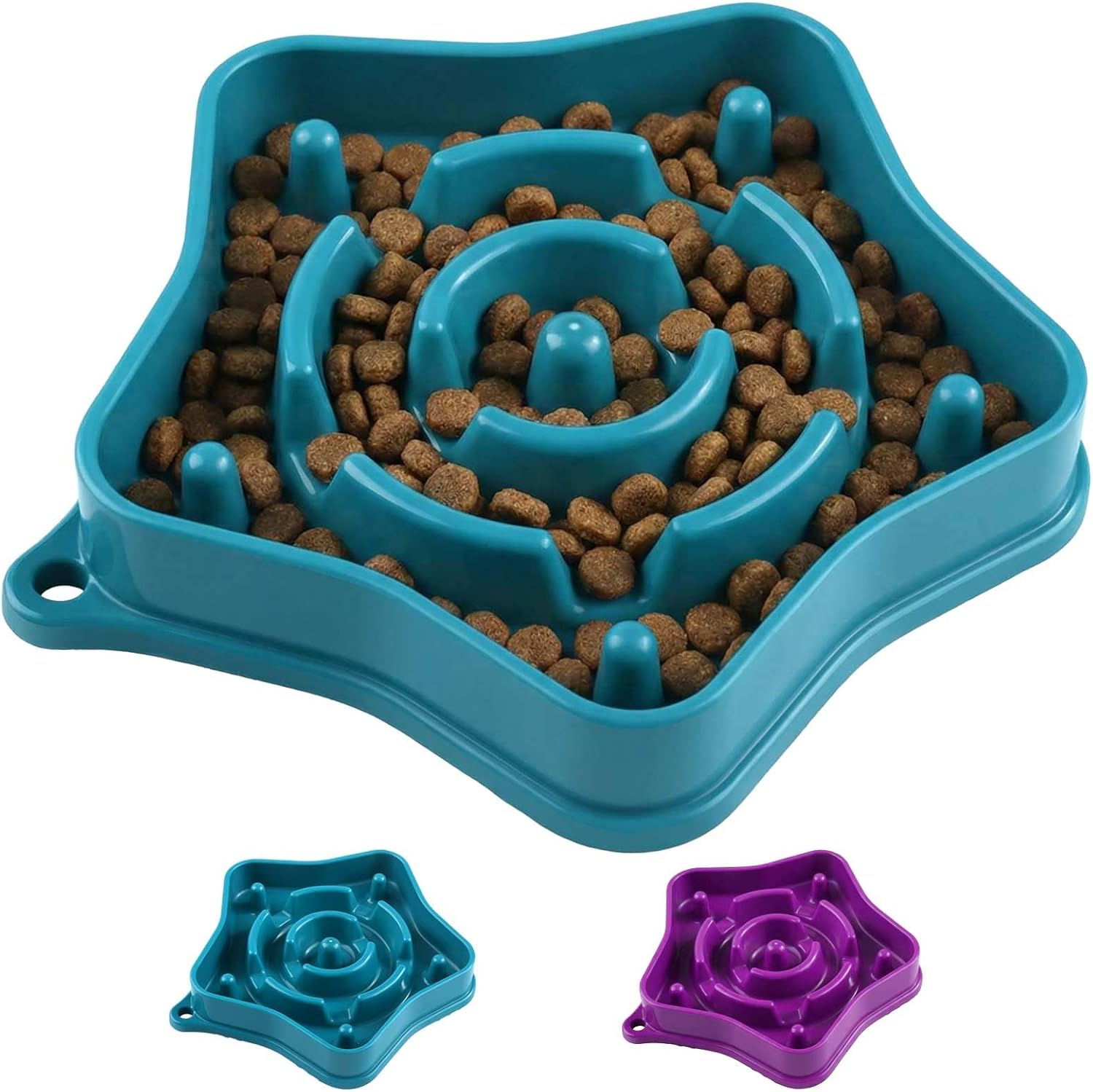
The Sufisat feeder is built around one honest idea: a small dog needs a small bowl. The 350ML capacity limits portions to puppy and petite-breed servings, which means you are not staring at a half-empty basin or overfeeding just to fill the space. That right-sized design is the whole point for households where the maze bowls sold for retrievers simply do not fit the dog or the feeding corner. Raised starfish and circular ridges create more tongue work than a flat dish, so a gulper has to slow down and nose food out of the grooves rather than scooping it in one pass. That pacing is what reduces the air intake tied to rapid eating. Food-grade PP keeps the bowl light and top-rack dishwasher safe, so the daily rinse after wet food does not become a chore, and the smooth plastic should clear residue faster than textured rubber or fabric mats. A built-in hanging hole lets it dry vertically instead of sitting damp in a cabinet, which is a small but real win in an apartment kitchen. Long-term durability cannot be verified from the supplied data, so treat it as a budget starter rather than a lifetime bowl.
Key features → what they mean for you
- 350ML capacity→Portions stay right-sized for small dogs and puppies instead of encouraging overfeeding in an oversized bowl
- Raised starfish and circular ridges→Forces a gulper to work food out slowly, cutting the air intake linked to fast eating
- Food-grade PP, top-rack dishwasher safe→Lightweight to handle and simple to sanitize after wet meals
- Smooth plastic surfaces→Rinse clean faster than textured rubber or fabric feeding mats
- Built-in hanging hole→Dries vertically and saves space in small kitchens or apartments
What works
- Compact capacity matches petite dogs better than oversized maze bowls.
- Top-rack dishwasher compatibility reduces cleanup friction after wet food.
- Maze ridges add feeding resistance without requiring electronics or moving parts.
- Hanging hole is useful in small kitchens or apartments.
Watch-outs
- No supplied review text confirms whether it stays put on smooth floors.
- Standard PP plastic is not a chew-resistant material for mouthy puppies.
- Large dogs or deep-chested fast eaters should use a heavier, larger slow feeder.
- Standard PP plastic is not chew-resistant, so a mouthy puppy that gnaws the rim can wear it down, and there is no confirmed feedback on whether it stays put on smooth floors.
Better alternative: The UPSKY Slow Feeder, when you want a heavier six-point non-slip base and a larger two-cup capacity

The Bifeaw leans on silicone rather than hard plastic, and that choice shapes everything about how it lives in a busy pet home. High-quality silicone resists tearing through repeated use and shrugs off the drops that would crack a rigid bowl, so a dog that shoves the dish across the floor is not going to split it. The puzzle ridges do the real work, breaking a meal into small pockets so a gulper has to slow the pace, which helps reduce the bloating risk tied to rapid eating. A non-slip base keeps the bowl planted on tile or hardwood during an enthusiastic meal, so it stays put instead of chasing the dog around the kitchen. Where this feeder pulls ahead is temperature range: freezer and microwave compatibility means you can freeze a lick-worthy treat for a hot afternoon or gently warm wet food in the same dish, and dishwasher-safe silicone makes the daily clean simple with no residue buildup in the grooves. The tradeoff is depth. The shallow profile limits total food volume, so very large dogs may need refills, and dogs that like tall walls for licking will find it low. For a small-to-medium gulper, though, it covers the essentials at a friendly price.
Key features → what they mean for you
- High-quality silicone construction→Resists tearing and survives drops that would crack a hard plastic bowl
- Puzzle ridges→Slow the eating pace to reduce bloating risk in fast eaters
- Non-slip base→Keeps the bowl stable on tile and hardwood during meals
- Dishwasher-safe material→Simplifies daily sanitation with no residue trapped in the grooves
- Freezer and microwave compatible→Lets you freeze cooling treats or warm wet food in the same dish
What works
- Forces moderate eating pace for dogs prone to gulping.
- Flexible silicone withstands drops without cracking.
- Compact size fits most standard feeding areas.
Watch-outs
- Shallow 1.2-inch profile restricts total food volume.
- May require frequent refills for very large dogs.
- Lacks raised edges some dogs prefer for licking.
- The shallow profile restricts total food volume, so larger dogs may need mid-meal refills and lickers miss the taller walls some bowls offer.
Better alternative: The Sufisat Starfish feeder, when you specifically want a right-sized bowl for a truly petite dog

The UPSKY takes the slow-feeder idea and pushes hard on two problems: sliding and gulping. Recessed bone-pattern pillars force a small dog to nose and lick food out of individual grooves instead of scooping it, which physically stretches mealtime and cuts the air intake behind rapid eating. Those grooves are described as deeper than comparable budget feeders, so a clever dog has a harder time cheating the maze. Underneath, six individual rubber pads on the hexagonal base spread friction across the whole footprint rather than trusting a single ring seal, which is why it resists sliding on the two surfaces where cheap bowls fail: hardwood and tile. The low-profile flat design is a quiet advantage for short-muzzled dogs like pugs and French bulldogs that cannot reach into tall-walled maze feeders. PP construction is non-porous and hydrophobic, so odor molecules from wet food do not soak in the way they can with silicone or coated ceramic, and dishwasher compatibility means you sanitize those tight grooves without hand-scrubbing with a narrow brush. At around 5.4 ounces it stays light enough for an older dog that paws its dish yet stable enough not to tip during a full two-cup meal. The catch is chew resistance and ceiling: PP holds up poorly to a rim-chewer, and two cups is undersized for bigger breeds.
Key features → what they mean for you
- Deeper recessed bone-pattern grooves→Makes it harder for a determined gulper to scoop food, extending mealtime
- Six-point rubber non-slip base→Spreads friction across the footprint so the bowl stays put on hardwood and tile
- Low-profile flat design→Lets short-muzzled breeds reach food they cannot get in tall maze feeders
- Non-porous PP construction→Wet-food odors do not absorb the way they can with silicone or coated ceramic
- Two-cup dry kibble capacity→Covers a full meal for most dogs under thirty pounds with no mid-meal refill
- Roughly 5.4-ounce weight→Light for a dog that paws its dish, yet stable enough not to tip during a meal
What works
- Bone-pattern grooves are described as deeper than comparable budget feeders, which makes it harder for a determined gulper to clean the bowl in one sweeping lick.
- Dishwasher-safe single-piece PP body simplifies the daily sanitizing step that tiered or multi-insert feeders make tedious.
- Six-point non-slip base resists sliding on hardwood and tile, two surfaces where standard bowl bases fail under an enthusiastic eater.
- Two-cup dry kibble capacity covers a full meal for most dogs under 30 pounds without requiring mid-meal refills.
Watch-outs
- PP plastic is low-resistance to persistent chewing: a dog that chews the bowl rim rather than eating from it can compromise the structure within days.
- The two-cup ceiling means this bowl is undersized for medium-to-large breeds on higher-calorie diets, and the only UPSKY upgrade to larger capacity also adds a raised stand, changing the ergonomic fit for flat-faced breeds.
- Without confirmed long-term review data, durability past six months of daily dishwasher cycling cannot be verified at this time.
- PP plastic offers low resistance to persistent chewing, so a dog that gnaws the rim rather than eating from it can wear the bowl down, and long-term durability past heavy dishwasher use is not confirmed in the supplied data.
Better alternative: The Bifeaw silicone feeder, when you want drop-proof flexibility and freezer or microwave use

The MateeyLife set covers three feeding jobs in one purchase: a maze-pattern slow feeder, a stainless steel water bowl, and a non-spill silicone mat that holds both in place. Based on the published specs, the maze ridges force a dog to work around raised obstacles to reach kibble, which stretches out mealtime and cuts the air swallowing that fast eaters take in with each gulp. For a small dog that inhales dinner, that slower pace is the practical payoff. The mat uses food-grade silicone, the same material class as kitchen prep tools, so contact with wet food or water carries no plasticizer worry. The steel bowl’s rust-resistant finish matters more than it sounds: cheaper plated bowls pit over time, and those tiny pits hold bacteria that muddy drinking water between washes. Cleaning stays flexible because both bowls lift off the mat, so you can hand-rinse the mat and send the bowls through the dishwasher without cycling the whole unit. Capacities sit at 328 ml for the feeder and 285 ml for the water bowl, which lines up with single-meal portions for small to medium breeds and keeps you from overfilling. The folding mat is the standout for travel, halving its footprint for a crate or a car trip. Aggregated owner reviews show the set earns its keep for compact households, though the same listing notes that enthusiastic eaters can shift the mat mid-meal, so the non-slip claim has limits.
Key features → what they mean for you
- Maze-pattern slow feeder with raised ridges→Forces a fast eater to work around obstacles, stretching mealtime and cutting the swallowed air that contributes to bloat
- Food-grade silicone mat→Shares the safety standard of kitchen prep tools, so contact with wet food or water carries no plasticizer risk
- Rust-resistant stainless steel water bowl→Avoids the surface pitting that harbors bacteria in plated bowls, keeping drinking water cleaner between washes
- Detachable bowls that lift off the mat→Lets you clean each piece by the right method instead of running the whole unit through the dishwasher
- Foldable mat that halves its footprint→Packs down for travel or crate setups where floor space is tight
What works
- Maze ridges actively slow eating speed rather than just presenting a smaller opening, which more effectively addresses gulping and post-meal gas in fast-eating small breeds.
- Detachable bowls mean the silicone mat, slow feeder, and steel bowl can each be cleaned by the method most appropriate for that material, rather than forcing all three through the same wash cycle.
- Foldable mat design makes this the only feeder set in this price range that realistically fits in a travel bag or carry-on without a dedicated case.
- Stainless steel water bowl resists the surface scratches that cause odor retention in plastic alternatives, a meaningful hygiene advantage for households with cats or dogs prone to water bowl sensitivities.
Watch-outs
- The product listing itself warns that larger or enthusiastic eaters can shift the mat during meals, which means the non-slip claim has a clear size threshold: this set is not designed for dogs above medium breed weight.
- At 1.38 cups maximum capacity, the slow feeder bowl cannot accommodate a full meal for any dog on a diet of more than one and a half cups per sitting, requiring a second-pass refill that undermines the paced-eating purpose.
- No long-term durability data is currently available for this specific model; buyers who need confirmed multi-year performance should consider an established brand with a documented track record.
- At roughly 1.38 cups maximum, the slow feeder cannot hold a full meal for dogs eating more than a single small portion, and the mat can shift under vigorous eaters.
Better alternative: The Franklin Slow Feed Tornado Bowl, when you need a sturdier single bowl for a medium or large dog rather than a small-portion set
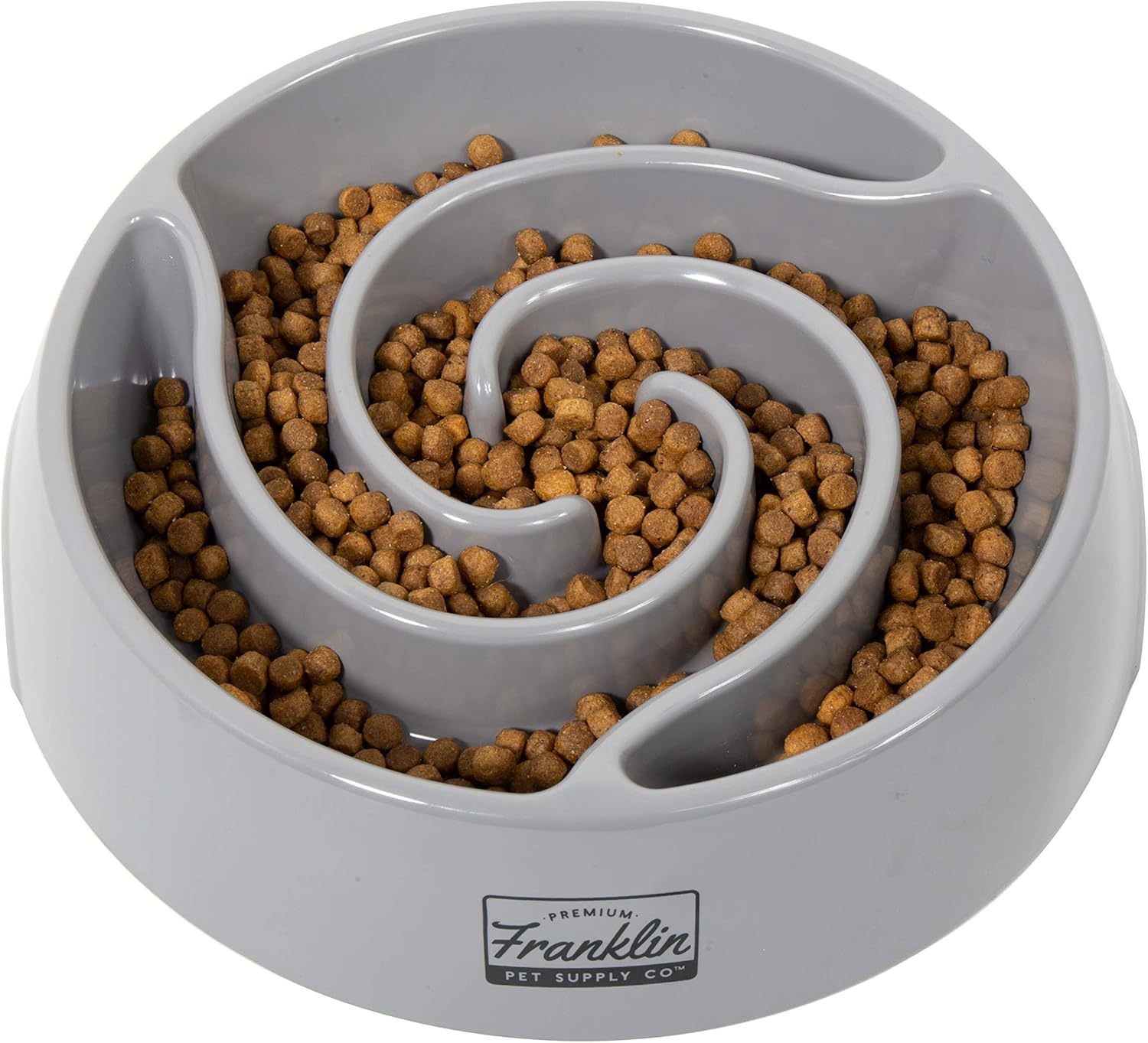
Franklin’s Tornado bowl builds its slowdown around a raised spiral at the center of the dish. Based on the published construction, that tornado shape makes a dog reposition its snout between bites rather than clearing a section in one pass, which extends mealtime well past what a simple divided bowl manages. The design scales across small, medium, and large breeds, so a multi-dog home can standardize on one bowl instead of buying separate feeders. Cleanup is straightforward because the bowl is dishwasher safe, and that matters with a spiral: wet food packs into the channels, and machine washing reaches crevices that hand scrubbing tends to miss. Stability comes from four rubber feet with anti-skid pads and a widened base that lowers the center of gravity. Owner feedback consistently mentions that plastic feeders skate across hardwood and tile during eager meals, and the grippier base plus lower profile pushes back on both the sliding and the tipping. The slowdown itself has a health angle worth naming: reducing swallowed air lowers one documented risk factor for gastric dilatation in deep-chested dogs. The trade-offs are honest ones. Plastic offers little chew resistance, so a dog that mouths its bowl between meals will wear down the maze. The rubber feet are adhesive-bonded rather than molded in, which raises a durability question through repeated dishwasher heat. Flat-faced breeds like pugs and bulldogs may also find the spiral geometry a poor match for their muzzle shape.
Key features → what they mean for you
- Tornado-shaped central spiral maze→Makes a dog reposition its snout between bites, extending mealtime far beyond a standard divided bowl
- Dishwasher-safe construction→Machine washing reaches the spiral channels where wet food packs in, so the crevices stay sanitary without extra scrubbing
- Four anti-skid rubber feet→Resists the lateral push a large dog applies, cutting the sliding that frustrates owners on hard floors
- Widened base with a lower center of gravity→Reduces the tipping that flat-bottomed single-maze feeders are prone to during enthusiastic eating
- Sizing marketed for small through large breeds→Gives a multi-dog household one compatible feeder rather than several
What works
- Maze depth is sufficient for medium to large muzzles to engage meaningfully, unlike shallow-ridge designs that larger dogs clear in seconds.
- Dishwasher compatibility means the spiral crevices where wet food accumulates stay sanitary without extra effort.
- Anti-skid rubber feet address one of the most common frustrations with plastic slow feeders on hardwood or tile.
Watch-outs
- Plastic construction offers low chew resistance: a dog that mouths or chews its bowl between meals will degrade the maze ridges quickly.
- The rubber feet are adhesive-bonded rather than molded, which is a durability risk through repeated dishwasher heat cycles — verify adhesion regularly.
- Flat-faced breeds such as bulldogs and pugs may find the spiral channel geometry poorly matched to their muzzle shape; a wide-flat lick mat is a better fit for those dogs.
- The plastic body has low chew resistance and the anti-skid feet are adhesive-bonded, so both can degrade with rough handling or repeated dishwasher cycles.
Better alternative: The PETLIBRO stainless steel slow feeder, when you want a chew- and odor-resistant surface for a cat or small dog

PETLIBRO takes the maze concept and builds it in stainless steel rather than plastic, which changes the calculus on hygiene and longevity. Based on the published specs, the corrosion-resistant surface does not absorb odors the way plastic maze bowls do over months of use, so the feeding surface stays cleaner between washes. The raised maze pattern does the core work, forcing small dogs and cats to eat around obstacles, and veterinary guidance consistently ties that slower pace to lower bloat risk in fast eaters. At 1.125 cups, the bowl sits squarely in single-meal territory for cats and small-breed dogs, which discourages overfilling. Steel also tolerates a full dishwasher cycle without warping or flattening the ridges, a common failure point on plastic equivalents. A specific selling point: the bowl drops directly into PETLIBRO’s camera automatic feeder with no adapter, so owners already inside that ecosystem avoid the alignment headaches of pairing a third-party bowl. And because food-grade stainless carries no BPA, phthalates, or leaching risk, it is a real upgrade for cats prone to plastic-linked chin acne. The limits are worth stating plainly. That 1.125-cup capacity is too small for most dogs over roughly fifteen pounds eating standard twice-daily meals, so it is a cat-and-tiny-dog tool. With only 41 reviews at the time of writing, there is not yet enough owner data to confirm how the ridges hold up over years. And the bowl has no non-slip base, so aggressive pawing pets may push it around smooth floors.
Key features → what they mean for you
- Corrosion-resistant stainless steel body→Does not absorb odors like plastic maze bowls, keeping the feeding surface hygienic between washes
- Raised maze pattern→Forces cats and small dogs to eat around obstacles, a slowdown veterinary guidance links to reduced bloat risk
- Dishwasher-safe steel construction→Tolerates a full hot cycle without warping or flattening ridges, unlike many plastic feeders
- Direct fit with the PETLIBRO camera auto feeder→Drops into an existing automated setup with no adapter, avoiding third-party misalignment
- Food-grade steel with no BPA or phthalates→Removes the plastic leaching risk tied to chin acne in some cats
What works
- Stainless steel maze ridges are durable enough to withstand daily dishwasher cycles without the ridge flattening or peeling that affects plastic slow feeders.
- Native fit with the PETLIBRO camera auto feeder eliminates the misalignment issues that arise when pairing third-party bowls with proprietary feeder bases.
- The non-toxic, corrosion-resistant surface is a meaningful upgrade for cats with plastic chin acne, a condition linked to bacteria buildup in porous plastic bowls.
Watch-outs
- The 1.125-cup capacity is too small for most dogs over roughly 15 pounds who eat standard twice-daily meals, meaning the bowl will need mid-meal refills or a second serving.
- With only 41 reviews available at time of writing, there is not enough long-term owner data to confirm how the maze ridges hold up after six or more months of daily dishwasher use.
- The bowl provides no non-slip base, so cats and small dogs who paw at maze feeders aggressively may push it across smooth floors mid-meal.
- The 1.125-cup capacity rules out most dogs over fifteen pounds, and the lack of a non-slip base lets pawing pets slide it across smooth floors.
Better alternative: The MateeyLife 3-in-1 set, when you want a bundled feeder, water bowl, and non-slip mat for a small dog at a lower cost

Most slow feeders in this size range are molded plastic, and that carries a quiet cost. Based on the published specs, the LE TAUCI is fully ceramic, which sidesteps the plastic degradation that can leave discoloration around a small dog’s muzzle over time. The maze pattern is the functional core here: the raised ridges force a dog to eat around obstacles rather than scoop food in a single motion, so it targets the behavior behind fast eating instead of just shrinking the surface. At roughly 0.45 kg, the bowl carries enough weight to stay planted on tile without a rubber mat, which is a practical detail for lightweight small breeds that push a plastic dish across the floor with every nudge. The smooth glazed interior wipes clean and runs through a dishwasher without the porous grooves that trap bacteria in silicone feeders, and the ceramic is microwave-safe, so warming wet food happens in the same dish. The 6-inch diameter and 1.4-inch height keep the feeding surface near nose level, easing neck strain for a small dog. Four colors, including purple, let it sit in a feeding corner without looking purely utilitarian. The trade-off is capacity: at 0.6 cups, larger portions pile above the maze ridges and defeat the slowing effect.
Key features → what they mean for you
- Full ceramic, non-porous construction→No plastic breakdown or odor absorption, and no muzzle discoloration risk over months of daily use
- Raised ridge and maze interior→Physically slows a fast eater by forcing food out of pockets, which aids digestion and reduces gulping
- Roughly 0.45 kg weight→Stays put on tile and hardwood without a separate mat, even when a small dog nudges it mid-meal
- Smooth glazed, dishwasher-safe surface→Cleanup after wet food is a quick task rather than scrubbing residue from grooves
- Microwave-safe ceramic→Warm wet meals in the same bowl, skipping the transfer to a separate dish
- 6-inch diameter, 1.4-inch height→Keeps the feeding surface near nose level, easing neck strain for toy and small breeds
What works
- Ceramic material is non-porous, so it does not absorb food odors or harbor bacteria the way plastic or low-grade silicone bowls can after repeated use.
- Dishwasher safe with a smooth glaze means cleanup after wet food is a genuine 30-second task rather than scrubbing food residue out of maze crevices by hand.
- The 6-inch diameter and 1.4-inch height keep the feeding surface at nose level for small breeds, reducing the neck strain that taller elevated bowls can cause in dogs under 15 lb.
- Microwave-safe ceramic means warming wet food is possible without transferring to a separate dish, a small but real convenience for owners managing prescription or senior diets.
Watch-outs
- The 0.6-cup maximum is a hard constraint: any dog eating larger portions will have food piled above the maze ridges, which completely defeats the slow-feed purpose and wastes the price premium over a standard bowl.
- Ceramic chips if dropped on tile or hardwood, and a chipped food-contact surface should be replaced rather than used, adding a potential replacement cost that a silicone or stainless bowl avoids.
- Insufficient review evidence is available to verify long-term glaze durability through repeated dishwasher cycles; buyers should monitor for crazing or surface degradation and check current Amazon reviews before purchasing.
- The 0.6-cup maximum is a firm limit; any dog eating more will have food heaped above the ridges, which cancels the slowing benefit.
Better alternative: The Catstages Kitty Slow Feeder, if you want a lower price and a non-slip base and can accept plastic construction

The Catstages Kitty is built around a maze channel that makes a cat work food out of individual pockets instead of sweeping a tongue across an open surface, which limits intake rate without any owner involvement at each meal. That matters most for longer-muzzled cats and extra-small dogs, and the manufacturer is upfront that flat-faced breeds, including Persians, Himalayans, and Exotic Shorthairs, are excluded because they cannot reach into the channels. The material disclosure is stronger than most at this price: it is free of BPA, PVC, phthalates, and lead, with explicit callouts rather than a vague food-safe label. The non-slip base solves a real problem, since cats tend to chase a sliding bowl and eat in rapid bursts, which undoes the whole point of a slow feeder. At three-quarters cup, it doubles as a portion-control tool for a measured diet, and top-rack dishwasher compatibility clears wet food packed into the ridges without hand scrubbing. The 5-inch footprint fits neatly on a feeding mat in a small kitchen. The honest limits are the shallow plastic construction, which offers low chew and scratch resistance, and a 1-inch depth that suits cats more than energetic small dogs.
Key features → what they mean for you
- Maze channel interior→Slows intake for longer-muzzled cats and small dogs, easing digestion without owner effort
- Free of BPA, PVC, phthalates, and lead→A clear, specific food-contact material profile that removes guesswork for a cautious owner
- Non-slip base→Keeps the bowl stationary so a cat cannot chase it and gulp in bursts
- Three-quarter cup capacity→Doubles as a portion measure, cutting a separate scooping step before each meal
- Top-rack dishwasher safe→Clears wet food packed into the ridges in a normal wash cycle
What works
- Ridge geometry physically slows intake for longer-muzzled cats without requiring owner involvement at each meal.
- Free from BPA, PVC, phthalates, and lead, with explicit material callouts rather than vague ‘food-safe’ labeling.
- Top-rack dishwasher safe, which matters for ridged feeders where wet food residue packs into channels.
- Non-slip base keeps the bowl stationary during feeding, preserving the slowing effect.
Watch-outs
- Flat-faced breeds, including Persians, Himalayans, and Exotic Shorthairs, are explicitly excluded by the manufacturer due to snout-to-channel fit issues.
- The shallow plastic construction offers low chew and scratch resistance, meaning a dog or cat that mouths the bowl edge will degrade it quickly.
- With no long-term review data available in this dataset, durability beyond three months cannot be independently verified before publishing.
- The shallow plastic build has low chew and scratch resistance, so a pet that mouths the edge can damage it quickly.
Better alternative: The LE TAUCI ceramic feeder, if you want a non-porous, longer-lasting surface and can accept the smaller 0.6-cup capacity
What Buyers Consistently Say
What owners reward most
Aggregated owner reviews across these bowls point to one consistent win: fast eaters actually slow down. Owner feedback repeatedly describes meals stretching from a rushed thirty seconds to several minutes, with fewer post-meal regurgitation episodes. The bowls with deeper, tighter channels earn the strongest praise here. Reports on the vancasso ceramic, the Outward Hound Fun Feeder, and the Feedoo double-wall stainless model consistently mention that the maze geometry genuinely interrupts the gulping pattern rather than just narrowing the opening.
Material preference is the second clear theme. Owners who have cycled through cheaper plastic feeders often mention switching to ceramic or stainless steel after noticing odor retention, staining, or chin irritation on their dogs. Aggregated reviews for the vancasso and Feedoo bowls repeatedly note that these surfaces rinse cleaner and stay fresher over months of twice-daily use. Silicone models like the Bifeaw and the suction-cup XAQMHSW bowl draw praise for flexibility during cleaning and for doubling as freezable enrichment tools.
Stability comes up constantly. Owner feedback consistently mentions the difference a non-slip base or suction cup makes. Buyers of lightweight plastic bowls without good grip describe chasing the dish across tile mid-meal, which defeats the purpose. The heavier bowls (Feedoo at 0.77 lb, the ceramic vancasso, the weighted OXO) draw repeated comments about staying planted even under an enthusiastic pusher.
Common complaints
Capacity is the single most frequent frustration. Reports indicate that the small-breed bowls capped at 0.6 to 1 cup force mid-meal refills for dogs eating larger portions, and owners note that overfilling piles food above the ridges where the slowing effect disappears. This surfaces across the vancasso, LE TAUCI, and Feedoo reviews.
Chew resistance is the second recurring concern, concentrated in the PP plastic models. Owner feedback on the Sufisat, MateeyLife two-pack, YINEYA, and UPSKY bowls warns that a dog who mouths the bowl between meals can crack or deform the maze walls. Buyers with puppies or persistent chewers repeatedly recommend stepping up to stainless or ceramic.
The Catstages bowl shows the weakest review profile in this group, with a notably higher share of one and two star ratings. Aggregated feedback points to fit issues for flat-faced pets, whom the manufacturer explicitly excludes, and to thin construction that some owners found flimsy.
Patterns by use case
For multi-pet households, owners gravitate toward the three difficulty tiers of the Outward Hound line or the two-pack rotation of the MateeyLife bowls, since these let one bowl run while another washes. For wet food and raw feeders, reviews favor removable-insert or non-porous designs, with the OXO silicone insert and stainless options drawing praise for reaching the crevices where residue hides. For brachycephalic dogs and cats, low-profile bowls like the Outward Hound and UPSKY earn specific thanks for letting short muzzles reach the food. For apartment dwellers, the foldable MateeyLife set and the freezable silicone bowls come up as space-conscious picks. Across every category, the throughline is simple: a bowl that stays put, cleans easily, and matches the dog’s snout keeps getting used, while one that slides or stains gets abandoned in a drawer.
What Most Buying Guides Miss
The insight most buying guides miss
The slowing effect of a maze bowl is a function of two variables working together: channel depth and kibble size relative to that depth. Based on the published specs and construction, a bowl with tall ridges only works if the kibble is large enough to get trapped between them. This is why the Feedoo listing quietly warns that very fine kibble under 5mm can settle beneath the raised channels and be consumed at nearly full speed. The practical takeaway: measure your kibble before you buy the bowl. Small-breed dogs often eat small-diameter kibble, which means an aggressive maze can be defeated by physics alone. Pair fine kibble with a bowl that has narrower, tighter channels rather than tall open ones.
A contrarian view on material
Stainless steel and ceramic get treated as automatically superior to plastic, and on hygiene grounds that holds up. But there is a real tradeoff people skip past: hard bowls do not fold, flex, or absorb impact. A flexible silicone bowl bends to release food trapped in the ridges without a brush, and it survives being dropped on tile. Ceramic does not; a dropped ceramic bowl on a hard floor is a broken bowl and a possible injury. For households with clumsy hands, active kids, or feeding stations near stairs, the safety-first pick may actually be food-grade silicone, not the premium ceramic. Match the material to your environment, not to a ranking.
Common buyer mistakes
The first mistake is buying on capacity alone and choosing a big bowl for a small dog. A 2-cup maze feeder given a half-cup meal spreads food thin across shallow territory, and a petite dog simply works around the obstacles. Small breeds are usually better served by a smaller, tighter bowl sized to their portion. The second mistake is ignoring the floor surface before buying a suction-cup model. Suction cups need a smooth, flat, hard surface to grip; on textured tile, a rubber mat, or a raised feeder, they fail completely. The third mistake is underestimating cleaning friction with wet food. Owners who feed wet or raw and buy a single-piece bowl with narrow, deep grooves often abandon it within weeks. If you feed wet, prioritize removable inserts or wide channels.
The product we would skip
We would pass on the Catstages Kitty Slow Feeder for a dog household. Its review profile is the weakest in this set, with roughly a quarter of ratings at three stars or below, and the manufacturer explicitly excludes flat-faced breeds. It is designed around cat feeding behavior and a shallow one-inch depth, which limits its usefulness for the small dogs this guide targets. If you want a low-profile bowl for a short-muzzled dog, the Outward Hound or UPSKY designs cover that need with stronger feedback and clearer material disclosures.
One more overlooked detail
The PETLIBRO stainless bowl carries a feature nobody else here does: native compatibility with an automatic camera feeder. For owners already running an automated feeding setup who want to add pacing, that direct fit removes the adapter guesswork of pairing a third-party bowl. It is a narrow benefit, but for that specific household it is the deciding factor, and it is worth knowing the option exists before defaulting to a generic maze bowl that will not seat correctly in the dispenser tray.
How to Choose — What Actually Matters
Match maze depth and spacing to your dog’s snout and kibble
The pacing benefit lives entirely in the geometry. A bowl with tall ridges and tight channels slows a determined gulper, while shallow bumps or wide-open channels let a petite dog eat around the obstacles with little effort. Small breeds need spacing tuned to a small muzzle, not a scaled-down version of a large-dog maze. Before you buy, check two things: the ridge depth described in the specs and the size of your dog’s kibble. Fine kibble under about 5mm can slip beneath raised channels and get eaten at nearly full speed, which defeats a deep, open maze. If your dog eats small kibble, favor a tighter labyrinth pattern over tall widely spaced pillars. If your dog eats larger kibble, a deeper maze holds each piece longer. Flat-faced breeds are a special case: they cannot reach comfortably into deep bowls, so a shallow low-profile design like the Outward Hound or UPSKY actually serves them better than a taller maze that looks more aggressive on paper but leaves the dog unable to reach the bottom.
Choose the material for your household, not just the ranking
On hygiene alone, non-porous ceramic and 304 stainless steel win. They do not develop the micro-scratches where bacteria colonize, they resist odor retention, and they tolerate full dishwasher cycles without warping. That matters most for wet or raw feeders using the same bowl twice a day for years. But hard materials carry a real tradeoff: ceramic chips or shatters when dropped on tile, and a chipped food surface should be replaced. Food-grade silicone flexes, survives drops, and bends to release trapped food without a brush, which makes it the safer pick for busy kitchens, homes with kids, or feeding spots near stairs. PP plastic is the budget path and cleans fine, but reports consistently flag low chew resistance, so it is a poor match for puppies or dogs that mouth the bowl between meals. Decide what your environment demands first, then pick the material that fits it rather than defaulting to whatever sits at the top of a spec sheet.
Confirm the bowl stays planted on your specific floor
A slow feeder that slides across the kitchen cancels its own purpose, because the dog simply follows it and keeps gulping. Owner feedback consistently ranks stability among the top daily-use frustrations. Three mechanisms handle this, and each has a catch. Weight alone (the ceramic vancasso, the 0.77 lb Feedoo stainless, the weighted OXO) resists nosing without any special surface requirement. Non-slip rubber pads or grip rings work on most hard floors but can lose tack over time and through repeated dishwasher heat. Suction cups grip the hardest of all, but only on a smooth, flat, hard surface. Put a suction bowl on textured tile, a rubber mat, or a raised feeder and it will not hold. Before buying a suction model like the XAQMHSW, look at where your dog actually eats. If that spot is textured or matted, choose weight or rubber pads instead.
Size the capacity to a single small-breed meal
Capacity is the most common complaint across these bowls, and the fix is counterintuitive. Bigger is not safer. A slow feeder only works while food sits down in the channels; the moment you overfill and food piles above the ridges, a dog scoops it off the top at full speed. Most bowls here cap between 0.6 and 2 cups. For a genuinely small dog eating a modest portion, a 0.6 to 1 cup bowl like the vancasso, LE TAUCI, or Feedoo keeps food in the maze where it belongs. Dogs eating larger portions will need mid-meal refills with these, which some owners find tedious. If your small dog eats closer to 1.5 or 2 cups per meal, step up to the YINEYA, MateeyLife two-pack, or UPSKY, but do not oversize beyond that, since a large bowl given a small meal spreads food too thin for the maze to engage. Weigh or measure a typical meal, then buy the smallest bowl that holds it without piling.
Plan for how you will actually clean it
The bowls people abandon are almost always the ones that were miserable to clean. This matters far more if you feed wet or raw food, which packs into ridges and hardens. Single-piece bowls with deep, narrow grooves are the hardest to sanitize by hand, and a narrow brush becomes a daily chore. Removable-insert designs like the OXO split into two simple pieces so you can reach every surface. Wide-channel bowls like the YINEYA let a tongue and a sponge reach the bottom without special tools. Flexible silicone bowls bend to pop out trapped food. True top-rack dishwasher compatibility helps across all materials, but verify it applies to the whole bowl, including any rubber feet, since adhesive-bonded pads can degrade under repeated heat cycles. If you feed only dry kibble, cleaning friction is lower and most of these bowls are fine. If you feed wet, treat cleaning ease as a top-three priority, not an afterthought.
Decision Matrix — Match Your Priority
Final Verdict
For most small-dog households, the vancasso ceramic bowl is the pick we keep coming back to. It solves the two problems that quietly undermine cheaper feeders: the ceramic surface stays hygienic without the micro-scratches and odor retention plastic develops, and the bowl’s own weight keeps it planted without a mat. The maze depth appears tuned for small snouts rather than scaled down from a large-dog design. Its only real limit is the 0.6-cup capacity, which is fine for a genuinely petite eater but tight for anything larger. On a budget, the Outward Hound Fun Feeder earns its long-standing reputation. Aggregated owner reviews consistently confirm the ridge-and-groove maze slows fast eaters, the three difficulty tiers let multi-pet homes match resistance to each animal, and the low profile suits flat-faced breeds. It is plastic, so chewers will degrade it, but for the price it delivers real pacing. For buyers who want a bowl to outlast several plastic replacements, the Feedoo double-wall stainless model is the premium choice. Reports indicate the 304 steel resists odor and bacteria, the weight plus silicone ring keeps it stationary, and it handles full dishwasher cycles that warp plastic. Watch the fine-kibble caveat and the small capacity. We would skip the Catstages bowl for a dog household. Its review profile is the weakest here, it excludes flat-faced pets by design, and it is built around cat feeding behavior. Small-dog owners get more from the Outward Hound or UPSKY low-profile designs.



Write Your Review
No reviews yet. Be the first to share your experience!