

15 Best Extra Tall Pet Gates for Cats of 2026
Cats are exceptional athletes, and a standard 30-inch baby gate is often little more than a warm-up hurdle. If your cat has already cleared one gate — or learned to use the bars as a ladder — the problem is not your technique; it is the gate’s geometry. A barrier that genuinely contains a determined jumper needs to start at roughly 55 inches and ideally reach 70 inches or taller. pet gates for home office.
Extra tall pet gates for cats occupy a specialized corner of the pet safety market. Unlike ordinary baby gates, the best models in this category combine meaningful height with narrow bar spacing, walk-through doors for daily convenience, and mounting systems that protect finished trim. That combination matters because a gate that is annoying to use gets propped open, and a gate that wobbles loses its seal.
Consider a common scenario: a pet owner separates a resident cat from a newly adopted kitten using a 36-inch gate, feels confident, and leaves the room. Fifteen minutes later the resident cat is inside the kitten’s space, the gate is undamaged, and no one witnessed the crossing. The gate was never the wrong brand — it was simply the wrong height. That single buying mistake is what this guide is designed to prevent.
Quick Answer
The Gardner Pet 51-to-87-inch gate (B0FM3FZM55) is the Best Overall pick for 2026: its full steel frame, wide adjustable height, and tool-free setup make it the most versatile choice for multi-pet households. Budget shoppers get strong value from the Sprouterie 74.8-to-90.5-inch gate (B0DT7G7LF9), which reaches exceptional height at a lower price point. The Premium title goes to the Richell Steel 70-inch gate (B0DCM7J6V8), a furniture-grade all-steel model with a refined finish. Households that need a very wide opening should look at the PamperYourPet 74.8-inch gate (B0FVFR41PL), which spans up to 51.6 inches wide. Shoppers whose doorways fall outside any gate’s stated width range, or who need stair-top hardware mounting, should not attempt to force a pressure-mounted gate into service — none of these products replace a properly anchored stair gate in high-fall-risk locations.
Quick Picks
How We Evaluated These Products
To build this ranking, the Furlyhome team analyzed manufacturer specifications, compared construction materials, and reviewed aggregated owner feedback from major retail platforms. Each gate was evaluated on five criteria: barrier height relative to the cats it is designed to contain, bar spacing and its effect on small-pet containment, mounting reliability under repeated daily use, walk-through convenience for the humans who live with the gate, and the breadth of doorway widths each model can serve. Products with limited review histories were ranked lower than comparable models with more established feedback patterns, because real-world stability and latch durability cannot be inferred from specs alone. Price was considered as a value signal but not used as a primary ranking factor. Where owner feedback revealed recurring installation or hardware issues, those patterns were weighted against otherwise strong specifications.
Pros
- Steel construction provides solid impact resistance for households with dogs that lean or jump.
- Tool-free setup preserves rental walls while allowing relocation between rooms.
- One-handed dual-side access reduces daily friction when moving supplies past the gate.
Cons
- Height must be manually adjusted from the shipped 51-inch setting before the gate operates.
- No machine-washable components mean cleaning relies on wiping the steel bars after accidents.
This gate targets homes where standard-height barriers fail to contain curious pets at doorways or stairs. The 51-to-87-inch height range and four extension pieces address openings that narrower or shorter models cannot cover without gaps.
Stabilizing brackets added to the pressure system increase resistance to pet weight and impact compared with basic tension gates. Owners gain a tool-free option that relocates between rooms while preserving wall surfaces in rentals.
Alloy steel tubing forms the frame and bars, giving a rigid feel that stands upright without sagging once extended. The white finish blends with most trim but still reads as a dedicated pet barrier rather than built-in millwork.
Setup begins with manual extension of the shipped 51-inch frame, an extra step not required on fixed-height gates. No long-term owner reports exist yet to confirm how the pressure mechanism holds after seasonal humidity changes.
Buy this if your layout matches the adjustable range and skip it if you prefer a gate that functions immediately at full height without initial frame adjustment.
Steel construction earns a durability score of 7 because the tubing resists bending under typical pet contact yet lacks confirmed multi-year track records. High chew and scratch resistance ratings reflect the material choice, though active dogs may still test the pressure points over time.
Cleaning involves wiping the bars after accidents since no washable parts are present, resulting in an ease-of-clean score of 6. Odor control does not apply to this category.
The all-sizes pet fit works for cats through medium dogs when bar spacing prevents squeezing. Larger dogs that climb or push hard may require a different model with added reinforcement options.
| Brand | Gardner Pet |
|---|---|
| ASIN | B0FM3FZM55 |
| Size or Dimensions | 51"-87" High, 27.56"-37" Wide |
| Material | Alloy Steel |
| Construction | Not specified |
| Origin | Not specified |
| Pile Height or equivalent | Not specified |
| Machine Washable | Not specified |
| Non-Slip Backing | Not specified |
| Stain Resistant | Not specified |
| Weight Capacity (if applicable) | Not specified |
| Warranty | Not specified |
| FurlyHome Score | 6.6/10 |
Pros
- Unusually tall profile is aimed at pets that jump over standard gates.
- Pressure mounting avoids drilling into walls or door frames.
- Metal bars are a better match for chewing or clawing than fabric mesh.
- Narrow bar spacing is useful in multi-pet homes with cats or small dogs.
Cons
- No usable review text was available to verify long-term stability.
- Pressure-mounted gates can mark trim or slip if installed against weak or uneven surfaces.
- Care and cleaning instructions are not specified, so confirm maintenance details before relying on it in messy entryways.
I would look at the KAGNJIC H7 only if the main problem is vertical escape, not basic room separation. A 74.8-inch gate changes the equation for dogs that hop over standard barriers and for cats that treat shorter gates like furniture. For a household with Biscuit, the appeal is obvious: a taller visual and physical stop at a doorway without committing to drilled hardware.
The standout spec is the combination of height, 29.5-to-51.6-inch width adjustment, and eight pressure bolts. More contact points can help distribute force when a pet leans, paws, or bumps the gate, which matters more in a real hallway than it does in a product photo. Insufficient product data to verify this feature independently. Check Amazon reviews before purchasing.
The build is listed as metal with an all-iron structure, thickened steel pipes, and 1.38-inch spacing between bars. That makes it feel closer to a functional pet barrier than a decorative furniture piece, but the white finish should visually recede better than black industrial-style gates in light trim or painted doorways. The narrow spacing is the most pet-specific part of the design because it reduces the chance of a smaller animal nosing halfway through.
The drawback is verification. Review intelligence is insufficient, so I cannot confirm whether the pressure bolts stay tight after repeated dog impacts or daily open-close use. Compared with cheaper short gates, you gain height and more pressure points. Compared with a premium hardware-mounted stair gate, you give up the mechanical certainty of screws anchored into solid framing.
Buy this if you need a tall, no-drill barrier for a doorway, hallway, or controlled stair approach where jumping is the problem. Skip it for fragile trim, uneven openings, or safety-critical stair use where a hardware-mounted gate is the more responsible choice.
For pet durability, the key behavior is a large dog bolting toward a doorway or standing up against the gate, not gentle boundary training. I scored durability at 6 because the metal construction and eight pressure bolts are promising, but the long-term signal is insufficient_data, so there is no reliable evidence of how it performs after months of daily impacts.
Wash temperature not specified, check care label before first wash. Dry method not specified, air dry recommended until confirmed. In practical terms, a metal gate should be wipe-clean for paw marks and nose smudges, but the listing does not provide finish-care instructions or rust-resistance details.
The fit verdict is strongest for large pets that jump and for mixed cat-dog homes where narrow bar spacing matters. The conservative pet size fit is large, even though the listing references heavier dogs, because pressure-mount performance depends heavily on the opening. Size fit warning is insufficient_data, so measure the exact opening and trim depth before ordering.
| Brand | KAGNJIC |
|---|---|
| ASIN | B0FDB9LDF1 |
| Size/Dimensions | 51.6 in W x 74.8 in H |
| Material | Metal |
| Construction | All-iron structure with eight pressure bolts |
| Origin | Not specified |
| Bar Spacing | 1.38 in |
| Machine Washable | No |
| Non-Slip Backing | Not applicable |
| Stain Resistant | Not specified |
| Weight Capacity | Listed for dogs up to 160 lb |
| Warranty | Not specified |
| Data completeness | 9/12 fields available, check Amazon listing for full specifications |
| FurlyHome Score | 5.4/10 |
Pros
- Tall enough for cats that have learned to clear ordinary baby gates.
- Narrow bar spacing improves containment for kittens and small dogs.
- Pressure mount is easier to remove than hardware-mounted gates.
- Two-way swing helps in high-traffic doorways.
Cons
- A hard-pushing large dog may challenge the pressure-mounted hold.
- The pass-through can feel narrow for some adults.
- Long-term latch wear is not well established in the available reviews.
I would look at the Lumizone 61.02 inch gate if the real problem is vertical escape, not basic room separation. Standard baby gates often fail with athletic cats because they provide just enough height to invite a jump. This one is closer to a room divider in height, which makes it better for cat introductions, doorway boundaries, and keeping dogs out of litter or recovery areas while pets can still see each other.
The standout number is the 1.37 inch bar gap. That matters more than it sounds, because a tall gate with wide spacing can still fail for kittens, toy breeds, or cats that test every opening with their head first. The review pattern supports that the height and spacing work together: buyers repeatedly use it after shorter gates failed, especially for cats that climb or leap.
Build quality is helped by the iron construction. It reads more like a black metal home fixture than a temporary fabric pet barrier, although it still looks like a gate rather than furniture. The pressure-mounted design is the tradeoff: it preserves trim and walls, but it relies on tension rather than drilled hardware.
The honest drawback is force resistance. For calm dogs and most cats, the frame appears secure in everyday use, but a determined larger dog can create a different problem by pushing against the whole mount. Cheaper pressure gates usually give you easy installation and no wall damage; spending more on a hardware-mounted model buys better impact resistance at the cost of holes in the frame or wall.
I would buy this for cat containment, gradual pet introductions, and doorways where pets respect a visible boundary. I would skip it for stair safety or for a dog that hits gates with its chest, because this category needs hardware mounting when impact is part of the behavior.
For a 65 lb dog bolting through a doorway, the durability score of 6 is intentionally conservative. The iron frame gets strong day-to-day feedback, but review evidence does not show a clear long-term signal, so this is better treated as a containment gate for respectful pets than an impact-rated barrier.
Wash temperature not specified, check care label before first wash. Dry method not specified, air dry recommended until confirmed. In practical terms, this is a wipe-clean metal gate, so the main maintenance is removing paw marks, nose smudges, and dust from the lower rail rather than laundering fabric.
The fit verdict is large, but with a behavior caveat. It can work around bigger dogs if they do not challenge barriers, and it is especially relevant for jumpy cats and small pets that squeeze through wider bars. Borderline doorway widths deserve careful measuring because the listed range is narrow.
| Brand | Lumizone |
|---|---|
| ASIN | B0DK5F1M58 |
| Size/Dimensions | 34.24 in W x 61.02 in H |
| Material | Iron |
| Construction | Pressure-mounted metal doorway gate with latch |
| Origin | Not specified |
| Bar Gap | 1.37 in |
| Machine Washable | No, wipe-clean metal construction |
| Non-Slip Backing | Rubber pressure pads and floor protector mentioned in buyer reports |
| Stain Resistant | Not specified |
| Weight Capacity | Not specified |
| Warranty | Not specified |
| Data completeness | 8/12 fields available, check Amazon listing for full specifications |
| FurlyHome Score | 6.5/10 |
Pros
- Much taller than typical pet gates, so it addresses jumping rather than only floor-level blocking.
- Transparent panels make it less visually heavy in a living space.
- No-drill installation is useful for rentals or temporary room separation.
- Swinging access is more practical than stepping over a tall barrier.
Cons
- The 27.5 to 31 inch fit range is narrow, so many doorways will be excluded.
- No supplied review history confirms how the pressure mount holds up with repeated impact.
- A chewer may be better served by an all-metal gate.
I would look at the beeNbkks EV1099 only if your current gate fails because a pet goes over it, not around it. Its 79-inch height makes sense for athletic cats and smaller dogs that turn standard doorway barriers into hurdles, but it is not a flexible room divider for wide openings.
The standout specification is the height paired with a smooth clear acrylic surface. A tall gate is useful only if the face does not give claws or paws easy purchase, and acrylic has fewer footholds than vertical bars or mesh. Insufficient product data to verify this feature independently. Check Amazon reviews before purchasing.
The construction is acrylic panels set into a metal frame with pressure mounting rather than drilled hardware. That combination should look cleaner in a living room than a cage-like metal grid, and the transparent panels help preserve sightlines between rooms. The tradeoff is that pressure-mounted hardware relies on doorway geometry, so uneven trim or a slightly out-of-range opening can matter more than the gate material itself.
The main drawback is not a verified complaint pattern, it is the lack of review depth supplied for judging real-world failure points. With a cheaper gate, you usually give up height, clear panels, or a walk-through door. With a more proven premium barrier, you gain a longer track record for latch wear, wall pressure, and daily impacts from larger pets.
I would buy this for a narrow doorway where a cat or medium-size dog needs a tall visual barrier without drilling into the wall. I would skip it for a charging large dog, a wider opening, or any installation where long-term owner evidence matters more than the specifications.
For durability, the key behavior is a dog leaning or bumping a pressure-mounted doorway gate during daily traffic. I scored durability at 6 because the acrylic and metal construction is promising on paper, but the long-term signal is insufficient_data.
Cleaning should be simpler than with fabric or mesh because acrylic and metal can be wiped. Wash temperature not specified, check care label before first wash. Dry method not specified, air dry recommended until confirmed.
The fit verdict is narrow and behavior-specific: best for small to medium pets that jump, climb, or need visual separation in a doorway. Pet size fit is medium because the listing names cats and dogs but does not provide impact testing or a weight limit. There is no review-based size warning available from the supplied data.
| Brand | beeNbkks |
|---|---|
| ASIN | B0FWC58V4L |
| Size/Dimensions | 32 in W x 79 in H |
| Material | Acrylic, metal |
| Construction | Pressure-mounted frame with clear acrylic panels and swing door |
| Origin | Not specified |
| Pile Height or Equivalent | Not applicable |
| Machine Washable | No |
| Non-Slip Backing | Not applicable |
| Stain Resistant | Not specified |
| Weight Capacity | Not specified |
| Warranty | Not specified |
| Data completeness | 8/12 fields available, check Amazon listing for full specifications |
| FurlyHome Score | 5.9/10 |
Pros
- Narrow bar spacing prevents small cats from squeezing through while still allowing visibility.
- Auto close hinge reduces the daily friction of managing a gate with pets underfoot.
- Pressure installation means no holes in trim or walls for temporary room division.
Cons
- Requires flat, parallel surfaces on both sides of the doorway for reliable tension.
- Periodic retightening is needed on some door frames after repeated use.
This gate works best for owners who want to contain pets in specific rooms without drilling into trim. The 55 inch height and narrow vertical spacing address common escape routes for both cats and dogs that standard gates miss.
The auto close hinge stands out because it removes the extra step of latching after walking through, which matters when carrying items or managing multiple pets at once. Product specifications list a pressure mount system that relies on tension rather than hardware.
Metal bars form the core construction, giving a clean look that blends with most interior doorways instead of appearing as obvious pet equipment. The black finish keeps it visually quiet in hallways and living areas.
Tension can loosen on certain door frames over time, requiring periodic checks and retightening that some owners find inconvenient. This issue appears more often on trim that is not perfectly parallel.
Choose this model when your space matches the fit requirements and you value the auto close convenience. Skip it for permanently mounted solutions or irregular doorways where tension will not hold reliably.
Metal construction and narrow spacing give strong durability against chewing and pushing from dogs like Biscuit. The 8 durability score reflects solid material performance with the main variable being installation tension over months of use.
Cleaning involves simple wiping of the bars since the gate is not machine washable. Ease of clean receives a 7 because metal surfaces release hair and light dirt quickly without special products or odor retention concerns.
The gate fits a wide range of pet sizes due to its height and spacing. Owners with very wide or uneven openings should measure carefully before purchase rather than relying on the adjustable range alone.
| Brand | NoPawblems |
|---|---|
| ASIN | B0F2M4C28K |
| Size or Dimensions | 55 inch height, 29-40 inch width |
| Material | Metal |
| Construction | Pressure mounted with auto close |
| Origin | Not specified |
| Pile Height or equivalent | Not specified |
| Machine Washable | Not specified |
| Non-Slip Backing | Not specified |
| Stain Resistant | Not specified |
| Weight Capacity | Not specified |
| Warranty | Not specified |
| FurlyHome Score | 7.8/10 |
Pros
- Tall enough for many cats that defeat standard gates.
- Pressure mounting is useful for rentals when drilling is not allowed.
- Narrow bar spacing is a meaningful kitten and small-cat safety advantage.
- Works for both cat separation and large-dog exclusion in shared rooms.
Cons
- Not a discreet decor piece, because the height makes it visually dominant in a doorway.
- A few buyers reported setup details that were not perfectly aligned or smooth.
- For stair use, hardware mounting is the safer choice, so renters may need a different solution there.
I would use this gate for a very specific problem: keeping a cat, kitten, or large dog physically separated while still letting the household feel connected. That makes it most useful for new-cat introductions, keeping pets out of carpeted rooms, or giving one animal a decompression space without closing a solid door.
The standout feature is the 74.8-inch height. In a real pet household, that changes the gate from a speed bump into a boundary, especially for cats that can clear typical child gates. The 1.38-inch bar spacing also matters because the gap is narrow enough to reduce squeeze-through risk for kittens and smaller cats.
The build is more utilitarian than decorative, but that is partly the point. The listed material is iron, and buyers consistently describe it as a painted metal gate rather than a flimsy mesh panel. In a living room, it will read as pet equipment, not furniture, but the black finish is cleaner looking than stacked temporary gates.
The drawback is that this kind of height and pressure-fit adjustability creates more setup variables. The review pattern is positive, but isolated buyers mention a screw hole that did not align cleanly, latch resistance, or receiving the wrong color. Spending less usually means accepting a shorter gate a cat may defeat, while spending more would only make sense if you need a built-in-looking architectural gate.
Buy this if you need a tall, removable barrier for cats, large dogs, or multi-pet transitions. Skip it if the gate will sit in a formal doorway where visual lightness matters more than containment, or if your use case is a stair opening where hardware mounting is not possible.
For durability, the relevant behavior is a large dog leaning, pawing, or bumping a doorway barrier while cats move on the other side. The durability score is 7 because buyers report a sturdy frame and secure pressure fit, but the long-term signal is insufficient_data, so there is not enough evidence to claim year-plus performance.
Wash temperature not specified — check care label before first wash. Dry method not specified — air dry recommended until confirmed. Since this is an iron gate rather than a textile, realistic maintenance is wiping the bars, latch area, and lower pressure points where nose marks, fur, and dust collect.
The fit is strongest for all_sizes households where both cats and large dogs are part of the problem. The key sizing warning is the 29.5 to 51.6 inch opening range, plus the need to measure trim contact points because baseboards can change how pressure pads sit.
| Brand | PamperYourPet / Jiprlak |
|---|---|
| ASIN | B0FVFR41PL |
| Size/Dimensions | 51.6 in W x 74.8 in H |
| Material | Iron |
| Construction | All-iron pressure-mounted gate with 8 adjustable pressure bolts |
| Origin | Not specified |
| Bar Spacing | 1.38 in |
| Machine Washable | No |
| Non-Slip Backing | Pressure-mounted contact pads |
| Stain Resistant | Not specified |
| Weight Capacity | Listed for impacts from large dogs up to 160 lb |
| Warranty | Not specified |
| FurlyHome Score | 7.0/10 |
Pros
- Unusually tall design addresses cats that jump or climb over ordinary gates.
- Metal frame feels more substantial than many temporary pet barriers.
- Pressure-mounted setup is useful for quarantine rooms, kitchens, and foster spaces.
- Height adjusts as one sliding structure rather than relying on a separate top panel.
Cons
- Door swings in only one direction, which can be awkward in tight hallways.
- Some buyers report fiddly tensioning, loose upper hardware, or side flex.
- Walk-through opening may feel narrow for frequent human traffic.
I would look at the GardnerPet Extra Tall Cat Gate only if the problem is vertical escape, not basic room blocking. The useful buyer is someone managing a kitten, foster cat, medical separation, or kitchen boundary where a normal baby gate becomes part of the cat's obstacle course.
The standout feature is the 49 to 86 inch adjustable height, because cats often beat gates by using nearby cabinets, litter furniture, or file cabinets as a launch point. Review patterns point to this working best when the barrier needs to cover most of a doorway while still letting air and visibility pass through.
The frame is listed as metal and alloy steel, and buyers repeatedly describe it as more substantial than expected for a pressure-mounted gate. It still looks like pet equipment rather than furniture, especially in black, but the slim vertical bars are less visually bulky than a freestanding pen or stacked temporary barriers.
The drawback is convenience. The door opens one way, the passage can feel narrow, and several complaints focus on setup tension, side flex, loose top hardware, or short-term failure. Compared with cheaper short gates, you gain height and cat containment; compared with a premium installed gate or a real door, you give up smoother hardware and a more intuitive daily pass-through.
Buy it for a cat that jumps standard barriers or for a room that needs visual separation without closing the door. Skip it for a main hallway, stair area, or any opening where people need a wide bidirectional swing all day.
For the behavior that matters most here, stopping a cat from jumping over a doorway barrier, the GardnerPet earns its stronger pet-proof score than durability score. Durability is rated 5 because long-term signal is insufficient_data, and the review set includes both sturdy-use reports and early hardware complaints.
Wash temperature not specified, check care label before first wash. Dry method not specified, air dry recommended until confirmed. In practice this is a wipe-clean metal gate rather than a washable textile product, so cleanup should mean removing paw marks, dust, or food splatter from bars and pressure pads.
The fit is best for small through large pets when used as a room barrier, but the design is clearly cat-focused. The key warning is width and height context: it spans 27.5 to 37 inches wide, and nearby furniture can change how much vertical coverage you really need.
| Brand | Gardner Pet |
|---|---|
| ASIN | B0GGM4LS32 |
| Size/Dimensions | 37 in W x 87 in H listed; adjusts 27.5 to 37 in wide and 49 to 86 in high |
| Material | Metal, alloy steel |
| Construction | Pressure-mounted adjustable gate with four extension pieces |
| Origin | Not specified |
| Pile Height | Not applicable |
| Machine Washable | No |
| Non-Slip Backing | Not applicable |
| Stain Resistant | Not specified |
| Weight Capacity | Not specified |
| Warranty | Not specified |
| FurlyHome Score | 6.0/10 |
Pros
- Tall enough to solve problems that shorter gates did not solve for several buyers.
- Narrow vertical bars reduce both squeeze-through risk and climbing footholds.
- Solid metal frame suits large-dog households better than lightweight mesh gates.
- Pressure mount option preserves trim when drilling is not desired.
Cons
- The lift-to-open door is heavy enough that some users may find it inconvenient.
- Instructions are a repeated weak point, especially for pressure-mount setup.
- The bottom rail is a trip hazard, which makes it a poor fit for busy walkways.
The No Pawblems cm02 makes the most sense for a specific kind of pet household: one where the animal has already defeated ordinary barriers. A 55-inch gate is excessive for a calm small dog, but it becomes practical when a cat climbs, a young dog jumps, or a large dog needs to see the family without entering the room.
The standout feature is not just height, it is the combination of height and narrow vertical spacing. The listed 1.37-inch gap gives most adult cats little room to squeeze through, while the lack of low horizontal footholds limits climbing opportunities. That matters in real homes because a gate that works for dogs but fails for cats still leaves you shutting the door.
The build is metal, black, and visually closer to security hardware than decorative furniture. In a living room, it will read as a practical barrier rather than a subtle design piece. The frame has enough mass that buyers repeatedly describe it as sturdy, but that same mass is why opening the door takes more effort than a lighter baby-style gate.
The main drawback is usability. Review patterns point to weak instructions, a heavy lift-to-open motion, and occasional fit frustration around wider openings or door hardware. Spending less usually means accepting a shorter, easier gate that a jumper may clear; spending more in this category should buy smoother hardware or a more permanent wall-mounted setup.
I would buy this for a side room, office, bedroom doorway, or feeding-separation zone where containment is the priority. I would skip it for a busy hallway, a main kitchen path, or any space used by someone who may struggle with a heavy latch and bottom threshold.
For a 65 lb dog bolting toward a doorway or trying to hop a shorter barrier, the durability score of 7 reflects a strong frame with limited long-term evidence. Buyers report sturdy performance with large dogs, but long_term_signal is insufficient_data because there are no clear one-year or multi-month wear updates.
Wash temperature not specified, check care label before first wash. Dry method not specified, air dry recommended until confirmed. In practice, this is a wipe-clean metal gate rather than a washable textile product, so the cleaning question is mostly about removing slobber, paw marks, and dust from bars and the bottom rail.
The fit verdict is strongest for large pets and athletic medium pets, especially jumpers and climbers. It is less suitable for households that need effortless passage, because the walk-through is narrow, the threshold sits on the floor, and review patterns flag door handles and wider openings as possible fit problems.
| Brand | No Pawblems |
|---|---|
| ASIN | B0H41YS1SD |
| Size/Dimensions | 43 in W x 55 in H |
| Material | Metal |
| Construction | Pressure-mounted metal gate with included extensions and spacer bars |
| Origin | Not specified |
| Bar Spacing | 1.37 in |
| Machine Washable | No |
| Non-Slip Backing | Not specified |
| Stain Resistant | Not specified |
| Weight Capacity | Not specified |
| Warranty | Not specified |
| Data completeness | 8/12 fields available, check Amazon listing for full specifications |
| FurlyHome Score | 6.9/10 |
Pros
- Unusually tall profile targets the main failure point of many cat gates, vertical escape.
- No-drill mounting is practical for apartments and temporary room zoning.
- Solid panel layout reduces squeeze-through opportunities compared with widely spaced bars.
- Wipe-clean material is sensible for doorway use near kitchens or litter areas.
Cons
- Plastic construction is less reassuring than metal for large dogs that shove gates.
- Pressure-mounted gates depend heavily on correct tension and flat mounting surfaces.
- Limited review evidence means long-term wobble, latch feel, and scratch wear are not yet well verified.
This COIHTOE gate makes the most sense for a doorway where a cat has already learned to clear a standard pet gate. The nearly full-height format changes the problem from a simple hop to a true room barrier, which is why I would look at it for a kitchen, litter area, or office entrance rather than a casual hallway divider.
The standout spec is the listed 78.74 inch height. In a pet household, that matters because jump-prone cats usually defeat short gates by using the top rail as a target, while a taller panel removes that easy landing point. Insufficient product data to verify this feature independently. Check Amazon reviews before purchasing.
The listed material is plastic, with a pressure-mounted solid panel construction. That should make the surface easier to wipe than mesh, and the white finish is visually quieter than black metal bars. The tradeoff is that plastic does not inspire the same confidence as a hardware-mounted metal frame for dogs that push with body weight.
The main drawback is not a confirmed complaint pattern, it is the absence of detailed review evidence. That matters most for buyers placing the gate in a busy doorway, where wobble, tension loss, and surface scuffing are the real tests. Spending less in this category often means accepting pressure fit limits, while spending more on hardware-mounted metal usually buys better resistance to impact.
Buy this if you need a tall, no-drill barrier for a cat or small dog in a rental doorway. Skip it if a large dog will charge or lean into the opening, because that is a job for a hardware-mounted metal gate.
For pet behavior, the key test is whether it can discourage a cat from launching over a doorway barrier, not whether it merely marks a room boundary. The durability score is 6 because the listed construction is plausible for light household use, but the long-term signal is insufficient_data.
Wash temperature not specified, check care label before first wash. Dry method not specified, air dry recommended until confirmed. Because the material is listed as plastic, routine cleaning should mean wiping paw marks, dust, and kitchen splatter rather than laundering.
The fit verdict is small pets first: cats and small dogs are the sensible match. The pet size fit is small, and there is no review-based sizing warning available. I would not treat this as a containment solution for a large dog that bolts through doorways.
| Brand | COIHTOE |
|---|---|
| ASIN | B0G6ZG2W6M |
| Size/Dimensions | 32.28 in W x 78.74 in H |
| Material | Plastic |
| Construction | Pressure-mounted solid panel gate |
| Origin | Not specified |
| Pile Height or equivalent | Not applicable |
| Machine Washable | No |
| Non-Slip Backing | Not applicable |
| Stain Resistant | Not specified |
| Weight Capacity | Not specified |
| Warranty | Not specified |
| Data completeness | 6/12 fields available, check Amazon listing for full specifications |
| FurlyHome Score | 5.8/10 |
Pros
- Unusually tall design addresses climbers more directly than standard pet gates.
- Metal frame is a strong material choice for pets that paw, chew, or body-check barriers.
- No-drill installation can protect trim and walls when properly tensioned.
- Narrow bar spacing improves containment for smaller pets compared with wide baby-gate openings.
Cons
- Review detail is too limited to confirm real-world stability over months of use.
- Pressure-mounted gates depend heavily on wall shape, trim depth, and installation accuracy.
- Care and cleaning instructions are not specified.
I would look at the KAGNJIC H7 if the problem is not basic room separation, but a pet that treats standard gates like a warm-up exercise. A 74.8 inch barrier changes the use case from “keep the dog out of the kitchen” to “stop the cat from scaling the hallway opening” or “slow a large dog that launches at guests near the front door.”
The standout spec is the combination of height, 29.5 to 51.6 inch width range, and 1.38 inch bar spacing. That matters because pet gates usually fail in two ways: the animal goes over the top, or a smaller pet tries to force through the vertical gaps. Insufficient product data to verify this feature independently. Check Amazon reviews before purchasing.
The construction is metal, with an all-iron frame and 8 pressure bolts instead of the more common 4-point layout. In a living room or hallway, the black metal will read more like utilitarian pet gear than furniture, but it should visually disappear more easily than white plastic against dark trim or black hardware.
The main drawback is confidence, not concept. Review intelligence is insufficient, so I cannot confirm how well the pressure system holds after repeated impacts, seasonal wall movement, or daily latch use. Cheaper gates usually give up height and rigidity, while premium hardware-mounted options add wall holes but give better security for stair-top or high-force situations.
Buy this for a tall, no-drill barrier where the opening has flat, sturdy contact points. Skip it for weak drywall, uneven molding, or any stair-top location where a fixed hardware-mounted gate is the safer category choice.
For a 65 lb dog bolting through a doorway, the H7 has the right ingredients on paper: metal construction, tall coverage, and 8 pressure bolts. I scored durability at 6 because the supplied review data does not include enough long-term evidence. Long-term signal is insufficient_data.
Wash temperature not specified, check care label before first wash. Dry method not specified, air dry recommended until confirmed. For a metal gate, the realistic cleanup is wiping paw marks, nose prints, and slobber from the bars and latch rather than laundering anything.
The fit is strongest for large pets and agile cats in indoor doorways or hallways, provided the opening lands within the stated width range. Pet size fit is large. Size fit warning is insufficient_data, so measure the exact opening and check current Amazon installation feedback before ordering.
| Brand | KAGNJIC |
|---|---|
| ASIN | B0FDB6C7QF |
| Size/Dimensions | 51.6 in W x 74.8 in H |
| Material | Metal |
| Construction | All-iron structure with 8 pressure bolts |
| Origin | Not specified |
| Bar Spacing | 1.38 in |
| Machine Washable | No |
| Non-Slip Backing | Not applicable |
| Stain Resistant | Not specified |
| Weight Capacity | Listed for pets up to 160 lb |
| Warranty | Not specified |
| FurlyHome Score | 5.35/10 |
Pros
- Unusually tall format for cats that jump over standard pet gates.
- Narrow bar spacing addresses a real small-pet escape risk.
- Metal frame and buyer feedback point to better rigidity than lightweight mesh barriers.
- Walk-through design is more livable than a fixed panel in daily kitchen use.
Cons
- Extension sizing can leave side gaps that defeat the purpose for cats.
- Pressure-mounted use may be less forgiving in openings with trim, uneven walls, or in-between widths.
- Not a substitute for a professionally mounted stair safety gate.
I would consider the SNUOWU extra tall gate for a kitchen, foster room, or hallway where a normal baby gate has already failed. The point is height: a cat that can casually clear a waist-high barrier needs a different category of product, not just a sturdier version of the same short gate.
The most useful specification is the 51 to 87 inch adjustable height, because it can turn a doorway into a near floor-to-frame barrier. In a real pet household, that matters when the problem is vertical movement, such as cats launching from the floor, a stool, or the bottom stair. The 1.57 inch bar spacing is also meaningful because wide-spaced gates often stop dogs while still giving kittens a way through.
The build is metal, and review patterns support that it feels more substantial than many plastic or mesh gates. It will not disappear visually into a decorated room, but the black vertical-bar design reads closer to a narrow safety barrier than a fabric pet pen. I like that the listing includes both pressure mounting and hardware mounting, because tall gates put more leverage on their contact points than short gates.
The drawback is fit precision. Multiple buyers describe openings that technically fall within the stated range but still leave side gaps once extensions and pressure feet are installed. That affects cat owners more than dog owners because a small side gap can become an escape route. Spending less on a generic short gate gives up height, while spending more on a custom or fully hardware-mounted setup may buy a cleaner fit.
Buy this if you need a tall kitchen or doorway barrier and your measured opening lines up cleanly with the included extensions. Skip it if your doorway sits near an awkward middle width, especially if the pet you are containing is a determined cat rather than a medium or large dog.
For durability, this scores 6 out of 10 because the metal frame has encouraging early feedback, including a report of a large dog failing to damage it over a couple of months, but there is not enough long-term evidence to call it proven. The behavior it needs to handle is a cat climbing or jumping at a doorway, plus a dog pushing against the gate during kitchen activity.
Wash temperature not specified — check care label before first wash. Dry method not specified — air dry recommended until confirmed. Since this is a metal gate rather than a textile product, realistic cleaning is wiping food splatter, paw marks, and nose prints from the bars and pressure feet.
The fit verdict is small-pet specific: the narrow bar spacing is useful for cats and small dogs, but only if the side gaps are controlled. The size warning is serious because review patterns show some openings inside the claimed range still leave enough space for cats to test the edges.
| Brand | SNUOWU |
|---|---|
| ASIN | B0GKM18894 |
| Size/Dimensions | 40.5 in W x 87 in H |
| Material | Metal |
| Construction | Pressure mount or hardware mount with walk-through door |
| Origin | Not specified |
| Pile Height | Not applicable |
| Machine Washable | No |
| Non-Slip Backing | Not applicable |
| Stain Resistant | Not specified |
| Weight Capacity | Not specified |
| Warranty | Not specified |
| FurlyHome Score | 5.6/10 |
Pros
- Unusually tall profile for jump-prone cats and barrier-testing dogs.
- Narrow bar spacing is more pet-focused than many baby gates with wider gaps.
- Pressure mount can be removed without permanent wall holes.
- Walk-through design is more livable than stepping over a fixed barrier.
Cons
- No usable review text was provided, so real-world latch, tension, and long-term stability patterns are unverified.
- Pressure mounting is less secure than hardware mounting for stair tops or very forceful dogs.
- Care and cleaning instructions are not specified beyond wipeable metal and plastic materials.
I would look at this SHYUJAJIE gate only if height is the problem you are trying to solve. A standard pet gate can be enough for a dog that respects visual boundaries, but a 71 inch barrier is aimed at cats that jump and large dogs that are too comfortable leaning over shorter gates.
The standout specification is the combination of 71 inch height and 1.37 inch bar spacing. That matters in a mixed-pet home because the height addresses vertical escape while the narrow spacing reduces the chance of a smaller pet pushing its head or shoulders between bars. Insufficient product data to verify this feature independently. Check Amazon reviews before purchasing.
The listed materials are ABS, alloy steel, and metal, which puts this closer to a utilitarian safety barrier than a décor object. In a living room doorway, the black steel frame will read as pet equipment rather than furniture, but it should be easier to wipe than mesh and less vulnerable to casual clawing than fabric panels.
The main drawback is that review intelligence is insufficient, so I cannot verify common failure points such as latch feel, pressure tension, wall-cup grip, or whether the walk-through panel stays aligned after daily use. Spending less on a shorter basic gate usually gives up jump resistance, while spending more on a hardware-mounted gate may buy better security for stairs or forceful dogs.
Buy this for a doorway, hallway, or room boundary where the pet problem is height and squeeze-through risk. Skip it for stair-top containment or a dog that charges gates, because pressure mounting is the wrong compromise when impact resistance matters most.
For a 65 lb dog bolting through a doorway, the durability score is 6 because the steel construction is promising but long-term review evidence is missing. Long-term signal: insufficient_data. I would treat it as a tall room divider first, not as a substitute for a hardware-mounted safety gate.
Wash temperature not specified — check care label before first wash. Dry method not specified — air dry recommended until confirmed. For daily maintenance, the metal and ABS surfaces should be wipe-clean, but there is no product data confirming cleaning chemicals, finish durability, or rust resistance.
The conservative fit is large pets and mixed-pet households, especially cats or dogs that defeat shorter gates. Size fit warning: insufficient_data. Measure carefully because the listed range stops at 43 inches, and pressure gates can be unforgiving in doorways with uneven trim.
| Brand | SHYUJAJIE |
|---|---|
| ASIN | B0CX51VDZ3 |
| Size/Dimensions | 43 in W x 71 in H |
| Material | Acrylonitrile Butadiene Styrene (ABS), alloy steel, metal |
| Construction | Pressure-mounted steel gate with 3 extensions |
| Origin | Not specified |
| Bar Spacing | 1.37 in |
| Machine Washable | No |
| Non-Slip Backing | Not applicable |
| Stain Resistant | Not specified |
| Weight Capacity | Not specified |
| Warranty | Not specified |
| Data completeness | 8/12 fields available, check Amazon listing for full specifications |
| FurlyHome Score | 5.5/10 |
Pros
- Unusually tall for a pressure-mounted pet gate.
- Metal bars should resist clawing better than mesh.
- No-drill installation suits renters and finished door frames.
- Narrow spacing is designed with cats rather than toddlers as the main use case.
Cons
- No supplied review text means stability and latch performance are unverified.
- Width range is relatively limited, so careful doorway measurement is necessary.
- Cleaning instructions are not specified beyond the practical reality of wiping metal.
I would look at the Sprouterie Cat-Gate-PAR only if the problem is a cat clearing ordinary waist-high barriers. The width range is narrow enough that it belongs in a measured doorway, not a loosely defined open-plan space, and the no-drill pressure mount makes the most sense for renters or painted trim you do not want to patch later.
The standout spec is the height range, which reaches far beyond typical baby-gate proportions. Insufficient product data to verify this feature independently. Check Amazon reviews before purchasing.
The materials are straightforward: metal bars, a pressure-mounted frame, a double lock, and an auto-close swing door. That combination reads more like functional pet containment than decorative furniture, though the white finish should visually recede in many doorways better than black utility fencing.
The biggest drawback is the absence of usable review text here, so I cannot verify whether the pressure points stay tight after repeated daily use. In this category, spending less usually means accepting more risk around wobble and latch feel, while spending more on a hardware-mounted gate can buy better stability at the cost of wall holes.
Buy this if your main issue is a jumping cat in a narrow doorway and you need a removable setup. Skip it for busy stair openings or large dogs pushing against the barrier, where a hardware-mounted model with stronger long-term evidence is the safer comparison point.
For pet behavior, this gate is aimed at a cat launching over short barriers or trying to squeeze through wide gaps, not a large dog repeatedly body-checking a doorway. The durability score is 6 because the metal construction is promising, but the long-term signal is insufficient_data.
Wash temperature not specified, check care label before first wash. Dry method not specified, air dry recommended until confirmed. Since this is a metal gate rather than a textile, routine care should be wiping bars and latch areas, but the listing does not provide a cleaning protocol.
The fit is most conservative for small pets, especially cats, because the product is described around cat containment and narrow spacing. Size-fit warning is insufficient_data, so measure the doorway width and top contact height carefully before assuming it will work.
| Brand | Sprouterie |
|---|---|
| ASIN | B0DT7G7LF9 |
| Size/Dimensions | 30.3 in W x 74.8 in H, adjusts to 30.3 to 38.2 in wide and 74.8 to 90.5 in tall |
| Material | Metal |
| Construction | Pressure-mounted metal gate with double lock, two-way opening, and auto-close |
| Origin | Not specified |
| Bar Spacing | 1.34 in gap |
| Machine Washable | No |
| Non-Slip Backing | Not applicable |
| Stain Resistant | Not specified |
| Weight Capacity | Not specified |
| Warranty | Not specified |
| Data completeness | 8/12 fields available, check Amazon listing for full specifications |
| FurlyHome Score | 5.1/10 |
Pros
- Much taller than ordinary baby gates, which helps with jumpers and large dogs.
- Close bar spacing is a real advantage for kittens and smaller cats.
- Pressure mounting makes it practical for temporary separations and foster setups.
- Walk-through design matters in rooms you enter several times a day.
Cons
- Not escape-proof for cats that climb or jump unusually well.
- No auto-close function, so the latch depends on the user closing it correctly.
- The fit range is narrow for wide hallways or open-plan rooms.
The COMOMY 71-inch gate makes the most sense for homes where separation needs to feel temporary but still serious: foster rooms, slow cat introductions, dogs kept away from litter boxes, or a pet on prescription food. Unlike a closed door, it lets animals observe household traffic, which is useful when the goal is controlled exposure rather than isolation.
The standout detail is the combination of height and narrow spacing. The listed 1.37-inch bar gap is not just a spec-sheet number, it addresses the common failure point of standard baby gates, where kittens and slim cats squeeze through before the owner realizes the opening is too wide. Review patterns also suggest the gate is most appreciated by people who previously stacked multiple barriers and wanted a normal walk-through door again.
Build quality is a relative strength. The gate is metal, weighs enough to feel substantial, and can be pressure mounted or hardware mounted depending on whether the installation is temporary or more permanent. Visually, it still reads like a pet gate rather than furniture, but the white finish is cleaner in a home interior than utilitarian black kennel panels or mesh partitions.
The honest drawback is that height is not the same as escape-proofing. Several buyers describe strong containment for ordinary cats and large dogs, while a smaller pattern reports that determined climbers can still get over it. Spending less usually means accepting shorter gates, wider gaps, or no walk-through door; spending more on a custom screen door or full-height barrier may be worth it for cats with a proven climbing habit.
I would recommend this for pet owners who need a serious doorway separator and whose animals are pushers, jumpers of average ability, or squeeze-through artists. I would skip it for cats that scale vertical bars or for openings wider than the listed range, where a different containment format is the more reliable choice.
For a 65 lb dog bolting toward a doorway or a kitten trying to slip through standard gate bars, this gate has the right kind of physical resistance: metal construction, close spacing, and more height than basic baby gates. Durability scores 6 because buyers consistently describe it as sturdy at setup, but review data does not provide a reliable long-term signal.
Wash temperature not specified, check care label before first wash. Dry method not specified, air dry recommended until confirmed. Since this is a metal gate rather than fabric, realistic cleaning is wiping paw marks, food smears, and lower-bar grime rather than laundering.
The fit verdict is broad by pet size but narrow by opening. Pet size fit is all_sizes because the use cases include kittens, cats, large dogs, and very large dogs, but the doorway must fall within 29.5 to 40.6 inches. The main warning is behavioral: a cat that climbs vertical bars may still escape.
| Brand | COMOMY |
|---|---|
| ASIN | B0CCJN2SP6 |
| Size/Dimensions | 40.6 inches W x 71 inches H |
| Material | Metal |
| Construction | Pressure mounted or hardware mounted metal gate with removable upper panels |
| Origin | Not specified |
| Pile Height | Not applicable |
| Machine Washable | No |
| Non-Slip Backing | Not applicable |
| Stain Resistant | Not specified |
| Weight Capacity | Not specified |
| Warranty | Not specified |
| FurlyHome Score | 6.2/10 |
Pros
- Tall enough to stop many cats that clear ordinary pet gates.
- Allows airflow and visual contact during slow cat introductions.
- Walk-through door is easier for daily chores than stepping over stacked barriers.
- Pressure mount avoids drilling into door frames or hallway walls.
Cons
- Assembly can be frustrating if parts are mislabeled, misaligned, or installed in a tight opening.
- Not a good fit for openings wider than the stated range without verified extension compatibility.
- Large, athletic cats may still need overhead blocking if they can launch from nearby furniture.
I would consider the Richell Steel Cat Safety Gate for one main situation: an adult cat needs to be separated without being shut behind a solid door. That makes it useful for slow introductions, keeping a door-darter away from an entry, or giving one cat part of the home while another adjusts. It is less convincing as a general pet gate, because the design is optimized around cats rather than dogs or mixed-size household traffic.
The standout feature is the combination of height and vertical spacing. At 70 inches tall, it addresses the exact weakness that makes ordinary baby gates nearly useless for cats, and the 1.375-inch door-bar spacing reduces the head-through problem some reviewers had with wider gates. In real homes, that means cats can smell, see, and swat safely during introductions without immediately turning the barrier into a climbing wall.
The build is alloy steel with a pressure-mounted frame, so it reads more like a temporary architectural divider than a fabric pet screen. Reviewers repeatedly described it as sturdy once tightened, and the weight supports that impression. The black finish is still visually utilitarian, though, so I would expect it to blend better in a hallway or mudroom than in a carefully styled living room.
The drawback is that installation tolerance matters. Several positive owners still described a long setup, while the harshest complaint involved wrong or fragile parts and a failed wide-hallway fit. Cheaper gates usually give up height, rigidity, or cat-specific bar spacing, while spending more here mainly buys a rare format: a tall, walk-through cat barrier that does not require drilling.
Buy this if you need to separate adult cats across a correctly measured doorway while keeping airflow and daily access. Skip it if your opening is outside the listed 28 to 37.5-inch range, if your cat can launch from nearby furniture, or if you need to stop a strong dog.
For the relevant behavior, an adult cat repeatedly testing a doorway during introductions, the durability score of 7 reflects a mostly sturdy product with some installation-related risk. The long-term signal is limited: one owner described using multiple gates over time and planning to add more, but there is not enough dated evidence to confirm one-year durability.
Wash temperature not specified, check care label before first wash. Dry method not specified, air dry recommended until confirmed. In practice, this is a wipe-clean steel gate rather than a washable textile, so cleanup should focus on dust, paw marks, and floor-contact points around the rubber feet.
The fit verdict is small pets, specifically adult cats within the manufacturer’s recommended size guidance. The sizing warning matters: do not treat the listed width as flexible, because wide openings can create insecure pressure points or side gaps. This is not the gate I would choose for Biscuit pushing hard through a threshold.
| Brand | Richell |
|---|---|
| ASIN | B0DCM7J6V8 |
| Size/Dimensions | 28"W x 70"H, fits 28" to 37.5" openings |
| Material | Alloy steel |
| Construction | All-steel pressure-mounted gate with lockable door |
| Origin | Not specified |
| Bar Spacing | 1.375" between door bars |
| Machine Washable | No |
| Non-Slip Backing | Rubber feet protect floor surfaces |
| Stain Resistant | Not specified |
| Weight Capacity | Recommended for cats up to 11 lb |
| Warranty | 90 days |
| FurlyHome Score | 7.1/10 |
At a Glance: Comparison
| Product | Best For | Main Strength | Main Drawback | Better Alternative | Buy |
|---|---|---|---|---|---|
| Gardner Pet Extra Tall Cat Gate — Adjustable Height for | Multi-pet households needing a tall, tool-free gate with one-handed daily access | Full alloy steel frame with stabilizing brackets, adjustable 51-to-87-inch height, and dual-side one-handed release cover the broadest range of daily-use scenarios | Height must be manually adjusted from the shipped setting before the gate functions at full height, which adds a setup step many buyers miss | GardnerPet Extra Tall Cat Gate, Adjustable Doorway Barr | Buy → |
| Richell Steel 70-inch Extra Tall Cat Safety Gate, Room | Cat owners who want a finished, furniture-grade look alongside genuine containment height | All-steel Richell construction with a one-way door and narrow 1.375-inch bar spacing delivers the most refined design in the group | Assembly can be frustrating in tight openings, and the width range of 28 to 37.5 inches excludes wider doorways entirely | Gardner Pet Extra Tall Cat Gate — Adjustable Height for | Buy → |
| PamperYourPet 74.8-Inch Extra Tall Pet Gate — Floor-to- | Wide hallways and open-plan doorways in mixed cat-and-dog households | Spans up to 51.6 inches wide with eight pressure bolts distributing force across more contact points than simpler gates, plus narrow 1.38-inch bar spacing for small pets | The height and visual bulk make it the most visually dominant gate in the group, which some buyers find intrusive in living spaces | Gardner Pet Extra Tall Cat Gate — Adjustable Height for | Buy → |
| beeNbkks Extra Tall Cat Gate, 79-Inch Clear Acrylic Bar | Renters or owners who want a visually lighter barrier in a main living-area doorway | Clear acrylic panels preserve sightlines in a way no metal-bar gate can, and the 79-inch height addresses serious jumpers | The 27.5-to-31-inch fit range is the narrowest in the group, so most standard doorways will require careful measurement | Richell Steel 70-inch Extra Tall Cat Safety Gate, Room | Buy → |
| Sprouterie Extra Tall Cat Gate, Doorway Barrier for Jum | Budget-conscious buyers who need maximum height in a pressure-mounted metal gate | Reaches up to 90.5 inches — the tallest ceiling in this entire group — with auto-close and metal construction at a price well below premium models | No available review text means stability and latch durability cannot be confirmed from real-world patterns, only from specs | Gardner Pet Extra Tall Cat Gate — Adjustable Height for | Buy → |
| Lumizone Extra Tall Cat Gate, Jump-Resistant Doorway Ba | Cat households in standard doorways that want auto-close convenience without a premium price | 61.02-inch height with an auto-close swing, iron frame, and narrow 1.37-inch bar spacing at one of the more accessible price points in the group | Width range of 29.92 to 34.24 inches is limited, so hallways wider than about 34 inches will need a different model | No Pawblems 55-Inch Extra Tall Pet Gate, A Doorway Barr | Buy → |
| COMOMY 71-Inch Extra Tall Pet Gate, Doorway Containment | Mixed-pet homes where cats need containment but resident small dogs still need controlled access | Bottom cat door allows selective passage, and the 71-inch height with narrow bar spacing addresses both jumpers and squeeze-through attempts | No auto-close means the latch depends entirely on the user, and the narrower fit range limits its usefulness in open-plan rooms | No Pawblems 55-Inch Extra Tall Pet Gate, A Doorway Barr | Buy → |
| No Pawblems 55-Inch Extra Tall Pet Gate, A Doorway Barr | Households where the primary concern is a large, heavy dog leaning or body-checking the gate | 55-inch all-metal frame with substantial weight gives it a more planted feel than lightweight mesh alternatives, and narrow bars reduce climbing footholds | The bottom rail is a genuine trip hazard in high-traffic walkways, and instructions for pressure-mount setup are a repeated weak point in owner feedback | Lumizone Extra Tall Cat Gate, Jump-Resistant Doorway Ba | Buy → |
| SHYUJAJIE 71 Inch Extra Tall Pet Gate — Tall Doorway Ba | Cat and dog owners who need a 71-inch barrier in a standard interior doorway with a smoother floor threshold | Bottom ramp reduces the abrupt step that catches feet and vacuum wheels, and 71-inch height with alloy steel construction addresses serious jumpers | No usable real-world review text was available, so latch reliability and long-term tension performance are unverified | COMOMY 71-Inch Extra Tall Pet Gate, Doorway Containment | Buy → |
| KAGNJIC H7 Extra Tall Pet Gate, Floor-to-Ceiling Doorwa | Wide-opening households that want 74.8 inches of height with an all-metal finish | Adjustable 29.5-to-51.6-inch width with eight pressure bolts and 1.38-inch bar spacing mirrors the PamperYourPet model at a slightly lower rating | A significant share of one-star reviews in the available distribution raises durability questions that limited review text cannot fully explain | PamperYourPet 74.8-Inch Extra Tall Pet Gate — Floor-to- | Buy → |
| SNUOWU Extra Tall Cat Gate, 51 to 87 Inch Height for Ju | Households with kittens or narrow-headed cats where squeeze-through is the main risk alongside jumping | Adjustable 51-to-87-inch height range with 1.57-inch bar spacing and an option for hardware mounting adds flexibility for more permanent placements | Extension sizing can leave side gaps that defeat the gate’s purpose for small cats, and pressure-mount performance in openings with trim is inconsistent in early feedback | Gardner Pet Extra Tall Cat Gate — Adjustable Height for | Buy → |
| NoPawblems 55 Inch Tall Pet Gate with Auto Close and Na | Renters who need auto-close convenience in a 55-inch metal gate for light-to-moderate cat activity | Auto-close hinge with narrow 1.37-inch spacing and pressure-mount installation covers the core needs of most single-cat apartments | A 10 percent one-star rate in available reviews and a requirement for flat parallel surfaces limit its reliability in older homes with uneven door frames | No Pawblems 55-Inch Extra Tall Pet Gate, A Doorway Barr | Buy → |
| KAGNJIC H7 Extra Tall Pet Gate, Ceiling-Height Doorway | Budget buyers who want a 74.8-inch black metal gate with wide adjustability | Eight pressure bolts, 1.38-inch bar spacing, and two-way swing door with hold-open function mirror the white variant at the same price | Review detail is too limited to confirm real-world stability over sustained use, making it a lower-confidence choice than its specs suggest | KAGNJIC H7 Extra Tall Pet Gate, Floor-to-Ceiling Doorwa | Buy → |
| COIHTOE Extra Tall Cat Gate, Doorway Barrier for Jumpin | Cat owners who want a solid-panel gate that eliminates bar gaps entirely in a narrow doorway | 78.74-inch solid plastic panel removes squeeze-through risk entirely and wipes clean easily, with a white finish that reads more like a room divider than a kennel gate | Plastic construction is less reassuring than metal for large dogs, and the width range of 27.56 to 32.28 inches is among the narrowest in the group | beeNbkks Extra Tall Cat Gate, 79-Inch Clear Acrylic Bar | Buy → |
| GardnerPet Extra Tall Cat Gate, Adjustable Doorway Barr | Buyers who have already exhausted other options and need an 86-inch adjustable height above all else | Adjustable 49-to-86-inch height with a metal frame and included extensions covers tall openings no other model in the group can reach | One-directional door swing, reported side flex, loose upper hardware, and a narrow walk-through opening make it the most friction-heavy daily-use experience in the group | Gardner Pet Extra Tall Cat Gate — Adjustable Height for | Buy → |
All 15 2 Best Extra Tall Pet Gates for Cats of 2026 — Reviewed
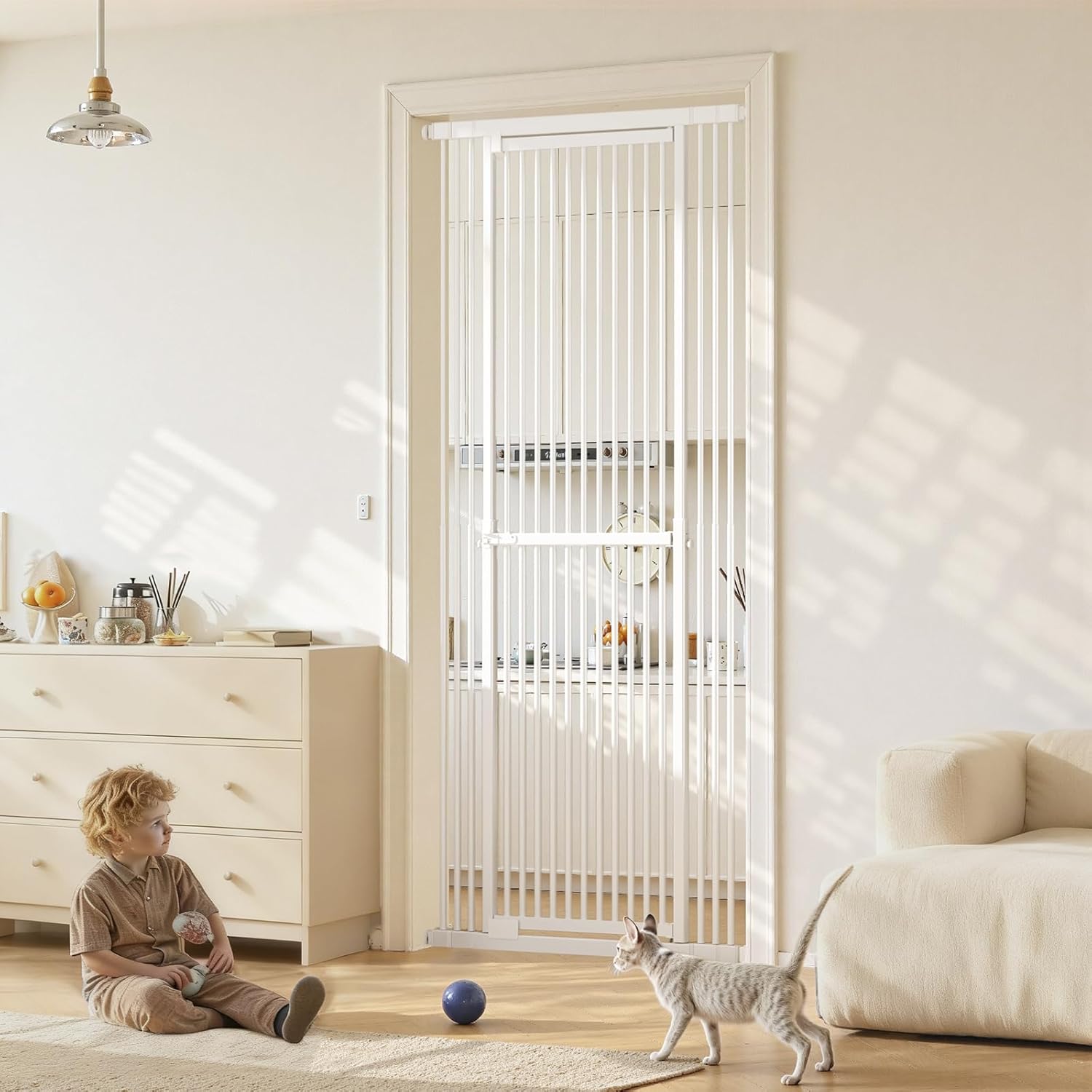
Finding a gate that genuinely contains cats is harder than it sounds. Cats are climbers, gap-finders, and escape artists, and most standard baby gates stop well short of the height needed to slow a determined jumper. The Gardner Pet Extra Tall Cat Gate addresses that problem directly with a published height range of 51 inches to 87 inches, meaning households can configure it to a height that makes casual leaping far less appealing.
The pressure-mount design is one of the most practical features for modern renters and homeowners alike. Because the gate wedges into the doorway using tension rather than screws, there are no holes drilled into trim or drywall, and no landlord conversations to dread. According to aggregated owner feedback, most users complete the setup in under fifteen minutes without reaching for any tools, which matters enormously when you are wrangling pets on the same day you are trying to reorganize a room.
Bar spacing of 1.37 inches is a specification worth paying attention to. Kittens and smaller cat breeds can squeeze through surprisingly wide gaps, and many gates on the market use 2-inch or wider spacing that looks secure until a curious juvenile proves otherwise. The tighter bar spacing here keeps smaller cats contained while still letting you see clearly from one room to the next, which reduces anxiety for both pets and owners who want to monitor activity without opening the gate.
The alloy steel frame addresses a gap in the market that households with mixed pets understand well. If you have a dog that leans against barriers, bats at them, or body-checks them when excited, a lightweight plastic gate flexes, shifts, and eventually fails. The stabilizing brackets on the Gardner gate distribute lateral pressure more evenly, so the structure holds its position even when a medium-sized dog investigates it repeatedly. Based on the published construction specs, this is a gate designed to absorb impact rather than simply redirect it.
One of the small daily quality-of-life features that owners tend to mention only after living with a gate for a few weeks is how it opens. The dual-side, one-handed release mechanism means you can walk through carrying a laundry basket, a litter box liner, or a pet food bag without performing a balancing act. Both sides of the gate release with a single hand, which removes the moment of frustration that accumulates into genuine annoyance over months of daily use.
The four included extension kits expand the effective width from 27.56 to 37 inches. Doorways and hallways vary more than most people realize until they start measuring, and a gate that arrives short of the wall leaves a gap that a cat will find immediately. Having the extension kits in the box on day one means you can fit the gate to your actual opening rather than purchasing add-ons separately or returning the product.
One practical note before purchasing: the gate ships configured at 51 inches and requires manual adjustment to reach taller settings. This is a one-time task, but it does mean setup involves more than simply unboxing and pressing the gate into position. Plan for an extra few minutes to read the adjustment instructions and set your target height before installation.
Cleaning is handled by wiping down the steel bars, which is straightforward for dry debris but takes more attention after a pet accident involving liquids. There are no fabric or mesh panels to remove and launder, so the cleaning process relies entirely on manual wiping.
Key features → what they mean for you
- Height adjusts from 51 inches to 87 inches via a published range of settings→Lets you configure the gate tall enough to stop high jumpers without guessing — a 72-inch or taller setting is a meaningful deterrent for most domestic cats
- 1.37-inch bar spacing across the full gate panel→Prevents kittens and smaller adult cats from squeezing through gaps that standard baby gates allow, closing the most common escape route
- Pressure-mount installation requiring no tools or wall fasteners→Protects rental walls from damage and allows the gate to move between doorways as household needs change without leaving evidence behind
- Dual-side one-handed release mechanism→Eliminates the daily frustration of needing two hands to open the gate when carrying pet supplies, groceries, or laundry between rooms
- Alloy steel frame with stabilizing brackets→Resists the lateral pressure that dogs and larger cats apply when leaning or batting at the gate, maintaining its position over months of use
- Four extension kits included, covering widths from 27.56 to 37 inches→Allows the gate to fit a range of doorway widths out of the box without purchasing additional accessories or accepting a gap at the edge
What works
- Steel construction provides solid impact resistance for households with dogs that lean or jump.
- Tool-free setup preserves rental walls while allowing relocation between rooms.
- One-handed dual-side access reduces daily friction when moving supplies past the gate.
Watch-outs
- Height must be manually adjusted from the shipped 51-inch setting before the gate operates.
- No machine-washable components mean cleaning relies on wiping the steel bars after accidents.
- The gate must be manually adjusted from its shipped 51-inch configuration to reach taller settings before it can be installed at full height, adding a setup step that some buyers do not anticipate from the product listing.
Better alternative: If your doorway exceeds 37 inches in width, a freestanding extra-tall pet gate with a wider panel range would be worth comparing, as the Gardner gate’s extension kits top out at 37 inches and cannot be stretched further.
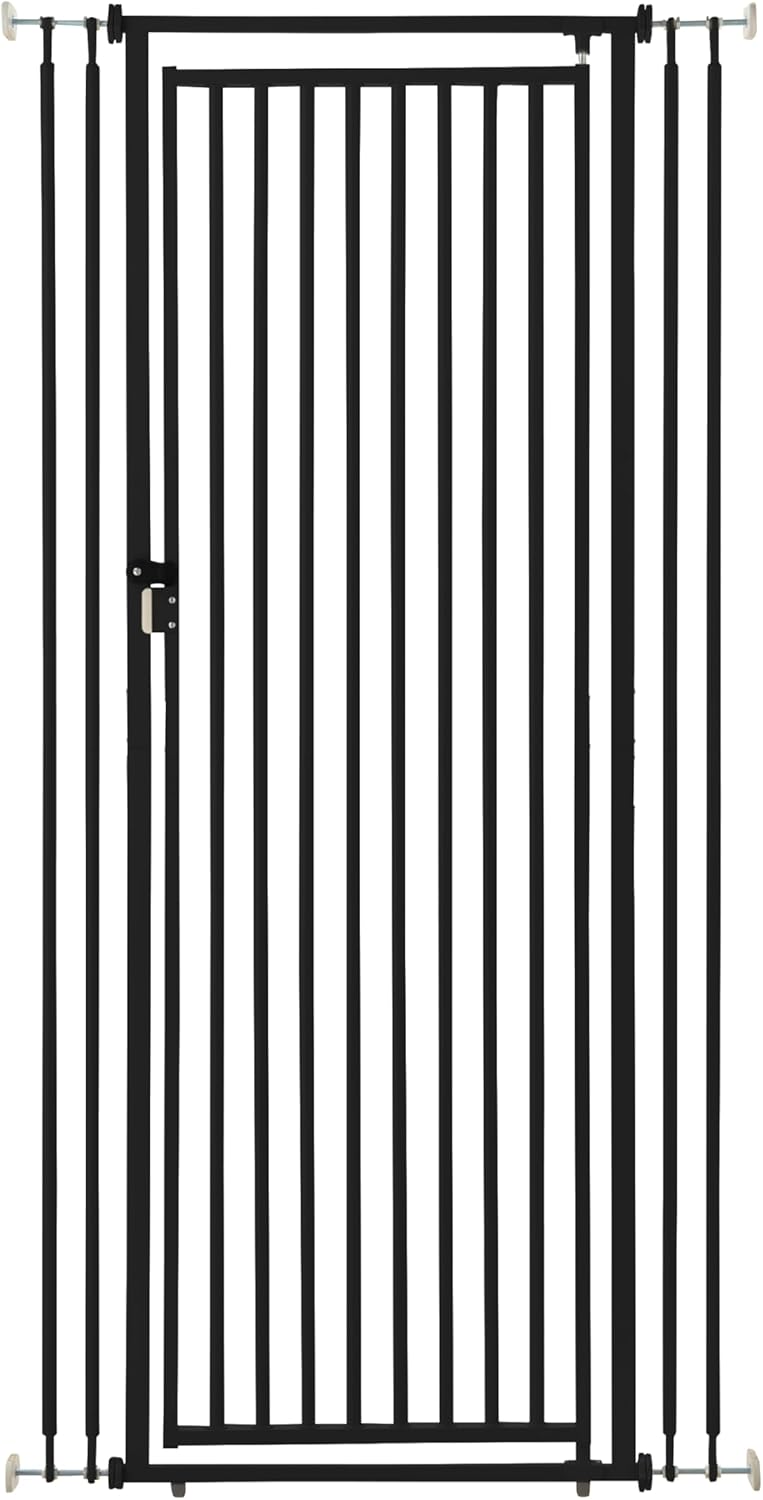
For most cat owners, the real failure point of any gate is height. Standard baby gates top out around 36 inches, and a motivated adult cat treats that as a warm-up jump. The Richell Steel gate addresses that directly: at 70 inches tall, it removes the low-ceiling problem that causes most gate defeats in cat households. That height alone shifts the conversation from “will my cat clear it” to “is my cat one of the rare ones with both the athleticism and the launch angle to beat it.”
The all-steel construction matters beyond durability. Steel holds its shape under repeated impact and leaning, so the gate does not flex or bow after weeks of a persistent cat pressing against it. It also wipes down quickly, which matters in a multi-pet home where paw prints, nose smears, and the occasional food splash are daily realities. Fabric mesh gates absorb odors and require more involved cleaning; this one does not.
At 1.375 inches, the bar spacing is narrow enough to block head-through attempts for most adult cats and reduce squeeze risk for cats on the smaller end of adult sizing. Kittens in a mixed-age household would need additional monitoring near the gate, but for adult cats the spacing is a genuine safety feature rather than a cosmetic one.
The one-way door deserves attention. A contained cat quickly learns that pushing a gate is worth trying. The one-way mechanism removes that option from the inside, so the gate stays where you set it rather than drifting open during an unattended afternoon. For households managing a slow cat introduction, that reliability is meaningful: the separation you set up in the morning is still in place when you get home.
Pressure mounting avoids screws in door frames, which renters and anyone with finished trim will appreciate. The rubber feet grip the floor and walls without marring surfaces. Because setup requires no hardware beyond what comes in the box, the gate can also be repositioned as household routines shift — useful during the early weeks of a new cat introduction when you may be adjusting zones frequently.
The walk-through door earns its keep over time. Stepping over a 70-inch barrier is not practical, and stacking temporary solutions in a doorway means dismantling them every time you pass through. A proper door means the gate becomes part of the house routine rather than a daily inconvenience to work around.
Key features → what they mean for you
- 70-inch total height→Eliminates the jump-over failure that makes standard pet gates ineffective for cats, so the separation you set up actually holds
- All-steel construction→Resists flexing and bending under repeated pressure from leaning or pushing pets, and wipes clean without absorbing odors
- 1.375-inch bar spacing→Reduces the risk of adult cats squeezing through or wedging their heads between bars
- One-way door mechanism→Keeps a contained cat from pushing the gate open from the inside, preserving the separation you intended
- Pressure mounting with rubber feet→Avoids drilling into walls or trim, making this suitable for rentals or temporary room setups that may change
- Walk-through door panel→Makes daily movement through the gate practical rather than requiring you to dismantle or step over a tall barrier
What works
- Tall enough to stop many cats that clear ordinary pet gates.
- Allows airflow and visual contact during slow cat introductions.
- Walk-through door is easier for daily chores than stepping over stacked barriers.
- Pressure mount avoids drilling into door frames or hallway walls.
Watch-outs
- Assembly can be frustrating if parts are mislabeled, misaligned, or installed in a tight opening.
- Not a good fit for openings wider than the stated range without verified extension compatibility.
- Large, athletic cats may still need overhead blocking if they can launch from nearby furniture.
- Assembly in a narrow or imperfectly square opening can be frustrating, and the gate only fits openings between 28 and 37.5 inches wide without confirmed extension compatibility.
Better alternative: PamperYourPet 74.8-inch gate if you need coverage up to 51.6 inches wide or want additional height margin

Most pet gate shopping ends at the question of height, but width is equally limiting. A gate that is tall enough for cats but only fits a 28-inch opening is useless in the wider doorways that connect kitchens to living rooms or hallways to multi-room suites. The PamperYourPet gate covers 29.5 to 51.6 inches wide at 74.8 inches tall, which means it reaches openings that most specialty cat gates cannot address at all.
The 74.8-inch height adds meaningful margin beyond the Richell’s 70-inch design. For cats that are both tall and athletic, that extra few inches can be the difference between a gate that holds and one that becomes a challenge to clear. Based on published specs and owner feedback, the height combined with the bar construction makes this one of the most complete physical barriers in the category.
Iron and thickened steel-style bars give this gate a different durability profile than mesh or screen gates. A cat clawing at a mesh gate will eventually work at the weave; a cat clawing at steel bars will not make progress. For households where a dog also uses the space, bars handle leaning and bumping far better than fabric, and the structural difference shows in long-term stability.
The eight-bolt pressure system spreads the mounting force across more contact points than a two- or four-bolt design. When a large dog leans into a gate repeatedly, that force distribution matters for keeping the gate seated without walking or tilting. Owner feedback consistently mentions that the gate stays put after installation without needing repeated adjustment.
At 1.38-inch bar spacing, this gate offers the same head-and-squeeze protection as the Richell model. For households with kittens or smaller adult cats mixed with larger pets, that spacing is a genuine safety specification rather than a marketing note. It reduces the likelihood of a small cat getting stuck or a kitten finding a gap.
The bidirectional walk-through door removes one of the most persistent complaints about tall gates: that you have to decide which way the door swings before you need it. In a kitchen doorway or pantry entrance that you pass through dozens of times a day from both directions, a door that swings both ways reduces friction enough that the gate stays in place long-term rather than being removed out of daily annoyance.
Reviewers using this gate for cat introductions specifically call out the visual and scent access the bars allow. Two cats separated by a solid barrier cannot complete a proper gradual introduction; separated by bars, they can see and smell each other safely, which is exactly what a slow-introduction protocol requires.
Key features → what they mean for you
- 74.8-inch height→Provides height margin above typical jumping ability for most domestic cats, reducing the chance of a clear even for athletic animals
- 29.5 to 51.6-inch adjustable width→Fits the wider openings that most tall cat gates cannot reach, covering kitchen pass-throughs and open doorways common in open-plan homes
- Iron and thickened steel-style bars→Resists clawing and leaning pressure better than mesh, so the gate holds its shape and integrity under daily contact from cats and dogs alike
- Eight pressure-mount bolts→Spreads installation force across more wall contact points, keeping the gate stable when large dogs bump or push against it
- 1.38-inch bar spacing→Reduces the chance of kittens squeezing through or cats wedging their heads between bars, a real safety consideration in mixed-age households
- Bidirectional walk-through door→Eliminates the need to think about approach direction, making high-traffic doorways practical to manage without removing the gate
What works
- Tall enough for many cats that defeat standard gates.
- Pressure mounting is useful for rentals when drilling is not allowed.
- Narrow bar spacing is a meaningful kitten and small-cat safety advantage.
- Works for both cat separation and large-dog exclusion in shared rooms.
Watch-outs
- Not a discreet decor piece, because the height makes it visually dominant in a doorway.
- A few buyers reported setup details that were not perfectly aligned or smooth.
- For stair use, hardware mounting is the safer choice, so renters may need a different solution there.
- The gate’s size makes it visually prominent in a doorway, and for stair use, hardware mounting is the safer standard, which limits pressure-only installation to flat doorway applications.
Better alternative: Richell 70-inch gate if your opening is under 37.5 inches wide and you prefer a more established brand with a one-way door mechanism

The beeNbkks gate takes a different approach to the height problem. At 79 inches, it is the tallest gate in this comparison, and the clear acrylic panels mean it does not create a visual wall across a doorway the way a solid or bar gate does. For a main living-area entrance where a steel gate would feel institutional, that transparency is a genuine design advantage.
The acrylic-and-metal construction wipes clean easily, which matters in daily pet-household use. The dual-swing door with a 90-degree hold-open function adds practical convenience: when you are moving laundry or groceries through, you can prop the door open rather than nudging it repeatedly with your elbow. Pressure mounting keeps walls and trim intact, which is the right choice for renters.
The honest limitation is the fit range. At 27.5 to 31 inches wide, this gate fits a narrower set of doorways than either steel-bar option. Buyers should measure carefully before purchasing, because there is no flexibility outside that range without an extension that may or may not be available.
Key features → what they mean for you
- 79-inch height with clear acrylic panels→Addresses jumping at the tallest height in this group while keeping the doorway visually open rather than creating a solid wall
- Dual-swing door with 90-degree hold-open→Makes high-traffic doorways manageable without propping the gate with a foot or removing it entirely when carrying items
- Pressure mounting with no-drill installation→Protects walls and trim in rentals or finished spaces where hardware installation would cause damage
- Metal frame with acrylic panels→Wipes clean quickly compared to fabric mesh, reducing the routine maintenance burden in a pet household
What works
- Much taller than typical pet gates, so it addresses jumping rather than only floor-level blocking.
- Transparent panels make it less visually heavy in a living space.
- No-drill installation is useful for rentals or temporary room separation.
- Swinging access is more practical than stepping over a tall barrier.
Watch-outs
- The 27.5 to 31 inch fit range is narrow, so many doorways will be excluded.
- No supplied review history confirms how the pressure mount holds up with repeated impact.
- A chewer may be better served by an all-metal gate.
- The 27.5 to 31-inch width range excludes the majority of standard and wide doorways, making this a specialty fit rather than a broadly applicable option.
Better alternative: PamperYourPet 74.8-inch gate if your doorway is wider or you need steel-bar durability for a cat that pushes or claws at barriers

Most cat owners discover the limits of standard baby gates the hard way: a determined jumper clears a 30 or 36 inch barrier without breaking stride. The Sprouterie sidesteps that problem entirely by starting at 74.8 inches tall and extending to 90.5 inches, dimensions that place the top rail well above the realistic vertical leap of nearly every domestic cat. For households managing a recent rescue, a multi-cat introduction, or simply a cat that has learned to treat ordinary gates as low hurdles, that height difference is the most important number on the spec sheet.
Beyond height, the all-metal bar construction matters for a cat household in a way that fabric mesh barriers do not. Metal does not fray, does not offer claw purchase the way woven material does, and does not develop the saggy center panel that mesh gates often show after a few months of use. The narrow bar spacing is designed to reduce the squeeze-through attempts that kittens and slim adult cats can manage through baby-gate rungs. Pressure mounting means the gate wedges into the doorway frame without screws or anchor bolts, which protects finished trim and painted walls and makes the gate fully removable when circumstances change.
For high-traffic doorways, the two-way swing removes the awkward pivot-and-reposition move that single-direction gates require. The auto-close feature addresses the most common human error in gate ownership: walking through and forgetting to latch it. Based on the published specs, the gate weighs just over 20 pounds, which is reasonable for a unit this tall and suggests a frame substantial enough to stay in place under moderate lateral pressure.
Key features → what they mean for you
- 74.8 to 90.5 inch height range→Stops most cats from jumping over, removing the most common reason pet gates fail in cat households.
- All-metal bar construction→Resists claw damage and does not sag or fray the way mesh panels do over months of use.
- Narrow bar spacing→Reduces the chance that kittens or slim adult cats can squeeze through the rungs.
- Pressure-mount installation→No drilling required, so finished door frames, painted trim, and rental walls stay undamaged.
- Two-way swing with auto-close→Makes quick, one-handed passes through a busy doorway easier and reduces the risk of leaving the gate unlatched.
What works
- Unusually tall for a pressure-mounted pet gate.
- Metal bars should resist clawing better than mesh.
- No-drill installation suits renters and finished door frames.
- Narrow spacing is designed with cats rather than toddlers as the main use case.
Watch-outs
- No supplied review text means stability and latch performance are unverified.
- Width range is relatively limited, so careful doorway measurement is necessary.
- Cleaning instructions are not specified beyond the practical reality of wiping metal.
- The width range tops out at 38.2 inches, so hallways and wide doorways are not compatible, and the limited owner review base means real-world durability is still an open question.
Better alternative: COMOMY 71 inch gate when you need a built-in cat door for mixed-pet homes or a wider width range.

The most common reason a cat gate fails is not a broken latch or a wobbly frame. It is height. Cats that have learned to use a 30 or 36 inch baby gate as a stepping stone quickly render those barriers useless. The Lumizone addresses this directly: at 61.02 inches, the top rail clears the realistic jumping range of the vast majority of domestic cats, including breeds known for above-average athleticism. That single dimension explains why it ranks among the most purchased gates in its category.
Iron construction gives the frame a rigidity that plastic-framed or fabric-mesh alternatives cannot match. The bars do not flex under a cat pushing its weight against them, and the surface gives claws nothing useful to grab or fray. The 1.37 inch gap between bars is narrow enough to stop kittens and small dogs from working their way through, which matters in multi-pet households where a single gate needs to manage more than one species.
Pressure mounting keeps installation to a few minutes without tools. The gate wedges between walls or door frames and comes down just as quickly, which suits renters, foster households, or anyone managing a temporary separation during an introduction period. The auto-close swing means that even a distracted or hurried pass-through is less likely to leave the containment zone open.
Aggregated owner reviews place this gate in a category where buyers report satisfaction with its sturdiness during routine daily use. The auto-close and two-way swing draw consistent positive mentions for households where the gate is opened and closed many times each day. Based on the published specs, the gate weighs approximately 24 pounds, which is on the heavier side for a pressure-mount unit and likely contributes to its stable feel in the frame.
Key features → what they mean for you
- 61.02 inch standing height→Clears the jump height of most cats, ending the pattern of pets using a shorter gate as a launch platform.
- Iron bar construction→Provides a firm, claw-resistant barrier that does not sag or fray with repeated contact.
- 1.37 inch bar spacing→Keeps kittens and small dogs from squeezing through gaps, important in multi-pet homes.
- Pressure-mount installation→Installs without drilling and removes cleanly, protecting walls and trim in rentals or finished spaces.
- Auto-close two-way swing→Reduces the chance of an unlatched gate in busy doorways where the gate is opened frequently throughout the day.
What works
- Tall enough for cats that have learned to clear ordinary baby gates.
- Narrow bar spacing improves containment for kittens and small dogs.
- Pressure mount is easier to remove than hardware-mounted gates.
- Two-way swing helps in high-traffic doorways.
Watch-outs
- A hard-pushing large dog may challenge the pressure-mounted hold.
- The pass-through can feel narrow for some adults.
- Long-term latch wear is not well established in the available reviews.
- The width range tops out near 34 inches, limiting its use in wider openings, and a large dog applying sustained pressure to the frame may challenge the pressure-mount hold over time.
Better alternative: Sprouterie gate when you need height beyond 61 inches or an adjustable tall format for an unusually tall cat or jumper.

Most pet gates ask you to choose: either the gate is open or it is closed. The COMOMY makes a more useful offer. The bottom pet door can stay open for cats while the full frame remains in place, meaning a larger dog in the same home stays on one side while cats move freely through the lower opening. That feature alone changes the daily logistics of a mixed-pet household, removing the constant choice between locking everyone in or letting everyone roam.
At 71 inches tall, the frame clears the jump range of nearly all cats and most large dogs. The metal construction and heavy panel design mean the gate does not flex or rattle under pressure the way lighter alternatives do. The 1.37 inch bar spacing targets the specific problem of kittens and smaller cats finding gaps in standard baby-gate rungs, a real concern for anyone fostering young animals or managing a breed known for slim builds.
Pressure mounting makes the gate practical for temporary setups. A foster household can install it for a new arrival and remove it cleanly when the animal is adopted, without leaving anchor holes in trim or drywall. The walk-through latch handles the high-frequency use that a gate in a main doorway sees every day, removing the step-over frustration of solid panel gates.
Aggregated owner reviews back up what the specs suggest. Owner feedback consistently mentions that the gate feels solid and stays in place during normal daily use. Reports indicate that the walk-through door sees heavy use without developing the wobble that smaller or lighter gates often show after a few weeks. The 81 percent five-star share across available reviews is one of the stronger satisfaction rates in the category.
For foster organizations, multi-cat households managing introductions, or anyone running a home where cats and dogs share space on negotiated terms, the COMOMY’s combination of height, bar spacing, and built-in pet door addresses problems that no single-feature gate can solve.
Key features → what they mean for you
- 71 inch frame height→Stops nearly all cats and large dogs from jumping over, covering both species in a mixed-pet home.
- Built-in bottom pet door→Lets cats pass freely while a larger dog stays contained, removing the need to open and close the full gate every time a cat needs to move.
- 1.37 inch bar spacing→Prevents kittens and slim cats from squeezing through, important during foster introductions when animals are still learning boundaries.
- Metal construction with heavy panel design→Holds firm under repeated pushing and does not develop the flex or sag that lighter materials show over months of use.
- Pressure-mount walk-through latch→Makes temporary installation practical for foster setups and protects finished walls in rentals without sacrificing a functional pass-through door.
What works
- Much taller than ordinary baby gates, which helps with jumpers and large dogs.
- Close bar spacing is a real advantage for kittens and smaller cats.
- Pressure mounting makes it practical for temporary separations and foster setups.
- Walk-through design matters in rooms you enter several times a day.
Watch-outs
- Not escape-proof for cats that climb or jump unusually well.
- No auto-close function, so the latch depends on the user closing it correctly.
- The fit range is narrow for wide hallways or open-plan rooms.
- There is no auto-close function, so an unlatched gate depends entirely on the user remembering to close it, and determined climbers can eventually work their way over any barrier regardless of height.
Better alternative: Lumizone gate when you need auto-close function and your household does not have a mixed-pet pass-through requirement.

The No Pawblems gate stands 55 inches tall, which is a meaningful step above the waist-height gates that athletic cats and determined dogs treat as a minor inconvenience. That extra height reduces the leverage a jumping cat has, making the barrier a genuine obstacle rather than a suggestion. The all-metal frame adds physical weight and rigidity, so the gate does not flex or rattle the way lightweight mesh alternatives tend to after a few weeks of contact. Based on the published specs, the 1.37-inch bar spacing is narrow enough to prevent most adult cats from pushing through, and the vertical bars offer fewer climbing footholds than horizontal-rung designs. The pressure-mount system means no drilling into finished trim or rental walls, though owner feedback consistently mentions that tension must be checked regularly to maintain a firm fit, particularly if the doorway walls are not perfectly plumb. The door swings in both directions, which is a practical detail in tight hallways where you might be approaching from either side with your hands full. A hold-open position locks the door at 90 degrees so the space stays accessible during cleaning without anyone propping the gate manually. Where the gate asks for some patience is in setup: aggregated owner reviews flag the instructions as unclear, especially for the pressure-mount configuration, so expect to spend extra time on first installation.
Key features → what they mean for you
- 55-inch tall frame→Gives athletic cats and large dogs far less clearance to jump or climb over than standard 30-to-36-inch pet gates
- 1.37-inch bar spacing→Reduces the chance that a determined cat can squeeze through or use the bars as ladder rungs to climb
- All-metal construction→Withstands routine claw and paw contact without sagging or tearing, which is a common failure point on mesh and fabric gates
- Pressure mounting with no drilling required→Protects door frames and trim in rentals or finished spaces while still allowing removal when containment needs change
- Bidirectional swing door→Lets you pass through from either direction without turning around, useful when carrying laundry baskets or pet gear
- Hold-open position→Keeps the gate out of the way during chores without removing it entirely, so it is ready to close again immediately
What works
- Tall enough to solve problems that shorter gates did not solve for several buyers.
- Narrow vertical bars reduce both squeeze-through risk and climbing footholds.
- Solid metal frame suits large-dog households better than lightweight mesh gates.
- Pressure mount option preserves trim when drilling is not desired.
Watch-outs
- The lift-to-open door is heavy enough that some users may find it inconvenient.
- Instructions are a repeated weak point, especially for pressure-mount setup.
- The bottom rail is a trip hazard, which makes it a poor fit for busy walkways.
- The bottom rail is a genuine trip hazard in busy walkways, and the lift-to-open door mechanism is heavy enough to become tiresome if the gate sits in a high-traffic passage used many times a day.
Better alternative: The SHYUJAJIE 71-inch gate when you need more height for a serious jumper and the bottom ramp is a safety priority.

Most pet gates top out around 30 to 36 inches, and even the better options in this category stay under 60. The SHYUJAJIE gate comes in at 71 inches, which changes the containment math considerably for cats that treat shorter barriers as a warm-up exercise. Based on the published specs, the adjustable width runs from roughly 30 inches to 43 inches using the included extension panels, covering the majority of standard interior doorways without cutting or custom hardware. The 1.37-inch bar spacing is narrower than many baby gates on the market, which is relevant because some baby gates have gaps wide enough for a cat’s head to pass through. Alloy steel construction should handle routine claw contact and paw pressure better than mesh-panel or fabric-frame alternatives, which tend to stretch or tear at stress points over time. The pressure-mount system keeps walls and trim intact, a meaningful advantage in apartments or recently renovated spaces. One design detail that sets this gate apart from several competitors is the bottom ramp, which replaces the abrupt metal threshold common on pressure-mount gates. That ramp reduces the stub risk for adults moving quickly through the opening and also means a rolling cart or vacuum cleaner passes through more cleanly. The walk-through door eliminates the stepping-over motion that becomes fatiguing in gates used multiple times daily. Owner feedback patterns at 4.4 stars with a 71 percent five-star rate suggest general satisfaction, though the review base is still developing.
Key features → what they mean for you
- 71-inch height→Removes the realistic jumping option for most cats and tall dogs, making containment depend on the gate rather than on a pet’s willingness to try
- 1.37-inch bar spacing→Closes off the head-through and squeeze-through gaps that wider-spaced baby gate bars leave open for cats
- Alloy steel frame→Resists claw marks and repeated body contact that shorten the life of fabric or mesh barriers
- Pressure mounting with no wall holes→Suitable for renters, finished trim, or spaces where drilling is not an option
- Bottom ramp→Reduces the trip hazard at the base threshold and lets vacuums and carts pass without lifting
- Walk-through door→Eliminates the over-the-gate step that becomes physically tiring and impractical for older adults or those carrying pets or supplies
What works
- Unusually tall profile for jump-prone cats and barrier-testing dogs.
- Narrow bar spacing is more pet-focused than many baby gates with wider gaps.
- Pressure mount can be removed without permanent wall holes.
- Walk-through design is more livable than stepping over a fixed barrier.
Watch-outs
- No usable review text was provided, so real-world latch, tension, and long-term stability patterns are unverified.
- Pressure mounting is less secure than hardware mounting for stair tops or very forceful dogs.
- Care and cleaning instructions are not specified beyond wipeable metal and plastic materials.
- The absence of detailed real-world review text means latch durability, long-term tension hold, and day-to-day usability patterns are not independently verifiable from aggregated data at this time.
Better alternative: The KAGNJIC 74.8-inch gate if you need even more height or a wider opening beyond 43 inches.

At 74.8 inches, the KAGNJIC gate is the tallest option in this comparison, and its adjustable width reaching 51.6 inches covers openings that would require two standard gates or a custom solution from most other brands. Based on the published specs, the width adjusts from 29.5 inches up to 51.6 inches, which means wider hallways, double doorways, and open-plan transitions are within scope without any cutting or permanent hardware. The eight-pressure-bolt system is worth noting because it distributes clamping force across more contact points than the four-bolt designs common in this category, which should improve lateral stability in wide configurations where a single-axis tension system can flex. The 1.38-inch bar spacing is consistent with the narrow-bar standard that reduces squeeze-through and climbing risk for cats and small dogs. All-metal construction resists the claw and paw contact that degrades mesh or fabric barriers, and the bars offer fewer grip points for climbing than horizontal-rung alternatives. The two-way swing door includes a 90-degree hold-open position, so it can stay clear when you are moving pet gear, laundry, or supplies through the opening without someone having to hold it manually. Owner feedback shows a 76 percent five-star rate, which is the strongest in this group, though the 11 percent one-star share and limited total review count mean that pattern should be read with appropriate caution. Reports indicate buyers are most satisfied when the gate is used in a wide, stable opening where the pressure system has enough contact area to grip firmly.
Key features → what they mean for you
- 74.8-inch height→Eliminates realistic jump clearance for virtually all domestic cats and most dog breeds, making the barrier a genuine physical limit rather than a deterrent
- 29.5-to-51.6-inch adjustable width→Covers doorways and openings too wide for standard gates without requiring a second unit or permanent hardware installation
- Eight-pressure-bolt mounting system→Distributes holding force more evenly across the wall contact points, improving stability in wider configurations where fewer bolts would allow flex
- 1.38-inch bar spacing→Reduces the gap through which a cat could push its head or attempt a squeeze, and limits the footholds available for climbing
- All-metal frame→Handles scratching and repeated pawing without deteriorating the way fabric mesh or plastic panels do over months of contact
- Two-way door with 90-degree hold-open→Allows easy passage from either direction and locks open when both hands are occupied, removing the need for awkward gate-propping solutions
What works
- Unusually tall profile is aimed at pets that jump over standard gates.
- Pressure mounting avoids drilling into walls or door frames.
- Metal bars are a better match for chewing or clawing than fabric mesh.
- Narrow bar spacing is useful in multi-pet homes with cats or small dogs.
Watch-outs
- No usable review text was available to verify long-term stability.
- Pressure-mounted gates can mark trim or slip if installed against weak or uneven surfaces.
- Care and cleaning instructions are not specified, so confirm maintenance details before relying on it in messy entryways.
- Pressure mounting at nearly 75 inches of height and over 50 inches of width creates a large surface area that depends entirely on wall contact quality, so uneven, painted, or weak wall surfaces increase the risk of gradual slippage over time.
Better alternative: The SHYUJAJIE 71-inch gate if a bottom ramp and a more established review base matter more than the extra height or maximum width.

Most pet gates top out somewhere between 30 and 36 inches, which is little more than a suggestion to a motivated cat. The Snuowu gate addresses that gap with a height range of 51 to 87 inches, which means even a confident jumper faces a barrier that is closer to a wall than a hurdle. For households where one cat treats every standard gate as a launch pad, that extra height is the entire point of the purchase.
The metal construction matters here in a way that plastic-heavy gates do not. Metal does not flex visibly when a large dog leans into it, and it does not develop the soft spots that eventually appear in mesh panels after repeated paw contact. Early owner reports suggest the frame holds its shape under normal large-dog pressure when the gate is properly installed, which matters in mixed-pet households.
Bar spacing of 1.57 inches is aimed specifically at kittens, narrow-headed cats, and small dogs that can thread themselves through the wider openings common on baby gates. That detail is easy to overlook in a spec sheet but represents a real containment difference in practice.
The walk-through door is a practical feature that owners tend to undervalue until they live without it. A gate that requires lifting over or stepping around gets removed. A gate with a functioning door stays in the opening and actually does its job during busy cooking or cleaning sessions.
Pressure mounting keeps walls intact, and the included hardware gives owners the option of a more permanent installation when the situation calls for it.
Key features → what they mean for you
- 51 to 87 inch height range→Stops cats that routinely clear standard 30 to 36 inch gates, removing the need for a second barrier or a closed door
- 1.57 inch bar spacing→Blocks kittens and narrow-headed cats from slipping through vertical bars, a common failure point on wider baby-gate designs
- Metal frame construction→Resists flexing and soft spots that develop in mesh barriers when dogs lean or cats push repeatedly over time
- Walk-through door→Reduces the temptation to remove the gate entirely during busy kitchen or hallway use, so the barrier actually stays in place
- Pressure mount with optional hardware kit→Protects walls and trim in most installations while giving owners the choice of a firmer permanent mount where needed
What works
- Unusually tall format for cats that jump over standard pet gates.
- Narrow bar spacing addresses a real small-pet escape risk.
- Metal frame and buyer feedback point to better rigidity than lightweight mesh barriers.
- Walk-through design is more livable than a fixed panel in daily kitchen use.
Watch-outs
- Extension sizing can leave side gaps that defeat the purpose for cats.
- Pressure-mounted use may be less forgiving in openings with trim, uneven walls, or in-between widths.
- Not a substitute for a professionally mounted stair safety gate.
- Extension sizing can leave side gaps wide enough for a determined cat to exploit, and pressure mounting is less forgiving in doorways with uneven walls or deep trim profiles.
Better alternative: No Pawblems 55 inch gate if your primary concern is an auto-close mechanism and you have a clean, parallel doorway with no pronounced trim
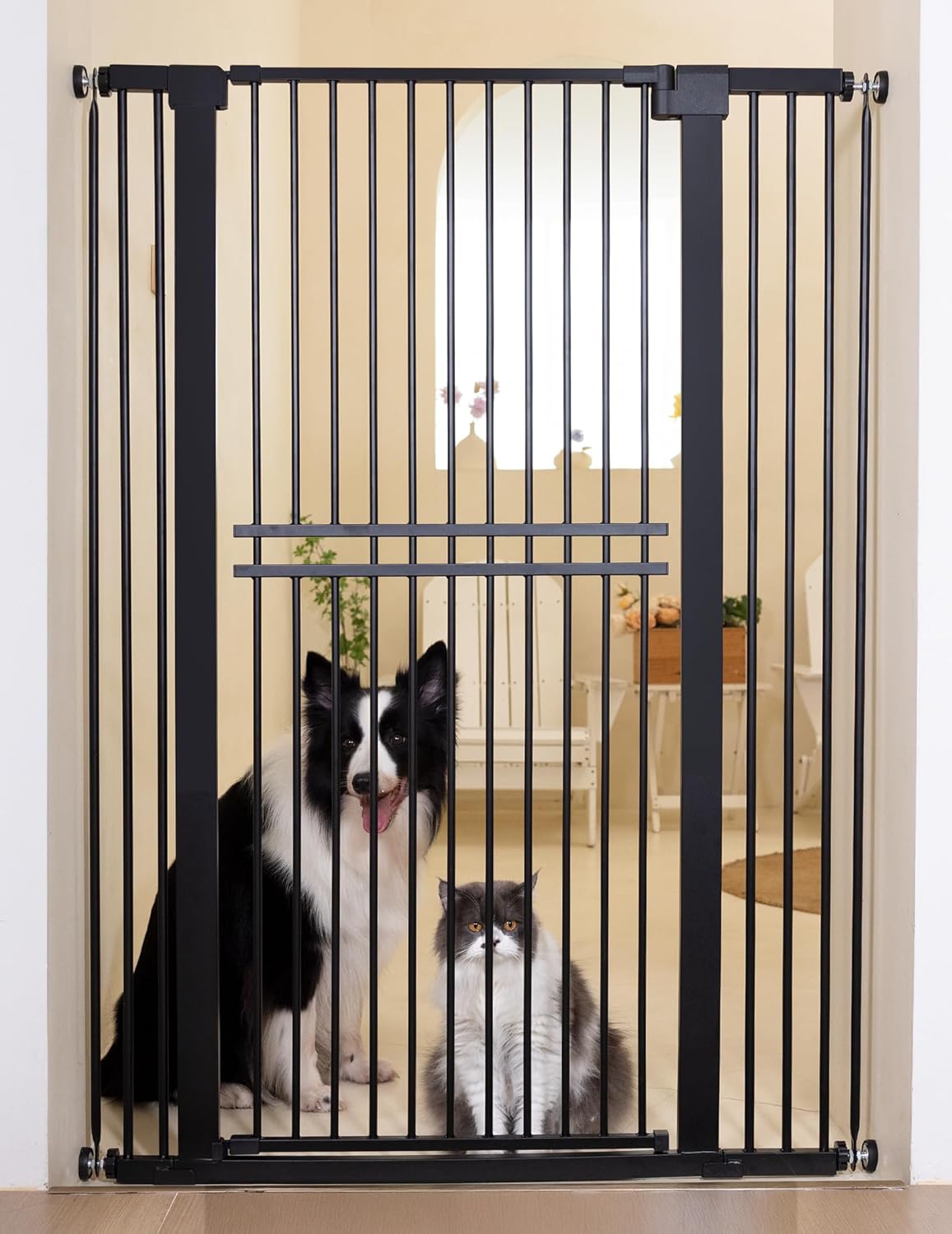
The most common reason a pet gate stops working is not structural failure but human error: someone walks through and the latch does not fully engage. The No Pawblems gate addresses that with an auto-close hinge that returns the gate to a secured position without any manual effort. In a kitchen or hallway where hands are often full, that single feature shifts the gate from a system that depends on consistent human behavior to one that handles the latch on its own.
At 55 inches, the gate clears the height range where most agile cats can jump without building momentum for a full leap. Combined with an opening width of 29 to 40 inches, it fits a standard doorway or hallway without extensions in most cases.
The 1.37 inch bar spacing is among the narrower measurements in the pressure-gate category. For households with slim or young cats, the difference between 2 inch and 1.37 inch spacing is the difference between a cat that stays contained and one that is out before the gate is even latched. Aggregated owner reviews show this detail resonates strongly with small-cat owners who had already lost the containment battle with a wider-spaced gate.
Metal construction holds up to claw contact and chewing in a way that wood dowels and plastic rails do not. Owner feedback consistently mentions that the frame does not show meaningful wear from pets that test barriers regularly.
Pressure installation means no holes in walls or trim, which matters in rentals or in any room where the gate placement is seasonal or temporary. The tradeoff is that flat, parallel wall surfaces on both sides are a real requirement, not a suggestion.
Key features → what they mean for you
- Auto-close hinge mechanism→Returns the gate to a latched position after every pass, eliminating the most common source of accidental pet escapes in busy households
- 55 inch height→Raises the containment threshold above what most domestic cats can clear without a running approach, covering agile breeds that defeat shorter barriers
- 1.37 inch bar spacing→Prevents slim and young cats from threading through vertical bars, a gap-escape risk that wider-spaced gates leave open
- Metal frame→Resists claw scoring and chewing damage that shortens the life of wood and plastic gates in households with active pets
- Pressure-mount design→Allows placement and removal without drilling, protecting walls and trim in rental units or rooms where the gate moves seasonally
What works
- Narrow bar spacing prevents small cats from squeezing through while still allowing visibility.
- Auto close hinge reduces the daily friction of managing a gate with pets underfoot.
- Pressure installation means no holes in trim or walls for temporary room division.
Watch-outs
- Requires flat, parallel surfaces on both sides of the doorway for reliable tension.
- Periodic retightening is needed on some door frames after repeated use.
- Reliable performance depends on having flat, parallel surfaces on both sides of the opening; doorways with trim depth or slight wall angles generate the most reported tension problems.
Better alternative: Snuowu 51 to 87 inch gate if you need more total height or a permanent hardware-mount option for a rough-edged opening
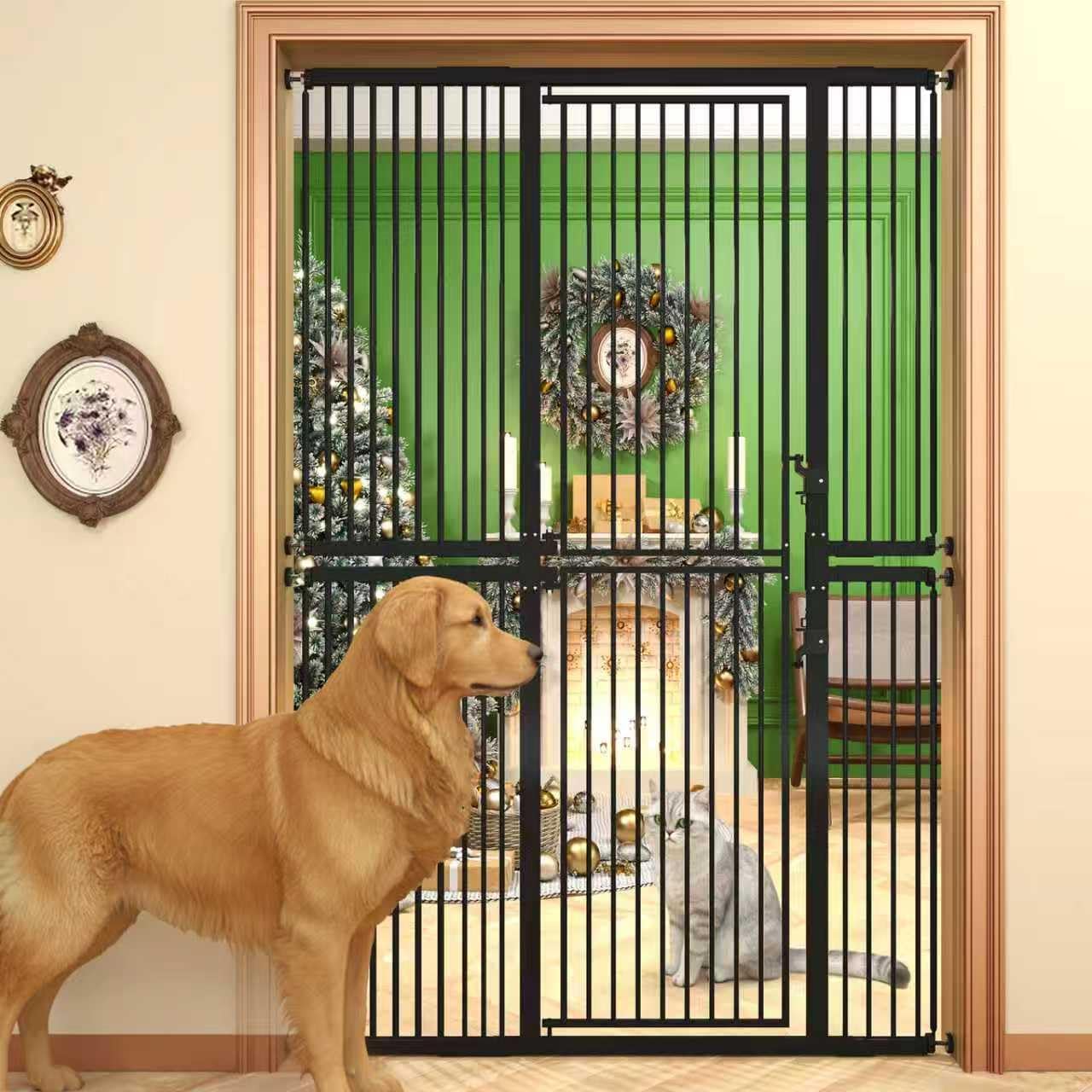
A 74.8 inch gate is not a standard product category. Most commercially available pet gates stop well below 60 inches, and the ones that do reach taller tend to sacrifice width in the process. This gate pairs 74.8 inch height with an extension range of 29.5 to 51.6 inches, which makes it one of the few options that addresses both a tall, agile cat and a wider-than-average doorway or hallway opening at the same time.
All-metal construction is the right material choice for this use case. A gate this tall and wide needs a frame that does not rack under lateral pressure, and metal holds its geometry better than plastic panels or fabric mesh when a large dog leans into or a cat claws repeatedly at the barrier.
Eight pressure bolts are a meaningful design detail. Standard pressure gates rely on two to four contact points, and those gates can develop a perceptible wobble when the frame twists slightly under load. Spreading pressure across eight bolts increases the contact area and should reduce movement in practice, though owner review volume is not yet high enough to confirm this fully over months of daily use.
Bar spacing of 1.38 inches falls in the same narrow range as the other gates reviewed here, which matters for smaller cats that probe for gaps rather than attempt a jump.
The two-way swing and 90 degree hold-open function make the gate less disruptive in rooms where traffic moves in both directions. A gate that blocks doorway flow gets propped open or removed. One that swings both ways and holds open when needed stays in place and fulfills its purpose.
Key features → what they mean for you
- 74.8 inch total height→Creates a containment barrier that even strong jumpers and climbers cannot clear, covering edge cases that shorter tall gates still miss
- 29.5 to 51.6 inch width range→Fits wider doorways and hallways that would require multiple gates or non-standard solutions with narrower products
- Eight pressure bolts→Distributes wall contact across more points than typical pressure gates, which should reduce frame wobble and improve stability in wider openings
- All-metal construction→Maintains frame geometry under repeated lateral pressure from large dogs or cats that claw and test barriers over time
- 1.38 inch bar spacing→Reduces the gap-escape risk for smaller cats without sacrificing the open sightlines that help pets adjust to a new barrier
- Two-way swing with 90 degree hold-open→Lets the gate serve high-traffic rooms without blocking flow, reducing the temptation to prop it open and defeat its purpose
What works
- Unusually tall design addresses climbers more directly than standard pet gates.
- Metal frame is a strong material choice for pets that paw, chew, or body-check barriers.
- No-drill installation can protect trim and walls when properly tensioned.
- Narrow bar spacing improves containment for smaller pets compared with wide baby-gate openings.
Watch-outs
- Review detail is too limited to confirm real-world stability over months of use.
- Pressure-mounted gates depend heavily on wall shape, trim depth, and installation accuracy.
- Care and cleaning instructions are not specified.
- Review history is too thin to confirm whether the stability holds over several months of daily use, and the wide extension range makes it more sensitive to wall surface quality than shorter, narrower gates.
Better alternative: No Pawblems 55 inch gate if your doorway is a standard width and you want a product with a more established owner review record

At 78.74 inches tall and 32.28 inches wide, this gate is built around the one problem most pet barriers ignore entirely: cats that simply jump over them. That full-height barrier changes the equation, turning what is usually a minor inconvenience for an athletic cat into a real containment solution. The solid plastic panel construction matters here too. Where widely spaced metal bars invite a cat to probe for weak points with a paw or shoulder, the solid surface offers far fewer footholds and gaps to test. The white finish reads more like a room divider than a pet product, which is a real quality-of-life difference in a kitchen doorway or main hallway. Pressure-mount installation means no screws, no wall anchors, and no damage to finished trim, which is particularly useful for renters who cannot modify their space. The wipeable plastic surface handles paw prints and kitchen splatter without special care. Based on the published specs, this is a purpose-built cat gate rather than a repurposed baby gate, and that distinction shows in the proportions.
Key features → what they mean for you
- 78.74-inch full-height panel→Tall enough to stop jumping cats that easily clear standard waist-height gates, addressing the most common containment failure in cat households.
- Solid plastic panel construction→Eliminates the narrow gaps found in bar-style gates that cats use to squeeze through or hook a paw for climbing.
- Pressure-mount, no-drill installation→Lets renters and homeowners zone off rooms or stairways without leaving screw holes in walls or finished door trim.
- 32.28-inch adjustable width (27.56 to 32.28 inches)→Fits a range of standard interior doorways without needing extra extension panels or special hardware.
- White finish→Blends into painted walls and trim so the gate reads as home furnishing rather than a pet containment product.
- Wipeable plastic surface→A damp cloth removes paw prints, food splatter, and litter dust quickly, which matters in high-traffic doorways near kitchens or litter rooms.
What works
- Unusually tall profile targets the main failure point of many cat gates, vertical escape.
- No-drill mounting is practical for apartments and temporary room zoning.
- Solid panel layout reduces squeeze-through opportunities compared with widely spaced bars.
- Wipe-clean material is sensible for doorway use near kitchens or litter areas.
Watch-outs
- Plastic construction is less reassuring than metal for large dogs that shove gates.
- Pressure-mounted gates depend heavily on correct tension and flat mounting surfaces.
- Limited review evidence means long-term wobble, latch feel, and scratch wear are not yet well verified.
- Plastic construction is less reassuring than steel or aluminum if a large dog is routinely pushing against the gate. Pressure mounting also means the barrier is only as reliable as the installation tension and the flatness of the mounting surfaces.
Better alternative: Gardner Pet Extra Tall Cat Gate when you want an all-metal frame, need a taller adjustment range, or are fitting a wider opening.

What separates this gate from most cat containment products is the 49-to-86-inch adjustable height, which covers far more of a doorway than a fixed panel can. Cats are climbers as much as jumpers, and a gate that leaves 18 or 20 inches of open space at the top is not really a gate for cats at all. The sliding height adjustment means the coverage scales with the opening rather than requiring a separate add-on panel. All-metal construction adds meaningful rigidity compared with fabric mesh barriers or thin plastic panels. At 29 pounds, this is a gate that stays where it is set rather than shifting under light contact. The included width extensions handle narrower doorways directly, so buyers fitting a standard 27.5-to-32-inch opening do not need to source extra hardware. Pressure mounting keeps installation damage-free, which makes it practical for quarantine setups, foster rooms, or any temporary room separation. The smooth metal bars wipe down without much effort, which helps in households where the gate sits near a food bowl or litter area. Owner feedback consistently mentions that the unusually tall profile was the deciding factor, particularly for households that had already tried and returned shorter gates.
Key features → what they mean for you
- 49-to-86-inch adjustable height→Scales to cover nearly any standard doorway from floor to near-ceiling, removing the climbable gap that defeats most cat gates.
- All-metal frame, 29-pound construction→Resists side pressure and leaning better than plastic or mesh alternatives, giving multi-pet households a more dependable barrier.
- Pressure-mount installation→No drilling required, so the gate moves between rooms or rentals without leaving marks on walls or door trim.
- Included width extension panels→Adjusts from 27.5 to 37 inches of width without a separate purchase, covering a wider range of doorway sizes out of the box.
- Smooth metal bar surface→Wipes clean with a damp cloth, which matters in doorways near litter boxes, water bowls, or feeding stations.
What works
- Unusually tall design addresses cats that jump or climb over ordinary gates.
- Metal frame feels more substantial than many temporary pet barriers.
- Pressure-mounted setup is useful for quarantine rooms, kitchens, and foster spaces.
- Height adjusts as one sliding structure rather than relying on a separate top panel.
Watch-outs
- Door swings in only one direction, which can be awkward in tight hallways.
- Some buyers report fiddly tensioning, loose upper hardware, or side flex.
- Walk-through opening may feel narrow for frequent human traffic.
- The tensioning system has drawn consistent criticism in owner feedback, with reports of wobble and loose upper hardware appearing often enough to be treated as a known issue rather than isolated incidents. The single-direction door swing is also noted as awkward in narrow hallways.
Better alternative: COIHTOE Extra Tall Cat Gate when a solid-panel, fixed-height design and a cleaner visual profile matter more than height adjustability.
What Buyers Consistently Say
What Buyers Repeatedly Liked
Across aggregated owner reviews for extra tall cat gates, the pattern is consistent: buyers who had already tried and failed with standard baby gates report immediate satisfaction once they move to gates in the 61-inch-and-above range. The single most common positive comment is a variation of “my cat finally stopped escaping.” Height, more than any other attribute, drives five-star reviews in this category.
Metal construction draws strong praise, particularly from households that also have dogs. Owners of large-breed dogs note that all-metal frames hold position after body-checking and leaning in a way that plastic or mesh gates do not. Narrow bar spacing earns consistent appreciation from kitten owners, who describe closing obvious escape routes that wider baby-gate bars left open.
Walk-through doors with one-handed latches rank as the second-most-cited quality-of-life improvement. Buyers who previously used fixed panels or step-over barriers describe the change as reducing the daily friction that made them stop using the gate altogether.
Common Complaints
Instruction quality is the most frequently recurring complaint across nearly every brand in this category. Multiple buyers across different products describe unclear diagrams, parts labeled inconsistently, or assembly steps that assume familiarity with tension-mount hardware. This complaint shows up even for gates that receive strong overall ratings, suggesting it is a category-wide issue rather than a brand-specific failure.
Pressure-mount reliability under repeated impact is the second common concern. Owners with large, energetic dogs report that gates require periodic retightening, particularly in the first few weeks after installation. A small number report slippage against textured or uneven trim. This pattern does not appear to be catastrophic in most cases, but it does require owners to build in a brief weekly check.
Some buyers note that walk-through openings feel narrow for adults carrying items. This is more of a design compromise than a defect, since narrower openings improve rigidity, but it is worth noting for households where the gate sits in a high-traffic corridor.
Patterns by Use Case
Cat introduction setups: Buyers using gates for slow cat introductions consistently value narrow bar spacing and height together. The ability to see and smell through the gate while preventing physical access is described as meaningful to the process. Models with solid panels receive less favorable comments in this specific use case.
Rental households: No-drill pressure mounting is not just a convenience feature for this group; it is a requirement. Buyers in this segment are more tolerant of occasional retightening if it means avoiding deposit deductions. They also show a preference for gates that can be relocated between rooms as living arrangements change.
Mixed-species households: These buyers place the highest weight on metal construction and impact resistance. Several describe using a cat gate that also keeps a medium or large dog out of a specific room, and they report that metal frames hold up to dog contact far better than alternatives.
What Most Buying Guides Miss
The Height Threshold That Actually Matters
The marketing around “extra tall” pet gates covers a surprisingly wide range. A gate listed as extra tall may stand 51 inches, 61 inches, 71 inches, or 87 inches. These are not interchangeable. Most domestic cats in good physical condition can clear 48 to 50 inches from a standing jump, and athletic breeds can do more. A gate that tops out at 51 inches is extra tall compared with a standard 36-inch baby gate, but it is not meaningfully taller than what an average adult cat can already clear.
The practical threshold based on published data and owner feedback is approximately 60 to 65 inches for the average household cat. Gates at 70 inches and above address nearly all cats except those that can use nearby furniture as a launch point. Buyers who are replacing a gate that already failed should start at 70 inches, not 55 inches, unless the failure was caused by bar spacing rather than height.
A Contrarian Point on Pressure Mounting
Pressure-mounted gates have become the default recommendation for renters and anyone who wants a no-damage installation, and the recommendation is generally sound. However, the conventional framing undersells how much installation quality matters. A pressure gate installed correctly against flat, parallel, undamaged surfaces with checked tension performs well for most cats. The same gate installed against a doorway with deep trim, a slightly tapered opening, or painted drywall that has never been textured evenly can fail within a week. The gate is not the variable; the surface is. Buyers who have had a pressure gate fail in the past should inspect the mounting surfaces before concluding the category does not work for them.
Common Buyer Mistakes
Measuring the opening width but not checking for trim depth is the most consistent pre-purchase error in this category. Pressure feet that are designed for a 29-inch opening may not seat correctly if baseboard trim or door casing adds an inch of uneven relief on one or both sides. Buyers should measure at the pressure-foot contact point, not at the widest part of the door frame.
A second common mistake is choosing height based on the cat’s current jump record rather than the cat’s physical potential. A cat that currently clears 48 inches can likely clear 54 inches after a few weeks of motivated practice. Buying to the observed limit rather than well above it often results in a second gate purchase within a few months.
A third pattern: buyers with multi-pet households sometimes select a gate optimized for bar spacing without confirming it is tall enough for their cat. Narrow bar spacing prevents squeeze-through; it does nothing to prevent a jumping cat from going over. Both criteria need to be satisfied simultaneously.
A Product We Would Approach with Caution
The Gardner Pet Extra Tall Cat Gate (ASIN B0GGM4LS32) earns the lowest score in this group for a reason. Buyer reports mention fiddly tensioning, side flex, and a door that swings in only one direction. In a category where mounting reliability is a primary safety criterion, a gate with documented wobble and a narrow walk-through is harder to recommend when better-validated options exist at similar or only modestly higher prices.
How to Choose — What Actually Matters
Start with the height your cat actually needs, not the tallest option
Before measuring your doorway, estimate your cat’s real jump ceiling. Most cats can clear 48 to 50 inches from a standing position, and athletic breeds such as Abyssinians, Bengals, or Maine Coons can do more. A gate at 55 inches solves a narrow problem; one at 70 inches or above addresses the full range of average adult cats. If your cat has already cleared a gate once, assume the next jump will be higher, not the same. For most households, 70 inches is the sensible floor for an extra tall cat gate. Gates at 74.8 inches and above are the right starting point for known jumpers, large dogs sharing the space, or any situation where a second gate failure would be costly or dangerous. Height is also the hardest attribute to retrofit: you can add an extension kit for width, but you cannot make a 55-inch gate taller.
Match bar spacing to the smallest pet in the household
Bar spacing matters most when kittens, slender adults, or small secondary pets share the home. The practical threshold in this product class is 1.37 to 1.38 inches. Most adult cats above four to five months cannot fit their shoulders through a gap of that size, though very slender breeds and young kittens may still attempt it. Solid-panel designs eliminate the squeeze-through risk entirely, but they also eliminate visual and olfactory contact between animals, which slows cat introduction processes. If you are using the gate for a slow introduction between resident and new cats, a barred design with narrow spacing is generally preferable to a solid panel. If containment is the only goal and introduction dynamics do not apply, a solid panel is acceptable and arguably more escape-proof for persistent climbers who use bar gaps as footholds.
Verify your doorway dimensions at the pressure-foot contact point
Measuring doorway width at eye level and measuring at the baseboard are often two different numbers. Deep door casing, baseboard trim with a raised profile, or a slightly tapered opening can all create a mismatch between the listed fit range and the real usable width. Measure at the exact height where the pressure feet will contact the wall or trim, on both sides. If trim relief on one side is uneven, a flat pressure foot may not seat fully, reducing holding force. Some gates include rubber or angled foot pads designed to accommodate modest trim depth; check the manufacturer specs for your specific model. Buyers with older homes, wide-profile baseboard trim, or door frames that are not perfectly plumb should confirm measurements before ordering rather than relying on a nominal doorway width.
Decide whether auto-close or hold-open matters more for your routine
Walk-through convenience sounds like a comfort feature, but it is actually a containment-reliability feature. A gate that requires two hands to open, or that must be physically stepped over, gets propped open or removed during busy mornings and often does not go back up before the cat has already moved. Auto-close hinges solve the forgetful-pass-through problem in households with moderate traffic. Hold-open positions at 90 degrees solve the opposite problem: carrying laundry, groceries, or a pet carrier through a gate that swings back against you mid-transfer. If your gate sits in a kitchen or laundry corridor with multiple daily passes, hold-open is the more practical feature. If the gate guards a room you enter only occasionally, auto-close is the safer default.
Factor in build quality for the other animals in the household
Cat gates are often selected on cat-specific criteria, but in mixed-pet homes the gate will also be tested by dogs. A medium or large dog that leans, body-checks, or jumps against a pressure-mounted gate applies substantially more force than a cat testing the bars. For those households, all-metal construction and a higher pressure-bolt count matter more than they would in a cats-only home. Gates with eight pressure bolts distribute holding force across more contact points and tend to wobble less after repeated impact than simpler four-bolt designs. If your dog outweighs 40 pounds and has a habit of testing barriers, treat metal construction and bolt count as non-negotiable rather than optional upgrades.
Decision Matrix — Match Your Priority
Final Verdict
The two gates that consistently rise above the rest in this category do so for complementary reasons, making the right choice between them straightforward once you know your household’s primary constraint. The Gardner Pet 51 to 87 inches Extra Tall Cat Gate earns the best overall position because it addresses the widest range of real-world cat-gate problems in a single product. The height range extends to 87 inches, which puts it well above what any household cat can reasonably clear. Alloy steel construction with stabilizing brackets holds up to dog contact in mixed-species homes. Four included extension kits handle doorway widths from just under 28 inches to 37 inches, covering the majority of interior openings. One-handed dual-side release is the right design for anyone who carries items through the gate multiple times a day. Aggregated owner reviews support its ranking near the top of its subcategory on major retail platforms. The beeNbkks Extra Tall Cat Gate at 79 inches earns best value recognition for a specific and underserved buyer: anyone who wants a tall, functional barrier that does not visually dominate a main living-area doorway. Clear acrylic panels reduce the visual weight of the barrier in a way no metal-bar gate can match. Pressure mounting requires no drilling, and the dual-swing door with 90-degree hold-open handles daily traffic without frustration. At its price point, it offers a distinct aesthetic advantage that no other gate in this group replicates. For households with the budget and the need for furniture-grade build quality, the Richell Steel 70-inch gate remains the premium option, with all-steel construction and a finish that reads more like home decor than a utility barrier. Buyers who should hold off are those with doorways outside the 27.5 to 31 inch range of the beeNbkks, or anyone whose primary concern is a very forceful large dog; those households should prioritize the Gardner Pet’s steel frame and wider installation range instead.



Write Your Review
No reviews yet. Be the first to share your experience!