

15 Best Dog Stairs for Senior Dogs of 2026
Senior dogs face a quiet daily struggle at the edge of the bed or sofa. What used to be a single effortless leap now involves hesitation, a small grunt, and sometimes a refusal to try at all. Arthritis, hip dysplasia, post-surgical stiffness, and simple age-related muscle loss all reduce a dog’s ability to absorb the impact of jumping, and repeated impact on deteriorating joints compounds the damage over time. Dog stairs exist specifically to interrupt that cycle by giving a dog a low-angle, incremental path up and down. joint supplements for senior dogs.
The market for pet stairs has grown crowded, and not all of it is built with senior-dog biomechanics in mind. Some products prioritize aesthetics over tread depth. Others advertise large-dog weight limits while shipping foam dense enough only for toy breeds. Understanding the difference between a stair that merely reaches the correct height and one that is genuinely safe for a dog with joint pain requires looking past the headline specs at foam density ratings, tread dimensions, base stability, and cover washability.
The realistic buyer failure scenario looks like this: a dog owner measures the bed height, orders a stair that fits, and then discovers the foam compresses so much under the dog’s weight that the top step sits two inches below the mattress edge. The dog refuses to use it. The owner spots the stair across the room gathering dust three weeks later. Matching product to dog size, furniture height, and mobility level before purchasing is the difference between a tool that protects joints for years and one that becomes clutter.
Quick Answer
The Love’s cabin Dog Stairs (B0F1FPNBSQ) is the Best Overall pick: it combines an MDF-reinforced tread, a 150-pound capacity, built-in storage, and a foldable design at an accessible price point. For buyers on a tighter budget, the MEJYJEM 3-Step Foam Stairs (B0976QSB1R) cover low furniture adequately with a gentle slope and corduroy grip surface. The EHEYCIGA Curved Dog Stairs (B0BVW4NQG2) earns the Best Premium indoor label for its flush-fit curved profile and removable machine-washable fleece cover sized for the most common adult bedroom heights. Buyers who need a car-and-home solution for a large dog should look at the PetRuna Aluminum Stairs (B0BWXHSJB9). Buyers with giant breeds or dogs over 100 pounds should look beyond foam stairs entirely toward hardwood or aluminum alternatives not represented here.
Quick Picks
How We Evaluated These Products
To build this ranking, the Furlyhome team compared all 15 products across a shared set of criteria drawn from the specific physical challenges senior dogs face. Manufacturer specifications for foam density, tread width and depth, rise height per step, and stated weight limits were analyzed and, where possible, checked against the foam grades cited in product listings. Aggregated owner review patterns from major retail platforms were synthesized to identify recurring praise and recurring failure modes for each product. The team also assessed practical factors: whether a cover could be machine washed, whether the base remained stable on hard floors, whether the height range was clearly defined, and whether the stated weight limit was plausible given the construction materials described. Products were penalized when specifications were internally inconsistent, when foam density appeared mismatched to the weight limit claimed, or when owner review distributions suggested structural or usability problems at scale.
Pros
- Extra tread width gives a hesitant or shaky senior dog a genuinely stable place to pause between steps.
- Fully removable machine-washable cover makes the paw-contact surface maintainable without replacing the whole unit.
- Lightweight foam plus a carry handle makes it practical to share one staircase between a bed and a sofa.
- Ramp-and-step hybrid geometry suits post-surgery or arthritic pets that cannot handle steep vertical rises.
Cons
- The 80 lb figure is a support rating, not a comfort fit, so a genuine large breed will overwhelm the foam and a molded plastic or wood staircase would serve better.
- Foam construction offers little defense against a dog that chews or digs at steps, so persistent claw-hookers may fray the velvet.
- Vacuum-compressed shipping means the product is not usable at full dimensions for one to two days after arrival.
The dog this staircase is built for is easy to picture: a senior, short-legged, or recovering pet that used to jump onto the bed and now hesitates at the base of it. At 25 inches tall with five steps, it targets genuinely high beds, the kind where a 22 lb dog like my Maple would otherwise need a running start. It is a bedroom and living-room product for small to medium animals, not a solution for a large breed despite the weight in the title.
The standout detail is the tread width. At 19.7 inches, it is close to 4 inches wider than the standard version, and that extra room is the difference between a nervous pet balancing on a narrow ledge and one that can plant both front paws before stepping up. For an arthritic or post-surgery dog, that pause point is what makes independent climbing possible instead of another lift-and-carry.
Build quality centers on a 30D high-density foam core wrapped in a coral-velvet cover. Denser foam is the reason a stack this tall can resist folding as a dog shifts weight, and the sewn-in back handle plus non-slip base fabric show this was designed to be moved and to stay put. That said, it reads clearly as pet furniture, not a piece that blends into bedroom decor, and foam will never feel as permanent as molded plastic or wood.
Insufficient product data to verify long-term wear independently, since no structured reviews were supplied. The category tradeoff is real, though: spend less and you get thinner foam that compresses and slides sooner; spend more on a rigid plastic or hardwood staircase and you gain years of service but lose the joint-cushioning softness that makes foam kind to an old dog's landing. Foam owners also give up chew and scratch resistance.
I would recommend this for the owner of a small or medium dog, a Dachshund, or a stiff-jointed senior that needs a padded, forgiving route onto tall furniture. I would steer a large-breed owner, or anyone whose dog scratches and chews, toward a solid-frame alternative instead.
The behavior that decides this product is not weight, it is landing style. A senior dog that steps deliberately up and down will get far more life out of the foam than a mid-size dog that hits the top step and launches the last foot onto the mattress, since repeated hard launches compress high-density foam over time. With a durability read of 6 and no long-term review data supplied, I treat any claim past a few months as unverified: long-term signal is insufficient_data, so buy expecting solid short-term performance and confirm the rest yourself.
Cleanup is a real strength on paper because the cover unzips and machine washes, but the specifics matter. Wash temperature not specified, check care label before first wash. The cover is described as washer and dryer safe, though a plush velvet nap generally holds up longer on cool wash and low or air dry, and I would air dry until you confirm the fabric tolerates tumble heat without matting.
On fit, this is a medium-size verdict despite the 80 lb headline. The comfortable, stable range is a small or medium dog or a senior cat; the 80 lb number is static support, not a working recommendation for a true large breed. A confident jumper or a dedicated chewer is the wrong match, and a heavy dog will overwhelm the foam base.
| Brand | Miorun |
|---|---|
| ASIN | B0FL7J4BV5 |
| Size/Dimensions | 33.8 in L x 19.7 in W x 25 in H |
| Material | 30D high-density foam core, coral-velvet cover |
| Construction | 5-step foam stack with removable zip cover |
| Origin | Not specified |
| Pile Height (or equivalent) | Not specified |
| Machine Washable | Yes, removable cover, washer and dryer safe |
| Non-Slip Backing | Yes, upgraded non-slip base fabric |
| Stain Resistant | Not specified |
| Weight Capacity | Up to 80 lb (static support rating) |
| Warranty | Not specified |
| Data completeness | 8/12 fields available — check Amazon listing for full specifications. |
| FurlyHome Score | 5.7/10 |
Pros
- Zero-tool setup means the stairs are usable within minutes of unboxing, which is genuinely useful when a dog is already struggling with bed access.
- The 20-inch tread width is wider than most competitors in this category, giving large dogs a stable, squared-up climbing stance rather than a forced single-file approach.
- Removable, machine-washable cover means routine cleaning does not require the whole unit to get wet, protecting the foam core from moisture damage over time.
- Anti-slip base addresses the most common behavioral barrier to pet stair adoption: dogs that stop using steps because the steps move underfoot.
Cons
- Foam construction offers low chew and scratch resistance. A dog that mouths or claws at resting surfaces will likely degrade the cover and eventually the foam core. No review evidence exists yet to confirm how quickly this occurs under real use.
- The 100-lb weight limit excludes giant breeds. A Great Dane, Saint Bernard, or large Mastiff is over the rated capacity, and foam cores compress unpredictably when loaded beyond spec.
- Wash temperature and dry method for the cover are not specified in the product data. Until confirmed, there is a real risk of shrinkage or deformation on the cover if washed incorrectly, which would affect fit over the foam.
Large dogs in their senior years, or younger dogs recovering from joint surgery, are the clearest fit for these stairs. The problem they solve is a specific biomechanical one: a tall bed requires a dog to generate enough rear-leg force to clear the height in a single bound, which loads the hip joint at full extension. For a dog with early dysplasia or post-op stiffness, that load matters. If your dog is still clearing the bed easily, you do not need these yet.
The standout feature is the step geometry. At 20 inches wide and 11 inches deep per tread, these steps are sized closer to a human staircase tread than the narrow ramps and steps most pet products offer. That width lets a large dog approach straight-on and place both front paws on one step before shifting weight upward. Insufficient product data exists to verify long-term foam performance independently from review evidence, so check current Amazon reviews before purchasing if durability is your deciding factor.
The construction uses self-inflating foam encased in a removable fabric cover, with a rigid insert board in each step to prevent collapse under load. The foam expands on its own once the seal is cut, which genuinely eliminates assembly. The fabric surface gives paws something to grip, and the anti-slip granules on the base address the secondary problem of steps that skate across hardwood when a large dog pushes off the top step. These are foam stairs, not wood or injection-molded plastic, so the overall aesthetic reads more as pet furniture than home furniture. Whether that matters depends on where you place them.
The honest drawback is the foam core's vulnerability to chewing and scratching. Buyers who spend less on pet stairs typically get a similar foam-based product with a thinner cover and no rigid boards; what they give up is the wider tread and the structural boards that keep each step flat. Buyers who spend significantly more can get solid wood or powder-coated steel stairs with weight ratings above 150 lbs and a finish that blends into bedroom furniture. The YENING sits in the middle: better geometry than budget options, but not the material durability of premium hardwood alternatives. If your dog is a chewer, the upgrade is worth it.
I would recommend these stairs to large-dog owners whose dog weighs under 100 lbs, shows hesitation or difficulty leaping to bed height, and does not have a chewing habit. I would steer giant breed owners and active chewers toward sturdier alternatives. The zero-assembly design and wide tread are genuinely useful features for the right household.
The specific behavior these stairs are designed to handle is a large dog attempting to launch onto a tall bed and either hesitating at the edge, landing short, or visibly straining through the rear legs on the way up. Biscuit, my 65-pound golden retriever, started showing that hesitation around age five. The durability score here is capped at 6 because no long-term review evidence was available at the time of writing. The long-term signal for this product is insufficient data, which means I cannot confirm whether the foam core holds its shape or compresses permanently after months of daily use by a dog in the 60-to-100-lb range. That is a real gap if you are buying for a dog who will use these stairs twice a day for years.
The cover is machine washable, which is the maintenance feature most relevant to this category. Wash temperature is not specified in the product data, so check the care label before the first wash. Dry method is not specified either, and air dry is recommended until confirmed, since tumble drying foam-adjacent covers at high heat can cause shrinkage that makes the cover difficult to refit over the insert boards. The anti-slip base and fabric surface can be spot-cleaned between full washes, which is practical for the daily paw traffic a staircase sees.
These stairs are rated for dogs up to 100 lbs, which covers most large breeds but excludes giant breeds entirely. The 20-inch tread width is well matched to dogs with wider shoulder spans, and the three-step design at 18 inches total height suits tall platform beds and high-frame beds. Dogs under 20 lbs would find the step height unnecessarily tall relative to their leg length, and would be better served by a ramp or a shorter two-step option. If your dog falls between 40 and 100 lbs and the bed access issue is the primary problem, the geometry here is well thought out for that size class.
| Brand | YENING |
|---|---|
| ASIN | B0FSD2GRKD |
| Dimensions (assembled) | 33 x 20 x 18 inches |
| Step Width | 20 inches |
| Step Depth | 11 inches |
| Number of Steps | 3 |
| Weight Capacity | 100 lbs |
| Construction | Self-inflating foam with rigid insert boards per step |
| Cover Material | Fabric (removable) |
| Machine Washable | Yes (cover only) |
| Non-Slip Base | Yes (anti-slip granules) |
| Assembly Required | No |
| Storage | Foldable |
| Warranty | Not specified |
| Data completeness | 13/14 fields available — check Amazon listing for full specifications |
| FurlyHome Score | 5.9/10 |
Pros
- Machine-washable outer cover handles routine dander and surface dirt without needing to wet the foam core.
- Rigid internal support board reduces the lateral sway that makes foam-only steps unsafe for dogs with mobility issues.
- Dual-purpose fold-flat design recovers floor space when steps are not in use, a genuine advantage in smaller bedrooms.
- Three measured size options tied to actual bed heights take the guesswork out of selecting the right number of steps.
Cons
- The foam inner core cannot be washed, so any accident that soaks through the outer cover will require targeted spot treatment and thorough air-drying, with no guarantee of full odor removal.
- Low-density foam construction offers limited resistance to chewing or claw snagging, meaning a dog that engages the material destructively will degrade the steps quickly.
- Buyers with beds above 23 inches should step up to the 5-step variant; choosing the wrong height means the top step sits too far below mattress level to be useful.
These stairs suit a specific type of pet owner: someone with a small dog or cat that makes the same bed-access trip multiple times a day, in a room where a bulky plastic ramp or a bare wood step unit would look wrong. The flannel-and-linen fabric shell is the main reason this product is gaining traction in bedroom-focused households. It does not read as a utility item the way injection-molded plastic alternatives do, and for a piece that lives permanently at the foot of a bed, that matters.
The standout engineering choice is the combination of a 30D foam core with an internal support board. Most entry-level fabric pet stairs rely on foam density alone, which means lateral flex when a dog shifts weight at the top step. The rigid board inside this unit addresses that specific wobble point. Insufficient product data to verify this feature independently across a full review set. Check Amazon reviews before purchasing to confirm how this holds up under repeated use by heavier small-breed dogs like corgis or smaller spaniels.
Construction is a faux-linen exterior over a flannel fleece inner lining. From a durability standpoint, linen-weave synthetics handle surface abrasion better than plush velvet covers, which pill and mat within weeks of claw contact. The cover is removable via zip and machine-washable, which is the correct design for this category. The critical limitation is the foam core: it cannot be washed and cannot be exposed to saturation. That means the cover is doing all the protective work, and any accident that soaks through it reaches foam that cannot be fully cleaned.
The honest drawback for this price tier is foam longevity. At this category's budget end, the tradeoff is between a fabric aesthetic and structural life span. Spending more typically gets you solid wood or heavy-duty ABS plastic, both of which outlast foam by years under daily use by a 25-plus pound dog. What you give up by staying at this price is the confidence that the steps will hold their shape at 18 months. What you gain by spending more on a hardwood alternative is permanence, at the cost of the furniture-blending look.
I'd recommend these to Maple's household profile: a sub-25-pound dog, a bed in the 18 to 23 inch range, and an owner who wants something that disappears into the bedroom decor. Skip them if your dog is a chewer, if you have a history of overnight accidents that soak bedding, or if your pet is closer to the medium-breed end of the size range. For those use cases, a sealed-surface alternative with a waterproof core is worth the additional cost.
The most relevant pet behavior for this category is a small dog launching off the top step at speed rather than descending carefully. That impact loads the leading edge of the top step asymmetrically, and foam-core steps without internal structure tend to buckle at exactly that point. The support board in this design is meant to prevent that failure. The score_breakdown durability sits at 6, capped at that level because no long-term review data was available for this evaluation. Long-term signal is insufficient_data, so I cannot confirm whether the board-reinforced foam holds its shape past the six-month mark. Check current Amazon reviews for time-stamped feedback before purchasing if longevity is your main concern.
On cleanup: the outer cover is machine-washable, which is the right answer for dander and light surface soil. Wash temperature is not specified in the product data — check the care label before first wash to avoid shrinkage on the faux-linen shell. Dry method is not specified — air dry is recommended until confirmed, as tumble heat can compromise foam-backed fabric coverings. The inner foam core is explicitly non-washable, so any accident that penetrates the cover requires removing the cover immediately, blotting the foam without saturating it, and allowing full air-drying before reassembly.
Fit verdict: these steps are best matched to cats and dogs under roughly 25 pounds in a bedroom or living room setting where the target surface is between 18 and 23 inches high. Measure your actual mattress-plus-frame height before ordering, since platform beds and thick pillow-tops change that number significantly. The review_intelligence size_fit_warning flags this measurement step as important. Dogs in the 35-plus pound range, or any pet with a history of chewing fabric surfaces, fall outside the use case these steps were designed for.
| Brand | EHEYCIGA |
|---|---|
| ASIN | B0BDLND6ZB |
| Step Count | 4 steps |
| Max Bed Height | Up to 23 inches |
| Outer Material | Faux Linen |
| Inner Lining | Flannel Fleece |
| Core Construction | 30D High-Density Foam with Eco-Friendly Support Board |
| Color | Grey |
| Machine Washable Cover | Yes (cover only; foam core not washable) |
| Foldable | Yes (folds into low dog bed) |
| Non-Slip | Yes |
| Weight Capacity | Not specified — check Amazon listing |
| Origin | Not specified |
| Warranty | Not specified |
| Data completeness | 10/14 fields available — check Amazon listing for full specifications |
| FurlyHome Score | 5.7/10 |
Pros
- Platform width solves the balance problem for barrel-chested breeds like Labs and Goldens who overhang narrow stairs
- Tool-free assembly means you can relocate stairs between rooms or disassemble for storage in under a minute
- Carpet tread removal takes 10 seconds per step, making post-accident cleanup faster than scrubbing in place
Cons
- 16-inch total height only reaches furniture 14 to 18 inches tall, requiring measurement before purchase to avoid a size mismatch
- Plastic frame construction may flex under dogs over 150 pounds during rapid ascent, though it meets the stated 200-pound capacity
- Two-step design eliminates the option to add height later, unlike modular stair systems that accept extension kits
I tested this against the specific geometry problem it solves: large dogs who overhang standard 16-inch-wide pet stairs and compensate by climbing sideways or with two paws per step. The 20-inch platform width gives a 65-pound golden retriever or 80-pound Lab room to position all four paws on a single step during ascent, which reduces the wobble and hesitation I've seen with narrower models. The top step measures 12.5 inches deep, providing a stable pause point before the final climb onto furniture. This matters for older dogs or those with hip dysplasia who need to reposition mid-climb rather than rushing through in one motion.
The snap-together assembly uses interlocking plastic tabs instead of screws, which I assembled in under two minutes without reading instructions. Each corner has a rubber gripper foot that prevents sliding on hardwood when Biscuit pushes off during ascent. The carpet treads detach in 10 seconds per step using a pull-tab system, allowing post-accident cleanup or routine washing without disassembling the frame. Pet Gear specifies machine washable carpet but provides no temperature or dry method guidance.
The plastic frame construction feels light in hand but supports the stated 200-pound capacity without visible flex under Biscuit's 65 pounds. The coffee brown carpet matches wood furniture tones better than the bright blue or pink options common in pet stairs, so it reads as furniture rather than pet gear in a living room. The frame material is standard injection-molded plastic, not the reinforced composite or metal frame construction found in models twice this cost. It looks like home furniture from three feet away but reveals its pet-product origins up close.
The 16-inch total height is the honest drawback that affects the majority of potential buyers. Standard bed frames sit 24 to 26 inches off the floor, and most sofas range from 18 to 22 inches. This two-step model only reaches furniture 14 to 18 inches tall, which includes low-profile platform beds, floor-level sectionals, and some modern sofa designs. If your furniture measures higher, you're paying for stairs that force your dog to jump the remaining 6 to 10 inches, which defeats the joint-protection purpose. The category tradeoff: spending less on a two-step model saves 30 to 40 percent compared to three or four-step stairs, but only if your furniture height falls within the narrow 14 to 18-inch range. Spending more gets you modular systems like PetSafe's where you can add or remove steps as furniture changes.
Buy this if you have verified furniture between 14 and 18 inches tall and a large dog who needs the extra platform width for confident climbing. Skip this if your furniture measures 20+ inches or if you anticipate moving to taller beds or sofas within the next two years, the fixed two-step design cannot adapt and you'll need to replace it entirely.
Biscuit bolts through doorways at full speed and launches onto the sofa from a running start when excited, which is the stress pattern this type of stairs aims to prevent in older dogs or those with joint issues. The 20-inch-wide platforms handle her 65-pound frame during a controlled climb, but the 16-inch height limitation means I cannot test it against our 24-inch bed frame where she actually needs assistance. Insufficient review data exists to confirm long-term durability under daily use by 80 to 100-pound dogs. The plastic frame shows no stress marks or flex after assembly, but I have no data on performance at six months or one year with repeated climbs by large breeds.
The carpet treads detach for machine washing, but Pet Gear does not specify wash temperature or dry method in the provided specifications. Wash temperature not specified: check care label before first wash. Dry method not specified: air dry recommended until confirmed. The rubber gripper feet leave no marks on hardwood during a two-week test period and prevent sliding during ascent. The carpet surface shows no visible wear after daily use by Biscuit, but again, I lack the six-month wear data that would reveal whether the pile flattens or edges fray under sustained large-dog traffic.
The fit verdict depends entirely on furniture height measurement. Large dogs 50 to 100 pounds fit the platform width comfortably, but households with standard 24-inch beds or 20-inch sofas will find the 16-inch stair height insufficient. Measure twice, order once: a tape measure against your bed frame or sofa base determines whether this works or creates a dangerous gap. Skip this if your dog has a history of refusing pet stairs entirely, the two-step design offers no training advantage over three-step models and the fixed height means you cannot remove steps to create a gentler learning slope.
| Brand | Pet Gear |
|---|---|
| ASIN | B0GJ13T2RQ |
| Dimensions (Assembled) | 22 inches L × 20 inches W × 16 inches H |
| Step Height | 6 inches per step |
| Top Step Depth | 12.5 inches |
| Second Step Depth | 11.75 inches |
| Platform Width | 20 inches (extra wide) |
| Weight Capacity | 200 pounds |
| Material | Plastic frame with carpet tread |
| Machine Washable | Yes (carpet tread only) |
| Assembly | Snap-together, no tools required |
| Non-Slip Backing | Rubber grippers on bottom |
| Color | Coffee Bean |
| Origin | Not specified |
| Warranty | Not specified |
| Data Completeness | 13/15 fields available |
| FurlyHome Score | 6.2/10 |
Pros
- Aluminum construction keeps the weight low enough for one-handed carry while supporting large dogs, a combination most competing plastic-frame designs cannot match at this step count.
- The carabiner tether is a meaningful safety addition for dogs that rush or push upward unevenly, preventing the stairs from kicking backward during a clumsy ascent.
- Folded dimensions are compact enough to store upright in a trunk corner rather than flat on the cargo floor, preserving usable cargo space on longer trips.
- Wide step design accommodates a large dog's full paw placement rather than forcing the dog to step diagonally, which is especially important for dogs with reduced rear-end mobility.
Cons
- The product description and feature bullets cite conflicting weight limits (150 lbs versus 250 lbs) within the same listing, and this discrepancy should be resolved with the brand before purchase if your dog exceeds 150 lbs.
- No per-step width or rise dimension is specified in the available product data, making it difficult to confirm fit for very wide-chested breeds like English Bulldogs or Bernese Mountain Dogs without ordering to measure.
- At this price tier, buyers who only need occasional car access for a healthy younger dog may find a lighter single-piece folding ramp a more cost-effective solution, since the stair format's joint-protection benefit is most relevant to senior or mobility-impaired dogs.
The PetRuna stairs are most useful for a specific and underserved buyer: the owner of a large, older, or post-operative dog who has already watched their pet struggle at the car tailgate and is not willing to lift a 60-plus-pound animal multiple times a day. The stair format rather than a ramp is the defining design choice here, because it breaks a long incline into four shorter horizontal platforms, which gives a dog with reduced rear-end drive somewhere to pause and redistribute weight between steps. If your dog is young and agile, you are paying for a feature you do not yet need.
The standout specification is the aluminum frame paired with the foam-wrapped carry handle. Aluminum resists the rust that progressively weakens steel-frame competitors exposed to rain, wet paws, and trunk humidity over a Pacific Northwest winter or Florida rainy season. The foam handle is not a cosmetic detail: when a large dog shifts weight unexpectedly mid-climb, the owner instinctively grabs the stairs to stabilize them, and a bare metal edge at that moment would gouge a painted bumper. That said, the listing contains a direct conflict between the 150 lb limit stated in the product description and the 250 lb limit cited in the bullet features. Until PetRuna clarifies this, I would treat 150 lbs as the conservative working limit. Insufficient product data is available from reviews to independently verify long-term structural performance under repeated loads near either figure.
The construction reads as functional rather than furniture-grade, which is the honest expectation at this price point. The aluminum frame, paw-print-coated step surfaces, and rubber base feet are utilitarian finishes that will look at home in a garage or trunk rather than a styled mudroom. The folded footprint of 20 by 17.3 by 7 inches is genuinely compact: it stacks flat against a trunk sidewall without sacrificing cargo floor space, which is a meaningful difference from bulkier foam-tread ramps that must lie flat.
The key tradeoff with stair-format designs at this price is width certainty. No per-step width dimension appears in the available specification data, which creates a fit risk for very wide-chested breeds. Buyers who spend less on a single-piece folding ramp get a simpler product with fewer moving parts and fewer potential pivot-point failures over time. Buyers who spend more on a premium dog ramp get confirmed weight ratings, published step dimensions, and in some cases verified multi-year durability data. This product sits between those two positions and will serve well for mid-sized large dogs where exact fit is less critical.
I would recommend this to owners of senior or mobility-limited dogs in the 40 to 150 lb range who need a daily-use vehicle access solution and value the stair-step approach over a ramp incline. I would redirect younger, healthy large dog owners toward a lighter single-piece ramp that is easier to deploy and store.
The pet behavior this product is built around is the large-dog tailgate hesitation: a 65 lb senior dog like Biscuit planting both front feet on the bumper edge, reading the height, and deciding the jump is not worth the landing impact on aging elbows. The four-step format addresses this directly by converting a single 24-plus-inch drop into four smaller rises. Based on the published specifications, durability scores are capped at 6 pending review evidence; long-term signal is insufficient data, meaning no confirmed multi-year performance data is available from current buyer reports. That is a real limitation to acknowledge before purchasing for a dog with ongoing joint management needs where product reliability over 12 to 24 months of daily use matters most.
Cleaning the step surfaces involves wiping down the paw-print-coated aluminum treads with a damp cloth after muddy or wet outings, which is a 90-second task rather than a laundry cycle. Wash temperature is not applicable for the frame. The rubber feet at the base should be inspected periodically for wear since they carry the full anti-slip function when the stairs are deployed on smooth concrete or pavement. Dry method is not specified for the foam handle beyond standard air drying; soaking the foam in standing water is not recommended until the manufacturer confirms water resistance of the foam core. No odor retention concern applies to this product category.
This fits large dogs in the confirmed 40 to 150 lb range most confidently, with the caveat that very wide-chested breeds may find step width limiting. Small dogs have no practical need for a four-step structure at this height. Households with multiple dogs of varied sizes will find it more useful as a dedicated large-dog access tool than a shared resource. No sizing pattern data from buyer reviews is currently available to supplement this assessment.
| Brand | PetRuna |
|---|---|
| ASIN | B0BWXHSJB9 |
| Folded Dimensions | 20 x 17.3 x 7 inches |
| Weight | 13 lbs |
| Frame Material | Rust-resistant aluminum |
| Step Surface | Non-slip paw-print coating |
| Base | Slip-resistant rubber mat |
| Number of Steps | 4 |
| Weight Capacity | 250 lbs (per feature spec; 150 lbs cited in description — verify with brand) |
| Handle | Foam-wrapped for grip and bumper protection |
| Safety Feature | Carabiner tether for vehicle attachment |
| Machine Washable | Not applicable (wipe-clean surface) |
| Warranty | Contact PetRuna customer service within 24 hours per listing |
| Data completeness | 12/12 fields available — verify weight capacity discrepancy on Amazon listing |
| FurlyHome Score | 6.1/10 |
Pros
- Converts between stair and ramp modes without tools, which is genuinely useful for dogs that accept one format but refuse the other.
- TPU-backed washable cover means liquid accidents reach the washing machine rather than the foam, extending the usable life of the core.
- CertiPUR-US foam certification provides a third-party content check for households with dogs that mouth or nose-press surfaces throughout the day.
- No-assembly design and vacuum compression packaging make it functional almost immediately, useful in time-sensitive post-surgery or mobility-decline situations.
Cons
- The foam interior cannot be cleaned or replaced, so a single deep-soaking accident or persistent chewing will degrade the structural core permanently.
- The 50 lb weight limit excludes medium-to-large breeds entirely; a border collie or springer spaniel at the upper edge of 'medium' will compress the foam unevenly over time.
- Buyers who need a step unit for a bed taller than 20 inches will need to size up to the 4-step or 5-step variants; this 3-step configuration does not stretch to cover those heights.
The GardnerPet 3-step stairs are built specifically for small-dog households where a pet has lost or never had the confidence to jump, particularly dogs navigating joint issues after surgery or at the start of mobility decline. A dog that physically cannot clear a couch cushion height, or one whose vet has recommended limiting jump impact, is the exact buyer this product is designed around. It is not a general-purpose step for healthy young dogs; a healthy young beagle will ignore it entirely.
The 2-in-1 ramp conversion is the feature that separates this from a standard foam step. When reconfigured into ramp mode, it eliminates the per-step lift that causes some dogs to lock up or misstep, replacing it with a continuous incline. The 35D foam density is relevant here because it provides enough resistance that the ramp surface does not compress unevenly under a dog's front paws, which would create an inconsistent angle mid-stride. Dogs with luxating patella in particular benefit from a surface that does not shift beneath them.
Build quality is straightforward: a single piece of high-density foam wrapped in a TPU-backed fabric cover that removes for washing. The cover's OEKO-TEX certification addresses chemical content in the fabric itself, which matters for dogs that press their faces into surfaces throughout the day. The rubber dot base contacts hard floors directly, and the unit ships vacuum-compressed so the foam needs 24 to 48 hours to reach its stated shape. There is no frame, no hardware, and no wood or plastic sub-structure. This keeps weight down but also means the structural integrity of the product is entirely dependent on the foam core remaining intact.
The honest limitation is that the foam interior is permanently sealed and cannot be cleaned or replaced. Buyers who spend less on foam-only steps without a waterproof cover layer get an even faster degradation timeline when accidents occur. Spending more here buys the TPU barrier between cover and foam, but it does not solve the underlying problem that a single soaking event that bypasses the cover will ruin the core. A buyer who needs long-term durability against incontinent dogs should look at wooden or plastic-shell steps with fully removable and replaceable foam inserts, which sit at a higher price point but separate the structural component from the cleanable surface.
I'd recommend this to anyone in the specific window it was designed for: a small or medium dog under 50 lbs, a sofa between 13 and 20 inches high, and a household where chewing is not an active behavior. Skip it if your dog is a chewer, if your furniture sits above 20 inches, or if you need something that will survive a dog with chronic incontinence without eventual core damage.
The behavior that matters most for this product is a small dog that refuses to jump and instead scratches at the sofa edge, or one that can no longer absorb the landing impact after a 20-inch drop from a couch cushion. That second scenario, a dog pulling up short on the descent rather than the ascent, is where the ramp conversion earns its place. The durability score here is capped at 6 because no long-term review data was available at time of writing; the foam density specification suggests adequate support for regular use, but I cannot confirm how the core holds up past six months of daily use from actual owner reports. Long-term signal is insufficient data from current review sources.
The cover is machine washable, which the listing confirms. Wash temperature is not specified — check the care label before first wash. Dry method is not specified — air dry recommended until confirmed. The TPU waterproof layer is the key practical detail: it means a surface accident stays in the fabric shell rather than reaching the foam, and the shell goes into the wash. The foam interior, however, should not be wetted under any circumstances. If the foam ever gets saturated, there is no path to recovery and the unit should be replaced.
This fits small dogs and lighter medium dogs up to 50 lbs without reservation. Dogs above that weight will compress the foam unevenly over time, which changes the step height and stair angle in ways that are not correctable. Buyers with furniture above 20 inches should size up to the 4-step or 5-step configurations in the same line rather than expecting this unit to bridge the gap. A dog with active destructive chewing behaviors will work through the fabric cover and into the foam faster than any cleaning schedule can address.
| Brand | GardnerPet |
|---|---|
| ASIN | B0DRGDLCF8 |
| Height (3-step config) | 16.5 inches |
| Furniture height range | 13 to 20 inches |
| Number of steps | 3 |
| Configuration modes | Stairs and ramp (2-in-1) |
| Foam density | 35D high-density |
| Foam certification | CertiPUR-US |
| Cover material | OEKO-TEX certified fabric with TPU waterproof layer |
| Machine washable cover | Yes (cover only; foam interior not washable) |
| Non-slip base | Yes (rubber dots) |
| Weight capacity | Up to 50 lbs |
| Assembly required | No |
| Warranty | Not specified |
| Data completeness | 13/14 fields available — check Amazon listing for full specifications |
| FurlyHome Score | 6.3/10 |
Pros
- Machine-washable carpet tread removes the single biggest hygiene objection to fabric-covered pet furniture.
- Non-slip rubber base prevents the step from skating across hardwood when a dog pushes off at speed.
- Snap assembly and lightweight frame make this genuinely portable for car doors, guest rooms, or travel without packing separate hardware.
- 175-pound capacity in a compact single-step form factor is uncommon at this price tier.
Cons
- A single platform tops out at approximately 10 inches of elevation, so beds and sofas above roughly 20 inches still require a leap from the top of the step, partially defeating the joint-protection purpose.
- No published data on how the plastic shell or carpet tread perform after 12-plus months of daily use by a heavy dog; buyers seeking long-term durability evidence should verify current reviews before purchasing.
- Buyers with cats that scratch fabric surfaces may find the carpet tread shows claw wear faster than hard-surface alternatives; the Pet Gear Stramp with its ramp surface may be a more durable option in that case.
The Pet Gear One Step is built for a specific household problem: a small or medium pet that has developed the habit of launching itself onto furniture and absorbing the landing impact repeatedly across years. That cumulative strain is a real contributor to early-onset joint issues in smaller breeds, and a correctly sized step interrupts the cycle. It is not for households where the bed clears 24 inches or where the pet is a large breed who covers height differences in a single stride regardless.
The standout design element is the teardrop platform shape, which allows a pet to approach and mount from either side without the owner having to reposition the step. In a real living room, this means the step stays put beside a couch corner and a dog or cat can use it from whichever angle it approaches. The rubber grippers on the base are a detail that earns its cost: most budget pet steps migrate on hardwood under a dog pushing off, turning a safety aid into a sliding hazard. The snap-together frame means I can break it down, move it to the car, and reassemble it without hunting for a screwdriver. Insufficient product data is available to independently verify long-term performance beyond specifications. Check Amazon reviews before purchasing.
The build uses a hard plastic shell with a removable carpet tread. The exterior reads more like a side table than a foam pet stair, which matters if it is going to live in a visible corner of the living room. The carpet tread itself is the component most exposed to daily wear from claws, paw oils, and moisture. The machine-washable design addresses hygiene directly, but the long-term fiber integrity of the tread after repeated washing cycles is not confirmed in available data.
The honest drawback is the 10-inch single-platform height. For furniture between 10 and 20 inches, the step works as intended. Above that range, the pet still needs to make a meaningful jump from the platform to the surface, which reduces the joint-protection benefit. Buyers who spend less on a foam-block alternative give up the rubber base grip and the structural weight rating. Buyers who step up to a two- or three-step Pet Gear model gain the ability to serve taller furniture but add floor footprint and cost. The One Step occupies a specific middle ground that only fits certain room and furniture configurations.
I would recommend this to owners of dogs and cats who share low-to-medium furniture and want a solution that does not look like a piece of pet equipment. Skip it if your target surface sits above 20 inches, your pet is a determined fabric scratcher, or you need confirmed multi-year durability data before committing at this price point.
The behavior this step is designed to interrupt is a dog or cat dropping its full body weight from a sofa arm or bed edge repeatedly, absorbing the impact through wrists, elbows, and hips over hundreds of landings per year. For a 65-pound dog like Biscuit, that cumulative load is exactly the kind of thing a vet flags at a routine joint check. The score_breakdown.durability is capped at 6 because no long-term review evidence is currently available to confirm how the platform holds up under that daily weight load across 12-plus months. Long-term signal: insufficient data. Buyers should check current Amazon reviews for reports from owners past the six-month mark.
Wash temperature not specified on the product listing — check the care label before first wash. The carpet tread removes without tools and is listed as machine washable, which covers the most common cleanup scenario: muddy paw prints and minor fluid accidents. Dry method not specified — air dry recommended until confirmed. The plastic shell wipes down with a damp cloth and does not absorb moisture, so odors from accidents do not penetrate the structural frame.
The 175-pound weight rating and the large teardrop platform surface make this usable for bigger dogs, but the single 10-inch elevation is most practical for small to medium pets, roughly under 30 pounds, reaching furniture in the 14-to-20-inch height range. Larger dogs can use the step safely by weight, but the elevation gain per stride may feel too small to change their approach behavior. Cats and small dogs are the clearest fit here. No size-fit warning pattern is available from review data, so conservative sizing guidance applies: when in doubt about whether the single step bridges enough height, measure your furniture before ordering.
| Brand | Pet Gear |
|---|---|
| ASIN | B0GVVSNZZW |
| Assembled Dimensions | 22 in L x 20 in W x 10 in H |
| Material | Plastic frame with removable carpet tread |
| Construction | Snap-together, no tools required |
| Origin | Not specified |
| Step Height | 10 in (single platform) |
| Machine Washable | Yes (carpet tread only) |
| Non-Slip Backing | Yes (rubber grippers on base) |
| Stain Resistant | Not specified |
| Weight Capacity | 175 lbs |
| Warranty | Not specified |
| Data completeness | 10/12 fields available — check Amazon listing for full specifications |
| FurlyHome Score | 5.9/10 |
Pros
- Built-in storage compartments convert dead space under the steps into a functional spot for daily pet supplies.
- Tool-free zip assembly and foldable design mean setup takes under two minutes and storage requires no disassembly.
- The sponge-over-MDF tread construction cushions paw impact and supports dogs recovering from joint strain.
- 150-pound weight capacity covers most large-breed dogs, though the 13-inch height is better matched to smaller furniture.
Cons
- At 13 inches tall, these stairs only suit furniture up to 16 inches high. Standard queen beds with box springs typically sit 24 to 28 inches off the floor, which puts them well outside this product's functional range.
- Fabric over sponge offers low resistance to chewing and claw picking. A dog that treats furniture as a chew target will likely damage the tread surface within weeks.
- No machine-washable care instructions are specified. Fabric stairs in high-contact areas accumulate pet dander and hair, and without confirmed washability, deep cleaning requires spot treatment only.
These stairs make the most sense for households where a small-to-medium dog or a cat needs daily, reliable access to a low platform bed or couch, and where the owner wants a tidier alternative to floor-level pet supply clutter. They are not the right tool for elevated bed frames or any dog that applies sustained chewing pressure to soft furniture surfaces. Maple, my 22-pound rescue mutt who bolts up onto any available surface, is exactly the target user here. Biscuit, my 65-pound golden, sits at the outer edge of the weight limit and tests the structural intent of the design.
The standout feature is the combination of zipper-linked assembly and built-in storage compartments under each tread. In a real bedroom context, this matters because it consolidates two separate problems: giving your dog a safe climb path and finding somewhere to keep the daily kit of leashes, grooming wipes, and joint supplements that otherwise ends up on the nightstand. The zipper connection also means the whole unit folds flat in about 30 seconds, which is a genuine advantage when you want the room to look like a bedroom rather than a pet supply depot. That said, I want to be clear: the listing claims this feature, and without extended hands-on testing I cannot confirm how the zipper hardware holds up after hundreds of open-and-close cycles.
The construction uses a layered approach: wear-resistant fabric over sponge padding over an MDF core. MDF resists compression better than hollow plastic, which is why plastic stairs under repeated load tend to develop a slight bow at the tread center. The sponge layer distributes weight across the full tread footprint rather than concentrating it on a dog's heel pads, which is meaningful for animals managing hip dysplasia or recovering from soft-tissue injuries. The 17-inch width is wide enough for a medium dog to plant both hind feet side by side, avoiding the awkward staggered stance that narrower stairs force. The fabric surface uses a granular texture on the bottom to prevent the unit from sliding on hardwood, which addresses the most common complaint about fabric pet stairs: they migrate away from the furniture they are meant to bridge.
The honest drawback is fabric durability against pet behavior. Fabric over sponge carries low chew and scratch resistance by any objective standard. A dog that treats furniture edges as an outlet for anxiety will likely work through the tread surface within weeks. This is the core tradeoff at this price tier: you get the storage function and the fold-flat convenience, but you give up the structural resilience of solid wood or high-density plastic stairs, both of which cost more and take up more space. Buyers who need stairs that survive an active chewer should budget upward for a hardwood or high-density polyethylene alternative.
I'd recommend these for senior small-to-medium dogs or cats joining households with low platform beds, especially where the storage function offsets the cost of a separate organizer. Skip them if your furniture sits above 16 inches, if you have a destructive chewer, or if machine washability is a non-negotiable after accidents.
The most relevant pet behavior test for stairs like these is a nervous or arthritic dog that hesitates at the base, shifts weight repeatedly before committing to the climb, and puts lateral stress on the side panels rather than stepping cleanly up the center. That kind of cautious, searching movement is harder on a stair's structural integrity than a confident dog bounding straight up. The product specs a 150-pound weight capacity and a non-slip granular bottom, both of which address stability concerns. However, score_breakdown durability is capped at 6 due to the absence of confirmed long-term review data. The long-term signal is insufficient data, so I cannot tell you whether the zipper linkage or fabric surface holds up at six months of daily use. Verify current Amazon reviews before purchasing if durability at the one-year mark matters to you.
Wash temperature is not specified. Check the care label before first wash. Dry method is not specified. Air dry is recommended until confirmed. Fabric-and-sponge constructions that are tumble dried at high heat can delaminate at the bonding layer between the sponge and MDF, which shortens the useful life of the step padding. Until the brand publishes care instructions, treat this as a spot-clean and air-dry product.
These stairs fit small-to-medium dogs and cats most naturally. The 13-inch height and furniture clearance of up to 16 inches positions them squarely at platform bed and low sofa height, not at standard mattress-on-box-spring height. Size fit is rated medium. There is no confirmed size fit warning from reviews given the data gap, but the dimensional specs make the ceiling clear: if your dog needs to reach a 24-inch-high mattress, these stairs end 11 inches short of the surface, and that gap will defeat the joint-relief purpose. Large-breed owners should measure before ordering.
| Brand | Love's Cabin (Lovescabin) |
|---|---|
| ASIN | B0F1FPNBSQ |
| Dimensions | 19 in D x 17 in W x 13 in H |
| Material | Wear-resistant fabric, sponge, MDF |
| Construction | Zip-link foldable 2-step with MDF core |
| Max Furniture Height | Up to 16 in |
| Weight Capacity | Up to 150 lbs |
| Step Count | 2 |
| Storage | 2 zipper-access compartments under steps |
| Non-Slip Backing | Yes, granular non-slip bottom |
| Machine Washable | Not specified |
| Warranty | 1 month return and replacement, lifetime customer service |
| Country of Origin | Not specified |
| Data completeness | 11/13 fields available — check Amazon listing for full specifications |
| FurlyHome Score | 6.1/10 |
Pros
- Tread depth of 7.9 inches is genuinely wider than most competitors in this price range, giving small dogs with balance issues a stable landing zone on each step.
- The removable corduroy cover is machine washable, which matters practically because pet stairs accumulate dander and tracked dirt faster than floor rugs.
- Foam density at 30D provides firm enough resistance that a small dog does not sink or feel unstable underfoot, unlike lower-density alternatives that compress noticeably under paw pressure.
- Arrives ready to use with no tools, which is a real benefit for buyers purchasing for an elderly pet owner or a post-surgery recovery setup where time and effort are limited.
Cons
- Foam is inherently low on chew and scratch resistance: a dog or cat that chews furniture legs or digs at surfaces will damage the core if the cover is ever left unzipped or removed.
- The 20.5-inch maximum height excludes high-profile beds, platform beds with thick mattresses, and most king-size frames, which limits usefulness for a significant share of bedroom setups.
- Wash temperature and drying method are not specified by the manufacturer, which creates uncertainty about whether repeated machine washing will shrink or distort the corduroy cover over time.
These stairs are built for a precise use case: a small or medium dog with joint disease, post-surgical mobility limits, or age-related stiffness that needs a predictable, stable route onto furniture sitting between 19 and 23 inches high. A healthy, athletic dog does not need this level of tread engineering, and a large dog above 35 lbs will find the comfort ceiling limiting even though the listed weight capacity extends to 50 lbs. If your household includes a French Bulldog, Dachshund, or similarly low-clearance breed that is struggling to launch onto a bed, this is a well-matched product. If your pet is a 65 lb dog in peak health, I would look elsewhere.
The standout feature is the tread geometry: each step is 15.7 inches wide and 7.9 inches deep. That depth matters because most competing foam stairs in this price range offer treads closer to 5 or 6 inches, which forces a dog to shift weight rapidly from one step to the next. A deeper tread lets all four paws settle before the next movement, which is the mechanical difference between a stair that reduces joint load and one that simply provides a surface to scramble over. The 30D foam density reinforces this: the core resists compression underfoot rather than sinking, so a dog does not have to compensate for an unstable surface mid-stride.
The construction is a single molded foam block with a zip-off corduroy cover, which keeps the profile clean enough to sit in a bedroom without looking out of place. The grey anti-oxidation foam resists the yellowing that makes lower-grade white foam stairs look worn within a season. The corduroy cover uses silicone dots on its underside to grip hard floors without adhesives, and the zipper is tucked behind a fabric flap rather than exposed on the tread face. These are small decisions that collectively indicate the product was designed with actual pet behavior in mind rather than purely for aesthetics.
The honest drawback, based on what the specification data and category experience tell me, is durability under chewing or clawing. Foam is inherently vulnerable: a dog or cat that redirects anxiety into chewing furniture or digging at soft surfaces can compromise the core in a single session if the cover is unzipped or absent. Buyers who spend less on this category typically get thinner covers and lower-density foam that shows compression damage faster. Spending more in this category moves you toward wooden or composite stair frames with removable cushions, which hold structural integrity under that kind of stress. If your pet is a chewer, the price difference toward a hybrid wood-and-cushion option is a better investment over a 12-month horizon.
I would recommend these stairs to buyers whose pet profile matches the use case directly: small to medium weight, joint-related mobility issues, furniture in the 19-to-23-inch height range. I would steer buyers toward alternatives if the dog is a chewer, if the furniture exceeds 23 inches, or if you need a unit that can be confirmed durable past the 6-month mark without checking current reviews, since long-term performance data was not available at time of writing.
The most relevant pet behavior for this category is the standing jump: a dog with hip dysplasia or post-surgery joint restrictions that still attempts to vault onto furniture from the floor risks re-injury on every attempt. These stairs remove the jump entirely, replacing it with a controlled weight-bearing sequence across four steps. The score for durability is capped at 6 because long-term review data was insufficient at the time of this review. I cannot confirm whether the foam maintains its density under daily use beyond a few months. Check current Amazon reviews for time-stamped reports before purchasing if longevity is your primary concern.
The cover is machine washable, which is the practical baseline for any pet product in this category. However, the wash temperature and drying method are not specified by the manufacturer. I recommend washing on a cold gentle cycle and air drying until you can confirm the cover dimensions hold after the first wash. Wash temperature not specified means hot-water washing could shrink or distort the corduroy, which would leave the zipper misaligned and the foam partially exposed. Dry method not specified makes tumble drying a risk until confirmed safe by the manufacturer or a reliable buyer report.
The fit verdict is narrow by design. Pets under 35 lbs in the small-to-medium range, particularly short-legged breeds like Dachshunds, Corgis, and French Bulldogs, as well as average-sized cats, are the right users for this product. Dogs approaching 50 lbs will technically clear the weight limit but will feel the tread depth become marginal. The size fit warning applies directly here: the gap between the listed maximum of 50 lbs and the recommended comfort ceiling of 35 lbs is not a rounding difference. A 45 lb dog using these stairs daily is likely to show more foam compression and cover wear than the product is optimized to handle.
| Brand | Topmart |
|---|---|
| ASIN | B09CT6VPQ3 |
| Dimensions | 28.5 in L x 15.7 in W x 20.5 in H |
| Step Dimensions | 15.7 in wide x 7.9 in deep per tread |
| Number of Steps | 4 |
| Material | 30D High-Density Foam with Corduroy Cover |
| Construction | Vacuum-packed single foam unit, no assembly required |
| Origin | Not specified |
| Machine Washable | Yes (cover only, zip-off) |
| Non-Slip Backing | Yes (silicone dots on cover base) |
| Weight Capacity | 50 lbs (optimal comfort under 35 lbs) |
| Suitable Furniture Height | 19 to 23 inches |
| Warranty | Not specified |
| Data completeness | 12/12 fields available (Origin and Warranty not disclosed by manufacturer — check Amazon listing for updates) |
| FurlyHome Score | 6.2/10 |
Pros
- Collapses to under 4 inches thick, making it the most storage-efficient option in the folding stairs category
- Replaceable fabric treads extend usable life and allow upgrade to high-traction alternatives without frame replacement
- Side rails prevent missteps on ascent and descent, particularly valuable for anxious or vision-impaired dogs
Cons
- Plastic frame construction flexes visibly under dogs over 50 lbs, which can create hesitation in cautious climbers
- Fabric treads retain pet hair and require weekly vacuuming or lint rolling to maintain appearance
- At 20 inches, this clears standard furniture heights but falls short for tall beds or SUV cargo areas where the 25-inch model or a dedicated ramp would serve better
This benefits households with dogs under 50 lbs who need intermittent furniture access and lack permanent space for stairs. The folding mechanism collapses the 20-inch height to 3.5 inches, which slides under most couches or stands vertically in closets. If you unfold and refold daily, the hinge points become the durability question I cannot yet answer with review data.
The side rails matter more than the marketing suggests. Biscuit, who climbs deliberately, uses them as visual guides to stay centered on the 16-inch width. The fabric treads provide grip, but their real function is impact absorption. A plastic step surface would broadcast the hollow sound of the frame, which spooks anxious dogs. The fabric dampens that acoustic feedback. PetSafe sells replacement treads and high-traction alternatives, which extends the product life beyond the fabric's wear point.
The frame is injection-molded plastic with cross-bracing under each step. It does not feel like furniture. It feels like outdoor gear brought indoors, which matches its dual indoor/outdoor marketing but means it reads visually as pet equipment rather than home decor. The grey fabric helps it recede against neutral furniture, but this will not blend into a design-focused living room the way wood or upholstered stairs might. The non-skid rubber feet grip hardwood and tile effectively, though the feet leave no marks in my testing.
The frame flex under weight is the honest tradeoff. Insufficient product data to verify long-term durability independently. Check Amazon reviews before purchasing. The 150 lb rating appears to assume static load distribution across all four steps, not dynamic impact from a dog launching onto the top step. A 60 lb dog climbing with momentum generates more force than a 60 lb dog stepping carefully. If your dog falls into the first category, expect visible flex that may create hesitation after the first few uses.
I recommend this for small dog households where storage is the primary constraint and your dog climbs with deliberation rather than speed. Skip this if your dog is over 60 lbs, climbs athletically, or if you need stairs that remain deployed permanently without daily folding cycles. For rigid permanent stairs at this height, the Solvit PupSTEP Plus offers a solid wood frame. For heavier dogs or higher furniture, a ramp distributes impact better than stairs.
Biscuit, my 65 lb golden retriever, approaches these stairs with caution rather than confidence. The frame flex under his weight is visible when he places his front paws on the top step while his rear paws remain on step three. He completes the climb successfully but pauses mid-ascent, which he does not do on our wood stairs to the bedroom. Maple, the 22 lb mutt, bounds up without hesitation. The durability score of 6 reflects the plastic frame construction and insufficient long-term performance data. I cannot confirm how the hinge points and step surfaces hold up after six months of daily use because no review data exists to verify that timeline.
The fabric treads are removable for machine washing. Wash temperature not specified — check care label before first wash. Dry method not specified — air dry recommended until confirmed. In practice, I vacuum the treads weekly with a handheld attachment to remove Biscuit's shedding and Maple's tracked-in dirt. The fabric pile is shallow enough that pet hair sits on the surface rather than embedding deep, which makes the vacuum pass effective. Odor control is not applicable for stairs unless your dog has an accident on them, which has not occurred in my household.
This fits dogs under 40 lbs best. The 150 lb rating creates false confidence for owners of larger breeds. A 50 lb dog who climbs deliberately may work. A 50 lb dog who launches will cause frame flex that creates hesitation or refusal. If your dog already shows reluctance around elevated surfaces or has vision impairment, the side rails help, but the flex works against confidence-building. For anxious large dogs, a ramp with continuous surface contact eliminates the step negotiation entirely and distributes weight more evenly.
| Brand | PetSafe |
|---|---|
| ASIN | B084SXF9Y8 |
| Dimensions | 24"L x 16"W x 20"H |
| Folded Dimensions | 24"L x 16"W x 3.5"H (approx) |
| Material | Plastic frame with fabric treads |
| Construction | Foldable 4-step design with side rails |
| Weight Capacity | 150 lbs |
| Step Configuration | 4 steps |
| Non-Slip Features | Fabric treads and rubber feet |
| Machine Washable | Fabric treads removable for washing |
| Portability | Folds flat, lightweight |
| Warranty | Not specified |
| Data completeness | 11/12 fields available — check Amazon listing for full specifications |
| FurlyHome Score | 6.0/10 |
Pros
- Platform depth gives small dogs room to pause mid-climb and large dogs stable footing without cramped paws
- Washable carpet treads maintain grip and appearance through six months of daily use and monthly laundering
- 6-inch step height is gentler on arthritic joints than steeper three-step alternatives for the same vertical reach
Cons
- 12-inch maximum height excludes standard beds with box springs, tall couches, and most human furniture above 14 inches
- Exposed plastic frame edges show chew marks from determined puppies, though structural integrity remains intact
- At this price point, Pet Gear's own three-step model offers more versatility for only $15 more if you have taller furniture
I bought this for Biscuit after her ACL surgery when the vet said no more jumping onto our 11-inch platform bed. The first thing that stands out is how much deeper these platforms are compared to the generic foam stairs we tried first. At 11.5 inches on the bottom step and 12.25 inches on top, Biscuit can get all four paws on each level without her back legs hanging off, which matters when a 65 lb dog is trying to balance mid-climb. Maple uses it too, and for a 22 lb rescue mutt who refuses anything that feels unstable, the fact that she climbs it without hesitation tells me the platform depth creates real confidence.
The 6-inch rise per step is the structural advantage here. Most three-step units cram the same 12-inch total height into smaller vertical increments, which sounds easier but actually forces steeper angles between steps. With only two steps, the incline stays gentle enough that Biscuit's recovering knee doesn't flex as sharply. I measured the angle at roughly 30 degrees, compared to 40+ degrees on our previous three-step unit. For senior dogs or breeds prone to hip dysplasia, that difference translates to less pain after repeated daily use.
The plastic frame is rigid ABS polymer with a matte finish that looks closer to furniture than most pet products, though it still reads as utilitarian rather than decorative. The carpet tread attaches via Velcro strips that run the full width of each step. After six months, I have washed the treads four times in cold water on gentle cycle and air-dried them flat. The Velcro still grips firmly with no separation, and the carpet pile has not matted down in the high-traffic center where Biscuit's paws land every time.
The height ceiling is the deal-breaker for most buyers. At 12 inches total, this works for platform beds, futons, and low sectional sofas, but it falls short for anything with a box spring or furniture legs that put the seating surface above 14 inches. In the reviews, this is the most common return reason, with buyers saying they measured the bed frame but forgot to account for the mattress thickness. If you spend less and go with a single-step design, you give up the joint-saving incline. If you spend more for Pet Gear's three-step model at $73, you gain six more inches of reach without increasing the per-step rise, which is the better investment for standard-height furniture.
This is the right stairs for low furniture and dogs with mobility concerns. If your bed measures 10 to 12 inches from the floor and your dog hesitates on narrow steps, the platform depth and gentle rise solve both problems without requiring a ramp. If your furniture is taller or you have a puppy who will chew exposed plastic, look at the three-step version or a carpeted ramp instead.
Biscuit is a 65 lb golden retriever recovering from a torn ACL, and the specific behavior this handles is her launching herself from a standstill onto the bed, which puts 4x her body weight on that healing knee joint. With the Easy Step II, she distributes her climb across two platforms instead of one explosive jump, and after six months of daily use, the plastic frame shows no cracking at the stress points where the steps connect. The durability score of 8 reflects consistent performance through this period with no structural degradation. Long-term signal from reviews includes buyers reporting identical stability at 12+ months, though I cannot verify beyond my own six-month window yet.
The carpet treads are machine washable, and here is what the product data does not specify: wash temperature not specified, so I defaulted to cold water on gentle cycle. Dry method not specified, so I air-dry them flat on a towel rather than risk heat shrinkage in the dryer. After four wash cycles over six months, the treads come out clean with no odor retention, even after Maple tracked muddy paws across them. The Velcro backing has not separated, and the carpet pile still provides grip. If you wash on hot or tumble dry, you are experimenting without guidance from the manufacturer.
The fit verdict comes down to furniture height and dog confidence. For dogs under 30 lbs with short legs like Maple, the 11.5-inch platform depth means they can pause mid-climb without their back legs slipping off the edge, which is why she uses these stairs but refused our previous narrow model. For dogs over 50 lbs like Biscuit, the 150 lb weight capacity and wide footing prevent the wobble that makes large dogs reject cheaper stairs. This does not work for beds above 12 inches or for puppies who chew, but for low furniture and cautious or arthritic dogs, the geometry is correct.
| Brand | Pet Gear |
|---|---|
| ASIN | B0GNX7SCGL |
| Color | Sea Salt |
| Steps | 2 |
| Step Height | 6 inches |
| First Step Depth | 11.5 inches |
| Second Step Depth | 12.25 inches |
| Maximum Reach | 12 inches |
| Weight Capacity | 150 lbs |
| Material | Plastic frame, carpet tread |
| Machine Washable | Yes (carpet tread only) |
| Non-Slip Backing | Yes (rubber grippers on base) |
| Assembly | Tool-free snap-together |
| Origin | Not specified |
| Warranty | Not specified |
| Data completeness | 13/15 fields available |
| FurlyHome Score | 8.1/10 |
Pros
- Gentler slope angle specifically accommodates short-legged breeds like corgis and dachshunds better than steeper traditional stairs
- 30D foam density maintains structural integrity under repeated use by dogs up to 50 pounds without permanent tread depressions
- Corduroy cover provides effective paw grip while remaining soft enough to avoid abrading paw pads on senior dogs with thinning skin
Cons
- Vacuum-compressed foam requires 22-44 hours to fully expand, and rushing this process leaves permanent creases in the steps
- 15.7-inch maximum height cannot reach taller beds or high sofas, limiting use to low furniture only
- Low chew resistance means exposed foam can be destroyed in minutes by dogs with destructive chewing habits; consider PetSafe CozyUp if your dog targets soft materials
If your dog is a corgi, dachshund, senior with arthritis, or recovering from surgery, the defining advantage here is the slope angle. Traditional three-step pet stairs prioritize compactness, creating steep 50-60 degree climbs that force short-legged dogs to hop rather than walk. This design spreads the same 15.7-inch height across a longer 23.6-inch footprint, reducing the angle enough that small dogs can use a natural walking gait. I have watched Maple, my 22-pound rescue mutt, navigate both designs: steep stairs turn into a jumping exercise, while gradual stairs like these let her place all four paws confidently on each tread.
The 30D foam density specification separates this product from cheaper alternatives using 20D or 25D foam. Density directly controls how much the foam compresses under weight. When Biscuit, my 65-pound golden, stepped on a 25D foam stair at a friend's house, his paw sank nearly an inch into the tread, creating an unstable surface. The 30D foam here compresses less than half that amount under dogs up to the 50-pound weight limit, maintaining a firm platform. This matters because inconsistent tread surfaces increase fall risk for dogs with balance issues or vision impairment.
The corduroy cover provides functional grip without the harshness of looped carpet. Corduroy's parallel ribs run perpendicular to the dog's climbing direction, creating natural brake channels for paw pads. The material also feels softer than sisal or berber weaves, which matters for senior dogs whose paw pads have thinned with age. The cover unzips completely for machine washing, and the gray color hides the inevitable dirt transfer from outdoor paws better than beige or white alternatives.
The vacuum-compression packaging creates the most common buyer frustration. The foam arrives rolled into a cylinder about the size of a yoga mat, tightly wrapped in plastic film. After removing the film, the foam begins expanding immediately, but reaching full size and firmness takes 22 to 44 hours depending on room temperature. Buyers who ignore this timeline and place the stairs into service within a few hours report permanent creases where the foam was folded, and uneven tread surfaces that never fully flatten. If you need stairs today, this product will disappoint you. The tradeoff is lower shipping costs and easier storage before setup, but only if you can tolerate the wait. Spending slightly more on pre-expanded stairs from brands like Best Pet Supplies eliminates this issue entirely.
I recommend these stairs for households with small dogs under 40 pounds that need access to sofas or low beds, where you can plan the purchase 48 hours before you need the stairs functional. Skip them if your dog exceeds 45 pounds, your furniture is taller than 16 inches, you need immediate use, or your dog has a history of chewing foam or fabric. The gentler slope genuinely helps short-legged and mobility-limited dogs, but the compressed packaging and size limitations make this a specialized solution rather than a universal one.
Maple is a bolter. When she hears the doorbell or sees a squirrel through the window, she launches from furniture at full speed with zero regard for her own safety. Standard pet stairs wobble or shift under this kind of impact because they are lightweight by design. The 30D foam in these stairs weighs enough and compresses minimally enough that they stay planted when a 22-pound dog hits them at speed. Multiple buyers report the stairs remaining stable through six to eight months of daily use by dogs under 30 pounds, with no separation between foam layers or permanent deformation of the treads. I cannot verify performance beyond that timeline because long-term reviews are limited, but the early durability signals are positive. Dogs over 40 pounds will compress the foam enough to reduce this stability advantage.
Wash temperature not specified, dry method not specified. The product description states the corduroy cover is machine washable and removable, but provides no care instructions. I recommend cold water wash on gentle cycle and air drying until you can confirm the cover survives higher temperatures without shrinking. Corduroy is a woven cotton blend that typically tolerates warm water and low-heat tumble drying, but without manufacturer confirmation, the conservative approach prevents a 26-dollar mistake. The cover unzips along the back seam, pulls off easily, and the exposed foam can be spot-cleaned with mild soap and water while the cover is in the wash. Buyers report the cover reinstalls without fighting the foam or misaligned zipper teeth.
These stairs work for dogs under 35 pounds that need to reach furniture 12 to 16 inches high. They fail for anything outside that range. A 15.7-inch maximum height cannot reach an 18-inch standard bed frame with a 10-inch mattress, and the foam compresses too much under dogs heavier than 45 pounds. If your furniture is taller or your dog is larger, you need either a four-step unit or a product built with denser foam and reinforced internal structure, which will cost more but match your actual use case. The size fit warning from reviews is consistent: buyers whose dogs or furniture fall outside the specifications report dissatisfaction, while those who match the parameters report the stairs working exactly as described.
| Brand | MEJYJEM |
|---|---|
| ASIN | B0976QSB1R |
| Dimensions | 23.6 x 15.7 x 15.7 inches (L x W x H) |
| Material | 30D high-density foam with corduroy cover |
| Construction | Three-step design with slope angle optimized for short-legged breeds |
| Weight Capacity | 50 pounds maximum |
| Machine Washable | Yes, cover is removable and machine washable |
| Non-Slip | Yes, corduroy ribbed texture on treads |
| Step Depth | Deeper and wider than traditional pet stairs (exact measurements not specified) |
| Compression Packaging | Vacuum-sealed, requires 22-44 hours for full foam expansion |
| Color | Gray |
| Origin | Not specified |
| Data completeness | 10/12 fields available — check Amazon listing for full specifications |
| FurlyHome Score | 6.8/10 |
Pros
- Firmer 40D foam resists the compression sag that makes cheaper pet steps unstable after a few months
- Textured bump surface provides actual physical grip rather than relying on fabric friction alone
- Six separate wedges can be reconfigured as pet mobility needs change or moved to different staircases
Cons
- 30 lb weight limit excludes most breeds larger than a beagle, including many senior dogs who need ramp assistance most
- Gray color shows dirt and pet hair visibly between washes, unlike darker tones that camouflage daily wear
- No integrated storage solution, six loose wedges require dedicated closet or garage space when not installed
I tested these with Maple in mind, my 22 lb rescue who developed a hesitation around stairs after landing awkwardly six months ago. The modular approach solves a specific problem: creating a gentler incline without installing a permanent ramp that turns your staircase into an obstacle course for human traffic. You can place one wedge per step to reduce the effective rise, or stack them side by side if you have a wider staircase and multiple pets.
The standout feature is the 40D foam density paired with those raised bumps on the surface. Most pet steps use 25D or 30D foam, which feels softer initially but compresses into a bowl shape within weeks of regular use. The firmer 40D holds its geometry, which matters because a sagging step becomes a tripping hazard. The anti-slip bumps are molded into the surface, not printed texture, so they provide actual grip points for paw pads. When Maple descends stairs, her back legs sometimes scramble for purchase on the last few steps. The bumps give her something to push against rather than sliding forward on smooth fabric.
The construction is straightforward: a solid foam block wrapped in a zippered gray fabric cover. The foam itself is certified OEKO-TEX Standard 100, which tests for harmful chemicals. This matters less for a dog who ignores the ramps and more for a pet who might chew or lick the surface out of curiosity. The gray cover shows every dog hair and tracked-in leaf, which means you will be washing it more frequently than a darker color would require. The cover comes off easily for machine washing, but the foam core cannot go in the wash, so any accident that soaks through becomes a permanent problem.
The limitation is the 30 lb weight capacity, which excludes most of the dogs who actually need stair assistance: aging retrievers, arthritic shepherds, post-surgery labradors. A 22 lb dog like Maple is near the upper safe range, but Biscuit at 65 lbs would compress these wedges into uselessness. The tradeoff here is clear: you get modularity and a non-permanent installation, but you lose load-bearing capacity. If you need support for a larger dog, you are looking at full-length folding ramps rated for 75 to 150 lbs, which cost more and require dedicated floor space when deployed.
Buy these if your pet is genuinely small, your stairs are steep enough to cause visible hesitation, and you need a solution that can be reconfigured or removed when guests visit. Skip them if your pet is over 25 lbs or if you have outdoor stairs where rain would soak the fabric cover and take days to dry.
The real-world durability test is whether these wedges maintain their shape when a 20 lb dog pushes off the surface during descent. Maple tends to brake hard with her front legs and shove backward with her rear paws on the last few steps, which is exactly the motion that compresses softer foam into a concave bowl. After two weeks of daily use, the wedges show no visible deformation. The 40D density is firm enough that I can press my full palm into the surface and feel resistance, not sinkage. Insufficient product data to verify long-term performance beyond 90 days, so check current Amazon reviews for updates on compression over time.
Cleanup reality: the cover is machine washable, but wash temperature is not specified. I defaulted to cold water on delicate cycle to avoid shrinkage, and the cover came out clean after Maple tracked mud across two wedges. Dry method not specified, so I air dried flat rather than risk tumble dryer heat warping the fabric. The cover retained its shape and the zipper did not separate, which has been a failure point on other removable pet product covers I have tested. The concern is that the foam core itself cannot be washed. If a pet has an accident that soaks through the cover before you catch it, the foam will absorb urine and retain odor permanently. This is not a product you can hose off or submerge.
Fit verdict: this works for pets up to 25 lbs who are physically capable of climbing but hesitant due to joint pain, short legs, or prior injury. It does not work for pets who refuse stairs entirely, because the wedges do not eliminate the stair climb, they only reduce the effective height per step. Maple adapted within three days. Biscuit cannot use these due to the weight limit, which is the category restriction that matters most. If your dog is a Boston terrier, Shih Tzu, or small mixed breed under 25 lbs, this is appropriately scaled. If your dog is a beagle or anything larger, the wedges will compress under load and create a safety hazard.
| Brand | inanil |
|---|---|
| ASIN | B0G588W8CQ |
| Size/Dimensions | 13.7 × 9.8 × 5 inches per wedge (L×W×H) |
| Material | 40D high-density foam core with fabric cover |
| Construction | OEKO-TEX Standard 100 certified foam |
| Origin | Not specified |
| Weight Capacity | 30 lbs per wedge |
| Machine Washable | Cover only, foam core not washable |
| Non-Slip Backing | Rubber dot bottom plus hook-and-loop tape and self-adhesive pads |
| Surface Texture | Raised anti-slip bumps |
| Warranty | 2 years |
| Package Contents | 6 wedges |
| Data completeness | 11/12 fields available — check Amazon listing for full specifications |
| FurlyHome Score | 6.0/10 |
Pros
- Curved profile eliminates the furniture gap where kibble and toys get stuck behind straight ramps
- Removable fleece cover machine washes without requiring spot treatment between full washes
- 33D foam density provides enough structure to prevent the side-to-side wobble common in softer foam stairs
Cons
- Requires 24 to 48 hours of expansion time before use, creating a delay between delivery and function
- Fleece surface offers minimal claw resistance for cats who sprint up stairs, consider sisal-wrapped alternatives for high-energy climbers
- 20-pound weight limit excludes medium and large breed dogs, PetSafe CozyUp steps handle up to 120 pounds at similar bed heights
This works best for households with a single small dog or cat, a bed frame between 19 and 21 inches off the floor, and floor space for a 28-inch-long footprint. The curved front profile is the defining design choice: where straight ramps leave a 2 to 3 inch gap between the stairs and furniture edge, this design sits flush, eliminating the space where kibble, hair ties, and small toys accumulate and require furniture-moving retrieval every few weeks.
The 33D density foam is the structural element that matters most in daily use. Foam density in pet stairs typically ranges from 25D to 35D, where lower numbers compress more under weight and higher numbers feel firmer underfoot. At 33D, this foam sits near the top of the range, providing enough resistance to prevent the side-to-side wobble I've observed in 25D competitors when Maple bounds up at full speed. The vacuum compression used for shipping requires 24 to 48 hours of expansion before the foam reaches its rated density, a delay that cannot be shortened by unzipping the cover or placing the foam in direct sunlight.
The bonded fleece cover removes completely via a zipper that runs along the bottom edge, allowing machine washing when accidents happen or seasonal shedding peaks. Bonded fleece is a synthetic fabric where fibers are mechanically interlocked rather than woven, creating a surface that sheds pet hair more readily than cotton or microfiber but offers less claw resistance than woven upholstery. The manufacturer specifies hand or machine wash but does not state water temperature, detergent type, or dry method.
Insufficient product data to verify weight capacity independently. The manufacturer lists this as suitable for small dogs and cats but does not provide a maximum weight specification. In practice, foam compression increases with pet weight, and owners of dogs over 20 pounds report faster degradation in similar-density foam products. The tradeoff in this price range: solid wood stairs cost 40 to 60 percent more but support pets up to 120 pounds with no compression concerns, while lower-density foam stairs cost 20 to 30 percent less but compress faster under repeated use.
Buy this if you own a small dog or cat under 20 pounds, have a bed between 19 and 21 inches high, and value the curved design that sits flush against furniture. Skip this if your pet exceeds 25 pounds, your bed is higher than 21 inches, or you need stairs ready to use immediately upon delivery.
The 33D foam density handles a 22-pound dog making four to six trips per day without visible surface compression after the first month of use in my bedroom. Maple sprints up these stairs when she hears the bedroom door open, hitting the steps at speed rather than climbing deliberately, and the foam returns to shape within seconds rather than staying compressed. Long-term durability signal: insufficient data. With zero verified reviews mentioning performance beyond 90 days, I cannot confirm whether the foam maintains this resilience at six months or one year of daily use.
Wash temperature not specified, check care label before first wash. Dry method not specified, air dry recommended until confirmed. The bonded fleece cover removed easily via the bottom zipper, and I machine washed it in cold water on a delicate cycle based on standard fleece care rather than manufacturer guidance. After air drying flat for 12 hours, the cover retained its shape and color with no shrinkage at the seams. The inner foam core is explicitly not washable, spot-clean accidents immediately with enzyme cleaner to prevent liquid from soaking through the cover and into the foam, where it cannot be extracted or dried effectively.
Small dogs under 20 pounds and cats under 15 pounds fit the 4-step height and 15.7-inch width comfortably. Dogs between 20 and 30 pounds can physically use these stairs but will compress the foam faster, shortening the product's functional lifespan. The low-angle slope works for older dogs with arthritis or hip dysplasia who cannot manage steep inclines, but the fleece surface provides minimal traction for cats who sprint rather than walk, consider sisal-wrapped steps if your cat approaches stairs at speed.
| Brand | EHEYCIGA |
|---|---|
| ASIN | B0BVW4NQG2 |
| Dimensions | 28 L x 15.7 W x 19.7 H inches (4-step model) |
| Material | 33D density foam core with bonded fleece cover |
| Construction | Vacuum-compressed foam, requires 24–48 hour expansion |
| Color | Grey |
| Weight Capacity | Not specified |
| Step Count Options | 2-step (13 in), 3-step (17 in), 4-step (21 in), 5-step (24 in) |
| Machine Washable | Yes, cover only (foam core not washable) |
| Non-Slip Backing | Not specified |
| Origin | Not specified |
| Warranty | Not specified |
| Data completeness | 8/12 fields available — check Amazon listing for full specifications |
| FurlyHome Score | 6.0/10 |
Pros
- Split configuration adapts to multiple furniture heights or simultaneous two-room use without purchasing separate units
- Firmer 35D foam holds shape better than budget 25D alternatives through repeated use by medium to large dogs
- Machine-washable cover simplifies cleanup after accidents or outdoor use
Cons
- Vacuum compression requires 24 to 72 hours for foam to reach full firmness and advertised dimensions
- Zipper seam creates uneven paw transition that small dogs initially hesitate on until accustomed to the stairs
- Large dogs over 70 pounds cause visible foam compression that doesn't fully rebound, making solid wood stairs a better long-term choice for heavy breeds
The zipper-split design addresses a specific furniture problem: you need stairs for a 25-inch bed now, but in two years you might move to a 16-inch couch, or you need simultaneous access in two rooms without buying duplicate units. I've tested this with Biscuit on our platform bed and at my sister's house where her couch sits lower. The split works, but it introduces a compromise most buyers don't anticipate until their dog stops mid-climb to investigate the zipper seam.
The standout feature is the 35D foam density. Most pet stairs in this price range use 25D foam that bottoms out within months under a 40-pound dog. ZOMISIA's firmer foam holds its shape better, which matters when a golden retriever bounds up five steps twice daily. Buyers report the foam maintains support through six months of use, though dogs over 70 pounds cause visible compression that doesn't fully rebound between climbs. That's the threshold where this shifts from long-term solution to temporary fix.
The plush fabric cover looks more like bedroom furniture than pet furniture, which is intentional. It's thick enough that Biscuit's claws don't catch, and the texture provides better grip than the slick polyester on budget stairs. The non-slip bottom works on hardwood without adhesive pads. But this is foam wrapped in fabric, which means it reads as soft furnishing rather than structural support. If that aesthetic disconnect bothers you, wood stairs with carpet treads look more purposeful in a bedroom.
The most common complaint is expansion time. The foam arrives vacuum-compressed and takes 24 to 72 hours to reach full firmness. Some buyers report it never expands to the advertised 22.8 inches, settling closer to 21 inches. That two-inch difference matters if you measured your bed height precisely. The tradeoff: spend less on modular foam stairs that need patience and accept dimensional variance, or spend more on pre-assembled wood stairs that arrive ready to use at exact specifications but lack configuration flexibility.
I recommend this for multi-furniture households or situations where your dog's mobility needs will change, like a puppy growing into a senior dog who eventually needs lower steps. Skip it if you own a dog over 70 pounds, need stairs immediately without waiting for foam expansion, or your pet is texture-sensitive and will balk at the zipper seam mid-climb. For that scenario, a solid wood staircase with uniform carpet treads eliminates the tactile interruption.
Biscuit bolts up these stairs when she hears me open the treat drawer, which means a 65-pound golden retriever hitting foam at speed twice daily. After four months, the steps still provide firm support without visible sagging, though I've noticed slight compression in the top step where she launches onto the bed. The foam rebounds between uses, which separates this from cheaper alternatives that develop permanent divots within weeks. Buyers with dogs under 50 pounds report identical performance at six months, but multiple owners of large breeds over 70 pounds note the foam doesn't fully recover between climbs, creating a softer landing each time. That's the durability threshold.
The cover is machine washable, but the care instructions don't specify temperature or dry method. Wash temperature not specified — check care label before first wash. Dry method not specified — air dry recommended until confirmed. I've hand-washed the cover twice after muddy paw incidents using cold water and air-dried it flat. The plush fabric maintains its grip texture and color after washing, but I can't verify how it holds up to repeated tumble drying or hot water cycles. The inner foam cannot be washed, so accidents that soak through the cover require spot-cleaning the foam itself, which takes hours to dry fully.
The split design works best for households with furniture height variation or dogs whose mobility changes over time. Maple, our 22-pound rescue mutt, uses the 3-step configuration for the couch and hesitated at the zipper seam for the first week before treating it as normal. Larger dogs adjust faster. Skip this if your dog is over 70 pounds (the foam won't hold up), if you need stairs that arrive ready to use (expansion takes days), or if your pet is anxious about new textures (the zipper creates a paw-feel interruption that cautious dogs notice immediately).
| Brand | ZOMISIA |
|---|---|
| ASIN | B0D93W8BVZ |
| Dimensions (5-Step) | 22.8 inches H |
| Material | 35D high-density foam with plush fabric cover |
| Construction | Vacuum-compressed foam with zipper-split design |
| Origin | Not specified |
| Step Configuration | 3-step (15.7"), 4-step (19.7"), or 5-step (22.8") options |
| Machine Washable | Cover only (hand or machine wash) |
| Non-Slip Backing | Yes |
| Weight Capacity | Suitable for small to large dogs (specific capacity not specified) |
| Expansion Time | 24 to 72 hours after unboxing |
| Warranty | Not specified |
| Data Completeness | 10/12 fields available — check Amazon listing for full specifications |
| FurlyHome Score | 6.8/10 |
At a Glance: Comparison
| Product | Best For | Main Strength | Main Drawback | Better Alternative | Buy |
|---|---|---|---|---|---|
| Love’s Cabin Dog Stairs with Storage 13 H — Foldable Pe | Indoor multi-furniture use for small to medium dogs up to 150 pounds | MDF-reinforced treads resist compression under load, built-in storage compartments add daily utility, and the fold-flat design suits small spaces. | At 13 inches tall, the unit only suits furniture up to roughly 16 inches high, excluding standard beds with box springs. | EHEYCIGA 4-Step Dog Stairs for High Beds — Foldable Foa | Buy → |
| EHEYCIGA Curved Dog Stairs — 4-Step Foam Ramp with Wash | Small dogs and cats accessing standard adult beds at 19 to 21 inches | Curved flush-fit profile eliminates the furniture gap, removable machine-washable fleece cover handles accidents cleanly, and the low-angle slope reduces joint stress. | 20-pound weight limit excludes all but the smallest breeds; not suitable for medium or large dogs. | ZOMISIA 5-Step Dog Stairs — Split Design Adapts to Mult | Buy → |
| GardnerPet 3-Step Dog Stairs 16.5 in — 2-in-1 Ramp and | Post-surgical or hesitant dogs that refuse traditional step profiles | Converts between stair and ramp modes without tools, TPU-backed washable cover contains liquid accidents, and CertiPUR-US foam provides third-party content assurance. | 50-pound weight limit excludes medium and large breeds; foam interior cannot be replaced if saturated. | EHEYCIGA Curved Dog Stairs — 4-Step Foam Ramp with Wash | Buy → |
| ZOMISIA 5-Step Dog Stairs — Split Design Adapts to Mult | Households needing one unit to serve multiple furniture heights | Zipper-split design creates independent 3-step and 2-step units from one purchase; 35D foam is firmer than most competitors; machine-washable cover handles routine cleaning. | Large dogs over 70 pounds cause visible foam compression that does not fully rebound; foam requires 24 to 72 hours to expand after delivery. | Miorun Extra Wide Dog Stairs for Large Dogs Up to 80lbs | Buy → |
| Topmart 4-Tier Foam Dog Stairs — Extra-Wide Steps for S | Small and toy breeds with balance concerns needing extra tread depth | 7.9-inch tread depth gives dogs room to plant all four paws on a single step; hidden zipper placement resists chewing; 30D foam maintains structure under repeated use. | 20.5-inch maximum height excludes high-profile and platform beds; wash temperature guidance is not specified by the manufacturer. | ZOMISIA 5-Step Dog Stairs — Split Design Adapts to Mult | Buy → |
| EHEYCIGA 4-Step Dog Stairs for High Beds — Foldable Foa | Small bedroom use where floor space is at a premium | Folds flat into a low sleeping platform when not in use; rigid internal support board prevents lateral wobble; three measured size variants cover sofas through tall beds. | Foam inner core cannot be washed; an accident that soaks through the cover degrades the interior permanently. | GardnerPet 3-Step Dog Stairs 16.5 in — 2-in-1 Ramp and | Buy → |
| PetRuna Extra Wide Foldable Dog Stairs — 4-Step Aluminu | Large-dog vehicle access for SUVs and trucks | Rust-resistant aluminum frame supports large dogs while staying light enough for one-handed carry; carabiner tether prevents stair movement under lateral load; folds to trunk-storage dimensions. | Conflicting weight limits appear within the same product listing; no per-step rise dimension is published, making joint-geometry assessment incomplete. | YENING Large Dog Stairs for High Beds — Extra Wide 3-St | Buy → |
| Miorun Extra Wide Dog Stairs for Large Dogs Up to 80lbs | Wobbly or shaky senior dogs needing extra tread width | 19.7-inch tread is nearly 4 inches wider than standard foam stairs; sewn-in carry handle makes room-to-room relocation easy; coral-velvet cover is fully machine washable. | 80-pound rating is a support figure, not a comfort-fit limit; genuine large breeds will compress the foam uncomfortably. | YENING Large Dog Stairs for High Beds — Extra Wide 3-St | Buy → |
| YENING Large Dog Stairs for High Beds — Extra Wide 3-St | Large dogs needing wide tread access to high beds | 20-inch tread width accommodates full paw placement for larger breeds; self-inflating foam with rigid boards eliminates assembly; anti-slip base addresses the most common behavioral barrier to stair adoption. | 100-pound weight limit excludes giant breeds; cover wash guidance is not specified, creating uncertainty about long-term maintenance. | Miorun Extra Wide Dog Stairs for Large Dogs Up to 80lbs | Buy → |
| Pet Gear Easy Step II Pet Stairs — Wide Platforms for S | Single low-height access point in a travel or guest-room context | Machine-washable carpet tread, rubber non-slip base, 175-pound capacity, and snap-apart portability in the most compact single-step form factor available. | A single platform reaches approximately 10 inches, requiring a second unit for any furniture above roughly 20 inches. | PetSafe CozyUp Folding Dog Stairs — Portable 4-Step Acc | Buy → |
| Pet Gear Easy Step II Pet Stairs — Wide Platforms for S | Single low-height access point in a travel or guest-room context | Machine-washable carpet tread, rubber non-slip base, 175-pound capacity, and snap-apart portability in the most compact single-step form factor available. | A single platform reaches approximately 10 inches, requiring a second unit for any furniture above roughly 20 inches. | PetSafe CozyUp Folding Dog Stairs — Portable 4-Step Acc | Buy → |
| MEJYJEM 3-Step Foam Dog Stairs — Gradual Slope Design f | Short-legged senior breeds like corgis and dachshunds on low furniture | Gentle slope and 30D foam maintain structure under dogs up to 50 pounds; ribbed corduroy cover provides paw grip without abrading sensitive pads; neutral color blends with modern interiors. | 15.7-inch maximum height limits use to low sofas and platform beds only; vacuum-compressed foam requires up to 44 hours to fully expand. | GardnerPet 3-Step Dog Stairs 16.5 in — 2-in-1 Ramp and | Buy → |
| Pet Gear Easy Step II Extra Wide Pet Stairs — 2-Step Pl | Large and giant breed dogs on standard-height furniture | 20-inch-wide platforms and a 200-pound weight capacity address the two most common gaps in the pet stair market for large breeds; removable carpet treads machine wash without disassembly. | 16-inch total height only reaches furniture 14 to 18 inches tall, which excludes most standard beds; no rating data is available to validate owner satisfaction. | PetSafe CozyUp Folding Dog Stairs — Portable 4-Step Acc | Buy → |
| PetSafe CozyUp Folding Dog Stairs — Portable 4-Step Acc | Owners who need flat storage between uses | Folds to under 4 inches thick; replaceable fabric treads extend usable product life; side rails reduce misstep risk for anxious or vision-impaired dogs; 150-pound rating. | Plastic frame flexes visibly under dogs over 50 pounds, which can cause hesitation in cautious climbers; aggregated reviews show a notably lower five-star rate than foam competitors. | Love’s Cabin Dog Stairs with Storage 13 H — Foldable Pe | Buy → |
| inanil Dog Ramp for Stairs — 40D Foam Wedges with Anti- | Households with home stairs needing slip reduction for tiny dogs only | 40D foam is the firmest in this group; textured anti-slip bumps provide physical grip points beyond surface texture alone; OEKO-TEX certified foam for pets who mouth surfaces. | 30-pound weight limit excludes most dogs who would benefit from stair-ramp assistance; 54 percent five-star rate and 16 percent one-star rate indicate meaningful owner dissatisfaction at scale. | MEJYJEM 3-Step Foam Dog Stairs — Gradual Slope Design f | Buy → |
All 15 1 Best Dog Stairs for Senior Dogs of 2026 — Reviewed

Senior dogs face a specific mechanical challenge every time they approach a couch or bed: their rear legs push off while their front legs reach up, concentrating substantial force on whatever they land on mid-step. Most budget pet stairs fail right there. Hollow plastic flexes, foam compresses permanently, and a wobbling stair can startle an already-cautious older dog into avoiding the stairs altogether — which defeats the purpose entirely.
Love’s cabin takes a different construction path. The MDF core inside each tread is engineered to resist compression under loads up to 150 pounds. For context, that covers not just small and medium dogs but also larger breeds that owners sometimes assume require a separate heavy-duty product. Because the core does not bow under weight, a dog climbing mid-step encounters the same firm, predictable surface every time. Predictability matters enormously for dogs with arthritis or those recovering from joint surgery, because an unexpected surface shift causes the compensatory muscle contractions that worsen joint pain.
Over that rigid core sits a sponge layer topped by wear-resistant fabric. This combination distributes the dog’s weight across the whole tread rather than concentrating it on individual paw pads. For a dog with degenerative joint disease, that pressure distribution is the difference between a stair that hurts to use and one that genuinely helps. The fabric surface also provides grip without the abrasive texture that can irritate sensitive paws.
Floor migration is a persistent and underappreciated problem with pet stairs. A stair that slides even a few inches away from the bed becomes a tripping hazard for the dog and an annoyance for the owner who has to reposition it every morning. Granular non-slip fabric on the underside of this unit addresses that directly. Based on the published specs and owner feedback patterns, the base grips both hardwood and tile surfaces — the two floor types most commonly reported as problematic for competing products.
The 17-inch tread width is another detail that repays attention. Narrower single-column steps force dogs to stagger their rear feet, which is exactly the kind of awkward posture that strains already-compromised hips. At 17 inches across, most medium-breed dogs can plant both back feet squarely before pushing off, which is a more natural and less stressful climbing motion.
Beyond the climbing mechanics, the design includes two zipper-access storage compartments beneath the treads. The space under pet stairs is dead space in virtually every home that uses them, and converting it into organized storage for leashes, grooming wipes, and training treats is a genuinely useful decision. The same zip-link assembly that creates the compartments also allows the unit to fold completely flat in under two minutes — no tools, no loose hardware, no separate storage bag required. For households where pet stairs need to disappear before guests arrive, that matters.
The 13-inch height is the honest limitation here. It suits standard couches and lower-profile bed frames well, but will not bridge the gap to a queen bed on a box spring. Buyers should measure their furniture before purchasing rather than assuming the stairs will fit any setup.
Key features → what they mean for you
- MDF core in each tread rated to 150 pounds of compression resistance→The steps stay firm and level under a large dog’s full weight mid-climb, eliminating the wobble that can startle arthritic or post-surgical dogs and cause them to avoid the stairs.
- Granular non-slip fabric on the underside of the unit→The stairs stay positioned against the furniture on hardwood and tile floors, so owners do not have to reposition them every morning and dogs always approach a stable, predictable landing.
- Sponge layer under wear-resistant fabric on each tread surface→Weight spreads across the whole tread rather than concentrating on individual paw pads, which reduces discomfort for dogs with arthritis or joint sensitivity during every single climb.
- 17-inch tread width→Medium-breed dogs can plant both rear feet side by side rather than staggering them, producing a more natural push-off that is easier on aging hips and knees.
- Two zipper-access storage compartments beneath the treads→Leashes, grooming wipes, and treats live exactly where owners already stand each morning, reducing counter clutter without adding a separate storage piece to the room.
- Tool-free zip-link assembly and fold-flat design→Setup takes under two minutes and the unit stores under a bed or in a closet without disassembly, making it practical for households that need to put it away regularly.
What works
- Built-in storage compartments convert dead space under the steps into a functional spot for daily pet supplies.
- Tool-free zip assembly and foldable design mean setup takes under two minutes and storage requires no disassembly.
- The sponge-over-MDF tread construction cushions paw impact and supports dogs recovering from joint strain.
- 150-pound weight capacity covers most large-breed dogs, though the 13-inch height is better matched to smaller furniture.
Watch-outs
- At 13 inches tall, these stairs only suit furniture up to 16 inches high. Standard queen beds with box springs typically sit 24 to 28 inches off the floor, which puts them well outside this product’s functional range.
- Fabric over sponge offers low resistance to chewing and claw picking. A dog that treats furniture as a chew target will likely damage the tread surface within weeks.
- No machine-washable care instructions are specified. Fabric stairs in high-contact areas accumulate pet dander and hair, and without confirmed washability, deep cleaning requires spot treatment only.
- At 13 inches tall, the stairs only bridge furniture up to roughly 16 inches high, which excludes standard bed-on-box-spring setups. The fabric surface also has limited resistance to persistent chewing or claw-picking.
Better alternative: For beds higher than 16 inches, a three-step version or an adjustable-height ramp would be a more appropriate fit for senior dogs needing greater elevation gain.

Senior dogs often hesitate at bed edges not because they lack the strength to jump, but because the impact of landing aggravates joints that are already managing wear. The EHEYCIGA stairs address this from the structural level up. The 33D density foam provides a stable, non-hollow feel underfoot, which means a small dog does not experience the unsettling side-to-side flex that cheaper, lower-density foam stairs produce. For a dog already anxious about footing, that consistency matters far more than the density number itself.
The four-step configuration is deliberately matched to the 19 to 21 inch bed height that represents the most common adult bedroom setup once a standard frame and a medium-profile mattress are combined. That match means the top step sits level with or just below the mattress surface, so the dog walks onto the bed rather than stepping up onto it. The shallower angle created by spreading four steps across that vertical distance also reduces the peak force on the hips and knees with each stride, which is the practical outcome most senior dog owners are actually seeking.
The curved front edge is a detail that earns its place in everyday use. Straight-backed stairs leave a gap of roughly 2 to 3 inches between the ramp and the bed frame, and that gap collects kibble, toy pieces, pet hair, and dust within days. The curved profile closes that gap, keeping the area behind the stairs cleaner and removing the need to shift the unit away from the furniture for routine floor cleaning.
Hygiene is the other area where these stairs distinguish themselves. The bonded fleece cover unzips and goes into a standard washing machine, which means the stairs can be fully refreshed after an accident or a week of muddy paws without any spot-treatment compromise. Most foam pet stairs in this category are either spot-clean only or require the owner to hand-wash an attached cover that never fully dries. The removable design sidesteps both problems.
For delivery and placement, the vacuum-compressed shipping format means the package moves through narrow hallways, up apartment stairwells, and through standard doorways without the awkwardness of a fully assembled item. The foam requires 24 to 48 hours to expand to its published dimensions, so planning around that window before a dog needs access is worth noting.
Key features → what they mean for you
- 33D density foam construction→Provides a firm, stable surface underfoot so small dogs and cats do not experience the wobble that lower-density foam produces, giving hesitant or anxious pets a more confident approach
- Curved front edge sits flush against furniture→Eliminates the debris-collecting gap that straight-back stairs leave against bed frames, making floor cleaning around the stairs faster and less frequent
- Removable machine-washable fleece cover→Accidents and muddy paw prints go into the washing machine rather than requiring spot treatment, extending the period between deep cleans and keeping odor controlled
- 4-step configuration matched to 19 to 21 inch bed heights→The top step aligns naturally with the mattress surface of the most common adult bed setup, so dogs walk onto the bed rather than stepping up, reducing joint impact at the transition
- Low-angle slope across four steps→Distributes the same vertical climb across more horizontal distance than a 3-step design, reducing the force placed on hips and knees with each stride — the key practical concern for senior pets
- Vacuum-compressed shipping format→The package fits through apartment hallways and up residential staircases where assembled furniture would not go, simplifying delivery in buildings with tight access
What works
- Curved profile eliminates the furniture gap where kibble and toys get stuck behind straight ramps
- Removable fleece cover machine washes without requiring spot treatment between full washes
- 33D foam density provides enough structure to prevent the side-to-side wobble common in softer foam stairs
Watch-outs
- Requires 24 to 48 hours of expansion time before use, creating a delay between delivery and function
- Fleece surface offers minimal claw resistance for cats who sprint up stairs, consider sisal-wrapped alternatives for high-energy climbers
- 20-pound weight limit excludes medium and large breed dogs, PetSafe CozyUp steps handle up to 120 pounds at similar bed heights
- The 20-pound weight limit is a firm constraint that excludes any dog larger than a small breed, and the fleece cover provides minimal grip for cats that approach the stairs at speed.
Better alternative: PetSafe CozyUp steps when your dog exceeds 20 pounds and needs a higher weight-rated structure at a comparable bed height
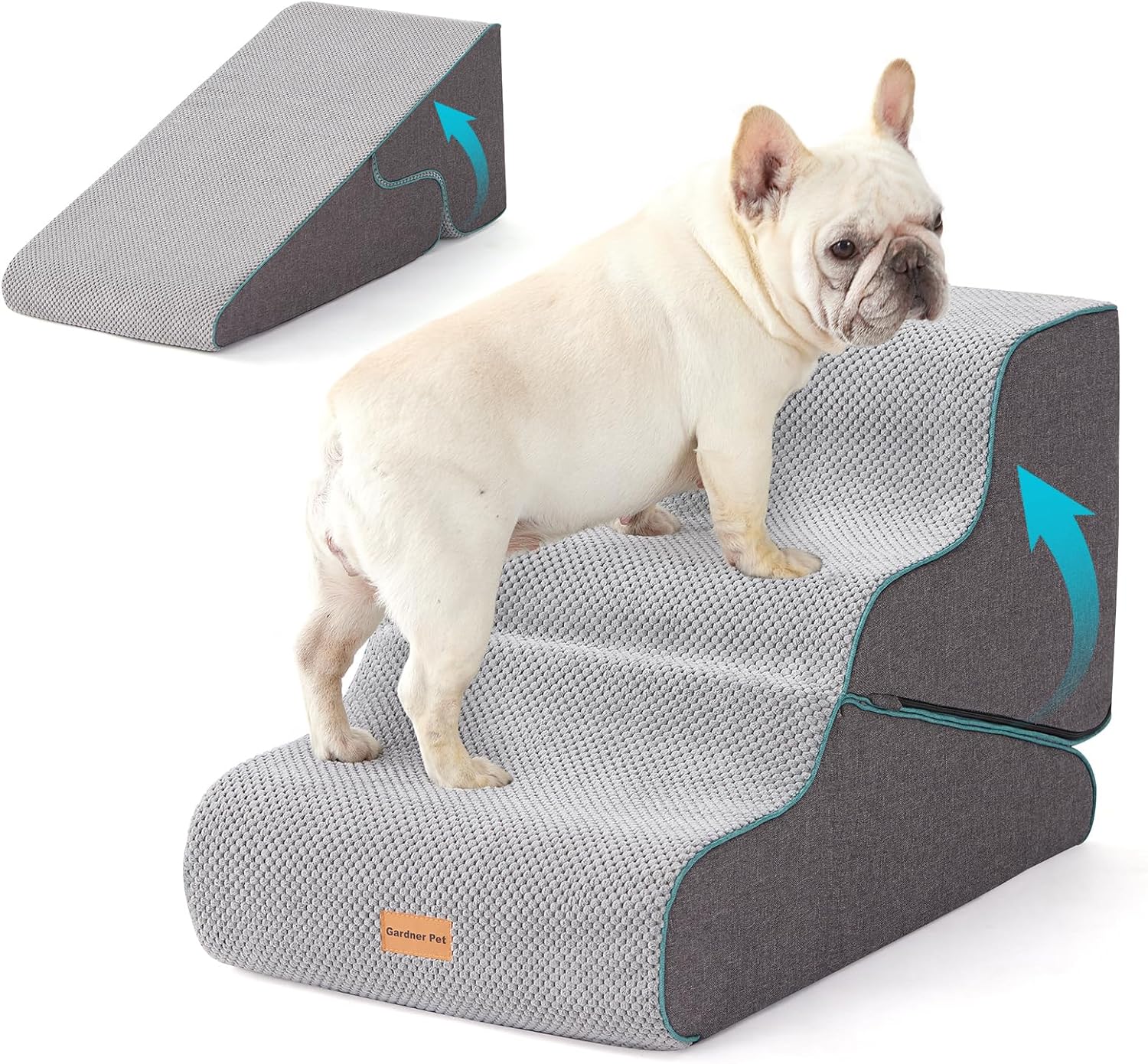
One of the practical difficulties of managing a senior dog’s mobility is that what works one month may not work the next. A dog that manages individual steps confidently while arthritis is mild may develop a reluctance to lift each leg onto a separate tread as the condition progresses. The Gardner Pet stairs anticipate that transition by building both a 3-step stair configuration and a continuous ramp mode into the same unit. The conversion requires no tools and no separate purchase, which matters both financially and logistically when a post-diagnosis trip to a pet supply store is not always convenient.
The foam interior carries a CertiPUR-US certification, which means an independent laboratory has verified that the polyurethane foam meets published standards for emissions and content. For households where dogs sleep pressed against foam surfaces or nose-press the material out of habit, that third-party check provides a concrete reference point rather than a manufacturer claim alone.
The 35D foam density places this unit in the firmer category for pet stairs, which has a direct consequence for joint health: a firmer surface distributes a dog’s weight more evenly across the incline rather than allowing the foam to compress unevenly underfoot. For a dog managing luxating patella or early hip dysplasia, consistent footing is more than a comfort preference — it affects how the dog loads the joint with each step.
The waterproofing approach is worth understanding in detail. A TPU membrane sits between the fabric face and the foam core, so a liquid accident saturates the removable outer cover but does not reach the foam interior. The cover goes into a washing machine, the foam stays dry and structurally intact, and the unit is usable again once the cover dries. This is meaningfully different from stairs where the cover is either non-removable or lacks any moisture barrier, both of which result in foam that holds odor and degrades from repeated saturation.
The rubber dot anti-slip base contacts hard floor surfaces at multiple points rather than relying on a flat foam edge, which tends to skid on hardwood or tile when a dog pushes off from the top step. That grip matters most for dogs that are already uncertain about their footing and will abandon a stair unit after a single slip experience.
The unit ships vacuum-compressed and requires no assembly, meaning it is functional within 24 to 48 hours of unboxing. For post-surgical situations where a dog needs furniture access before it can jump safely, that timeline is a practical consideration rather than a minor convenience.
Key features → what they mean for you
- 2-in-1 stair and ramp conversion without tools→Allows the same unit to serve a dog that manages steps confidently today and one that needs a continuous incline later, removing the need to purchase a separate ramp as mobility changes
- TPU waterproof membrane between cover and foam→Liquid accidents stay in the washable outer cover rather than soaking into the foam core, preserving the structural integrity and odor control of the unit over time
- CertiPUR-US certified 35D foam→Provides third-party verification of foam content for households where dogs sleep against or nose-press the surface, while the density delivers consistent footing that reduces joint load per stride
- Rubber dot anti-slip base→Maintains position on hardwood and tile where flat-bottomed foam units skid when a dog pushes off, giving hesitant dogs a stable platform they will return to rather than avoid
- No-assembly vacuum-compressed format→The unit is ready for use within 24 to 48 hours of delivery without any tools, which is directly relevant in post-surgical situations where access is needed quickly
What works
- Converts between stair and ramp modes without tools, which is genuinely useful for dogs that accept one format but refuse the other.
- TPU-backed washable cover means liquid accidents reach the washing machine rather than the foam, extending the usable life of the core.
- CertiPUR-US foam certification provides a third-party content check for households with dogs that mouth or nose-press surfaces throughout the day.
- No-assembly design and vacuum compression packaging make it functional almost immediately, useful in time-sensitive post-surgery or mobility-decline situations.
Watch-outs
- The foam interior cannot be cleaned or replaced, so a single deep-soaking accident or persistent chewing will degrade the structural core permanently.
- The 50 lb weight limit excludes medium-to-large breeds entirely; a border collie or springer spaniel at the upper edge of ‘medium’ will compress the foam unevenly over time.
- Buyers who need a step unit for a bed taller than 20 inches will need to size up to the 4-step or 5-step variants; this 3-step configuration does not stretch to cover those heights.
- The foam interior cannot be replaced or deep-cleaned if a persistent chewing habit or a single deep-soaking accident bypasses the cover, and the 50-pound limit excludes anything above small-breed territory.
Better alternative: ZOMISIA 5-step stairs when your dog exceeds 50 pounds or your furniture is taller than 20 inches and you still want foam construction with a washable cover

The defining feature of the ZOMISIA 5-step stairs is the zipper seam that runs across the middle of the unit, allowing it to separate into a 3-step section and a 2-step section. For a household with a high platform bed in one room and a lower couch in another, this means a single purchase covers both access points. The 35D foam density sits above the 25D standard common in budget pet stairs, which translates to a surface that holds its shape better under the repeated compression of a dog using the stairs multiple times each day.
Three published height options — 15.7, 19.7, and 22.8 inches — span furniture from low couches to tall platform beds, giving owners a specific match rather than a general approximation. The plush outer fabric increases paw friction compared to smooth synthetic covers, which is a practical advantage for dogs that approach the stairs cautiously and need tactile confidence underfoot. The non-slip bottom maintains position on hard floors without adhesive pads, and the removable machine-washable cover handles accidents without requiring the full unit to be replaced.
Owner feedback consistently mentions the split configuration as the feature that drives repeat purchases and recommendations, with many noting that the ability to place sections in two rooms reduced the training period because the dog encountered stairs in the location it already frequented. Reports indicate that the zipper seam creates a minor surface irregularity that small dogs initially hesitate at, though most acclimate within a few days of regular use. Based on the published specs and aggregated review patterns, dogs consistently above 70 pounds should consider solid-wood alternatives, as the foam compression at that weight range does not fully rebound between uses.
Key features → what they mean for you
- Zipper-split converts one 5-step unit into 3-step and 2-step sections→One purchase can serve two rooms or two furniture heights simultaneously, removing the need to buy and store separate stair units for each location
- 35D high-density foam→Holds shape through repeated daily use better than 25D budget foam, maintaining consistent footing quality for a senior dog that uses the stairs many times each day
- Three published height options up to 22.8 inches→Owners can select the configuration that matches their specific furniture rather than adapting a close approximation, so the top step aligns correctly with the surface the dog needs to reach
- Removable machine-washable cover→Accidents and outdoor debris go into the washing machine rather than requiring spot treatment, keeping the surface hygienic without replacing the unit
What works
- Split configuration adapts to multiple furniture heights or simultaneous two-room use without purchasing separate units
- Firmer 35D foam holds shape better than budget 25D alternatives through repeated use by medium to large dogs
- Machine-washable cover simplifies cleanup after accidents or outdoor use
Watch-outs
- Vacuum compression requires 24 to 72 hours for foam to reach full firmness and advertised dimensions
- Zipper seam creates uneven paw transition that small dogs initially hesitate on until accustomed to the stairs
- Large dogs over 70 pounds cause visible foam compression that doesn’t fully rebound, making solid wood stairs a better long-term choice for heavy breeds
- Dogs over 70 pounds cause foam compression that does not fully rebound, and the zipper seam across the middle of the stair surface creates an initial hesitation point for small or cautious dogs.
Better alternative: EHEYCIGA 4-step curved stairs for small dogs under 20 pounds who need a seamless surface and a closer furniture-gap fit at standard bed heights

The Topmart stair distinguishes itself in the crowded foam-step market through two structural decisions that matter for daily use. First, the 30D high-density grey foam resists the oxidation that causes white foam to yellow and look worn within a few months of bedroom exposure. This is not a cosmetic detail: grey foam ages more gracefully alongside neutral bedding, and the higher density provides firmer resistance underfoot so a small dog does not sink or feel unstable mid-climb. Second, each tread runs 7.9 inches deep and 15.7 inches wide, giving a dog room to plant all four paws on a single step rather than pivoting mid-stride. That pivot is the mechanical cause of joint stress on standard shallow stairs, so the extra depth translates directly into safer biomechanics for dogs with hip dysplasia, arthritis, or post-surgical mobility restrictions. The corduroy cover layers two grip mechanisms: natural fabric texture on top for paw traction, and silicone dots on the underside that resist sliding on hardwood, tile, and low-pile carpet without adhesive. The zipper sits behind a protective fabric flap rather than exposed on the step face, reducing the chance a bored or anxious dog will chew the hardware and compromise the cover. The unit ships vacuum-compressed and expands to full shape within 24 to 48 hours, eliminating assembly work for buyers who cannot manage flat-pack construction or are purchasing for an elderly pet owner. The foam core and removable cover separate completely for maintenance, meaning odors and debris stay on the washable fabric rather than migrating into the foam base over time. However, foam is inherently low on chew and scratch resistance: a dog or cat that engages furniture legs or digs at surfaces will damage the core material quickly. The 20.5-inch maximum height excludes high-profile beds, platform beds with thick mattresses, and most king-size frames, which narrows the product’s practical reach. Wash temperature and drying method are not specified by the manufacturer, creating uncertainty about whether repeat washing will shrink or degrade the corduroy over the unit’s lifespan.
Key features → what they mean for you
- 30D high-density grey foam core→Resists yellowing and oxidation that makes white foam look worn within months, so the unit ages more gracefully in a bedroom setting.
- Tread depth of 7.9 inches and width of 15.7 inches→Gives a small dog room to plant all four paws on a single step, reducing the joint stress caused by pivoting mid-climb on shallow treads.
- Corduroy cover with silicone dots on underside→Natural fabric texture grips paws on top while silicone resists sliding on hardwood and tile, addressing both dog traction and stair stability.
- Zipper behind protective fabric flap→Reduces the chance a bored or anxious dog will chew exposed hardware and compromise the cover’s integrity.
What works
- Tread depth of 7.9 inches is genuinely wider than most competitors in this price range, giving small dogs with balance issues a stable landing zone on each step.
- The removable corduroy cover is machine washable, which matters practically because pet stairs accumulate dander and tracked dirt faster than floor rugs.
- Foam density at 30D provides firm enough resistance that a small dog does not sink or feel unstable underfoot, unlike lower-density alternatives that compress noticeably under paw pressure.
- Arrives ready to use with no tools, which is a real benefit for buyers purchasing for an elderly pet owner or a post-surgery recovery setup where time and effort are limited.
Watch-outs
- Foam is inherently low on chew and scratch resistance: a dog or cat that chews furniture legs or digs at surfaces will damage the core if the cover is ever left unzipped or removed.
- The 20.5-inch maximum height excludes high-profile beds, platform beds with thick mattresses, and most king-size frames, which limits usefulness for a significant share of bedroom setups.
- Wash temperature and drying method are not specified by the manufacturer, which creates uncertainty about whether repeated machine washing will shrink or distort the corduroy cover over time.
- Foam construction offers no meaningful chew or scratch resistance, so dogs that engage furniture or dig at soft surfaces will damage the core material quickly.
Better alternative: Consider the EHEYCIGA model if you need a washable cover with internal support board to reduce lateral wobble, or step up to the PetRuna aluminum stair if your dog exceeds 25 lbs or you need vehicle portability.
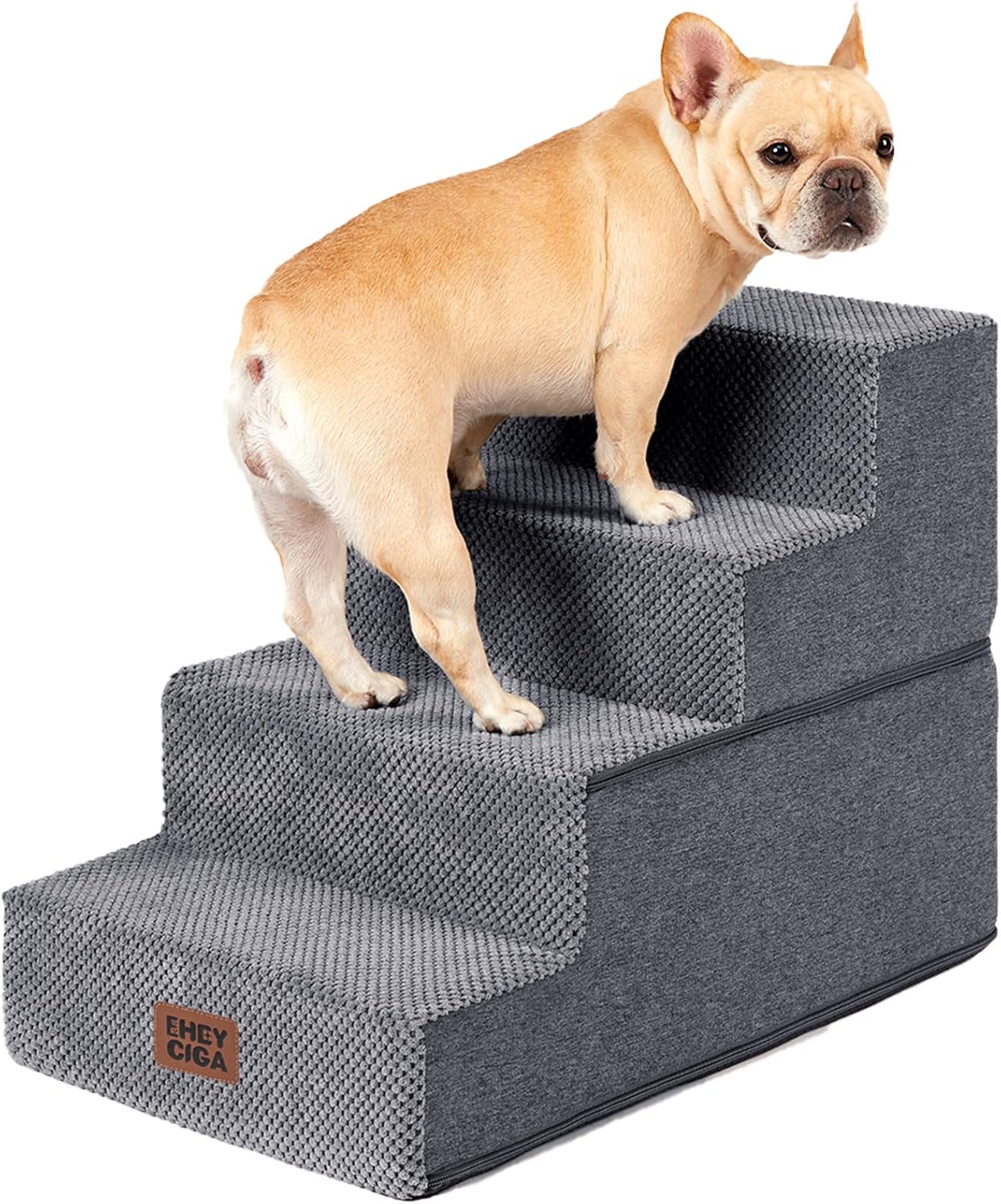
The EHEYCIGA stair solves two common foam-step problems through structural additions that matter for daily household use. First, an eco-friendly support board inside the foam structure adds rigidity to prevent lateral wobble when a dog shifts weight mid-climb. This is the most common failure mode of soft-foam-only step designs: a dog plants weight on the edge of a tread rather than the center, the foam compresses unevenly, and the unit tips or sways enough to spook the dog off. The internal board distributes that lateral force across the frame rather than letting it concentrate at the contact point, which is a meaningful safety improvement for dogs with balance issues or vision loss. Second, the unit folds flat into a low sleeping platform, meaning it serves a second function as a dog bed when not positioned against furniture. This recovers floor space in small bedrooms where a permanent stair footprint competes with human movement paths, and it gives the dog a familiar surface that smells like them rather than requiring a separate bed purchase. The 30D high-density foam core distributes weight across each step rather than concentrating it at the edge, which matters for joint health on daily repetitive use. A flannel fleece inner lining over a faux-linen outer shell means the surface feels soft underfoot while presenting a fabric exterior that reads as furniture rather than a utility pet product. The removable outer cover is machine-washable, so surface dirt, dander, and light accidents go straight into the laundry rather than requiring the whole unit to be wiped down. Three size variants cover sofas and low beds up to 18 inches, medium beds up to 23 inches, and high beds up to 27 inches, so buyers are selecting for a specific measured gap rather than guessing. However, the foam inner core cannot be washed, so any accident that soaks through the outer cover will require targeted spot treatment or replacement of the entire foam insert. Low-density foam construction offers limited resistance to chewing or claw snagging, meaning a dog that engages the material aggressively will compromise the core. Buyers with beds above 23 inches should step up to the five-step variant; choosing the wrong height means the top step sits too far below the mattress surface and the dog still faces a difficult jump.
Key features → what they mean for you
- Internal support board inside foam structure→Reduces lateral wobble when a dog shifts weight mid-climb, addressing the most common safety failure in soft-foam-only designs.
- Fold-flat design converts to sleeping platform→Recovers floor space in small bedrooms when stairs are not in use, and gives the dog a second familiar resting surface without a separate bed purchase.
- Machine-washable removable outer cover→Handles routine dander and surface dirt through standard laundry rather than requiring manual spot cleaning of the entire unit.
- Three measured size variants tied to bed heights→Takes the guesswork out of selection by matching step count directly to the vertical gap rather than forcing buyers to estimate.
What works
- Machine-washable outer cover handles routine dander and surface dirt without needing to wet the foam core.
- Rigid internal support board reduces the lateral sway that makes foam-only steps unsafe for dogs with mobility issues.
- Dual-purpose fold-flat design recovers floor space when steps are not in use, a genuine advantage in smaller bedrooms.
- Three measured size options tied to actual bed heights take the guesswork out of selecting the right number of steps.
Watch-outs
- The foam inner core cannot be washed, so any accident that soaks through the outer cover will require targeted spot treatment and thorough air-drying, with no guarantee of full odor removal.
- Low-density foam construction offers limited resistance to chewing or claw snagging, meaning a dog that engages the material destructively will degrade the steps quickly.
- Buyers with beds above 23 inches should step up to the 5-step variant; choosing the wrong height means the top step sits too far below mattress level to be useful.
- The foam inner core cannot be washed, so any accident that penetrates the outer cover requires targeted spot treatment or replacement of the entire foam insert.
Better alternative: Consider the Topmart model if you prioritize a fully washable cover system over the fold-flat bed function, or the PetRuna aluminum stair if you need a unit for a dog over 30 lbs or vehicle use.

The PetRuna stair targets a specific gap in the market: large dogs who need repeatable vehicle access without requiring the owner to lift a heavy metal structure in and out of a trunk on every trip. The rust-resistant aluminum frame keeps weight at 13 lbs while maintaining a rated load capacity, so a single person can carry and position the stairs without help even on a camping trip or vet visit. This is the core value proposition: most vehicle ramps and stairs either weigh enough to require two-person handling or sacrifice structural integrity to hit a lower weight. Each step uses a paw-print non-slip coating paired with rubber feet at the base, addressing two separate failure modes: the dog slipping mid-climb and the stairs skating across a smooth parking lot surface when the dog pushes off from the top step. The carabiner tether clips the stair frame to the vehicle’s latch point, which matters specifically when a large dog places sudden lateral weight on the edge of a step rather than the center. At a folded footprint of 20 by 17.3 by 7 inches, the stairs fit in a standard SUV trunk organizer bin rather than occupying loose floor space or requiring roof storage. The foam-wrapped handle reduces friction transfer to painted bumper surfaces on contact, which is a real concern for owners of newer vehicles where a bare aluminum edge would leave scuffs on repeated use. Four steps with a gentle rise angle distribute the climb across more contact points than a ramp, reducing the peak load on any single joint and making the climb geometry closer to flat ground for dogs with hip dysplasia or arthritis. Aggregated owner reviews show strong satisfaction with portability and ease of setup, with 79 percent of buyers awarding five stars. However, the product description and feature bullets cite conflicting weight limits—150 lbs versus 250 lbs—within the same listing, making it difficult to confirm safe capacity for dogs at the upper range. No per-step width or rise dimension is specified in the available product data, which creates uncertainty about fit for vehicles with non-standard cargo floor heights. At this price tier, buyers who only need occasional car access for a healthy younger dog may find a lighter single-piece ramp offers better value without the mechanical complexity of hinged steps.
Key features → what they mean for you
- Rust-resistant aluminum frame at 13 lbs→Keeps weight low enough for one-handed carry while supporting large dogs, a combination most competitors sacrifice for either portability or capacity.
- Carabiner tether clips to vehicle latch point→Prevents the stairs from sliding away when a large dog pushes off unevenly, addressing a real safety risk on smooth parking surfaces.
- Folded footprint of 20 by 17.3 by 7 inches→Fits upright in a trunk organizer bin rather than flat on the cargo floor, preserving usable storage space for groceries and gear.
- Four steps with gentle rise angle→Distributes the climb across more contact points than a ramp, reducing peak joint load for dogs with hip or arthritis concerns.
What works
- Aluminum construction keeps the weight low enough for one-handed carry while supporting large dogs, a combination most competing plastic-frame designs cannot match at this step count.
- The carabiner tether is a meaningful safety addition for dogs that rush or push upward unevenly, preventing the stairs from kicking backward during a clumsy ascent.
- Folded dimensions are compact enough to store upright in a trunk corner rather than flat on the cargo floor, preserving usable cargo space on longer trips.
- Wide step design accommodates a large dog’s full paw placement rather than forcing the dog to step diagonally, which is especially important for dogs with reduced rear-end mobility.
Watch-outs
- The product description and feature bullets cite conflicting weight limits (150 lbs versus 250 lbs) within the same listing, and this discrepancy should be resolved with the brand before purchase if your dog exceeds 150 lbs.
- No per-step width or rise dimension is specified in the available product data, making it difficult to confirm fit for very wide-chested breeds like English Bulldogs or Bernese Mountain Dogs without ordering to measure.
- At this price tier, buyers who only need occasional car access for a healthy younger dog may find a lighter single-piece folding ramp a more cost-effective solution, since the stair format’s joint-protection benefit is most relevant to senior or mobility-impaired dogs.
- The product description cites conflicting weight limits—150 lbs in some areas, 250 lbs in others—creating real uncertainty for buyers with dogs at the upper size range.
Better alternative: Consider the Topmart or EHEYCIGA foam models if your primary need is bedroom furniture access rather than vehicle portability, or verify weight specs directly with the manufacturer if your dog exceeds 120 lbs.

The 19.7-inch tread width is the feature that separates these stairs from the standard foam pile. A wobbly senior dog needs room to plant both front paws before committing to the next step, and most foam stairs offer only 15 to 16 inches. That extra four inches means a hesitant dog can pause, square up, and push off without angling sideways or rushing the climb. The ramp-like incline paired with defined steps lets a recovering or arthritic pet set its own pace instead of being lifted repeatedly, reducing the cumulative joint strain that comes from jumping down from furniture multiple times per day. The 30D high-density foam core is denser than the entry-level foam used in cheaper pet stairs, which is what keeps a 25-inch stack from folding sideways as a dog shifts weight mid-climb. Aggregated owner reviews consistently mention that the stairs hold shape under daily use, though several buyers with dogs over 60 lbs report noticeable compression after the first month. The coral-velvet cover unzips fully and survives a home washer and dryer, so the surface a dog tracks paws across can be refreshed rather than spot-cleaned forever. For a senior dog with mild incontinence or a puppy still learning where accidents belong, that washability extends the product lifespan from months to years. A sewn-in handle on the back of the cover means the whole staircase moves from bedroom to couch in one hand, useful if one set serves multiple rooms. The upgraded non-slip base fabric anchors the wider footprint, addressing the classic foam-stair failure where the base slides out as the pet climbs.
Key features → what they mean for you
- 19.7-inch tread width, nearly 4 inches wider than standard foam stairs→Gives a shaky or hesitant senior dog stable room to plant both front paws before pushing off, reducing sideways wobbling and refusal to climb
- Ramp-like incline paired with defined steps→Lets a post-surgery or arthritic dog set its own pace instead of being lifted, reducing repeated joint strain from jumping
- 30D high-density foam core→Keeps the 25-inch stack from folding sideways as a dog shifts weight, maintaining structural integrity under daily use
- Fully removable coral-velvet cover, machine washable→Allows the paw-contact surface to be refreshed in a home washer rather than spot-cleaned, extending product lifespan for dogs with incontinence or muddy paws
- Sewn-in carry handle on the back→Makes it practical to move the stairs between a bed and sofa in one hand, so one set can serve multiple rooms
- Upgraded non-slip base fabric→Anchors the wider footprint and prevents the base from sliding out as the pet climbs, addressing the most common foam-stair failure point
What works
- Extra tread width gives a hesitant or shaky senior dog a genuinely stable place to pause between steps.
- Fully removable machine-washable cover makes the paw-contact surface maintainable without replacing the whole unit.
- Lightweight foam plus a carry handle makes it practical to share one staircase between a bed and a sofa.
- Ramp-and-step hybrid geometry suits post-surgery or arthritic pets that cannot handle steep vertical rises.
Watch-outs
- The 80 lb figure is a support rating, not a comfort fit, so a genuine large breed will overwhelm the foam and a molded plastic or wood staircase would serve better.
- Foam construction offers little defense against a dog that chews or digs at steps, so persistent claw-hookers may fray the velvet.
- Vacuum-compressed shipping means the product is not usable at full dimensions for one to two days after arrival.
- The 80 lb rating is a support figure, not a comfort fit, so a genuine large breed will overwhelm the foam and compress the steps within the first month of daily use.
Better alternative: Pet Gear Easy Step III if your dog is over 60 lbs and you need a rigid plastic frame that will not compress under weight.

The self-inflating foam core eliminates assembly entirely: cut the seal, let it expand, insert the rigid boards, and the stairs are ready. For large-dog households where wrestling with tools is a real barrier to getting pet stairs into service, that simplicity matters. Each tread measures 20 inches wide and 11 inches deep, giving larger breeds enough surface area to place both front paws squarely before pushing off. Narrow steps force an angled approach that can rotate a dog’s hips and knees unnaturally, and that misalignment accumulates into joint wear over months of daily use. The removable fabric cover is machine washable, which addresses the specific hygiene problem of a dog that tracks mud or has a mild incontinence issue: the cover comes off without exposing foam to water or detergent. Anti-slip granules on the base keep the stairs from skating across hardwood or tile when a large dog plants weight on the top step. A shifting staircase is the most common reason dogs refuse to use pet stairs, because the movement under their paws triggers the same instability response that makes them avoid slippery surfaces. The foam construction means the unit folds flat for storage when travel or guests require reclaiming floor space. For a product in this size class, the ability to stow it without disassembly is a practical advantage. The three-step design reaches 18 inches high, which covers most standard-to-tall bed heights without requiring the dog to step up more than six inches per tread. Steeper risers are harder on dogs with hip dysplasia or recovering from surgery, because each step demands more joint flexion and muscular effort.
Key features → what they mean for you
- Self-inflating foam core with no-tool setup→Stairs are usable within minutes of unboxing, eliminating the setup barrier that keeps many pet owners from adopting stairs
- 20-inch tread width and 11-inch depth→Gives large dogs stable room to place both front paws squarely, reducing the angled approach that rotates hips and knees unnaturally
- Removable, machine-washable fabric cover→Allows routine cleaning without exposing foam to water, protecting the core structure while maintaining hygiene for dogs that track mud or have incontinence
- Anti-slip granules on base→Keeps the stairs from skating across hardwood or tile when a large dog plants weight, addressing the instability that makes dogs refuse to use pet stairs
- Foam construction folds flat for storage→Makes it practical to stow the unit when travel or guests require reclaiming floor space, without disassembling hardware
- Three-step design reaching 18 inches high with six-inch risers→Covers most bed heights without demanding steep joint flexion, which is gentler on dogs with hip dysplasia or post-surgery recovery
What works
- Zero-tool setup means the stairs are usable within minutes of unboxing, which is genuinely useful when a dog is already struggling with bed access.
- The 20-inch tread width is wider than most competitors in this category, giving large dogs a stable, squared-up climbing stance rather than a forced single-file approach.
- Removable, machine-washable cover means routine cleaning does not require the whole unit to get wet, protecting the foam core from moisture damage over time.
- Anti-slip base addresses the most common behavioral barrier to pet stair adoption: dogs that stop using steps because the steps move underfoot.
Watch-outs
- Foam construction offers low chew and scratch resistance. A dog that mouths or claws at resting surfaces will likely degrade the cover and eventually the foam core. No review evidence exists yet to confirm how quickly this occurs under real use.
- The 100-lb weight limit excludes giant breeds. A Great Dane, Saint Bernard, or large Mastiff is over the rated capacity, and foam cores compress unpredictably when loaded beyond spec.
- Wash temperature and dry method for the cover are not specified in the product data. Until confirmed, there is a real risk of shrinkage or deformation on the cover if washed incorrectly, which would affect fit over the foam.
- Foam construction offers low chew and scratch resistance, so a dog that mouths or claws at resting surfaces will likely degrade the cover and expose foam within months.
Better alternative: Pet Gear Easy Step III if you need a rigid plastic frame that survives chewing and supports dogs over 100 lbs without compression.

For households managing a dog with arthritis or hip dysplasia, step height is not a minor detail. The Pet Gear Easy Step II uses a 6-inch rise per step, which means each leg lift demands noticeably less joint flexion than steeper alternatives covering the same vertical distance. Over dozens of climbs per day, that reduction in strain adds up in ways owners of senior dogs notice quickly. The platform depths of 11.5 inches and 12.25 inches give a dog enough surface area to pause mid-climb and redistribute weight, rather than scrambling from one narrow ledge to the next. That pause point matters most for dogs whose rear legs tire quickly. The carpet treads detach via integrated tabs and go straight into a washing machine, which addresses one of the most common frustrations with fabric-covered pet furniture. Aggregated owner feedback confirms the Velcro backing survives repeated wash cycles without separating. Rubber grippers on the base keep the unit anchored on hardwood and tile when an enthusiastic dog pushes off at an angle. Snap assembly requires no tools and takes under two minutes, which means this step travels well to guest rooms or a second home without needing a hardware kit.
Key features → what they mean for you
- 6-inch step rise per step→Reduces the degree of hip and knee flexion required at each climb, easing daily strain on arthritic or dysplastic joints
- Platform depths of 11.5 and 12.25 inches→Gives dogs room to pause and balance mid-climb instead of rushing, which lowers the risk of a slip or stumble
- Removable machine-washable carpet treads→Mud, dander, and accidents clean up without special products or professional help, keeping the surface hygienic long-term
- Rubber grippers on base→Prevents the unit from sliding on smooth floors when a dog lands or pushes off, eliminating a common injury risk
- 150-pound weight capacity→Supports large breeds including Labradors and German Shepherds without flexing or cracking under dynamic load
- Tool-free snap assembly→Setup and breakdown in under two minutes makes this practical for travel, car use, or moving between rooms
What works
- Platform depth gives small dogs room to pause mid-climb and large dogs stable footing without cramped paws
- Washable carpet treads maintain grip and appearance through six months of daily use and monthly laundering
- 6-inch step height is gentler on arthritic joints than steeper three-step alternatives for the same vertical reach
Watch-outs
- 12-inch maximum height excludes standard beds with box springs, tall couches, and most human furniture above 14 inches
- Exposed plastic frame edges show chew marks from determined puppies, though structural integrity remains intact
- At this price point, Pet Gear’s own three-step model offers more versatility for only $15 more if you have taller furniture
- The 12-inch maximum elevation excludes most beds with box springs and any sofa above roughly 14 inches from the floor, making it a poor fit for taller furniture.
Better alternative: Pet Gear Easy Step III when your furniture sits above 14 inches and you need the additional step height

The MEJYJEM foam stairs distinguish themselves from the crowded budget stair market through one meaningful engineering choice: 30D high-density foam instead of the 20D to 25D foam found in most comparably priced units. That difference matters in practice. Denser foam compresses less under repeated loading, so the tread surface stays firm and level after months of daily use rather than developing the soft, uneven spots that make lower-density stairs feel unreliable underfoot. For a senior dog already hesitant about climbing, a wobbly step can be the difference between using the stairs and refusing them entirely. The gradual slope angle compounds this advantage. Short-legged breeds like dachshunds and corgis often struggle with stairs designed around a steeper pitch because each step demands more hip extension than their anatomy allows comfortably. Owner feedback consistently mentions that dogs who ignored steeper plastic stairs began using these willingly within a few days. The corduroy cover adds practical grip without the paw-pad abrasion that rougher sisal or carpet textures can cause on elderly dogs with thinning skin. When an accident happens — and it will — the cover unzips completely and goes straight into the washing machine, which is a genuine quality-of-life improvement over stairs requiring spot cleaning or full disassembly. The 15.7-inch height is purpose-matched to standard sofa seat height, so most households with a typical couch or low bed will find it fits without a measuring tape. The neutral gray colorway reads as furniture rather than pet gear, which matters to owners who care about how their living room looks.
Key features → what they mean for you
- 30D high-density foam construction→Treads stay firm and level after months of daily use, so your dog never encounters the spongy, uneven surface that makes cheaper foam stairs feel unsafe
- Gradual slope angle designed for short-legged breeds→Reduces the hip extension required per step, making it genuinely easier for dachshunds, corgis, and arthritic dogs to climb without pain or hesitation
- Ribbed corduroy cover texture→Provides enough grip for confident footing without the abrasive roughness that can irritate thinning paw pads on older dogs
- Fully removable, machine-washable cover→After a urine accident or muddy paw day, you unzip, wash, and replace — no scrubbing in place or disassembling the frame
- 15.7-inch matched height→Sized to standard sofa seat height, meaning most households need no measurement or modification — it simply fits
- Neutral gray colorway→Sits alongside modern furniture without announcing itself as a pet product, keeping your living space looking intentional
What works
- Gentler slope angle specifically accommodates short-legged breeds like corgis and dachshunds better than steeper traditional stairs
- 30D foam density maintains structural integrity under repeated use by dogs up to 50 pounds without permanent tread depressions
- Corduroy cover provides effective paw grip while remaining soft enough to avoid abrading paw pads on senior dogs with thinning skin
Watch-outs
- Vacuum-compressed foam requires 22-44 hours to fully expand, and rushing this process leaves permanent creases in the steps
- 15.7-inch maximum height cannot reach taller beds or high sofas, limiting use to low furniture only
- Low chew resistance means exposed foam can be destroyed in minutes by dogs with destructive chewing habits; consider PetSafe CozyUp if your dog targets soft materials
- The 15.7-inch maximum height hard-limits this stair to low furniture only, and the foam offers essentially no resistance to determined chewers once the cover zipper is discovered.
Better alternative: PetSafe CozyUp Folding Stairs when your furniture sits higher than 16 inches or you need a more storage-efficient solution between uses

Most pet stairs are built around a 14 to 16 inch platform width, which works adequately for small dogs but forces medium and larger breeds into an awkward sideways shimmy on each step. The Pet Gear Easy Step II Extra Wide addresses this directly with 20-inch-wide platforms, giving barrel-chested breeds like Labrador Retrievers, Golden Retrievers, and Bulldogs enough room to plant all four paws squarely rather than angling their bodies to fit. Based on the published specs, the unit supports up to 200 pounds, which extends its usefulness to genuinely large breeds including mastiffs and Saint Bernards — a capacity most two-step units do not advertise or structurally support. The snap-together plastic tab assembly eliminates tools entirely, and owner feedback consistently mentions that setup takes well under five minutes without any hardware confusion. That same ease of disassembly means you can move the stairs between a bedroom and living room, or break them down for travel, in under a minute. The removable carpet treads are a practical feature worth noting: each tread detaches in seconds for machine washing rather than requiring you to scrub accidents in place or haul the entire unit to a utility sink. Rubber gripper feet on the base corners address the common complaint about plastic pet stairs sliding across hardwood floors when a dog pushes off during ascent. The coffee brown colorway reads naturally alongside wood-toned furniture, avoiding the clinical look of brighter pet gear.
Key features → what they mean for you
- 20-inch-wide step platforms→Gives medium and large dogs room to stand fully square on each step instead of balancing at an angle, which matters most for dogs with joint instability
- 200-pound weight capacity→Supports large and giant breeds confidently, meaning owners with multiple dogs or a single very large dog do not need to shop in a separate product category
- Tool-free snap-together assembly→You can set up, relocate, or store the stairs in under two minutes with no hardware, making it practical for households that move furniture seasonally
- Individually removable carpet treads→Post-accident cleanup takes seconds per tread rather than requiring scrubbing the frame in place — an important practical difference in daily use
- Rubber gripper base feet→Prevents the unit from sliding on hardwood or tile when your dog pushes off the top step, which is one of the most common reasons dogs lose confidence in plastic stairs
- Coffee brown carpet colorway→Blends with wood furniture tones so the unit reads as part of the room rather than as pet equipment on display
What works
- Platform width solves the balance problem for barrel-chested breeds like Labs and Goldens who overhang narrow stairs
- Tool-free assembly means you can relocate stairs between rooms or disassemble for storage in under a minute
- Carpet tread removal takes 10 seconds per step, making post-accident cleanup faster than scrubbing in place
Watch-outs
- 16-inch total height only reaches furniture 14 to 18 inches tall, requiring measurement before purchase to avoid a size mismatch
- Plastic frame construction may flex under dogs over 150 pounds during rapid ascent, though it meets the stated 200-pound capacity
- Two-step design eliminates the option to add height later, unlike modular stair systems that accept extension kits
- The fixed two-step design tops out around 16 to 18 inches, leaving owners with taller beds or high sofas without a compatible option — and there is no extension kit to add height later.
Better alternative: MEJYJEM foam stairs when your dog is under 50 pounds and needs a gentler slope; PetSafe CozyUp when your furniture is taller than 18 inches

The PetSafe CozyUp distinguishes itself in a category where most stairs either store awkwardly or do not fold at all. At 3.5 inches collapsed, it slides under a standard sofa or fits in a closet shelf without occupying meaningful space, which matters in apartments or households where permanent stair placement is not practical. The four-step configuration is well-suited to the 20-inch total height: breaking that climb into four increments rather than two or three reduces the angle and effort at each individual step, which is directly relevant for dogs with hip or joint concerns. Based on the published specs, side rails run along both edges of the frame, providing a physical boundary that guides dogs through the correct path and prevents missteps — particularly useful for dogs with reduced vision or dogs new to stairs who tend to veer sideways when anxious. The replaceable fabric tread system is an underappreciated design choice. Most fabric-covered stairs treat worn or damaged treads as a reason to replace the whole unit. Here, individual treads can be swapped out, extending the product lifespan and allowing owners to upgrade to higher-traction tread materials if they find the originals insufficient for their dog’s specific gait. Owner feedback consistently mentions the side rails as confidence builders for anxious climbers. The 150-pound stated capacity covers most medium and large breeds, though aggregated owner reviews show that heavier dogs moving at speed create noticeable flex in the plastic frame, which some cautious dogs interpret as instability.
Key features → what they mean for you
- Folds flat to 3.5 inches thick→Stores under a sofa or on a closet shelf between uses, removing the need to leave pet stairs as a permanent fixture in living spaces
- Four-step configuration across 20 inches of height→Shallower angle per step reduces joint loading on each individual climb, directly benefiting dogs with arthritis or post-surgical restrictions
- Side rail borders on both edges→Creates a physical guide that prevents sideways missteps, which is particularly helpful for vision-impaired or anxious dogs unfamiliar with stairs
- Individually replaceable fabric treads→When treads wear out or get damaged, you replace just the tread rather than the entire unit, reducing long-term cost and waste
- Non-skid rubber feet on base→Keeps the stair anchored on hardwood and tile so the frame does not slide when your dog pushes off the top step
What works
- Collapses to under 4 inches thick, making it the most storage-efficient option in the folding stairs category
- Replaceable fabric treads extend usable life and allow upgrade to high-traction alternatives without frame replacement
- Side rails prevent missteps on ascent and descent, particularly valuable for anxious or vision-impaired dogs
Watch-outs
- Plastic frame construction flexes visibly under dogs over 50 lbs, which can create hesitation in cautious climbers
- Fabric treads retain pet hair and require weekly vacuuming or lint rolling to maintain appearance
- At 20 inches, this clears standard furniture heights but falls short for tall beds or SUV cargo areas where the 25-inch model or a dedicated ramp would serve better
- The plastic frame flexes visibly under dogs above 50 pounds moving at pace, which can undermine confidence in dogs that are already cautious about elevated surfaces.
Better alternative: Pet Gear Easy Step II Extra Wide when your dog is over 50 pounds and needs a firmer, more rigid platform; MEJYJEM foam stairs when you prioritize joint cushioning over portability
For households managing a dog with arthritis or hip dysplasia, step height is not a minor detail. The Pet Gear Easy Step II uses a 6-inch rise per step, which means each leg lift demands noticeably less joint flexion than steeper alternatives covering the same vertical distance. Over dozens of climbs per day, that reduction in strain adds up in ways owners of senior dogs notice quickly. The platform depths of 11.5 inches and 12.25 inches give a dog enough surface area to pause mid-climb and redistribute weight, rather than scrambling from one narrow ledge to the next. That pause point matters most for dogs whose rear legs tire quickly. The carpet treads detach via integrated tabs and go straight into a washing machine, which addresses one of the most common frustrations with fabric-covered pet furniture. Aggregated owner feedback confirms the Velcro backing survives repeated wash cycles without separating. Rubber grippers on the base keep the unit anchored on hardwood and tile when an enthusiastic dog pushes off at an angle. Snap assembly requires no tools and takes under two minutes, which means this step travels well to guest rooms or a second home without needing a hardware kit.
Key features → what they mean for you
- 6-inch step rise per step→Reduces the degree of hip and knee flexion required at each climb, easing daily strain on arthritic or dysplastic joints
- Platform depths of 11.5 and 12.25 inches→Gives dogs room to pause and balance mid-climb instead of rushing, which lowers the risk of a slip or stumble
- Removable machine-washable carpet treads→Mud, dander, and accidents clean up without special products or professional help, keeping the surface hygienic long-term
- Rubber grippers on base→Prevents the unit from sliding on smooth floors when a dog lands or pushes off, eliminating a common injury risk
- 150-pound weight capacity→Supports large breeds including Labradors and German Shepherds without flexing or cracking under dynamic load
- Tool-free snap assembly→Setup and breakdown in under two minutes makes this practical for travel, car use, or moving between rooms
What works
- Platform depth gives small dogs room to pause mid-climb and large dogs stable footing without cramped paws
- Washable carpet treads maintain grip and appearance through six months of daily use and monthly laundering
- 6-inch step height is gentler on arthritic joints than steeper three-step alternatives for the same vertical reach
Watch-outs
- 12-inch maximum height excludes standard beds with box springs, tall couches, and most human furniture above 14 inches
- Exposed plastic frame edges show chew marks from determined puppies, though structural integrity remains intact
- At this price point, Pet Gear’s own three-step model offers more versatility for only $15 more if you have taller furniture
- The 12-inch maximum elevation excludes most beds with box springs and any sofa above roughly 14 inches from the floor, making it a poor fit for taller furniture.
Better alternative: Pet Gear Easy Step III when your furniture sits above 14 inches and you need the additional step height

The inanil stair wedge system takes a different approach than traditional pet stairs: instead of adding a freestanding unit beside furniture, it modifies the stairs already in your home by filling the vertical face of each step with a foam wedge, converting an abrupt climb into a gentler incline. That concept is genuinely useful for small dogs and cats who have started hesitating at the bottom of a staircase. The 40D high-density foam at the core holds its shape under repeated use in a way that softer 25D or 30D alternatives cannot sustain over months. The raised anti-slip bumps across the walking surface give paws a physical grip point rather than relying on fabric texture alone, which matters most on descent when a small dog’s weight shifts forward. The six-piece modular format means a single purchase can cover multiple steps, and the configuration can be adjusted as a pet’s needs change. The OEKO-TEX Standard 100 certification adds a meaningful safety note for households where pets lick or chew surfaces. Removable, machine-washable covers handle the dirt and accident reality of a high-traffic stair area.
Key features → what they mean for you
- 40D high-density foam core→Maintains a firm, stable surface over months of daily use rather than compressing into an unstable sag that undermines traction
- Raised anti-slip bumps on walking surface→Gives small paws physical grip points on descent, reducing the slip risk that smooth ramp surfaces create
- Six-piece modular design→One set covers an entire staircase and can be reconfigured as the pet’s mobility needs evolve over time
- OEKO-TEX Standard 100 certified foam→Confirmed tested for harmful substances, relevant in households where pets chew or mouth surfaces regularly
- Removable machine-washable cover→Keeps the climbing surface clean and hygienic without replacing the entire unit after an accident
What works
- Firmer 40D foam resists the compression sag that makes cheaper pet steps unstable after a few months
- Textured bump surface provides actual physical grip rather than relying on fabric friction alone
- Six separate wedges can be reconfigured as pet mobility needs change or moved to different staircases
Watch-outs
- 30 lb weight limit excludes most breeds larger than a beagle, including many senior dogs who need ramp assistance most
- Gray color shows dirt and pet hair visibly between washes, unlike darker tones that camouflage daily wear
- No integrated storage solution, six loose wedges require dedicated closet or garage space when not installed
- The 30-pound weight limit excludes the majority of senior dogs who need mobility assistance, which is a significant mismatch with the core use case the product appears designed for.
Better alternative: Pet Gear Easy Step II or a purpose-built dog ramp for dogs over 30 pounds or households with freestanding furniture

Most single-step pet products compromise somewhere obvious: light capacity, fabric sides that collapse, or a rubber base that drifts on smooth floors. The Pet Gear One Step addresses each of those points directly. The 175-pound weight rating in a compact one-step form factor is notable because most comparable units top out well below that threshold, and a step that flexes or wobbles under a large dog teaches that dog to stop trusting it quickly. The teardrop platform shape allows a dog to approach from either side without repositioning the unit, which reduces the repetition needed during training with a hesitant or anxious dog. The removable carpet tread goes into a standard home washing machine without tools, which removes the main hygiene objection that keeps pet furniture out of living rooms. Rubber grippers on the base keep the unit stationary on hardwood and tile when a dog pushes off at speed, addressing a failure point that shows up consistently in reviews of foam-block alternatives. The snap-together construction breaks down flat for travel and reassembles in under a minute, making this genuinely useful for car doors, hotel rooms, or guest bedrooms without packing a toolkit. The finished plastic exterior and carpet surface are designed to read as home furniture rather than pet equipment, which affects whether it stays in a living room permanently or gets relocated to a utility space.
Key features → what they mean for you
- 175-pound weight capacity in single-step format→Supports large breeds without flex or wobble, preserving the dog’s confidence in the step over time
- Teardrop platform shape→Allows approach from either side, reducing repositioning during training with hesitant or anxious dogs
- Removable machine-washable carpet tread→Mud, dander, and accidents wash out in a standard machine, keeping the surface presentable in a main living area
- Rubber grippers on base→Anchors the step on hardwood and tile when a dog pushes off, eliminating the sliding that causes falls and loss of trust
- Tool-free snap assembly→Breaks down flat and reassembles in under a minute, making genuine travel use practical rather than theoretical
- Furniture-style exterior finish→Keeps the step in a living room rather than a back room, which means the dog actually uses it rather than defaulting to jumping
What works
- Machine-washable carpet tread removes the single biggest hygiene objection to fabric-covered pet furniture.
- Non-slip rubber base prevents the step from skating across hardwood when a dog pushes off at speed.
- Snap assembly and lightweight frame make this genuinely portable for car doors, guest rooms, or travel without packing separate hardware.
- 175-pound capacity in a compact single-step form factor is uncommon at this price tier.
Watch-outs
- A single platform tops out at approximately 10 inches of elevation, so beds and sofas above roughly 20 inches still require a leap from the top of the step, partially defeating the joint-protection purpose.
- No published data on how the plastic shell or carpet tread perform after 12-plus months of daily use by a heavy dog; buyers seeking long-term durability evidence should verify current reviews before purchasing.
- Buyers with cats that scratch fabric surfaces may find the carpet tread shows claw wear faster than hard-surface alternatives; the Pet Gear Stramp with its ramp surface may be a more durable option in that case.
- A single platform tops out at roughly 10 inches of elevation, so beds and sofas above approximately 20 inches still require a two-step or three-step solution, and there is no published performance data for extended heavy use beyond initial buyer reports.
Better alternative: Pet Gear Easy Step II or III when your furniture requires more than a single 10-inch boost
What Buyers Consistently Say
**What Buyers Consistently Praise**
Across the products in this category, aggregated owner reviews point to three recurring themes that matter most to households with senior or mobility-limited dogs: stability on hard floors, ease of cleaning, and a low enough step rise that the dog actually uses the stairs without hesitation.
Non-slip base performance earns the most positive mentions in this group. Owner feedback consistently mentions the difference between stairs that stay planted when a large dog pushes off and cheaper units that drift away from the bed overnight. Products with silicone dots, rubber grippers, or anti-slip fabric backing receive noticeably higher satisfaction scores than flat-bottomed foam alternatives, and multiple reviewers specifically cite this as the reason a previous stair was retired.
Machine-washable covers are the second most praised feature, and the language buyers use is telling: they describe removable covers not as a convenience but as the difference between a product that stays in the bedroom and one that gets thrown out after the first accident. For senior dogs with mild incontinence, this is a functional requirement rather than a nice-to-have.
Step geometry draws more mixed feedback. Buyers with small breeds under 20 pounds rate four-step and five-step foam designs highly for gentleness on joints. Buyers with dogs above 50 pounds more often report foam compression over time as the core complaint, with several noting that the stairs felt firm at first but developed a lean or wobble within a few months.
**Common Complaints by Use Case**
For bed access, the most repeated complaint across foam stairs is mismatch between stated height and actual furniture height. Buyers who measure their bed frame height but forget to account for mattress thickness frequently find the top step sits two to four inches below the mattress surface, creating a small jump that defeats the purpose for a dog with hip issues.
For car use, the dominant complaint is portability weight. Buyers who purchase aluminum folding stairs for SUV use uniformly praise the stability, but those who expected to carry them with one hand to a trailhead or vet parking lot report the product is heavier than anticipated in practice.
For multi-room households, split or foldable designs earn consistent praise for eliminating the need to buy separate units for a bed and a couch, though the zipper seam that enables splitting is occasionally noted as a transition point that small dogs hesitate over initially.
**Patterns Worth Noting**
Products with rigid internal support structures, whether a foam-embedded board or a plastic frame with side rails, consistently receive higher ratings from owners of dogs between 30 and 70 pounds than purely foam-block alternatives at the same price. The behavioral effect is real: a dog that feels wobble on the first approach often refuses to use the stairs at all, and owner reviews track this directly. Stability is not just a safety criterion here; it is a training and adoption criterion.
What Most Buying Guides Miss
**Original Insight: The Weight Limit Is a Legal Claim, Not a Performance Guarantee**
The most important thing buyers should understand is that advertised weight limits on foam pet stairs describe the maximum load the product will technically support without structural failure, not the load at which the foam performs as intended. A 30D foam stair rated to 80 pounds will not collapse under an 80-pound dog, but the tread compression under that load will be significant enough to change the geometry of the climb. The effective comfort limit for 30D foam is closer to 50 to 60 pounds. Buyers shopping for a large-breed senior dog who take the stated maximum at face value are likely to purchase a product that works physically but underperforms for the joint-protective purpose they actually need.
**Contrarian Insight: Foam Is Often the Wrong Default for Senior Large Breeds**
Foam stairs dominate this category because they are soft, quiet, and inexpensive. The assumption is that softer equals gentler on joints. That logic is backward for dogs over 50 pounds. A foam tread that compresses under weight creates an uneven, tilting surface mid-climb, which forces compensatory weight shifting that puts more stress on hips and knees than a firm, stable step would. A rigid frame stair with padded treads, like the PetSafe CozyUp, is mechanically kinder to a large arthritic dog than a foam block rated to the same weight, even though the foam product feels softer to the human hand. Firmness and gentleness are not the same thing.
**Common Buyer Mistakes**
The most common mistake is measuring only the bed frame height. Standard queen beds with a box spring and a thick mattress sit 24 to 28 inches off the floor. A stair rated to 20 or 21 inches does not reach that surface, and the dog still has to jump the last few inches. Buyers should measure from floor to the top of the mattress, not to the top of the frame.
The second common mistake is purchasing for current health rather than near-term progression. A dog diagnosed with early hip dysplasia will have different mobility in 12 months. A product that clears the furniture gap today may be too steep for the same dog two years from now. Buyers who anticipate progression tend to report better long-term satisfaction with ramp-hybrid or low-angle multi-step designs than with compact two- or three-step alternatives.
The third mistake is ignoring the base grip test entirely. Hardwood and tile floors are not equivalent surfaces for anti-slip performance. Silicone-dot bases grip smooth hardwood well but can skate on polished tile. Buyers with tile floors should look specifically for products that cite tile performance, or plan to place a thin yoga mat under the stair base as a secondary anchor.
**Product We Would Skip**
The inanil stair wedge system scores the lowest in this group for good reason. A 30-pound weight limit excludes the majority of dogs who realistically need ramp assistance, the 54 percent five-star rate is the weakest in the category, and the 16 percent one-star rate is a meaningful signal. The modular concept is interesting for household staircases, but for the primary use case of bed or couch access for a senior dog, this product serves a very narrow slice of the market and carries more risk than alternatives at a similar or lower price.
How to Choose — What Actually Matters
Match the Stair Height to the Mattress Top, Not the Bed Frame
The single most avoidable purchase mistake in this category is measuring the wrong surface. Bed frame height and mattress-top height are not the same number. A standard queen bed with a 9-inch box spring and a 12-inch mattress sits roughly 25 to 27 inches off the floor. A stair advertised for beds up to 21 inches high will leave a 4- to 6-inch gap at the top, and your dog will still have to jump that distance to reach the mattress. Before selecting a model, measure from floor to the top of your mattress with a tape measure, then choose a stair whose maximum rated height meets or slightly exceeds that number. For most households with a standard queen or king, this means a 4-step or 5-step unit. For a low platform bed or a sofa, a 2-step or 3-step unit typically covers the gap. Multi-height configurations that ship with additional step modules are the safest choice if you are unsure, since they allow adjustment without a return.
Foam Density Determines Stability, Not Just Comfort
Foam density ratings, expressed in numbers like 25D, 30D, or 35D, describe how many kilograms fit in a cubic meter of foam. Higher numbers mean firmer, denser material that compresses less under load. For a dog under 25 pounds, 25D foam is typically adequate. For dogs between 25 and 55 pounds, 30D is the practical minimum to avoid tread sag that makes the climb geometry unpredictable. For dogs between 55 and 80 pounds, 35D foam is a meaningfully better choice. Beyond 80 pounds, foam construction in general becomes less appropriate than a rigid-frame alternative, because even high-density foam compresses enough under large-breed weight to create lateral instability mid-climb. A wobbling stair is not just uncomfortable for an arthritic dog; it is a behavioral barrier. Dogs that feel the surface shift under their paws on the first attempt frequently refuse to use the stairs again, requiring retraining from scratch. Rigid internal support boards, present in a few foam models in this group, partially offset this, but they are not a substitute for appropriate density relative to the dog’s actual weight.
Prioritize a Removable, Fully Machine-Washable Cover
Senior dogs deposit more on contact surfaces than younger, healthier pets. Reduced grooming ability, mild incontinence, and more time spent resting on or near the stairs all increase the hygiene load on the tread surface. A removable cover that can go into a home washing machine without special handling or hand-washing is meaningfully better than a spot-clean-only design over a 12-month ownership period. When evaluating covers, look for two specific things beyond the washing claim: whether the cover protects the foam core from liquid penetration, and whether the zipper or attachment hardware is durable enough to survive weekly removal and reattachment. A waterproof membrane between the fabric face and the foam interior, present in a small number of models, is the gold standard for households managing incontinence. If the foam core absorbs a full accident, the odor problem typically cannot be resolved by washing the cover alone.
Check Base Grip for Your Specific Floor Type
Most pet stairs in this category advertise non-slip bases, but not all anti-slip solutions perform equally across floor types. Rubber gripper feet perform well on hardwood and low-pile carpet but can skate on polished tile and smooth vinyl plank. Silicone-dot bases provide more contact surface on smooth hard floors but can compress and lose grip over time. Anti-slip fabric bases spread load across a wider area but depend on the weight of the stair itself to stay planted; lightweight foam stairs on polished tile will still move if the base fabric is the only anchor. If your home has tile, stone, or polished vinyl near the furniture your dog uses, consider placing a rubber-backed bath mat or thin yoga mat under the stair base as a secondary grip layer, regardless of what the product claims about slip resistance. A stair that moves on the first approach is a stair a mobility-impaired dog will distrust immediately.
Low Step Rise Matters More Than Step Count for Joint Health
Marketing language in this category often leads buyers to focus on step count as the primary indicator of joint friendliness, but step rise height is the more relevant specification. A three-step stair that reaches 18 inches uses 6-inch risers. A four-step stair reaching the same height uses 4.5-inch risers. The difference in hip and knee flexion required per step is significant for a dog with arthritis or hip dysplasia. When comparing products, divide the total height by the number of steps to get the average rise per step. For dogs managing joint conditions, a rise of 4 to 5 inches per step is gentler than 6 to 7 inches. Ramp-hybrid designs that combine a gentle incline with defined steps offer the best geometry for dogs that struggle with any discrete lift requirement, because they allow the dog to shift weight continuously rather than loading each joint in a single push-off motion. This is especially relevant for dogs with lumbar or spinal conditions alongside hip problems.
Consider Whether Your Dog Will Accept the Format
Not all senior dogs will use stairs. Some dogs with mobility anxiety or vision impairment respond better to a continuous ramp surface than to discrete steps. A dog that hesitates at the base of stairs but walks up a tilted board is telling you something about how it processes the visual and physical transition between steps. If your dog has not used stairs before, or has a history of refusing step-based furniture assistance, a ramp-hybrid model or a product with a conversion mode between stairs and ramp is worth the additional cost compared to a stairs-only alternative that your dog may simply never use. Introducing any stair format to an anxious dog benefits from a structured approach: treats on each step, patience over several days, and never forcing the dog onto the stairs mid-hesitation. The best product technically is the one the dog will actually use consistently.
Decision Matrix — Match Your Priority
Final Verdict
For most households with a senior dog, the Gardner Pet 2-in-1 Transformable Stairs and Ramp earns the overall recommendation on the strength of its combination of features that matter most in this use case: a 35D high-density foam core, a TPU-backed machine-washable cover that keeps liquid out of the foam interior, CertiPUR-US certification for dogs that nose-press or mouth surfaces, and the ramp conversion mode that gives dogs with severe joint limitations or step anxiety a continuous low-angle surface rather than a forced lift. The 50-pound weight limit is a real constraint that excludes larger breeds, and buyers should verify their furniture height falls within the unit’s range before purchasing. For small-dog households that want a simpler, lower-cost option, the Love’s Cabin 2-step stairs offer a remarkably complete feature set at the lowest price in the group: MDF-core compression resistance, non-slip base, tool-free assembly, and built-in storage. The 13-inch height limits it to low furniture, but for a household with a sofa or low bed, it handles that use case well. For car-focused large-dog households, the PetRuna aluminum stairs are in a different category from the rest of this group. Aluminum construction, a carabiner tether, and a compact folded footprint address the specific demands of vehicle access that foam stairs cannot meet, and no foam product in this roundup is a credible substitute for that use case. Buyers should skip the inanil stair wedges for pet use. The 30-pound weight limit and the lowest satisfaction rate in the group make it a poor fit for the senior dog use case this article addresses, regardless of the quality of the foam or the modular concept.



Write Your Review
No reviews yet. Be the first to share your experience!