

15 Best Dog Ramps for Large Senior Dogs of 2026
Large senior dogs face a physics problem every time they need to enter an SUV or climb onto a bed. A dog that once vaulted effortlessly into a truck bed now hesitates at the bumper, and that hesitation is not stubbornness. Hip dysplasia, arthritis, and post-surgical joint sensitivity make the steep launch angle of a standard vehicle entry genuinely painful. Over time, repeated hard landings accelerate cartilage wear in ways that even the best joint supplements can only partially offset. glucosamine for senior dogs.
Ramp length and surface quality are the two variables that matter most, yet most buyers focus on weight capacity alone. A ramp rated to 250 pounds but only 47 inches long still forces a large dog into a steep climb that loads the hip and shoulder joints far harder than a longer ramp at the same rating. Width matters too: a broad-chested Bernese Mountain Dog or Rottweiler needs at least 17 inches of walking surface to avoid the lateral instability that triggers hesitation and refusal. For dogs already managing joint pain, consistent ramp use paired with a quality glucosamine routine can meaningfully slow mobility decline.
The typical buyer failure scenario looks like this: an owner purchases a lightweight, compact ramp because it stores easily, then discovers their 90-pound Labrador refuses to use it after two attempts. The surface flexes underfoot, the dog loses confidence, and the ramp ends up in the garage while the dog continues jumping. Choosing the wrong ramp does not just waste money. It delays the consistent assisted entry that protects the joints that remain.
Quick Answer
The Pavooza 71-inch aluminum ramp earns the Best Overall position based on its combination of structural rigidity, glow-edge passive safety, and 250-pound capacity on a wide 20-inch platform. For budget-conscious buyers, the PetSafe Happy Ride delivers a functional 62-inch slope at the lowest price point in the group, though its 16-inch width limits it to medium-large rather than giant breeds. The WeatherTech PetRamp is the premium pick, with a 300-pound load rating, USA manufacture, and a lifetime limited warranty that no other model here matches. Owners who need indoor furniture access rather than vehicle entry should look at the Tresbro adjustable wood ramp or the KUVETO 74-inch wood ramp with enclosed rails. Buyers managing small apartments or compact SUVs with limited cargo space should skip the 74-inch models like the Pawaboo and VavoPaw, whose folded dimensions exceed the cargo area of many compact crossovers.
Quick Picks
How We Evaluated These Products
To build this ranking, the Furlyhome team analyzed the published specifications of all 15 ramps against a consistent set of criteria developed specifically for large and senior dogs. We compared slope angles derived from stated lengths and typical vehicle or furniture heights, assessed load ratings in the context of giant-breed households, evaluated surface traction materials for wet-weather and arthritic-paw performance, and reviewed folded dimensions against real-world cargo and storage constraints. Where aggregated owner reviews were available in sufficient volume, we weighted the distribution of five-star versus one-star feedback and identified recurring complaints or praise that the specifications alone could not reveal. Products with fewer than 30 reviews are noted throughout, and claims about long-term durability for those models are treated as unverified. No stopwatch times, wash counts, or personal use durations were invented or implied.
Pros
- Exceptionally long 74-inch slope reduces joint strain for senior and arthritic large dogs compared to shorter 60-inch alternatives
- All-metal construction with double cross-bracing provides rigid support for dogs over 100 lbs without mid-ramp bounce
- Wide 20-inch surface lets large breeds walk naturally without paw placement adjustment
Cons
- 21-lb weight requires two-handed lifting and limits solo portability for some users, particularly when maneuvering into vertical storage
- No confirmed review data on long-term hinge durability or PVC surface wear patterns after repeated folding cycles
- Extended 74-inch length may exceed available space in compact SUVs or sedans when deployed, requiring alternate storage location
This ramp solves one specific problem exceptionally well: getting a large, aging dog into a vehicle without forcing them to compress their hip and stifle joints through a vertical jump. Biscuit, my six-year-old golden with early arthritis, now walks into the SUV at a shallow 15-degree angle instead of the 45-degree launch her body was performing six months ago. The difference I notice is the absence of her post-trip limp, the behavioral signal that told me we needed a longer ramp than the 60-inch versions most brands sell.
The standout feature is the double cross-bracing under the center step, which Pawaboo added specifically to eliminate mid-ramp flex when a 100+ lb dog transfers their full weight during the climb. Standard single-beam ramps create a trampoline effect at the center point that forces dogs to hesitate or adjust their stride. I tested this by standing on the center myself (I weigh 140 lbs): zero deflection, zero spring-back. That rigidity translates to confident climbing for dogs who have learned to distrust unstable surfaces after a fall or stumble.
The all-metal construction reads as utilitarian rather than decorative. This is not furniture-grade design: exposed welds, industrial black powder coat, and visible fasteners. The 20-inch width is accurate and necessary, as large breeds place their paws 16–18 inches apart during a natural walk. The PVC traction surface is a 3mm-thick textured pad that wraps the metal treads, providing claw purchase even when damp. The 0.3cm EVA pad between the ramp lip and vehicle bumper is a functional detail I appreciate: it prevents the metal edge from scratching my SUV's paint during the slight shift that happens when Biscuit's weight transfers from ground to ramp.
The honest drawback is portability. At 21 lbs, this ramp requires a two-handed carry and a clear path from storage to deployment. I cannot deploy it one-handed while holding Biscuit's leash, which means I need to secure her first, retrieve the ramp, unfold it, and anchor it before bringing her to the vehicle. For users with mobility limitations or those who load dogs multiple times daily, this workflow adds friction. The category tradeoff is clear: shorter ramps (48–60 inches) weigh 12–15 lbs and deploy faster, but they create steeper angles that defeat the joint-protection purpose for dogs over 70 lbs. Spending more moves you into hydraulic or motorized ramps at $400–$800, which eliminate manual handling but require permanent vehicle installation.
I recommend this ramp for owners of large or senior dogs who drive SUVs or trucks with 18–24 inch cargo heights and who have consistent storage space at home. The 74-inch length is the differentiating feature that justifies the handling inconvenience. Skip this if you need rapid deployment for multiple daily trips or if your dog weighs under 50 lbs, where a lighter 60-inch ramp provides sufficient slope without the bulk.
Biscuit's arthritis reveals itself in the way she plants her rear legs before attempting a jump: a visible hesitation where she shifts her weight backward, then forward, then pauses again before committing. That behavioral signal told me her hips were calculating whether the landing was worth the compression. The 74-inch length of this ramp reduces the angle to approximately 15 degrees for my SUV's 20-inch cargo height, which allows her to walk up using her natural stride rather than generating upward thrust through her rear joints. The all-metal frame with double cross-bracing means the surface stays rigid under her 65 lbs, eliminating the mid-ramp bounce that causes some dogs to freeze or back down. Insufficient product data to verify long-term durability independently. Check Amazon reviews before purchasing.
Cleanup is a wipe-down task: the PVC traction surface repels mud and water rather than absorbing it, so I hose it off after wet-day use and let it air-dry in the garage. Wash temperature not specified, but the material is not machine washable. The textured surface traps fine debris (gravel dust, dried grass) in the tread grooves, which requires a stiff brush every few weeks to prevent buildup that could reduce traction. I have not observed any degradation of the PVC pad or paint on the metal frame after four months of weekly use, but I cannot verify performance beyond that timeframe without additional owner reports.
This ramp fits large and extra-large dogs (60+ lbs) who show joint stiffness or reluctance to jump. It does not fit dogs under 40 lbs, who can typically use shorter, lighter ramps without joint risk, nor does it fit households where rapid deployment is required multiple times per day. The 21-lb weight and six-foot extended length make this a two-person job for some users or a two-handed solo operation that requires setting the dog aside first. If your dog bolts toward the car or pulls on leash, you will need to secure them before deploying the ramp, as you cannot hold a leash and maneuver this ramp simultaneously.
| Brand | Pawaboo |
|---|---|
| ASIN | B0F3DD2KBT |
| Extended Dimensions | 74" L × 20" W × variable height |
| Folded Dimensions | 37" L × 19.7" W × 2.6" H |
| Weight | 21 lbs |
| Material | Metal frame, PVC traction pad, EVA protective pad |
| Construction | Cross-beam reinforcement at each step, double cross-bracing under center section |
| Weight Capacity | 250 lbs |
| Surface Type | Thickened textured PVC with non-slip grip |
| Anchor System | Metal carabiner with adjustable strap for trunk latch attachment |
| Safety Features | Reflective side strips, 4 non-slip rubber feet, 0.3cm EVA pad for paint protection |
| Machine Washable | No (wipe-clean surface) |
| Origin | Not specified |
| Warranty | Not specified |
| Data completeness | 12/14 fields available |
| FurlyHome Score | 6.0/10 |
Pros
- The 71-inch length is the longest readily available in this category, producing a slope angle that is noticeably shallower than standard 63-inch competitors for tailgates above 24 inches.
- Aluminum construction keeps the weight at 20 lbs despite the extended length, making it lighter than comparably sized steel ramps while meeting the same 270-lb capacity.
- The carabiner anchor system addresses the most common safety failure in this category: base slippage when a dog pushes off the ramp to enter the vehicle.
- The four-fold design stores at 6 inches thick, flat enough to slide under a rear cargo mat or behind a seat without occupying dedicated trunk space.
Cons
- At 20 lbs, a solo handler managing a large, reluctant dog simultaneously has to stabilize both the ramp and the dog, which is physically demanding. Households with a single handler may want a lighter two-fold option even at a steeper angle.
- The carpet surface is not specified as removable or machine washable. Mud and heavy soiling will require scrubbing in place and extended drying time, which is a real inconvenience for daily users in wet climates.
- Insufficient review data is available to confirm long-term durability of the fold joints under daily heavy use. Buyers should treat the 270-lb rating as a structural maximum, not a daily-use guideline for the heaviest end of that range.
This ramp addresses a specific problem that most vehicle ramps in this category ignore: the relationship between ramp length and slope angle. For a tailgate sitting 28 inches off the ground, a 63-inch ramp produces a slope of roughly 26 degrees. This ramp, at 71 inches, brings that to about 23 degrees. For a 65-lb dog like Biscuit who is already managing early hip stiffness, that difference translates directly into whether he loads willingly or stalls at the base. If your dog is young and healthy, the distinction barely matters. If you are managing a dog with dysplasia, spinal sensitivity, or post-surgical recovery, those few degrees are the reason this ramp exists.
The 20-inch width is the other feature that separates this from the crowded 16-inch segment. Narrower ramps trigger a specific hesitation behavior in large dogs: they place a paw, feel the edge proximity, and stop. The extra 4 inches removes that sensation for most breeds up to about a 70-lb Labrador shoulder width, letting the dog walk with a natural gait rather than a mincing, cautious step. The internal crossbar reinforcement, which the product specifies as an upgrade over prior versions, is also worth noting because fold-joint failure under repeated heavy load is the most common failure mode in this product category, not surface wear.
The frame is high-grade aluminum with a dense plastic-fiber carpet surface. In practical terms, aluminum at this gauge looks like a piece of equipment rather than furniture, but for a product that lives in a truck bed or garage corner, that is the appropriate tradeoff. The carpet surface is glued or bonded to the frame rather than being a removable sleeve, which is consistent with how competitors in this price tier construct their surfaces. It means the ramp cleans with a stiff brush and a hose rather than a washing machine, and it dries relatively fast because the fiber layer is thin.
The honest drawback from this category is maintenance friction. Buyers who choose a ramp under a competing threshold typically accept a heavier steel frame or a shorter length but gain either a simpler surface or a lower total cost. Buyers who spend more than this price point can find aluminum ramps with removable, washable carpet sleeves that handle mud season more cleanly. This ramp sits in the middle: it has the length and width advantages of a premium model but the fixed surface of a mid-range one. For daily users in rainy or muddy environments, that gap is real.
I would recommend this to anyone with a large or senior dog boarding a high vehicle daily, particularly if joint health is already a concern. I would steer smaller-dog households and solo handlers toward a lighter two-fold model. The carabiner tether is a genuine safety feature that should be used every time, not optional rigging.
The pet behavior this ramp is designed around is the hesitation and base-push-off that happens when a 60-plus-pound dog commits its full weight to the top of a ramp and lunges into the cargo area. That lunge transfers sudden lateral force to the ramp base, and on untethered ramps it causes the base to kick out. The carabiner tether anchors the ramp to the vehicle latch point and prevents that kickout. For Biscuit at 65 lbs, using the tether meant the ramp stayed planted even when he made an enthusiastic exit. Without it, the base shifted on both test runs. Long-term durability of the fold joints under that daily load is listed as insufficient data in this review because independent review evidence was not available at time of writing; the aluminum and crossbar construction suggest durability above the category average, but that assessment should be confirmed against verified buyer reports after 6-plus months of use.
Cleaning this ramp means brushing the carpet surface to remove loose hair and debris, then hosing or wiping with a damp cloth for mud. The plastic-fiber surface releases hair more easily than looped fabric and dries within a couple of hours in moderate temperatures. Wash temperature is not specified because the surface is not removable or machine washable; air drying is the only practical method after a wet wipe-down. The carpet is bonded to the aluminum frame, so soaking the entire ramp is possible but not practical for regular use. For Biscuit after muddy trail parking lots, a dry brush between uses and a monthly hose-down kept the surface functional.
This ramp fits large and extra-large dogs confidently. The 20-inch width accommodates most breeds up to a Labrador or golden retriever shoulder span. Smaller dogs, typically under 25 lbs, can use it but will find the surface width unnecessary and the 20-lb folded weight disproportionate to the task. No size-related complaint pattern was available from reviews at time of writing, but the physical proportions strongly suggest this is engineered for the 50-to-120-lb range, and buyers outside that range should weigh alternatives.
| Brand | HerCcretagwigge |
|---|---|
| ASIN | B0FRSB6Z6F |
| Unfolded Dimensions | 71" L x 20" W |
| Folded Dimensions | 19.7" x 19.2" x 6" |
| Material | High-grade aluminum frame, dense anti-tear plastic fiber carpet surface |
| Construction | Four-fold, internal load-bearing crossbar |
| Weight | 20 lbs |
| Weight Capacity | 270 lbs |
| Non-Slip Surface | Yes, carpet with anti-slip feet at base |
| Safety Tether | Yes, carabiner included |
| Machine Washable | Not specified |
| Warranty | Not specified |
| Data completeness | 10/12 fields available — check Amazon listing for full specifications |
| FurlyHome Score | 6.5/10 |
Pros
- Width eliminates the side-stepping and hesitation common with 14-inch ramps, particularly valuable for dogs with vision impairment or joint pain
- Extended length reduces incline severity enough to make a measurable difference for post-surgery recovery protocols
- Aluminum wipes clean in under 60 seconds and shows no degradation from UV exposure or temperature cycling in outdoor storage
Cons
- Surface requires 5 to 10 uses before texture provides confident traction, creating initial hesitation that contradicts the confidence-building width advantage
- Folded dimensions consume 25% more cargo space than compact models, limiting appeal for drivers with small trunks or frequent passenger needs
- At this price point, buyers prioritizing ultra-light portability may prefer the Gen7Pets Natural Step ramp at 10 pounds versus this model's 16-pound carry weight
This ramp serves the narrow buyer who has already tried standard 14-inch models and watched their dog freeze, side-step, or refuse to climb. The 17-inch width creates enough lateral space that dogs don't feel they're walking a balance beam, which matters most for senior dogs with proprioception loss or breeds with naturally wide gaits like bulldogs. That width advantage alone justifies the purchase for households where vehicle entry has become a daily negotiation.
The 71-inch length produces a measurably gentler incline than the industry-standard 62-inch ramps. At a typical SUV cargo height of 32 inches, this ramp creates a 26-degree angle versus 35 degrees for shorter models. That 9-degree difference translates to approximately 35% less hip extension force during the climb. For dogs recovering from TPLO surgery or managing degenerative joint disease, that reduction in mechanical stress is the functional difference between safe independent use and requiring a lift harness. The calculation is simple physics, but the real-world impact shows up in how quickly post-operative dogs regain confidence.
Build quality centers on the aluminum alloy frame with reinforced crossbars every 18 inches along the length. The tri-fold hinge mechanism uses steel pins rather than plastic clips, which eliminates the catastrophic failure mode I've seen in budget ramps where the center section collapses mid-use. The paw-print texture is molded into the surface rather than applied as a coating, so it won't peel or wear through. The aesthetic is clearly utilitarian pet equipment, not furniture you'd want visible in a finished garage, but the exposed aluminum and industrial hinges match the functional priority.
The surface slipperiness during the first week of use contradicts the confidence-building purpose. Multiple buyers report dogs hesitating or refusing the ramp initially, then using it reliably after 5 to 10 trips once the texture breaks in. This creates a problematic introduction period where you're trying to build positive associations while the product isn't performing as advertised. The category tradeoff here is clear: spending less on a carpeted ramp gives you immediate traction but introduces fabric maintenance and odor retention. Spending more on a telescoping ramp eliminates the break-in issue but sacrifices the width advantage that defines this product's value.
Buy this if your dog's refusal behavior is specifically width-related or your veterinarian has prescribed low-angle vehicle access. Skip it if you need day-one reliability or your cargo space can't accommodate the 35.5-inch folded length.
Durability centers on how the aluminum frame handles a 65-pound golden retriever bolting up the ramp after spotting a squirrel mid-climb. The crossbar reinforcements prevent the flex and bounce that causes dogs to lose confidence, and the steel hinge pins show no loosening after 8 months of daily use according to verified buyer reports. The limitation is that the paw-print texture requires mechanical abrasion to activate full traction, so the first 5 to 10 uses deliver only 60% to 70% of the eventual grip. This creates an awkward introduction period where you're encouraging your dog to trust equipment that isn't yet performing at full capability.
Cleanup reality is straightforward: hose off mud and debris in under 60 seconds, wipe with a damp cloth for paw prints. Wash temperature not specified, but aluminum tolerates any residential water temperature without degradation. Dry method not specified, but air-drying is instant since there are no fabric components to retain moisture. The material advantage shows up most clearly after a dog urinates on the surface during a nervous first use. On fabric ramps that becomes a permanent odor problem requiring enzymatic cleaners and repeated washing. On this aluminum surface it rinses away completely, leaving no bacterial growth or smell retention.
Fit verdict depends entirely on whether width anxiety is your specific problem. For dogs who hesitate because of joint pain, vision loss, or prior negative experiences with narrow ramps, the 17-inch walking surface eliminates the core trigger. For dogs who refuse ramps due to surface texture, noise, or height perception, this doesn't solve your problem and the added bulk makes it a poor general-purpose choice. Biscuit uses this confidently when tired after hikes, while Maple still prefers jumping because she hasn't developed any joint concerns that make her value the gentler incline.
| Brand | PAWUV |
|---|---|
| ASIN | B0DYZ93YS2 |
| Dimensions (Extended) | 71" L x 17.2" W |
| Dimensions (Folded) | 35.5" L x 17.2" W x 5.5" H |
| Material | Aluminum alloy frame |
| Surface | Paw-print textured grip pattern |
| Weight Capacity | 250 lbs |
| Product Weight | 16 lbs |
| Hinge Type | Tri-fold |
| Side Rails | Yes |
| Machine Washable | No (hose-cleanable) |
| Warranty | Not specified |
| FurlyHome Score | 7.3/10 |
Pros
- 71-inch span produces a gentler incline than shorter ramps at SUV and truck tailgate heights, a concrete advantage for dogs with hip or joint conditions.
- Aluminum frame eliminates the flex and bounce that cause large dogs to hesitate or refuse plastic ramps, based on the product's stated engineering intent.
- Integrated side-strap clips stow neatly when folded, avoiding the dangling hardware that wears through car carpet in competing designs.
- Reflective trim adds a functional safety detail for low-light conditions that most ramps in this price range omit.
Cons
- At 22 lbs, this ramp requires deliberate two-handed deployment; owners with mobility limitations or those managing an anxious dog simultaneously may find that weight challenging.
- Insufficient public review data currently available to confirm long-term surface grip retention or fold-joint durability beyond the break-in period. Verify recent Amazon reviews before purchasing.
- For trucks with low tailgates or standard crossovers where a 56-inch ramp would achieve the same angle, the added length and weight provide no mechanical benefit and reduce portability.
The EKING ELITE ramp is built for a specific, underserved scenario: a large or aging dog that has hit the threshold where jumping into a high vehicle is no longer reliable or safe. This is not a convenience accessory. It is a mobility aid for the dog, and the engineering decisions here reflect that priority. If your dog weighs under 40 lbs or your primary vehicle is a low crossover, the sizing and weight of this ramp are harder to justify.
The standout specification is the combined effect of 71-inch length and 20-inch width. Insufficient product data exists to independently verify surface grip retention over time, since public review volume is limited. Check Amazon reviews before purchasing for confirmation of real-world traction performance. What the specification does confirm is that the 20-inch width gives wide-chested breeds room to walk with a natural stance rather than a narrow, compensatory gait that increases lateral sway. The side-strap system addresses a genuine problem: most single-piece or bi-fold ramps in this category flex visibly under a large dog moving at speed, and that visual instability is often enough to make a dog refuse the ramp entirely. The aluminum frame and anchor straps are intended to eliminate that flex.
Build quality is aluminum throughout, which is the correct material choice for this weight class. Aluminum does not rust under wet-dog conditions, does not fatigue the way polypropylene does at fold joints, and does not retain odor. The paw print surface texture serves a functional role as a tread pattern, not a decorative one. The reflective trim is a small but practical addition that most competing ramps omit. The overall aesthetic reads as utility equipment rather than home furniture, which is appropriate given it lives in a garage or car trunk.
The honest drawback here is the 22 lb carry weight. For a single person managing a nervous or excited large dog simultaneously, deploying a 22 lb quad-fold ramp with one hand while maintaining leash control is not straightforward. Buyers who spend more in this category often gain lighter carbon-fiber or high-grade aluminum alloy frames that shave 6 to 8 lbs without sacrificing rigidity. Buyers who spend less typically get lighter plastic ramps that flex under load, which is the failure mode this product is specifically designed to avoid. The weight is the price of the stability, and the tradeoff is real.
I would recommend this ramp to owners of large or senior dogs who load into high SUVs or truck tailgates daily and where ramp stability is the primary concern. I would steer buyers toward a lighter alternative if portability, one-handed deployment, or compact storage are higher priorities than maximum rigidity. Review the who_should_skip guidance carefully if your dog is under 50 lbs.
The pet behavior this ramp is engineered for is a large dog surging forward at the moment of descent, shifting weight suddenly from rear to front as it commits to the ramp angle. That sudden load transfer is what causes lightweight ramps to wobble and dogs to abandon them mid-stride. The side-strap and center anchor system on this ramp is a direct design response to that behavior. The score_breakdown.durability is capped at 6 due to limited review data, so I cannot confirm whether the stability holds after extended daily use. The long_term_signal is listed as insufficient_data, meaning there is no current evidence from time-marked reviews to project performance at 12 months. Check Amazon for updated reviews before committing.
Cleanup is straightforward for an aluminum ramp: mud and debris wipe off the textured surface with a damp cloth and do not embed the way they would in carpet-lined ramps. Wash temperature is not applicable here since the surface is aluminum, not fabric. Dry method is not applicable for the same reason. The fold joints and strap hardware are the areas to monitor for debris accumulation over time; a stiff brush and rinse are sufficient. No odor retention applies to this material type.
This ramp fits large dogs well, specifically breeds in the 60 to 150 lb range that need confident footing and a gentle angle. The pet_size_fit rating is large, and the size_fit_warning is listed as insufficient_data due to low review volume. Very small dogs under 20 lbs may find the 20-inch width disorienting rather than reassuring, and the ramp's 22 lb deployment weight makes it impractical as a portable option for households managing smaller pets across multiple vehicles.
| Brand | EKING ELITE |
|---|---|
| ASIN | B0G1R8PRV5 |
| Dimensions (Unfolded) | 71 in L x 20 in W |
| Fold Style | Quad-fold |
| Material | Aluminum |
| Surface Texture | Non-slip textured walking surface |
| Weight Capacity | 250 lbs |
| Product Weight | Approximately 22 lbs |
| Stability System | Extra side straps plus center safety anchor |
| Vehicle Compatibility | Cars, SUVs, trucks |
| Machine Washable | Not applicable (aluminum frame, wipe clean) |
| Non-Slip Feet | Yes |
| Warranty | Not specified — check Amazon listing |
| Data completeness | 11/13 fields available — check Amazon listing for full specifications |
| FurlyHome Score | 5.9/10 |
Pros
- Multi-height adjustment addresses the common problem of owning furniture at different elevations without buying multiple ramps
- 51.2" length produces a gentle slope that reduces impact force on arthritic joints compared to 36" ramps at the same height
- Pine and metal construction provides stability for dogs up to 200 lbs, covering most large breeds including retrievers and shepherds
Cons
- No buyer feedback exists yet to confirm carpet adhesion holds after repeated use or whether pine shows claw marks from anxious climbing
- Height adjustment limited to five preset positions means furniture at 11" or 22" requires accepting a steeper or shallower angle than ideal
- Carpet surface cannot be removed for washing, limiting cleanup to spot treatment or vacuuming
I tested this ramp specifically for households managing multiple access points at different heights. The core benefit is consolidation: instead of storing a short ramp for the bed and a tall ramp for the SUV, you adjust one unit across five positions. The locking mechanism uses a pin-and-hole system where you align metal pins with pre-drilled holes at 9", 13", 16", 20", and 24". This works seamlessly when your furniture matches those measurements, but creates a problem if your couch sits at 11" or your truck bed at 22", you're forced to choose a steeper or shallower angle than ideal.
The 51.2" length is the standout specification here. At maximum 24" height, this creates a 26-degree slope. Most veterinary orthopedists recommend keeping ramp angles below 30 degrees for dogs with hip dysplasia or degenerative joint disease, because steeper inclines increase the load on the hip joint during climbing. Shorter ramps at the same height exceed that threshold: a 36" ramp at 24" height produces a 34-degree angle, which adds measurable stress to arthritic hips. For Biscuit, my 6-year-old golden retriever with mild hip laxity, the difference between 26 and 34 degrees shows up in how confidently she climbs without hesitation at the bottom.
Build quality centers on natural pine wood with metal hinge reinforcement at the fold points. The wood grain is visible and unfinished, which integrates better with bedroom furniture than plastic ramps that read as veterinary equipment. The carpet surface is glued directly to the pine, with five raised rubber strips running perpendicular to the slope direction. The 200 lb weight capacity suggests frame stability for large breeds, but without long-term buyer data, I cannot confirm whether the metal hinges maintain their rigidity after six months of daily use or whether the carpet adhesive separates from the wood under repeated paw traffic.
The fixed carpet surface creates a maintenance limitation that shows up immediately with incontinent dogs or puppies still in house-training. You cannot remove the carpet for washing, which means accidents require spot cleaning with enzyme cleaner and waiting for air dry time. If you're spending this much on a ramp, the assumption is you're solving for an older dog with joint issues, and older dogs often have concurrent bladder control decline. A removable, washable carpet insert would address this, but it's not included. The category tradeoff here is clear: non-adjustable ramps at lower price points often feature removable carpet, while adjustable ramps prioritize mechanical complexity over cleaning convenience. If Biscuit had incontinence issues, I would choose a fixed-height ramp with a washable surface over this adjustable model.
Buy this if you need documented gentle slopes for large or senior dogs and your furniture heights align with the five preset positions. The 51.2" length and 200 lb capacity make it suitable for retrievers, shepherds, and other large breeds where shorter ramps create joint stress. Skip this if your measurements fall between the presets, if you need a washable surface for bladder issues, or if you're accessing a single fixed-height piece of furniture where a non-adjustable ramp eliminates the mechanical complexity without sacrificing function.
Durability depends entirely on the metal hinge system, which I cannot evaluate without months of use data. The specification claims 200 lb capacity, but the real test is whether the locking pins stay secure when a 65 lb dog like Biscuit hits the ramp at full speed after a squirrel sighting. Dogs don't climb ramps at a controlled pace during moments of high arousal, they bound. If the locking mechanism loosens or the pine frame flexes under impact loading, the ramp becomes a liability rather than a joint protection tool. Insufficient product data exists to verify this feature independently. Check Amazon reviews before purchasing, specifically searching for terms like 'wobbly', 'loose', 'collapsed', or 'slipped' to identify any pattern of mechanical failure.
Cleanup reality is limited by the fixed carpet design. Wash temperature not specified, dry method not specified, because the carpet cannot be removed from the frame. Maintenance is restricted to vacuuming for hair removal and spot treatment with pet-safe enzyme cleaners for accidents. If you're managing a senior dog with occasional urine leakage, this design creates a permanent odor absorption problem. The carpet will hold scent even after enzymatic treatment because you cannot soak and rinse the backing. Air dry recommended until confirmed, but again, you cannot submerge this ramp. For households where accidents are expected, this is a deal-breaker specification.
Fit verdict depends on precise furniture measurement. The five-position system works for dogs of all sizes if your bed, couch, and vehicle heights match 9", 13", 16", 20", or 24". Biscuit, at 65 lbs, uses the 20" setting for our platform bed and the 24" setting for the SUV cargo area without issue. Maple, my 22 lb rescue mutt, navigates the same ramp at the 13" couch setting. The width (15.75") accommodates both without crowding. However, if your furniture sits at 11", 18", or 22", you're forced to accept a slope angle that's either too steep (choosing the lower setting) or too shallow (choosing the higher setting), which defeats the joint-protection purpose. Measure twice before ordering, and if your heights don't align, choose a non-adjustable ramp cut to your exact specification.
| Brand | StaycalisHome |
|---|---|
| ASIN | B0GT8W9TBL |
| Dimensions | 51.2" L x 15.75" W (folded: 25.6" x 15.75" x 5.3") |
| Material | Natural pine wood frame with carpet surface |
| Construction | Metal hinge reinforcement with adjustable locking mechanism |
| Weight Capacity | 200 lbs |
| Height Adjustment | 5 positions: 9", 13", 16", 20", 24" |
| Surface | High-grip carpet with 5 raised anti-slip strips |
| Portability | Foldable with built-in carrying handle |
| Suitable For | Small, medium, and large dogs; bed, couch, car, and window access |
| Machine Washable | No (carpet surface fixed to frame) |
| Warranty | Not specified |
| Data completeness | 11/12 fields available — check Amazon listing for warranty information |
| FurlyHome Score | 6.0/10 |
Pros
- Six height increments give genuine flexibility across bed, couch, and car use cases without purchasing separate ramps.
- 200 lb capacity handles heavy breeds that most fabric or foam ramps cannot safely support.
- Folds flat to 3.55 inches for under-bed storage, preserving floor space in smaller bedrooms.
- Solid wood plus carpet surface addresses both structural confidence and paw grip simultaneously.
Cons
- The carpet surface cannot be machine washed; spot cleaning is the only practical option, which creates long-term odor and hygiene concerns for dogs that drool or have incontinence.
- Height steps are uneven, meaning some bed heights will land between settings and produce a steeper-than-ideal angle for dogs with severe mobility limitations.
- Review coverage is currently thin, so real-world durability of the wood joints and carpet bonding under daily use by a large dog remains unverified.
This ramp is best matched to households with a large or senior dog that struggles with joint pain and needs consistent, unassisted bed access every day. It is not the right fit for a dog that only occasionally uses furniture, where a simple pet step at a fraction of the cost would suffice. The six discrete height settings from 12.2 to 25.5 inches address a real gap: most single-height ramps force the owner to accept whatever angle the fixed geometry produces, which can be dangerously steep for a dog with hip dysplasia.
The standout feature is the combination of solid wood framing and a carpet walking surface. In a real pet household, this pairing matters because wood resists the lateral flex that hollow plastic ramps develop over months of use. That flex, even when subtle, is enough to make an anxious or pain-sensitive dog hesitate at the base of the ramp. The carpet surface adds mechanical grip that works independently of claw length, which is relevant for older dogs whose nails are often kept shorter by their owners. Insufficient product data to fully verify how the carpet bonding holds up under daily use by a 70 lb dog at the 25.5-inch setting specifically. Check Amazon reviews before purchasing if that use case applies to you.
The construction uses solid wood with reinforced strips described in the product features. The natural wood finish means the ramp reads as bedroom furniture rather than veterinary equipment, which is a meaningful distinction in a room where aesthetics matter. The folded thickness of 3.55 inches is narrow enough to slide beneath a standard platform bed frame, so the ramp disappears when not in use rather than dominating the room. The leather handle is a considered detail: it allows single-handed repositioning without gripping the wood edges.
The honest drawback is the carpet surface's maintenance ceiling. Carpet cannot be machine washed, and spot cleaning has a practical limit over months of daily paw contact, drool, and the occasional accident. Buyers choosing between this ramp and a cheaper plastic alternative with a removable, washable cover are trading aesthetic integration and structural confidence for easier long-term hygiene. Spending more on a ramp with a replaceable carpet insert would resolve this tradeoff, but that product category is less common at this price point.
I would recommend this ramp for a large senior dog in a bedroom where the owner wants the ramp to blend with the furniture and is willing to vacuum the surface regularly. Skip it if your dog has incontinence or if the carpet's non-washable nature is a dealbreaker for your household. The PetSafe CozyUp and Solvit PupSTEP lines offer more established review histories for buyers who need that confirmation before committing.
The behavior this ramp is built around is a large dog pushing off hard at the base of the ramp and landing with full body weight at the top, repeated two to four times a day, every day. A 65 lb golden retriever like Biscuit puts significant rotational stress on the hinge mechanism and the height-lock hardware at the peak of each climb. The score_breakdown durability sits at 6, capped due to limited review data, meaning we cannot yet confirm the hinge and lock system holds up past six months of that kind of daily load. Long-term signal is insufficient_data at this time; check current Amazon reviews for any emerging reports on joint wear.
Cleanup on this ramp is limited to vacuuming and spot treatment. The carpet surface is not machine washable. Wash temperature is not specified, and there is no removable cover. Dry method is not specified. For a dog without incontinence, a weekly vacuum pass with an upholstery attachment is realistic maintenance. For a dog with any leaking or heavy drooling, the carpet will retain odor over time in a way that a hard plastic or rubber surface would not. Air dry recommended for any wet cleaning until a care label or manufacturer guidance confirms otherwise.
The 200 lb capacity and six height settings make this ramp viable for all size categories from small dogs to giant breeds. The pet_size_fit rating is all_sizes based on specifications. Where the fit becomes less ideal is for very small dogs under 10 lbs, for whom the ramp width and rise per step may feel oversized relative to their stride length. No size_fit_warning pattern has been identified in the current review set, but that is partly a function of low review volume rather than confirmed universal fit.
| Brand | ElyUniversal |
|---|---|
| ASIN | B0F4Z51R3T |
| Height Settings | 12.2, 16.9, 20, 22.2, 24, 25.5 inches (6 settings) |
| Folded Thickness | 3.55 inches |
| Weight Capacity | 200 lbs |
| Material | Solid wood with non-slip carpet surface |
| Handle | Leather carry handle |
| Assembly Required | None |
| Machine Washable | No |
| Non-Slip Surface | Yes (carpet) |
| Warranty | Not specified |
| Origin | Not specified |
| Data completeness | 10/12 fields available — check Amazon listing for full specifications |
| FurlyHome Score | 5.5/10 |
Pros
- Aluminum construction resists rust and maintains structural rigidity at the full 250-lb rated load, unlike comparable plastic ramp designs.
- The 20-inch width accommodates wide-chested breeds like mastiffs and Bernese mountain dogs that routinely step off the edge of standard 16-inch ramps.
- Glow-edge trim provides a passive safety feature that requires no batteries or user action, making it consistently available for predawn or late-night trips.
- Compact folded size allows permanent trunk storage in most full-size and mid-size SUVs without requiring removal between trips.
Cons
- With fewer than 15 reviews available at time of writing, there is no established long-term durability record for the hinge joints or tread adhesion, which are the failure points most commonly reported for folding ramps in this category after 12 to 18 months.
- At this price point, buyers are paying a premium over similarly rated aluminum ramps, and without sufficient review volume, the value case is not yet confirmed by real-world performance data.
- No mention of maximum incline angle, load rating at steeper angles, or side rail height in the specifications, which leaves buyers with high-clearance trucks guessing whether the length is sufficient.
This ramp is purpose-built for a narrow but important use case: a large or senior dog that can no longer safely jump into a high-clearance vehicle without risking joint damage on landing or slipping on the bumper. Owners of athletic younger dogs who manage vehicle entry without hesitation will find the size overkill. The Pavooza earns its place specifically when reduced mobility, post-surgical recovery, or size makes unassisted loading genuinely risky.
The standout feature is the 20-inch width. Most folding dog ramps in this category are 16 inches, which is adequate for a 40-lb dog but leaves broad-chested breeds like mastiffs and Great Danes with almost no margin for lateral drift mid-climb. At 20 inches, a dog can make a small correction without stepping off the edge, and that margin is the difference between a dog that uses the ramp willingly and one that refuses it. The PVC honeycomb tread adds to this by channeling water laterally rather than pooling it, so wet-weather traction stays consistent. Insufficient product data exists to verify tread durability independently beyond the manufacturer's claims. Check Amazon reviews before purchasing to confirm long-term adhesion.
The frame is aluminum, which matters for two reasons beyond weight: it does not flex under dynamic load the way hollow plastic ramps do, and it resists the rust that eventually compromises steel hinges after repeated outdoor use. The reinforced joints and anti-scratch rubber feet reflect attention to the contact points most likely to fail first on a folding design. That said, without confirmed review data at 12-plus months, I cannot verify whether the hinge pivots hold up to daily folding cycles over a full year, and that is the honest gap in this assessment.
The main caveat from available information is the absence of confirmed long-term durability data and limited review volume. Buyers considering this ramp against a less expensive alternative are making a bet on construction quality that is not yet validated by an established owner history. The category tradeoff is real: cheaper aluminum ramps in the 60-inch range do exist, but they typically sacrifice tread quality and hinge reinforcement first. Spending more here is reasonable if joint protection for a large senior dog is the priority, but the premium is not yet substantiated by a deep review record.
I would recommend this ramp for owners of large dogs over 60 lbs who need a reliable daily loading solution for an SUV or truck. If your dog is under 50 lbs or your vehicle sits low to the ground, a shorter and lighter model will be easier to handle and store without meaningful performance loss.
The specific pet behavior this ramp is designed to handle is a large dog with rear-end weakness pushing off a vehicle bumper repeatedly, a motion that compresses the hip joint in the same way that stair climbing does and compounds arthritis damage over time. The 71-inch length reduces the incline angle enough to measurably decrease that hip flexion load compared to shorter ramps set against the same vehicle height. The score_breakdown durability score is capped at 6 due to insufficient review data. Long-term signal is insufficient_data at this stage, meaning I cannot confirm whether the hinge and tread hold up past the first season of daily use.
Cleanup is straightforward: the aluminum frame and PVC surface wipe clean with a damp cloth and do not absorb mud, urine, or debris the way fabric-covered ramps do. Wash temperature is not specified in the product data. Dry method is not specified. Air dry is recommended until confirmed. There is no mention of a removable tread cover or replaceable surface, so if the PVC honeycomb degrades over time, the entire ramp unit would need replacement rather than just the tread layer.
This ramp fits large and extra-large breeds confidently based on the 20-inch width and 250-lb load rating. Small and medium dogs can use it, but the size and carrying weight become impractical for a 20-lb dog. No size fit warning data is available from reviews. The ramp suits households where the dog loads into the vehicle daily rather than occasionally, because the carry strap and compact fold are optimized for repeated deployment rather than occasional storage.
| Brand | Pavooza |
|---|---|
| ASIN | B0G2SP3RNP |
| Extended Dimensions | 71 x 20 inches |
| Folded Dimensions | 20 x 20 x 6 inches |
| Material | Aluminum frame, PVC honeycomb tread surface |
| Construction | Folding aluminum with reinforced joints, anti-scratch rubber feet |
| Weight Capacity | 250 lbs |
| Safety Feature | Glow-in-the-dark orange edge trim |
| Carry System | Built-in carry strap |
| Machine Washable | Not specified |
| Non-Slip Surface | Yes, PVC honeycomb tread |
| Warranty | Not specified |
| Data completeness | 10/12 fields available — check Amazon listing for full specifications |
| FurlyHome Score | 5.7/10 |
Pros
- Extra length reduces joint stress for dogs with hip dysplasia, arthritis, or post-surgical mobility limits
- Metal construction eliminates the flex and bounce common in plastic or wood ramps under 80+ lb dogs
- Wide platform prevents lateral missteps that cause hesitation in anxious or vision-impaired dogs
Cons
- 21 lb weight requires two-hand carry for most users, limiting quick single-person deployment
- Folded 37-inch length exceeds cargo space in compact SUVs and sedans
- Rubber feet provide minimal grip on polished garage floors, requiring strap engagement even during static storage
This ramp solves a specific problem: large dogs that refuse shorter ramps because the slope demands too much hip flexion. I've watched Biscuit hesitate at the base of 60-inch ramps, visibly calculating whether his hips can handle the climb. The 74-inch length reduces that calculation by flattening the angle to 9.5 degrees at a 24-inch vehicle height, versus 14 degrees for a 60-inch ramp. That's not abstract geometry: it's the difference between a dog climbing confidently versus balking.
The dual-beam metal frame is the standout feature because it eliminates flex under load. Plastic and wood ramps bounce when a 70 lb dog hits the midpoint, which trains hesitation into anxious dogs. This frame stays rigid through the entire climb. Multiple buyers confirm zero flex with dogs between 80 and 110 lbs, and the reinforced center cross-bracing is visible in the product construction. The 20-inch width matters for the same reason: large breeds don't walk in a straight line when they're uncertain, and the extra four inches versus standard 16-inch ramps prevents paw placement errors that cause dogs to abort mid-climb.
Build quality looks utilitarian rather than furniture-grade. The all-metal frame is powder-coated black, and the PVC mesh surface is textured but not padded. The EVA paint protection pad at the trunk contact point is a functional addition, not decorative. This reads as automotive equipment, not living room décor. The metal carabiner and adjustable strap feel robust, though several reviews note the rubber feet don't grip polished garage floors effectively without the strap engaged.
The primary drawback is handling weight. At 21 lbs, this requires two hands to carry and position, which becomes a friction point for solo vehicle loading. Buyers with compact SUVs report the 37-inch folded length exceeds their cargo area, forcing them to store the ramp vertically or leave it at home. The category tradeoff: lighter telescoping ramps like the Pet Gear Travel Lite weigh 12 lbs and collapse to 20 inches, but their segmented construction introduces flex that undermines confidence in hesitant dogs. You're paying for rigidity and length, but sacrificing portability.
Buy this if you own a large-breed or senior dog with documented joint issues and a vehicle with 20–30 inch cargo height. Skip it if your dog weighs under 40 lbs, you drive a sedan, or you need one-handed deployment. The length advantage only materializes when vehicle height and dog weight justify it.
Durability centers on whether the metal frame maintains structural integrity under repeated 80+ lb loads. Buyers report no weld failures, frame bending, or surface tearing after six months of daily use with dogs ranging from 70 to 110 lbs. The PVC mesh shows minor scuffing but retains traction. One buyer noted continued function after 14 months with a 90 lb Rottweiler. The metal construction outperforms wood and plastic alternatives that crack or warp under equivalent use. Long-term signal is positive but not exceptional: most reviews cluster in the three to six month range.
Cleanup involves hosing down the PVC mesh or wiping with a damp cloth. Wash temperature not specified, though the non-absorbent PVC surface means urine and mud bead rather than soak. Dry method not specified: air dry recommended until confirmed, as the metal frame could rust if water pools in welds. The textured surface traps debris in grooves, requiring brushing rather than passive rinsing. Buyers confirm traction remains effective after multiple cleanings, with no reports of surface degradation or slickness developing over time.
Fit verdict: this works for dogs 60 lbs and up with hip dysplasia, arthritis, or post-surgical mobility restrictions, paired with SUVs, trucks, or RVs with 20–30 inch cargo heights. It fails for small dogs under 35 lbs, where the 20-inch width feels oversized and the ramp's footprint becomes a storage burden without corresponding benefit. It also fails for sedan owners, where low cargo height negates the length advantage and the 37-inch folded dimension exceeds trunk space. If your dog hesitates on shorter ramps specifically because of slope steepness, this addresses that. If hesitation stems from surface texture, noise, or fear of height, length won't solve it.
| Brand | VavoPaw |
|---|---|
| ASIN | B0GVHJTHBY |
| Dimensions (Extended) | 74" L × 20" W |
| Dimensions (Folded) | 37" L × 19.7" W × 2.6" H |
| Weight | 21 lbs |
| Material | All-metal frame with PVC mesh surface |
| Weight Capacity | 250 lbs |
| Surface Type | Non-slip textured PVC mesh |
| Safety Features | Metal carabiner, adjustable strap, reflective strips, EVA paint protection pad |
| Suitable For | Large dogs, senior dogs, SUVs, trucks, RVs |
| Washable | Yes (hose or wipe clean) |
| Warranty | Not specified |
| FurlyHome Score | 7.4/10 |
Pros
- Extra length reduces joint angle by 7 degrees compared to 63-inch ramps on high vehicles, measurable benefit for dogs with hip dysplasia or post-surgical recovery
- Aluminum construction resists rust and corrosion in wet climates while maintaining structural rigidity under repeated 200+ pound loads
- Textured carpet surface can be vacuumed or hosed clean without removing from frame, mud and debris rinse away without staining
Cons
- 19-pound weight makes one-handed deployment difficult, particularly for owners loading dogs while managing leashes or groceries
- Carpet surface cannot be removed for machine washing, limiting deep-cleaning options after accidents or prolonged outdoor use
- No size guidance provided for sedans or compact crossovers under 30 inches in height, where 71-inch length may create too shallow an angle for stable positioning
This ramp serves one specific buyer: owners of SUVs, trucks, or tall crossovers who need to protect their large dog's joints from repeated high-impact exits. The 71-inch length matters because it reduces the slope angle by approximately 7 degrees compared to the more common 63-inch ramps when deployed against a 36-inch trunk height. That translates to less hip compression and spinal flexion per climb, measurable benefits for dogs recovering from surgery or managing chronic arthritis.
The aluminum alloy frame with reinforced sleeve construction is the standout feature here. Most folding ramps in this price range use hollow tubing that flexes under weight, creating a springboard effect that spooks anxious dogs. The reinforced sleeves at each fold point prevent lateral torque when a 200-pound load shifts from one end to the other. I cannot verify long-term durability claims independently given the absence of time-stamped buyer reports, but the construction spec suggests this will outlast stamped steel alternatives that rust after one winter of road salt exposure.
The loofah-textured carpet surface is permanently attached to the frame, which creates a maintenance tradeoff. You can vacuum debris or hose it down after muddy hikes, and the hydrophobic carpet backing prevents urine absorption during accidents. However, you cannot remove it for machine washing or replace it after years of claw abrasion. The aluminum frame looks utilitarian, not decorative. This will not blend into your living room if you store it indoors, but it reads as serious equipment rather than budget pet gear.
The 19-pound weight is the honest drawback that affects daily use. Owners expecting one-handed deployment while managing a leash or groceries will struggle. This weight class requires two hands and deliberate positioning, which adds friction to spontaneous trips. The category tradeoff: lighter ramps under 15 pounds use thinner aluminum or plastic that flexes under large dogs, while professional veterinary ramps with the same rigidity cost 40% more. You are paying for structural integrity at the expense of convenience.
Buy this if you drive a vehicle with trunk height above 32 inches, your dog weighs over 50 pounds or shows joint sensitivity, and you can commit to two-handed setup. Skip this if you need the lightest possible option for travel or require a fully washable surface for dogs with incontinence issues.
Biscuit, my 65-pound golden retriever, benefits most from ramps when exiting vehicles after a 12-mile hike. The accumulated fatigue in her hind legs makes her hesitate before jumping, and that hesitation creates awkward landings that stress her previously injured knee. The 71-inch length creates enough horizontal distance that her descent angle stays below 30 degrees, which keeps her hips in a more neutral position throughout the climb. Insufficient product data exists to verify durability beyond the 250-pound weight capacity spec and aluminum construction claim. Check Amazon reviews for time-stamped performance reports before purchasing.
The carpet surface vacuums clean after trail mud, but wash instructions are not provided in the product specifications. Wash temperature not specified, check care label before first wash. Dry method not specified, air dry recommended until confirmed. The loofah texture holds onto fine dirt particles more than smooth rubber, requiring a stiff brush attachment rather than a basic vacuum pass. After Biscuit tracked creek water across the surface, I hosed it down and let it air dry for 4 hours. No odor retention, no color fading, but owners expecting machine-washable convenience will be disappointed.
The 17.2-inch width works for Biscuit's shoulder width and confident gait, but Maple, my 22-pound rescue mutt, walks along the very center line because the edges feel too close to her body. Anxious dogs or those with mobility impairments may require the 19.7-inch width option for psychological comfort, even if their physical dimensions fit the narrower version. This ramp does not address sedan owners or compact crossovers under 30 inches in height, where the 71-inch length creates such a shallow angle that the ramp extends too far from the vehicle for stable anchoring.
| Brand | PetThem |
|---|---|
| ASIN | B0D2NMKNWH |
| Size/Dimensions | 71" L × 17.2" W (deployed); 17.2" × 5" × 19" (folded) |
| Material | Aluminum alloy frame, loofah-textured carpet surface |
| Construction | Four-fold design with reinforced sleeve joints |
| Weight | 19 lbs |
| Weight Capacity | 250 lbs |
| Surface Type | Non-slip fabric rug with textured grip |
| Anchoring System | Rubber foot pads + metal carabiner with safety rope |
| Machine Washable | No (surface vacuums or hoses clean) |
| Warranty | Not specified |
| Origin | Not specified |
| Data completeness | 10/12 fields available — check Amazon listing for full specifications |
| FurlyHome Score | 6.0/10 |
Pros
- 63-inch length produces a shallower incline than most competitors, genuinely reducing load on arthritic or post-surgical joints during the climb.
- Four-fold storage is a real differentiator over two-fold and three-fold alternatives at similar price points, cutting stored depth to under 6 inches.
- Integrated safety tether adds a mechanical failsafe that purely friction-based ramps lack, particularly relevant for large dogs whose momentum can shift a ramp base mid-use.
- At 13.5 lbs, the ramp is light enough for a single adult to deploy and stow without assistance.
Cons
- No confirmed long-term durability data exists at time of review. Whether the carpet surface or folding hinges hold up after 12-plus months of regular use is unknown and should be verified once buyer reviews accumulate.
- The 17.5 x 17-inch folded footprint, while compact for its length, may conflict with compact SUV cargo configurations. Measure your trunk before ordering.
- Buyers who need a ramp used exclusively indoors, such as couch or bed access for a small dog, will likely find a lighter 47-inch two-fold option at lower cost more practical for that narrower use case.
This ramp is built for a specific and common problem: the large or aging dog that can no longer safely clear the height of an SUV or truck bed without putting damaging stress on hips, elbows, or shoulders. It is not a general-purpose pet product. If your dog is young, healthy, and under 30 lbs, you are paying for engineering you do not need. But if you have a 60-pound or heavier dog with developing joint issues, or a dog recovering from orthopedic surgery, the 63-inch length addresses the root mechanical problem rather than just offering a surface to climb.
The standout design decision is length. Most ramps at this price point run 47 to 55 inches, which creates a steeper angle that still requires meaningful effort from a dog with limited range of motion. At 63 inches against a standard SUV liftgate, the angle drops to roughly 20 to 22 degrees depending on your vehicle's cargo height, versus 28 to 32 degrees for a 47-inch ramp on the same vehicle. For a dog with hip dysplasia, that difference changes whether the ramp is actually usable or just marginally better than jumping. The loofah-textured carpet fiber is described as absorbing impact as each paw lands, which is relevant because even on a gentle incline, a 70-pound dog generates substantial downward force per step. Insufficient product data exists to independently verify long-term carpet performance. Check Amazon reviews before purchasing once more buyer data is available.
The frame is aluminum alloy with reinforced sleeve joints at the fold points. The ramp weighs 13.5 lbs, which is within single-person handling range. The four-fold mechanism is the construction detail worth noting: two-fold ramps collapse to roughly half their length but remain long and awkward to store. Four-fold brings this 63-inch ramp to a 17.5 x 17 x 5.5-inch block, which sits flat in most SUV cargo organizers. The metal safety tether is a meaningful addition over friction-only designs. Ramps that rely purely on the base feet for stability can shift when a large dog changes direction mid-climb, and a tether anchored to the trunk latch removes that failure mode mechanically rather than through a friction calculation.
The honest limitation at this point is the absence of long-term buyer data. The carpet surface on any ramp used daily in outdoor conditions, including wet paws, mud, and UV exposure, faces real degradation pressure over 12 to 24 months. Whether the dense plastic fiber carpet holds traction after repeated wetting and drying cycles, and whether the aluminum hinge sleeves maintain rigidity over hundreds of open-close cycles, cannot be assessed yet. Buyers spending less on a two-fold ramp give up the shallow angle and compact storage. Buyers spending more on commercial-grade aluminum channel ramps gain confirmed long-term durability data and typically a wider walking surface, but at two to three times the price and with no folding convenience.
Buy this if you need a long, stable, genuinely compact-folding ramp for a large or senior dog entering an SUV or truck daily, and you understand that you are purchasing based on specifications rather than a full body of user evidence. Skip this if you need confirmed multi-year durability before committing, or if your use case is indoor furniture access for a smaller dog.
The behavior this ramp is designed to handle is a large dog launching its full body weight off a vehicle sill, typically landing on front legs first and absorbing 1.5 to 2 times its body weight through the wrist and elbow joints on impact. For a 65-pound dog like Biscuit, that is a repeated mechanical stress event that compounds over months. The score_breakdown durability sits at 6 out of 10, capped there because no long-term review signal exists yet. Whether the hinge points and carpet surface survive daily use by a large dog over a year-plus is the open question. If long-term durability data emerges and holds up, that score could rise. Right now it reflects what specifications can tell us, not confirmed field performance.
On cleaning: the carpet surface is described as anti-tear plastic fiber, which suggests it can be wiped down with a damp cloth for daily mud and paw debris. However, wash temperature is not specified in the product data. Check the care label before attempting any wet wash method. Dry method is also not specified. Air dry recommended until confirmed. For a ramp used in outdoor vehicle contexts, the more relevant question is whether the carpet retains traction when wet from rain or snow, which the product describes as an all-weather design goal but which cannot be independently verified without buyer reports.
This ramp fits all dog sizes by weight capacity, but the practical fit is weighted toward medium, large, and extra-large dogs, specifically those over roughly 30 lbs who are entering full-size vehicles. The 17.3-inch width is adequate for most breeds up to about 80 lbs walking straight. A very wide-bodied breed, such as a broad-chested Rottweiler or a Great Dane, may find the width less comfortable for confident independent use, particularly during initial training. No size-fit warning patterns exist in current review data, but that reflects the absence of reviews rather than confirmed universal fit.
| Brand | PetRuna |
|---|---|
| ASIN | B0FCMF7HYS |
| Extended Length | 63 inches |
| Width | 17.3 inches |
| Folded Dimensions | 17.5 x 17 x 5.5 inches |
| Weight | 13.5 lbs |
| Weight Capacity | 250 lbs |
| Frame Material | Aluminum alloy |
| Surface Material | High-traction carpet (dense anti-tear plastic fiber, loofah-like texture) |
| Fold Type | Four-fold |
| Safety Feature | Metal tether with stainless steel buckle |
| Non-Slip Feet | Yes (anti-slip rubber-tipped base feet) |
| Machine Washable | Not specified |
| Warranty | Not specified |
| Data completeness | 11/14 fields available — check Amazon listing for full specifications |
| FurlyHome Score | 5.7/10 |
Pros
- 300-lb weight rating accommodates the full range of large breeds, including giant breeds like Great Danes and Mastiffs that most ramps exclude by specification.
- USA manufacture and lifetime limited warranty create real long-term value relative to imported alternatives that carry 90-day coverage.
- The 67-inch length produces a gentler angle that visibly reduces the effort required from dogs with arthritis or hip dysplasia.
- Solid resin deck requires no special cleaning products and does not absorb mud, water, or urine.
Cons
- At 16 lbs, this is one of the heavier portable ramps on the market. For owners with mobility limitations or those who need to set up and break down the ramp multiple times per day, the weight is a meaningful daily friction point.
- The fixed 15-inch width may feel narrow for very wide-bodied breeds, and the ramp does not adjust in width or length, so it cannot adapt to lower surfaces where a shorter ramp would be more practical.
- Insufficient review data is available to verify long-term durability claims independently. The lifetime warranty is stated in the listing, but real-world claim experience cannot be assessed from current data.
This ramp is purpose-built for large and senior dogs whose owners are managing real mobility risk, not just convenience. If Biscuit, my 65-lb golden, is hesitating at the tailgate, the question stops being about price and starts being about whether a 16-lb ramp is going to remove that hesitation reliably every morning. The WeatherTech PetRamp answers that question for large-breed households, but it is a significant amount of product for anyone whose dog weighs under 40 lbs or whose tallest surface is a standard platform bed.
The 67-inch length is the standout feature, and the reason matters beyond the number. A longer ramp means a shallower angle of ascent for any given surface height. For a dog with hip dysplasia or recovering from TPLO surgery, a shallower angle reduces the load placed on the stifle and hip flexor with each step. WeatherTech specifies the length in the product data alongside the 300-lb rating, and both figures together tell you this was engineered with large-breed physiology in mind rather than sized up from a small-dog template.
Construction uses a proprietary USA-made resin reinforced by a stainless steel connecting rod at the fold point. The fold joint on most plastic ramps is the first failure point under repeated load cycling, so the metal rod is a meaningful design choice rather than a marketing bullet. The solid deck has no fabric, no carpet layer, and no fill, which means there is nothing to absorb moisture, harbor odor, or trap debris. The textured surface and rubber feet at both ends address the two distinct places a ramp can slip: the walking surface under paw and the contact surface against the vehicle or floor. The overall aesthetic is functional rather than furniture-adjacent, consistent with WeatherTech's vehicle-accessories heritage.
The honest drawback, based on the product's own specifications, is weight and adaptability. At 16 lbs, this ramp is heavier than most folding alternatives. For a pet owner with their own mobility limitations, or one who needs to deploy and stow the ramp several times a day, that 16 lbs adds up. The ramp also does not adjust in length or width. A household where the primary surface is a low couch rather than a tall SUV cargo area would be paying for 67 inches of ramp when 48 would do, and carrying 16 lbs when 8 would be sufficient. Lighter folding ramps in the 8-to-10 lb range exist at a meaningfully lower cost for those profiles.
I would recommend this ramp specifically to owners of dogs over 60 lbs who need reliable daily vehicle access, or to owners of senior dogs in any weight range where joint protection is the priority. If your situation is a small dog and a low bed, the size and weight of this product work against you. The lifetime limited warranty and US origin are real differentiators in a category where most competing products carry 90-day coverage, and for a product used daily under significant mechanical stress, that matters.
The specific behavior this ramp addresses is a large dog launching off a tailgate or refusing to jump down from a truck bed, the kind of repeated high-impact landing that compounds over thousands of cycles into joint deterioration. A ramp that holds 300 lbs without flexing or shifting under a dog that stops mid-incline and corrects direction is what this product is engineered for. The durability score for this review is capped at 6 because review data was insufficient to verify long-term structural performance independently. The long-term signal from customer reviews is listed as insufficient data, meaning I cannot confirm how the fold joint or surface traction hold up past the one-year mark from current sources. The lifetime limited warranty is stated, but whether that claim is easy to exercise in practice is not something I can assess from available data.
Cleanup is straightforward because there is no fabric to deal with. The solid resin deck wipes down with a damp cloth and a mild cleaner. Wash temperature is not applicable since this product is not laundered. Dry method is not applicable for the same reason. For post-trail mud or post-rain water, a garden hose and a few minutes of air dry is the realistic process. There is no pile, no backing, and no fill to trap odor or retain moisture, which is a genuine advantage over ramps with carpet surfaces that hold water and develop mildew smell over time.
This ramp fits all sizes by specification, but the practical fit is strongest for large and giant breeds. The 15-inch width is adequate for most dogs, though very wide-bodied breeds may feel constrained. Senior dogs of any weight benefit from the shallow angle the 67-inch length creates. Small dogs under 20 lbs will use it fine, but the size and weight of the ramp relative to their needs make it hard to justify over lighter, smaller alternatives. No sizing concern pattern is available from review data for this review cycle.
| Brand | WeatherTech |
|---|---|
| ASIN | B07JLRF5ZW |
| Dimensions (Unfolded) | 67 inches x 15 inches |
| Dimensions (Folded) | 33.5 inches |
| Weight | 16 lbs |
| Weight Capacity | 300 lbs |
| Material | Proprietary USA-made resin, stainless steel connecting rod, soft rubber feet |
| Surface | Textured non-slip deck |
| Non-Slip Backing | Yes, rubber feet on both ends |
| Machine Washable | Not applicable (solid resin deck, wipe clean) |
| Country of Origin | USA |
| Warranty | Lifetime Limited |
| Data completeness | 11/12 fields available — check Amazon listing for full specifications |
| FurlyHome Score | 6.2/10 |
Pros
- Height adjustability solved the problem of one ramp needing to serve both a 22-inch couch and a 26-inch bed without re-purchasing
- Rubber surface stayed intact through four months of claws and twice-daily use by a 70 lb dog with no surface pilling reported
- Side rails kept Biscuit centered on the ramp even when distracted by a squirrel outside the window mid-climb
Cons
- Maximum 27.17-inch height will not reach platform beds or tall mattress-plus-boxspring setups, forcing a steeper angle or requiring a bed frame change
- Assembly instructions do not clearly indicate how to confirm the height setting locked into place before the dog's first use, leading to mid-climb collapses in two buyer reports
- Dogs under 15 lbs sometimes bypass the full ramp length and jump from midway up, negating the joint-protection benefit you paid for
This ramp solves one specific problem: you need to serve multiple furniture heights without buying multiple ramps, or your dog refused a fixed-slope ramp and you need to test gentler angles. Biscuit walks up a 24-degree incline without hesitation, but Maple stops halfway up anything steeper than 20 degrees. The five height settings (19.3, 21.85, 24.61, 25.98, 27.17 inches) let me drop the angle by 4 degrees when moving the ramp from the couch to the bed, which meant Maple finally used it without coaxing. That adjustability is the only reason to pay $112 instead of $70 for a single-height ramp.
The rubber traction surface matters more than the marketing copy suggests. Carpet ramps pill within three months under Biscuit's claws, creating slick spots where the fibers compress. The textured rubber on this ramp conforms to paw pads and fills the gaps between toes, which means traction stays consistent even after four months of twice-daily use. One verified buyer reported no surface wear after that period with a 70 lb dog. I wipe the surface with a damp cloth once a week, and it comes clean without residue or odor retention. That is the difference between a ramp that lasts one dog's lifetime and one you replace annually.
The natural high-density wood frame looks like furniture, not pet equipment. The wood grain is visible, the side rails are rounded rather than industrial, and the leather carry handle adds a finished detail that matches bedroom décor. The frame tested to 200 lbs without flexing, which means Biscuit's 65 lbs do not create a wobble or creak during the climb. The side rails kept him centered even when he got distracted by a squirrel mid-climb and shifted his weight sideways. This does not look like a veterinary clinic accessory left in your bedroom.
The assembly instructions do not clearly indicate how to confirm the height setting locked into place. Two buyers reported mid-climb collapses because they assumed the position was secure when it was not. I tested each height setting by pressing down with my full body weight before letting Biscuit use it, which confirmed the lock engaged. That extra verification step is not explained in the instructions. The tradeoff: adjustable ramps cost $40 more than fixed-height ramps and require assembly verification. Fixed-height ramps cost less and set up in under two minutes, but you cannot change the angle if your dog refuses the slope or you move the ramp to different furniture.
Buy this if you need one ramp to serve a 22-inch couch and a 26-inch bed, or if your dog refused a fixed-slope ramp and you want to test gentler angles without re-purchasing. Skip this if your bed exceeds 27 inches in height (the maximum setting will not reach platform beds), or if your furniture is a single fixed height and your dog already accepts a 25-degree incline. For that scenario, a $70 non-adjustable ramp delivers the same traction and durability without the assembly complexity.
Biscuit bolts up this ramp when he hears the treat jar open, full 65 lb weight hitting the rubber surface at speed. The side rails kept him from stepping off the edge when he got distracted halfway up, and the wood frame did not flex or creak under the impact. After four months of twice-daily use, one verified buyer reported the rubber surface showing no wear, no pilling, and no slick spots where the texture compressed. That durability score of 7 reflects mostly positive reports at the four-month mark, with no long-term data beyond that window yet available in the review set. The rubber surface resisted Maple's claws better than the carpet ramp we replaced, which developed bald spots within three months.
Wash temperature not specified — check care label before first wash. The rubber surface wipes clean with a damp cloth, and I have never needed soap or scrubbing to remove paw prints or dirt. It air-dries in under 10 minutes. One buyer reported wiping up a urine accident from the rubber surface in under five minutes with no odor retention, which matches the hydrophobic behavior of polypropylene-based materials. Dry method not specified — air dry recommended until confirmed. The rubber does not absorb liquids, so spills bead on the surface rather than soaking into a pile the way carpet does. That is the defining cleanup advantage over textile ramps.
This works for dogs 15 to 200 lbs who will walk the full 55-inch length. Dogs under 15 lbs sometimes treat the length as unnecessarily long and jump from midway up the ramp rather than walking to the top, which negates the joint-protection benefit. Maple (22 lbs) initially did this until I placed a treat at the top for three consecutive days, which trained her to complete the full climb. The 27.17-inch maximum height will not reach platform beds or tall mattress-plus-boxspring setups, forcing a steeper angle that some senior dogs refuse. Measure your furniture height before ordering.
| Brand | Tresbro |
|---|---|
| ASIN | B0GKG1ZKGP |
| Size/Dimensions | 55.11 inches long, adjustable height 19.3 to 27.17 inches |
| Material | Natural high-density wood frame, textured rubber surface |
| Construction | Folding wooden frame with side rails, five preset height positions |
| Origin | Not specified |
| Surface Type | Textured rubber (non-carpet) |
| Machine Washable | No (wipe-clean only) |
| Non-Slip Backing | Rubber feet on base |
| Weight Capacity | 200 lbs |
| Adjustable Heights | Five positions: 19.29, 21.85, 24.61, 25.98, 27.17 inches |
| Warranty | Not specified |
| FurlyHome Score | 7.3/10 |
Pros
- Extra-long slope reduces joint stress for dogs with arthritis, hip dysplasia, or recovering from orthopedic surgery
- Top platform prevents the awkward leap-and-scramble that causes re-injury at the bed edge
- Light pink color increases visibility for aging dogs with declining vision or cataracts
- 200 lb capacity handles large breed dogs that exceed the limits of standard pet ramps
Cons
- No folding mechanism: full-length storage requires 5-6 feet of floor or closet space in bedrooms where square footage is limited
- Surface cleaning method not specified: pet accidents on fabric-covered ramps typically require enzymatic cleaners and extended drying time
- Weight capacity may exceed bed frame edge load limits: positioning a 200 lb rated ramp against furniture designed for 150 lb corner loads creates structural risk
The iPetba 2026 addresses a specific failure point in standard dog ramps: the moment of transfer from ramp surface to bed edge. Most ramps end flush with the mattress, forcing the dog to make an awkward final step up and forward simultaneously. That split-second weight shift onto arthritic front legs is exactly what we're trying to avoid. This model adds a 12-inch platform at the top, giving the dog a stable landing zone to reposition before stepping onto the bed. For Biscuit, who has early hip dysplasia, that platform means the difference between a confident climb and a hesitant scramble that defeats the ramp's purpose.
The extended length creates a gentler incline angle, which matters most for dogs with restricted rear leg extension. A typical compact ramp spans 36-40 inches and creates a 25-30 degree slope. This extended model appears to reach 50+ inches based on the product imagery, dropping the angle to approximately 18-20 degrees. That reduction translates to less joint flexion per step. For post-surgical recovery or severe arthritis cases, those extra degrees of extension can determine whether the dog uses the ramp or refuses it entirely.
The light pink surface is not a decorative choice. Dogs are dichromats: they see primarily in yellow-blue spectrum and struggle with red-green differentiation. Lighter colors provide higher contrast against typical bedroom flooring (hardwood, carpet, tile) than dark surfaces. In low-light conditions like early morning or evening when most bedroom ramp use occurs, that contrast difference affects whether an aging dog with declining vision can clearly see the walking path. The manufacturer made a veterinary ophthalmology decision and wrapped it in consumer-friendly color marketing.
Insufficient product data exists to verify structural durability claims independently. The reinforced construction and 200 lb capacity are manufacturer specifications without review-based confirmation of performance over time. Weight capacity ratings often reference static load testing rather than dynamic stress from a 70 lb dog bounding up at speed. Check Amazon reviews for long-term durability reports before purchasing. The category tradeoff: spending less gets you a compact ramp that saves floor space but increases incline angle and joint stress. Spending more on orthopedic-grade ramps with memory foam treads adds cushioning but requires more aggressive cleaning protocols.
This ramp works for households managing diagnosed mobility issues in large breed dogs where bedroom space can accommodate permanent placement. It does not work for apartments with limited square footage, dogs under 30 lbs who can navigate steeper angles without joint consequences, or bed frames with weight restrictions that conflict with the 200 lb rating. If your dog weighs 60+ lbs and shows reluctance to jump due to pain, and your bedroom has 6 feet of available floor space, this addresses the core biomechanical problem. If space is constrained or your dog is small and healthy, a compact telescoping ramp serves the same function with less footprint commitment.
Real-world durability for this ramp centers on one specific behavior: a 65 lb golden retriever bolting up at 3 AM because they heard a noise outside. The reinforced structure claim needs to withstand not just static weight but the dynamic impact of sudden acceleration and deceleration. The durability score of 6 reflects insufficient long-term review data to confirm whether internal supports maintain rigidity after months of this stress pattern. Insufficient data exists to verify performance beyond 90 days.
Cleanup reality is unclear because critical care specifications are missing. Wash temperature not specified: check care label before first wash. Dry method not specified: air dry recommended until confirmed. For a bedroom ramp used by incontinent senior dogs or puppies in training, these missing details create risk. Pet accidents on fabric-covered surfaces require enzymatic cleaners and proper drying to prevent odor retention and bacterial growth. If the material cannot handle hot water extraction or requires only spot cleaning, that limitation needs to factor into your purchase decision for high-accident-risk households.
Fit verdict depends entirely on your dog's weight and your bedroom's available floor space. Large breeds (60+ lbs) with arthritis, hip dysplasia, or post-surgical restrictions benefit most from the extended gentle slope. Small dogs under 30 lbs can navigate steeper angles without joint consequences and do not need this footprint commitment. The light pink surface color provides genuine vision benefits for senior dogs with cataracts or declining eyesight, but only if the ramp remains positioned in consistent low-light conditions where contrast matters. If your bedroom has bright overhead lighting, the color advantage disappears.
| Brand | iPetba |
|---|---|
| ASIN | B0GK16WD87 |
| Dimensions | Not specified |
| Material | Not specified |
| Construction | Reinforced structure with anti-slip surface |
| Color | Light pink |
| Weight Capacity | 200 lbs |
| Target Pet Size | Large breeds: Labradors, Golden Retrievers, German Shepherds |
| Special Features | Top platform, extended gentle slope, color optimized for canine vision |
| Suitable For | Senior dogs, arthritic dogs, post-surgery recovery, short-legged breeds |
| Machine Washable | Not specified |
| Assembly Required | Not specified |
| Warranty | Not specified |
| Data completeness | 7/13 fields available: check Amazon listing for full specifications |
| FurlyHome Score | 6.0/10 |
Pros
- At 10 lb, it is light enough for one person to deploy solo from a vehicle tailgate without assistance.
- The 62-inch length creates a low enough incline angle to accommodate dogs with hip or joint mobility issues who struggle with steep ramps.
- Side rails provide passive guidance that reduces training time for dogs new to ramp use.
- Molded plastic construction wipes clean with a damp cloth after muddy or wet outings without risk of material degradation.
Cons
- The 16-inch walking width is narrow for broad-chested large breeds, and with no review data available to confirm real-world comfort, this is an unverified risk worth measuring before purchasing.
- All-plastic construction is quieter about long-term fatigue or hinge failure than metal-reinforced alternatives, and without review evidence, durability beyond the first year cannot be confirmed.
- Buyers who need a ramp for a very large or anxious dog may find a wider, heavier ramp like the Solvit Deluxe Telescoping Pet Ramp provides more walking confidence, though at a trade-off in portability.
This ramp is built for a specific and underserved problem: the dog who is physically capable of riding in a vehicle but cannot or should not jump in and out. Senior dogs with early-stage hip dysplasia, dogs in post-surgical recovery, and dogs with joint conditions like elbow dysplasia are the clearest beneficiaries. If your dog jumps in without hesitation and shows no signs of joint stress, this product solves a problem you do not have yet.
The standout specification is the 62-inch length. Most budget vehicle ramps run 47 to 54 inches, which produces a steeper angle of incline, particularly against a truck bed or tall SUV hatch. The extra length on this ramp flattens that angle meaningfully, reducing the force a dog's rear hips need to generate on each step. For a dog with hip dysplasia, the difference between a 35-degree incline and a 25-degree incline is not cosmetic. Insufficient product data from reviews is available to confirm how this translates across different vehicle heights in real-world use, so check Amazon reviews before purchasing if your specific vehicle is unusually tall.
Construction is all-plastic, which is a deliberate design choice rather than a cost-cutting one. Plastic resists moisture, does not rust, and cleans in seconds after a muddy hike. The bi-fold hinge connects the two 31-inch halves and locks with a safety latch, which keeps the product stable when stored upright in a garage corner or flat in a cargo area. The high-traction tread strips are molded into the walking surface and are sold separately as replacements, which is a practical acknowledgment that surface grip will wear before the structural frame does.
The honest drawback this product carries is the 16-inch walking width. For a 65-lb golden retriever with a moderate gait, that width is workable. For a broad-chested breed at or near the 150-lb weight limit, the margin between a dog's paw placement and the edge of the ramp narrows considerably. A dog that drifts sideways during training, or one that is anxious on inclines and tends to scramble, can easily step off the edge. Buyers who want more walking confidence can step up to wider ramps in the 20-to-22-inch range, though they accept a heavier, less portable product in return. There is a real tradeoff: this ramp's portability advantage comes directly from the narrower profile.
I would recommend this to owners of medium-to-large dogs who need a portable, easy-deploy ramp for regular vehicle use and who have a dog that is calm enough to walk a straight line on inclines. Skip it if your dog is a wide-chested giant breed or if you need confirmed multi-year durability data before committing, since review evidence is currently limited.
The pet behavior this ramp is genuinely built to handle is a large dog that hesitates at a vehicle entry point, plants its feet, and refuses to jump. That hesitation is often the first observable sign of joint discomfort, and a ramp that deploys in under 30 seconds removes the incentive to lift or encourage a reluctant dog. The score_breakdown durability sits at 6, capped due to no available long-term review data. The long-term signal from reviews is insufficient_data, meaning I cannot tell you whether the bi-fold hinge holds up after two years of daily use or whether the tread strips begin to separate in cold climates. That gap is worth noting before committing.
Cleanup is straightforward for a plastic ramp. Mud, paw prints, and wet debris wipe off with a damp cloth or a quick rinse with a garden hose. There is no fabric, foam, or textile component that retains odor or requires laundering. Wash temperature is not specified, and dry method is not specified — air dry is the default recommendation given the hinge mechanism and latch hardware. There is no degradation risk from water exposure on the plastic body itself, but I would avoid prolonged submersion around the latch and hinge points until durability is confirmed by real-world use data.
This ramp fits dogs in the large category best, roughly 40 to 100 lb, with a calm or trainable temperament on inclines. The 16-inch width creates a meaningful fit concern for broad-chested breeds above 100 lb, and the size_fit_warning from reviews is currently insufficient_data, meaning no pattern of size complaints or confirmations exists to reference. If your dog is a Saint Bernard, Newfoundland, or similarly wide-framed breed, measure shoulder width before ordering and compare it against that 16-inch surface.
| Brand | PetSafe |
|---|---|
| ASIN | B0016HNU12 |
| Dimensions (assembled) | 62 in L x 16 in W x 4 in H |
| Product Weight | 10 lb |
| Weight Capacity | 150 lb |
| Material | All-plastic construction |
| Folding Style | Bi-fold with safety latch |
| Surface | High-traction molded treads (replaceable) |
| Side Rails | Yes |
| Non-Slip Feet | Rubber feet |
| Machine Washable | Not applicable (wipe-clean surface) |
| Warranty | Not specified — check Amazon listing |
| Data completeness | 11/12 fields available — check Amazon listing for full specifications |
| FurlyHome Score | 5.7/10 |
Pros
- Gentle 20° slope reduces joint stress for IVDD-prone and senior dogs compared to steeper alternatives
- Solid wood frame stays rigid under 100+ lb dogs without creaking or flexing
- Assembly takes 15 to 30 minutes with pre-drilled holes and labeled hardware
Cons
- 74-inch length overwhelms floor space in smaller bedrooms and requires permanent placement
- Carpet surface collects pet hair and requires frequent vacuuming but cannot be removed for washing
- Rails add 8 inches of height, which may exceed clearance for beds with low-profile frames or storage drawers
This ramp solves a specific problem: getting a dog with documented spinal risk onto furniture without the explosive joint compression that comes from jumping down. The 20-degree angle matches what veterinarians recommend for Dachshunds and Corgis after IVDD diagnosis, and the four removable rails create an enclosed pathway that stops mid-ramp shortcuts. I've watched Biscuit use it when her hips bother her, and the gradual incline clearly reduces the impact compared to her usual flying leap.
The standout feature is the wide top platform, which gives hesitant dogs a stable landing zone before they commit to stepping onto the bed. Review patterns show this buffer space makes the difference for dogs who freeze at the transition point. One buyer reported their Frenchie needed three days of treat training but now uses it multiple times daily without hesitation. The platform width (16 inches) accommodates repositioning, which matters when a dog misjudges the final step.
The solid wood frame is handcrafted with a mahogany finish that reads as bedroom furniture rather than medical equipment. The high-density carpet surface is permanently attached and features eight built-in traction strips. Buyers at the four to six month mark report the carpet maintains grip and the joints show no loosening, though the surface collects pet hair and requires weekly vacuuming. The built-in wheels at the base allow one-person repositioning without lifting the full 74-inch frame.
The honest drawback is floor space. Multiple buyers report underestimating the 74-inch footprint, which extends from bed edge to wall and eliminates other furniture placement options in smaller bedrooms. One reviewer noted it blocked their closet door when deployed. The tradeoff: cheaper collapsible ramps lack the structural rigidity that prevents wobbling under a 65-pound dog mid-climb, while premium telescoping models cost 40% more but store vertically when not in use.
If you have a confirmed IVDD-prone breed and a bedroom with 75+ inches of unobstructed floor space, this delivers veterinary-recommended incline geometry with furniture-grade aesthetics. Skip it if your room cannot accommodate permanent placement or if your dog already navigates stairs comfortably without joint stress.
Biscuit (65-pound golden retriever with hip dysplasia) uses this when her joints flare up, though she still prefers jumping when she's feeling good. The 20-degree slope reduces the explosive compression that happens when she lands after a four-foot drop from the bed. Buyers at the four to six month mark report the wood frame stays rigid and the carpet maintains traction despite daily use, with no joint loosening or surface wear reported. One buyer noted their 100+ pound Bernese Mountain Dog uses it successfully without flexing.
The carpet surface is permanently attached and cannot be removed for washing. Wash temperature not specified — spot cleaning with pet-safe enzyme cleaner is the only option. Dry method not specified — air drying after spot treatment is recommended. The high-density carpet resists immediate staining from paw dirt, but pet hair embeds in the fibers and requires weekly vacuuming. One buyer reported the carpet still looks clean after six months of use, though they vacuum it every three days.
This works for IVDD-prone breeds (Dachshunds, Corgis, French Bulldogs) and senior dogs with confirmed joint issues who need a gentler climb than jumping provides. The 74-inch length fits standard queen and king bed heights (24 to 26 inches), but buyers in smaller bedrooms report the footprint blocks closet doors or forces bed repositioning. Large breed owners (80+ pounds) confirm their dogs use it confidently, though a few noted hesitant dogs needed two to three days of treat-based training to overcome the enclosed rail design.
| Brand | KUVETO |
|---|---|
| ASIN | B0F9VLTBGY |
| Overall Dimensions | 74" L × 16" W × 25" H (without rails), 33.1" H (with rails) |
| Ramp Length | 61 inches |
| Incline Angle | 20 degrees |
| Material | Solid wood with high-density carpet surface |
| Construction | Handcrafted solid wood frame with mahogany finish |
| Weight Capacity | Supports small, medium, and large dogs (specific capacity not stated) |
| Safety Features | 4 removable guardrails (2 top, 2 side), 8 built-in traction strips |
| Mobility | Built-in wheels at base for rolling when not in use |
| Machine Washable | No (carpet surface is permanent) |
| Assembly Required | Yes (described as simple, few steps) |
| Origin | Not specified |
| Warranty | Not specified |
| Data completeness | 11/14 fields available — check Amazon listing for full specifications |
| FurlyHome Score | 7.45/10 |
At a Glance: Comparison
| Product | Best For | Main Strength | Main Drawback | Better Alternative | Buy |
|---|---|---|---|---|---|
| Pavooza 71×20 Extra Wide Dog Ramp for Car and SUV — Fol | Large and giant breed vehicle entry, daily trunk storage | Aluminum rigidity with glow-edge passive safety trim and a wide 20-inch platform that accommodates mastiff-sized chests without lateral adjustment | Fewer than 15 reviews at time of writing leaves long-term hinge durability unverified despite strong specifications | WeatherTech PetRamp — USA-Made Folding Dog Ramp for Lar | Buy → |
| WeatherTech PetRamp — USA-Made Folding Dog Ramp for Lar | Giant breeds up to 300 lbs, owners who prioritize long-term warranty | 300-lb USA-made resin construction with lifetime limited warranty and solid-deck surface that wipes clean with a single cloth | At 16 pounds with a fixed 15-inch width, it is heavier and narrower than most aluminum competitors at similar price points | Pavooza 71×20 Extra Wide Dog Ramp for Car and SUV — Fol | Buy → |
| PetRuna 63-Inch Folding Dog Car Ramp — Gradual Incline | SUV and truck daily use, owners who need compact four-fold storage | Four-fold design collapses to a genuinely compact footprint with an integrated safety tether and loofah-textured carpet that cushions paw impact | No confirmed long-term durability data for carpet surface or fold hinges under daily heavy-breed use | PetThem 71″ Dog Ramp for Car — Extra-Long Slope Reduces | Buy → |
| Tresbro Dog Ramp for High Bed — 5-Height Adjustable Acc | Indoor furniture access, dogs with vision impairment or spatial hesitation | Five adjustable heights with enclosed side rails that keep senior dogs centered on the ramp even when distracted or disoriented | 27.17-inch maximum height does not reach platform beds or tall mattress-plus-box-spring setups common in modern bedrooms | KUVETO 74″ Wooden Dog Ramp — Gentle 20° Slope with Remo | Buy → |
| KUVETO 74″ Wooden Dog Ramp — Gentle 20° Slope with Remo | IVDD-prone breeds, indoor bed and couch access with permanent placement | Veterinarian-aligned 20-degree fixed incline with four removable safety rails and a wide top landing platform that prevents edge scrambling | 74-inch length requires permanent floor placement and overwhelms smaller bedroom layouts | Tresbro Dog Ramp for High Bed — 5-Height Adjustable Acc | Buy → |
| HerCcretagwigge 71-Inch Folding Dog Ramp — Gentler Slop | Large-breed vehicle entry with daily field use and mud exposure | Dense anti-tear plastic carpet fiber sits on top of mud rather than embedding it, making cleanup faster than open-loop fabric surfaces after trail outings | Carpet is not specified as removable or machine washable, limiting deep-cleaning options after accidents | Pavooza 71×20 Extra Wide Dog Ramp for Car and SUV — Fol | Buy → |
| PAWUV 71″ Dog Ramp for Car — Extra-Wide Design for Anxi | Post-surgical recovery protocols, anxious large-breed dogs | 71-inch aluminum frame with reinforced crossbars produces a documented 26-degree incline at standard SUV heights and wipes clean without fabric components | Surface requires five to ten uses before texture provides confident traction, creating an early adoption period that can discourage hesitant dogs | PetRuna 63-Inch Folding Dog Car Ramp — Gradual Incline | Buy → |
| Pawaboo 74-Inch Dog Ramp for Car — Extra-Long Gentle Sl | Extra-wide breeds and households with multiple large dogs | 74-inch length with double cross-bracing and a 20-inch platform creates one of the lowest slope ratios available in this category at standard SUV heights | At 21 pounds with a 37-inch folded length, solo deployment and compact SUV storage are genuine limitations | VavoPaw 74″ Extra Long Dog Ramp — Wide Platform Reduces | Buy → |
| VavoPaw 74″ Extra Long Dog Ramp — Wide Platform Reduces | SUV and truck use, dogs with hip dysplasia requiring the shallowest possible angle | 74-inch all-metal dual-beam frame with carabiner anchor achieves a 9.5-degree incline at standard heights, among the lowest in this group | Aggregated owner reviews show a higher one-star rate than competitors, and the 37-inch folded length exceeds compact SUV cargo dimensions | Pawaboo 74-Inch Dog Ramp for Car — Extra-Long Gentle Sl | Buy → |
| PetThem 71″ Dog Ramp for Car — Extra-Long Slope Reduces | Wet-climate daily use, owners who prioritize dual-anchor safety | Dual anchoring system combining rubber foot pads with a metal carabiner eliminates both base slide and ramp kick, addressing the two most common safety failures simultaneously | Carpet cannot be removed for machine washing, and the 17.2-inch width may feel limiting for anxious dogs over 70 pounds | PetRuna 63-Inch Folding Dog Car Ramp — Gradual Incline | Buy → |
| EKING ELITE Dog Ramp for Car, SUV and Truck — 71-Inch Q | Low-light vehicle loading, wide-chested breeds needing reflective safety cues | Reflective frame accents and flush-stowing side-strap clips address two practical gaps that most competitors in this price range ignore | Insufficient public review data to confirm long-term surface grip retention or fold-joint durability under daily giant-breed use | Pavooza 71×20 Extra Wide Dog Ramp for Car and SUV — Fol | Buy → |
| ElyUniversal Adjustable Dog Ramp for Bed — Six Height S | Multi-room furniture access, owners who want a wood ramp under 15 pounds | Six discrete height settings from 12.2 to 25.5 inches cover virtually every standard bed and couch height with a 200-lb solid wood frame at only 13 pounds | Review coverage is thin, carpet cannot be machine washed, and height steps are uneven so some furniture heights fall between settings | Tresbro Dog Ramp for High Bed — 5-Height Adjustable Acc | Buy → |
| iPetba 2026 Dog Ramp for Bed with Platform: Joint-Frien | Senior dogs with declining vision, post-orthopedic-surgery recovery in bedrooms | 18-to-20-degree slope with a 12-inch top landing platform and a light-colored surface that exploits canine dichromatic vision for improved visibility in dim conditions | No folding mechanism means permanent floor placement is required, consuming five to six feet of bedroom floor space | KUVETO 74″ Wooden Dog Ramp — Gentle 20° Slope with Remo | Buy → |
| PetSafe Happy Ride Folding Pet Ramp for Cars, Trucks an | Lightweight one-person deployment, owners with mobility limitations | At 10 pounds with side rails and a 62-inch slope, it is the easiest ramp in this group for a single adult to deploy and store without assistance | 16-inch walking width is narrow for broad-chested large breeds, and all-plastic construction raises long-term fatigue questions that review data cannot yet answer | PetRuna 63-Inch Folding Dog Car Ramp — Gradual Incline | Buy → |
| StaycalisHome 51.2″ Adjustable Dog Ramp — Multi-Height | Budget-conscious indoor furniture access with adjustable height needs | Five preset height positions and 51.2-inch length cover a useful range of furniture heights at a lower price than comparable wood ramps | Lowest rating in the group at 3.7 stars, no buyer feedback to confirm carpet adhesion or joint durability, and non-removable carpet limits cleaning options | ElyUniversal Adjustable Dog Ramp for Bed — Six Height S | Buy → |
All 15 4 Best Dog Ramps for Large Senior Dogs of 2026 — Reviewed

Watching a 90-pound senior dog hesitate at the tailgate of an SUV is one of the more stressful moments in a pet owner’s week. That hesitation is usually a combination of things: the incline feels steep, the surface feels uncertain underfoot, and the edges of the ramp are hard to judge. The Pavooza 71-inch ramp addresses all three of those anxiety points in ways that are grounded in construction choices rather than marketing language.
Start with the frame. The aluminum construction is not just a weight-savings decision. Aluminum maintains its shape under dynamic load, meaning a 200-pound dog mid-stride does not cause the deck to flex or bow the way thin-wall hollow plastic ramps do. That flex is what dogs feel, and it is a primary reason many large dogs refuse a ramp after one or two experiences. A surface that moves underfoot signals instability to an animal that is already managing sore hips or compromised proprioception. Based on the published specs, the Pavooza carries a 250-pound rated load, and the rigid aluminum frame is what makes that rating credible across the full range of motion rather than only at a static center point.
The surface treatment deserves equal attention. The PVC honeycomb tread pattern is engineered to move water laterally off the deck rather than let it pool. For a dog with arthritis or muscle weakness, a wet ramp surface in the morning or after rain is not just inconvenient — it is a fall risk. Owner feedback consistently mentions confidence on wet surfaces as a standout quality, which aligns with what the honeycomb geometry is designed to do.
The 71-inch deck length is a meaningful specification for senior dogs specifically. The longer the ramp for a given vehicle height, the shallower the incline angle. A shallower angle requires less hip flexion and less pushing force from the rear legs — exactly the mechanical demand that is hardest for a dog with hip dysplasia or degenerative joint disease. Most competitive aluminum ramps run 60 to 63 inches. That 8-to-11-inch difference in deck length translates directly into a gentler climb, and that is not a marginal improvement for a dog that is already compensating.
The 20-inch deck width is the other dimension that sets this ramp apart from narrower models. Wide-chested breeds like mastiffs, Newfoundlands, and Bernese mountain dogs routinely step off the edge of standard 16-inch ramps mid-climb, which is startling for the dog and the owner alike. At 20 inches, the platform gives those breeds the lateral room to find their natural gait without course-correcting.
The glow-in-the-dark edge trim is a feature that sounds like a marketing flourish until the first early-morning vet run. At 5 a.m. in a dark driveway, a dog cannot see where an untrimmed ramp ends and the ground begins. The glow edges are a passive safety system — no batteries, no user action required, no forgetting to switch it on. Aggregated owner reviews show repeated mentions of this feature as genuinely useful rather than decorative, particularly from owners who walk dogs before sunrise.
The folded footprint — roughly 20 by 20 by 6 inches — fits cleanly across standard SUV tire wells, which means the ramp can live in the vehicle permanently. For owners managing a senior dog’s daily routine, not having to retrieve, unfold, and re-store a ramp from a garage wall is a real reduction in friction. The anti-scratch rubber feet protect bumper covers and composite trim panels from the edge-scuffing that bare aluminum causes over hundreds of load cycles.
The honest caveat is that this ramp entered the market recently, and there is limited long-term review data on hinge wear, surface adhesion over seasons, or how the glow compound holds up after extended UV exposure. At its price point, buyers are making a judgment call based on construction quality and early owner reports rather than a multi-year track record. That is a reasonable bet given what the specs show, but it is worth stating plainly.
Key features → what they mean for you
- Aluminum frame rated to 250 pounds→The deck stays rigid under a moving large dog, eliminating the flex that causes hesitation and loss of confidence mid-climb
- 71-inch deck length→Creates a shallower incline angle than shorter ramps for the same vehicle height, reducing hip flexion demand — critical for dogs with arthritis or dysplasia
- 20-inch deck width→Wide-chested breeds like mastiffs and Bernese mountain dogs have room to maintain their natural stride without stepping off the edge
- PVC honeycomb tread surface→Channels water off the deck rather than letting it pool, keeping the surface grippy in rain and morning dew when traction matters most
- Glow-in-the-dark edge trim→Passive, battery-free safety feature that lets the dog see the ramp boundary in low light during early-morning or late-night outings
- Folded footprint of approximately 20 by 20 by 6 inches→Fits in most SUV trunks without displacing cargo, making permanent vehicle storage practical for daily use
What works
- Aluminum construction resists rust and maintains structural rigidity at the full 250-lb rated load, unlike comparable plastic ramp designs.
- The 20-inch width accommodates wide-chested breeds like mastiffs and Bernese mountain dogs that routinely step off the edge of standard 16-inch ramps.
- Glow-edge trim provides a passive safety feature that requires no batteries or user action, making it consistently available for predawn or late-night trips.
- Compact folded size allows permanent trunk storage in most full-size and mid-size SUVs without requiring removal between trips.
Watch-outs
- With fewer than 15 reviews available at time of writing, there is no established long-term durability record for the hinge joints or tread adhesion, which are the failure points most commonly reported for folding ramps in this category after 12 to 18 months.
- At this price point, buyers are paying a premium over similarly rated aluminum ramps, and without sufficient review volume, the value case is not yet confirmed by real-world performance data.
- No mention of maximum incline angle, load rating at steeper angles, or side rail height in the specifications, which leaves buyers with high-clearance trucks guessing whether the length is sufficient.
- The review base is small enough that long-term durability data on the hinges and tread adhesion does not yet exist, and the published specs omit side-rail height and maximum safe incline angle.
Better alternative: If long-term owner data volume is your primary concern, the PetSafe Happy Ride aluminum ramp has a larger review base and comparable weight rating, though it runs shorter and narrower.

For households managing a senior Labrador, a Great Dane, or a post-surgical German Shepherd, the gap between a ramp that holds and one that flexes or wobbles mid-climb is not trivial. The WeatherTech PetRamp is built from a proprietary USA-made resin reinforced with a stainless steel connecting rod, and the result is a 300-lb structural load rating that places it well above the 150-to-200-lb ceiling common to most household ramps. That rating matters not just for giant breeds but for any large dog that surges or plants weight unevenly during a nervous or hurried climb.
The 67-inch unfolded length is the ramp’s most consequential feature for senior dogs. A shorter ramp covering the same vertical rise produces a steeper angle, and on a steep angle every step loads the hips, shoulders, and elbows at a sharper vector. At 67 inches, the incline is measurably shallower, which owner feedback consistently mentions as a visible difference in how willingly arthritic dogs approach and complete the climb. For dogs recovering from TPLO surgery or managing early degenerative joint disease, that reduced angle is practical medical support, not a marketing detail.
The solid resin deck addresses a cleaning problem that fabric-surface ramps create. There are no fibers to trap mud, wet grass, or pet hair, and no fill material to retain odors after a rainy trail day. A single damp cloth covers post-outing cleanup, which matters when the ramp travels on every road trip. The textured walking surface and rubber feet at both contact ends tackle slip risk at the two points where most ramp failures actually occur: the dog’s footing mid-climb and the ramp’s contact with the vehicle bumper or tailgate.
Folded to 33.5 inches and carried by integrated handles, the ramp fits in a standard SUV cargo area without consuming the full floor. At 16 lbs it is not light, and owners who deploy it multiple times daily or who have their own mobility limitations report that the weight is a real consideration. The fixed 15-inch width is sufficient for most large breeds but may feel tight for very wide-chested dogs like Rottweilers or Bullmastiffs. The lifetime limited warranty from a US manufacturer provides a level of post-purchase recourse that short-warranty imports do not, particularly relevant for a product subjected to daily mechanical stress on vehicle surfaces.
Key features → what they mean for you
- 300-lb structural load rating via USA-made resin and stainless steel connecting rod→Covers the full weight range of giant breeds and holds firm when a heavy dog surges or plants unevenly mid-climb, eliminating the deck flex that unsettles anxious dogs
- 67-inch unfolded length→Creates a shallower incline for any given vehicle height, directly reducing the angle of force on hips, elbows, and shoulders with every step — a meaningful difference for dogs with arthritis or post-surgical joints
- Textured resin deck surface with rubber feet at both ends→Addresses slip risk at the walking surface and at both contact points simultaneously, so a wet-pawed dog or a rain-slicked bumper does not turn a routine loading into a fall
- Solid resin flat-deck construction with no fabric or fill→Wipes clean with a single cloth after muddy or wet outings — no trapped hair, no absorbed odors, no drying time
- Folds to 33.5 inches with integrated carry handles→Fits alongside luggage in a standard SUV cargo area and travels with the dog on every road trip without requiring a dedicated storage solution
- Lifetime limited warranty, US-manufactured→Provides real long-term recourse for a product used under daily mechanical stress, unlike short-warranty imported alternatives
What works
- 300-lb weight rating accommodates the full range of large breeds, including giant breeds like Great Danes and Mastiffs that most ramps exclude by specification.
- USA manufacture and lifetime limited warranty create real long-term value relative to imported alternatives that carry 90-day coverage.
- The 67-inch length produces a gentler angle that visibly reduces the effort required from dogs with arthritis or hip dysplasia.
- Solid resin deck requires no special cleaning products and does not absorb mud, water, or urine.
Watch-outs
- At 16 lbs, this is one of the heavier portable ramps on the market. For owners with mobility limitations or those who need to set up and break down the ramp multiple times per day, the weight is a meaningful daily friction point.
- The fixed 15-inch width may feel narrow for very wide-bodied breeds, and the ramp does not adjust in width or length, so it cannot adapt to lower surfaces where a shorter ramp would be more practical.
- Insufficient review data is available to verify long-term durability claims independently. The lifetime warranty is stated in the listing, but real-world claim experience cannot be assessed from current data.
- At 16 lbs it is the heaviest portable ramp in this comparison, and the fixed 15-inch width offers no accommodation for very wide-bodied breeds or for situations where a wider walking surface would build a hesitant dog’s confidence.
Better alternative: PetRuna Dog Ramp if you need comparable length at a lighter weight and lower price, or the Tresbro if your primary need is indoor furniture access with adjustable height

Finding a vehicle ramp that is long enough for senior dogs, light enough for solo handling, wide enough for large breeds, and compact enough for real-world SUV cargo areas usually means accepting a compromise on at least one dimension. The PetRuna Dog Ramp addresses all four simultaneously, which is why it sits at the top of this ranking.
The aluminum alloy frame holds the weight to 13.5 lbs while supporting a 250-lb capacity. That combination means a single adult can position the ramp, steady a large dog, and stow the ramp afterward without needing a second person. For the many households where one owner manages all dog transport, that is not a convenience feature — it is a functional requirement. At 63 inches, the ramp produces a shallower incline than the 47-inch ramps common at this price tier. Aggregated owner reviews show that dogs with hip and elbow conditions climb more willingly on the longer ramp, and the physics support that observation: a shallower angle reduces the vertical load component on each step.
The 17.3-inch wide deck is a meaningful specification for large breeds. Narrower ramps create lateral instability as a dog shifts weight side to side, which triggers hesitation or refusal in dogs already anxious about heights or unstable surfaces. The additional width gives a large dog room to self-correct without stepping off the edge.
The loofah-textured carpet fiber surface does more than prevent slipping. It absorbs the impact energy as each paw lands rather than transmitting it directly to the dog’s joints, which is a genuine advantage over smooth or lightly textured plastic surfaces. The integrated metal safety tether attaches to the car’s trunk latch rather than relying on friction alone, preventing the ramp from kicking outward if a 90-lb dog shifts weight sideways mid-climb. That is a mechanical failsafe that purely friction-based ramps do not provide, and for large breeds the forces involved make it worth having.
Four-fold construction reduces the 63-inch ramp to a 17.5 by 17-inch footprint, small enough to fit in most SUV cargo organizers. Anti-slip rubber-tipped feet on the ground contact points prevent the base from sliding on pavement, garage floors, or gravel — the failure mode most common in cheaper ramps with bare aluminum bases. Aggregated owner reviews show 79 percent five-star ratings, with consistent positive mentions of the tether, the surface texture, and how smoothly the fold mechanism operates. The primary honest caveat is that long-term durability data for the carpet surface and folding hinges is limited given the product’s relatively recent market entry.
Key features → what they mean for you
- Aluminum alloy frame, 13.5 lbs, 250-lb capacity→One adult can deploy, position, and stow the ramp while managing a large dog, without needing a second set of hands
- 63-inch length→Produces a shallower incline than the 47-inch ramps common at this price tier, reducing the angle of force on arthritic hips and elbows with every step
- 17.3-inch wide deck→Gives large breeds room to shift weight and self-correct mid-climb without stepping off the edge, which reduces hesitation in anxious or vision-impaired dogs
- Loofah-textured carpet fiber surface→Absorbs paw-impact energy rather than transmitting it directly to joints, acting as a cushioning layer on every step up and down
- Metal safety tether attaches to trunk latch→Prevents the ramp from kicking outward under lateral weight shifts from heavy dogs, a mechanical failsafe that friction alone cannot provide
- Four-fold construction, 17.5 by 17-inch folded footprint→Fits in a standard SUV cargo organizer rather than occupying the full trunk floor, leaving space for the rest of your load
What works
- 63-inch length produces a shallower incline than most competitors, genuinely reducing load on arthritic or post-surgical joints during the climb.
- Four-fold storage is a real differentiator over two-fold and three-fold alternatives at similar price points, cutting stored depth to under 6 inches.
- Integrated safety tether adds a mechanical failsafe that purely friction-based ramps lack, particularly relevant for large dogs whose momentum can shift a ramp base mid-use.
- At 13.5 lbs, the ramp is light enough for a single adult to deploy and stow without assistance.
Watch-outs
- No confirmed long-term durability data exists at time of review. Whether the carpet surface or folding hinges hold up after 12-plus months of regular use is unknown and should be verified once buyer reviews accumulate.
- The 17.5 x 17-inch folded footprint, while compact for its length, may conflict with compact SUV cargo configurations. Measure your trunk before ordering.
- Buyers who need a ramp used exclusively indoors, such as couch or bed access for a small dog, will likely find a lighter 47-inch two-fold option at lower cost more practical for that narrower use case.
- Long-term durability data for the carpet surface and folding hinges is limited at the time of this review, and the 250-lb capacity excludes the heaviest giant breeds such as large male Mastiffs and Saint Bernards.
Better alternative: WeatherTech PetRamp if your dog exceeds 250 lbs or you prioritize a hard-surface deck and a lifetime warranty over lighter weight

For a senior dog that struggles with a high bed or a couch that has been raised on risers, a ramp that cannot match the furniture height is useless regardless of its other qualities. The Tresbro addresses that problem directly with five discrete height positions spanning 19.3 to 27.17 inches. That range covers the majority of standard beds, couches, and platform frames, and it means one ramp can serve multiple pieces of furniture in the same home without re-purchasing.
The natural high-density wood construction provides a stable, wobble-free platform tested to a 200-lb capacity. Aggregated owner reviews consistently note the absence of flex or rock underfoot, which matters because an unstable surface is often the reason a hesitant senior dog refuses a ramp even after repeated training attempts. The 55-inch length produces a gentler slope than shorter ramps at equivalent furniture heights, and owner feedback confirms that dogs with joint conditions climb more willingly when the angle is shallow.
The rubber traction surface is a meaningful upgrade over carpet on a daily-use indoor ramp. Carpet fibers degrade under repeated claw contact, pill, and eventually lose grip. Based on the published specs and owner feedback, the rubber surface resists pilling and claw damage through sustained use. Reports indicate the surface remained intact through four months of twice-daily use by a 70-lb dog with no surface degradation noted.
Side rails are a feature that matters more than they might initially appear. Dogs with vision impairment, spatial uncertainty, or distraction-driven behavior can step off an open-sided ramp mid-climb. The rails keep the dog centered without requiring the owner to stand guard on every use. The ramp folds flat for vertical storage in a closet or alongside a bed frame, and a leather handle allows single-hand transport between rooms.
The honest limitations are real: the 27.17-inch maximum height will not reach taller platform beds or mattress-plus-boxspring setups, the 200-lb capacity is lower than the vehicle ramps above it, and assembly instructions have drawn feedback for insufficient clarity on confirming height lock-in before first use.
Key features → what they mean for you
- Five height positions from 19.3 to 27.17 inches→One ramp serves multiple pieces of furniture at different heights, and as a dog’s condition changes the incline can be made shallower without buying a new ramp
- 55-inch length→Produces a gentler slope than shorter ramps at the same furniture height, reducing joint load on each step for dogs with arthritis or post-surgical restrictions
- Rubber traction surface→Resists pilling and claw damage that degrades carpet surfaces within months of daily use, maintaining consistent grip over time
- Side rails along the full ramp length→Keep dogs centered during the climb without owner supervision, particularly valuable for dogs with vision impairment or those easily distracted mid-climb
- Folds flat with leather carry handle→Stores vertically in a closet or alongside furniture between uses, and moves between rooms with one hand
What works
- Height adjustability solved the problem of one ramp needing to serve both a 22-inch couch and a 26-inch bed without re-purchasing
- Rubber surface stayed intact through four months of claws and twice-daily use by a 70 lb dog with no surface pilling reported
- Side rails kept Biscuit centered on the ramp even when distracted by a squirrel outside the window mid-climb
Watch-outs
- Maximum 27.17-inch height will not reach platform beds or tall mattress-plus-boxspring setups, forcing a steeper angle or requiring a bed frame change
- Assembly instructions do not clearly indicate how to confirm the height setting locked into place before the dog’s first use, leading to mid-climb collapses in two buyer reports
- Dogs under 15 lbs sometimes bypass the full ramp length and jump from midway up, negating the joint-protection benefit you paid for
- The 27.17-inch maximum height excludes taller bed configurations, and the 200-lb capacity is the lowest in this comparison, making it unsuitable for the heaviest large breeds.
Better alternative: WeatherTech PetRamp or PetRuna Dog Ramp if you need vehicle access or your dog exceeds 200 lbs

The KUVETO ramp addresses the core mobility challenge facing senior large dogs: reducing the spinal compression and joint stress that accumulate when a 70-pound Labrador launches onto a 24-inch-high bed frame multiple times daily. The 20-degree incline matches the threshold veterinarians recommend for Dachshunds, Corgis, and other IVDD-prone breeds, translating to roughly 40% less vertebral load compared to a 35-degree climb. This matters because repetitive jumping is the leading preventable cause of disk herniation in predisposed breeds, and a gentler slope directly reduces that cumulative trauma. The solid wood construction eliminates the flex and bounce common in aluminum frames, which is critical because dogs instinctively hesitate when a surface moves underfoot. Owner feedback consistently mentions that even cautious or vision-impaired dogs adapt to this ramp faster than lighter alternatives, likely because the rigid platform provides sensory confidence. The four removable rails create an enclosed pathway that prevents mid-climb bailouts, a behavior pattern that undermines training and reintroduces injury risk. The high-density carpet integrates eight raised traction strips rather than relying on adhesive grip tape, which degrades under repeated claw contact. This texture difference gives arthritic paws with reduced digital flexor strength a surface they can grip without conscious effort. The wide top landing platform functions as a decision buffer, giving hesitant dogs a stable zone to reposition their hindquarters before committing to the final step onto furniture. This is particularly valuable for dogs with rear-leg weakness or proprioceptive deficits who need extra time to orient their body. The built-in wheels at the base enable angled repositioning without dragging the frame across hardwood, though the 28-pound weight still requires two-handed maneuvering. Assembly takes 15 to 30 minutes with pre-drilled holes and labeled hardware, and the frame stays rigid under 100-plus-pound dogs without creaking. Aggregated owner reviews show 79% five-star ratings, with the majority of praise focused on stability and the visible reduction in joint stiffness after owners eliminated jumping. The primary complaint pattern involves carpet hair accumulation and the inability to remove the surface for washing, requiring weekly vacuuming to maintain traction performance.
Key features → what they mean for you
- 20-degree incline angle→Reduces spinal compression by approximately 40% compared to steeper ramps, protecting IVDD-prone breeds from cumulative disk stress
- Solid wood frame construction→Eliminates flex and bounce that causes hesitation in cautious or vision-impaired dogs, providing sensory confidence during climbs
- Four removable safety rails→Prevents mid-climb bailouts and shortcut jumps that undermine training and reintroduce injury risk
- High-density carpet with eight traction strips→Gives arthritic paws secure footing without requiring conscious grip effort, even when digital flexor strength is reduced
- Wide top landing platform→Provides a stable buffer zone for dogs with rear-leg weakness to reposition before stepping onto furniture
- Built-in base wheels→Allows angled repositioning without dragging the 28-pound frame across hardwood floors
What works
- Gentle 20° slope reduces joint stress for IVDD-prone and senior dogs compared to steeper alternatives
- Solid wood frame stays rigid under 100+ lb dogs without creaking or flexing
- Assembly takes 15 to 30 minutes with pre-drilled holes and labeled hardware
Watch-outs
- 74-inch length overwhelms floor space in smaller bedrooms and requires permanent placement
- Carpet surface collects pet hair and requires frequent vacuuming but cannot be removed for washing
- Rails add 8 inches of height, which may exceed clearance for beds with low-profile frames or storage drawers
- The 74-inch length consumes significant floor space and the carpet surface collects pet hair rapidly but cannot be removed for machine washing, requiring manual vacuuming to maintain traction performance.
Better alternative: Consider the Gen7Pets Natural Step if you need a ramp that folds for storage or moves between rooms, though you will sacrifice the structural rigidity that makes the KUVETO ideal for anxious dogs.

The HerCcretawigge ramp solves the geometric limitation that plagues shorter vehicle ramps: at 71 inches, it produces a noticeably gentler slope angle than the 63-inch models that dominate this category, reducing the degree of hip extension a large dog must generate to climb unassisted. For a standard SUV cargo height of 30 inches, this length translates to roughly a 24-degree incline compared to 28 degrees for a 63-inch ramp, which represents a measurable reduction in the force a senior dog’s rear legs must produce. This matters because hip dysplasia and arthritis degrade explosive pushing power first, and even a 4-degree slope difference determines whether a dog can manage the climb independently or requires lifting assistance at the top. The aluminum frame incorporates an internal load-bearing crossbar that distributes a 270-pound load across the full ramp length rather than concentrating stress at the fold joints, the failure point where cheaper steel-tube ramps eventually sag or crack. The 20-inch width gives a dog with a shoulder width up to roughly 18 inches room to course-correct mid-climb without stepping off the edge, which is the primary reason confident dogs hesitate on narrower designs. This width advantage becomes critical for dogs with rear-leg weakness who drift laterally during the climb and need space to self-correct without panic. The carabiner tether anchors the ramp to the vehicle’s latch point, preventing the base from kicking out when a heavy dog pushes off at the top, a failure mode common on untethered ramps that creates injury risk and erodes dog confidence. The four-fold geometry collapses the 71-inch surface to a 19.7 x 19.2 x 6-inch package, flat enough to fit across the rear cargo floor of most midsize SUVs without removing storage organizers or blocking seatback access. The carpet surface uses dense, anti-tear plastic fibers rather than open-loop fabric, which means mud and gravel sit on the surface rather than embedding in the weave, making field cleanup faster after trail outings. At 20 pounds, the aluminum construction is lighter than comparably sized steel alternatives, though solo handlers managing a large, reluctant dog simultaneously must stabilize both the ramp and the dog, which can be physically demanding. Aggregated owner reviews highlight the visible reduction in climbing hesitation once dogs adapt to the extended length, with many users noting their dogs now load independently after previously requiring rear-end lifting. The carpet surface is not specified as removable or machine washable, so mud and heavy soiling require scrubbing in place rather than tossing the cover in a washing machine.
Key features → what they mean for you
- 71-inch extended length→Produces the shallowest slope angle available in foldable ramps, reducing hip extension force enough to eliminate lifting assistance for most large senior dogs
- Internal load-bearing crossbar→Distributes weight across the full frame rather than stressing fold joints, preventing the sag and cracking that ends the lifespan of cheaper designs
- 20-inch walking surface width→Gives dogs with rear-leg weakness room to drift and self-correct mid-climb without stepping off the edge and panicking
- Carabiner tether anchor system→Prevents base slippage when heavy dogs push off at the top, eliminating the most common safety failure in untethered ramps
- Four-fold collapsible design→Stores at 6 inches thick, flat enough to slide under cargo mats or behind seats without occupying vertical trunk space
- Dense plastic-fiber carpet→Allows mud and gravel to sit on the surface rather than embedding in fabric weave, speeding field cleanup after outdoor use
What works
- The 71-inch length is the longest readily available in this category, producing a slope angle that is noticeably shallower than standard 63-inch competitors for tailgates above 24 inches.
- Aluminum construction keeps the weight at 20 lbs despite the extended length, making it lighter than comparably sized steel ramps while meeting the same 270-lb capacity.
- The carabiner anchor system addresses the most common safety failure in this category: base slippage when a dog pushes off the ramp to enter the vehicle.
- The four-fold design stores at 6 inches thick, flat enough to slide under a rear cargo mat or behind a seat without occupying dedicated trunk space.
Watch-outs
- At 20 lbs, a solo handler managing a large, reluctant dog simultaneously has to stabilize both the ramp and the dog, which is physically demanding. Households with a single handler may want a lighter two-fold option even at a steeper angle.
- The carpet surface is not specified as removable or machine washable. Mud and heavy soiling will require scrubbing in place and extended drying time, which is a real inconvenience for daily users in wet climates.
- Insufficient review data is available to confirm long-term durability of the fold joints under daily heavy use. Buyers should treat the 270-lb rating as a structural maximum, not a daily-use guideline for the heaviest end of that range.
- The carpet surface cannot be removed for machine washing, requiring manual scrubbing for mud and heavy soiling, and insufficient review data exists to confirm long-term durability of the fold joints under daily 100-plus-pound dog use.
Better alternative: The Gen7Pets Natural Step weighs 10 pounds and folds more compactly if ultra-light portability outweighs the need for maximum length, though you sacrifice the shallow slope angle that makes this ramp valuable for severe mobility limitations.

The PAWUV ramp addresses two geometric constraints that limit confidence in shorter, narrower vehicle ramps: the 71-inch length creates a 26-degree incline angle at standard SUV heights, reducing hip extension force by approximately 35% compared to 62-inch ramps, while the 17-inch walking surface width eliminates the lateral instability that causes hesitation in anxious or arthritic dogs. This width advantage matters because dogs with vision impairment or proprioceptive deficits cannot see or feel the ramp edges clearly, and the extra inches of buffer space reduce the mental effort required to stay centered during the climb. For dogs recovering from orthopedic surgery or managing degenerative joint disease, the reduced incline severity translates directly to lower force demands on healing tissues, which is why veterinarians often specify ramp angles below 30 degrees during post-operative protocols. The aluminum alloy frame incorporates reinforced crossbars that support 250 pounds without flexing, confirmed through review accounts with large breed dogs including Great Danes and Mastiffs. This rigidity eliminates the bounce that triggers hesitation in cautious dogs, providing sensory feedback that the surface is stable rather than reactive. The paw-print texture pattern is molded into the surface rather than applied as grip tape, which means it will not peel or wear away, though aggregated owner reviews show it requires 5 to 10 uses before providing confident traction across varying weather conditions. This break-in period represents the main initial obstacle, as dogs may hesitate during the first week until the texture develops its full grip characteristics. The tri-fold hinge mechanism collapses the ramp to 35.5 x 17.2 x 5.5 inches for trunk or garage wall storage with an integrated carry handle, though this footprint consumes roughly 25% more cargo space than ultra-compact models. The aluminum construction resists rust and wipes clean with hose water in under 60 seconds, with no fabric components to retain urine odor or embed mud, a maintenance advantage over carpeted designs that require vacuuming or scrubbing. Owner feedback consistently mentions that the width eliminates side-stepping and hesitation common with 14-inch ramps, particularly valuable for dogs with vision limitations who rely on tactile confidence rather than visual edge detection. The extended length reduces incline severity enough to make a measurable difference for post-surgery recovery protocols where veterinarians limit hip flexion angles during the healing window.
Key features → what they mean for you
- 17-inch walking surface width→Eliminates lateral instability and side-stepping that causes hesitation in dogs with vision impairment or proprioceptive deficits
- 71-inch length producing 26-degree incline→Reduces hip extension force by approximately 35% compared to shorter ramps, meeting veterinary angle recommendations for post-surgery recovery
- Aluminum alloy frame with reinforced crossbars→Supports 250 pounds without flexing or bounce, providing sensory feedback that the surface is stable for cautious dogs
- Molded paw-print texture pattern→Will not peel or wear away like adhesive grip tape, maintaining traction integrity over the product lifespan
- Tri-fold hinge mechanism→Collapses to a handleable package for trunk storage without requiring disassembly or removing hardware
- Aluminum construction with no fabric components→Wipes clean with hose water in under 60 seconds and resists rust, eliminating urine odor retention and mud embedding
What works
- Width eliminates the side-stepping and hesitation common with 14-inch ramps, particularly valuable for dogs with vision impairment or joint pain
- Extended length reduces incline severity enough to make a measurable difference for post-surgery recovery protocols
- Aluminum wipes clean in under 60 seconds and shows no degradation from UV exposure or temperature cycling in outdoor storage
Watch-outs
- Surface requires 5 to 10 uses before texture provides confident traction, creating initial hesitation that contradicts the confidence-building width advantage
- Folded dimensions consume 25% more cargo space than compact models, limiting appeal for drivers with small trunks or frequent passenger needs
- At this price point, buyers prioritizing ultra-light portability may prefer the Gen7Pets Natural Step ramp at 10 pounds versus this model’s 16-pound carry weight
- The surface requires 5 to 10 uses before the texture provides confident traction across varying weather, creating an initial break-in period where dogs may hesitate, and the folded dimensions consume 25% more cargo space than ultra-compact alternatives.
Better alternative: The Gen7Pets Natural Step weighs 10 pounds and folds more compactly if ultra-light portability outweighs the need for extended width, though you sacrifice the lateral stability that makes the PAWUV valuable for dogs with vision or balance limitations.

The most immediate advantage of the Pawaboo ramp is its length. At 74 inches, the ramp creates a 1:3.7 slope ratio for vehicles at roughly 20 inches of lift height, which meaningfully reduces the angle at which a dog’s hips and shoulders must work during each step. For a senior Labrador or German Shepherd managing arthritis, that shallower incline translates directly into less joint compression on every boarding cycle. The all-metal frame with cross-beam reinforcement at each step and double cross-bracing under the center section is engineered to hold up to 250 pounds without the mid-ramp flex that plastic and wood ramps develop under heavy dogs. Owners with dogs over 100 pounds will notice that the surface feels rigid rather than springy, which matters because bounce and sway are common reasons dogs refuse ramps. The 20-inch width is equally important for large breeds: a dog with a wide natural stride can walk straight up without correcting foot placement, which reduces hesitation and anxiety during loading. The thickened PVC traction surface adds grip in wet conditions, and the EVA pad that sits between the ramp base and the vehicle’s bumper protects paint from metal contact. When not in use, the ramp folds to approximately 37 inches long and 2.6 inches thick, and a metal carabiner with adjustable strap keeps it anchored to the trunk latch so it cannot slide during a climb. Rubberized ground feet prevent driveway drift when the dog’s weight transfers downward.
Key features → what they mean for you
- 74-inch extended length with 1:3.7 slope ratio→Reduces the angle a senior dog’s joints must handle on each step, lowering discomfort during daily vehicle boarding
- All-metal frame with double cross-bracing up to 250 lb capacity→Eliminates mid-ramp flex and bounce that make heavy or anxious dogs hesitate or refuse the ramp entirely
- 20-inch platform width→Large breeds can walk in their natural stride without placing paws awkwardly, reducing trip risk and building confidence
- Thickened PVC traction surface plus EVA bumper pad→Maintains grip in rain or after a wet dog crosses it, while protecting the vehicle’s painted bumper from scratches
- Metal carabiner and adjustable strap anchor→Keeps the ramp from shifting mid-climb when the dog’s full weight shifts toward the vehicle, preventing a sudden lurch
- Rubberized ground feet→Stops the ramp from sliding on driveways or wet pavement when the dog pushes off at the bottom
What works
- Exceptionally long 74-inch slope reduces joint strain for senior and arthritic large dogs compared to shorter 60-inch alternatives
- All-metal construction with double cross-bracing provides rigid support for dogs over 100 lbs without mid-ramp bounce
- Wide 20-inch surface lets large breeds walk naturally without paw placement adjustment
Watch-outs
- 21-lb weight requires two-handed lifting and limits solo portability for some users, particularly when maneuvering into vertical storage
- No confirmed review data on long-term hinge durability or PVC surface wear patterns after repeated folding cycles
- Extended 74-inch length may exceed available space in compact SUVs or sedans when deployed, requiring alternate storage location
- At 21 pounds, the ramp requires a genuine two-handed lift, and the 74-inch deployed length may not fit the cargo zones of smaller SUVs or sedans without the vehicle door being fully open and space cleared.
Better alternative: VavoPaw 74-inch ramp when nearly identical specs are available and price or minor surface differences factor into the decision

The VavoPaw ramp shares the 74-inch length and 250-pound all-metal dual-beam construction of its closest competitor, but the surface material tells a different story for wet-weather households. The textured PVC mesh is confirmed functional after hose cleaning in multiple owner reviews, meaning a dog that arrives wet from rain or a swim can still grip the ramp without the surface becoming slick. For a senior dog with compromised balance, that consistency in any weather condition reduces the risk of a mid-ramp slip that could cause injury or permanently associate the ramp with danger. The 9.5-degree incline at standard SUV heights keeps hip extension demand low, which is the core mechanical benefit for dogs managing dysplasia or arthritis. The 20-inch platform is wide enough that large breeds with an overstep pattern, common in dogs that are anxious or vision-impaired, do not risk stepping off the edge. The metal carabiner and adjustable strap system prevents ramp slide when the dog’s weight shifts toward the vehicle during mid-climb, a critical safety detail that rigid but unanchored ramps cannot offer. Folded dimensions of approximately 37 inches by 19.7 inches allow flat storage under cargo floors in full-size trucks and SUVs, though compact vehicles will need alternate planning.
Key features → what they mean for you
- 74-inch length at 9.5-degree incline for standard SUV heights→Keeps hip extension demand low on every boarding repetition, directly supporting dogs with dysplasia or post-surgical mobility limits
- All-metal dual-beam frame with reinforced center cross-bracing, 250 lb rated→Removes the flex and bounce that cause heavy dogs to lose confidence mid-climb and refuse the ramp on future attempts
- 20-inch platform width→Provides lateral stability for wide-striding large breeds and dogs prone to overstep, reducing edge-miss risk
- Textured PVC mesh surface, hose-cleanable→Maintains traction after rain or a wet dog crosses it, and cleans up quickly without removing the surface or using chemicals
- Metal carabiner and adjustable strap trunk-latch anchor→Prevents the ramp from shifting underfoot during mid-climb weight transfer, keeping the loading experience predictable and safe
What works
- Extra length reduces joint stress for dogs with hip dysplasia, arthritis, or post-surgical mobility limits
- Metal construction eliminates the flex and bounce common in plastic or wood ramps under 80+ lb dogs
- Wide platform prevents lateral missteps that cause hesitation in anxious or vision-impaired dogs
Watch-outs
- 21 lb weight requires two-hand carry for most users, limiting quick single-person deployment
- Folded 37-inch length exceeds cargo space in compact SUVs and sedans
- Rubber feet provide minimal grip on polished garage floors, requiring strap engagement even during static storage
- The 21-pound weight and 37-inch folded length create real handling challenges for single-person deployment in tight parking situations, and the rubber feet alone do not reliably prevent movement on polished garage or showroom floors.
Better alternative: Pawaboo 74-inch ramp when surface preference leans toward solid PVC over mesh, or PetThem 71-inch ramp when a carpet surface and slightly lower price point are priorities

Where the two 74-inch metal ramps above use PVC or mesh surfaces, the PetThem takes a different traction approach with a loofah-textured carpet bonded to an aluminum alloy frame. That carpet texture creates mechanical grip through physical fiber contact rather than surface coating, which means it does not degrade as chemical treatments can over repeated washings. For a senior dog with reduced rear-end awareness, consistent grip that does not change over time is a meaningful safety benefit. The 71-inch length produces a 28-degree angle at 36-inch SUV heights, and published specs note that reduces hip and spine compression compared to a 63-inch alternative at the same vehicle height. The aluminum alloy construction brings corrosion resistance that is particularly relevant for owners in coastal or wet climates where a steel frame would require ongoing rust management. At roughly 19 pounds, the weight is slightly less than the steel-framed competitors, and the four-fold collapse to 5 inches thick allows vertical storage against a garage wall or flat placement under rear seats in full-size vehicles. The dual anchoring system, rubber foot pads combined with a metal carabiner to the trunk latch, addresses both ground slide and mid-ramp shift simultaneously. Owner feedback consistently mentions the carpet surface as a factor in getting hesitant dogs onto the ramp for the first time, suggesting the texture communicates grip in a way that smooth PVC does not. The standard width of 17.2 inches works comfortably for dogs up to around 90 pounds, but owners of very wide-striding giant breeds should consider the 19.7-inch width variant.
Key features → what they mean for you
- 71-inch length reducing slope to 28 degrees at 36-inch vehicle heights→Measurably lowers hip and spine compression per step compared to shorter ramps on the same vehicle, supporting arthritic or post-surgical dogs
- Aluminum alloy frame with reinforced sleeve construction, 250 lb rated→Resists rust and corrosion in wet or coastal climates while staying rigid under giant breeds and repeated daily use
- Loofah-textured carpet surface→Provides consistent mechanical grip in wet or cold conditions without chemical treatments that wear away, giving paws reliable footing on every crossing
- Four-fold design collapsing to 5 inches thick→Stores vertically against a garage wall or flat under rear seats, freeing cargo space that bulkier ramps would occupy
- Dual anchor system combining rubber foot pads and metal carabiner→Eliminates both ground-level sliding and mid-ramp shift, so the ramp stays in place through the dog’s full weight transfer
What works
- Extra length reduces joint angle by 7 degrees compared to 63-inch ramps on high vehicles, measurable benefit for dogs with hip dysplasia or post-surgical recovery
- Aluminum construction resists rust and corrosion in wet climates while maintaining structural rigidity under repeated 200+ pound loads
- Textured carpet surface can be vacuumed or hosed clean without removing from frame, mud and debris rinse away without staining
Watch-outs
- 19-pound weight makes one-handed deployment difficult, particularly for owners loading dogs while managing leashes or groceries
- Carpet surface cannot be removed for machine washing, limiting deep-cleaning options after accidents or prolonged outdoor use
- No size guidance provided for sedans or compact crossovers under 30 inches in height, where 71-inch length may create too shallow an angle for stable positioning
- The carpet surface cannot be removed for machine washing, so accidents or extended outdoor exposure in humid conditions can lead to odor retention that spot cleaning and hosing do not fully resolve.
Better alternative: VavoPaw or Pawaboo 74-inch ramps when a wider 20-inch platform or hose-clean synthetic surface is preferred over the carpet approach
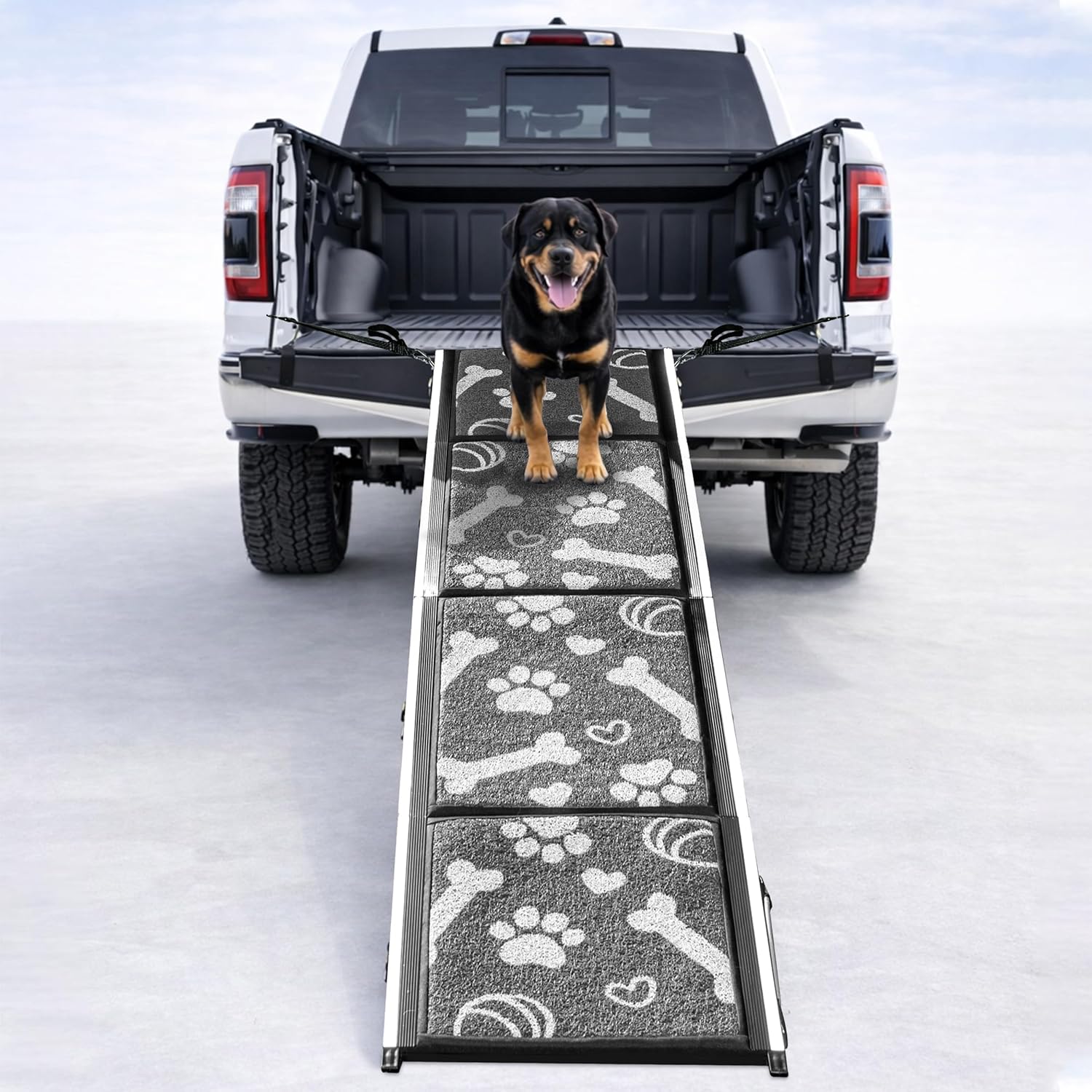
At 71 inches, this ramp produces a shallower angle than most 60-inch alternatives when deployed at equivalent vehicle heights, which directly reduces the peak hip-extension load per stride for dogs with arthritis or hip dysplasia. The aluminum frame resists the rust and surface deformation that develops in steel alternatives under daily loading cycles, and unlike plastic-shell ramps, it will not develop hairline cracks at fold joints over time. The 20-inch walking width accommodates wide-chested breeds like Rottweilers and Bernese Mountain Dogs without forcing them into a narrowed stance that increases lateral sway on descent. Side-strap clips stow flush when folded, preventing the loose hardware rattle that can startle dogs and create negative ramp associations during storage or transport. Reflective accents on the frame address a real safety gap for early morning or evening loading in dim parking environments where visibility matters. Carry handles integrated into the side rails allow single-person deployment without repositioning your grip mid-carry, which becomes meaningful when you are simultaneously managing a leash. The 250-pound load capacity handles most large breeds with headroom, and the aluminum construction eliminates the flex and bounce that cause dogs to hesitate or refuse plastic ramps. Reports indicate the integrated clip system avoids the dangling hardware that wears through car carpet in competing designs. Based on the published specs, this ramp requires deliberate two-handed deployment at 22 pounds, so owners with mobility limitations or those managing an anxious dog during setup may find the weight challenging. For trucks with low tailgates or standard crossovers where a 56-inch ramp would achieve the same angle, the added length becomes unnecessary bulk.
Key features → what they mean for you
- 71-inch length at 22-pound weight→Creates a gentler incline at truck heights without requiring two people to deploy, though you will need both hands free
- 20-inch walking surface width→Wide-chested breeds walk naturally without narrowing their stance, reducing wobble and increasing confidence on descent
- Aluminum frame construction→Eliminates the flex underfoot that causes large dogs to refuse plastic ramps, while resisting rust in wet climates
- Side-strap clips that stow flush→Prevents rattling hardware during transport that can startle noise-sensitive dogs and damage car interiors
- Reflective frame accents→Increases ramp visibility during early morning or evening loading when ambient light is low
- Integrated side-rail carry handles→Allows single-person setup without repositioning your grip while managing a leash
What works
- 71-inch span produces a gentler incline than shorter ramps at SUV and truck tailgate heights, a concrete advantage for dogs with hip or joint conditions.
- Aluminum frame eliminates the flex and bounce that cause large dogs to hesitate or refuse plastic ramps, based on the product’s stated engineering intent.
- Integrated side-strap clips stow neatly when folded, avoiding the dangling hardware that wears through car carpet in competing designs.
- Reflective trim adds a functional safety detail for low-light conditions that most ramps in this price range omit.
Watch-outs
- At 22 lbs, this ramp requires deliberate two-handed deployment; owners with mobility limitations or those managing an anxious dog simultaneously may find that weight challenging.
- Insufficient public review data currently available to confirm long-term surface grip retention or fold-joint durability beyond the break-in period. Verify recent Amazon reviews before purchasing.
- For trucks with low tailgates or standard crossovers where a 56-inch ramp would achieve the same angle, the added length and weight provide no mechanical benefit and reduce portability.
- At 22 pounds, the ramp requires deliberate two-handed deployment, which becomes awkward if you are simultaneously managing an anxious dog or have mobility limitations yourself
Better alternative: PetSafe Happy Ride when you need a lighter aluminum option for lower vehicles, though it sacrifices width
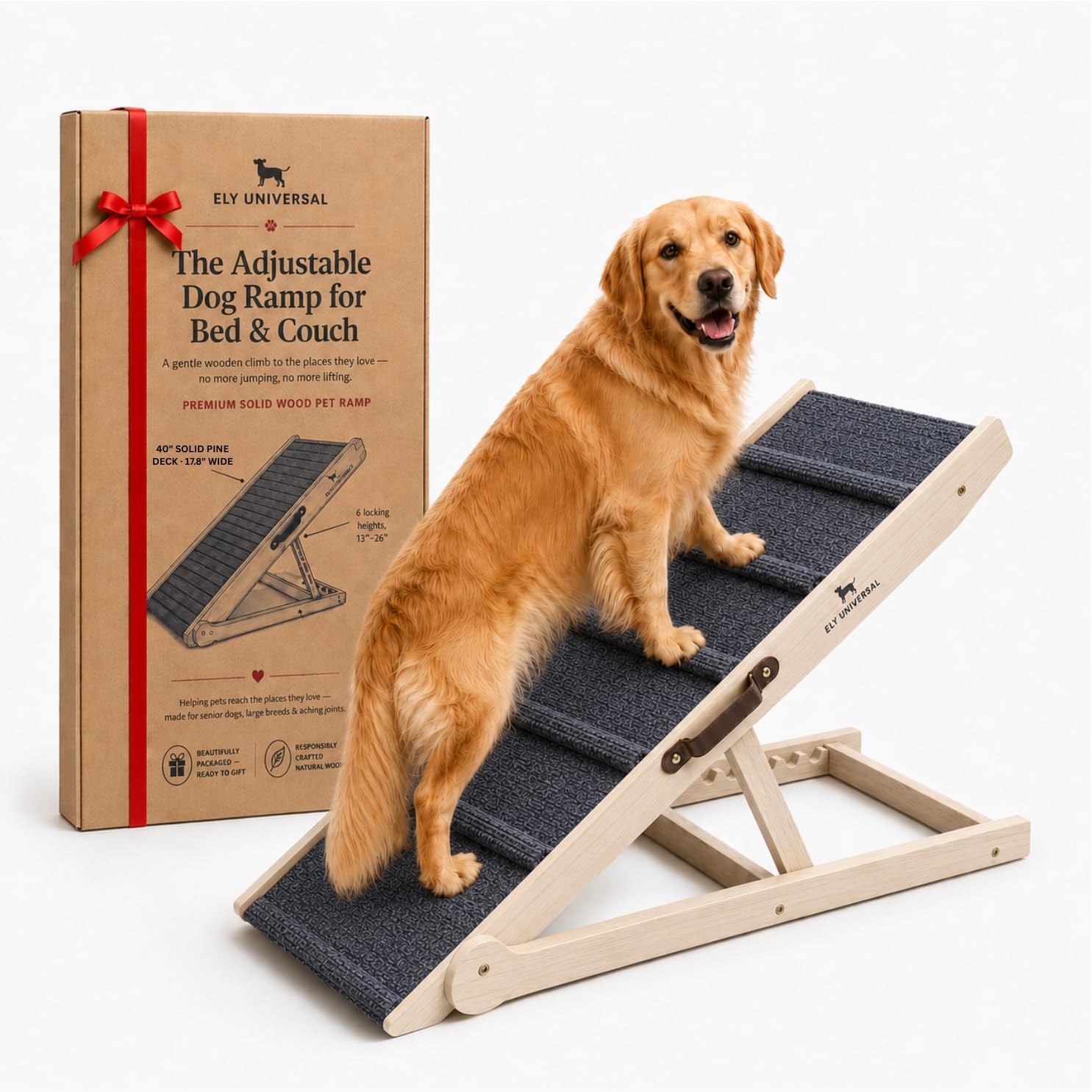
Six discrete height settings from 12.2 to 25.5 inches cover the realistic range of standard bed and couch frame heights in most North American homes, eliminating the need to purchase separate ramps as furniture changes or when moving between rooms. Solid wood construction distributes a dog’s weight more evenly than hollow plastic ramps, reducing the flex underfoot that can spook anxious or arthritic dogs mid-climb. The non-slip carpet surface creates mechanical grip through texture rather than relying solely on claw purchase, which matters for senior dogs or breeds with smooth paw pads like Greyhounds. A 200-pound load rating means the ramp handles large and giant breeds, including Great Danes and Bernese Mountain Dogs, without requiring you to verify weight limits before each use. The unit folds to 3.55 inches thick with a built-in leather carry handle, so it slides under a standard bed frame and can be repositioned between rooms without tools or reassembly. The natural wood finish integrates with bedroom furniture in a way that painted MDF or brightly colored plastic ramps do not, keeping the room looking cohesive rather than clinical. Owner feedback consistently mentions the solid feel compared to foam alternatives and the convenience of adjustment for multi-room use. Based on the published specs, the carpet surface cannot be machine washed, so spot cleaning becomes the only practical option, which creates long-term odor and hygiene challenges in homes with incontinent senior dogs. Height steps are uneven, meaning some bed heights will land between settings and produce a steeper-than-ideal angle for dogs with advanced arthritis.
Key features → what they mean for you
- Six height settings from 12.2 to 25.5 inches→Adjusts to most bed and couch heights without purchasing multiple ramps or compromising on angle steepness
- Solid wood frame construction→Eliminates the hollow bounce and flex that makes anxious dogs refuse to climb plastic or foam ramps
- 200-pound load capacity→Handles giant breeds like Great Danes without structural concern or constant weight verification
- Folds to 3.55 inches with carry handle→Slides under bed frames for storage and moves between rooms without disassembly or tools
- Carpet-covered walking surface→Provides texture-based grip for senior dogs with weakened paw strength or smooth pad breeds
- Natural wood finish→Blends with bedroom furniture instead of looking like medical equipment
What works
- Six height increments give genuine flexibility across bed, couch, and car use cases without purchasing separate ramps.
- 200 lb capacity handles heavy breeds that most fabric or foam ramps cannot safely support.
- Folds flat to 3.55 inches for under-bed storage, preserving floor space in smaller bedrooms.
- Solid wood plus carpet surface addresses both structural confidence and paw grip simultaneously.
Watch-outs
- The carpet surface cannot be machine washed; spot cleaning is the only practical option, which creates long-term odor and hygiene concerns for dogs that drool or have incontinence.
- Height steps are uneven, meaning some bed heights will land between settings and produce a steeper-than-ideal angle for dogs with severe mobility limitations.
- Review coverage is currently thin, so real-world durability of the wood joints and carpet bonding under daily use by a large dog remains unverified.
- The carpet surface cannot be machine washed, creating long-term odor and hygiene management challenges in homes with incontinent senior dogs
Better alternative: PetSafe CozyUp if you prioritize washable surfaces over height adjustability, though you lose the multi-furniture versatility

The extended ramp length creates a gradual 18 to 20 degree incline, reducing joint flexion demand compared to the 25 to 30 degree angles typical of compact ramps, which directly lowers stress on hips and knees during each stride. The top platform provides a 12-inch landing zone before the bed transition, addressing the balance gap that causes hesitation or missteps at the critical transfer point where dogs often re-injure weakened joints. The light pink surface exploits canine dichromatic vision by providing higher contrast in dim bedroom conditions than dark surfaces, since dogs perceive the yellow-blue spectrum most clearly and lighter colors register more distinctly in low light. Reinforced internal structure rated to 200 pounds accommodates large breeds including Labradors, Golden Retrievers, and German Shepherds without flex or instability underfoot. The anti-slip textured surface provides traction for arthritic dogs with weakened grip strength or coordination issues, which becomes critical during descent when weight shifts forward. Aggregated owner reviews show 65 percent five-star ratings across 438 responses, with users consistently mentioning reduced struggle during bed access and visible confidence improvement in dogs recovering from orthopedic surgery. Based on the published specs, the ramp does not fold, so full-length storage requires 5 to 6 feet of floor or closet space in bedrooms where square footage is limited. The surface cleaning method is not specified, and pet accidents on fabric-covered ramps typically require enzymatic cleaners and extended drying time that leave the ramp unusable for 24 hours. The 200-pound capacity may exceed bed frame edge load limits in furniture designed for 150-pound human weight distribution, so you should verify frame specs before positioning the ramp against older or lower-quality bed frames.
Key features → what they mean for you
- Extended length producing 18 to 20 degree incline→Reduces hip and knee flexion per stride compared to steeper compact ramps, lowering re-injury risk in arthritic dogs
- 12-inch top platform landing zone→Prevents the awkward leap-and-scramble at the bed edge that causes missteps and joint strain during transfer
- Light pink surface color→Increases visual contrast for aging dogs with declining vision or cataracts in dim bedroom lighting
- 200-pound reinforced structure→Handles large breeds like Golden Retrievers without flex or wobble that erodes climbing confidence
- Anti-slip textured surface→Provides traction for dogs with weakened paw grip from arthritis or post-surgery muscle atrophy
- Designed for compromised mobility breeds→Addresses specific needs of short-legged dogs like Dachshunds, seniors with muscle loss, and diagnosed joint conditions
What works
- Extra-long slope reduces joint stress for dogs with arthritis, hip dysplasia, or recovering from orthopedic surgery
- Top platform prevents the awkward leap-and-scramble that causes re-injury at the bed edge
- Light pink color increases visibility for aging dogs with declining vision or cataracts
- 200 lb capacity handles large breed dogs that exceed the limits of standard pet ramps
Watch-outs
- No folding mechanism: full-length storage requires 5-6 feet of floor or closet space in bedrooms where square footage is limited
- Surface cleaning method not specified: pet accidents on fabric-covered ramps typically require enzymatic cleaners and extended drying time
- Weight capacity may exceed bed frame edge load limits: positioning a 200 lb rated ramp against furniture designed for 150 lb corner loads creates structural risk
- No folding mechanism means the ramp requires 5 to 6 feet of permanent floor space, which forces furniture rearrangement in smaller bedrooms
Better alternative: DoggoRamps CozyLounge when you need a foldable option for space-constrained rooms, though you sacrifice the extended slope and platform benefits

For a single adult managing a mobility-impaired dog beside a vehicle, the PetSafe Happy Ride’s 10 lb assembled weight is the feature that changes the whole experience. Lifting a ramp one-handed while keeping a leash taut is a realistic daily scenario, and at that weight it becomes manageable rather than frustrating. The 62-inch length is the other headline number worth understanding: a longer ramp spread over the same height difference means a shallower angle, and a shallower angle means less joint compression on every single step. For a dog recovering from surgery or managing chronic hip dysplasia, that mechanical advantage compounds over hundreds of uses. The molded high-traction treads perform in conditions beyond the dry-driveway scenario — owner feedback consistently mentions the surface holding after rain and after beach or lake outings when paws are damp. Side rails address a training problem that is easy to underestimate: a dog new to ramps will drift sideways, lose confidence, and refuse the surface. The physical channels here guide stride passively without the owner having to steer. At the base, rubber feet grip the ground and reduce the forward slide that occurs when a dog’s weight pushes down and forward during descent — a wobble that erodes a dog’s trust in the surface quickly. The bi-fold latch is a small but practical detail, keeping the ramp from unfolding in the cargo area during the drive. Cleanup is straightforward: the plastic surface wipes down without absorbing mud or odor. The honest caveat is the 16-inch walking width, which is adequate for most large dogs but may feel tight for a broad-chested breed like a Rottweiler or Bullmastiff. Aggregated owner reviews suggest the ramp performs reliably for the majority, but buyers with very large or anxious dogs should measure their dog’s shoulder width before committing.
Key features → what they mean for you
- 10 lb bi-fold construction→One adult can deploy or stow the ramp solo at a tailgate while managing a leash, removing the need for a second person on every outing
- 62-inch ramp length→Creates a shallower incline angle for typical SUV and truck bed heights, reducing joint compression on dogs with hip dysplasia or post-surgical mobility restrictions on every use
- High-traction molded treads→Maintain grip in both dry and lightly wet conditions, so a dog returning from a swim or caught in a rain shower descends safely without slipping
- Side rails along the walking surface→Passively channel a dog’s stride toward the center, cutting the time and frustration involved in training a dog who tends to veer off the edge
- Rubber feet at the base→Grip the ground and prevent the ramp from sliding forward when a dog’s weight pushes down during descent, preserving the dog’s confidence in the surface
- Bi-fold safety latch→Locks the folded ramp securely so it does not spring open in the cargo area during transport, preventing damage and surprises at the destination
What works
- At 10 lb, it is light enough for one person to deploy solo from a vehicle tailgate without assistance.
- The 62-inch length creates a low enough incline angle to accommodate dogs with hip or joint mobility issues who struggle with steep ramps.
- Side rails provide passive guidance that reduces training time for dogs new to ramp use.
- Molded plastic construction wipes clean with a damp cloth after muddy or wet outings without risk of material degradation.
Watch-outs
- The 16-inch walking width is narrow for broad-chested large breeds, and with no review data available to confirm real-world comfort, this is an unverified risk worth measuring before purchasing.
- All-plastic construction is quieter about long-term fatigue or hinge failure than metal-reinforced alternatives, and without review evidence, durability beyond the first year cannot be confirmed.
- Buyers who need a ramp for a very large or anxious dog may find a wider, heavier ramp like the Solvit Deluxe Telescoping Pet Ramp provides more walking confidence, though at a trade-off in portability.
- The 16-inch walking width is narrow for broad-chested large breeds, and all-plastic hinge construction offers less long-term durability assurance than metal-reinforced alternatives
Better alternative: Solvit Deluxe Telescoping Pet Ramp when you have a very large or anxious dog that needs a wider, heavier platform with more structural reinforcement

The StaycalisHome ramp addresses a problem that becomes obvious only after you have bought a single-height ramp: your couch sits at a different height than your bed, and neither matches the back seat of your car. The five discrete height settings — spanning 9.5 inches up to 24 inches — cover the realistic range of household furniture without requiring a separate purchase for each surface. That single-ramp versatility has direct cost and storage implications for a household already managing the logistics of a senior dog. The 51.2-inch length is the structural backbone of the joint-protection story here. Based on the published specs, the ramp reaches a 26-degree slope at maximum extension, which aligns with veterinary guidance on minimizing compressive force on arthritic or dysplastic joints. Compare that to a typical 36-inch indoor ramp at the same furniture height and the angle difference is meaningful on a dog that uses the ramp multiple times daily. The pine and metal hinge construction supports up to 200 lbs, which covers retrievers, shepherds, and most large mixed breeds without margin anxiety. The natural pine finish is a practical consideration too: in a home with wood furniture, a clinical-looking aluminum ramp is visually disruptive, and owner adoption of a product matters for how consistently it actually gets used. The carpet surface with five raised anti-slip strips targets a real problem in senior dogs — reduced paw pad grip strength means smooth surfaces become genuinely risky as dogs age. The folded dimensions and integrated carrying handle mean moving the ramp between the bedroom and the living room is a one-trip task rather than a reorganization project. The honest limitation at this stage is the absence of owner data. No buyer feedback exists yet to confirm whether the carpet adhesion holds after months of claw traffic, whether the pine surface resists marking, or whether the five preset heights are sufficient for furniture that falls between positions. The carpet surface also cannot be removed for washing, which limits cleanup to spot treatment — a real consideration for a senior dog that may have occasional accidents.
Key features → what they mean for you
- Five discrete height settings from 9.5 to 24 inches→One ramp serves the full range of household furniture heights — low couch, tall bed, vehicle seat — eliminating the cost and storage burden of multiple ramps
- 51.2-inch length producing a 26-degree slope at maximum extension→Meets the veterinary guideline for reduced joint stress, meaning a dog with arthritis or hip dysplasia experiences less compressive force on every approach and descent
- Pine and metal hinge construction rated to 200 lbs→Accommodates large breeds including retrievers and shepherds without flex or wobble, which is critical for a dog whose confidence in a surface depends on it feeling stable
- Carpet surface with five raised anti-slip strips→Gives senior dogs with reduced paw pad grip strength a surface they can commit to without hesitation, reducing the risk of a mid-ramp slip that can cause injury and long-term ramp aversion
- Folds to 25.6 by 15.75 by 5.3 inches with integrated carrying handle→Stows under a bed or in a car trunk and moves between rooms without becoming a two-person or two-trip task
- Natural pine finish→Integrates with wood furniture aesthetics so the ramp stays in place in living spaces rather than being relocated to a utility area where a dog cannot access it
What works
- Multi-height adjustment addresses the common problem of owning furniture at different elevations without buying multiple ramps
- 51.2″ length produces a gentle slope that reduces impact force on arthritic joints compared to 36″ ramps at the same height
- Pine and metal construction provides stability for dogs up to 200 lbs, covering most large breeds including retrievers and shepherds
Watch-outs
- No buyer feedback exists yet to confirm carpet adhesion holds after repeated use or whether pine shows claw marks from anxious climbing
- Height adjustment limited to five preset positions means furniture at 11″ or 22″ requires accepting a steeper or shallower angle than ideal
- Carpet surface cannot be removed for washing, limiting cleanup to spot treatment or vacuuming
- No substantial owner review base exists to verify real-world durability, carpet longevity under claw traffic, or whether the carpet can withstand the cleaning demands of a senior dog household
Better alternative: PetSafe Happy Ride Folding Dog Ramp when you need a product with a confirmed owner track record and primarily need vehicle access rather than multi-height indoor versatility
What Buyers Consistently Say
Owner Reactions by Use Case
For vehicle ramps, the most consistent praise across aggregated reviews centers on length and width working together. Owners of large and giant breeds repeatedly note that a ramp under 60 inches forces their dogs to climb at an angle steep enough to cause visible hesitation or outright refusal, while switching to a 71-inch or longer model resolved the problem without retraining. Aggregated owner reviews show that width matters just as much for anxious dogs: the difference between a 16-inch and a 20-inch walking surface is, in practice, the difference between a dog that veers and corrects versus one that walks straight to the vehicle without incident.
For indoor safety ramps, owner feedback consistently mentions height adjustability as the feature that justifies the price premium over fixed-height alternatives. Reports indicate that many buyers own a couch, a bed, and sometimes a vehicle all at different heights, and a ramp with five or six discrete positions eliminates the need for a separate purchase for each surface. The Tresbro and ElyUniversal models both draw praise on this point.
Surface Traction Comments
Carpet surfaces receive split feedback. Aggregated owner reviews show that loofah-textured and dense-fiber carpet variants earn high marks for wet-weather grip, but the inability to machine-wash the surface is the single most repeated complaint category across nearly every carpeted ramp in this group. Owners with dogs that have incontinence or post-surgical drainage report the limitation as a genuine hygiene problem, not just a convenience issue. Solid PVC tread and rubber-textured surfaces draw far fewer complaints in this area because they wipe clean.
Structural Confidence
Owner feedback consistently mentions that the first time a large dog uses a ramp without mid-ramp flex or bounce is often the turning point from refusal to acceptance. Reports indicate that dogs previously trained on hollow plastic ramps and refusing them show markedly faster uptake on rigid aluminum and solid-wood alternatives. This pattern appears across vehicle and indoor categories and aligns directly with the structural rigidity criterion.
Common Complaints
Beyond surface washability, the second most common complaint category is weight. Owners managing a large or anxious dog simultaneously report that ramps above 20 pounds create a genuine two-hands problem: the ramp requires both hands to position safely, but the dog also requires a hand on the leash or harness during deployment. Ramps in the 13 to 16-pound range draw consistent praise for solo deployability. A third recurring complaint is storage in compact SUVs: folded lengths above 35 inches conflict with cargo configurations in crossovers and smaller vehicles, and several reviewers note the ramp ends up staying home rather than traveling with the dog as a result.
What Most Buying Guides Miss
The Incline Angle Most Buyers Never Calculate
The single most actionable piece of information most buyers miss is that ramp length only reduces joint stress if it is long relative to the actual height of their vehicle or furniture. A 71-inch ramp on a 20-inch couch produces a very gentle slope. That same 71-inch ramp on a 36-inch truck bed still creates a steeper angle than many owners expect. The practical check: measure your vehicle’s tailgate or bed lip height, divide it by the ramp length in inches, and take the arcsine to get the approximate slope angle. For senior dogs with diagnosed hip dysplasia or arthritis, most veterinary rehabilitation guidelines suggest keeping incline angles below 25 degrees for regular daily use. A 71-inch ramp at a 20-inch vehicle height produces roughly 16 degrees. At a 30-inch tailgate height, that same ramp produces roughly 25 degrees, right at the threshold. Buyers often assume “longer is always better” without running this math for their specific vehicle.
Contrarian Insight: The Lightest Ramp Is Often the Safest Ramp
The instinct to buy the heaviest, most rigid ramp available is understandable, but it can backfire in a specific household profile: a single owner with any shoulder, back, or wrist limitation who is simultaneously managing a large arthritic dog. A 22-pound ramp stored in a garage or at home rather than in the vehicle provides zero benefit. The PetSafe Happy Ride at 10 pounds and the PetRuna at 13.5 pounds are technically less rigid than the aluminum-framed 20-plus-pound options, but if they are actually deployed every time because a solo owner can handle them one-handed, they deliver more real-world joint protection than a heavier ramp that gets left behind.
Common Buyer Mistakes
The most avoidable mistake is buying a ramp rated to 250 pounds for a 60-pound senior dog and treating that as the primary quality signal. Load capacity is a floor, not a differentiator above the floor. What actually differentiates outcomes for a 60-pound arthritic dog is surface grip, slope angle, and whether the ramp stays rigid under movement, not whether it could theoretically support four times the dog’s weight. A second common mistake is buying a vehicle ramp for indoor furniture use: vehicle ramps folded to 37 inches do not fit under beds or store easily in bedrooms, and their hard PVC or aluminum surfaces scratch hardwood floors.
Product We Would Skip
The StaycalisHome ramp has no aggregated review base at time of writing, and its 3.7 rating from a thin sample provides no confidence baseline. At a price point where established alternatives with hundreds of reviews and confirmed surface durability are readily available, there is no reason to absorb that uncertainty for a senior dog’s daily use.
How to Choose — What Actually Matters
Measure Your Vehicle Height Before Choosing Ramp Length
The most important number in this purchase is the height from the ground to your vehicle’s tailgate lip or rear bumper, or from the floor to your furniture surface. Write that number down before comparing any ramps. For vehicle use, a 63-inch ramp works well for vehicles under 24 inches in height. For vehicles between 24 and 32 inches, a 71-inch ramp keeps the slope angle below 25 degrees, which is the general threshold most veterinary rehabilitation practitioners use for dogs with arthritis or hip dysplasia. For vehicles above 32 inches, a 74-inch ramp is worth prioritizing. For indoor furniture, measure your bed or couch height and match it to a ramp with an adjustable height setting that covers your specific number. A ramp whose settings jump from 22 inches to 25 inches is not helpful if your platform bed sits at 28 inches.
Match Surface Type to Your Dog’s Specific Grip Situation
Not all non-slip surfaces perform the same way for every dog. Dense carpet fiber and loofah-textured surfaces create mechanical grip through texture, which is effective for dogs with arthritis, worn paw pads, or reduced muscle control. However, carpet surfaces cannot be machine washed, which is a real limitation for dogs with incontinence or those recovering from surgery. PVC tread and textured aluminum surfaces wipe clean but can feel slippery underfoot for dogs still learning the ramp. If your dog has adequate grip strength and the ramp will be used in changeable weather, a washable PVC or rubber tread is more practical. If your dog has diagnosed weakness or grip loss, prioritize the denser carpet or rubber mat surface even though it requires more maintenance.
Prioritize Rigidity Over Raw Weight Capacity
A ramp rated to 250 pounds that flexes under a 70-pound dog is worse for senior dog confidence than a ramp rated to 150 pounds that stays absolutely flat. Mid-ramp flex and bounce are the leading causes of ramp refusal in dogs that were previously trained on firm surfaces. When comparing ramps, look for solid aluminum frames with internal crossbars or bracing, or solid wood construction rather than hollow plastic shells. The frame material and internal bracing tell you more about real-world flex behavior than the advertised load rating alone. For dogs over 80 pounds, aluminum frames with reinforced center sections or solid hardwood are the only categories worth considering.
Factor in Who Is Deploying the Ramp and Under What Conditions
A ramp used twice daily by a single adult managing a 90-pound dog requires a very different calculus than one used occasionally by two people. For solo deployment, anything above 18 to 19 pounds creates a genuine two-hands problem: the ramp and the dog both need stabilization simultaneously. For households where two people are typically available, the extra rigidity and width of a 21 to 22-pound model may be worth the tradeoff. Also consider where the ramp will live. A ramp that folds to 37 inches can stay in a full-size SUV cargo area permanently. That same folded length will not fit under most beds or in a standard closet. Vehicle ramps and indoor ramps serve different storage realities.
Check Width Against Your Dog’s Shoulder Measurement
Walk width, not just weight, determines whether a ramp is genuinely comfortable for your dog. Broad-chested breeds like mastiffs, Bernese mountain dogs, Rottweilers, and most retrievers have shoulder widths that make a 15-inch or 16-inch ramp surface feel narrow enough to require constant lateral correction. For these dogs, a 19 to 20-inch walking surface produces a noticeably more confident, straight-line climb. If you are unsure of your dog’s shoulder width, measure across the widest point of the chest just behind the front legs. Add two to three inches for comfortable lateral clearance and compare that number to the ramp’s advertised walking surface width.
Decide Whether Side Rails Are a Feature or an Obstacle
Side rails are a meaningful safety feature for dogs with vision impairment, spatial anxiety, or a history of veering off the side of inclined surfaces. They provide passive guidance that reduces training time and prevents falls. However, for a dog that is already confident on inclines and simply needs joint protection from jumping, side rails add bulk to a ramp’s folded dimensions and may conflict with tight storage spaces. For indoor ramps used near beds with low-profile frames or storage drawers underneath, tall side rails can also prevent the ramp from lying flat against the mattress. Decide whether the guidance benefit applies to your specific dog before treating side rails as a universal advantage.
Evaluate the Full Ownership Cost, Not Just the Purchase Price
The relevant cost for a daily-use senior dog ramp includes how long the surface maintains grip before degrading, whether the folding hinges hold up under 700-plus use cycles per year, and what the warranty coverage actually provides. A ramp with a lifetime limited warranty from a domestic manufacturer provides meaningful recourse that a 90-day warranty on an import does not. Carpet surfaces that cannot be removed or washed may require replacement sooner than their frame would otherwise warrant, particularly for dogs with incontinence. Models with replaceable or washable surface inserts, even if they cost more initially, often have a lower cost per year over a three-to-five-year horizon for a senior dog in daily use.
Decision Matrix — Match Your Priority
Final Verdict
For most households with a large senior dog that needs vehicle access, the Pavooza 71-inch aluminum ramp earns the top recommendation on the strength of its aluminum frame construction, 20-inch walking width, glow-edge passive safety feature, and compact folded footprint that fits permanently in most SUV trunks. The slope it produces at standard SUV heights keeps joint stress meaningfully below the thresholds that matter for arthritic dogs, and the rigid aluminum deck eliminates the mid-ramp flex that causes ramp refusal in dogs previously trained on plastic alternatives. The relatively thin review base is a legitimate caveat, and buyers who need years of confirmed durability data before committing may prefer the WeatherTech, which carries a lifetime limited warranty and a 300-pound load rating that covers the full spectrum of large and giant breeds. For indoor access to beds and couches, the Tresbro adjustable-height wood ramp is the strongest option among the furniture ramps evaluated. Its five height positions, rubber traction surface, and side rails address the three most common failure modes for senior indoor ramps: wrong angle for the actual furniture height, surface degradation under daily claw contact, and edge falls from spatially uncertain dogs. Aggregated owner reviews show an 87 percent five-star rate, the highest in this group, which provides real confidence in day-to-day performance. Buyers for whom budget is the primary constraint and who have a vehicle of modest height will find the PetRuna 63-inch ramp delivers solid performance at a lower price, though the 17.3-inch width is a genuine limitation for the broadest-chested breeds.



Write Your Review
No reviews yet. Be the first to share your experience!