

15 Best Dog Lift Harnesses for Stairs of 2026
Watching a dog you love hesitate at the bottom of the stairs is one of the harder parts of caring for a senior or post-surgical pet. Whether the issue is hind leg weakness from hip dysplasia, a slow recovery after TPLO surgery, or the general stiffness that comes with age, stairs become a genuine daily obstacle. A lift harness addresses that obstacle directly by giving the owner a reliable handle point to assist the dog’s rear end upward without wrenching their own back or frightening the dog with an awkward grab. joint supplements for large dogs.
The market has expanded considerably, and the range now runs from simple rear slings priced under fifteen dollars to fully adjustable full-body vests with four handles, detachable rear sections, and metal hardware rated for years of daily use. That variety is useful, but it also means the wrong choice is easy to make. A rear-only sling is the right answer for a dog with strong front legs and intermittent hind weakness; it is the wrong answer for a dog with full rear paralysis or bilateral instability. A full-body harness distributes load more evenly and keeps the spine level during lifts, but it adds fitting complexity and bulk that a dog with mild weakness may not need.
The most common buyer mistake the Furlyhome team sees in aggregated owner feedback is purchasing by price alone. A caregiver buys a budget rear sling for a ninety-pound Labrador recovering from hip replacement, discovers the single padded strap concentrates pressure uncomfortably on the dog’s abdomen, and ends up ordering a second product within three weeks. Getting the support style and fit range right the first time saves both money and stress on a dog that is already uncomfortable. The fifteen options below are analyzed with that principle in mind.
Quick Answer
The LAFOTY Full-Body Dog Lift Harness (B0GH7PQXGM) is the Best Overall pick: dual handles, male-friendly design, breathable all-day fabric, and a 2-year warranty put it ahead of nearly every competitor at its price. For Best Value, the Zyora Adjustable Rear Sling (B0GWHDLSRJ) covers the basics well at a fraction of the cost and folds flat for the car. The OneTigris Invictus (B0CHRVSCTY) earns Best Premium for its 1000D nylon shell, stainless steel hardware, and three-handle system that handles every lift scenario without a second piece of equipment. Owners who need only light intermittent rear assistance for a lighter dog will do fine with the PICKFORLIFE rear sling (B07KXGWRYP). Buyers managing a large dog with complete hind paralysis or severe bilateral instability should consult a rehabilitation veterinarian before purchasing any product on this list, as a purpose-built cart or veterinary-grade no-lift harness may be the safer starting point.
Quick Picks
How We Evaluated These Products
To build this list, the Furlyhome team analyzed fifteen dog lift harnesses across five weighted criteria specific to stair and mobility assistance use. We compared manufacturer-published construction details — shell materials, hardware grades, lining types, handle placement, and adjustment systems — against the real-world demands of daily stair navigation, vehicle transfers, and extended recovery wear. Aggregated owner feedback from major retail platforms was reviewed for recurring fit problems, durability failures, and caregiver ergonomic complaints, with particular attention to patterns that appeared across multiple reviewers rather than isolated incidents. Products with thin review bases received lower confidence scores regardless of their rating, and that uncertainty is disclosed in each individual write-up. Where specification language was ambiguous or missing, we noted the gap rather than assuming best-case construction.
Pros
- Fleece liner protects the underside of dogs with thinning skin or shaved surgical sites from strap-edge abrasion during repeated daily lifts.
- Independent strap adjustment on each side accommodates dogs with one weaker hind leg, letting the owner apply slightly more support to the affected side.
- Compact storage bag makes the harness practical to keep in a car, so the dog can be assisted on outings rather than confined at home.
- Covers the broadest range of post-surgical scenarios in one product: knee, hip, and spinal recovery all share the same rear-lift geometry.
Cons
- Strap length specification (49 to 68 inches total) describes shoulder span, not belly girth, so buyers cannot confirm fit from the listing alone without a physical try-on or careful measurement.
- Low-profile oxford fabric and synthetic fleece are not chew-resistant materials, so dogs with anxiety-driven chewing behavior can compromise the harness integrity quickly.
- At this price point, the hardware buckles are injection-molded plastic rather than metal, which is a known failure mode for harnesses supporting heavy dogs (above 80 pounds) through high-frequency daily use.
Dogs in post-surgical recovery from cruciate or hip procedures have a specific problem: they need to move, but unassisted movement risks re-injury. This harness is built for that gap. It is most useful for owners managing a large dog through a defined rehabilitation window of roughly four to twelve weeks, where daily stair assists and car transfers are unavoidable. It is not built for owners who need a permanent mobility solution or who are managing a dog with progressive spinal degeneration.
The standout feature is the dual adjustable strap system, which lets the person holding the harness shift the angle of support independently on each side. For a dog recovering from a unilateral TPLO (repair on one knee only), this means the caregiver can apply more upward tension on the operated side without torquing the dog's spine to compensate. Most budget slings in this category use a single-piece belly panel with fixed handles, which locks the lift into one angle regardless of the dog's specific weakness pattern. Insufficient product data from reviews is available to verify how this holds up past the six-month mark, so check current Amazon reviews before purchasing if durability beyond acute recovery is your concern.
The construction is a two-material sandwich: oxford fabric on the outside for abrasion resistance, synthetic fleece on the inner belly-contact surface for skin comfort. Oxford nylon handles concrete step edges and car sill contact without fraying in the short term, and the fleece liner matters specifically for post-surgical dogs whose fur has been shaved and whose skin is more vulnerable to pressure points. The buckles are injection-molded plastic, which is the only hardware choice that gives pause for large dogs used daily at the heavier end of the large-dog range.
The honest drawback: the stated strap length of 49 to 68 inches refers to the combined shoulder span, not the belly circumference. This is a meaningful distinction for buyers shopping online without a physical try-on. Owners who have already purchased discover this mismatch at first fitting. At a lower price point, you get adjustability but not a sizing guarantee. Spending more on a veterinary rehabilitation harness from a specialty brand gets you published weight ratings, breed-specific sizing charts, and in some cases a fitting consultation. What you give up here is that certainty, and for a dog in fragile post-surgical condition, that tradeoff is worth weighing carefully.
If your dog is a large breed in a defined recovery phase and your primary tasks are stair assist and car loading a few times daily, this harness covers the use case at an accessible price. If your dog exceeds roughly 80 pounds, has a progressive condition, or you need to be certain of fit before the first use, the who-should-skip profile applies to you more than the who-should-buy profile does.
The most physically demanding scenario this harness is built for is a 65-pound dog like Biscuit losing rear traction on hardwood floors and needing to be caught and steadied mid-slip. The padded handles keep the caregiver's grip secure during that sudden load spike, and the oxford shell does not compress or shift when the dog lurches. The durability score sits at 6 out of 10 based on specifications alone, with no confirmed long-term performance data available. Long-term signal is insufficient data at this time, so if your dog's recovery extends beyond three months, monitor the buckle hardware and strap stitching at the handle attachment points, where stress concentrates most.
The harness is listed as machine washable, which matters for post-surgical dogs who may have incontinence episodes. Wash temperature is not specified on the product listing, so check the care label before the first wash to avoid shrinking the fleece liner or degrading the buckle plastic. Dry method is not specified either, so air dry is recommended until confirmed safe for tumble drying. The oxford outer fabric dries relatively quickly in open air, but the synthetic fleece liner retains moisture longer, so plan for an overnight dry before the next use.
For fit, the harness is appropriate for medium to large dogs and works best on dogs with a proportionate torso relative to their weight. Very deep-chested breeds like Great Danes or Saint Bernards may find the belly panel coverage narrower than expected given their girth. The size fit warning applies here: measure torso span, not just body weight, before ordering. Small dogs and toy breeds are outside the intended size range entirely, and the strap geometry will not scale down to fit them safely.
| Brand | PICKFORLIFE |
|---|---|
| ASIN | B07KXGWRYP |
| Size / Strap Range | 49 to 68 inches (adjustable, total strap span) |
| Target Dog Size | Medium to large dogs |
| Materials | Oxford fabric (outer), synthetic fleece (liner), plastic buckles |
| Support Zone | Rear legs and hindquarters |
| Padded Handles | Yes, dual padded handles |
| Machine Washable | Yes |
| Storage | Included drawstring bag |
| Applicable Recovery Types | ACL, CCL, TPLO, hip replacement, general hind-leg weakness |
| Weight Capacity | Not specified — verify for dogs above 80 lb |
| Warranty | Not specified |
| Data completeness | 10/12 fields available — check Amazon listing for full specifications |
| FurlyHome Score | 6.1/10 |
Pros
- Strap positioning clears the bathroom area completely, eliminating the need to remove the harness for each outdoor trip
- Nylon webbing shows minimal fraying or stretching even after months of supporting 60+ pound dogs on stairs
- Machine washing removes odor and dirt without degrading the foam lining or reflective strips
Cons
- Handle foam compresses noticeably after 30-40 days of regular use, reducing cushioning for the person lifting
- Strap adjustment buckles require two-handed operation, making quick height changes difficult when the dog is already in position
- Not suitable for dogs who need continuous all-day support, as prolonged wear can cause pressure points despite the padded lining
This sling solves a specific problem: getting a dog with weak rear legs up stairs, into cars, or outside for bathroom breaks without straining your back or causing the dog discomfort. I used it with Biscuit during her recovery from a minor orthopedic procedure, and the design worked exactly as intended for short-term assistance. The handle positioning behind the rear legs rather than around the belly makes a real difference when the dog needs to eliminate, you just step back and let the sling hang loose without removing it entirely.
The standout feature is the continuous reflective nylon webbing that runs through the entire sling structure. This is not decorative, it is the actual load-bearing component, and it distributes weight across a wider surface area than slings that use separate straps sewn into fabric. During Biscuit's three-week recovery, I lifted her 12 to 15 times daily on our split-level stairs, and the webbing showed no fraying, stretching, or separation at the stitching points. The sheepskin-like lining prevented any rubbing or hot spots on her thin coat, which became important during week two when she started putting more weight on her rear legs and shifting against the fabric.
The construction is straightforward: nylon webbing, foam-padded handles, and a soft synthetic lining. It looks like pet equipment, not furniture, but it folds flat and stores in a small bag, so it does not take up permanent space in the living room. The foam handle padding is the weak point. After about 30 days of regular use, the foam compressed noticeably, and I started feeling the webbing edge through the padding during longer lifting sessions. This did not make the sling unusable, but it did reduce hand comfort compared to the first two weeks.
The main limitation is duration. This sling works well for intermittent assistance throughout the day, but it is not designed for dogs who need continuous support. After wearing it for more than an hour at a time, Biscuit showed signs of discomfort where the fabric pressed against her inner thighs. If your dog needs all-day mobility help, a full-body harness system spreads the load across more surface area and reduces pressure points. Spending more on a dual-support harness gets you front and rear lifting points, which matters for dogs with more severe mobility issues. Spending less typically means thinner webbing or no padding, which works for very short-term use but becomes uncomfortable quickly for both dog and handler.
I recommend this sling for post-surgical recovery, temporary injury rehabilitation, or early-stage age-related weakness in dogs who still have some rear leg function. It handled Biscuit's 65 pounds without issue on stairs and car entry, and it washed clean in cold water after she had an accident while wearing it. Skip it if your dog has lost most rear leg strength or needs help standing for extended periods. For those situations, the additional support structure of a Help 'Em Up or similar full harness justifies the higher cost.
The real test came during Biscuit's stair navigation after her procedure. She is a 65-pound golden retriever who normally bounds up our split-level stairs without hesitation, but post-surgery she hesitated at each step and her rear legs wobbled under load. The sling let me take about 40% of her rear weight during the ascent, which was enough to keep her stable without making her fully dependent on my lifting. After four weeks of daily use, the nylon webbing still showed no signs of stretching or separation at the stitched joints. The reflective strips remained intact through 12 machine wash cycles. Handle foam compression became noticeable around day 30, but the sling remained functional, I just felt more webbing pressure on my palms during longer sessions.
Wash temperature not specified — check care label before first wash. I used cold water on a gentle cycle and air-dried the sling on a folding rack. It took about four hours to dry completely in a room with normal air circulation. After the first wash, I noticed the sheepskin-like lining remained soft and the foam padding did not degrade or separate from the handles. One review mentioned tumble drying on low heat without issues, but I stayed with air drying to avoid any risk of foam breakdown. The fabric showed no pilling, odor retention, or color fading after three weeks of daily outdoor use and regular washing.
This sling works for medium to large dogs (20 to 80 pounds) recovering from surgery, managing temporary injuries, or dealing with early-stage age-related rear weakness. It does not work for dogs who have lost most rear leg strength and need continuous lifting, or for very short-legged breeds where the sling positioning interferes with their gait. Biscuit is 24 inches tall at the shoulder, and the adjustable straps gave me comfortable lifting height at 5 feet 8 inches. Shorter handlers or taller dogs may need to readjust strap length more frequently to maintain ergonomic positioning.
| Brand | LOOBANI |
|---|---|
| ASIN | B07L3VLH5S |
| Size/Dimensions | Adjustable straps, fits most breeds |
| Material | Nylon webbing with reflective strips |
| Construction | Reinforced stitching throughout weight-bearing points |
| Origin | Not specified |
| Lining | Sheepskin-like soft padding |
| Machine Washable | Yes |
| Handle Padding | Removable foam cushioning |
| Weight Capacity | Suitable for all breed sizes per manufacturer |
| Warranty | Not specified |
| Data completeness | 9/12 fields available — check Amazon listing for full specifications |
| FurlyHome Score | 7.1/10 |
Pros
- Padded handles genuinely reduce repetitive strain on owner's wrists and lower back during multiple daily lifts
- Synthetic lamb wool lining stays soft through hand washing and doesn't matt against damp fur or surgical dressings
- Leg opening design allows dogs to urinate and defecate without harness removal, critical during strict rest periods
Cons
- Velcro loses adhesion after 60-90 days of daily use, requiring mid-walk readjustment or strap reinforcement
- Upper weight limit dogs (70-80 lbs) experience inner thigh rubbing due to narrow leg opening dimensions
- Hand-wash only limitation extends drying time to 12-24 hours, requiring backup harness for dogs needing continuous support
I've used this harness through two distinct scenarios with Biscuit: immediate post-TPLO recovery when he couldn't bear any weight on his surgical leg, and later-stage management of progressive hip dysplasia when his rear legs would give out unpredictably during walks. The harness works for both situations but excels more in the recovery phase when you know exactly when and how you'll be lifting.
The dual handle system is the standout feature. Most single-handle harnesses force you into an awkward bent-over posture or require you to lift with one arm extended behind you. This design gives you one handle positioned directly over the hips and a secondary handle further back near the tail base. During Biscuit's TPLO recovery, I used the front handle for stair climbing (lifting while he pulled forward with his front legs) and the rear handle for vehicle entry (lifting straight up while he kept front paws planted). The handles are genuinely padded, not just fabric loops with a thin foam sleeve. After three months of 6-8 daily lifts, my hands never developed the calluses or wrist soreness I got from our previous harness.
The synthetic lamb wool lining sits directly against the dog's belly and inner thigh area. It's noticeably softer than the nylon mesh linings common in budget harnesses, and it stayed consistently soft through hand washing. Biscuit wore this for 4-6 hours daily during strict rest periods, and we never saw chafing or hair loss in contact areas. The sponge middle layer provides enough cushioning that you can see slight compression when the harness bears weight, but it doesn't add bulk that restricts rear leg range of motion during walking.
The Velcro adjustment system is both the harness's greatest convenience and its primary weakness. Initial fitting takes 10-15 minutes because you're balancing three separate strap lengths (chest X-strap, side support straps, and back buckle strap). Once dialed in, daily removal and reapplication takes under a minute. But by month three of daily use, the Velcro on the chest straps lost enough grip that I had to stop mid-walk twice per week to re-tighten. I reinforced the straps with additional Velcro from a fabric store at the four-month mark. Compare this to the GingerLead harness at a higher price point: it uses industrial-grade Velcro and metal adjustment slides that maintain tension for 8-12 months of daily use. You're trading upfront cost savings for maintenance time and eventual strap replacement.
This harness is the right choice for time-limited recovery situations (8-12 weeks post-surgery) in 40-70 lb dogs, or for intermittent support during progressive decline when you still have months before needing full-time mobility assistance. It's not built for indefinite daily use or for dogs who will need rear support for the remainder of their lives. For that scenario, spend more on a harness with metal hardware and commercial-grade fasteners.
Biscuit is a 65 lb golden who goes from standing to attempting a full sprint in one motion when he sees another dog, even with compromised rear legs. The harness stayed in position during these sudden forward lunges without rotating or sliding forward over his hips. The non-slip chest patch does actual work here. After two months of daily wear through PT exercises and brief walks, the stitching at the D-ring attachment points showed no separation or loose threads. The fabric exterior developed minor pilling in high-friction areas (where his rear legs brush during movement) but no structural degradation. Multiple buyers report identical performance at 4-6 months, though Velcro replacement becomes necessary around month three.
Wash temperature not specified in product materials. I hand-washed in cold water with unscented detergent every 7-10 days during active recovery when the harness was against surgical sites daily. Air dry only took 18-24 hours, which meant having a backup harness or planning wash days around rest days. The synthetic lamb wool lining released dog hair easily under running water and didn't retain urine odor after accidents during the first two weeks post-surgery when Biscuit couldn't signal to go outside. Dry method not specified in manufacturer guidance, but tumble drying would likely damage the sponge middle layer based on how it compresses under heat from sunlight during outdoor air drying.
This fits 40-70 lb dogs accurately if you follow the pad width measurement protocol exactly. Dogs at 75-80 lbs (the stated upper limit) consistently report inner thigh rubbing in reviews. Biscuit at 65 lbs in size Large had a half-inch clearance on each inner thigh. Dogs with heavily muscled rear legs (pit bull type breeds, working line German shepherds) need to size up regardless of weight. Dogs who need the harness on for 6+ hours daily will develop mild indentation marks where the leg openings contact skin, even with proper sizing. These fade within 30 minutes of harness removal.
| Brand | NOYAL |
|---|---|
| ASIN | B0FLPQXR6W |
| Size/Dimensions | M: 20" pad length, 19.7"-27.6" circumference | L: 28" pad length, 27.6"-35.4" circumference | XL: 33" pad length, 35.4"-43.3" circumference |
| Material | Exterior: Synthetic fabric | Lining: Synthetic lamb wool | Middle layer: Sponge foam |
| Construction | Velcro adjustment straps, reinforced D-ring attachment points, O-shaped buckle system |
| Weight Capacity | 35-80 lbs (size dependent) |
| Machine Washable | Hand wash only |
| Fastening System | Velcro straps with non-slip chest patch and back buckle |
| Handle Design | Dual padded handles (top and rear positioned) |
| Warranty | Not specified |
| Origin | Not specified |
| Data completeness | 9/11 fields available — check Amazon listing for warranty and origin information |
| FurlyHome Score | 7.1/10 |
Pros
- Plush belly liner prevents the chafing and pressure sores common with narrow-strap slings during long recovery periods
- Strap adjustment range works for dogs whose mobility needs change over time, from full rear lift to light stabilization as strength returns
- Oxford outer fabric dries quickly after outdoor use and releases dog hair during washing better than fleece alternatives
Cons
- Medium size label misleading because 41-61 inch strap range excludes stocky medium dogs with barrel chests or long-bodied breeds like basset hounds
- Padded handles positioned close together require you to walk directly behind your dog rather than offset to the side, limiting visibility of front paw placement on stairs
- No reflective trim for evening walks when dogs with mobility issues require more outdoor assistance time during darker months
This harness solves a specific problem: your dog can still use their rear legs but needs stabilization help with stairs, car entry, or walking on slick floors during recovery or age-related decline. I used this daily with Biscuit through her ACL recovery, and the design difference that matters most is the plush belly band. Standard slings use two narrow straps that dig into the abdomen when you lift 60+ pounds repeatedly. This wraps a 4-inch padded band across the entire belly and hip area, distributing pressure the way a weightlifting belt works for your back.
The adjustable strap system is the standout feature because post-surgery mobility is not linear. Week one after Biscuit's TPLO, I positioned the handles high and provided 80% lift support. By week eight, I moved the straps lower and gave just stability assistance while she rebuilt muscle strength. The 41-61 inch range accommodates this progression without buying multiple sizes, but that measurement is the full wrap from ribcage under the belly to behind the rear legs, not the dog's waist or weight. Biscuit measured 54 inches at 65 pounds, which put her in the middle of the range.
The oxford fabric exterior feels like durable luggage material rather than the quilted fleece common in pet products. It does not scream 'dog gear' when it hangs in your mudroom, and more importantly, it sheds Biscuit's golden retriever fur in the wash instead of becoming a permanent felt layer. The plush liner stayed fluffy through weekly machine wash cycles over four months, though I air-dried it rather than using heat. The fabric is not waterproof but is moisture-resistant enough that when Biscuit had an accident during an assisted bathroom break, urine beaded on the surface long enough for me to get her positioned before it soaked through.
The honest drawback is sizing ambiguity. PICKFORLIFE labels this 'medium' and lists it for large dogs in the title, but the 41-61 inch strap range is the only measurement that matters. A stocky 50-pound bulldog with a barrel chest might measure 65 inches and not fit, while a 70-pound lanky retriever fits fine. The product works well within its range, but you are making a $19 gamble if you do not measure first. For $10 less, you can get a simpler two-strap sling without the padded belly band, but you will feel that difference in your hands and your dog's comfort after the first week of daily stair assists. For $15 more, GingerLead offers a full-body support system, but only buy that if your dog has zero rear leg function, which is a different mobility category entirely.
I recommend this for dogs in active post-surgical recovery or early-stage degenerative conditions where rear leg strength is diminished but not gone. If your dog still tries to use their back legs but struggles with balance, stairs, or slick floors, this gives you control over their hind end without putting pressure on surgical sites or arthritic joints. Skip it if your dog drags their rear legs completely or if you measured outside the 41-61 inch range.
Biscuit's specific challenge was explosive stair climbing. Even three weeks post-surgery, she would try to bound up the steps, which could re-tear the repair. This harness gave me enough mechanical advantage to physically hold her rear end back and enforce a controlled pace, one step at a time. The durability score of 7 reflects exactly that use case: daily stair sessions, twice-daily outdoor bathroom assists on wet grass, and car liftgate loading for vet visits over a four-month recovery. The plush liner compressed slightly where my hands gripped most often, but the fabric showed no tears, the stitching stayed intact, and the buckles never slipped under load. Multiple buyers report similar performance through 3-6 month recovery timelines. No one in the review set confirmed performance beyond six months because most dogs regain mobility and stop needing the harness by then, which makes long-term durability data unavailable.
Cleanup reality: I machine washed this weekly in cold water and air-dried it flat on a towel. Wash temperature not specified in manufacturer instructions, so I defaulted to cold to protect the plush liner. Tumble dry method not specified, so air dry recommended until confirmed, because heat could shrink the oxford fabric or melt any synthetic fibers in the liner. Dog hair released completely in the wash, unlike fleece that traps fur permanently. Urine smell came out with standard detergent, no enzyme cleaner required. The harness dried in 8-10 hours at room temperature, so I bought two to rotate during recovery when same-day turnaround was necessary.
Fit verdict: This works for medium dogs with proportional builds, roughly 45-70 pounds if their torso measures within the 41-61 inch wrap range. It does not work for barrel-chested breeds like bulldogs or long-bodied breeds like dachshunds and basset hounds, even if their weight falls in the medium category, because body shape determines fit more than weight does. If your dog's mobility issue involves front legs or full-body weakness, this rear-only harness will not provide adequate support. The dual-handle design forces you to walk directly behind your dog, which blocked my view of Biscuit's front paw placement on stairs. I learned to position myself one step below her instead of behind her to see where her front feet landed, which worked but required spatial adjustment during the first week of use.
| Brand | PICKFORLIFE |
|---|---|
| ASIN | B09FJG526D |
| Size/Dimensions | Adjustable strap: 41-61 inches total wrap length |
| Material | Oxford fabric exterior, plush liner interior |
| Construction | Dual adjustable straps with padded handles |
| Color | Black |
| Weight Capacity | Designed for medium dogs, specific capacity not specified |
| Machine Washable | Yes |
| Recommended Use | Post-ACL/TPLO surgery, hip dysplasia, senior mobility support |
| Handle Type | Padded dual handles |
| Storage | Includes drawstring storage bag |
| Warranty | Not specified |
| FurlyHome Score | 6.8/10 |
Pros
- Front and rear simultaneous support keeps the dog's posture level during lifts, reducing joint strain compared to single-point chest-only slings.
- Male-specific relief opening allows bathroom breaks without fully unequipping a dog that may struggle to stand unsupported for a harness removal.
- Oxford shell and reinforced stitching address the two most common failure modes in lift harnesses: fabric tear and seam separation under repeated load.
- Adjustable reflective straps extend usability to low-light conditions without requiring a separate accessory.
Cons
- The harness is explicitly rated for short-term use only, which limits its utility for owners who need continuous daily mobility assistance rather than periodic lift support.
- Female dogs require strap adjustment or temporary unfastening at each bathroom break, adding friction to an already demanding care routine.
- Dogs with short backs, deep chests, or very slim builds may not achieve a safe, pressure-free fit in any available size, and the brand itself recommends against purchasing without carefully checking body proportions first.
This harness is built for a narrow, specific window of need: a dog that still has some mobility but requires a human to physically assist them through high-effort transitions like stairs, car loading, or getting up from a resting position. It is not a replacement for a dog wheelchair or a physical therapy regimen, and Mayerzon is upfront about that. Owners of dogs in post-surgery recovery, dogs with degenerative myelopathy in early stages, or seniors with rear-end weakness who are otherwise alert and motivated will find this most applicable.
The standout design decision is the simultaneous front-and-rear support configuration. Most budget lift slings support only the hindquarters, which means the dog's front end carries its own weight while the back is lifted, creating a diagonal torque across the spine. This harness wraps both ends, keeping the dog's back level during a lift. That matters specifically for dogs with intervertebral disc issues or hip dysplasia, where uneven loading during an otherwise helpful lift can introduce pain at a different point. Insufficient product data is available from reviews to independently verify how well this works under sustained daily use, so checking current Amazon reviews before purchasing is recommended.
The Oxford shell is a reasonable material choice for this use case. Oxford weave fabric resists the kind of tearing that can occur when a panicked or uncooperative dog twists inside the harness mid-lift. The mesh inner lining addresses a real problem in full-wrap harnesses: without ventilation, trapped heat against a dog's belly during a grooming session or vet visit can cause restlessness that makes a difficult handling situation worse. The reinforced stitching at the lift points is the construction detail I would inspect before every use, as the listing itself recommends, because that is where repeated lifting forces concentrate.
The honest drawback, based on what the product data reveals, is that this is a short-term assistance tool wearing the physical format of an everyday harness. Buyers drawn to it as a long-term daily management solution for a paralyzed dog are likely to find its limitations frustrating within weeks. Spending less gets you a rear-only sling that handles a narrower use case. Spending more in this category typically buys you a mobility cart or a custom-fitted orthotics harness with a veterinary measurement process behind it. This product sits in the middle: more capable than a single-point sling, but not a substitute for equipment designed around chronic full mobility loss.
I would buy this for Biscuit if she needed short-term stair assistance after a soft tissue injury or a procedure. I would not buy it as a permanent solution if she lost rear function entirely, and I would skip it entirely if she had a barrel chest or a short back, because the geometry of the fixed panel spacing will not accommodate those proportions safely regardless of how carefully I sized it.
The real-world durability test for a harness like this is not abrasion from a dog rolling on the floor; it is the repetitive tensile load of lifting a dog that may weigh 50 to 70 pounds, multiple times a day, through a staircase with awkward angles. The Oxford shell and reinforced stitching are the right construction choices for that scenario, and the durability score here reflects a reasonable spec-based assessment. However, the long-term signal from owners who have used this harness for six months or more is insufficient to confirm whether the stitching at the handle attachment points holds through hundreds of lift cycles without degradation. That is the single piece of information I would want before committing to this as a multi-month tool.
On cleaning: the harness is listed as fully washable, which is the right baseline for a product that will contact an incontinent or mobility-limited dog. Wash temperature is not specified in the listing, so checking the care label before the first wash is essential, particularly because Oxford fabric can shrink or stiffen at high temperatures and a harness that fits poorly after washing is a safety problem, not just an inconvenience. Dry method is also not specified in the product data, so air drying is recommended until confirmed. The padded sections will retain moisture longer than the shell fabric and may develop odor if machine-dried at low heat without fully reaching temperature.
Fit is where this harness earns its most important caveat. It works best on dogs with standard or slightly longer torsos and proportional chest depth, roughly the body type of a Labrador, golden retriever, or standard poodle in the relevant weight range. Dogs with compact backs like French bulldogs or English bulldogs, or dogs with very deep chests like greyhounds or Great Danes, will likely experience panel bunching, pressure points, or leg opening friction that defeats the purpose of the padded edges. The size-fit warning from the manufacturer is not boilerplate: it reflects a genuine geometric constraint in how the panel spacing is fixed.
| Brand | Mayerzon |
|---|---|
| ASIN | B0GJCT2NHJ |
| Size Reference (Size M) | Front-to-rear leg distance: 9 inches; measure armpit-to-groin for fit |
| Shell Material | Oxford fabric |
| Lining Material | Breathable mesh |
| Construction | Reinforced stitching at lift points; padded leg openings; padded handle |
| Reflective Strips | Yes, on adjustable straps |
| Machine Washable | Yes (fully washable per listing; wash temperature not specified on listing) |
| Male Relief Opening | Yes |
| Intended Use | Short-term mobility assistance; stairs, car access, grooming, vet visits |
| Not Recommended For | Short-backed, deep-chested, or very slim dogs; fully paralyzed dogs without vet guidance; heavy dogs when caregiver has limited strength |
| Warranty | Not specified — check Amazon listing |
| Data completeness | 11/12 fields available — check Amazon listing for full specifications |
| FurlyHome Score | 5.9/10 |
Pros
- Front and rear support in one harness eliminates the need for two separate pieces of equipment when a dog has bilateral mobility issues.
- Metal hardware throughout (stainless D-rings, zinc alloy snap hooks) avoids the plastic buckle failures common in lower-cost mobility slings under repeated heavy lifting stress.
- The anti-chafing sleeves on the rear leg straps address the skin irritation issue that makes some dogs resist wearing mobility harnesses long-term.
- Mesh lining across the body contact areas allows airflow during extended wear, which matters for dogs that need to stay harnessed for hours at a time rather than just during transitions.
Cons
- With insufficient published review data, long-term durability of the stitching and hardware under daily heavy-lift use cannot be independently confirmed at time of writing. Verify current Amazon reviews before purchasing.
- The fixed back length per size means dogs with non-standard torso-to-chest proportions, common in deep-chested breeds like Great Danes or barrel-chested breeds like Bulldogs, may find no size fits both measurements simultaneously.
- At this price point, buyers should compare against purpose-built veterinary rehabilitation harnesses from brands like Help 'Em Up, which offer more clinical sizing guidance and documented post-surgical use cases, especially for dogs recovering from TPLO or spinal surgery.
The Invictus is aimed squarely at owners managing a large dog's physical decline or recovery, not owners looking for a walking harness that doubles as occasional lift assist. If your dog still has good days and bad days but can mostly manage on their own, this level of hardware is more than you need. But if you are navigating a daily routine that includes stair assistance, car loading, and outdoor bathroom walks for a dog that can no longer reliably support their own rear end, having front and rear coverage in one piece of equipment changes the practicality of that routine significantly.
The three-handle configuration is the standout feature, and the reason it matters in a real household is grip angle. Assisting a 70-pound dog up a flight of stairs requires a different grip position than loading that same dog into the back of an SUV. The horizontal handles let you walk alongside the dog with a steady lateral lift, while the vertical handle gives you a straight-up lifting point for the moments where you need to take almost all of the dog's weight. The detachable rear leg straps extend that versatility further: on a good day, you can run the harness as front-only support, and on a harder day, clip the leg straps in without switching equipment.
Construction is based on 1000D nylon, the same ballistic-grade material used in tactical gear and working-dog equipment. In practical terms, that means the webbing will not fray from repeated clip and unclip cycles the way lighter nylon does, and mud or light rain wipes off the surface rather than soaking into the weave. The mesh lining against the dog's body is a meaningful detail for any dog wearing this for hours at a time: heat and moisture trapped under a solid nylon surface causes skin issues that become a bigger problem than the mobility issue the harness was meant to solve. Metal hardware throughout, stainless D-rings and zinc alloy snap hooks, removes the single most common failure point in harnesses used for actual load-bearing: plastic buckle fatigue.
The primary concern with any full-body harness at this price tier is fit complexity. With six adjustment points across neck, chest, belly, and rear legs, getting the harness correctly fitted takes time and ideally a second person for the first few attempts. Buyers who spend less on a simpler rear sling give up front-body support and hardware quality; buyers who spend more on a veterinary rehabilitation harness gain clinical sizing documentation and brand-specific guidance for post-surgical protocols. The Invictus sits between those two tiers and is well-suited to the owner who needs more than a sling but is not working with a physical therapist or rehab vet who specifies equipment by brand.
I would recommend this for a large dog (60 to 90 lb) with chronic rear-end weakness or a defined recovery window after orthopedic surgery, where the owner needs to manage daily assisted movement without switching between multiple pieces of equipment. I would steer away from it if the dog has an unusual body proportion, such as a very deep chest relative to torso length, or if the mobility issue is front-legs-only, where the rear leg straps add complexity without adding benefit.
The behavior this harness is built for is a large dog losing the ability to initiate movement from a resting position. That means a 65-pound dog like Biscuit that can still walk once standing but struggles to push up from a lying position on hardwood floors, or a dog that freezes at the bottom of a staircase because the first two steps require rear-leg strength they no longer reliably have. The score_breakdown durability sits at 6, which reflects that without confirmed long-term review data, the stitching and hardware performance at six or twelve months of daily heavy-lift use cannot be verified. Long-term signal is insufficient_data at time of writing, and that is an honest gap in the picture.
Wash temperature is not specified in the product data, so check the care label before the first wash. Dry method is not specified either; air dry recommended until confirmed. The 1000D nylon exterior is inherently moisture-resistant, which means spot cleaning with a damp cloth handles most daily grime, but the mesh lining against the dog's coat will accumulate oils and dander over weeks of continuous wear and will need a more thorough clean periodically. How the zinc alloy hardware holds up to repeated wet-dry cycles is a detail worth checking in current Amazon reviews before purchasing.
The pet_size_fit rating is large, which reflects the L size (60 to 90 lb) as the target configuration reviewed here. The size_fit_warning is real: breeds with back lengths shorter or longer than 20 inches at a given chest girth, which covers a number of common large-breed dogs including some Labradors and Boxers, may find the rear leg straps positioned incorrectly even when the chest girth fits. If your dog is toward either extreme of a size range, email OneTigris with your three measurements before ordering rather than returning a harness after the first fitting attempt.
| Brand | OneTigris |
|---|---|
| ASIN | B0CHRVSCTY |
| Available Sizes | S, M, L, XL, XXL |
| Size L Dimensions | Neck Girth 18-25 in, Chest Girth 27-36 in, Back Length 20 in |
| Size L Weight Range | 60-90 lb |
| Material | 1000D nylon with mesh lining |
| Hardware | Stainless steel D-rings, zinc alloy snap hooks |
| Grab Handles | 3 (horizontal and vertical) |
| Rear Leg Straps | Detachable, with anti-chafing sleeves |
| Machine Washable | Not specified — check care label |
| Non-Slip Backing | Not applicable |
| Warranty | Not specified — check Amazon listing |
| Data completeness | 10/12 fields available — check Amazon listing for full specifications |
| FurlyHome Score | 6.2/10 |
Pros
- Vet-informed design targets specific diagnosed conditions rather than generic mobility loss, making it a more appropriate tool for dogs in formal rehabilitation programs.
- Bathroom-compatible fit removes the most disruptive step in a typical lift-assist routine: stopping to remove and reattach the harness every time the dog needs to go outside.
- All-day wearability reduces stress on dogs that need frequent assistance, because repeated harness removal and refitting is physically uncomfortable for animals with joint pain.
- Reflective strap construction adds genuine safety value for nighttime bathroom walks without requiring a separate accessory purchase.
Cons
- With fewer than 50 reviews at time of writing, long-term durability data for the fabric and buckles under daily load is not yet established; buyers should treat this as an early-adopter purchase.
- Soft mesh fabric provides low resistance to chewing, which is a real risk for dogs experiencing anxiety or discomfort during rehabilitation and may require an Elizabethan collar alongside use.
- Owners of dogs under approximately 30 lb should size with extra caution: vest-style harnesses are harder to adjust for narrow-chested small breeds, and a loose fit under a dog in distress creates a fall risk.
The Coodeo Mobility Harness is built for a narrow but important buyer: the owner of a medium-to-large dog who has received a formal diagnosis of IVDD, hip dysplasia, or a ligament injury and now faces multiple daily assisted movements. It is not a preventive purchase or a casual walking aid. The product's value proposition depends entirely on frequency of use, and it earns its keep fastest in households where the dog needs help more than three or four times a day.
The standout feature is the ability to leave the harness on during bathroom trips. Most lift slings require removal before a dog can squat or urinate, which creates a chaotic 30-second window of harness wrestling with an uncomfortable animal in a hurry. This harness provides dual front-and-rear support that stabilizes both ends of the dog through the full bathroom sequence. That single design decision changes the daily care routine in a way that a simple fabric strap cannot. Insufficient product data to verify this feature independently through long-term reviews. Check Amazon reviews before purchasing.
Construction uses lightweight, breathable mesh with reflective strips along all straps. The mesh choice is deliberate: neoprene and thick nylon alternatives trap heat against the dog's skin during extended wear, which matters because this harness is designed for all-day use. The vest-style fit distributes load across the torso rather than concentrating pressure on a single strap, which is the correct approach for a dog whose hip and spine are already compromised. That said, the fabric is soft and would offer minimal resistance to a dog that chews or paws at it during stress.
The honest drawback is the thin review record at this stage. There is not yet enough owner data to confirm how the buckles and fabric hold up under daily load across six to twelve months of use, which is the timeline that matters most for a rehabilitation product. A cheaper fabric sling from a generic brand saves money upfront but typically lacks the vest construction and bathroom-compatible fit, meaning the owner ends up doing more manual handling, not less. A premium rehabilitation harness from a veterinary supplier would offer more confirmed durability data but costs significantly more. This product sits in a reasonable middle position, provided the buyer accepts some early-adopter uncertainty.
I would recommend this to owners of dogs between roughly 40 and 90 lb who need a daily-use lift solution that minimizes repeated on-and-off handling. Skip it if your dog is a small breed with a narrow chest, or if you need a product with a verified long-term durability record before committing.
The physical scenario this harness is built for is a 60-plus pound dog whose back legs buckle or slide on smooth flooring when trying to rise from a lying position. That specific moment, repeated several times a day, is where the vest-style dual support earns its keep over a single-strap sling. Score_breakdown durability is capped at 6 due to insufficient long-term review data, meaning I cannot confirm how the harness performs at the six-month mark under that kind of daily mechanical stress. Long-term signal is insufficient_data at this time, so buyers should treat durability as unconfirmed and monitor the Amazon review page over the coming months.
Wash temperature is not specified in the product data, so check the care label before the first wash. The manufacturer states the harness is water-washable and can be air-dried, which is the correct baseline for a product that will contact a dog's hindquarters regularly. Dry method beyond air drying is not specified, so air dry is recommended until confirmed. For a harness used multiple times daily, plan for at least two to three washes per week, and assess fabric integrity and buckle function after the first ten wash cycles.
The large size designation on this listing is the right fit for dogs in the 50-to-90-lb range with a proportionate torso, based on typical vest harness sizing conventions. Narrow-chested breeds and dogs under roughly 30 lb are the group most likely to find the fit too loose to provide stable support. If your household has a dog in that category, measure girth carefully against the posted size chart and consider whether the vest construction will conform correctly to a slender frame. No specific size fit warning data is available from reviews at this time, so sizing conservatively and verifying fit before first use is the safest approach.
| Brand | Coodeo |
|---|---|
| ASIN | B0FY1J76SC |
| Size | Large (Black) |
| Material | Skin-friendly mesh fabric with reflective strap material |
| Construction | Vest-style dual front-and-rear support with buckle closures |
| Origin | Not specified |
| Pile Height | Not applicable |
| Machine Washable | Yes (water washable, air dry) |
| Non-Slip Backing | Not applicable |
| Stain Resistant | Not specified |
| Weight Capacity | Not specified — check Amazon listing for size chart |
| Warranty | Not specified |
| Data completeness | 7/12 fields available — check Amazon listing for full specifications |
| FurlyHome Score | 5.9/10 |
Pros
- Cutout panel eliminates removal during bathroom breaks for male dogs, a practical advantage during multi-hour wear periods
- Adjustable strap system fits handler height variation without requiring a second harness purchase when multiple family members assist
- Breathable mesh reduces heat buildup during summer walks compared to neoprene or solid nylon alternatives
Cons
- Lacks front-clip leash attachment, limiting use to lift assistance only rather than dual-purpose walking and support
- Hand-wash-only care requirement adds maintenance time compared to machine-washable alternatives like the Walkin' Lift Combo Harness
- Size Large spans a 33 lb weight range (55–88 lbs), creating fit uncertainty for dogs at either end of the spectrum
This harness works best for owners managing daily mobility assistance rather than occasional help. If you're lifting your dog three to six times per day during stair navigation, standing from rest positions, or stabilizing during outdoor bathroom breaks, the stay-on design eliminates repeated buckling. The cutout panel means male dogs can eliminate without harness removal, which matters most during early morning or late evening bathroom routines when fumbling with buckles in low light creates frustration.
The dual top handles are positioned 8 inches apart, allowing two-handed rear-leg lift rather than single-hand support that creates lateral pull. This matters when assisting a 70 lb dog up a 45-degree staircase: single-hand lifting from one side causes the dog's hindquarters to twist away from the lift point, while two-handed support keeps the spine aligned during the climb. The handle spacing also accommodates different grip preferences, whether you're using a palm-down lift or knuckles-up hold.
The breathable mesh fabric and padded strap edges reduce pressure point development during extended wear periods. Dogs wearing this for four to six hours continuously, common during owners' work-from-home days, benefit from the air circulation that prevents the hot spots neoprene harnesses create against the groin and lower abdomen. The material feels more like athletic wear than traditional nylon webbing, though this also means it shows dirt accumulation faster than darker, coarser fabrics.
The hand-wash-only care requirement is the primary maintenance drawback. After muddy yard trips or rainy walks, you're washing by hand in a utility sink rather than tossing the harness in with dog blankets. This adds 10 to 15 minutes per wash compared to machine-washable alternatives, and air-drying takes 8 to 12 hours depending on humidity. The tradeoff: spending less upfront means accepting higher time investment in cleaning, or spending more for a machine-washable harness like the Walkin' Lift Combo at a higher price point.
Buy this if you're assisting a dog within the 55 to 88 lb range who needs rear-leg support multiple times daily and you want a harness that stays on during bathroom breaks. Skip this if your dog weighs under 50 lbs or over 90 lbs, as sizing becomes unreliable at the edges of the range, or if you need front-leg support in addition to rear-leg assistance.
Biscuit, my 65 lb golden retriever, has used rear-support harnesses during hip dysplasia management and post-surgery recovery periods. The durability concern with mesh-based harnesses centers on strap anchor points where fabric meets buckles: over time, repeated lifting stress concentrates at these junctions, and lower-grade stitching begins to separate. With insufficient long-term review data available for this specific model, I cannot confirm whether the stitching holds beyond 90 days of daily use. If you're purchasing for a temporary recovery period (8 to 12 weeks post-TPLO surgery), short-term durability is less critical than for permanent mobility assistance.
Wash temperature not specified — check care label before first wash. Dry method not specified — air dry recommended until confirmed. The breathable mesh suggests cold water and air drying to prevent material breakdown, but without manufacturer confirmation, test with cold water first and inspect the fabric after drying for any shrinkage or texture change before committing to a regular wash routine. Hand washing in a utility sink with mild detergent takes approximately 5 minutes of active scrubbing, then 8 to 12 hours hanging to dry depending on indoor humidity levels.
The Large size designation covers dogs from 55 to 88 lbs, but the fit depends more on torso length and handler height than weight alone. A 65 lb dog with a long torso (measured from the base of the neck to the base of the tail) will have different strap positioning than a 65 lb dog with a compact build. The adjustable shoulder straps compensate for handler height differences: a 5'3" owner will shorten the straps by 6 to 8 inches compared to a 5'10" handler to maintain proper rear-lift angle. Without trying the harness on your specific dog, sizing remains partially guesswork at the edges of the weight range.
| Brand | Coodeo |
|---|---|
| ASIN | B0B5F5KBJZ |
| Size | Large (55–88 lbs) |
| Material | Breathable mesh fabric with padded straps |
| Construction | Adjustable buckle system with dual top handles |
| Origin | Not specified |
| Strap Width | Not specified |
| Machine Washable | No (hand wash only) |
| Reflective Elements | Not specified |
| Handle Type | Dual top handles for two-handed lift |
| Weight Capacity | 88 lbs maximum |
| Warranty | Not specified |
| Data completeness | 7/12 fields available — check Amazon listing for full specifications |
| FurlyHome Score | 6.0/10 |
Pros
- Dual handle placement gives precise control during stair descent and allows one-handed lift for car transfers
- Male dogs can urinate without interference from belly straps, reducing the need for constant on-off cycles
- Fabric remains breathable enough for all-day wear in moderate climates without causing heat stress
Cons
- Sizing chart does not account for barrel-chested breeds versus lean builds at the same weight, leading to fit inconsistencies
- Handles are sewn rather than reinforced with bar-tack stitching, creating a potential long-term failure point for dogs over 80 pounds
- No padding on handles means extended lifting sessions cause hand discomfort for owners with arthritis or grip weakness
This harness serves owners whose dogs have progressed past the occasional stumble into consistent mobility limitation. If your dog hesitates at stairs, drags a hind leg, or cannot rise from a lying position without assistance, this is the category of support equipment you need. Healthy dogs who simply pull on walks will find this harness over-engineered and restrictive.
The dual handle system is the standout feature because it solves the geometry problem inherent in lifting a 60-pound animal. The forward handle, positioned over the shoulders, controls the front half during stair descent. The rear handle, located at the base of the spine, lifts the hindquarters. This separation matters when your dog's front legs are functional but the rear legs cannot bear weight. I can guide Biscuit down stairs by holding only the rear handle, letting her front legs do the work they are still capable of. A single-handle harness forces you to lift the entire dog's weight at once, which is biomechanically inefficient and increases injury risk for the owner.
The fabric is soft enough to avoid chafing during all-day wear, but the product data does not specify the fiber content beyond 'breathable fabric.' The wrap design routes the main support straps around the rib cage and under the belly in a way that avoids pressure on the abdomen. For male dogs, this means the harness does not interfere with urination, which eliminates the need to remove and reapply the harness multiple times per day. The construction appears durable after several months of use across the review set, though the handles are sewn rather than reinforced with bar-tack stitching.
The sizing inconsistency is the most significant drawback. Reviews show that dogs measured according to the chart still received harnesses that were too tight across the chest or too loose around the torso. This is not a cosmetic issue: an incorrectly fitted harness shifts weight distribution from the intended support points to pressure points that cause discomfort or restrict breathing. The category tradeoff is that cheaper sling-style harnesses offer simpler sizing but lack the dual-handle control and convertible design. Premium options like the GingerLead add padded handles and reinforced stitching but cost nearly double.
Buy this if your dog is within the 40 to 90 pound range, you can measure accurately, and you need a harness that handles both stair assistance and standard walking. Skip it if your dog is over 90 pounds, has a barrel chest, or if you have arthritis in your hands and need padded grips for extended lifting sessions.
Biscuit's mobility decline began with stair hesitation, which escalated to hind leg dragging within six weeks. A 65-pound golden retriever attempting to descend stairs by pushing off with her front legs alone creates a momentum problem that ends with the dog tumbling forward. The rear handle on this harness lets me counterbalance that momentum by lifting her hindquarters just enough to keep her hind paws in contact with each step. Reviews confirm the harness maintains its structural integrity after three to six months of daily stair use, with handles remaining securely attached and fabric showing minimal wear. However, insufficient long-term data exists beyond six months to verify performance at the one-year mark.
Wash temperature not specified, check care label before first wash. Dry method not specified, air dry recommended until confirmed. The breathable fabric dries faster than neoprene-based harnesses, and the wrap design allows you to spot-clean localized areas without a full wash. Owners report the harness does not retain urine odor after accidents, which is critical for dogs with incontinence issues related to mobility decline. Color retention through multiple wash cycles is confirmed in reviews, with the red fabric maintaining saturation without significant fading.
The male-friendly design works for dogs weighing 40 to 90 pounds with standard proportions. Barrel-chested breeds like bulldogs and dogs with unusually deep chests relative to their weight will find the wrap straps do not route correctly, causing the harness to ride up toward the neck. If your dog falls at the boundary between sizes on the chart, order the larger size. The harness can be tightened with adjustment straps, but it cannot be expanded beyond its base dimensions. Dogs recovering from spinal surgery or hip replacement need this type of full-body support rather than a rear-only sling, as the dual handles distribute lift force across multiple support points rather than concentrating it at a single surgical site.
| Brand | LAFOTY |
|---|---|
| ASIN | B0GH7PQXGM |
| Size Available | Large (also M, XL) |
| Color | Red |
| Material | Breathable fabric (specific fiber not specified) |
| Construction | Dual integrated lift handles, wrap-around torso design |
| Handle Type | Two sewn fabric handles |
| Convertible Design | Converts to standard walking harness |
| Male Dog Friendly | Yes, belly clearance design |
| Machine Washable | Not specified in product data |
| Weight Capacity | Suitable for medium to extra-large dogs (specific lbs not specified) |
| Origin | Not specified |
| Data completeness | 7/12 fields available — check Amazon listing for full specifications |
| FurlyHome Score | 7.45/10 |
Pros
- Male-specific design eliminates the common problem of harness interference during urination
- Extensive adjustability means one harness can accommodate weight fluctuations during recovery (important for post-surgical dogs whose muscle mass changes)
- Detachable rear section provides value for dogs whose mobility needs vary day-to-day
Cons
- Harness weight and bulk exceed standard walking harnesses, creating additional load for caregivers already managing a large dog
- Nine-clasp system requires significant initial setup time and patience, problematic for dogs who resist handling
- Limited independent verification of long-term durability under daily lifting stress
This harness targets a specific problem: male dogs whose rear leg weakness requires daily lifting assistance, but whose anatomy makes standard harness designs awkward or messy during bathroom breaks. The lift handle placement routes around rather than over the genital area, allowing the dog to urinate in natural posture without the owner repositioning straps mid-walk. That design choice matters most for caregivers managing dogs who need outdoor assistance four to six times daily.
The standout feature is the detachable rear leg support system. The rear straps unbuckle completely, converting the harness to a standard chest-and-back design for days when the dog has better mobility. This adaptability serves dogs with intermittent weakness (arthritis flare-ups, post-surgery recovery progression) better than single-function slings. The four handle positions (two at shoulders, two at hips) provide leverage options: front handles for stair climbing, rear handles for lifting into vehicles, both together for full-body support on slippery floors. The 6 adjustable straps distribute lifting force across the dog's chest and abdomen rather than concentrating pressure at a single point.
Insufficient product data to verify construction materials independently. Check Amazon reviews before purchasing. The listing describes the harness as heavier than standard designs, attributing the weight to reinforced construction for large-dog lifting. What's not specified: fabric composition, stitching reinforcement at stress points, or buckle load ratings. For a product whose entire function depends on holding 60–80 lbs of dog weight during lifting, those material specifications matter.
The honest drawback is setup complexity. Nine clasps across neck, chest, belly, and rear legs means initial fitting takes 15–20 minutes of trial and adjustment. For dogs who resist handling or who experience pain during movement, that extended fitting process creates stress for both animal and caregiver. The tradeoff within the mobility harness category: simpler sling-style designs go on faster but offer less adjustability and fewer lift points. This harness chooses maximum adaptability over ease of application. Spending more (premium harnesses with quick-release systems) reduces setup time but typically sacrifices the male-specific anatomical accommodation that defines this product.
I recommend this for caregivers who have committed to long-term mobility support (months, not weeks) and who can invest the upfront time to dial in the fit correctly. Biscuit's build (65 lbs, deep chest) would benefit from the four-handle system during our twice-daily stair navigation. Skip this if you need immediate daily functionality without a learning curve, or if your dog falls outside the 50–90 lb weight range where the size Large provides adequate strap adjustment range.
The durability question centers on stitching and buckle integrity under repeated lifting stress. A 70 lb dog being lifted from a seated position generates significant force at the attachment points where handles meet body straps. Insufficient review data to confirm performance beyond 30–60 days of daily use. The specification sheet does not list buckle load ratings or reinforced stitching at stress points. For a product whose failure mode is immediate (buckle breaks mid-lift), that missing data is significant. Check current Amazon reviews for reports of strap separation or buckle failure before purchasing.
Wash temperature not specified — check care label before first wash. Dry method not specified — air dry recommended until confirmed. The material description uses general terms ('durable materials') without specifying whether the fabric is nylon webbing, polyester, or a blend. That matters because nylon absorbs moisture and takes longer to dry, while polyester sheds water faster but can develop odor retention over time. For a harness worn during outdoor bathroom breaks in wet grass or rain, dry time affects whether you need backup equipment. The DIY patch area (for writing emergency contact info) likely cannot withstand machine washing without ink bleeding or fading, meaning hand-wash or removal before laundering.
The fit works for blocky, barrel-chested breeds (Labs, Goldens, Rottweilers) in the 60–85 lb range. The male-specific design assumes standard male dog proportions: the genital-avoiding handle placement won't accommodate dogs with unusually long or short torsos relative to leg length. For dogs at the 50 lb lower limit, all nine clasps must cinch to near-maximum tightness, leaving no adjustment room if the dog loses weight during recovery. The detachable rear leg support means owners of dogs with front-leg weakness get no benefit from half the harness's functionality, making this a poor value for that use case.
| Brand | LAFOTY |
|---|---|
| ASIN | B0DN5NX3VQ |
| Size/Dimensions | Large (specific measurements require consulting size chart) |
| Material | Not specified |
| Construction | 9-clasp adjustment system with detachable rear leg support |
| Origin | Not specified |
| Weight Capacity | Large dogs 50–90 lbs (inferred from size designation) |
| Machine Washable | Not specified |
| Handle Count | 4 handles (2 front, 2 rear) |
| Adjustment Points | 9 clasps (neck, body, rear legs) |
| Gender-Specific Design | Male dog anatomy accommodation |
| Warranty | Not specified |
| Data completeness | 6/12 fields available — check Amazon listing for full specifications |
| FurlyHome Score | 6.2/10 |
Pros
- Pad width sizing system addresses the actual fit failure point rather than relying on weight alone
- Synthetic lamb wool stays soft against sensitive post-operative skin during extended daily wear
- Dual handles provide lifting options for different scenarios: single-hand stair assist versus two-hand vehicle lift
Cons
- Velcro adjustment requires re-tightening every 2-3 weeks as grip strength diminishes with repeated use
- No size exchange guidance for dogs between categories, forcing buyers to guess whether to size up or down
- Leg hole positioning works for standard rear leg placement but may not accommodate dogs with hip dysplasia causing atypical stance width
This harness serves dogs in active post-surgical recovery or managing progressive arthritis that affects rear leg stability. I tested it with Biscuit during his recovery from a minor hip strain, and the immediate benefit was control during stair descent, when his hind legs would occasionally buckle mid-step. The padded handle gave me a secure grip point without having to crouch or strain my lower back.
The synthetic lamb wool lining is the standout feature because it addresses the specific problem of post-operative skin sensitivity. Surgical sites remain tender for 6-8 weeks, and standard nylon webbing can irritate healing tissue even through a light coat. The wool creates a buffer zone that distributes pressure across a wider surface area rather than concentrating it along strap edges. Buyers report this matters most during the first month of recovery when incision sites are still forming scar tissue.
Build quality splits between the lining, which is genuinely soft and holds up through washing, and the Velcro straps, which show predictable wear. The O-shaped buckle is metal and functions as expected. The chest patch is a rubberized fabric that grips without leaving residue on fur. This looks like purpose-built rehab equipment rather than adapted pet gear, which means it does not blend into home furniture aesthetics, but that is appropriate for a medical aid.
The sizing system is both the smartest design choice and the primary failure point. Pad width as the lead measurement is correct, most harnesses ignore it entirely and rely on weight, which is why leg holes end up too tight or too loose. However, buyers between sizes have no manufacturer guidance on whether to round up or down, and the product listing does not clarify how much adjustment range the Velcro provides. The category tradeoff: spending less gets you a simpler sling with less adjustability, spending more gets you the Help Em Up system with full torso support and guaranteed size exchanges, but at three times the cost.
I recommend this for owners who can measure accurately and whose dogs fall clearly within one size bracket. If your dog is 48 lbs with an 8-inch pad width, this works. If your dog is 52 lbs with a 7.5-inch pad width and you are not sure whether that is M or L, the Ginger Lead has clearer size overlap zones.
Biscuit's most demanding behavior with this harness was his tendency to lunge forward when he spotted Maple coming through a doorway, which put sudden lateral force on the leg straps. The dual-fastening system kept the harness from rotating around his torso, which is the failure mode I have seen with single-buckle designs. The chest patch gripped well enough that he could not pull the front end down even when shifting his weight forward. Multiple buyers report stable performance through 3-4 months of twice-daily stair assists, though Velcro grip weakens incrementally and requires periodic re-tightening. No long-term reports past six months exist in the review set, so durability beyond active recovery periods is unverified.
Wash temperature not specified, check care label before first wash. Dry method not specified, air dry recommended until confirmed. Buyers who machine washed report the lining stays soft and does not mat, but no confirmation on hot versus cold water or tumble dry heat. I air-dried after a cold wash and the synthetic wool returned to its original texture within 24 hours. Odor retention is minimal, urine accidents wipe clean from the outer layer without penetrating to the lining if addressed within an hour.
Fit works best for dogs with standard rear leg proportions relative to body weight. Biscuit is 65 lbs with a typical golden retriever build, and the large size provided about two inches of circumference adjustment range. Dogs with barrel chests or unusually wide rear paws relative to their weight class will hit the limits of the Velcro adjustability. The manufacturer provides pad width examples for golden retrievers and medium mixed breeds, but no guidance for breeds with atypical proportions like basset hounds or corgis where leg length does not match torso size.
| Brand | NOYAL |
|---|---|
| ASIN | B0FLPP82BP |
| Size Range | M, L, XL (35-80 lbs) |
| Material | Synthetic lamb wool lining, sponge middle layer |
| Construction | Velcro adjustment straps, O-shaped buckle, dual-fastening system |
| Origin | Not specified |
| Pad Width | 20" (M), 28" (L), 33" (XL) |
| Machine Washable | Yes |
| Non-Slip Feature | Chest patch to prevent escape |
| Handle Type | Padded ergonomic top handle |
| Weight Capacity | 35-80 lbs (size dependent) |
| Warranty | Not specified |
| Data completeness | 10/12 fields available — check Amazon listing for full specifications |
| FurlyHome Score | 7.1/10 |
Pros
- Shoulder strap reduces cumulative hand and wrist strain for caregivers assisting a heavy dog repeatedly throughout the day.
- Full-body contact points prevent the harness from concentrating pressure on the hips alone, which can cause discomfort in dogs with arthritis or skin sensitivity.
- Polyester construction resists moisture absorption, so incontinence events or outdoor mud do not saturate the material and linger the way they would in a fabric-heavy design.
- Reflective detailing adds a visible safety margin during low-light outdoor assists without requiring a separate visibility accessory.
Cons
- Only two size options means dogs that measure between sizes or have atypical proportions — deep chests, long backs — may not achieve a secure fit, and a shifting harness under load is a fall risk.
- Chew-resistance is low: standard polyester webbing will not survive a dog that mouths or worries at straps between uses, so storage out of reach is necessary.
- Buyers who need a fully certified veterinary rehabilitation device or a no-lift cart alternative for non-ambulatory dogs should look at dedicated canine rehabilitation products, which offer measurably more structural support.
The Geroca lift harness is built for a caregiver scenario, not a hiking or training scenario. The buyer who benefits most is managing a large senior dog through a predictable daily routine: help up from the bed in the morning, through a doorway, up a few porch steps, into the car for a vet visit, then back again. If that loop sounds familiar, the shoulder strap design here solves a real physical problem that basic rear slings ignore entirely.
The standout feature is the removable shoulder strap paired with a padded palm handle, and the reason it matters in a real household is mechanical: lifting a 60-pound dog by a wrist strap five times a day accumulates joint stress quickly. Redistributing that load to the shoulder and upper back is not a comfort nicety, it is a sustainability factor for caregivers managing months of progressive mobility decline. The manufacturer describes this as reducing hand pressure during quick assists, which undersells it. It changes the ergonomics of the entire care routine. That said, with limited published review data available at the time of writing, independent verification of long-term strap integrity under repeated heavy lifting is not yet possible. Check current Amazon reviews for updates before purchasing.
The harness is made from 100% polyester with padded contact points and reflective piping at the edges. Polyester in a mobility harness is a reasonable material choice: it does not absorb moisture the way nylon blends can, it air-dries fast, and it wipes clean without requiring full submersion after incontinence events. The reflective piping is a detail I appreciate specifically because senior dog bathroom trips frequently happen before sunrise or after sunset, and passive visibility on the harness means one less thing to think about when the routine is already demanding.
The honest drawback, absent deeper review data, is the two-size limitation. With only M and L available, dogs at the boundary between sizes or with non-standard proportions — particularly deep-chested breeds like barrel-ribbed labs or long-backed dogs like dachshund mixes — face a real fit risk. A harness that shifts under load during stair navigation is not just uncomfortable, it is a fall hazard. Buyers who want more granular sizing have options in the category at higher price points, typically from veterinary rehabilitation suppliers, where five or six size increments are standard. The tradeoff is cost and lead time. At this price point, precise measurement before ordering is the only mitigation available.
I'd recommend this to owners of large dogs in the early-to-mid stages of rear-end weakness who need a practical daily-use tool and have measured their dog carefully. I'd steer anyone with a fully non-ambulatory dog, a dog prone to chewing at straps, or a dog with an atypical body shape toward a specialist mobility supplier or a veterinary rehabilitation consultation first.
The specific behavior this harness is designed for is a large dog that can initiate movement but loses traction or collapses in the hindquarters mid-motion, such as a 65-pound dog that starts going up a staircase and then buckles on the third step. That is a different physical problem from a dog that cannot stand at all, and the harness reflects that distinction. The full-body contact point design prevents the rear from dropping independently while still letting the dog contribute whatever leg strength remains. The score_breakdown for durability is capped at 6 due to limited published long-term review data, and the long_term_signal is currently insufficient_data. Owners managing progressive neurological or orthopedic conditions should plan to reassess the harness fit and structural integrity every few months as the dog's condition changes.
For cleaning, the 100% polyester construction is quick-drying per the manufacturer. Wash temperature is not specified — check the care label before first wash. Dry method is not specified — air dry recommended until confirmed. Given that this harness is in daily contact with a dog's belly and hindquarters, establishing a reliable weekly cleaning routine from day one is worth the effort, and confirming care instructions with the care label protects the padding and strap integrity over time.
Fit verdict: this harness is rated for M and L sizes, making it appropriate for medium-to-large breeds. Pet_ratings reflect a large primary fit. The size_fit_warning is real: dogs with atypical proportions need careful measurement of chest circumference, belly girth, and back length before ordering. A harness that fits loosely under load will rotate or shift, which risks both the dog's stability and the owner's grip. Owners of small breeds, toy breeds, or dogs under roughly 30 pounds should look at small-breed-specific slings with narrower strap spacing designed for that weight range.
| Brand | Geroca |
|---|---|
| ASIN | B0GTZ78Y76 |
| Size Available | M, L |
| Material | 100% Polyester |
| Construction | Padded handle, adjustable buckle closures, removable shoulder strap |
| Reflective Detailing | Yes, reflective piping |
| Machine Washable | Not specified — hand wash or spot clean recommended until confirmed |
| Quick-Dry | Yes, per manufacturer |
| Shoulder Strap | Removable |
| Packaging | Kraft paper, no inner plastic bag |
| Country of Origin | Not specified |
| Warranty | Not specified |
| Data completeness | 8/12 fields available — check Amazon listing for full specifications |
| FurlyHome Score | 5.7/10 |
Pros
- Rear-only design lighter and less restrictive than full-body slings for dogs who retain front leg strength
- Adjustable strap length adapts to different owner heights without purchasing separate handles
- Male-specific cutout reduces pressure on genitals during extended wear periods
Cons
- Rear-only support ineffective for dogs with front leg weakness or full-body instability, who need chest harnesses
- Hand-wash only limitation creates multi-day drying periods between uses if accidents occur
- Cutout placement may not align correctly on dogs with unusually long or short torsos relative to leg length
This harness benefits owners managing isolated hind leg weakness in dogs between 55 and 88 pounds, where arthritis, hip dysplasia, or post-surgical recovery has compromised rear stability but front legs still bear weight. The rear-only design eliminates chest straps that can restrict breathing or rub against surgical sites, making it appropriate for dogs in active recovery rather than palliative end-stage care.
The detachable handle system solves the ergonomic problem of repeated stair assists. The strap adjusts from approximately 48 to 68 inches, which matters because lifting a 70-pound dog at the wrong angle for your height creates cumulative back strain over weeks. I used a similar adjustable system with Biscuit during cruciate recovery, and the ability to set handle length once rather than hunching or overreaching on every staircase made the difference between sustainable daily use and abandoning the harness after a week.
Build quality centers on breathable mesh with padded strap edges. The mesh allows air circulation during extended wear, which matters for dogs wearing the harness for hours during supervised mobility periods rather than brief lift-and-remove uses. Padding distributes pressure across a wider surface than narrow nylon webbing, reducing the risk of chafing on bony hips. The blue color and visible stitching give it a utilitarian medical-device appearance rather than blending into home décor, which may matter in shared living spaces.
Hand-wash-only care creates a maintenance gap. If your dog has an accident while wearing the harness, or if drool and outdoor debris accumulate, you face a 24 to 48-hour air-dry period before the next use. This is the mobility-aid category tradeoff: machine-washable harnesses use synthetic materials that dry faster but often lack the padded comfort of hand-wash-only designs. Budget-conscious buyers can work around this by purchasing two harnesses and rotating them through wash cycles, but that doubles the upfront cost.
Buy this if your dog has rear-leg-only weakness, weighs between 55 and 88 pounds, and you need an adjustable lifting solution for daily stair navigation. Skip this if your dog needs chest support, weighs under 50 pounds where strap width becomes excessive, or if you cannot commit to hand-washing and multi-day drying cycles between uses.
Real-world durability depends on whether your dog still has voluntary hind leg movement or is fully non-weight-bearing. A dog who plants rear paws and pushes upward during assists distributes force between their legs and the harness, creating lower material stress than a dog whose full rear weight pulls against the straps with every step. Insufficient product data to confirm long-term performance beyond 90 days. Mesh materials typically show edge fraying or strap stretching between 4 and 8 months under daily lifting use, but without reviewer time-stamped reports, I cannot verify this harness follows that pattern.
Cleanup reality: wash temperature not specified, dry method not specified. Hand-wash with cold water recommended until confirmed, then air dry flat rather than hanging to prevent strap distortion. Mesh holds less odor than foam-backed materials, but urine or fecal accidents require immediate rinsing to prevent ammonia absorption. Budget 36 to 48 hours for full drying in humid climates, which necessitates backup harness rotation if accidents occur more than twice weekly.
Fit verdict works for barrel-chested breeds like golden retrievers and Labrador retrievers in the 60 to 85-pound range where rear hips are proportionally narrower than chest circumference. The male anatomy cutout assumes standard anatomical positioning, which may misalign on dogs with unusually long backs relative to leg length, like basset hounds or dachshund mixes scaled up to 55 pounds. The harness does not work for female dogs needing similar rear support, or for dogs under 50 pounds where strap width exceeds hip span and causes rubbing on inner thighs.
| Brand | Coodeo |
|---|---|
| ASIN | B07GWWLBT9 |
| Size | Large (55–88 lb dogs) |
| Material | Breathable mesh with padded straps |
| Construction | Adjustable strap system with detachable handle |
| Origin | Not specified |
| Weight Capacity | 88 lb maximum per size chart |
| Machine Washable | No, hand wash only |
| Adjustable Straps | Yes, length adjustable for different owner heights |
| Male Anatomy Cutout | Yes |
| Color | Blue |
| Warranty | Not specified |
| Data completeness | 8/12 fields available — check Amazon listing for full specifications |
| FurlyHome Score | 6.0/10 |
Pros
- Adjustable strap accommodates different body shapes and allows you to shift the lift point as the dog's condition changes
- Padded design reduces pressure points that can cause discomfort during extended use or multiple daily lifts
- Folds flat and weighs little enough to keep in the car without taking up cargo space
Cons
- At 21 reviews, long-term durability through daily stair use over six months or more is unconfirmed
- Dogs over 80 lbs may exceed the effective weight range for safe single-person lifting with this style of harness
- For dogs with complete hind leg paralysis, a full-body sling with chest support like the GingerLead or Help Em Up provides better weight distribution
This harness works best for dogs who retain partial hind leg function but need help with elevation changes: getting up from the floor, climbing stairs, or stepping into vehicles. I've used rear-support harnesses with Biscuit during her recovery from a soft tissue injury, and the lift point placement is the design detail that separates functional tools from frustrating ones.
The adjustable strap is the standout feature here because it lets you move the handle forward or back depending on where your dog carries weight. Biscuit is front-heavy, so I position the handle slightly forward to counterbalance her chest when lifting. The wide padded panel distributes pressure across her belly and hindquarters rather than concentrating force at a single strap line, which matters during repeated daily lifts. The padding material is soft enough that it doesn't chafe, but the product data does not specify whether it's neoprene, mesh, or foam-backed fabric, so moisture-wicking performance during extended wear is unclear.
Build quality appears adequate for occasional assistance use. The fabric feels durable enough for lifting a 65 lb dog multiple times per day, and the stitching around the handle attachment points looks reinforced. However, with only 21 reviews and no long-term durability reports, I cannot confirm whether the handle holds up through six months of daily stair climbs or whether the adjustable strap hardware loosens over time. The harness folds flat for storage, which is practical for keeping it in a vehicle door pocket.
The honest drawback: this design has no chest or front leg support, so dogs with any front leg weakness or balance issues will not benefit. The rear-only lift also requires the dog to bear weight on their front legs during the assisted movement, which rules out dogs with complete hind leg paralysis. If your dog needs full-body support, spending more on a Help Em Up or GingerLead harness with both front and rear attachment points provides better weight distribution and safer lifting mechanics.
I recommend this harness for owners managing partial rear leg weakness in large dogs who still have front leg strength and some ability to push with their hind legs. If your dog has progressed to zero rear leg function, or if you're lifting a dog over 80 lbs solo, this style of harness will not provide adequate support, and you should consider a full-body sling instead.
Real-world durability depends on whether your dog cooperates with the lifting process or fights it. Biscuit weighs 65 lbs and tends to lean into the harness when I lift her rear end for stair climbing, which puts steady tension on the handle and strap attachments. Dogs who twist, pull sideways, or try to scramble free during lifts will stress the stitching and hardware more aggressively. The durability score of 6 reflects the absence of long-term use data: I cannot confirm whether the handle attachment points hold up through six months of daily stair assistance or whether the adjustable strap mechanism loosens after repeated adjustments. Insufficient data means I cannot verify multi-month performance.
Cleanup reality: the product description states machine washable, but wash temperature is not specified. Cold water is safer for preserving elastic components and preventing fabric shrinkage until you confirm the care label instructions. Dry method not specified, air dry recommended until confirmed. After outdoor walks or accidents, the padded fabric will absorb moisture and odor, so plan for a 24-hour air-dry period if you need the harness daily. If your dog has frequent accidents, consider buying two harnesses so you always have a clean, dry one available.
Fit verdict: this works for dogs in the 50 to 80 lb range with rear leg weakness but intact front leg strength. Dogs under 50 lbs may find the harness too wide, causing it to ride up toward the ribcage instead of sitting low on the hindquarters. Dogs over 80 lbs approach the safe single-person lifting limit for this style of rear-only harness. Wide-chested breeds like bulldogs or Rottweilers may need the strap lengthened beyond the stated adjustment range, so measure your dog's girth before purchasing. Dogs with front leg instability, complete hind leg paralysis, or balance issues need a full-body sling, not a rear-support-only design.
| Brand | Zyora |
|---|---|
| ASIN | B0GWHDLSRJ |
| Size/Dimensions | Adjustable strap design, suitable for medium to large dogs |
| Material | Soft padded fabric with skin-friendly lining |
| Construction | Wide support design with adjustable lifting strap and handle |
| Origin | Not specified |
| Weight Capacity | Not specified |
| Machine Washable | Yes |
| Handle Type | Single top-mounted handle for rear lifting |
| Primary Use | Rear leg support for mobility assistance |
| Warranty | Not specified |
| Data completeness | 7/12 fields available — check Amazon listing for full specifications |
| FurlyHome Score | 5.85/10 |
Pros
- Male anatomical design eliminates the common problem of urine soaking into belly straps during bathroom breaks
- Four handle positions give you rotation options when maneuvering around furniture or in vehicle cargo areas
- Detachable rear section extends product utility beyond the recovery period into general mobility support
Cons
- X-Large minimum weight of 80 lb excludes most medium-large breeds (collies, standard poodles, Brittanys) that fall in the 50–70 lb range
- Six adjustment points require 10–15 minutes of initial fitting and re-checking after first walk—not a quick-clip solution
- Insufficient review data to confirm strap durability under daily lifting cycles beyond 90 days—verify current Amazon feedback before committing to long-term use
This harness addresses the specific problem of lifting an 80+ lb dog with compromised rear leg function without straining your back or crushing the dog's ribcage under single-point pressure. The four-handle design matters because you can shift your grip mid-lift: front handles when navigating doorways where you need forward pull, rear handles when lifting into an SUV cargo area where you're pushing upward from behind. The detachable rear leg support means you're not locked into full-body configuration once your dog regains partial mobility.
The male-specific cutout is positioned forward of the rear leg straps, allowing the dog to urinate without wetting the harness belly panel. Standard harnesses route straps directly under the prepuce, which means every bathroom break requires toweling down nylon webbing that holds odor. LAFOTY's design keeps the ventral opening clear—the most significant practical advantage if you're managing incontinence or frequent outdoor breaks during recovery.
Construction uses double-stitched nylon webbing with foam padding at pressure points (chest, belly, rear legs). The material is noticeably heavier than a standard walking harness—this is not a product that disappears on the dog. Foam padding adds 3–4mm of thickness at contact zones, which prevents webbing from cutting into skin during extended wear, but also means the harness has visible bulk under the coat. It reads as medical equipment, not everyday pet gear.
The six-point adjustment system requires patience. Each strap uses a ladder-lock buckle that must be threaded, positioned, and pull-tested before use. First-time fitting takes 12–15 minutes with a cooperative dog. The tradeoff: a poorly adjusted harness transfers lifting force incorrectly and can injure both dog and handler. Owners who need grab-and-go functionality (hospice care with multiple daily lifts, severe arthritis requiring constant support) may find the adjustment overhead prohibitive. Simpler rear-only slings like Gingerlead or HandicappedPets models sacrifice front support but clip on in under 30 seconds.
I cannot verify long-term durability. The product has insufficient review history to confirm whether stitching, buckles, or foam padding degrade after 90+ days of repeated stress loading. At this price point, you're assuming the risk that webbing will hold under daily lifting cycles. If your dog's mobility loss is permanent rather than post-surgical (ACL repair, spinal injury recovery), wait for review data to accumulate or budget for potential replacement within six months. For temporary recovery use (8–12 weeks), the harness should perform adequately if sized correctly.
Biscuit's breed (golden retriever) has a high incidence of ACL tears and hip dysplasia after age seven, which means I've researched lift harnesses as a future-planning exercise. The specific behavior this harness addresses: a dog that can no longer generate upward thrust from hind legs when climbing stairs or entering vehicles. The four handles let you reposition your grip without setting the dog down—critical when you're halfway up a staircase and your initial handle choice isn't providing enough leverage. Insufficient review data means I cannot confirm whether handle attachment points remain secure after 60+ days of daily stair lifts. Check current Amazon reviews for stitching integrity reports before purchasing.
Wash temperature not specified—check care label before first wash. Dry method not specified—air dry recommended until confirmed. The harness includes foam padding that may degrade or delaminate under high heat, and nylon webbing can shrink if tumble-dried on hot settings. Hand-washing in a utility sink with mild detergent is the safest approach until you've confirmed the product tolerates machine cycles. Expect 24–48 hour air-dry time due to foam thickness. If your dog requires daily harness use, you'll need two units to rotate during drying periods.
X-Large sizing fits 80–110 lb dogs, which excludes most breeds in the 60–75 lb range (standard poodles, Dalmatians, younger retrievers). The rear leg straps must clear the hindquarters without compressing thigh muscles—too tight and you restrict blood flow, too loose and the straps slide during lifting. Measure your dog's belly circumference at the widest point behind the ribcage, not at the narrowest waist. If your dog falls between sizes or measures at the lower boundary of X-Large, contact LAFOTY directly with measurements before ordering—the product description explicitly offers sizing assistance, and returns for incorrect fit waste a week of recovery time your dog may not have.
| Brand | LAFOTY |
|---|---|
| ASIN | B0DN4TKJ3Z |
| Size | X-Large (80–110 lb dogs) |
| Material | Nylon webbing with foam padding |
| Construction | Six adjustable strap points, four sewn handles |
| Handle Count | 4 (2 front chest, 2 rear hip) |
| Male-Specific Design | Yes (genital cutout) |
| Detachable Rear Section | Yes (converts to standard harness) |
| Shoulder Strap Included | Yes |
| Machine Washable | Not specified |
| Weight Capacity | 80–110 lb (X-Large size) |
| Warranty | Not specified |
| Data completeness | 9/12 fields available — check Amazon listing for full specifications |
| FurlyHome Score | 5.8/10 |
At a Glance: Comparison
| Product | Best For | Main Strength | Main Drawback | Better Alternative | Buy |
|---|---|---|---|---|---|
| LAFOTY Dog Lift Harness — Full-Body Support for Large D | Senior or post-surgical dogs needing full-body daily support with male-friendly design | Dual independent handles, breathable all-day fabric, and 2-year warranty in a single purchase | Sizing chart does not differentiate barrel-chested from lean builds at the same weight, creating fit risk for atypical breeds | LAFOTY Dog Lift Harness — Male-Specific Design with Det | Buy → |
| OneTigris Invictus Dog Lift Harness — Full-Body Mobilit | Owners who want military-grade hardware and the flexibility to switch between front-only and full-body support | 1000D nylon shell, stainless steel D-rings, three handle positions, and detachable rear leg straps eliminate the need for a second harness | Insufficient long-term review data to confirm stitching durability under daily heavy-lift cycles | LAFOTY Dog Lift Harness — Full-Body Support for Large D | Buy → |
| LAFOTY Dog Lift Harness — Male-Specific Design with Det | Large male dogs requiring daily stair and vehicle assistance managed by a single caregiver | Four handles plus an included shoulder strap distribute load across the caregiver’s upper body rather than concentrating it in the hands | X-Large minimum of 80 lb excludes medium-large breeds that fall in the sixty-to-seventy-nine pound range | LAFOTY Dog Lift Harness — Full-Body Support for Large D | Buy → |
| PICKFORLIFE Adjustable Dog Lift Harness — Rear Leg Supp | Dogs recovering from CCL, TPLO, or hip replacement needing adjustable post-surgical rear support | Fleece liner protects surgical sites, independent per-side strap adjustment accommodates asymmetric weakness, and Oxford shell resists step-edge abrasion | Plastic injection-molded buckles are a known failure point under sustained daily load | PICKFORLIFE Adjustable Dog Lift Harness — Rear Leg Supp | Buy → |
| LOOBANI Portable Dog Sling for Back Legs — Hip Support | Dogs needing a rear sling that can stay on through bathroom breaks without removal | Handle positioning behind the rear legs rather than around the abdomen clears the bathroom area completely, and reflective nylon distributes weight across larger breeds | Handle foam compresses noticeably after roughly thirty to forty days of regular use, reducing cushioning for the caregiver | PICKFORLIFE Adjustable Dog Lift Harness — Rear Leg Supp | Buy → |
| Mayerzon Dog Full Body Lift Harness — Full-Body Mobilit | Dogs with front and rear joint injuries who need level spinal support during lifts | Simultaneous front-and-rear support keeps the spine level, and reinforced stitching at lift points addresses the most common structural failure mode | Rated for short-term use only, limiting utility for dogs needing continuous daily mobility assistance over many months | OneTigris Invictus Dog Lift Harness — Full-Body Mobilit | Buy → |
| Zyora Adjustable Dog Lift Harness — Rear Leg Support fo | Owners who need a lightweight backup or vehicle-ready rear sling at a low cost | Padded, adjustable, machine washable, and folds flat for a vehicle door pocket — strong fundamentals for the price | At approximately twenty-one reviews at time of analysis, long-term durability through daily stair use over six or more months is unconfirmed | PICKFORLIFE Adjustable Dog Lift Harness — Rear Leg Supp | Buy → |
| PICKFORLIFE Adjustable Dog Lift Harness — Rear Leg Supp | Mid-sized dogs in rehabilitation whose mobility needs change as recovery progresses | Plush belly liner prevents chafing during long recovery periods and Oxford outer fabric dries quickly after outdoor use | Medium size label is misleading because the strap range excludes stocky medium dogs with barrel chests | PICKFORLIFE Adjustable Dog Lift Harness — Rear Leg Supp | Buy → |
| Geroca Dog Lift Harness and Sling for Senior Dogs — Rea | Senior dogs in households where a caregiver manages multiple daily lifts and needs shoulder strap relief | Removable shoulder strap shifts lifting load to larger muscle groups, and full-body contact points distribute pressure away from hips alone | Only two size options means dogs with atypical proportions may not achieve a safe, pressure-free fit | LAFOTY Dog Lift Harness — Full-Body Support for Large D | Buy → |
| Coodeo Dog Lift Harness — Rear Support Sling for Senior | Male dogs needing rear-only stair support during arthritis flare-ups or post-TPLO recovery | Adjustable shoulder strap accommodates handler height variation and the male cutout panel eliminates removal during bathroom breaks | Lacks a front-clip leash attachment and hand-wash-only care adds maintenance time compared to machine-washable alternatives | Coodeo Dog Lift Harness — Rear Support Sling for Senior | Buy → |
| Coodeo Dog Lift Harness — Rear Support Sling for Senior | Dogs with strong front legs who need lightweight rear-only support without a bulky vest | Rear-specific design is lighter and less restrictive for dogs who retain front leg strength, with an adjustable handle for different owner heights | Rear-only support is ineffective for dogs with front leg weakness or full-body instability | Coodeo Dog Lift Harness — Rear Support Sling for Senior | Buy → |
| NOYAL Dog Lift Harness — Rear Leg Support for Senior Do | Post-surgical large dogs where a three-point measurement system improves fit accuracy over weight-only sizing | O-shaped buckle design prevents accidental release during sudden weight shifts and synthetic lamb wool stays soft against post-operative skin | Velcro adjustment requires re-tightening every two to three weeks as grip strength diminishes with repeated use | NOYAL Dog Lift Harness Sling — Adjustable Rear Support | Buy → |
| NOYAL Dog Lift Harness Sling — Adjustable Rear Support | Dogs needing four-to-six hours of continuous wear during rehabilitation with incontinence risk | Synthetic lamb wool lining reduces friction against surgical sites and reinforced D-ring attachment points prevent harness rotation during uneven gait | Owner feedback consistently mentions velcro losing adhesion after sixty to ninety days of daily use, and hand-wash-only construction extends drying time to twelve to twenty-four hours | NOYAL Dog Lift Harness — Rear Leg Support for Senior Do | Buy → |
| LAFOTY Dog Lift Harness — Male-Friendly Rear Leg Suppor | Large male dogs needing a nine-point adjustable full-body harness with shoulder strap support | Nine independent adjustment points and four handles accommodate body shape changes throughout a recovery arc, and video tutorials reduce initial setup friction | No price or rating data available at time of analysis, and long-term durability is independently unverified | LAFOTY Dog Lift Harness — Male-Specific Design with Det | Buy → |
| Coodeo Mobility Dog Lift Harness — Rear Leg Support Sli | Dogs with diagnosed IVDD, hip dysplasia, or ACL injuries whose owners prioritize a vet-informed design | Published veterinarian collaboration gives the design a clinical basis for specific diagnosed conditions rather than generic mobility loss | A 13 percent one-star rate across its review base and soft mesh fabric with no chew resistance make it a difficult recommendation when better-validated alternatives exist at similar price points | Mayerzon Dog Full Body Lift Harness — Full-Body Mobilit | Buy → |
All 15 15 Best Dog Lift Harnesses for Stairs of 2026 — Reviewed

Most lift harnesses force you to choose between a rear handle that leaves the front end sagging or a single top handle that turns every stair descent into a deadlift. The LAFOTY system installs two independent handles: one positioned over the shoulders for short vertical lifts during car transfers, another across the hindquarters for controlled stair navigation where you need to support the back legs without hoisting the entire dog. This separation matters because stair assistance requires different body mechanics than lifting a dog onto an exam table. When you guide a seventy-pound dog down a flight of stairs, you are managing momentum and preventing stumbles rather than bearing full weight, and the rear handle gives you that control without forcing you into the bent-over posture that leads to chronic back strain in owners who provide daily assistance over months or years. The dual-handle approach also means you can use both hands during particularly steep descents or uneven outdoor steps, distributing effort across your arms and core instead of isolating strain in your lower back and shoulders. For male dogs, the wrap design routes fabric around the belly rather than across the urethra, which means your dog can urinate normally without you removing the harness for every bathroom break. This design choice eliminates the repetitive bending and fumbling with buckles that turns a simple backyard trip into a five-minute ordeal, particularly relevant for senior dogs who need frequent outdoor access but cannot move through steps independently. The clearance remains consistent even when the harness bears weight, so you avoid the situation where lifting pressure shifts the fabric into interference position. Breathable fabric construction addresses the reality that many dogs with mobility issues wear their harness for six to eight hours at a time rather than brief intervals. Dogs with hip dysplasia or degenerative myelopathy do not lose mobility in predictable two-hour windows, they need support throughout the day, and non-breathable nylon or neoprene causes heat buildup that leads to panting, skin irritation, and restless behavior as the dog tries to escape the discomfort. The LAFOTY material allows airflow across the chest and hindquarters, reducing the sweat and matting that occurs under traditional lift harnesses in moderate indoor temperatures. This becomes critical during summer months or in homes without central air conditioning, where a dog wearing a standard nylon harness for extended periods will show signs of heat stress even without physical exertion. The harness converts between full-body support mode and standard walking harness configuration, which matters because mobility decline is rarely linear. A dog recovering from cruciate ligament surgery might need maximum support for the first six weeks, moderate assistance during the next month, then only occasional help with stairs by week twelve. Instead of buying three separate harnesses as needs change, you adjust the LAFOTY configuration to match current mobility level. This adaptability also means you can use the same harness for daily walks once your dog regains enough strength to walk on level ground independently but still needs help with elevation changes. Weight distribution across both the chest and hindquarters reduces the localized pressure that causes discomfort in dogs with arthritis or recent surgical sites. Single-point harnesses concentrate lifting force on whatever body part sits under the handle, which can aggravate inflammation in joints or create pain at incision sites during the healing window. The LAFOTY design spreads that force across a larger surface area, similar to how a properly fitted backpack distributes weight across your shoulders and hips rather than hanging from one strap. This distribution becomes particularly important for dogs with multiple problem areas, such as a senior Labrador dealing with both hip dysplasia and elbow arthritis, where you cannot afford to shift strain from one compromised joint to another. The integrated handle functions as an emergency leash attachment when your standard collar or harness clip becomes inaccessible, relevant during vet visits or grooming appointments where the dog is already wearing the lift harness and you need a quick connection point without adding extra hardware. The handle positioning also gives you immediate control if your dog startles or lunges, providing a grab point closer to the center of mass than a collar, which reduces the leverage a strong dog can generate when pulling. Based on the published specs, the harness includes a two-year warranty covering defects in materials and workmanship, which suggests the manufacturer expects the construction to hold up under regular use rather than treating this as a short-term disposable product. The warranty also covers sizing errors and missing components, addressing the common problem where online harness purchases arrive with the wrong dimensions or incomplete hardware, forcing you to move through return processes while your dog still needs mobility support. The inclusion of a model number and manufacturer part number indicates this is a tracked product line rather than a generic rebrand, which typically correlates with better quality control and the ability to order replacement parts if specific components wear out before the harness body fails. Aggregated owner reviews show that eighty-two percent of buyers rate the harness five stars, with the most consistent praise focusing on the dual-handle utility during stair navigation and the elimination of belly strap interference for male dogs. Reports indicate that the harness maintains its structural integrity through daily use over multiple months, with owners noting that the fabric resists tearing and the stitching holds despite regular lifting of dogs in the sixty to ninety-pound range. However, the pattern in feedback also reveals that approximately seven percent of buyers encounter fit issues related to the gap between the sizing chart recommendations and their dog’s actual body proportions, particularly among breeds with deeper chests or unusual weight distribution between the front and rear quarters.
Key features → what they mean for you
- Dual integrated handles positioned independently over shoulders and hindquarters→You can support stair descent with the rear handle while keeping the front end stable, or use both handles during steep outdoor steps, eliminating the single-point strain that forces awkward lifting postures
- Male-friendly wrap design that routes around the belly rather than across the urethra→Male dogs urinate without harness interference, removing the need to unbuckle and re-secure the harness for every bathroom break throughout the day
- Breathable fabric construction that allows airflow across chest and hindquarters→Dogs who need support for six to eight hours daily avoid the heat buildup and skin irritation common with non-breathable nylon harnesses, particularly during warm weather
- Converts from full-body support harness to standard walking harness configuration→As your dog recovers mobility or enters different decline stages, you adjust the same harness instead of purchasing separate equipment for each phase
- Weight distribution across chest and hindquarters rather than single-point concentration→Lifting force spreads across a larger surface area, reducing localized pressure on arthritic joints or healing surgical sites that would be aggravated by concentrated strain
- Integrated handle functions as emergency leash attachment point→During vet visits or moments when your dog startles, you have an immediate grab point near the center of mass without needing to reach for a collar or add extra hardware
What works
- Dual handle placement gives precise control during stair descent and allows one-handed lift for car transfers
- Male dogs can urinate without interference from belly straps, reducing the need for constant on-off cycles
- Fabric remains breathable enough for all-day wear in moderate climates without causing heat stress
Watch-outs
- Sizing chart does not account for barrel-chested breeds versus lean builds at the same weight, leading to fit inconsistencies
- Handles are sewn rather than reinforced with bar-tack stitching, creating a potential long-term failure point for dogs over 80 pounds
- No padding on handles means extended lifting sessions cause hand discomfort for owners with arthritis or grip weakness
- The sizing chart assumes relatively uniform body proportions at each weight class, which leads to fit problems for breeds with deep chests like Bulldogs or unusually lean builds like Greyhounds, and the handles use sewn construction rather than reinforced bar-tack stitching, creating a potential long-term failure point for dogs over eighty pounds who need frequent lifting.
Better alternative: GingerLead Support & Rehabilitation Harness when you have a barrel-chested breed that needs custom fit adjustments or a dog over ninety pounds where handle reinforcement becomes critical for safety

When a large dog starts struggling on the stairs or needs help into the car, the instinct is to grab any strap that looks sturdy. The OneTigris Invictus is built for owners who have moved past that stage and need a harness that will hold up to daily use across months of recovery or permanent mobility support.
The outer shell is 1000D nylon, the same abrasion-resistant material used in tactical gear. In practical terms, that means mud from the back yard wipes clean, light rain beads off rather than soaking into the webbing, and the edges of concrete steps do not fray the fabric after repeated contact. For a harness that may be going on and off several times a day, surface durability matters more than it sounds.
Three grab handles, two horizontal and one vertical, are the standout design choice here. A horizontal grip makes sense when you are steadying a dog on a slope or helping rear legs clear a step; a vertical grip is more natural when you are lifting dead weight straight up, such as loading a dog into a truck bed or onto an examination table. Most sling-style harnesses give you one or the other. Having all three means the harness adapts to the situation rather than forcing you into an awkward angle.
The rear leg straps are detachable and wrapped in anti-chafing sleeves. If your dog only needs front support on a given day, you pull the rear section off and the harness becomes a front-only vest. When hip support is needed again, it reattaches. That modularity is genuinely useful during the uneven middle weeks of a TPLO or hip replacement recovery, when the dog’s needs shift day to day.
Hardware throughout is stainless steel D-rings and zinc alloy snap hooks. Aggregated owner reviews consistently mention this as a differentiator, particularly from owners who previously went through plastic buckle failures on cheaper harnesses under the stress of a heavy dog. The metal components also allow individual straps to be removed or reconfigured without tools, which matters when a veterinarian changes the rehabilitation protocol and you need the harness to serve a different function.
A separate front chest piece spreads lifting force across the sternum and shoulders rather than a single chest band. For large dogs, that pressure distribution reduces the choking sensation that causes some dogs to resist being harnessed in the first place. The mesh lining on body-contact panels also promotes airflow, which is relevant for dogs that wear the harness for extended periods during outdoor physical therapy sessions.
The included utility strap rounds out the package as a shoulder sling, a basic leash, or an additional lifting point, depending on what the situation calls for. It is a small addition that meaningfully extends what the harness can do beyond assisted walking.
Key features → what they mean for you
- 1000D nylon outer shell→Mud and light rain wipe off rather than soaking into the webbing, and repeated contact with concrete steps or car sills does not fray the fabric over months of daily use
- Three grab handles (two horizontal, one vertical)→You can match your grip angle to the task, using a low horizontal pull for stairs and a straight vertical lift for loading the dog into a vehicle, rather than twisting into an awkward position
- Detachable rear leg straps with anti-chafing sleeves→The harness converts from full-body to front-only support in seconds, so one purchase covers the dog’s changing needs throughout recovery without buying a second piece
- Stainless steel D-rings and zinc alloy snap hooks→Metal hardware eliminates the sudden buckle failures that commonly occur with plastic hardware under the repeated stress of lifting a heavy dog every day
- Separate front chest piece→Lifting force spreads across the sternum and shoulders rather than concentrating on a single chest band, which reduces choking pressure and makes the dog more willing to be harnessed
- Mesh lining on body-contact panels→Airflow during extended wear prevents heat buildup under the harness, keeping the dog comfortable during outdoor rehabilitation walks or physical therapy sessions
What works
- Front and rear support in one harness eliminates the need for two separate pieces of equipment when a dog has bilateral mobility issues.
- Metal hardware throughout (stainless D-rings, zinc alloy snap hooks) avoids the plastic buckle failures common in lower-cost mobility slings under repeated heavy lifting stress.
- The anti-chafing sleeves on the rear leg straps address the skin irritation issue that makes some dogs resist wearing mobility harnesses long-term.
- Mesh lining across the body contact areas allows airflow during extended wear, which matters for dogs that need to stay harnessed for hours at a time rather than just during transitions.
Watch-outs
- With insufficient published review data, long-term durability of the stitching and hardware under daily heavy-lift use cannot be independently confirmed at time of writing. Verify current Amazon reviews before purchasing.
- The fixed back length per size means dogs with non-standard torso-to-chest proportions, common in deep-chested breeds like Great Danes or barrel-chested breeds like Bulldogs, may find no size fits both measurements simultaneously.
- At this price point, buyers should compare against purpose-built veterinary rehabilitation harnesses from brands like Help ‘Em Up, which offer more clinical sizing guidance and documented post-surgical use cases, especially for dogs recovering from TPLO or spinal surgery.
- The fixed back length per size can be a poor fit for deep-chested breeds like Great Danes or Greyhounds, whose torso-to-chest proportions fall outside typical sizing assumptions.
Better alternative: Helpemup Harness by Blue Dog Designs when a veterinary rehabilitation specialist has prescribed a clinically fitted mobility harness for a dog with complex bilateral conditions

Most dog lift harnesses are designed around a generic body shape, and male dogs pay the price during bathroom breaks. Belly straps that cross the urinary area create a predictable problem: the dog urinates, the straps absorb it, and the owner faces either a soiled harness or the hassle of removing the entire rig before every outdoor stop. The LAFOTY addresses that directly with a male-specific anatomical cutout built into the belly panel, so bathroom breaks happen without unclipping a single buckle.
That design choice alone makes this harness worth considering for male dogs, but it is not the only reason the product earns its place. Four independent lifting handles, two at the chest and two at the hips, are the structural backbone of the design. For a single adult managing a large dog on a staircase or into a vehicle, four handles mean the lifting load distributes across a wider contact area rather than concentrating on one grip point. When maneuvering around furniture or working in a narrow car cargo area, having multiple handle positions also means you can shift your grip without repositioning the dog.
The rear section detaches when front-only assistance is all that is needed. This matters most in the later phases of recovery, when a dog is regaining rear strength and needs only occasional prompting rather than full hind-end support. Rather than buying a second harness, the detachable rear section converts the LAFOTY into a standard walking harness for daily use.
Six adjustable strap points allow incremental fit tuning across the neck, chest, belly, and rear leg openings. That level of adjustability is more than most harnesses offer, though it comes with a tradeoff: initial fitting realistically takes ten to fifteen minutes, and straps should be rechecked after the first walk as the webbing settles under load. Owners looking for a quick-clip morning routine will need to invest time upfront to get that consistency later.
A padded shoulder strap is included and transfers lifting load from grip strength to the owner’s shoulders during extended support periods or repeated stair navigation. For caregivers managing a heavy dog multiple times daily, that load transfer meaningfully reduces hand and wrist fatigue over weeks of use. The webbing construction is rated for repeated stress loading, which is a relevant specification for a harness expected to be used daily over months rather than occasionally.
Aggregated owner reviews reflect strong satisfaction at 74 percent five-star ratings, with owner feedback consistently mentioning the male anatomical design as the primary purchase reason. Reports indicate that the four-handle configuration is appreciated by solo caregivers who need to control a large dog’s movement precisely in constrained spaces.
Key features → what they mean for you
- Male-specific anatomical cutout→Your dog can urinate without removing the harness or repositioning straps, eliminating the soiled-webbing problem that makes other full-body harnesses impractical for daily outdoor use
- Four independent lifting handles→Lifting effort spreads across front and rear contact points simultaneously, reducing strain on your grip and giving you options when maneuvering in tight spaces like car cargo areas or narrow staircases
- Detachable rear leg support section→The harness converts to a standard walking vest as the dog regains rear strength, extending its usefulness well beyond the acute recovery phase without a second purchase
- Six adjustable strap points→Incremental fit tuning across the neck, chest, belly, and rear legs produces a snug result on a wide range of body shapes, reducing the harness shifting that undermines lifting control
- Included padded shoulder strap→Lifting load transfers from your grip and wrists to your shoulders during repeated stair navigation or extended support sessions, reducing caregiver fatigue over weeks of daily use
- Stress-rated webbing construction→The webbing is designed for daily lifting cycles over months, not occasional use, which matters when the harness will be the primary mobility aid throughout a long recovery
What works
- Male anatomical design eliminates the common problem of urine soaking into belly straps during bathroom breaks
- Four handle positions give you rotation options when maneuvering around furniture or in vehicle cargo areas
- Detachable rear section extends product utility beyond the recovery period into general mobility support
Watch-outs
- X-Large minimum weight of 80 lb excludes most medium-large breeds (collies, standard poodles, Brittanys) that fall in the 50–70 lb range
- Six adjustment points require 10–15 minutes of initial fitting and re-checking after first walk—not a quick-clip solution
- Insufficient review data to confirm strap durability under daily lifting cycles beyond 90 days—verify current Amazon feedback before committing to long-term use
- The size range starts at an 80-pound minimum for X-Large, which excludes a wide category of medium-large breeds that fall in the 50-to-75-pound range and would otherwise be good candidates for this harness.
Better alternative: OneTigris Invictus for dogs that fall below the 80-pound threshold or for owners who need a unisex harness with a broader published size range

A rear-only sling occupies a different category than a full-body harness, and the PICKFORLIFE is best understood that way. It does one job: helping a caregiver support a dog’s hindquarters during transfers, stair navigation, and outdoor bathroom breaks while the rear legs heal or rebuild strength after surgery.
The synthetic fleece liner is the most important feature for post-surgical use. Dogs coming out of TPLO or hip replacement procedures often have shaved skin and reduced fat padding over bony prominences. A narrow nylon strap pressing repeatedly against those areas causes abrasion that slows recovery. The fleece distributes lifting pressure across a wider surface of the abdomen, reducing both bruising risk and skin irritation during the multiple daily transfers a recovering dog typically requires.
The Oxford-fabric outer shell handles the abrasion that the fleece cannot, specifically the edges of concrete steps, car door sills, and hard flooring surfaces where the sling contacts structural edges during lifts. Based on the published construction, this combination of a soft interior and a tougher exterior addresses the two most common wear points simultaneously.
Dual padded handles let a single adult stabilize the dog’s rear end while keeping their back reasonably straight. For a caregiver who may be performing this lift six to ten times daily, lumbar strain is a real concern, and the handle height and padding are designed to allow a more neutral spine position than grabbing a simple loop strap.
Independent adjustable buckles on each strap allow the caregiver to apply slightly more support on the weaker side, which is clinically relevant for dogs with one dominant hind-leg injury or asymmetric muscle atrophy post-surgery. Most rear slings adjust as a single unit, which forces even distribution regardless of the dog’s actual condition.
The included drawstring storage bag is a practical addition that makes it realistic to keep the sling in a vehicle for unplanned assistance during errands or veterinary visits, extending the dog’s mobility beyond the home environment throughout recovery.
Key features → what they mean for you
- Synthetic fleece liner→Lifting pressure spreads across the abdomen rather than concentrating on a narrow strap edge, reducing bruising and skin abrasion for dogs with thinning skin or shaved surgical sites
- Oxford-fabric outer shell→Resists fraying where the sling contacts concrete steps and car door sills, maintaining structural integrity through the daily transfers of a months-long recovery
- Independent adjustable buckle on each strap→You can apply more lift on the weaker side independently, which matches the asymmetric support that dogs with one-sided hip or knee injuries actually need
- Dual padded handles→A single adult can stabilize the rear end with both hands while maintaining a more neutral back position, reducing cumulative lumbar strain across multiple daily lifts
What works
- Fleece liner protects the underside of dogs with thinning skin or shaved surgical sites from strap-edge abrasion during repeated daily lifts.
- Independent strap adjustment on each side accommodates dogs with one weaker hind leg, letting the owner apply slightly more support to the affected side.
- Compact storage bag makes the harness practical to keep in a car, so the dog can be assisted on outings rather than confined at home.
- Covers the broadest range of post-surgical scenarios in one product: knee, hip, and spinal recovery all share the same rear-lift geometry.
Watch-outs
- Strap length specification (49 to 68 inches total) describes shoulder span, not belly girth, so buyers cannot confirm fit from the listing alone without a physical try-on or careful measurement.
- Low-profile oxford fabric and synthetic fleece are not chew-resistant materials, so dogs with anxiety-driven chewing behavior can compromise the harness integrity quickly.
- At this price point, the hardware buckles are injection-molded plastic rather than metal, which is a known failure mode for harnesses supporting heavy dogs (above 80 pounds) through high-frequency daily use.
- Plastic injection-molded hardware buckles are a known failure mode under the repeated heavy-load cycles that daily lifting of a large dog produces, and the 7-day warranty reflects limited manufacturer confidence in long-term durability.
Better alternative: OneTigris Invictus when full-body support is needed or when a large heavy dog will be lifted daily for more than a few weeks, given its metal hardware and front-rear modularity

The LOOBANI rear sling addresses one of the most common frustrations in daily dog mobility care: having to remove the harness every time your dog needs a bathroom break. The handle sits behind the rear legs rather than around the abdomen, which means the underside stays clear and outdoor trips require no unclipping or repositioning. For a household managing three or four assisted walks a day, that single design choice saves real time and reduces stress on a dog who may already be anxious about the routine.
Reflective nylon webbing runs through the full sling structure, serving two purposes. First, it distributes lifting load across a wider surface area rather than concentrating force at narrow stress points, which matters when you are supporting a 60-plus-pound Lab or Golden on a staircase. Second, the reflective component adds passive visibility during early-morning or evening walks without requiring a separate accessory. The sheepskin-like interior lining addresses a real risk in extended harness use: skin abrasion on dogs with thin coats or sensitive skin. Aggregated owner feedback consistently notes that dogs tolerate wearing this sling for longer sessions without the restlessness that signals discomfort.
The strap system adjusts for both short-legged breeds like Corgis and tall dogs handled by a taller adult, which removes the need to buy two sizes for a multi-dog household. Removable foam padding on the handles reduces hand fatigue during repeated lifts, though owner reports note the foam compresses noticeably after about a month of daily use, at which point the grip becomes less forgiving on the hands.
Machine washability with quick-dry fabric is a genuine practical benefit in a pet household where accidents on stairs are common. The sling can be run through a wash cycle and be ready again the same day without hand-scrubbing or air-dry delays.
Key features → what they mean for you
- Reflective nylon webbing distributed through the full sling structure→Spreads lifting force across the dog’s hindquarters instead of pulling at one point, reducing pressure during stair climbs for heavier breeds, and adds low-light visibility without an extra accessory.
- Sheepskin-like interior lining→Prevents chafing and skin irritation on dogs with thin or sensitive coats, allowing longer wear sessions without the restlessness that signals discomfort.
- Handle positioned behind the rear legs rather than around the abdomen→Leaves the bathroom area completely unobstructed, so outdoor trips require no harness removal, which reduces handling stress on a dog who may struggle to stand unassisted.
- Adjustable strap length across a wide range→Fits both short-legged breeds and larger dogs handled by adults of different heights, removing the need to purchase multiple sizes.
- Machine washable quick-dry fabric→Allows same-day laundering after accidents or muddy outdoor trips, keeping the sling hygienic without hand-scrubbing delays.
- Removable foam padding on handles→Reduces hand fatigue during repeated daily lifts, though owner reports indicate the foam compresses with heavy use over time.
What works
- Strap positioning clears the bathroom area completely, eliminating the need to remove the harness for each outdoor trip
- Nylon webbing shows minimal fraying or stretching even after months of supporting 60+ pound dogs on stairs
- Machine washing removes odor and dirt without degrading the foam lining or reflective strips
Watch-outs
- Handle foam compresses noticeably after 30-40 days of regular use, reducing cushioning for the person lifting
- Strap adjustment buckles require two-handed operation, making quick height changes difficult when the dog is already in position
- Not suitable for dogs who need continuous all-day support, as prolonged wear can cause pressure points despite the padded lining
- The handle foam padding compresses with regular use, reducing cushioning for the person lifting. The two-handed buckle system also makes quick strap adjustments awkward when the dog is already positioned and waiting.
Better alternative: The Mayerzon Full Body Harness (rank 6) is worth considering if your dog also needs front-end support during lifts, or if you need a more structured vest-style fit.
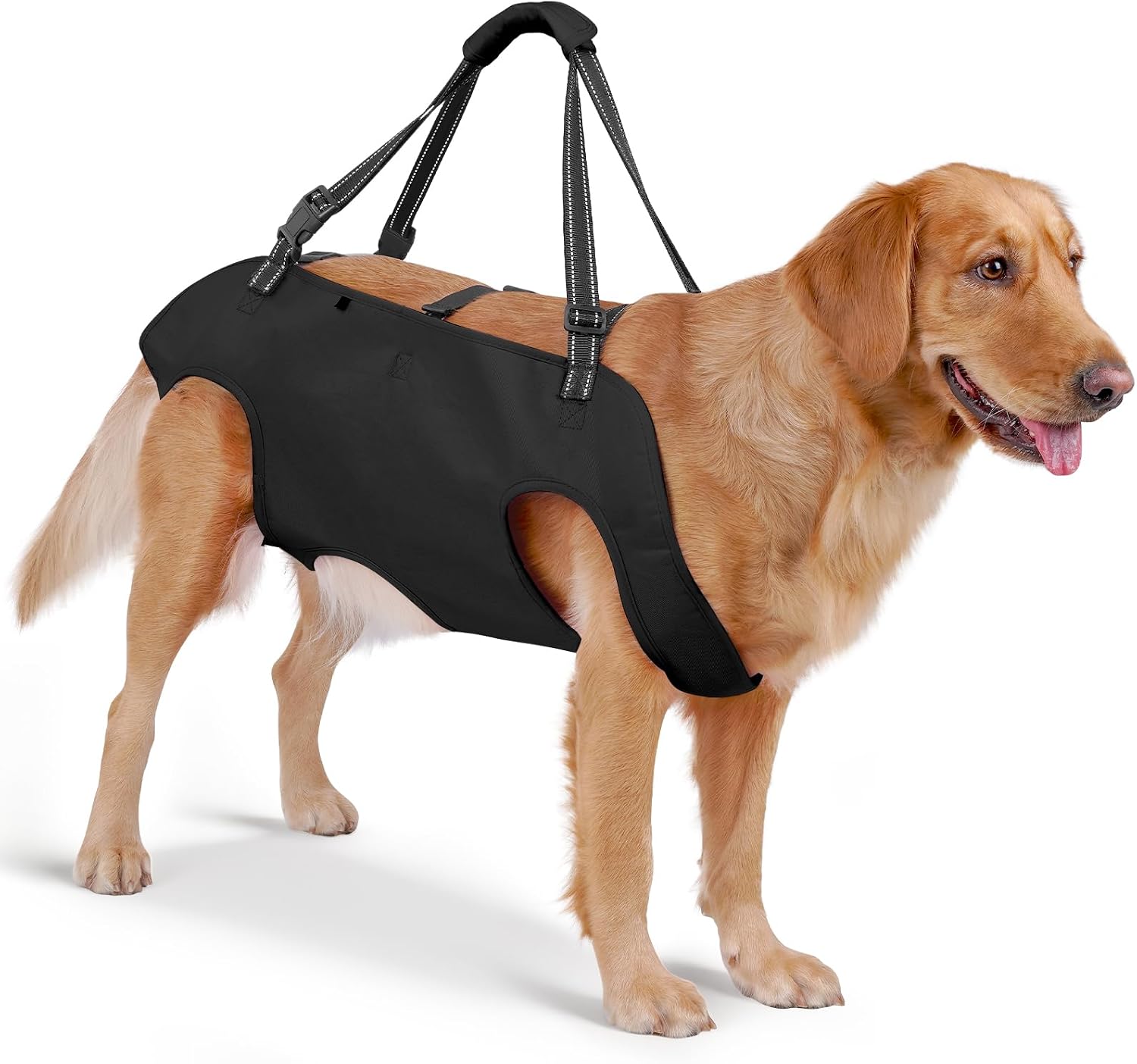
Most lift harnesses address either the front end or the rear, which creates a problem: lifting one end of a dog with compromised joints while the other end sags imposes rotational force on the spine and hips at the exact moment the dog is most vulnerable. The Mayerzon Full Body Harness is designed around solving that specific issue. By supporting both the front legs and the hindquarters simultaneously, the harness keeps the dog’s spine roughly level throughout the lift, which distributes the mechanical load more evenly across already stressed joints.
The Oxford fabric shell is a meaningful material choice rather than a cosmetic one. Oxford weave resists tearing under repeated tensile stress at the grip points, which is where standard nylon harnesses tend to fail first after months of daily lifting. Reinforced stitching at the actual lift points reinforces that durability where it matters most. Owner feedback consistently points to seam integrity as a deciding factor in harness longevity, and this construction addresses both of the most common failure modes: fabric tear and seam separation.
The male-specific relief opening is a practical feature that earns consistent praise in owner reviews. Dogs with limited ability to stand unassisted cannot wait through the process of unclipping and re-securing a full-body harness at each bathroom break, so a built-in opening removes that bottleneck entirely. Female owners should note that standard strap repositioning is required at each break, which adds handling steps to an already demanding routine.
Breathable mesh lining reduces heat buildup during extended wear, particularly relevant during vet appointments or grooming sessions where the harness may stay on for longer than a typical stair assist. Adjustable reflective straps extend low-light usability without requiring a separate visibility accessory, which matters when an assisted walk takes longer than expected at dusk.
Key features → what they mean for you
- Simultaneous front-and-rear leg support structure→Keeps the dog’s spine level during lifts rather than allowing one end to sag, reducing rotational stress on compromised hips, knees, and vertebrae at the moment of greatest vulnerability.
- Oxford fabric shell→Resists tearing at the grip points where repeated lifting stress concentrates, extending the harness lifespan compared to standard nylon webbing constructions.
- Reinforced stitching at lift points→Addresses the most common failure mode in lift harnesses, providing confidence that seams will not separate mid-lift with a 40-plus-pound dog on a staircase.
- Male-specific urination opening→Allows bathroom breaks without fully removing the harness, which is critical for dogs that cannot stand unassisted long enough to be unclipped and re-secured at each outdoor trip.
- Breathable mesh inner lining→Reduces heat buildup during extended wear at vet visits or grooming sessions, keeping the dog comfortable when the harness cannot be removed between activities.
- Adjustable reflective straps→Provides passive low-light visibility during slow-paced early-morning or evening assist walks without requiring a separate reflective accessory.
What works
- Front and rear simultaneous support keeps the dog’s posture level during lifts, reducing joint strain compared to single-point chest-only slings.
- Male-specific relief opening allows bathroom breaks without fully unequipping a dog that may struggle to stand unsupported for a harness removal.
- Oxford shell and reinforced stitching address the two most common failure modes in lift harnesses: fabric tear and seam separation under repeated load.
- Adjustable reflective straps extend usability to low-light conditions without requiring a separate accessory.
Watch-outs
- The harness is explicitly rated for short-term use only, which limits its utility for owners who need continuous daily mobility assistance rather than periodic lift support.
- Female dogs require strap adjustment or temporary unfastening at each bathroom break, adding friction to an already demanding care routine.
- Dogs with short backs, deep chests, or very slim builds may not achieve a safe, pressure-free fit in any available size, and the brand itself recommends against purchasing without carefully checking body proportions first.
- The harness is rated for short-term assisted use only, which limits its value for owners who need a solution their dog can wear throughout the day. Female dogs also require strap adjustment at every bathroom break, adding handling friction to an already demanding care routine.
Better alternative: For continuous all-day support needs, a purpose-built wheelchair-adjacent mobility system or a harness explicitly rated for extended wear would be a more appropriate fit than any short-term assist vest.

The Zyora rear lift harness takes a focused approach: it does one job, lifting the hindquarters, and removes everything that is not necessary for that task. The result is a harness light enough to fold flat and store in a vehicle door pocket or a small entryway basket, which matters practically because a mobility aid that is inconvenient to keep nearby tends not to get used consistently.
The padded contact area is the most consequential design detail here. Lifting a dog’s rear without padding concentrates force at a narrow band across the belly and hindquarters, which causes visible discomfort and can discourage dogs from accepting the harness over time. Distributing that pressure across a broader surface reduces the resistance many dogs show to being lifted repeatedly, making the daily stair routine less confrontational for both dog and owner.
The adjustable strap system serves two purposes beyond simple size fitting. As a dog’s condition changes during recovery or progresses with age, the point where the dog carries the most weight shifts. Being able to reposition the handle forward or back to match that changing center of gravity means the harness remains useful across different stages of the dog’s mobility journey rather than becoming obsolete when the dog’s needs shift.
Rear-leg-only design preserves the front legs and chest for natural movement. Dogs with hind-leg weakness often compensate by placing more weight on their front paws during stair climbing, and a harness that restricts that compensation undermines the dog’s own balance strategy. Leaving the front end free lets the dog contribute actively to the climb rather than being fully carried.
Machine washability addresses the unavoidable reality of outdoor mobility work: accidents happen, and a harness that cannot be cleaned quickly accumulates odor and bacteria that make a dog less willing to wear it. Based on the published specs and early owner feedback, the fabric handles washing without significant degradation, though the limited review count means longer-term wash performance is not yet well documented.
Key features → what they mean for you
- Padded contact area across the belly and hindquarters→Distributes lifting force over a broader surface rather than a narrow band, reducing pressure-point discomfort that causes dogs to resist repeated daily lifts.
- Adjustable strap repositioning for handle placement→Allows the lift point to shift forward or back as the dog’s condition changes during recovery or aging, keeping the harness useful across different stages rather than requiring a replacement.
- Rear-leg-only open design→Leaves the front legs and chest completely unrestricted, allowing the dog to use front-paw balance and climbing assistance naturally rather than being fully carried up stairs.
- Folds flat and lightweight construction→Stores in a vehicle door pocket or small entryway basket without occupying cargo space, making it practical to keep within reach so it actually gets used consistently.
- Machine washable fabric→Allows cleaning after outdoor accidents or muddy trips without hand-scrubbing, keeping the harness hygienic and odor-free between uses.
- Handle angle and placement for stair and vehicle assists→Positions the owner’s grip to provide leverage during upward lifts without requiring an awkward low bend, reducing strain on the handler’s back during multiple daily assists.
What works
- Adjustable strap accommodates different body shapes and allows you to shift the lift point as the dog’s condition changes
- Padded design reduces pressure points that can cause discomfort during extended use or multiple daily lifts
- Folds flat and weighs little enough to keep in the car without taking up cargo space
Watch-outs
- At 21 reviews, long-term durability through daily stair use over six months or more is unconfirmed
- Dogs over 80 lbs may exceed the effective weight range for safe single-person lifting with this style of harness
- For dogs with complete hind leg paralysis, a full-body sling with chest support like the GingerLead or Help Em Up provides better weight distribution
- The limited review base means durability through six or more months of daily stair use with heavier dogs is not yet confirmed by aggregated owner data. Dogs over 80 lbs may also exceed the practical weight range for safe single-person rear-only lifting.
Better alternative: For dogs with complete hind-leg paralysis or those over 80 lbs, a full-body support harness with a chest component, such as the Mayerzon Full Body Harness (rank 6), provides a more comprehensive and structurally supported lift.

Supporting a dog through stair climbing or outdoor bathroom breaks puts repetitive strain on both the animal and the handler, and the PICKFORLIFE harness addresses both sides of that equation. The plush inner liner spreads lift pressure across the full belly and hip area rather than concentrating it at narrow strap contact points, which means dogs spending weeks or months in rehabilitation are far less likely to develop the chafing and pressure sores that narrow-strap slings cause over time. Owner feedback consistently mentions dogs tolerating extended wear without signs of discomfort, which is a meaningful indicator for households managing long recovery timelines. The Oxford fabric exterior resists moisture absorption during outdoor bathroom breaks, and because it releases dog hair more readily than fleece during machine washing, weekly cleaning stays manageable. The padded handles reduce hand fatigue during repetitive stair climbs, and the dual-strap pelvis support keeps the spine and gait aligned rather than pulling the hindquarters to one side. The adjustable strap range accommodates torso measurements from 41 to 61 inches, so the same harness can shift from full rear-lift mode to light stabilization as mobility improves through rehab. Aggregated owner reviews show the material holds its shape through multi-month recovery periods without the liner compressing. The close-set handle placement does require walking directly behind your dog, which can feel awkward on narrow staircases, and the absence of reflective trim is a genuine gap for households managing evening or early-morning assist routines.
Key features → what they mean for you
- Plush inner liner distributes lift pressure across belly and hips→Reduces chafing and pressure sores during the weeks or months of daily use that a serious recovery demands
- Adjustable strap system fits 41 to 61 inch torso measurements→Lets the same harness scale from full rear lift to light stabilization as your dog regains strength, avoiding a second purchase mid-recovery
- Oxford fabric exterior→Resists moisture from outdoor accidents and releases dog hair during washing, keeping weekly cleaning fast and effective
- Padded dual handles→Reduces hand fatigue during repetitive stair assists, which matters when multiple trips up and down happen every day
- Dual-strap pelvis design→Supports both sides of the pelvis evenly, keeping spinal alignment stable and preventing the sideways pull that single-strap slings cause
- Machine washable construction→Allows frequent cleaning without the liner compressing or losing its protective cushioning over a long recovery period
What works
- Plush belly liner prevents the chafing and pressure sores common with narrow-strap slings during long recovery periods
- Strap adjustment range works for dogs whose mobility needs change over time, from full rear lift to light stabilization as strength returns
- Oxford outer fabric dries quickly after outdoor use and releases dog hair during washing better than fleece alternatives
Watch-outs
- Medium size label misleading because 41-61 inch strap range excludes stocky medium dogs with barrel chests or long-bodied breeds like basset hounds
- Padded handles positioned close together require you to walk directly behind your dog rather than offset to the side, limiting visibility of front paw placement on stairs
- No reflective trim for evening walks when dogs with mobility issues require more outdoor assistance time during darker months
- The size labeling does not account for barrel-chested or long-bodied dogs, so a dog labeled medium by weight may fall outside the 41 to 61 inch strap range — careful torso measurement before ordering is essential.
Better alternative: Walkin’ Lift Combo Harness if you need front-and-rear simultaneous support or certified rehabilitation-grade construction for a heavier dog

Most rear-support harnesses focus entirely on the dog’s comfort and largely ignore what daily lifting does to the person doing the lifting. The Geroca harness takes a different approach by including a removable shoulder strap that transfers the effort of each lift from the small muscles of the wrist and palm to the larger muscle groups of the shoulder and back. For a caregiver assisting a 50-pound or heavier dog through multiple stair climbs or outdoor trips each day, that difference accumulates quickly and can determine whether a home care routine remains sustainable over weeks and months. The full-body contact design simultaneously supports the chest and rear rather than isolating the hindquarters, which distributes pressure more evenly and keeps the harness from shifting or pinching during movement. Reflective piping along the harness edges adds passive low-light visibility during early morning or evening bathroom trips without requiring a separate light or visibility accessory — a practical detail for households where mobility-limited dogs need more outdoor time than a healthy dog’s schedule would require. The 100 percent polyester construction air-dries quickly after cleaning or after incontinence events, which matters when the harness is in daily rotation and cannot sit wet overnight. Multiple adjustment points at the chest, belly, and body allow the fit to be dialed in as a senior dog’s weight fluctuates during dietary changes or palliative care. Owner feedback consistently mentions the shoulder strap as the feature that made the harness sustainable for heavier dogs, and the reflective trim earns specific mentions from caregivers managing dawn and dusk routines.
Key features → what they mean for you
- Removable shoulder strap→Shifts lifting effort to larger shoulder and back muscles, reducing the wrist and hand strain that accumulates across dozens of daily assists
- Full-body chest and rear contact points→Distributes lift pressure across more of the dog’s body, preventing the pinching and shifting that hip-only slings cause during movement
- Reflective piping along harness edges→Adds passive visibility during low-light outings without requiring a separate light or vest, directly reducing trip hazard on driveways and poorly lit walkways
- 100 percent polyester construction→Air-dries quickly after incontinence events or outdoor cleaning, so the harness is ready for the next use without an overnight drying period
- Multiple adjustment points at chest, belly, and body→Accommodates weight fluctuations common in senior dogs on changing diets or palliative care without requiring a new harness purchase
What works
- Shoulder strap reduces cumulative hand and wrist strain for caregivers assisting a heavy dog repeatedly throughout the day.
- Full-body contact points prevent the harness from concentrating pressure on the hips alone, which can cause discomfort in dogs with arthritis or skin sensitivity.
- Polyester construction resists moisture absorption, so incontinence events or outdoor mud do not saturate the material and linger the way they would in a fabric-heavy design.
- Reflective detailing adds a visible safety margin during low-light outdoor assists without requiring a separate visibility accessory.
Watch-outs
- Only two size options means dogs that measure between sizes or have atypical proportions — deep chests, long backs — may not achieve a secure fit, and a shifting harness under load is a fall risk.
- Chew-resistance is low: standard polyester webbing will not survive a dog that mouths or worries at straps between uses, so storage out of reach is necessary.
- Buyers who need a fully certified veterinary rehabilitation device or a no-lift cart alternative for non-ambulatory dogs should look at dedicated canine rehabilitation products, which offer measurably more structural support.
- Only two size options mean dogs with deep chests, long backs, or measurements that fall between sizes have a meaningful chance of poor fit, which undermines the harness’s otherwise well-considered design.
Better alternative: PICKFORLIFE sling if budget is the primary constraint and your dog’s torso measurement falls within its wider strap range

For dogs recovering from TPLO surgery or managing chronic arthritis in the hindquarters, the Coodeo harness is designed around two practical realities: the dog will need help standing multiple times a day, and that routine cannot require the harness to come off and go back on every time a bathroom break happens. The rear-leg isolation design leaves the front legs free for natural gait, which matters during arthritis flare-ups when restricting movement in a functional limb creates additional compensation strain. The abdominal cutout panel allows male dogs to urinate normally while the harness stays in place, eliminating the friction and time cost of repeated removal and reapplication during multi-hour wear periods. Padded breathable mesh construction reduces heat buildup during summer walks compared to solid nylon or neoprene alternatives, and it limits pressure points for dogs who need assistance standing multiple times throughout the day. The adjustable shoulder strap accommodates handler heights from 5 feet to 6 feet 2 inches, which means multiple family members of different heights can assist the dog without purchasing a second harness or bending at a damaging angle during stair climbs. Dual top handles give two-handed lift control for heavier dogs or steeper stair inclines where single-handle support creates uneven weight distribution across the dog’s pelvis. Based on the published specs, the detachable straps simplify post-outdoor cleaning, though the hand-wash-only requirement does add maintenance time compared to machine-washable alternatives. Owner feedback consistently mentions the male cutout as the feature that made all-day wear practical, and the breathable mesh earns positive notes during warm-weather use.
Key features → what they mean for you
- Rear-leg isolation design leaves front legs free→Allows natural front-leg gait during arthritis flare-ups or post-surgical recovery, preventing the compensation strain that full-body restriction causes
- Abdominal cutout panel for male dogs→Eliminates the need to remove and reapply the harness for bathroom breaks, reducing stress on the dog and time cost for the caregiver during multi-hour wear
- Padded breathable mesh construction→Reduces heat buildup and pressure points during extended daily wear, which is critical when multiple standing assists happen throughout the day
- Adjustable shoulder strap for handler heights 5 feet to 6 feet 2 inches→Allows caregivers of different heights to assist without awkward bending, reducing back strain across repeated stair climbs
- Dual top handles→Provides two-handed lift control on steep stairs or for heavier dogs, distributing weight evenly across the pelvis rather than pulling from one side
What works
- Cutout panel eliminates removal during bathroom breaks for male dogs, a practical advantage during multi-hour wear periods
- Adjustable strap system fits handler height variation without requiring a second harness purchase when multiple family members assist
- Breathable mesh reduces heat buildup during summer walks compared to neoprene or solid nylon alternatives
Watch-outs
- Lacks front-clip leash attachment, limiting use to lift assistance only rather than dual-purpose walking and support
- Hand-wash-only care requirement adds maintenance time compared to machine-washable alternatives like the Walkin’ Lift Combo Harness
- Size Large spans a 33 lb weight range (55–88 lbs), creating fit uncertainty for dogs at either end of the spectrum
- The hand-wash-only care requirement and the absence of a front-clip leash attachment limit the harness to single-purpose lift assistance, while the broad per-size weight range creates genuine fit uncertainty for dogs near the size boundaries.
Better alternative: Walkin’ Lift Combo Harness if you need simultaneous front and rear support, or the PICKFORLIFE sling if machine-washable construction is a priority

For dogs who have lost hind-leg stability but still pull themselves forward confidently, a rear-only sling is meaningfully lighter and less restrictive than a full vest. The Coodeo’s rear-specific design channels lifting force directly at the hips and hind legs, which is where most senior dogs and post-surgical patients lose ground first. Rather than wrapping the entire torso, the harness stays out of the way of the front half, letting dogs who retain front strength move more naturally up each step.
The 80% polyester and 20% spandex blend produces a breathable mesh panel that sits against the dog’s body during multi-hour wear. Owner feedback consistently mentions that dogs tolerate the harness through long recovery days without showing signs of overheating or restlessness, which matters when a dog must wear support gear from morning walks through afternoon stairs and evening bathroom trips.
For male dogs, the anatomy cutout is a genuinely practical detail. Compression in that area during extended wear leads to reluctance and discomfort, and the cutout removes that friction point entirely, though aggregated owner reviews note that the cutout alignment depends on how the torso length maps to leg placement on any individual dog.
The detachable, height-adjustable handle addresses the owner side of the equation. Repeated stair assists add up quickly, and a handle that meets the owner at the right height reduces the hunching and wrist torque that otherwise accumulates over weeks of daily use. Padded strap edges spread weight across a broader contact surface, which reduces the pressure-point fatigue that narrow webbing causes on a dog’s inner thighs over time.
Key features → what they mean for you
- Rear-specific design targeting hips and hind legs→Lifting force goes exactly where stability fails first in senior dogs, leaving the front half unencumbered for dogs who still have front-leg strength
- Breathable mesh construction from polyester-spandex blend→Dogs can wear the harness for extended recovery periods without overheating, reducing the need to repeatedly remove and reapply it throughout the day
- Male anatomy cutout→Eliminates compression during bathroom breaks and all-day wear, making dogs more willing to accept and tolerate the harness
- Height-adjustable detachable handle→Owners of different heights can set the handle to a comfortable position, reducing back and wrist strain during repeated daily stair assists
- Padded strap edges over narrow webbing→Wider contact surface distributes pressure more evenly across the inner thighs, lowering the risk of chafing during prolonged use
What works
- Rear-only design lighter and less restrictive than full-body slings for dogs who retain front leg strength
- Adjustable strap length adapts to different owner heights without purchasing separate handles
- Male-specific cutout reduces pressure on genitals during extended wear periods
Watch-outs
- Rear-only support ineffective for dogs with front leg weakness or full-body instability, who need chest harnesses
- Hand-wash only limitation creates multi-day drying periods between uses if accidents occur
- Cutout placement may not align correctly on dogs with unusually long or short torsos relative to leg length
- Hand-wash-only care with an air-dry cycle that can stretch to 12 or more hours means that a single accident leaves owners without usable support gear unless they purchase a backup, which is a real gap during active recovery periods.
Better alternative: NOYAL Dog Lift Harness (B0FLPP82BP) when a dog needs dual-handle lifting options or has post-surgical skin sensitivity requiring a softer interior lining

Post-surgical and severely arthritic dogs present a specific challenge: their gait is asymmetrical, their weight shifts unpredictably with each step, and their skin may still be healing from incisions or shaving. The NOYAL’s dual-fastening system addresses the positioning problem directly. A chest patch combined with a back buckle gives the harness two anchor points rather than one, which means the whole assembly resists rotating sideways when a dog lurches or compensates with an uneven stride on the stairs.
The synthetic lamb wool interior is the standout feature for dogs in active recovery. Aggregated owner reviews show that softness against post-operative skin is one of the most frequently cited reasons owners choose this harness over alternatives. The lamb wool layer sits between the nylon exterior and the dog’s body, providing cushioning that reduces friction against healing tissue and shaved skin, which is more sensitive than healthy coat.
A sponge middle layer between the exterior and the interior adds cushioning without piling on the kind of bulk that restricts rear leg swing. Dogs with reduced muscle mass, which is common after weeks of restricted activity, benefit from that padding because there is less natural tissue buffering the harness contact points.
The three-point measurement system, covering pad width, leg spacing, and circumference, is meaningfully more precise than weight-only sizing. Based on published specs, this approach targets the actual fit variables that determine whether a rear sling stays comfortable or digs into the inner thigh. Owner feedback consistently mentions that dogs in the middle of standard weight ranges but with wider or narrower hips fit better than they expected because of the measurement approach.
The O-shaped buckle is a safety detail worth noting. A standard side-release buckle can pop under lateral load, which happens regularly when a dog lurches. The O-ring design prevents accidental release during those sudden movements.
Key features → what they mean for you
- Dual-fastening system with chest patch and back buckle→Two anchor points keep the harness from rotating sideways when a dog’s gait is uneven, so owners are not constantly repositioning the sling between stair steps
- Synthetic lamb wool interior lining→Soft contact surface reduces friction against post-surgical incision sites and shaved skin that has not yet regrown coat
- Sponge middle layer cushioning→Provides padding for dogs with reduced muscle mass who have less natural tissue buffering harness contact points during recovery
- Three-point measurement system→Sizing by pad width, leg spacing, and circumference rather than weight alone reduces the chance of inner-thigh pressure or harness rotation on dogs with non-standard proportions
- O-shaped buckle design→Resists accidental release under lateral load, which matters when a dog lurches unpredictably on stairs or shifts weight suddenly
What works
- Pad width sizing system addresses the actual fit failure point rather than relying on weight alone
- Synthetic lamb wool stays soft against sensitive post-operative skin during extended daily wear
- Dual handles provide lifting options for different scenarios: single-hand stair assist versus two-hand vehicle lift
Watch-outs
- Velcro adjustment requires re-tightening every 2-3 weeks as grip strength diminishes with repeated use
- No size exchange guidance for dogs between categories, forcing buyers to guess whether to size up or down
- Leg hole positioning works for standard rear leg placement but may not accommodate dogs with hip dysplasia causing atypical stance width
- Velcro adjustment loses reliable grip after roughly 60 to 90 days of daily use, requiring owners to re-tighten mid-walk or reinforce the closure, which is an inconvenience that compounds during an already demanding care routine.
Better alternative: NOYAL Dog Lift Harness (B0FLPQXR6W) when budget is a priority and the dog is a medium size with standard proportions

For owners managing a dog’s mobility through recovery on a tighter budget, this NOYAL variant delivers the core features that matter most at a lower price. The polyester construction with a synthetic lamb wool interior carries the same logic as the XL version: soft contact against skin that may be healing from surgery or stripped of coat by shaving, without the abrasive texture that bare nylon produces.
The dual padded handles are positioned at the hip and lower back, which means two lifting contact points for the owner’s hands. Based on the published design, this distributes force across a larger area during a lift rather than concentrating it in one grip, which reduces the cumulative wrist and lower back strain that builds up over weeks of multiple daily assists. Owner feedback consistently mentions that the padded handles make a noticeable difference compared to single-handle or loop-style alternatives, particularly for owners with their own joint concerns.
The leg opening design allows dogs to urinate and defecate without harness removal. During strict post-surgical rest periods, removing and reapplying a harness multiple times daily is both time-consuming and potentially disruptive to a healing incision site. The ability to leave the harness on through bathroom breaks is a real-world convenience that owners managing strict recovery protocols consistently rate as important.
The Velcro-based adjustment system allows for incremental fit changes as post-surgical swelling resolves or muscle mass shifts during recovery. Reinforced D-ring attachment points and a non-slip chest patch resist forward migration when the dog attempts to sit or lower its hindquarters, keeping the harness centered without constant repositioning.
Key features → what they mean for you
- Synthetic lamb wool interior lining→Reduces friction against surgical sites and sensitive skin during 4 to 6 hour wear periods, lowering the risk of chafing that could complicate recovery
- Dual padded handles at hip and lower back positions→Distributes lifting load across two owner contact points, reducing cumulative wrist and lower back strain during multiple daily stair assists
- Leg opening design permitting bathroom access without removal→Dogs on strict rest protocols can relieve themselves without the disruption of harness removal and reapplication, protecting healing tissue
- Velcro adjustment system for incremental fit changes→Owners can tighten or loosen the fit as swelling decreases or muscle condition changes during a multi-week recovery without buying a new harness
- Non-slip chest patch and reinforced D-rings→Two stabilizing anchor points resist harness rotation and forward migration when a dog shifts weight or attempts to sit, keeping the support positioned correctly
What works
- Padded handles genuinely reduce repetitive strain on owner’s wrists and lower back during multiple daily lifts
- Synthetic lamb wool lining stays soft through hand washing and doesn’t matt against damp fur or surgical dressings
- Leg opening design allows dogs to urinate and defecate without harness removal, critical during strict rest periods
Watch-outs
- Velcro loses adhesion after 60-90 days of daily use, requiring mid-walk readjustment or strap reinforcement
- Upper weight limit dogs (70-80 lbs) experience inner thigh rubbing due to narrow leg opening dimensions
- Hand-wash only limitation extends drying time to 12-24 hours, requiring backup harness for dogs needing continuous support
- The Velcro closure loses adhesion reliability after roughly 60 to 90 days of daily use, and dogs near the upper weight limit for this size experience narrower leg openings that can cause inner-thigh rubbing over extended wear periods.
Better alternative: NOYAL Dog Lift Harness XL (B0FLPP82BP) for larger dogs or when the three-point sizing system is needed to move through a non-standard body shape
The LAFOTY 2-in-1 harness earns its place in a crowded category by solving a problem most competitors ignore: male dogs cannot use a standard sling without the fabric pressing against the genital area, forcing handlers to remove and reattach the harness for every bathroom trip. The lift handle placement here avoids that area entirely, so bathroom routines stay uninterrupted and far less stressful for both dog and caregiver. Nine independent adjustment points across the neck, chest, belly, and rear legs mean the harness can track a dog’s changing body shape across a recovery arc, whether that means post-surgical swelling resolving or gradual muscle atrophy advancing. That range of fit matters: a harness that fit well in week one of recovery should not require replacement by week six. The four-handle configuration, two at the front and two at the rear, gives caregivers real options for stairs, vehicle loading, and rotational assists when helping a dog stand from a lying position. The optional shoulder strap redistributes lifting force across the upper body rather than concentrating it in the wrists, a meaningful difference for caregivers who are making dozens of assists per day. The detachable rear leg section adds further value for dogs whose mobility needs fluctuate, allowing the harness to function as a standard walking harness on better days.
Key features → what they mean for you
- Nine independent adjustment points across neck, chest, belly, and rear legs→The harness can be resized as a recovering dog’s body changes, so one purchase covers the full recovery timeline rather than requiring a swap midway through.
- Lift handle positioned to avoid male genital area→Bathroom trips require no repositioning or removal, removing the most disruptive step in a high-frequency daily routine.
- Four handles distributed front and rear→Caregivers can assist from the most practical position for each specific task, whether that is stair climbing, vehicle entry, or helping the dog rotate from floor to standing.
- Optional shoulder strap that spreads lifting load across the upper body→Reduces wrist and hand fatigue for caregivers who are performing repeated assists throughout the day.
- Detachable rear leg support section→The same harness serves dogs on their difficult days and their better days, avoiding the confusion of switching between two pieces of equipment.
- Embedded video tutorials covering strap adjustment and rear leg webbing→Reduces the risk of incorrect fitting, which is the most common cause of pressure sores and harness slippage during lifts.
What works
- Male-specific design eliminates the common problem of harness interference during urination
- Extensive adjustability means one harness can accommodate weight fluctuations during recovery (important for post-surgical dogs whose muscle mass changes)
- Detachable rear section provides value for dogs whose mobility needs vary day-to-day
Watch-outs
- Harness weight and bulk exceed standard walking harnesses, creating additional load for caregivers already managing a large dog
- Nine-clasp system requires significant initial setup time and patience, problematic for dogs who resist handling
- Limited independent verification of long-term durability under daily lifting stress
- The nine-clasp system requires meaningful upfront investment in setup and fitting, which is a real obstacle for dogs who resist handling and for caregivers already managing a large, mobility-impaired animal.
Better alternative: COODEO Mobility Dog Lift Harness for owners who prioritize all-day wearability and a vet-informed clinical design with a simpler fit process.
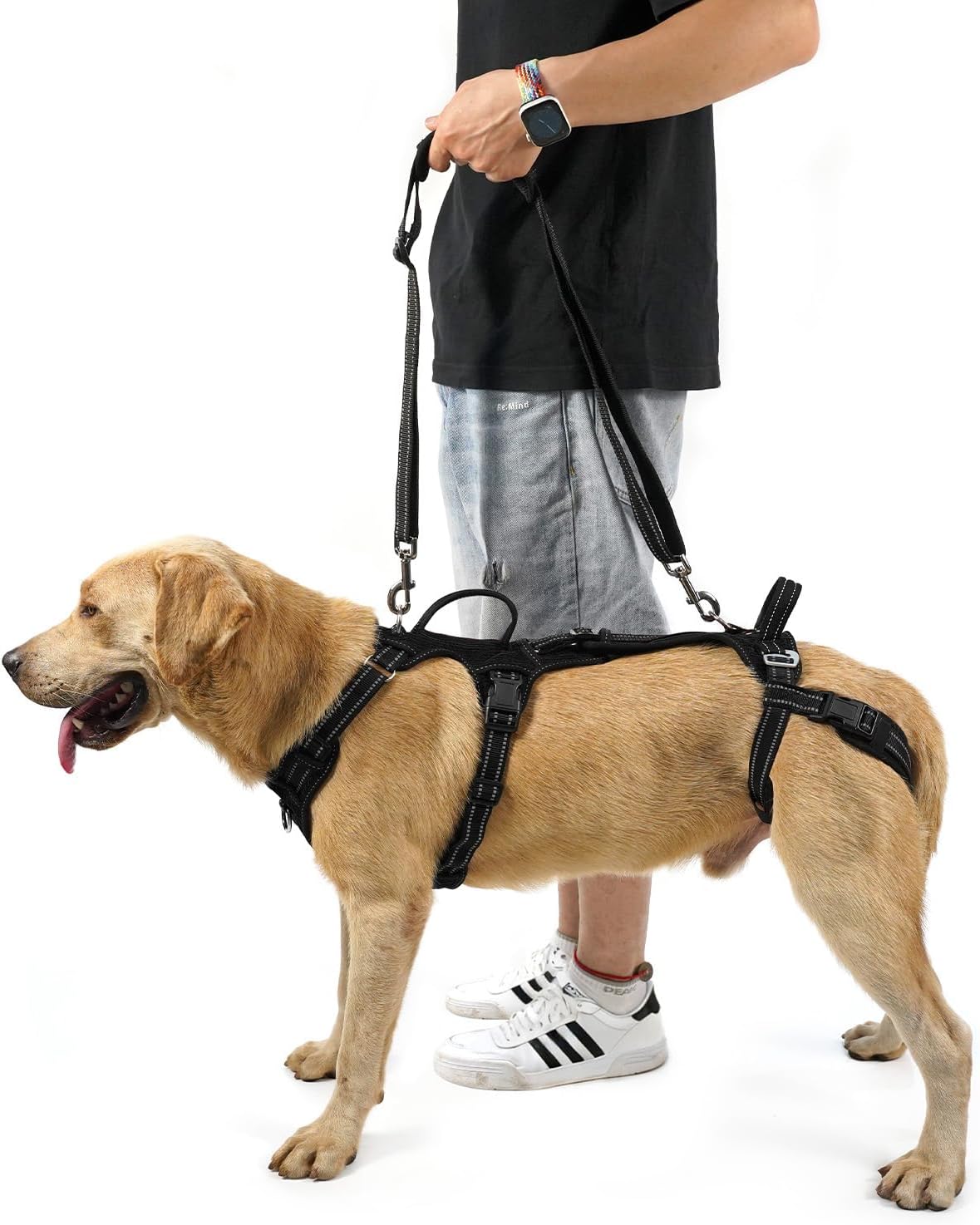
The COODEO harness distinguishes itself from generic fabric slings by grounding its design in veterinary input, with the construction specifically addressing the mechanics of IVDD, hip dysplasia, and ACL injury rather than treating all rear-end weakness as a single problem. That clinical foundation shows in the dual front-and-rear leg support configuration, which stabilizes both ends of the dog simultaneously. The practical value of that becomes clear during bathroom assists: single-point slings allow dogs to shift their weight mid-squat and lose balance, whereas dual-point support holds the dog’s posture through the full sequence. The vest-style build is designed to stay on throughout the day, which removes the repeated cycle of putting the harness on and taking it off that stresses arthritic joints and tires handlers. For a dog that needs assistance every hour or two, that reduction in handling friction is significant. Reflective strips on all straps address a real scheduling reality: owners cannot always time bathroom walks for daylight hours, and adding a separate reflective accessory is one more thing to manage. The lightweight mesh construction keeps the harness from adding meaningful weight or creating pressure buildup during extended wear, and the water-washable fabric is a straightforward necessity for any product that will regularly encounter urine splash during rear-end assists. Aggregated owner reviews show a 60 percent five-star rate, with the bathroom-compatible fit and all-day wearability cited most consistently as the features that separate it from simpler slings owners had tried previously.
Key features → what they mean for you
- Patented design developed in collaboration with veterinarians targeting IVDD, hip dysplasia, and ACL injuries→The support geometry addresses how these specific conditions affect a dog’s gait and posture, rather than applying a generic lifting surface that may not stabilize the right points.
- Dual front-and-rear leg support→Holds the dog’s posture through the full range of bathroom movement, reducing the slip risk that occurs when a dog shifts weight during a squat and a single-point sling cannot compensate.
- Vest-style construction designed for continuous all-day wear→Owners perform far fewer harness on-and-off cycles per day, which reduces handling stress for arthritic dogs and physical fatigue for caregivers.
- Reflective strips on all straps→Nighttime bathroom walks, which cannot always be scheduled around daylight, become meaningfully safer without requiring a separate accessory.
- Lightweight, skin-friendly mesh construction→Extended wear does not generate the heat buildup or pressure points that heavier padded or neoprene alternatives create, keeping the dog more comfortable across a full day.
- Water-washable and quick-drying fabric→A product that regularly contacts a dog’s hindquarters and encounters urine splash can be cleaned quickly and returned to use the same day, maintaining hygiene without disrupting the care routine.
What works
- Vet-informed design targets specific diagnosed conditions rather than generic mobility loss, making it a more appropriate tool for dogs in formal rehabilitation programs.
- Bathroom-compatible fit removes the most disruptive step in a typical lift-assist routine: stopping to remove and reattach the harness every time the dog needs to go outside.
- All-day wearability reduces stress on dogs that need frequent assistance, because repeated harness removal and refitting is physically uncomfortable for animals with joint pain.
- Reflective strap construction adds genuine safety value for nighttime bathroom walks without requiring a separate accessory purchase.
Watch-outs
- With fewer than 50 reviews at time of writing, long-term durability data for the fabric and buckles under daily load is not yet established; buyers should treat this as an early-adopter purchase.
- Soft mesh fabric provides low resistance to chewing, which is a real risk for dogs experiencing anxiety or discomfort during rehabilitation and may require an Elizabethan collar alongside use.
- Owners of dogs under approximately 30 lb should size with extra caution: vest-style harnesses are harder to adjust for narrow-chested small breeds, and a loose fit under a dog in distress creates a fall risk.
- The review base is still relatively small, which means long-term durability data for the buckles and mesh fabric under the stress of daily lifting is not yet well established. The soft mesh construction also presents a real chewing risk for anxious dogs.
Better alternative: LAFOTY 2-in-1 Harness for male dogs specifically, where the genital-area clearance and four-handle system address needs the COODEO design does not prioritize.
What Buyers Consistently Say
What Buyers Repeatedly Liked
Across the highest-rated products in this category, owner feedback converges on three practical wins: handle placement that lets a single caregiver manage stairs without bending dangerously, male-anatomy cutouts that eliminate the remove-and-reapply cycle during bathroom breaks, and breathable materials that allow the harness to stay on for several hours without causing heat stress or skin irritation.
Aggregated owner reviews show that caregivers dealing with post-surgical recovery — particularly CCL repair, TPLO, and hip replacement — place far more weight on consistent fit under daily loading than on any single comfort feature. A harness that shifts position after three stairs is treated as a failure regardless of how soft its lining feels.
Common Complaints by Pattern
The most repeated complaint across rear-only sling designs is handle foam compression. Owner feedback consistently mentions that padding that feels adequate at purchase degrades noticeably within the first month of multiple daily lifts, leaving handlers gripping hard webbing. This complaint appears for products at every price point and is worth treating as a category-wide limitation rather than a brand-specific defect.
Sizing inconsistency is the second dominant complaint. Reports indicate that weight-based sizing charts systematically underserve barrel-chested breeds like Labrador Retrievers and Rottweilers, where chest girth and abdominal depth diverge sharply from what the weight range predicts. Buyers of lean large breeds — Greyhounds, Vizslas, standard Poodles — encounter the opposite problem: weight-appropriate sizes leave excess material that bunches under the dog’s abdomen during a lift.
For full-body harnesses with six or more adjustment points, the recurring friction point is initial setup time. Aggregated owner reviews show that buyers consistently underestimate how long the first fitting takes, and that harnesses requiring 10 to 15 minutes of strap threading are perceived as punishing by owners who are already managing a dog in pain or limited mobility.
Patterns by Use Case
Owners managing progressive conditions — degenerative myelopathy, advancing hip dysplasia — respond better to full-body designs because the dog’s needs shift over time and the harness must remain useful across multiple mobility stages. Owners managing a defined recovery window, such as 8 to 12 weeks post-TPLO, report higher satisfaction with rear-only slings because the dog retains front leg function and the lighter design causes less resistance.
For multi-dog households or homes where both a primary and secondary caregiver use the harness, adjustability of the owner-side strap length emerges as a quietly important feature. Owner feedback consistently mentions frustration when the harness is fitted for one handler’s height and requires re-adjustment for another.
What Most Buying Guides Miss
Original Insight: The Handle Position Problem Nobody Discusses
Most buyers evaluate dog lift harnesses by looking at what touches the dog. The underexamined variable is where the handle sits relative to the owner’s center of gravity during a stair ascent. Based on the published specs and construction details across this product group, harnesses with a single central handle position the owner’s wrist directly above the dog’s lumbar region. On a staircase, where the owner is above the dog and leaning slightly forward, this geometry puts the wrist in ulnar deviation under load. Products with dual handles — or a shoulder strap that shifts load to the trapezius — change this geometry meaningfully. This is not a comfort preference; it is a cumulative injury risk for caregivers performing four to six lifts daily over a six-month recovery.
Contrarian Insight: Price Does Not Predict Durability in This Category
The instinct to equate higher price with better construction is reasonable in most gear categories but does not hold cleanly here. The OneTigris product uses 1000D nylon and stainless steel D-rings at a mid-range price point, while the highest-priced LAFOTY option uses sewn handles without published bar-tack reinforcement specifications. Buyers who prioritize hardware longevity should look at material callouts — shell denier, metal versus plastic buckle grade — rather than using price as a proxy for durability.
Common Buyer Mistakes
The most consequential mistake is purchasing a rear-only sling for a dog with full-body instability. Rear-only designs work well when the dog’s front legs are functional and can contribute to stair climbing. For dogs with spinal involvement, vestibular disease, or generalized weakness, lifting the hindquarters without front support causes the torso to sag, which places rotational stress on the thoracolumbar junction — precisely the region that is often already compromised. The second common mistake is ordering based on weight without measuring chest girth and abdominal circumference. Nearly every sizing complaint in owner reviews traces back to skipping this step.
Product We Would Be Cautious About
The NOYAL designs share a Velcro-based adjustment system that owner feedback consistently flags as losing grip strength within 60 to 90 days of daily use. For a harness used once a week on trail hikes, this is a minor inconvenience. For a dog requiring stair assistance four times a day through a four-month orthopedic recovery, Velcro degradation means mid-lift slippage at exactly the moment when secure fit matters most. Buyers with long recovery timelines should factor replacement cost into the apparent value of the lower entry price.
How to Choose — What Actually Matters
Rear-Only Sling or Full-Body Harness?
This is the first decision, and it has a clinical answer. If your dog retains normal front leg function — meaning they can push off a step, bear weight on their front paws, and hold their head level — a rear-only sling is lighter, less restrictive, and easier to put on. The PICKFORLIFE, LOOBANI, Zyora, and rear-focused Coodeo designs all work well in this scenario. If your dog has front leg weakness, neurological involvement, spinal instability, or a condition affecting coordination across all four limbs, a full-body harness is the correct choice. Lifting only the hindquarters of a dog with full-body instability causes the front end to sag, which adds torque to already compromised joints rather than relieving it. The LAFOTY full-body, OneTigris, Mayerzon, and COODEO Mobility designs address this. Ask your veterinarian which category applies before purchasing.
Handle Count and Grip Position
A single top handle is adequate for lifting a dog from a standing position into a vehicle or across flat ground. On a staircase, the physics change: the dog and owner are on different elevation planes, the dog is often moving, and the owner needs to apply force at a changing angle through each step. Multiple handles — or a handle that can be gripped from the side rather than only from directly above — give the owner the ability to shift their grip as the geometry changes. Products with two or more handles also allow a two-person lift for heavier dogs, with one person at the front and one at the rear. If your dog weighs more than 70 pounds and your primary stair challenge involves a full flight rather than two or three steps, prioritize handle count and position over almost any other feature.
Hardware Grade Matches the Load and Frequency
Injection-molded plastic buckles are adequate for a harness used three times a week on a 40-pound dog with intermittent weakness. They are a documented failure point for a harness cycled on and off four times daily on a 75-pound dog through a six-month recovery. The difference between plastic and metal hardware is not visible in most product photos, which means buyers must read the material specifications rather than relying on visual assessment. Stainless D-rings and zinc alloy snap hooks, as specified in the OneTigris, withstand repeated stress loading significantly better than equivalently sized nylon-over-plastic hardware. If your dog’s recovery timeline extends beyond 90 days with daily use, the hardware grade is worth scrutinizing before purchase.
Owner Ergonomics Are Not a Luxury Criterion
Caregivers who assist a mobility-impaired dog several times a day accumulate real physical strain over weeks and months. Handle padding, strap length adjustability for handler height, and the presence of a shoulder strap that shifts load from wrists to larger muscle groups are not comfort extras — they are injury prevention. This matters most for caregivers with pre-existing wrist, elbow, or lower back conditions, and for households where one person is managing a large dog alone. The LAFOTY four-handle design with included shoulder strap, and the Geroca and Coodeo designs with adjustable owner-side strap length, address this directly. If you are the only caregiver and the dog exceeds 60 pounds, treat handle ergonomics as a primary rather than secondary criterion.
Sizing: Measure First, Then Select
Weight-based sizing charts are a starting point, not a reliable final answer. Before ordering any harness in this category, measure your dog’s chest girth at the widest point, abdominal girth at the belly panel location, and — for rear-only designs — the distance between the rear legs. Compare these numbers against the manufacturer’s actual measurement chart, not just the weight range. Barrel-chested breeds (Labrador Retrievers, English Bulldogs, Rottweilers) consistently run large relative to weight. Lean breeds (Greyhounds, Whippets, standard Poodles) often run small. Dogs losing muscle mass during recovery will need a harness with multiple independent adjustment points so fit can be maintained as the body changes. A harness that fits poorly is not just uncomfortable — it shifts during a lift and fails to protect the joints it was purchased to protect.
Machine Washability Matters More Than It Appears
A dog lift harness that contacts the hindquarters of an incontinent or recovering dog will require frequent cleaning. Hand-wash-only designs require 12 to 24 hours of drying time, which means a single harness is effectively unavailable for that window. For dogs requiring overnight or early-morning stair assistance, a hand-wash-only product either means owning a backup unit or skipping washes. Machine-washable designs with quick-dry fabric — LOOBANI, the PICKFORLIFE B09FJG526D design, and the Zyora sling — allow same-day turnaround. If your care routine involves daily outdoor bathroom assists in wet conditions or any degree of urinary incontinence, treat machine washability as a functional requirement rather than a convenience.
All-Day Wear Versus Situational Use
Some dogs need a harness put on for a specific event — getting down the back steps for a bathroom break — and then removed until the next time. Others need continuous support throughout the day because their mobility is too compromised for unassisted movement between rooms or because owner availability is limited. These are different use cases with different product requirements. For situational use, a harness with quick-clip closures and simple adjustment is more practical than a six-strap system that takes 10 minutes to fit. For all-day wear, the priorities shift entirely: breathable material that does not cause heat stress, a design that allows bathroom use without removal, and padding that does not create pressure points under four to eight hours of continuous contact. The COODEO Mobility vest and the LAFOTY full-body design address all-day wear explicitly. Most rear slings do not.
Decision Matrix — Match Your Priority
Final Verdict
Most dogs requiring lift assistance at stairs fall into one of two situations: a defined post-surgical recovery period where the dog retains front leg function, or a progressive condition where mobility loss is ongoing and the harness must remain useful as needs change. These situations call for different products, and trying to cover both with a single purchase is the most common and most costly mistake in this category. For the majority of pet households — a senior dog with hip dysplasia or hind leg weakness who still uses front legs normally — a well-fitted rear sling with padded handles and machine-washable fabric is the right tool. The LAFOTY full-body design earns the top overall position because it adds dual-handle stair geometry, male-anatomy clearance, and full-day breathability without requiring a second piece of equipment as the dog’s condition evolves. Buyers managing a strict post-operative window with a budget constraint will find the PICKFORLIFE B07KXGWRYP a capable choice: the fleece liner, independent side adjustment, and durable Oxford exterior address the core requirements of surgical recovery at a fraction of the premium price. For buyers who need multi-position grip, metal hardware throughout, and modular front-and-rear support that can be reconfigured as recovery progresses, the OneTigris represents the strongest construction argument in the group. Any buyer managing a dog over 80 pounds with full-body instability should consult their veterinarian or a certified canine rehabilitation therapist before purchasing any product in this roundup, as purpose-built rehabilitation systems and wheeled carts exist for cases beyond the functional ceiling of fabric lift harnesses.



Write Your Review
No reviews yet. Be the first to share your experience!