

A home office is a natural place for a dog bed — your dog wants to be near you while you work, and a bed of their own beats the floor under your feet. The real question is placement: where can your dog relax without getting underfoot, chilled by a draft, or tangled in cables?
Quick answer
The best spot for a dog bed in a home office is near your desk but just outside your rolling-chair and cable path — close enough that your dog can rest beside you, since dogs are social and settle better near their people, yet out of the daily foot traffic that keeps a resting dog on alert. Pick a quiet corner your dog already gravitates toward, keep it draft-free and away from heaters and vents, route power cords out of reach, and leave a clear line of sight to you. Avoid busy doorways, the walk-through path, and cold, breezy spots directly under a window or vent.
Safety first
A home office is full of cords, chargers, and power strips, so where the bed goes is a safety decision as much as a comfort one. American Humane’s pet-proofing guidance says to move electrical and phone wires out of reach and keep dangling cords from lamps, monitors, and other electronics away from pets that might chew them. Place the bed where your dog can’t reach a cord, and tuck power strips behind furniture or into a cover.
Keep the bed draft-free and away from heat sources. Preventive Vet’s crate-setup guidance advises against placing a dog’s resting spot by a fireplace or on top of — or very close to — heating or cooling vents, and away from drafty doors and uninsulated windows. A warm, sheltered corner helps a dog settle, but warmth here means comfort, not medical treatment. If your dog seems anxious or can’t settle even in a good spot, talk to your veterinarian or a qualified trainer — placement supports a happy dog but is not a substitute for professional care.
Who this is for
This guide is for anyone who works from home and wants their dog nearby without turning the office into an obstacle course. It’s a placement decision, not a training program.
- This is for you if: your dog likes to be in the room with you, you have a rolling chair, cables, or a heating and cooling vent to work around, and you want a layout that keeps your dog calm and out from underfoot.
- This is a bigger project if: your dog paces, whines, or can’t settle even when you’re right there — that points to a comfort or anxiety issue a good spot supports but doesn’t fix on its own.
- Loop in a professional if: your dog is destructive, panics when left alone, or seems distressed no matter where the bed goes. A vet or certified trainer can help more than any furniture change.
What makes a good spot: five things to get right
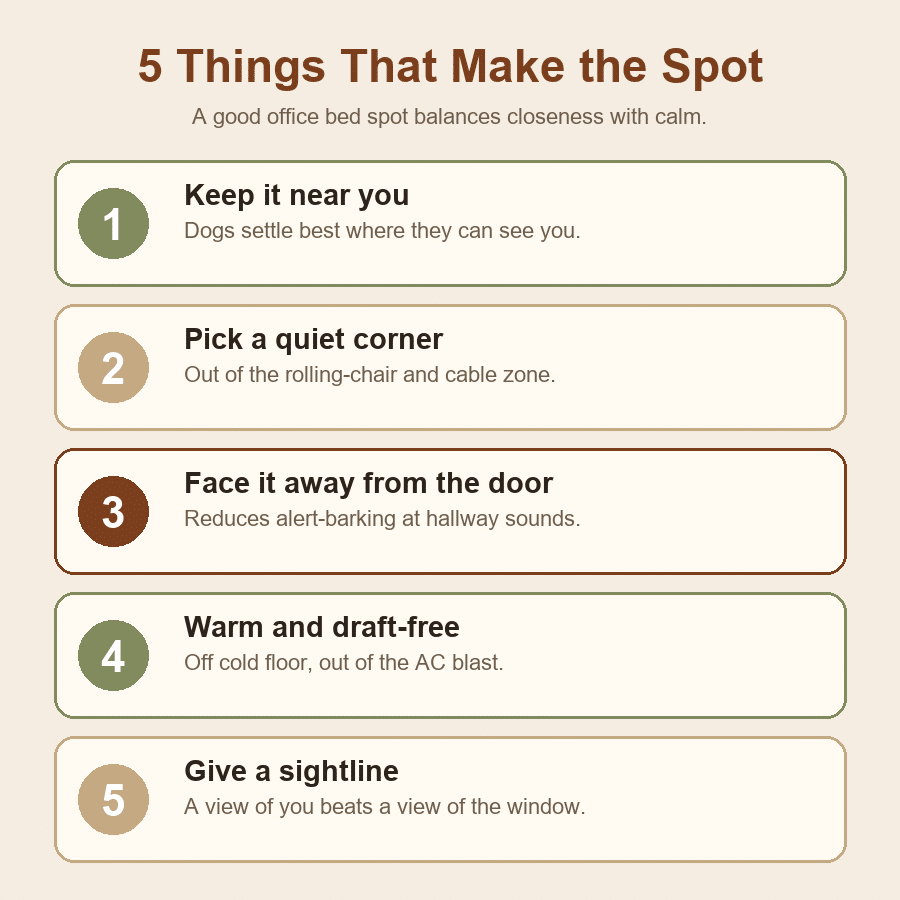
A good office spot balances closeness with calm. These five factors, in roughly the order that matters most, turn a random patch of floor into a bed your dog uses.
1. Near you — but out of the traffic path
Put the bed within a few feet of your chair, off to one side. Dogs are social animals: the American Kennel Club describes them as pack animals who want to stay close to their people, and Preventive Vet notes that dogs can become distressed when isolated and rest better near their family. A spot beside your desk gives your dog that closeness while you work.
The balance to strike is traffic. Being near you is not the same as being in the walkway. Vet Help Direct points out that high-traffic areas — where people are constantly coming and going — can be disruptive to a resting dog. Position the bed to the side of your chair’s roll zone and out of the direct line between the door and your desk.

2. A quiet corner your dog already likes
Watch where your dog chooses to flop in the office and build the spot there. Preventive Vet’s safe-space guidance suggests noting where your dog naturally goes when they need a break, and setting the resting spot away from outside noise. A corner — two walls at the dog’s back — feels more secure than the open floor and keeps the bed out of the main path.
3. Warm and draft-free, away from vents
Temperature matters for a dog that’s going to lie still for hours. Preventive Vet advises keeping a dog’s resting spot away from drafty doors and uninsulated windows, and not placing it by a fireplace or right on top of or next to heating and cooling vents. A blast of AC or a hot vent makes a dog get up and move; a stable, sheltered corner lets them stay put. Think comfort, not treatment — a cozy spot helps a dog settle, but it isn’t a remedy for a health issue.
4. A clear line of sight to you
This one is common sense rather than a hard rule: many dogs settle better when they can see you from their bed. If your dog can lift their head and spot you at the desk, they’re less likely to get up every time you shift in your chair. Angle the bed so your dog has an easy view of you rather than a blank wall.
5. Clear of cords, the chair, and the doorway
The last factor is what should not be around the bed. Keep it clear of the cable run under your desk, the sweep of your rolling chair, and the doorway. American Humane’s pet-proofing guidance is explicit about keeping electrical and phone wires out of a pet’s reach, so route cords along the wall or into a sleeve and set the bed where your dog can’t get to them. A clear doorway is simply practical — a bed that blocks the exit is one you’ll both trip over.
Match the spot to your office setup
Every home office is shaped differently. Use these if-then rules to place the bed for the room you have.
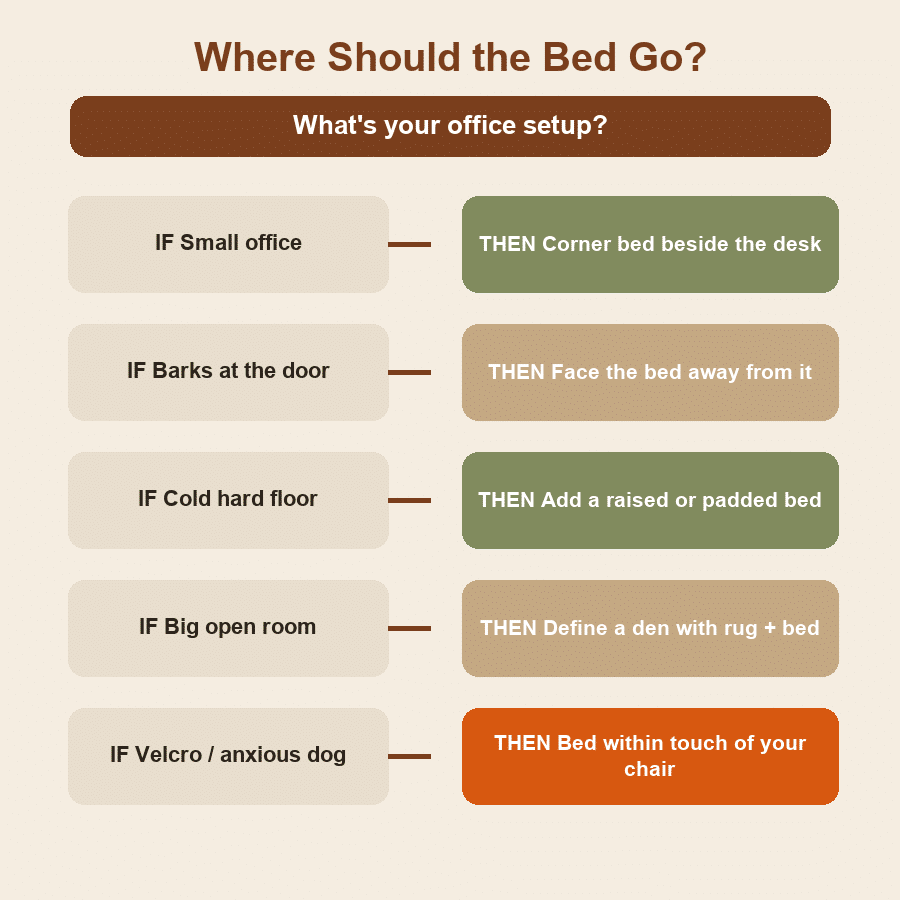
- If your desk sits against a wall with a corner nearby, then put the bed in that corner, just off your chair’s roll zone — closeness plus two walls of shelter.
- If your chair rolls a lot or your desk has a tangle of cables, then place the bed on the far side of the desk from the cable run, and sleeve or wall-clip the cords first.
- If the only open floor is under a window or right by a vent, then move the bed to an interior wall instead, rather than leaving your dog in the cold air stream.
- If your office doubles as a walkway to another room, then tuck the bed into a corner out of the through-path so your dog isn’t in the constant coming and going.
- If your dog already has a favorite napping spot in the room, then start there — a bed where they already rest beats a “better” spot they ignore.
- If the office is small and every spot has a trade-off, then prioritize draft-free and cord-free over perfect closeness; your dog can always move a foot closer on their own.
Do and don’t at a glance
The quick version: the left side is a spot your dog will use; the right side is what quietly keeps them on their feet.
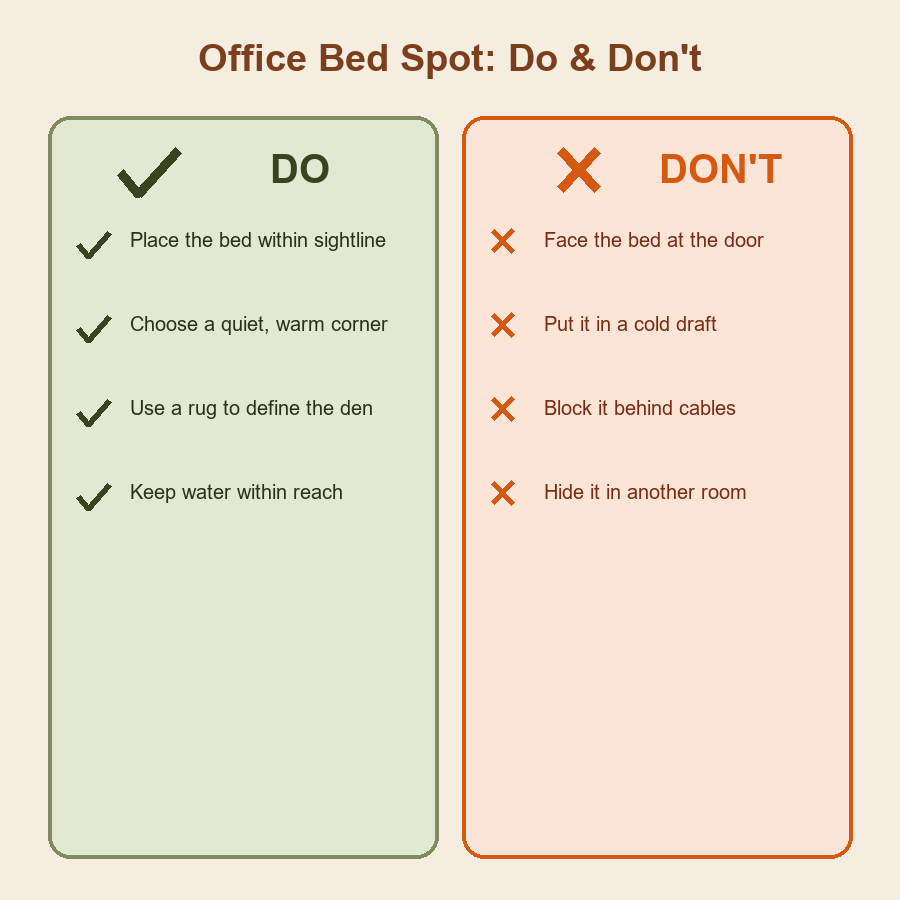
- Do place the bed beside your desk, just outside the chair and cable zone. Don’t put it where you’ll roll into it or step over it.
- Do pick a quiet corner your dog already likes. Don’t drop it in the doorway or the middle of the room’s traffic.
- Do keep it draft-free and away from vents and heaters. Don’t park it under a window or in an AC stream.
- Do route power cords out of reach before the bed goes down. Don’t leave chewable wires dangling next to it.
- Do leave your dog a clear sightline to you. Don’t force them to face a wall or block the exit.
Common mistakes to avoid
A few placement habits make even a great bed go unused. Each comes with the sign to watch for and the fix.
- Putting the bed in the doorway. Sign: your dog keeps getting up as people pass, or you find yourself stepping over them. Fix: shift the bed into a corner off the main path while keeping it near your desk.
- Leaving it in the chair’s roll zone. Sign: you bump the bed with your chair, or your dog drifts away from your desk. Fix: slide it just past the arc your chair travels, to one side.
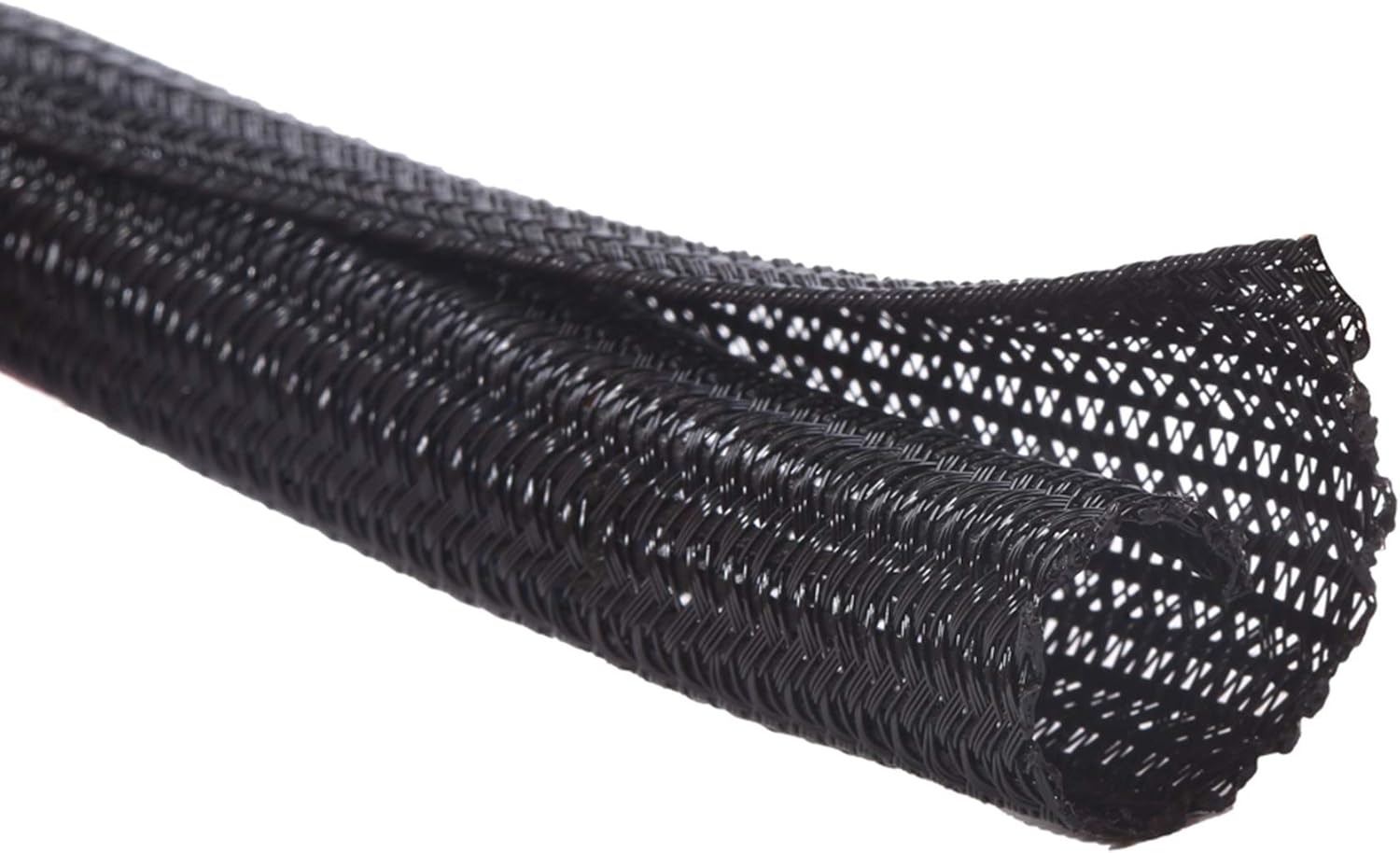
- Ignoring cords and cables. Sign: wires run right past the bed within nose reach. Fix: sleeve or clip cords to the wall and set the bed on the cord-free side.
- Placing it under a vent or window. Sign: your dog abandons the bed when the heat or AC kicks on. Fix: move it to a sheltered interior wall, away from the draft.
- Choosing the spot for you, not the dog. Sign: you like how the bed looks there, but your dog naps elsewhere. Fix: follow your dog’s habit and place the bed where they already settle.
What most guides get wrong
Most “dog bed in the office” advice jumps straight to which bed to buy and skips the part that decides whether your dog uses it: where it goes.
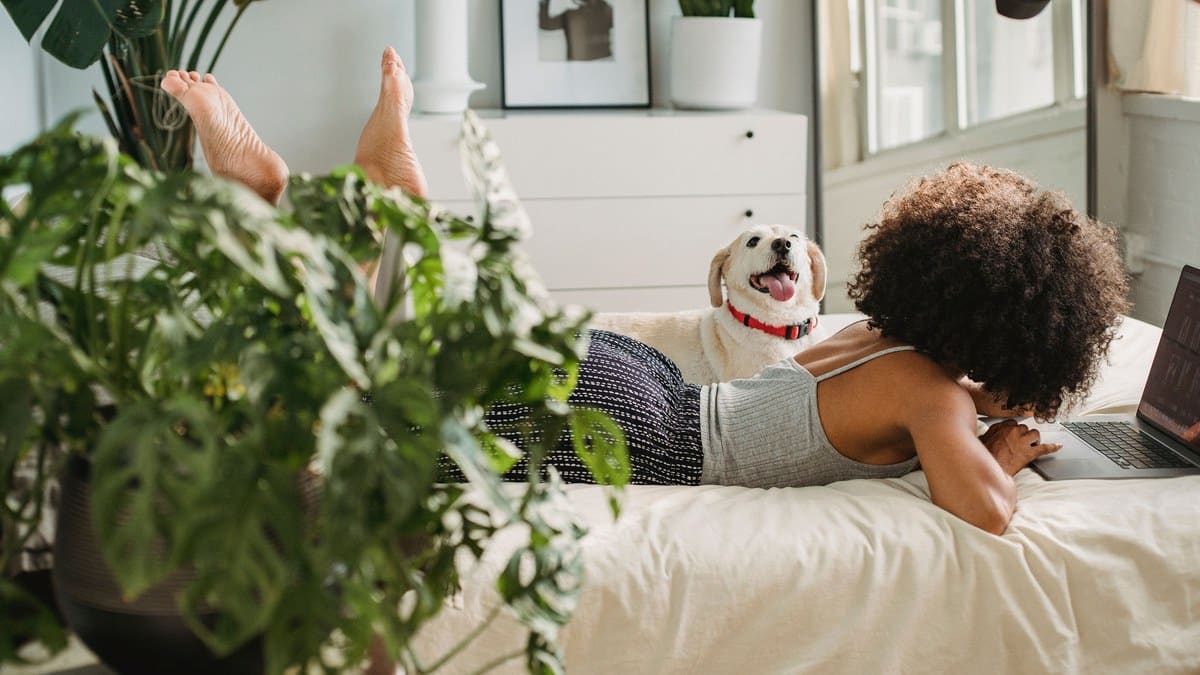
- They treat closeness as the only rule. “Keep your dog near you” is right — dogs are social and rest better near their people — but near-you-in-the-walkway backfires. The overlooked half is traffic: a resting dog on a busy path stays half-awake. The best spot is near you and out of the flow.
- They ignore the vent. Generic guides rarely mention that a heating or cooling vent can drive a dog off an otherwise perfect bed. Preventive Vet flags vents, fireplaces, and drafty windows specifically — a common reason a well-placed-looking bed sits empty.
- They forget the office is a cable jungle. A bedroom corner is simple; a desk is a nest of power strips and charger cords. Placement in an office is a pet-proofing job first, and American Humane’s guidance to keep wires out of reach applies directly under your desk.
- They sell warmth as therapy. A cozy, draft-free corner helps a dog settle — that’s comfort. It is not a treatment for stiffness, anxiety, or age, and framing it that way can delay a conversation with your vet that a genuinely uncomfortable dog needs.
Choosing a bed that fits the spot
Once you’ve found the spot, match the bed to it — the size of the corner, the temperature, and your dog’s sleeping style all point to different picks. This is about how to choose, not a ranking.
Measure the corner first, then match the bed to how your dog sleeps. Sprawlers do better on a flat, roomy pad; dogs that curl up or lean their back against something often prefer a bolster with raised sides. If you’re weighing those shapes, our comparison of memory foam vs. bolster dog beds covers which suits which sleeper. For the fill itself — supportive foam versus a plusher feel, and what that means for an older or heavier dog — see orthopedic vs. memory foam dog beds.
If the office bed is one of several around the house, think about the whole setup. Our roundup of cozy dog corner ideas shows how to build a warm rest spot that works in an office corner as well as a living room. Whatever you choose, buy for your dog’s size and sleeping habit — the best bed is the one your dog actually settles into.
FAQ
Should the dog bed be right next to my desk?
Close is good, but just off to the side is better than right underfoot. Aim for a spot within a few feet of your chair where your dog can see and reach you, but outside the arc your chair rolls through and clear of the cables under the desk. Dogs settle better near their people, so closeness helps — as long as your dog isn’t in the traffic path.
Where should I not put a dog bed in a home office?
Avoid the doorway and the main walk-through, the direct path your rolling chair travels, and anywhere with a draft — under a window, by an exterior door, or right at a heating or cooling vent. Keep it away from dangling power cords your dog could chew. These spots are most likely to leave a bed empty or create a hazard.
My office is tiny. What matters most?
When you can’t have everything, prioritize safety and temperature over perfect closeness. Get the bed away from cords and off any draft or vent first; a dog will happily scoot closer to you on their own, but they’ll abandon a bed that’s cold or tangled in wires. A corner that’s cord-free and draft-free beats a prime desk-side spot that isn’t.
How do I get my dog to actually use the bed?
Start where your dog already likes to rest in the room, make that spot quiet and comfortable, and let them choose it rather than forcing them onto it. A clear sightline to you and a calm corner do most of the work. If your dog still won’t settle near you, that’s more likely a comfort or anxiety question than a placement one, and worth raising with your vet or a trainer.
Can I put the bed near a heater to keep my dog warm in winter?
Keep the bed warm but not right against a heat source. Preventive Vet advises against placing a dog’s resting spot by a fireplace or on top of or very close to heating vents. A draft-free interior corner holds warmth without the risk of overheating or of a dog that can’t move away from the heat. Warmth here is comfort, not treatment for a condition.
The bottom line
Start by watching where your dog already chooses to rest while you work, then refine that spot: near your desk but out of the chair and cable path, in a quiet corner with a sightline to you, draft-free and away from vents, with power cords tucked out of reach. Get those right and the bed becomes a place your dog settles on their own. For more ways to set up a pet-friendly workspace, visit our FurlyHome home-office ideas hub.
Sources
- Preventive Vet — How to Set Up a Safe Space for Your Dog — supports choosing a quiet resting spot away from noise and traffic, built where your dog naturally goes to take a break.
- Preventive Vet — Setting Up Your Dog’s Crate for Comfort & Safety — supports keeping a resting spot draft-free and away from doors, uninsulated windows, fireplaces, and heating or cooling vents, and notes that dogs are social and can become distressed when isolated.
- Vet Help Direct — Where’s the Best Place to Put a Dog’s Bed? — supports keeping a resting dog out of high-traffic areas, which can be disruptive.
- American Kennel Club — Why Does My Dog Follow Me Everywhere? — supports that dogs are pack animals that want to stay close to their people.
- American Humane — Pet-Proofing Your Home — supports moving electrical and phone wires and dangling cords out of a pet’s reach.
Last reviewed July 2026.


Write Your Review
No reviews yet. Be the first to share your experience!