

Why Does My Dachshund Have Back Problems?
Dachshunds have back problems because of their genetics. The same gene that produces their signature elongated body and short legs — a form of dwarfism called chondrodystrophy — also causes the intervertebral discs in their spine to harden and calcify faster than in other breeds. These hardened discs are prone to rupturing under normal everyday stress, pressing on the spinal cord and causing pain, weakness, or paralysis. This condition is called intervertebral disc disease, or IVDD, and it affects up to 25% of dachshunds over their lifetime.
This is not a lifestyle problem or a failure of care — it is a structural vulnerability built into the breed. But the home environment significantly affects how often and how severely IVDD episodes occur.
What Is IVDD?
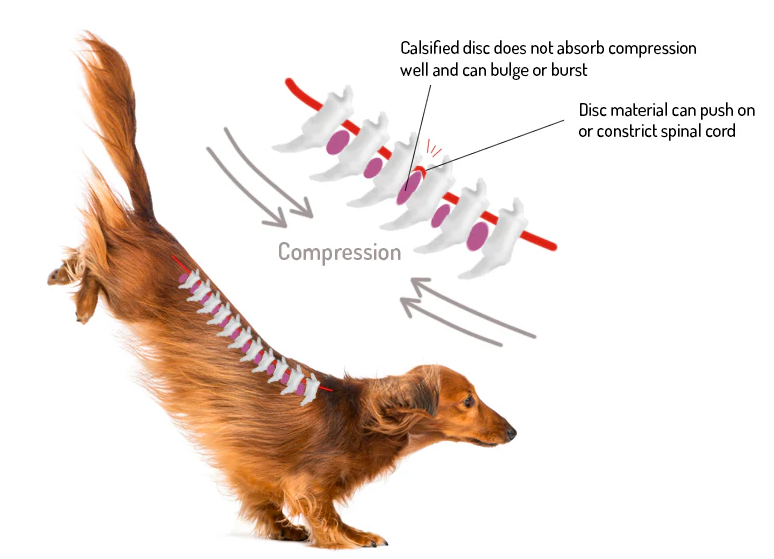
The intervertebral discs are gel-filled cushions that sit between each vertebra in the spine, absorbing shock and allowing flexible movement. In healthy dogs, the disc’s outer layer (the annulus fibrosus) remains flexible throughout life, and the inner gel (the nucleus pulposus) stays soft and shock-absorbing.
In chondrodystrophic breeds like dachshunds, the inner gel calcifies — hardens — beginning as early as 2 years of age. A calcified disc loses its shock-absorbing function and becomes brittle. Under stress — which can be something as minor as jumping off a sofa — the outer layer ruptures, and hardened disc material presses against the spinal cord or nerve roots.
The result ranges from mild pain and reluctance to move, to partial paralysis, to complete hind-end paralysis. Severity depends on where in the spine the rupture occurs, how much material is extruded, and how quickly the dog receives treatment.
Which Part of the Spine Is Most at Risk?
The thoracolumbar junction — the area where the chest spine meets the lower back, roughly at the level of the last few ribs — is the most common site of IVDD episodes in dachshunds, accounting for roughly 65 to 75% of cases. This area bears the highest stress during the twisting and bending movements that dachshunds perform constantly.
Cervical (neck) IVDD is the second most common site, accounting for 15 to 20% of cases. Cervical episodes cause neck pain, reluctance to lift the head, and in severe cases forelimb weakness.
Signs Your Dachshund Is Having a Back Problem
Early signs are easy to miss because dachshunds are stoic and often mask pain. Watch for: reluctance to jump or climb stairs they normally manage easily; yelping when picked up or when moving; a hunched or arched back posture; shivering or trembling without obvious cause; reduced appetite; slower-than-usual movement on walks.
More serious signs requiring immediate veterinary attention: wobbling or stumbling in the hind legs; dragging a rear leg; inability to stand or walk; loss of bladder or bowel control; complete hind-end paralysis. The window for effective treatment — particularly surgery — is time-sensitive. If your dachshund shows any sign of hind-end weakness or inability to walk, treat it as an emergency and contact your vet immediately.
What Makes IVDD Episodes More Likely
Jumping on and off furniture:The impact of landing from a jump — even a modest sofa height — generates significant spinal compression in a dachshund’s already-vulnerable disc. This is the single highest-risk daily activity for IVDD episodes in home environments.
Stair climbing:Repeated stair use flexes the thoracolumbar spine in ways that stress disc integrity over time. For a dachshund with known disc calcification (visible on X-ray), stairs should be blocked off where possible.
Obesity:Excess body weight dramatically increases the compressive load on every intervertebral disc with every step. Even one to two pounds above ideal weight in a small dog represents meaningful additional spinal stress. Keeping a dachshund lean is the most important preventive measure available to owners.
Twisting and rough play:Activities that combine rotation and extension — rough wrestling, being picked up awkwardly, sudden direction changes — stress the annulus fibrosus (the disc’s outer layer) in ways that jumping alone does not.
Collar use vs. harness:A neck collar transmits leash pressure directly to the cervical spine. For dachshunds, a harness that distributes leash pressure across the chest and shoulders is strongly preferred to avoid cervical disc stress.
How to Protect Your Dachshund’s Back at Home
Install ramps and steps:Replace jumping with ramped access to all elevated surfaces — sofas, beds, armchairs. Ramps rated for small dogs with gentle inclines (under 20 degrees) allow dachshunds to move between heights without the spinal impact of jumping. Teach ramp use early — dachshunds learn quickly when treats are involved. For a dog bed designed specifically to reduce spinal stress, see our best dog bed for dachshund bad back guide.
Block stair access:Baby gates at the top and bottom of stairs prevent unsupervised stair use. This is particularly important at night when you cannot observe the dog’s movement.
Use a harness, not a collar:Switch to a well-fitting harness for all walks and leash activity. Avoid harness styles that cause the dog to step through a front loop, as these can restrict shoulder movement — look for a back-clip harness with chest and girth straps.
Maintain healthy weight:Feed measured portions rather than free-feeding, and factor in any treats and chews in daily calorie counting. If you are uncertain whether your dachshund is at a healthy weight, see how to tell if your dog is overweight.
Teach proper pick-up technique:Always support both the chest and hindquarters when lifting a dachshund — never pick them up by the front legs or under the arms alone, which allows the spine to sag and increases thoracolumbar stress.
Treatment Options When IVDD Occurs
Treatment ranges from conservative management (strict crate rest for four to six weeks, anti-inflammatory medication, pain management) for mild episodes, to surgical decompression for severe or rapidly progressing cases. The choice depends on the severity of neurological signs and the speed of onset.
Early surgery — typically within 24 to 48 hours of severe signs — offers the best prognosis for recovery of hind-end function in dogs that have lost the ability to walk. Dogs that delay surgery by 48 to 72 hours have meaningfully lower recovery rates. This is why treating hind-leg weakness as an emergency is critical.
For long-term spinal support, a glucosamine and chondroitin supplement may slow disc deterioration — see our best glucosamine supplement for senior dogs for options reviewed for small breeds.
Frequently Asked Questions
Is IVDD in dachshunds curable?
IVDD is not curable — dachshunds that are genetically predisposed remain at risk throughout their lives. However, individual episodes are treatable, and most dogs recover meaningful function with appropriate care. The goal is managing the environment to reduce the frequency and severity of episodes.
At what age do dachshunds typically get IVDD?
IVDD episodes most commonly occur between ages 3 and 7, when disc calcification is advanced but the dog is still physically active and engaging in high-risk movements. Episodes can occur at any age — some as young as 2, some as late as 12 — but the 3-to-7 range is highest risk.
Can a dachshund recover from paralysis?
Many dachshunds recover full or near-full hind-end function after IVDD episodes, particularly when treated promptly. Dogs with deep pain sensation intact at the time of treatment have significantly better prognosis than those who have lost all sensation. Early intervention is the most important factor in outcome.
More FurlyHome Breed and Health Guides
- Best Dog Bed for Dachshund Bad Back
- How Long Do Dachshunds Live?
- How to Help an Arthritic Dog at Home
- Best Glucosamine Supplement for Senior Dogs
- How to Tell If Your Dog Is Overweight
Verdict
Dachshund back problems are structural and genetic — the same trait that makes the breed distinctive creates a lifelong spinal vulnerability. You cannot eliminate IVDD risk, but you can dramatically reduce episode frequency and severity through consistent home management: ramps instead of jumping, harness use, healthy weight, and early treatment at the first signs of pain or weakness. For dachshund owners, understanding and preventing IVDD is not optional knowledge — it is the most important thing to learn about the breed.







Write Your Review
No reviews yet. Be the first to share your experience!