

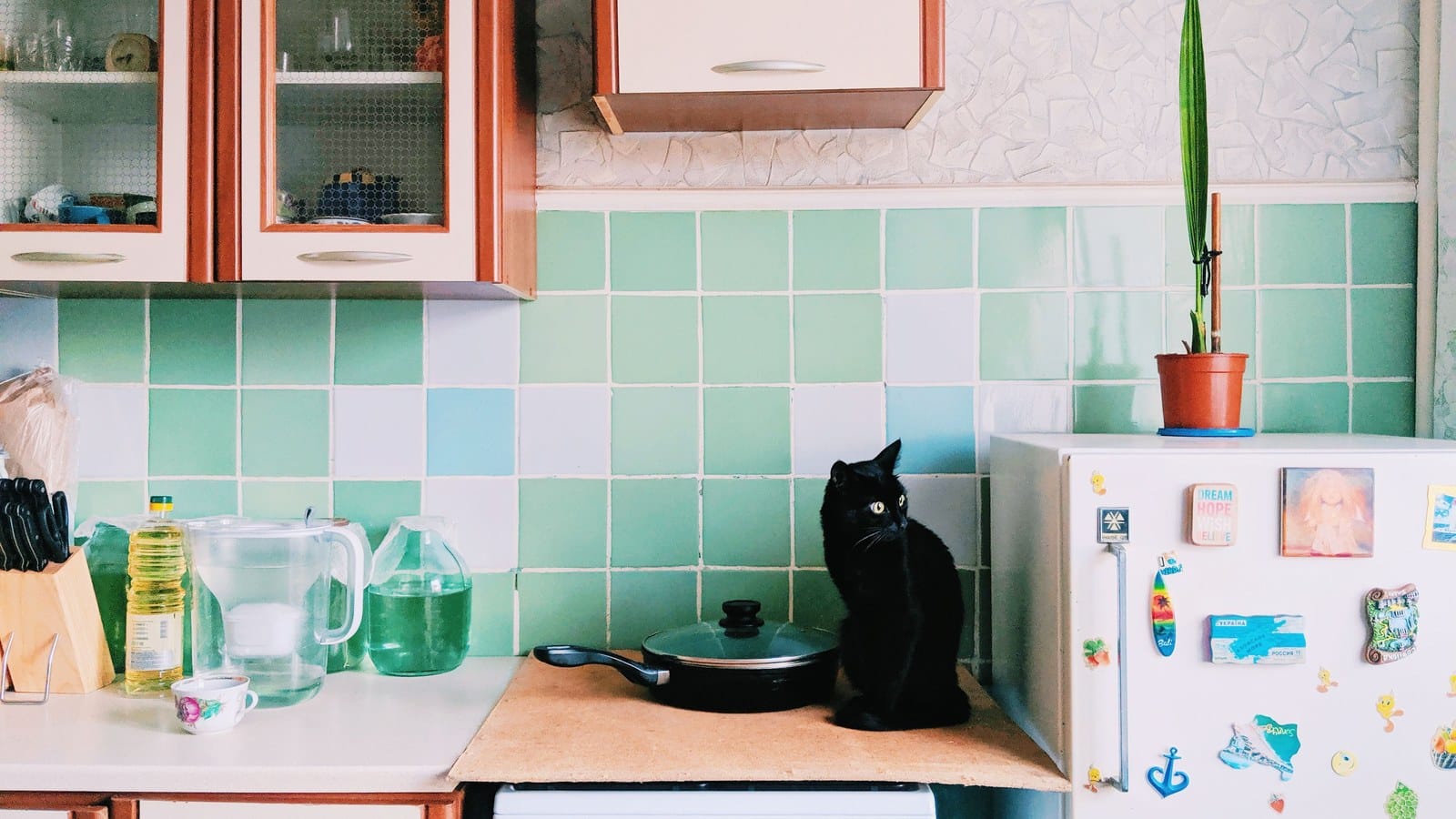
For most cats, the kitchen counter is the best seat in the house — high up, warm, and often dusted with crumbs. The good news: you can keep your cat off it without a single squirt bottle.
Quick answer
You can’t punish a cat out of jumping on the counter — cats climb by instinct, and the counter offers both height and the chance of food. Instead, remove the reward and redirect the instinct. Clear away food, crumbs, and dirty dishes so the counter is boring, fix any dripping faucet, and set up a cat tree or shelf as tall as the counter where your cat likes to watch the kitchen. Reward your cat every time they use the perch, and stay consistent across the whole household. Skip spray bottles and loud noises — they damage trust and don’t fix the habit.
Safety first
This is a behavior-and-setup guide, not medical advice. The most important rule is to use only humane, redirect-based methods. Veterinary-reviewed guidance is clear that spray bottles, compressed-air or forced-air devices, loud noise makers, and physical punishment should be avoided — they don’t fix why your cat jumps, and they can teach your cat to fear you or simply wait until you leave the room. Keep your cat safe from real kitchen hazards too, including hot burners, sharp knives, and food left within reach. And if your cat’s counter-surfing is sudden and intense, or comes alongside other changes in appetite or behavior, mention it to your veterinarian — a sudden change is worth a professional’s eyes.
Who this is for (and who should check with a vet first)
This guide is for owners of a healthy cat who has simply learned that the counter pays off — they jump up to hunt for food, watch the room, or get your attention. The steps below change the environment and the payoff, not your cat’s health.
- This is for you if: your cat is generally healthy and you want to break the counter habit humanely and for good, without startle tactics.
- Do this alongside a vet chat if: the counter-surfing is brand-new, sudden, or paired with constant hunger, weight change, or other new behaviors — a change in appetite or behavior is worth mentioning to your veterinarian.
- This won’t stick if you only block: taking the counter away without offering a better high spot just moves the problem — cats need somewhere elevated to go.
Why cats can’t resist the kitchen counter
Cats jump on counters for a mix of reasons — height, food, attention, and stimulation — and the kitchen happens to deliver all four at once. Understanding the pull is what makes the fix work, because you have to remove the reward and satisfy the instinct at the same time.
Height is instinct. Cats are climbers who feel safest surveying a room from above, and a veterinary teaching hospital’s indoor-cat program notes that a high perch gives a cat a safe, private place to watch the action. To your cat, the counter is simply the tallest, most central lookout in the busiest room of the house.
Food is the second magnet. Counters are where meals are prepared, dropped, and left out, so to a cat they read as a reliable hunting ground for scraps and other high-value items. Every crumb your cat finds up there is a small jackpot that trains them to check again.
Because the draw is both instinct and reward, blocking alone never holds. Veterinary-reviewed guidance frames keeping cats off food-prep surfaces as being in everyone’s best interest, and the durable way to get there is to make the counter dull while giving the instinct a better outlet.
Before you start: figure out what’s pulling your cat up
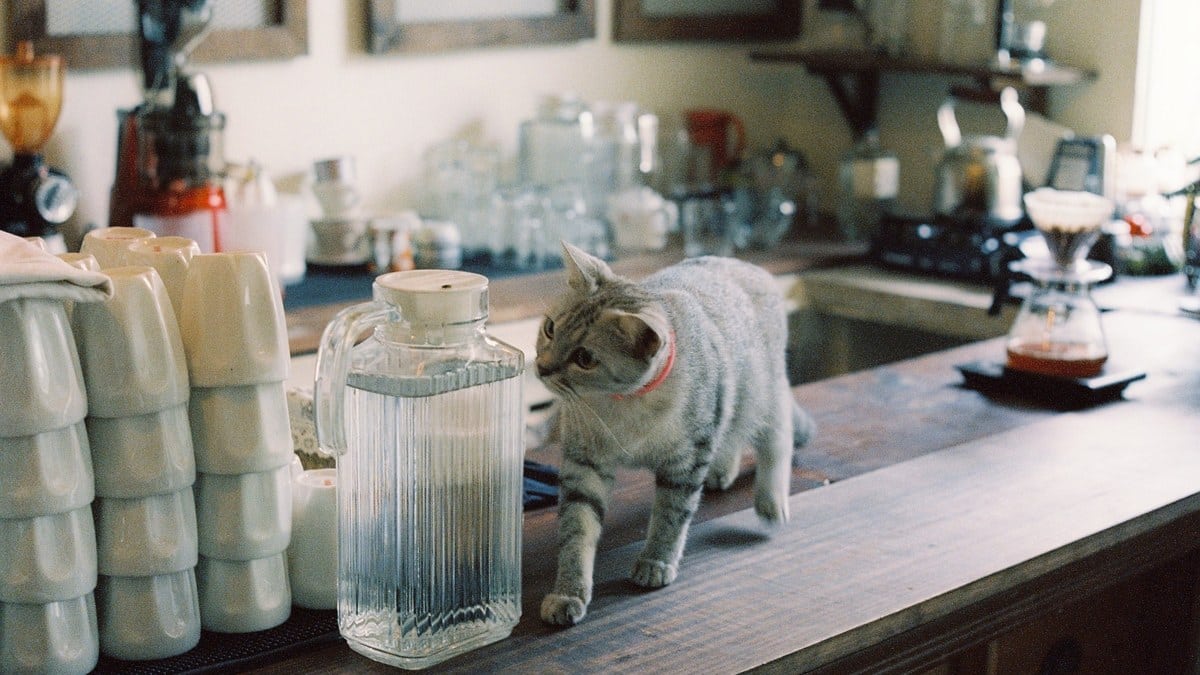
Before you rearrange anything, spend a day watching when and why your cat jumps up. The trigger tells you which fix to lead with.
- Do they jump up right before meals, or the moment you start cooking or prepping?
- Do they head straight for the sink to drink from a dripping or running faucet?
- Do they climb up to nap in a sunny spot or watch the room and the window?
- Do they land on the counter mainly when they want your attention?
- Do they check the counter after you’ve left food, a fruit bowl, or dirty dishes out?
Each pattern points to one of the steps below. You don’t have to do everything at once — start with whatever reward your cat is actually chasing, then add the perch that gives the instinct somewhere better to land.
Step by step: break the counter habit for good
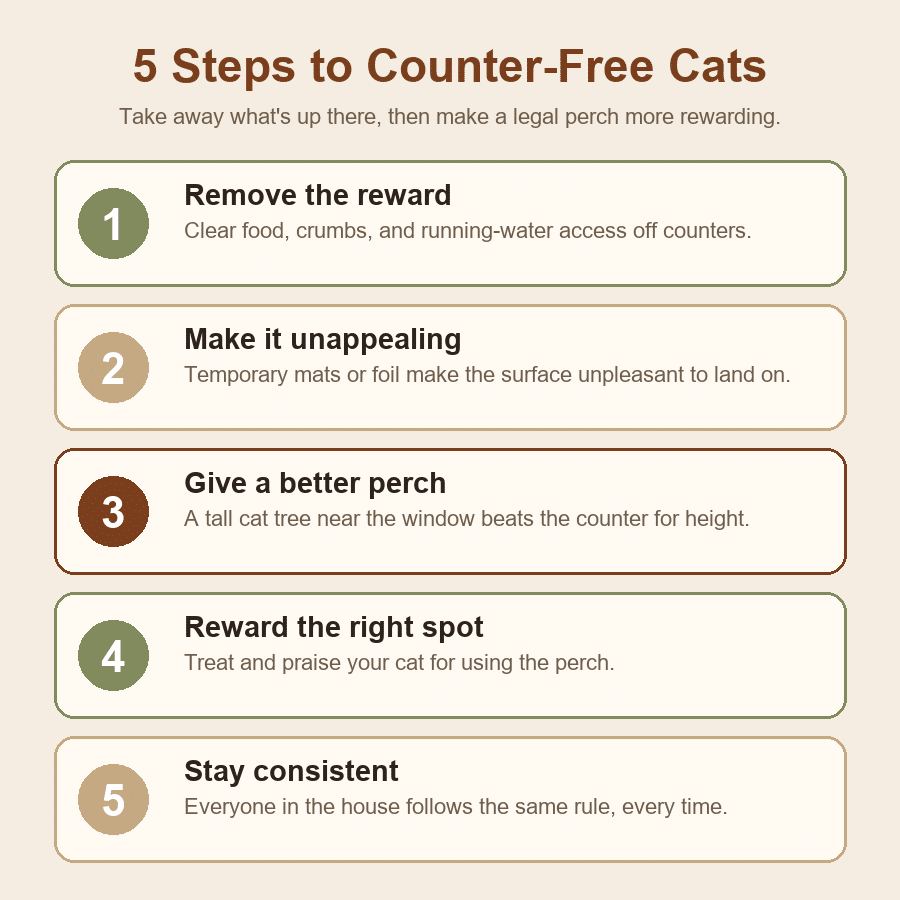
1 Remove the reward
What to do: Keep the counter completely clear of food, crumbs, and dirty dishes, and wipe surfaces down after every meal and prep session. Store bread, fruit bowls, and treats in closed cabinets, and fix a dripping faucet so the sink stops offering fresh running water. Why: Counters attract cats as a source of food scraps and high-value items, so every crumb or trickle of tap water is a payoff that rewards the jump and keeps your cat coming back to check. Success cue: Your cat investigates once, finds nothing, and starts checking the counter less often over the following days. Adjust: If your cat is really after the faucet, offer a cat water fountain somewhere away from the kitchen so moving, fresh water is available where you actually want them to drink.
2 Make the counter boring
What to do: Clear away the clutter and appliances that double as launch pads, tuck in chairs and stools so there’s no easy staging point, and move the toaster or bread box out of reach. If your cat is persistent, you can temporarily cover the counter with a texture cats dislike underfoot — smooth aluminum foil or a plastic carpet runner turned nubby-side up — as a passive deterrent, never a startle device. Why: Cats stop returning to a spot that is dull, offers no reward, and doesn’t feel good under their paws, and a passive deterrent works with the redirect instead of against your cat’s trust. Success cue: Your cat loses interest and no longer lingers or settles on the counter. Adjust: Peel the foil or runner away once the new habit has held for a few weeks, and never escalate to spray bottles, air cans, or noise makers if progress feels slow.
3 Give a taller, better perch
What to do: Set up a cat tree, wall shelf, or window perch near the kitchen action — as tall as or taller than the counter, stable, and positioned where your cat already likes to watch you. Why: Cats seek height by instinct, and a veterinary teaching hospital’s indoor-cat program recommends giving them places to climb and a safe perch to watch from above. Take the counter away without offering a legal high spot and you leave that instinct with nowhere to go. Success cue: Your cat chooses the perch to survey the room instead of aiming for the counter. Adjust: If your cat ignores the new perch, move it closer to the action or beside a window — height and sightline matter far more than looks. A tree that blends into the room makes this easier to live with; these picks show what to look for: modern cat trees that look like furniture.
4 Reward the right spot
What to do: The moment your cat uses the perch, make it worthwhile — toss a treat up to it, offer praise, play with a favorite toy there, or add a soft blanket in a sunny patch. Turn the perch into the most rewarding place in the room. Why: The most effective approach is to redirect rather than punish, and behavior that pays off gets repeated, so you’re simply moving the payoff from the counter to the perch. Success cue: Your cat starts defaulting to the perch on their own, without being prompted. Adjust: Feed meals or run play sessions near the perch to build the association, and never hand out attention on the counter — even a quick shooing is a reward to a cat who wanted you to notice.
5 Stay consistent, everyone and every time
What to do: Get the whole household on the same rules — no one feeds from the counter, leaves food out, or lets a quick “just this once” slide. When your cat does jump up, calmly and silently lift them onto the perch instead. Why: Cats learn from patterns, and a single success or one family member sneaking a treat keeps the habit alive on an intermittent schedule, which is the hardest kind to break. Success cue: Over about two to three consistent weeks, the jumps taper off and then stop. Adjust: If one room, one counter, or one person keeps being the weak link, tighten the routine there first before expecting the rest to hold.
Match the fix to why your cat jumps
Not every cat is chasing the same thing. Match your lead fix to what you actually see:
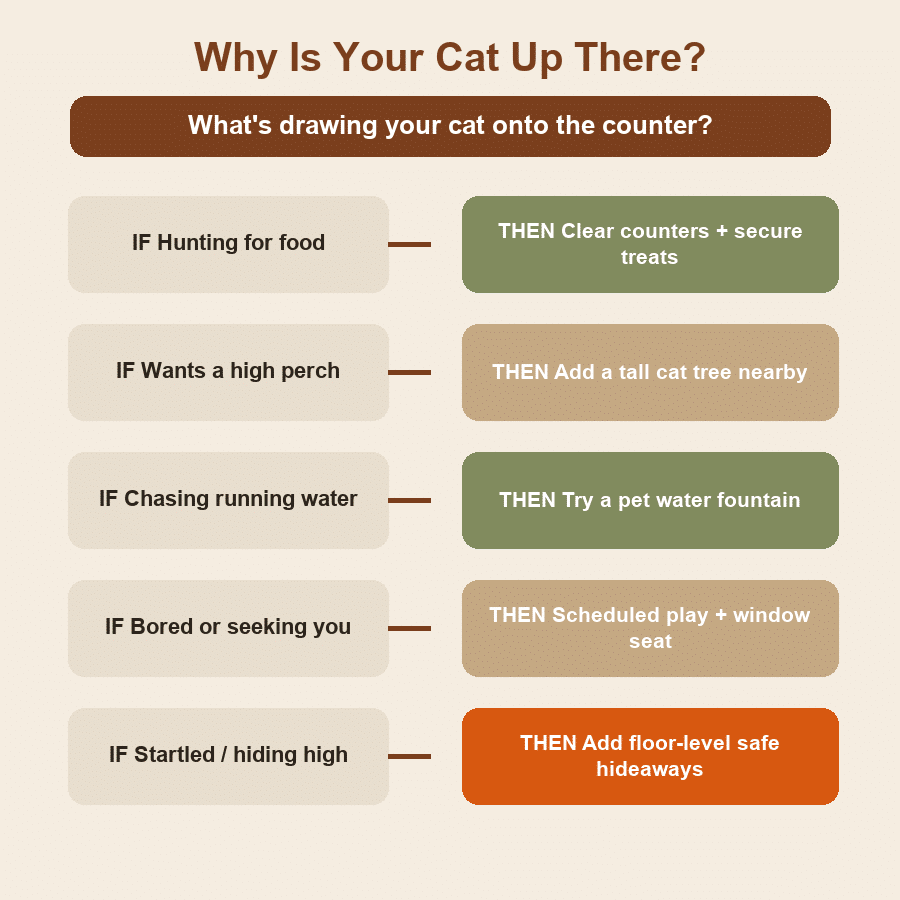
- If your cat jumps up around meals or while you cook, then lead with removing the food reward: clear and wipe every surface and store food away.
- If your cat makes a beeline for the sink, then fix the dripping faucet and set up a cat fountain away from the counter.
- If your cat climbs up to watch the room or nap in the sun, then lead with a tall perch or window seat right by the action.
- If your cat jumps up mainly when they want you, then give attention only when they’re on the perch or floor, never on the counter.
- If the counter-surfing is brand-new and intense or paired with other changes, then mention it to your veterinarian before assuming it’s just a habit.
Do and don’t: keeping cats off counters at a glance
If you remember nothing else, remember these. The left side is what humane, lasting redirection looks like; the right side is what quietly keeps the habit alive.
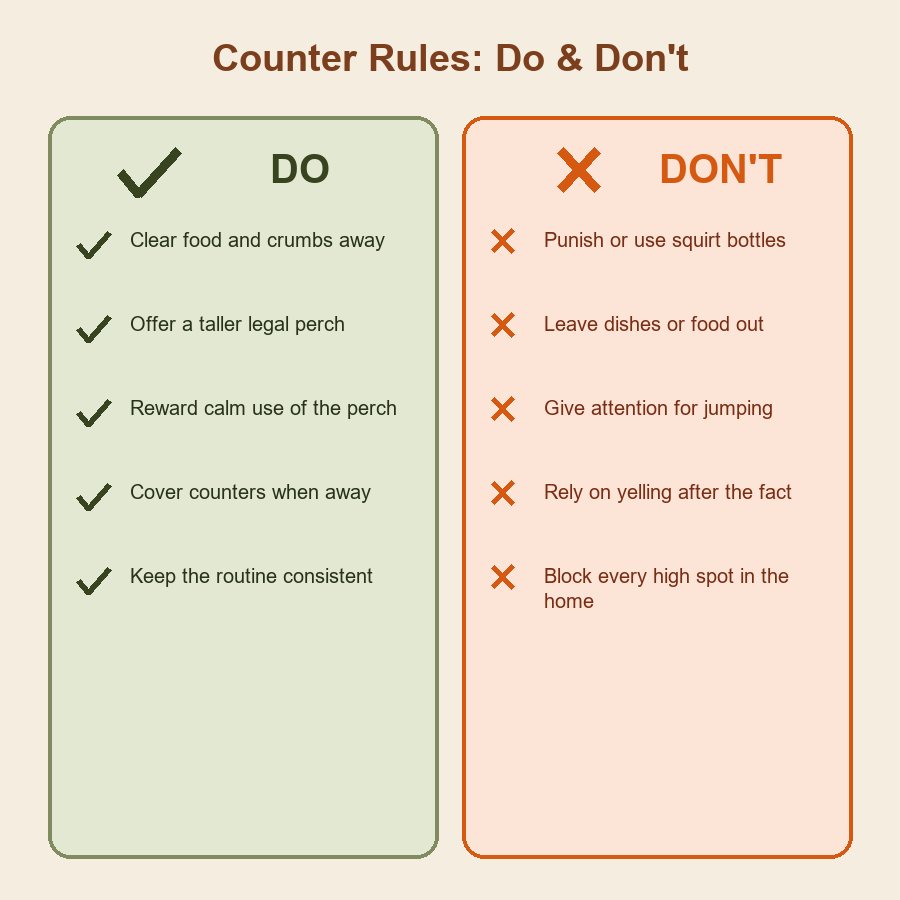
- Do keep counters clear and wiped after every meal. Don’t leave food, crumbs, or dishes where a cat can cash in.
- Do offer a perch as tall as the counter near the action. Don’t block the counter without giving a better height.
- Do reward your cat on the perch. Don’t reward — or even shoo — them on the counter, because attention is a reward.
- Do use passive, humane deterrents. Don’t use spray bottles, air cans, loud noises, or physical punishment.
- Do get the whole household consistent. Don’t let “just this once” undo weeks of work.
Common mistakes to avoid
- Reaching for the squirt bottle. Sign: your cat stays off the counter only while you’re watching. Fix: drop the startle tactics, remove the reward, and redirect to a perch — veterinary-reviewed guidance says spray bottles and similar devices should be avoided.
- Blocking without redirecting. Sign: your cat just finds another high spot or keeps trying the counter. Fix: add a tall, appealing perch near the action so the instinct has somewhere to go.
- Leaving food or a dripping tap. Sign: your cat keeps returning to the counter and the sink. Fix: store food, wipe crumbs, fix the drip, and offer a fountain elsewhere.
- Being inconsistent. Sign: the habit fades and then comes back. Fix: get everyone on the same rules, every single time.
- Putting the perch in the wrong place. Sign: your cat ignores the brand-new tree. Fix: move it into the kitchen sightline or next to a window where the view competes with the counter.
- Expecting overnight results. Sign: you give up after a few days. Fix: give it two to three consistent weeks before you judge whether it’s working.

What most guides get wrong
Most “cats off the counter” articles treat it as a discipline problem and hand you a gadget. That misses why the behavior is so stubborn and why the humane approach is also the one that actually lasts.
- They frame it as disobedience, not instinct plus reward. The counter wins on two axes at once — height and food — so a fix that beats only one of them leaves the other pulling your cat right back up.
- They recommend startle devices. Spray bottles, scat mats, and compressed-air cans get repeated everywhere, but veterinary-reviewed guidance says to avoid them: they erode trust and only “work” while you’re in the room to enforce them.
- They skip the perch entirely. The durable fix is to give the climbing instinct a better outlet, and a veterinary teaching hospital’s indoor-cat program is explicit that cats need places to climb and watch from up high. The same redirect-don’t-punish logic applies to other feline habits, like how to keep a cat from scratching the headboard.
- They stop at “keep it clean.” Hygiene matters, and keeping cats off food-prep surfaces is in everyone’s interest, but wiping the counter only removes the food half of the equation — the height half still needs a perch that competes.
Gear that makes a counter-free kitchen easier
You don’t need much to make this work, but one purchase does most of the heavy lifting: a tall, stable perch your cat genuinely wants to use. When you’re comparing options, focus on the traits that actually pull a cat off the counter.
- As tall as or taller than your counter, so it competes for the same vantage point.
- A sturdy base and a top platform big enough for your cat to stretch out and lounge.
- Placed near the kitchen or a window, in the room where your cat wants to be with you.
A perch that looks like a piece of furniture is easier to keep in the main living space, which is exactly where it needs to be. For styles that earn their spot in the room, see our guide to modern cat trees that look like furniture. Buy for your cat’s size and your sightlines rather than the flashiest listing — the best perch is simply the one your cat chooses over the counter.
Final recommendation
Start with the two moves that cost nothing: keep every surface clear and wiped, and give your cat a perch as tall as the counter right where they like to watch you. Reward the perch, get the whole household consistent, and skip the squirt bottle entirely. Give it two to three weeks of steady effort, adjust the perch’s spot if your cat isn’t biting, and treat this as a behavior-and-setup project rather than a battle of wills. If the counter-surfing is sudden, intense, or comes with other changes, check in with your veterinarian first.
For more cat-friendly kitchen setups in one place, visit our kitchen ideas hub. And if you’re pet-proofing beyond the kitchen, here’s how to pet-proof your living room.
FAQ
Does a spray bottle work to keep cats off counters?
No. Veterinary-reviewed guidance says to avoid spray bottles, forced-air devices, loud noises, and physical punishment. They teach your cat to avoid the counter only while you’re watching and can damage the trust between you. Remove the reward and offer a better, taller perch instead — that’s the approach that actually lasts.
Why does my cat jump on the counter even when there’s no food?
Height and curiosity. Cats feel safe watching a room from above, so the counter is appealing even when it’s spotless. Give your cat a tall perch or window seat near the action so the instinct to climb and survey has a better place to land.
What’s the fastest humane way to stop it?
There’s no overnight fix, but the fastest durable route is to remove every reward — food, crumbs, and tap water — and set up an appealing tall perch the same day, then reward your cat for using it. With consistency, most cats shift over about two to three weeks.
Is it okay to let my cat on the counter sometimes?
Consistency is what makes this work, so “sometimes” is the hardest rule for a cat to learn — an occasional success keeps the habit alive, and keeping cats off food-prep surfaces is in everyone’s best interest anyway. Pick one clear rule and keep it the same for everyone in the home.
Will a cat tree really keep my cat off the counter?
Often, as long as it truly competes with the counter: as tall, as stable, and near the action or a window. A tree tucked away in a spare room won’t win. Pair the perch with a cleared, wiped counter and reward your cat every time they choose the perch.
Sources
- PetMD — How To Keep Cats Off Countertops (vet-reviewed) — supports that cats jump on counters for height, food, attention, and stimulation and treat them as a source of food scraps; that spray bottles, forced-air devices, loud noises, and physical punishment should be avoided; and that redirecting a cat with cat trees, shelves, and enrichment is the effective approach.
- The Ohio State University Indoor Pet Initiative — Perches — supports that cats instinctively like to climb and feel safer up high, and that providing acceptable perches and places to climb gives them a safe spot to watch the room from above.
Last reviewed July 2026.





Write Your Review
No reviews yet. Be the first to share your experience!