

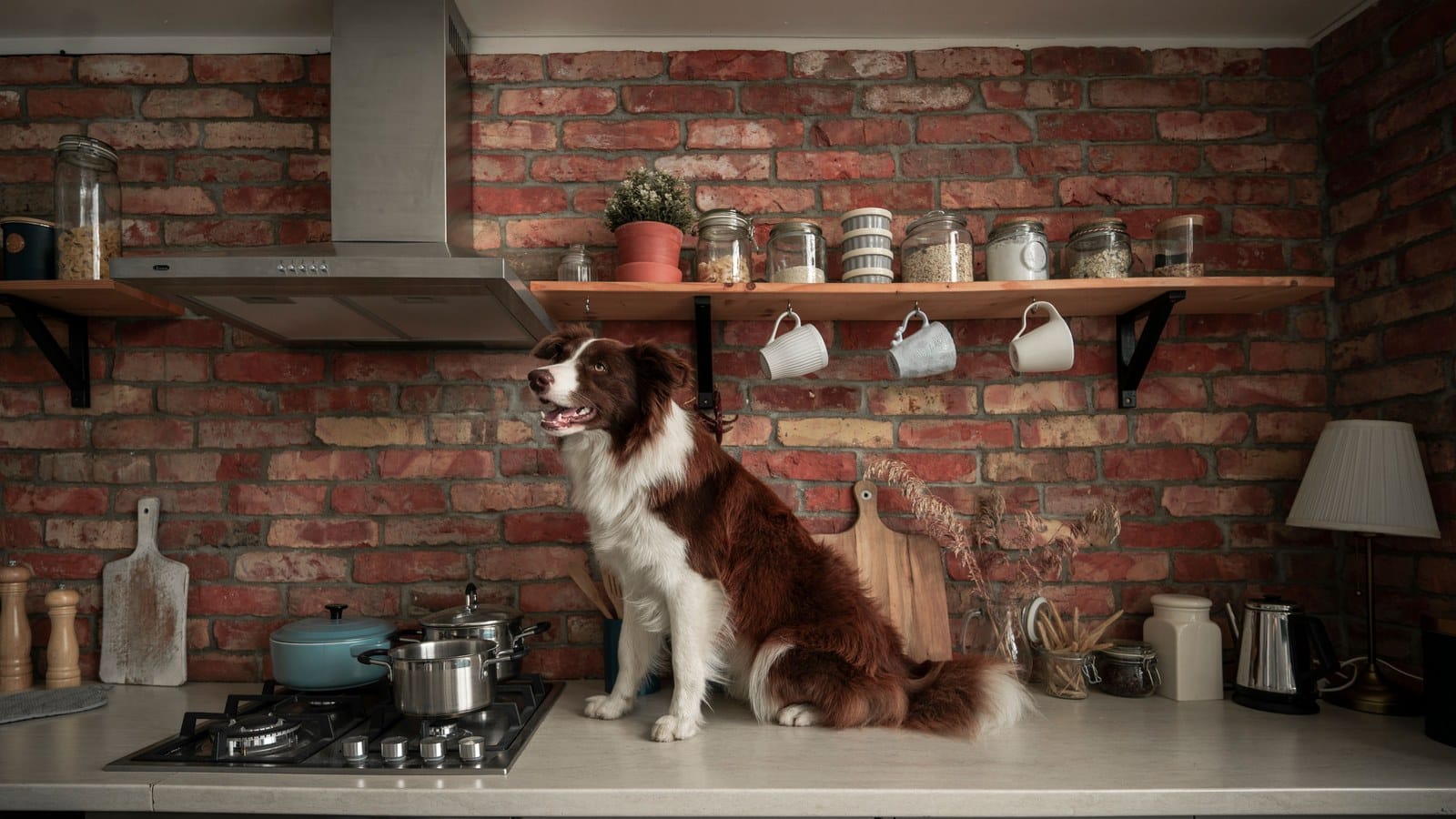
The kitchen is the one room where a dog underfoot is genuinely risky — hot surfaces, dropped food that can be toxic, and a cook who can’t watch every paw. Keeping your dog out doesn’t take scolding or a slammed door. It takes a clear boundary, a little training, and removing the reason they wander in.
Quick answer
Keep your dog out of the kitchen by combining three levers: a physical boundary such as a pet gate across the doorway, positive place-training that teaches your dog to settle on a mat just outside the room, and removing the food payoff by stopping floor-feeding, clearing scraps, and securing the trash. Reward your dog for staying on their spot instead of punishing them for coming in, and calmly guide them back if they cross the line. This protects them from hot surfaces and toxic foods while keeping mealtimes calm. If your dog guards food or has eaten something dangerous, call your vet.
Safety first
The kitchen is worth gating off for safety, not just tidiness. Several everyday kitchen foods are toxic to dogs. According to the ASPCA, chocolate, xylitol (a sweetener in sugar-free gum and baked goods), onions, garlic, chives, and grapes and raisins can all harm dogs, with effects that range from stomach upset to red-blood-cell or kidney damage depending on the food. Keep these off the floor and counters, and if you think your dog has eaten something toxic, call your veterinarian or the ASPCA Animal Poison Control Center right away rather than waiting to see what happens.
Cooking surfaces are the other hazard. Electric stovetops can heat up in seconds, and Preventive Vet notes that a curious pet jumping up or stepping on the controls can accidentally turn on a burner — one reason stove knob covers exist. Keep dogs away from the stove while you cook, and never leave a hot cooktop unattended with a pet loose in the room.
Finally, the method matters. This guide uses positive boundary training. Do not punish your dog for entering the kitchen — the American Kennel Club advises against it, because punishment creates fear and confusion without teaching the dog what to do instead. Reward the behavior you want. This article is home-setup and behavior guidance, not veterinary treatment; a dog that has eaten something dangerous or seems unwell needs a vet, not a training tip.
Who this is for (and who needs more than a gate)
This guide is for owners of a healthy dog who simply won’t stay out of the kitchen — the dog who begs at your feet while you cook, scavenges for scraps, or plants themselves in the busiest three feet of the house at the worst moment. The fixes below are boundary training and home setup, not a cure for a medical or serious behavior problem.
- This is for you if: your dog is underfoot, begging, or scavenging in the kitchen and you want a calm, humane routine that keeps them safely out.
- Add professional help if: your dog guards food, counters, or the trash with growling, snapping, or stiffness — resource guarding needs a qualified trainer or behaviorist, not just a gate.
- Handle it as an emergency if: your dog has just eaten something toxic or been burned — skip the training and call your veterinarian or the ASPCA Animal Poison Control Center right away.
Why the kitchen is worth making off-limits
A dog in the kitchen isn’t just inconvenient — it’s the one room where being underfoot is genuinely dangerous. Hot surfaces, sharp tools, and food that’s toxic to dogs all live here, and a cook carrying a pot of boiling water can’t watch every paw.
Cooking appliances are a real hazard. Electric cooktops can heat up in seconds, and Preventive Vet notes that a pet jumping up or stepping on the controls can accidentally turn on a burner — which is exactly why stove knob covers exist. A dog weaving around your legs at the stove also raises the odds of a spill or a trip. Keeping the dog beyond the doorway removes all of that at once.
Then there’s the food. Dropped scraps and an open trash can are a buffet to a dog, and some of what falls is dangerous — the ASPCA lists chocolate, xylitol, onions, garlic, chives, grapes, and raisins among common foods that can harm dogs. A boundary keeps curious noses away from the counter and the bin, which protects your dog as much as your dinner.
Before you start: figure out why your dog comes in
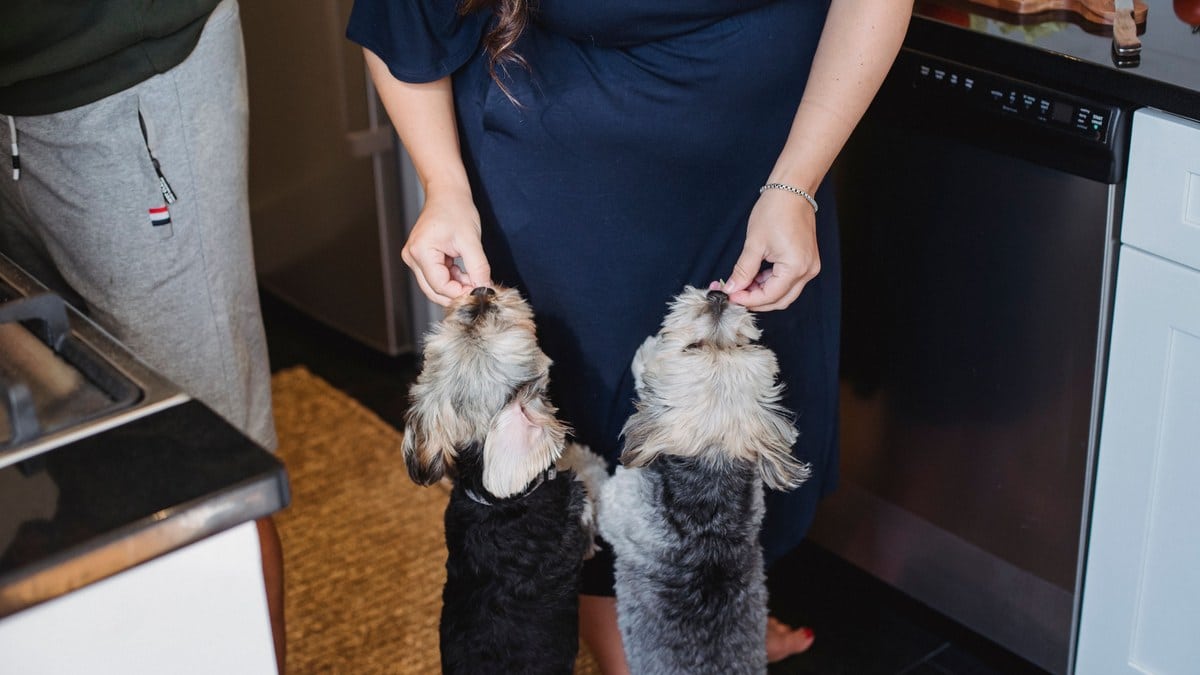
Before you set up a single gate, spend a few meals watching why your dog comes into the kitchen. The reason points straight to the fix.
- Are they hoovering up dropped food and crumbs off the floor?
- Do they appear the second they hear the fridge, a bag, or a can opener?
- Do they follow you in mainly to stay near you, not for food?
- Do they camp by a doorway or the trash and stiffen when you approach it?
- Are they bored and drifting in because the kitchen is where the action is?
Each pattern has a different answer, mapped in the decision guide further down. Most dogs show two or three at once — fix the biggest one first.
Step by step: a calm, dog-free kitchen
1 Set a clear boundary
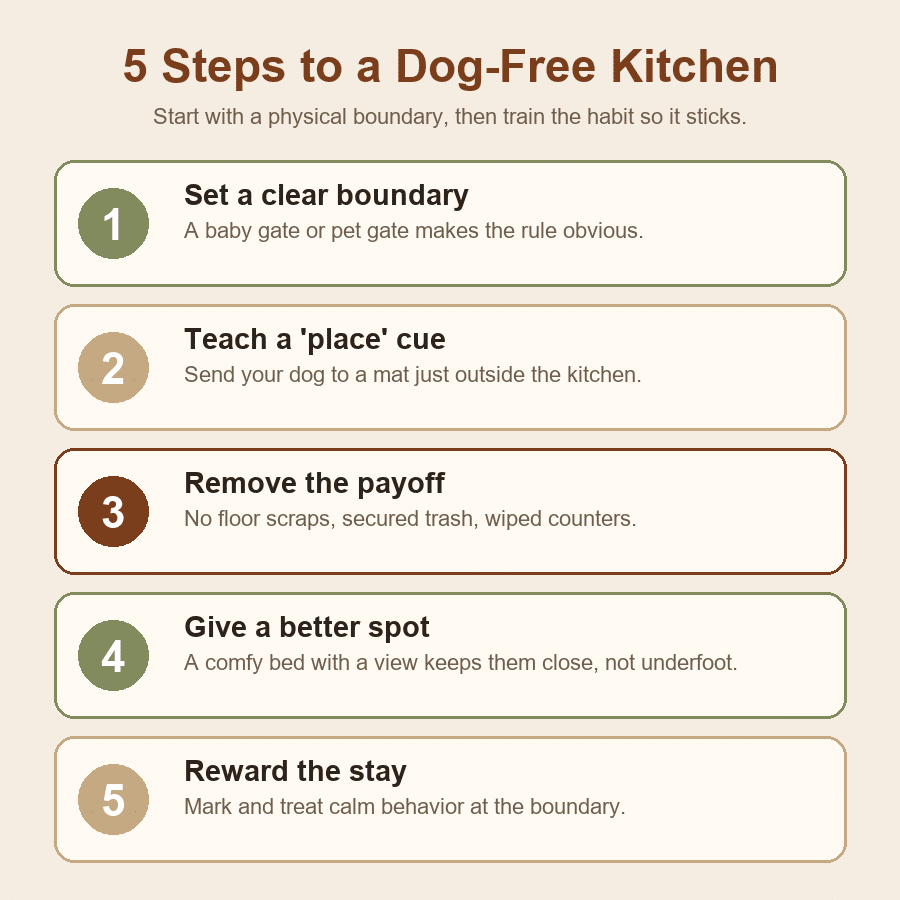
What to do: Put a physical barrier across the kitchen entrance — a pressure-mounted or freestanding pet gate is the simplest option. Choose one tall enough that your dog can’t jump it and sturdy enough that they can’t push through, and set it up before you start training so the rule is consistent from day one. Why: A boundary your dog can’t simply walk past does most of the work while the training catches up; the AKC notes that keeping a dog out of a room like the kitchen heads off problems such as counter-surfing before they start. Success cue: Your dog stops at the gate instead of barging through, even when food smells are strong. Adjust: If your dog jumps or climbs, switch to a taller gate; if they bolt through an open doorway, use a gate you can latch. Our roundup of the best pet gates for the living room covers styles that also suit kitchen doorways.
2 Teach a “place” cue
What to do: Pick a comfortable spot just outside the kitchen — a mat, bed, or rug — and teach your dog to go there on cue. Lead them to the spot, say “place,” reward the moment they settle, and slowly build up the time before the treat. Practice when you’re not cooking so the behavior is solid before mealtime pressure. Why: A trained “place” gives your dog a clear job that’s incompatible with wandering into the kitchen. Positive-reinforcement boundary training like this, per the AKC, is the humane and durable way to teach a dog where they may and may not go. Success cue: Your dog goes to the spot and stays when you say “place,” even from across the room. Adjust: If they pop up, lower the difficulty — reward faster and for shorter stays, then rebuild. Whatever happens, don’t punish a dog for crossing the line; the AKC specifically advises against it. Simply guide them back and reward the stay.
3 Remove the food payoff
What to do: Take away the reason the kitchen is rewarding. Stop feeding your dog from the counter or table, sweep up dropped scraps immediately, wipe spills, store food in closed containers, and use a trash can with a locking or dog-proof lid. Feed your dog their own meals away from the cooking zone. Why: Dogs repeat what pays off, and if the kitchen floor sometimes delivers a dropped chip or an unguarded trash bag, no gate will fully compete with that jackpot. Removing the payoff also removes a safety risk — many everyday kitchen foods, including chocolate, xylitol, onions, garlic, and grapes and raisins, are toxic to dogs according to the ASPCA. Success cue: Your dog loses interest in scavenging because the floor and trash no longer produce food. Adjust: If one person keeps sharing table scraps, get the whole household on the same page — one soft touch undoes everyone’s work. Move the can behind a latched cabinet if your dog is a determined raider.
4 Give them a better spot
What to do: Make the approved place genuinely appealing so staying out feels like the good option, not a punishment. Put a comfortable bed or washable rug where your dog can still see you, add a favorite chew or a food puzzle to occupy them while you cook, and keep water nearby. Why: A dog sent “away” with nothing to do will drift back, while a dog with a cozy station and something to chew has a reason to stay. This is the difference between shutting your dog out and giving them a place to belong. Success cue: Your dog chooses the spot on their own when kitchen activity starts. Adjust: Move the station if it’s too far to feel included or too close to be out of the work zone. A washable rug takes the mess and wear — our guide to washable rugs for dog owners covers options that hold up.
5 Reward the stay, every time at first
What to do: Reinforce the behavior you want. Every time your dog holds their spot while you cook, calmly reward them — a treat, a kind word, a scratch. Reward often at first, then gradually stretch the gaps as the habit sets. Why: Behavior that gets rewarded gets repeated, and consistency in the early weeks is what turns a trained cue into an automatic habit. The reward is also what keeps the boundary humane. Success cue: Your dog settles at their spot during cooking without needing a reminder and stops testing the gate. Adjust: If the habit slips — a new visitor, a holiday meal, a tempting smell — go back to rewarding more often for a few days. Never switch to scolding when progress stalls; drop the difficulty and rebuild the win.
Match the fix to why your dog comes in
Not every kitchen invader needs the same plan. Match your approach to why your dog actually comes in.
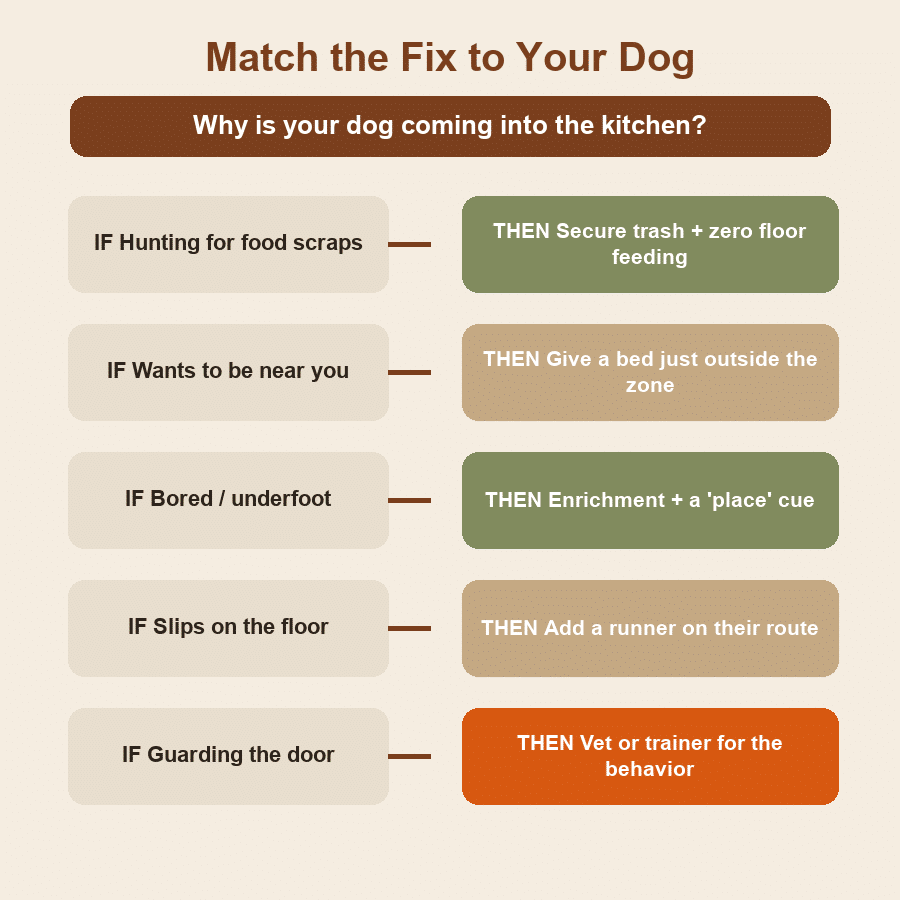
- If your dog comes in for dropped food and scraps, then focus first on removing the payoff — clear the floor, secure the trash, and stop counter-feeding.
- If your dog appears at every meal to beg, then teach and reward a solid “place” cue away from the cooking zone before mealtimes.
- If your dog follows you in just to be near you, then set their bed or mat where they can still see you, so staying out doesn’t mean being left out.
- If your dog is bored and drifts in, then give them a chew or food puzzle at their spot when kitchen activity starts.
- If your dog guards the trash, a bowl, or the doorway with growling or snapping, then don’t push the boundary yourself — work with a qualified trainer or behaviorist on the guarding first.
- If your dog has just eaten something toxic or been near a hot burner and seems hurt, then stop and call your veterinarian or the ASPCA Animal Poison Control Center — safety comes before training.
Do and don’t at a glance
If you remember nothing else, remember these. The left column builds a calm, reliable boundary; the right column quietly teaches your dog that the kitchen pays off or becomes something to fear.
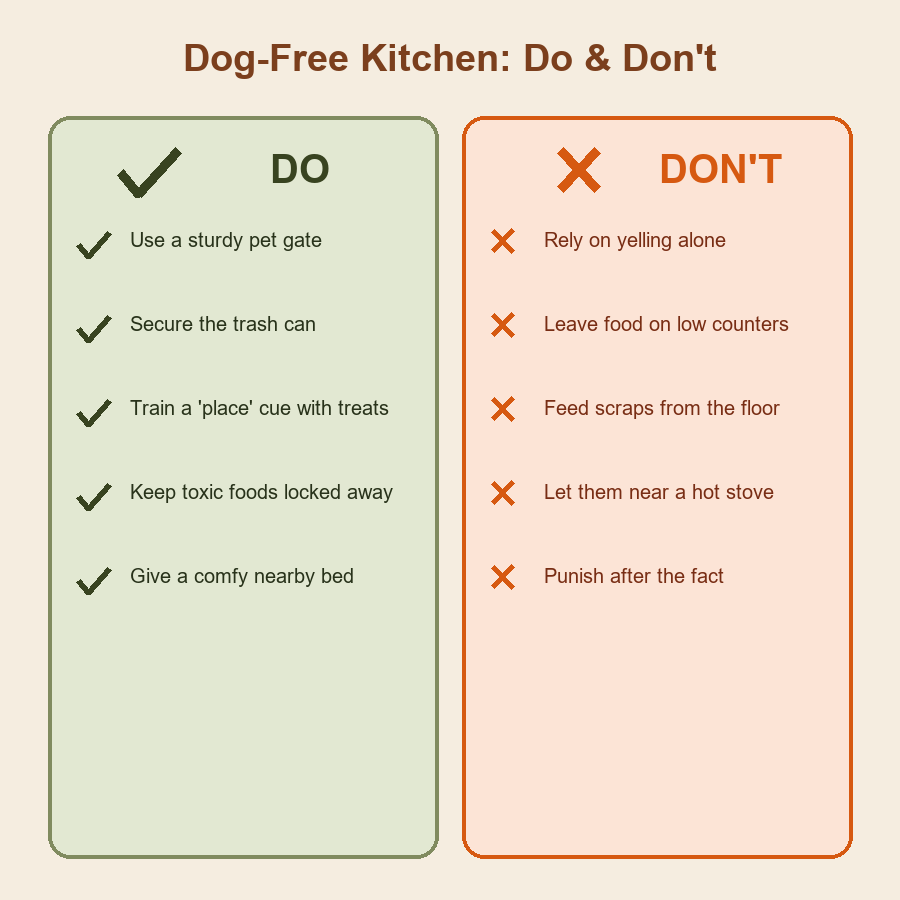
- Do put up a sturdy gate and keep the rule consistent from day one. Don’t leave the boundary open some days and closed others — mixed rules confuse a dog.
- Do teach and reward a comfortable “place” just outside the kitchen. Don’t just shoo your dog out with nothing better to go to.
- Do remove the payoff — clear scraps, secure the trash, stop counter-feeding. Don’t hand out table scraps from the kitchen and expect your dog to stay out.
- Do reward your dog for staying on their spot. Don’t punish, yell at, or scare a dog for crossing the line — the AKC advises against it, and it backfires.
- Do treat toxic food and hot surfaces as safety issues to design around. Don’t rely on “leave it” alone to protect your dog from a dropped grape or a hot stove.
Common mistakes to avoid
- Inconsistent boundaries. Sign: your dog tests the gate or wanders in whenever someone leaves it open. Fix: keep the barrier closed and the rule identical for every member of the household.
- Feeding from the kitchen. Sign: your dog hovers exactly where scraps once fell. Fix: feed only from their own bowl in their own spot, and clear dropped food fast.
- Punishing the dog. Sign: your dog slinks in when you’re not looking or acts anxious near the kitchen. Fix: switch to rewarding the stay — the AKC specifically warns against punishing a dog for crossing a boundary.
- Sending them away with nowhere to go. Sign: your dog drifts back within a minute of being shooed out. Fix: build an appealing station with a bed, a chew, and a clear view of you.
- Leaving the trash accessible. Sign: a tipped bin, shredded packaging, or your dog nosing the cabinet. Fix: use a locking lid or move the can behind a latched door — this is a safety fix, not just a tidiness one.
- Skipping the safety design. Sign: grapes, onion skins, or chocolate wrappers within a dog’s reach, or a dog loose at the stove. Fix: store and bin toxic foods out of reach and keep the dog beyond the doorway while burners are hot.
What most guides get wrong
Most “keep your dog out of the kitchen” articles stop at “buy a gate” — and then wonder why the dog still barges in the moment it’s left open.
- They treat the gate as the whole answer. A barrier buys time, but a dog that’s never taught what to do instead will exploit every open door. The gate and the training have to work together — the AKC’s approach is boundary training, not just a boundary.
- They skip the food payoff. If the kitchen floor still delivers the occasional dropped chip and the trash is still reachable, you’re training against a slot machine. Removing the reward matters more than the height of the gate.
- They reach for punishment. Yelling or startling a dog out of the kitchen can look like it works, but it teaches fear rather than a rule, and the AKC advises against it. A rewarded “place” outlasts a scare every time.
- They forget it’s a safety project, not a tidiness one. The real reason to keep a dog out isn’t crumbs on the floor — it’s hot burners and foods like chocolate, xylitol, onions, and grapes that the ASPCA flags as toxic. Design for the safety problem and the tidiness takes care of itself.
Gear that makes a dog-free kitchen easier
You don’t need much — a reliable boundary and a comfortable spot do most of the work. When you’re comparing options, these buying guides lay out what to look for:
- Pet gates for the living room — for a sturdy, well-fitted barrier that also suits a kitchen doorway.
- Washable rugs for dog owners — for a comfortable, mess-proof station where your dog can settle just outside the kitchen.
Choose based on your doorway width, your dog’s size, and how determined a climber they are — not the flashiest listing. The best setup is the one that stays consistent and the one your dog actually uses.
Final recommendation
Start with the two changes that do the most: put up a consistent boundary at the kitchen doorway, and remove the food payoff by clearing scraps, securing the trash, and feeding your dog elsewhere. Then teach a rewarded “place” just outside the room, make that spot genuinely comfortable, and reinforce the stay until it becomes a habit. Keep it humane — reward what you want instead of punishing what you don’t — and treat the whole thing as a safety project, because hot surfaces and toxic foods are the real reason the kitchen is off-limits. If your dog guards food or has eaten something dangerous, that’s a job for a professional or your vet, not a gate.
For more room-by-room setups and pet-friendly ideas, visit our kitchen ideas hub, and if you’re securing the rest of the house too, see how to pet-proof your living room.
FAQ
What’s the fastest way to keep my dog out of the kitchen?
Combine a physical gate with removing the food payoff. The gate stops the behavior immediately while you teach a rewarded “place” cue, and clearing scraps and securing the trash removes the reason your dog wants in. The gate alone works only until someone leaves it open, so pair it with training and a tidy floor.
Is it cruel to keep my dog out of the kitchen?
No — done right, it’s the opposite. You’re giving your dog a comfortable spot of their own and protecting them from hot surfaces and toxic foods. The key is positive-reinforcement training: reward the stay rather than punishing entry, which the AKC advises against.
My dog ate something off the kitchen floor — what do I do?
If it might be toxic — chocolate, xylitol, onions, garlic, grapes, and raisins are common culprits per the ASPCA — call your veterinarian or the ASPCA Animal Poison Control Center right away. Don’t wait for symptoms and don’t try to treat it at home. This article is about prevention, not treatment.
Do I need a tall gate, or will any barrier work?
Match the gate to your dog. A short step-over gate is fine for a small or non-jumping dog, but a tall, sturdy, latched gate is safer for a big or athletic dog that can jump or push through. If your dog climbs, prioritize height and stability over looks.
How long does boundary training take?
It varies by dog, but consistency matters more than speed. Practicing the “place” cue away from mealtimes, rewarding every success early on, and keeping the rule identical for everyone in the house usually builds a reliable habit over a few weeks. Slipping back to punishment or inconsistent rules is what stalls it.
Sources
- ASPCA — People Foods to Avoid Feeding Your Pets — supports the list of common kitchen foods toxic to dogs (chocolate, xylitol, onions, garlic, chives, grapes, and raisins) and the advice to contact a veterinarian or animal poison control after a suspected toxic exposure.
- Preventive Vet — Pets Starting Fires Happens a Lot — supports the stove and burner hazard, including pets accidentally turning on a burner and the use of knob covers.
- American Kennel Club — Dog Boundary Training — supports positive-reinforcement boundary training to keep a dog out of a room and the guidance not to punish a dog for crossing the boundary.
Last reviewed July 2026.



Write Your Review
No reviews yet. Be the first to share your experience!