
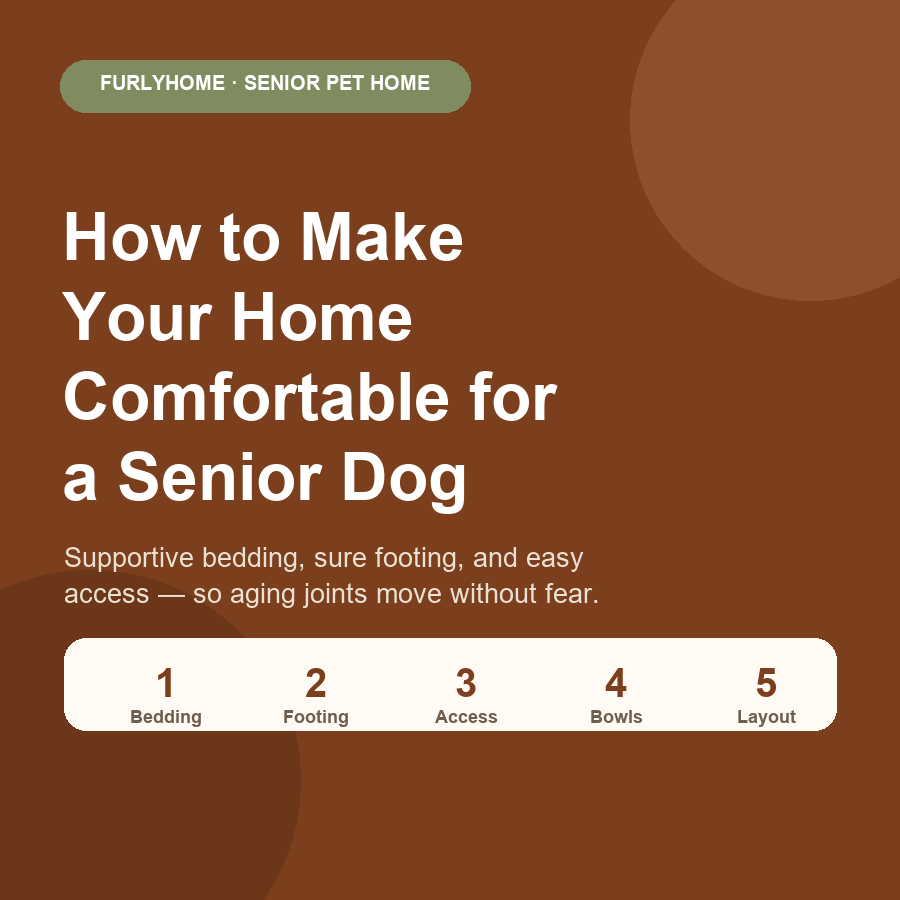
An aging dog rarely needs a new home — just a few thoughtful changes to the one they already know. Small adjustments to bedding, footing, and access take the strain off stiff joints and keep your senior dog moving safely and resting well.
Quick answer
Make your home comfortable for a senior dog by giving them supportive orthopedic bedding in a warm, draft-free spot, adding non-slip rugs or runners over slick floors, and raising food and water bowls to about elbow height so they don’t have to stoop. Add a ramp or low steps to reach the couch, bed, or car, keep everything they use daily on one level, and hold them at a healthy weight. If your dog is limping, reluctant to move, or seems painful, see your veterinarian before assuming it is “just age.”
Safety first
A comfortable home supports an aging dog, but it does not replace veterinary care. Stiffness, limping, difficulty rising, trembling, or reluctance to move can be signs of arthritis or pain that need a real diagnosis. Do not give human pain relievers — many are toxic to dogs. Talk to your veterinarian about any new or worsening mobility problem, and get help right away if your dog cannot stand, cries out in pain, or suddenly can’t use a limb.
Who this is for (and who should see a vet first)
This guide is for owners of an aging but stable dog who is simply slowing down — a little stiff after a nap, hesitant on slick floors, or not quite as eager to jump as they used to be. The changes below are comfort and safety adjustments to the home, not medical care.
- This is for you if: your dog is generally healthy for their age, moves on their own, and you want to remove daily strain, prevent slips, and help them rest better.
- Do these things alongside a vet visit if: your dog has new or worsening limping, stiffness, or trouble rising — the home changes support treatment, they don’t replace a diagnosis.
- Stop and call your vet first if: your dog can’t stand, is dragging or not using a limb, cries out in pain, or has suddenly declined. Comfort gear is not the priority in an emergency — a diagnosis is.
Why home comfort matters more as dogs age
As dogs get older, joints stiffen, muscles weaken, vision and balance fade, and the house they’ve navigated for years slowly becomes an obstacle course. A jump onto the couch that used to be effortless now jars a sore hip. A quick trip across the kitchen turns into a careful shuffle on slick tile. None of this means your dog is “done” — it means the environment needs to change to match the body they have now.
Small, targeted changes to bedding, footing, and access remove daily strain and lower the risk of slips and falls. The goal is simple: let your dog rest, eat, drink, and move around without pain or fear. Veterinary guidance on canine arthritis recommends exactly this kind of practical home adjustment — soft, supportive bedding, raised food and water dishes, non-skid flooring, and ramps or steps to reach favorite spots — alongside veterinary care. And the single most important thing you can do for aging joints is keep your dog at a healthy weight, because every extra pound adds load to joints that are already working hard.
Think of comfort as a system, not a single purchase. A great bed doesn’t help much if your dog slips on the way to it, and non-slip floors don’t matter if the water bowl is two flights up. The steps below build that system one room at a time.
Before you start: read your dog’s day
Before you buy anything, spend a day watching where your dog struggles. The moments that make them hesitate are your to-do list, in priority order.
- Do they slip or splay out on hard floors, especially on turns or when standing up?
- Do they pause and gather themselves before jumping onto the couch, bed, or into the car?
- Do they lower their whole body or stoop to reach the food and water bowls?
- Do they struggle on stairs, take them one at a time, or avoid them entirely?
- Do they circle for a long time, or shift and reposition, before settling to sleep?
- Do they seem to lose you in a dim room, or startle when approached from the side?
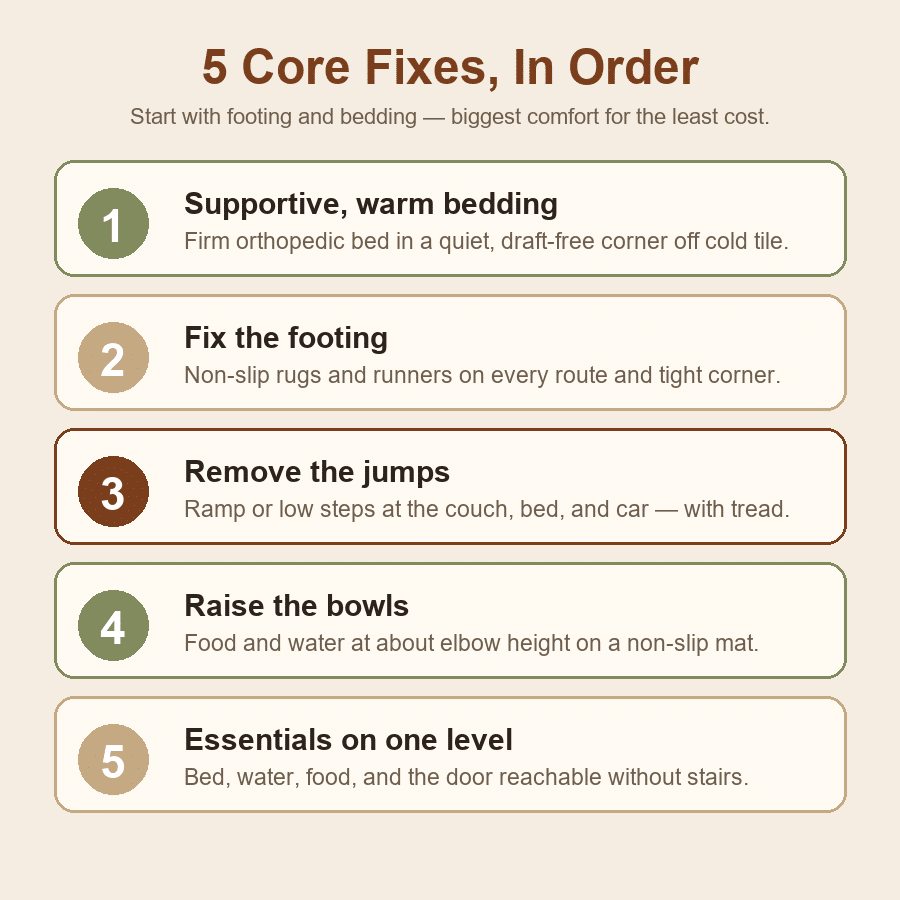
Each hesitation points to one fix below. You don’t need to do everything at once. Start with footing and bedding — they give the biggest comfort gain for the least money and effort — then work through access, feeding, and layout.
Step by step: make each room senior-friendly
1 Give them supportive, warm bedding
What to do: Replace thin or flat beds with a firm orthopedic bed that supports the joints instead of letting your dog sink to the floor underneath. Place it in a quiet, draft-free corner, off cold tile, and out of busy walkways so your dog isn’t stepped over while they rest. Why: Older dogs spend far more of the day lying down, and a supportive surface keeps sore hips and elbows off a hard floor. A warm, sheltered spot helps a stiff dog settle — that’s comfort, not a medical treatment. Success cue: Your dog chooses the bed on their own and settles quickly without circling or repositioning for a long time. Adjust: If they still curl up on cold floor or press against a wall for support, move the bed somewhere warmer and quieter, raise the bolster height, or add a second bed on the level where they spend the day so they never have to travel far to rest.
Bed choice matters here. A bed that’s too soft lets a heavy dog bottom out; one that’s too firm offers no relief. If you’re weighing options or thinking about added warmth, these comparisons walk through the trade-offs: orthopedic vs. memory foam dog beds and a heated dog bed vs. a heating pad.
2 Fix the footing on slick floors
What to do: Lay non-slip rugs, runners, or foam mats along the paths your dog uses most — from the bed to the water bowl, to the door they go out of, and around tight corners where they change direction. Why: Hardwood, tile, and laminate are slippery for aging paws, and a dog with weak or painful legs will brace, splay, or refuse to move on a surface they can’t trust. Veterinary guidance for dogs with osteoarthritis specifically calls out non-slip flooring as a way to give them safer footing. Success cue: Your dog walks the route at a normal pace without splaying, sliding, or hugging the wall. Adjust: Anchor rugs with non-slip pads so they don’t shift underfoot, and make runners wide enough that your dog isn’t tempted to step onto bare floor at the edges. Toe-nail traction helps too — keep nails trimmed and the fur between the pads tidy.
If you’d rather use washable, grippable coverage that stands up to accidents and shedding, our guide to washable rugs for dog owners covers what holds up over time.
3 Remove the jumps and hard climbs
What to do: Add a ramp or low, sturdy steps wherever your dog jumps up or down — the couch, the bed, or the car. Introduce it slowly, luring them across with treats until using it feels natural. Why: Repeated jumping jars sore joints on landing, and a gentle incline lets your dog reach the places they love without the impact. Success cue: Your dog chooses the ramp or steps instead of jumping, even when they’re excited. Adjust: If a steep ramp intimidates them, switch to steps; if steps are hard on the knees, switch to a lower-angle ramp. Non-slip tread on the surface matters as much as the incline. This walkthrough compares the two side by side: dog ramp vs. dog stairs for senior dogs.
4 Raise the food and water bowls
What to do: Raise the food and water dishes so your dog can eat and drink without stooping to the floor. Veterinary arthritis guidance suggests positioning raised bowls at roughly elbow height for the dog. Why: Bending all the way down strains a stiff neck, shoulders, and front legs, and a dog in pain may eat or drink less simply because reaching the bowl hurts. Success cue: Your dog eats and drinks in a relaxed, level stance instead of hunching or bracing. Adjust: Measure to your own dog’s elbow rather than buying a one-size stand, put a non-slip mat under the stand so it doesn’t skate away, and keep a second water station on any level where your dog rests so hydration is never a long trip.
5 Put daily essentials on one level
What to do: Arrange the bed, water, food, and the door your dog uses to go outside so all of it is reachable without stairs. Why: Stairs are one of the hardest challenges for an arthritic dog, and keeping the essentials on one floor spares them repeated climbs throughout the day. Success cue: Your dog can get through a normal day — rest, meals, water, potty breaks — without climbing stairs unless they choose to. Adjust: If stairs are unavoidable, add a runner or non-slip strips to every step, keep the stairwell well lit, and never rush your dog up or down. For a deeper routine on easing sore joints indoors, see how to help a dog with joint pain at home.
A quick room-by-room map
Once the five core fixes are in place, walk each room with fresh eyes. Small tweaks add up.
- Living room: Orthopedic bed in a warm corner, a ramp or steps at the couch, and a non-slip path from the bed to the door. Protecting the sofa with a washable cover also lets your dog rest with you without a stressful “off” every time — see pet-friendly sofa covers.
- Bedroom: If your dog sleeps with you, add steps or a ramp to the bed so they stop jumping down in the dark. A second bed on the floor gives them a supportive choice on stiff nights.
- Kitchen / feeding area: Raised bowls at elbow height on a non-slip mat, water within a few steps, and clear floor space so your dog isn’t maneuvering around chair legs.
- Entry and outside: A runner over slick entry tile, a ramp at any exterior step, and good lighting so an older dog with fading eyes can see the threshold.
- Stairs and hallways: Runners or strips on every step, night lights in dim halls, and nothing your dog has to squeeze past or step over.
Warmth, light, and better rest at night
Aging dogs often sleep more but sleep worse — stiff joints make it harder to get comfortable, and dimmer vision or hearing can leave them unsettled after dark. A few comfort-focused touches help them rest.
- Keep them warm, not hot. A warm, draft-free sleeping spot helps a stiff dog settle. If you use any heating aid, choose one made for dogs with a controlled temperature, and treat it as comfort rather than treatment — never as a substitute for veterinary care for a painful dog.
- Light the path. Low night lights along the route to the water bowl and the door help a dog with fading eyesight move confidently instead of freezing or bumping into things.
- Keep the layout predictable. Dogs losing vision navigate by memory. Leave furniture and bowls where they are, and clear clutter from the floor so nothing new trips them up.
- Approach gently. A dog who hears less can be startled awake. Let them see or smell you before you touch them, especially near their bed.
Weight and gentle movement do the heavy lifting
No amount of gear replaces the two factors that matter most for aging joints: a healthy weight and regular, low-impact movement. Veterinary guidance identifies weight control as the single most important factor in managing canine osteoarthritis — extra pounds add continuous load to sore joints, and even modest weight loss can make a visible difference in how easily your dog moves.
Movement matters too, but the kind changes with age. Controlled, gentle leash walks keep muscles and joints working without the pounding of hard play or long runs. Short and frequent beats long and occasional. Ask your veterinarian what’s appropriate for your dog’s condition, and let their comfort set the pace — a walk that ends with more limping than it started with was too long. Feeding for their life stage supports all of this; our guide to the best food for a senior golden retriever explains how senior formulas differ, and the same principles apply across breeds.
Choose the right approach for your dog
Not every senior dog needs the same setup. Match the fix to what you’re actually seeing:
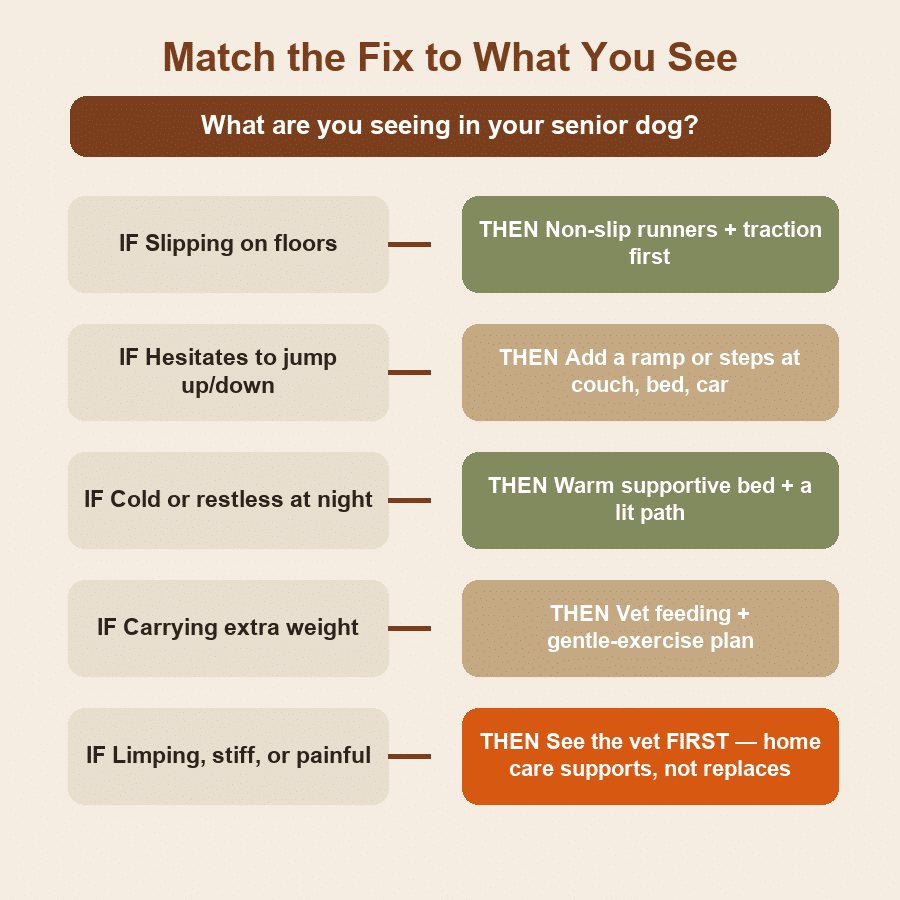
- If your dog mainly slips on floors, then start with non-slip runners and traction before spending on anything else.
- If your dog hesitates to jump up or down, then prioritize a ramp or steps at the couch, bed, or car.
- If your dog seems cold or restless at night, then focus on a warm, supportive bed in a draft-free spot with a lit path.
- If your dog is carrying extra weight, then talk to your vet about a feeding and gentle-exercise plan — it’s the highest-impact change you can make.
- If your dog is limping, stiff, or clearly painful, then book a vet visit first — home changes support treatment, they don’t replace a diagnosis.
Do and don’t: the senior-dog home at a glance
If you remember nothing else, remember these. The left column is what steady, low-cost comfort looks like; the right column is what quietly makes an aging dog’s day harder.
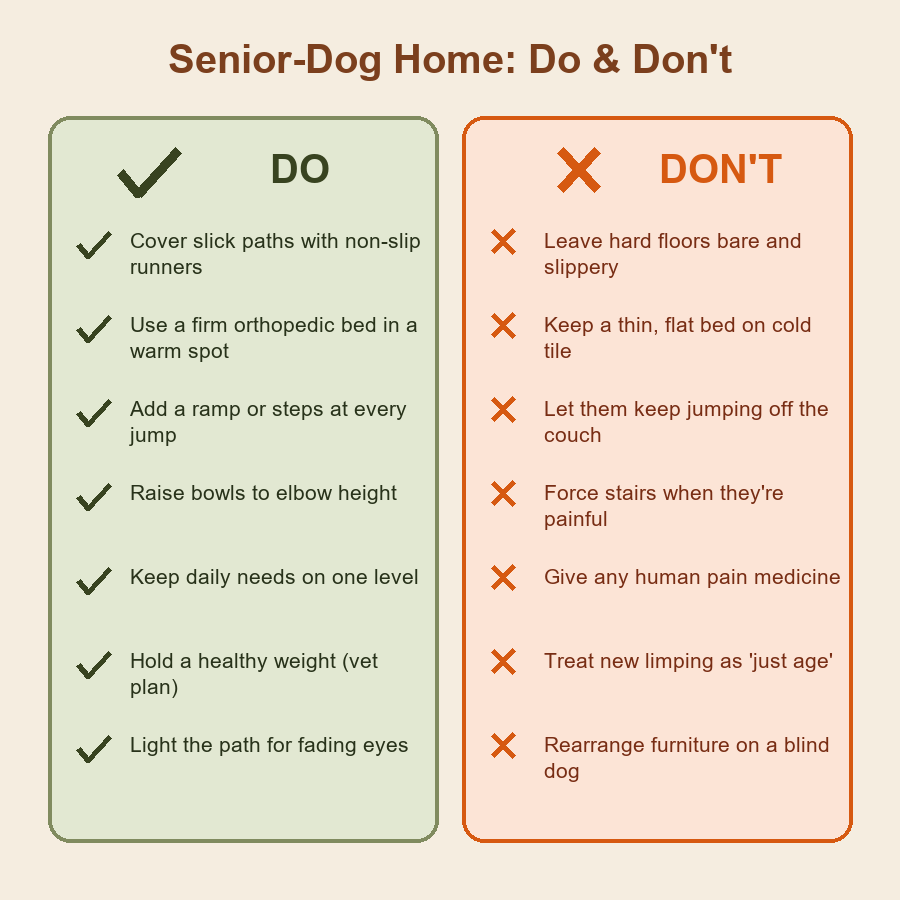
- Do give a firm orthopedic bed in a warm, draft-free spot. Don’t leave a thin, flat bed on cold tile.
- Do cover slick floors with anchored non-slip runners on every route. Don’t leave bare hardwood or tile where your dog braces and slides.
- Do add a ramp or steps and coax your dog to use them. Don’t let a stiff dog keep jumping on and off furniture or into the car.
- Do raise bowls to your own dog’s elbow height on a non-slip mat. Don’t force a sore neck and shoulders to stoop to the floor.
- Do work with your vet on a healthy weight and short, gentle walks. Don’t treat new pain as \”just old age\” or reach for human pain medication.
Common mistakes to avoid
- Leaving slick floors bare. Sign: your dog’s legs slide out from under them, or they refuse to cross a room. Fix: add non-slip runners on every route they use.
- Keeping a thin, flat bed. Sign: your dog sleeps pressed against a wall or on cool tile for support. Fix: switch to a firm orthopedic bed in a warm corner.
- Letting them keep jumping. Sign: a hard landing, a yelp, or a pause before the couch or car. Fix: add a ramp or steps and coax them to use it every time.
- Ignoring weight. Sign: a thickening waistline or a vet noting a rising body-condition score. Fix: ask your vet for a target weight and plan — weight control is the most important factor in managing arthritis.
- Skipping the water math. Sign: your dog drinks less because the bowl is far or low. Fix: add a raised second station on their level.
- Treating pain as “just old age.” Sign: new limping, stiffness, or reluctance to move. Fix: see your vet — arthritis is common and manageable, but it needs a diagnosis.
What most guides get wrong
Most \”senior dog comfort\” articles turn into a shopping list — buy this bed, buy this ramp, buy this heated pad — and skip the parts that actually decide whether your dog moves more easily.
- They lead with products, not with weight and footing. Veterinary guidance is clear that weight control is the single most important factor in managing canine arthritis, and traction on slick floors prevents the falls that gear can’t. Both are nearly free, and both matter more than any single purchase.
- They sell warmth as a treatment. A warm, draft-free spot helps a stiff dog settle — that’s comfort. It is not therapy for arthritis, and no bed or heating pad treats joint disease. Framing it that way delays the vet visit that an actually painful dog needs.
- They treat every senior dog the same. A dog that slips needs footing; a dog that hesitates to jump needs a ramp; a dog that’s overweight needs a vet-guided plan. Buying the whole list at once wastes money and often misses the one change that would have helped most.
- They stop at the purchase. A ramp your dog won’t use and a bed they avoid are just clutter. The measure of success is behavior — your dog choosing the bed, taking the ramp, walking the route without bracing — not the receipt.
A simple senior-dog home checklist
Run through this once a season — needs change as your dog does.
- Firm orthopedic bed in a warm, quiet, draft-free spot (a second bed if they use two levels).
- Non-slip runners on every route, corner, and slick floor; nails and paw fur trimmed for traction.
- Ramp or steps at the couch, bed, and car, each with non-slip tread.
- Food and water bowls raised to elbow height on non-slip mats; a second water station on their level.
- Daily essentials reachable without stairs; runners and lights on any stairs they still use.
- A healthy weight and a vet-approved plan of short, gentle leash walks.
- Night lights and a clutter-free, predictable layout for fading eyes and ears.
- A standing note of any new limping, stiffness, or behavior change to raise at the next vet visit.
When to stop and call your vet
Home comfort is supportive care, not a substitute for veterinary attention. Call your veterinarian if your dog shows new or worsening limping, struggles to rise or lie down, trembles, cries out, stops using a leg, loses appetite, drinks much more or less than usual, or seems suddenly reluctant to move. If you’re unsure whether your dog is hurting at all, this guide helps you read the signs: how to tell if your dog is in pain. And never give human pain medication — many common ones are toxic to dogs; ask your vet what is safe.
Gear that makes a senior-friendly home easier
A few well-chosen items do most of the work. Look for a firm, supportive sleeping surface, and choose any warmth aid that’s safe for use around an older dog. When you’re comparing options, these buying guides lay out what to look for:
- Supportive, sustainable dog beds — for a firm surface that keeps sore joints off the floor.
- Heating pads made for dogs — for gentle, controlled warmth in a resting spot (comfort, not treatment).
Buy based on your dog’s size, mobility, and your vet’s advice — not on the flashiest listing. The best setup is the one your dog actually uses.
Final recommendation
Start with the two changes that cost the least and help the most: cover slick floors with non-slip runners, and work with your vet to keep your dog at a healthy weight. Add a firm orthopedic bed in a warm, quiet corner, then a ramp or steps wherever your dog jumps, and raise the bowls to their elbow height. Keep daily essentials on one level, watch how your dog actually moves, and adjust from there. Above all, treat home comfort as support for veterinary care — not a replacement for it. If your dog is limping, stiff, or clearly hurting, book the vet visit first.
For more room-by-room setups, product comparisons, and senior-care guides in one place, visit our senior pet home hub.
FAQ
What is the single most important change I can make?
Two things tie for first. For the home itself, fix the footing — non-slip rugs over slick floors give an aging dog the traction to stand and walk safely, which prevents falls and takes strain off sore joints. For your dog’s body, keep them at a healthy weight, which veterinary guidance identifies as the most important factor in managing arthritis.
Is a heated bed safe for an old dog?
Gentle warmth can help a stiff dog settle and rest, but choose a product designed for dogs with a controlled temperature, and treat it as comfort rather than medical treatment. If your dog can’t move away from the heat on their own, don’t leave it running unattended. When in doubt, ask your vet.
Should I stop my senior dog from using stairs?
Not necessarily, but make them safer. Keep daily essentials on one level so climbing is optional, add a runner or non-slip strips to each step, light the stairwell, and never rush your dog. If stairs cause obvious pain or your dog refuses them, talk to your vet.
How do I know if it’s arthritis and not just aging?
You can’t tell for sure at home — stiffness, limping, difficulty rising, and reluctance to move all warrant a vet visit. Arthritis is common in older dogs and manageable with the right care, but it needs a proper diagnosis rather than a guess.
How much should I exercise a senior dog with stiff joints?
Favor short, frequent, gentle leash walks over long or high-impact activity, and let your dog’s comfort set the pace. If a walk leaves them more sore than when they started, it was too much. Ask your veterinarian for a plan matched to your dog’s condition.
Sources
- VCA Animal Hospitals — Arthritis in Dogs — supports orthopedic/supportive bedding, raised food and water bowls at elbow height, non-skid flooring, ramps and steps, weight control, and controlled exercise as home care for arthritic dogs.
- American College of Veterinary Surgeons — Osteoarthritis in Dogs — supports weight management as the most important factor, controlled leash activity, and non-slip flooring for dogs with osteoarthritis.
Last reviewed July 2026.