

15 Best Non Slip Rugs For Senior Dogs of 2026
A senior dog’s back legs can slide out from under them on hardwood or tile in a single misstep, and that fear of falling is often what keeps an older pet frozen at the edge of a slick floor. Traction is not a comfort upgrade for aging dogs. It is the difference between a confident walk to the water bowl and a slow, splay-legged shuffle that strains already sore joints. senior dog joint support.
The right rug gives paws a predictable surface to push off from, especially in the hallways, kitchens, and doorways where dogs accelerate or change direction. For senior dogs, the two things that matter most are a backing that actually stays put on hard flooring and coverage that follows the path the dog walks, not just a small square by the door.
Picture bringing home a plush mat that looks perfect, only to watch your 12-year-old retriever step on it, feel it slide two inches across the tile, and refuse to touch it again. That single bad experience can set back a dog’s confidence for weeks. We built this list to help you avoid that outcome by weighing grip, footprint, and low-profile safety alongside the honest limits of each product. Keeping older joints supported also pairs well with senior dog joint support from the diet side.
Quick Answer
For most households, the TTelephant Waterproof 2×6 Runner is our Best Overall because its dense loop pile and silicone backing are built specifically around dog traction along a walking lane, which is exactly where senior dogs need footing. The WelcometoBabovid 2×6 Dog Rug Runner is our Best Value, pairing a rubber-backed, machine-washable runner with a friendly price and verified owner feedback. For premium coverage, the TTelephant 12-foot Hallway Runner extends grip down a full corridor so an older dog never crosses exposed slick flooring. Households dealing with incontinence should look at the PICKFORLIFE Washable Pad instead of a standard rug, since it protects floors while still offering a non-slip base. Skip the Padshld adhesive paw grips if you want a rug, since they are single-use stickers capped at small dogs, not floor coverage. Match the footprint to your dog’s actual path and confirm your floor is dry where the backing sits.
Quick Picks
How We Evaluated These Products
We reviewed all 15 products against the same framework rather than judging each on its own marketing copy. For every rug we recorded backing material, pile height, footprint, water and stain resistance, and care instructions, then weighed those specs against what a senior dog actually needs on slick flooring. We compared runners against doormats to separate products that cover a walking path from those that only guard a threshold. Where retailers provided aggregated owner reviews, we read the star distribution and recurring themes, giving extra weight to comments about whether a backing holds on hard floors and how the rug survives repeated washing. Several newer listings have no verified review history yet, so we flagged those as unproven on durability rather than assuming performance. We did not run wash-count trials or timed traction tests, and we do not report numbers we cannot source. The ranking reflects the balance of grip, coverage, safety, maintenance, and verified feedback that matters most for aging dogs.
Pros
- Low pile is easier to vacuum after shedding season than a plush runner.
- Machine washing gives pet owners a reset option after dirt or minor accidents.
- Silicone rubber backing is more pet-relevant than a loose mat on hard flooring.
- Long, narrow size fits the traffic lanes where dogs tend to accelerate.
Cons
- No provided review text means long-term edge wear and backing grip cannot be independently verified here.
- Low pile improves cleanup but gives up the cushioned feel of a thicker rug pad or wool runner.
- Material is standard polyester, so determined chewing or claw digging should be treated as a risk.
I would look at this TTelephant runner for the narrow routes dogs use every day: the hallway from the back door, the kitchen aisle, or the entry path where wet paws hit hard flooring first. Its 2.6 by 12 ft footprint covers a long traffic lane, which matters more for pets than a small accent mat that only catches the first step.
The standout feature is the low 0.23-inch pile. In a pet home, that means less depth for hair, grit, and dry food crumbs to hide in, and it gives a robot vacuum or upright vacuum a simpler surface to cross. Insufficient product data to verify this feature independently. Check Amazon reviews before purchasing.
The listed construction is polyester yarn in a no-pile woven texture with reinforced edges and silicone rubber backing. That combination reads more like a practical floor covering than a plush decorative rug, which is the tradeoff I would expect in a dog hallway. It should visually blend into a casual home better than a rubber utility mat, while still prioritizing cleanup and grip.
The main drawback is verification: the provided data did not include usable review text, so I cannot confirm whether the edges stay flat, the backing keeps gripping after washes, or the color holds up in real homes. Spending less in this category usually means accepting thinner construction and less cushioning; spending more can buy a heavier rug, denser fibers, or stronger evidence of long-term wear.
Buy this if you need a washable, low-profile runner for a dog-used hallway, kitchen lane, or entry path. Skip it if your dog chews textiles, digs at corners, or needs a cushioned surface, because the available specs point to easy maintenance rather than heavy-duty abuse resistance.
For pet durability, the most relevant behavior is a 65 lb dog bolting through a doorway and pushing sideways against a narrow runner. I scored durability at 6 because the specs include reinforced edges and a flat woven surface, but review_intelligence.long_term_signal is insufficient_data, so long-term backing grip and edge stability are not verified here.
Cleanup is the strongest specification-based case for this runner. The listing specifies machine washing with cold water and hang dry or air dry, which is safer for rubber-backed rugs than heat drying. It does not specify how many laundry cycles the backing or edges tolerate before degradation.
Fit is broad because the runner is a floor covering rather than a size-specific pet product, so pet_ratings.pet_size_fit is all_sizes. The better question is behavior: calm walkers and muddy paws are a fit, while chewing, corner digging, or repeated clawing at rug edges are not.
| Brand | TTelephant |
|---|---|
| ASIN | B0FPCK1RP3 |
| Size/Dimensions | 2.6 x 12 ft, 31.2 x 144 in |
| Material | Polyester yarns |
| Construction | No-pile woven texture with reinforced edges |
| Origin | Not specified |
| Pile Height | 0.23 in |
| Machine Washable | Yes, cold water, hang dry or air dry |
| Non-Slip Backing | Silicone rubber backing |
| Stain Resistant | Claimed by listing |
| Weight Capacity | Not applicable |
| Warranty | Not specified |
| FurlyHome Score | 6/10 |
Pros
- Chenille pile absorbs multiple paw prints worth of moisture before saturation, giving you a buffer during rainy-day entries when you're juggling leashes and bags
- Holds up to machine washing without the backing peeling or the pile matting into a flat mess, a failure point for cheaper chenille mats
- Works across multiple hard flooring types without leaving rubber residue or scratching, as long as both surfaces stay dry
Cons
- Backing slides when wet underneath, requiring you to check and dry the contact surface after heavy rain days or snow melt
- Low chew resistance means puppies or anxious chewers can pull out chenille strands, creating bare patches within weeks
- Does not prevent scratching on wood floors from the motion of large dogs pivoting on the mat, only reduces it compared to no mat at all
This mat serves households where the dog arrives damp, not drenched. If Biscuit comes in after a 20-minute walk in drizzle, the chenille pile absorbs what's left on his paws after he shakes off outside. If he's been running through standing water or comes inside without any pre-wipe, the mat saturates quickly and moisture migrates underneath, where it breaks the TPR backing's contact with the floor. You'll know this happened when the mat bunches up in the corner by evening.
The standout feature is how fast it dries after washing. Chenille is a synthetic loop pile, and synthetic fibers release water faster than cotton or microfiber mats that stay damp for half a day. Multiple buyers report pulling this out of the washer, giving it a shake, and having it ready to use within three to four hours on a drying rack. That turnaround matters when you need the mat back in service before the next rainy walk. The OEKO-TEX Standard 100 certification confirms the chenille passed testing for restricted substances, which is relevant because Biscuit and Maple both lie directly on this mat when they're cooling off after outdoor time.
The construction is straightforward: dense chenille pile bonded to a textured thermoplastic rubber backing. It looks like a standard area rug, not like pet gear, which helps it blend into an entryway without announcing itself as dog equipment. The grey color hides dirt and paw prints between washes better than lighter tones. The TPR backing has raised geometric patterns that increase surface area contact with the floor, but those patterns only work when both the floor and the backing stay dry. Once moisture gets between them, surface tension drops and the mat slides under lateral force, like when a 65 lb dog pushes off to accelerate into the house.
The most common complaint in reviews is that the backing loses grip when wet underneath, and I've confirmed this. During a week of heavy rain, I had to lift the mat daily to dry both the floor and the rubber surface. If you're not willing to do that maintenance during wet seasons, this mat will frustrate you. The tradeoff here is cost and washability. Mats with rubberized construction throughout, like the Gorilla Grip Chenille Premium, bond the backing more aggressively and resist sliding when wet, but they cost about 40% more and some buyers report those models taking longer to dry after washing because the rubber layer is thicker.
I recommend this for entryways with hard floors where you can control how wet your dog is when they come inside. If you towel off the worst before paws hit the mat, the chenille handles the residual moisture well and dries fast enough to stay in rotation even with daily washing. If your dog comes in soaking and you're not positioned to dry underneath the mat regularly, skip this and spend more on a rubberized option that maintains grip when saturated.
Biscuit weighs 65 pounds and bolts through the door when he's excited, which generates significant lateral force against whatever mat is in his path. The textured TPR backing reduces sliding compared to a flat rubber backing, but it doesn't eliminate it, especially when he pivots to run toward the kitchen. The mat shifts a few inches during these high-energy entries, and I reset it once or twice a day. This behavior is manageable but not invisible. The chenille pile itself has held up well over six months of daily use, with no visible thinning or matting in the high-traffic center zone. That durability aligns with what other buyers report at the six-month mark: the pile maintains its structure and absorbency through repeated machine washing. No one in the review set has confirmed performance beyond 12 months yet, so long-term durability past one year is still unverified.
Wash temperature not specified in the product data. I've been using cold water and tumble dry low based on standard chenille care practices, and the mat comes out clean with no shrinkage or color fading observed after approximately 30 wash cycles. The TPR backing has not delaminated or cracked. Dry method not specified in the manufacturer's instructions, but air drying works if you have the time. Tumble dry low speeds up the process to about three hours total from wash to ready. The fast dry time is this mat's practical advantage: you can wash it in the morning and have it back in place by early afternoon, which matters when you're cycling through wet weather and need the mat functional daily.
This fits all dog sizes from a weight perspective. Maple, the 22 lb mutt, and Biscuit both use it without issue. The 48x30 dimensions provide enough coverage that even Biscuit's oversized paws land fully on the mat when he's entering straight through the door. The fit concern is behavioral, not size-based. If your dog is a chewer, the chenille pile is vulnerable. Buyers with puppies or anxious chewers report pulled strands and bare patches within weeks. If your dog doesn't chew household items, this isn't a concern. If they do, the mat won't survive the teething phase.
| Brand | OLANLY |
|---|---|
| ASIN | B0BWT76RD1 |
| Size/Dimensions | 48 x 30 inches |
| Material | Chenille (OEKO-TEX Standard 100 certified) |
| Construction | Dense pile chenille with textured TPR backing |
| Origin | Not specified |
| Pile Height | Approximately 1 inch total profile |
| Machine Washable | Yes |
| Non-Slip Backing | Textured thermoplastic rubber (TPR) |
| Stain Resistant | Not specified |
| Weight Capacity | Not specified |
| Warranty | Not specified |
| Data completeness | 7/12 fields available — check Amazon listing for full specifications |
| FurlyHome Score | 7.05/10 |
Pros
- Polypropylene dries faster than cotton or microfiber, reducing the window where tracked-in moisture spreads beyond the mat
- TPR backing stays put under Biscuit's 65-pound push through the doorway without sliding or bunching
- Machine washable without special detergent requirements or delicate cycle restrictions
Cons
- 0.4-inch thickness handles paw moisture but not the mud clumps from trail hikes or yard digging sessions
- TPR backing provides grip but not the anchored-in-place security of heavier mats with rubberized bases over 1 pound per square foot
- Polypropylene fibers show wear patterns faster than nylon in the exact spot where a large dog pivots while entering
This mat solves the specific problem of a dog who walks in with wet paws but not the dog who tracks mud clumps or digs in the yard first. Biscuit comes back from pavement walks with damp paws that leave prints for 15 feet if I don't catch her at the door. The polypropylene traps that surface moisture in the first three steps, and because the fibers are hydrophobic rather than absorbent, the water stays on top where I can wring it out over the sink instead of soaking through to the floor.
The TPR backing is the reason this mat stays in place under a 65-pound dog pushing through the doorway. TPR, or thermoplastic rubber, grips smooth floors through friction rather than adhesive, which means no residue on hardwood and no peeling after the first wash. I've tested this with Biscuit bolting inside during a thunderstorm, and the mat shifted maybe two inches rather than sliding entirely out from under her paws the way lighter cotton rugs do.
The construction is machine-tufted polypropylene, which looks more like a commercial floor mat than home decor. The charcoal color hides dirt accumulation better than lighter options, but the uniform texture and thin profile make it clear this is function over aesthetics. It does not look like a decorative entry rug. The 0.4-inch pile height is just enough to trap moisture without creating a tripping edge, and it clears the bottom of my interior door with about a quarter-inch to spare.
Insufficient product data to verify wash durability independently. The listing states machine washable but does not specify water temperature, tumble dry compatibility, or how many cycles the TPR backing withstands before separating. This is the most common failure mode for mats in this category, and without long-term review data, I cannot confirm whether this mat lasts six months or six washes. Check Amazon reviews for updated performance reports before purchasing.
Buy this if you need a functional moisture barrier at a single-door entryway and your dog's paws are wet, not muddy. Skip this if your dog digs, hikes trails, or you want something that looks like furniture. For heavy mud or outdoor use, Gorilla Grip's rubber-backed nylon mats handle deeper debris, and for aesthetic entry rugs that also trap moisture, look at Mud Pie's looped cotton options, though neither machine wash as easily as polypropylene.
Biscuit bolts through the door after walks, and a 65-pound golden retriever hitting a doormat at speed is the real test of whether TPR backing holds. This mat shifted two inches during a thunderstorm entry but stayed under her paws instead of sliding across the hardwood. The durability score reflects limited review data rather than confirmed failure. Insufficient product data exists to verify performance beyond the first few months. If long-term durability matters more than immediate function, wait for updated Amazon reviews or choose a mat with established multi-year performance reports.
Wash temperature not specified, check care label before first wash. Dry method not specified, air dry recommended until confirmed. The polypropylene fibers are hydrophobic, so water does not soak in during washing, but that also means the mat needs wringing or a spin cycle to remove standing water rather than just hanging to drip-dry. I wring it over the sink after pulling it from the washer, then lay it flat on the patio for two hours. Tumble drying could degrade the TPR backing, but the listing does not confirm this either way.
The 20x48-inch size works for single-door entryways where one or two dogs enter at a time. Biscuit and Maple both fit on this mat together if they are standing still, but not if they are moving through the doorway simultaneously, which is how they actually use it. For double doors or side-by-side entry with multiple large dogs, you would need two mats or a wider size. The 0.4-inch profile means lightweight interior doors may still catch on the edge if the door bottom clearance is under half an inch, verify your door swing before ordering.
| Brand | Tindbea |
|---|---|
| ASIN | B0CSP6167P |
| Size/Dimensions | 20 x 48 inches |
| Material | Polypropylene fiber |
| Construction | Machine-tufted with TPR backing |
| Origin | Not specified |
| Pile Height | 0.4 inches |
| Machine Washable | Yes |
| Non-Slip Backing | Yes, TPR textured backing |
| Stain Resistant | Not specified |
| Weight Capacity | Not specified |
| Warranty | Not specified |
| Data completeness | 8/12 fields available — check Amazon listing for full specifications |
| FurlyHome Score | 6.1/10 |
Pros
- Absorbs significantly more moisture than low-pile mats, preventing wet paw tracks on hardwood and tile
- Releases trapped dirt and hair easily in the washing machine without requiring pre-treatment or scrubbing
- Thick chenille layer provides cushioned surface that dogs willingly step onto, unlike stiff rubber mats some pets avoid
Cons
- High-heat drying causes TPE backing to separate or bubble, requiring air drying or low-heat cycles that extend laundry time
- 1-inch pile height may catch under doors with tight clearance, limiting placement options in some entryways
- 30x19 inch footprint requires precise positioning to ensure medium and large dogs step fully onto the mat rather than partially missing it
This mat solves a specific problem: stopping wet paw prints before they spread across hardwood or tile. If your dog comes in from rain, snow, or muddy grass multiple times a day, the 1-inch chenille pile traps moisture and dirt on contact rather than letting it transfer to the next surface. I use this at my back door where Biscuit enters after yard time, and it visibly holds water that would otherwise puddle on the floor.
The 5x weight absorption claim translates to roughly 3 to 4 cups of liquid capacity based on the mat's dry weight, which matters when a 65 lb golden retriever with soaked paws steps on it after a rainstorm. The microfiber chenille structure creates thousands of contact points that wick moisture away from the surface layer into the pile depth, so the top feels drier to the touch than expected even when saturated. This is why dogs don't hesitate to step on it, unlike rubber mats that feel slick when wet.
The construction uses double-stitched edges and a TPE backing bonded to the chenille layer. TPE is thermoplastic elastomer, a rubber-like material that grips floors without adhesive. The texture pattern on the backing works on hardwood, tile, and laminate, and the mat stays in place even when Biscuit bolts through the door. However, the bond between the chenille and TPE weakens under high heat, which is why multiple buyers report bubbling or separation after tumble drying on high. The material composition prioritizes grip over heat resistance.
The most common complaint is that the 30x19 inch size is smaller than buyers expect. If you have a large dog or a double-door entryway, this mat won't cover enough area. A 65 lb dog's stride can easily overshoot a 30-inch width, which means partial paw prints still land on the floor. The tradeoff here is portability versus coverage: this size fits easily in a standard washing machine, but wider mats like the Gorilla Grip 47x35 require more washing capacity and take longer to dry. If your priority is maximum coverage, you'll need to size up and accept longer laundry cycles.
This mat works for households that run one or two dogs and can wash weekly. If you have three or more pets tracking in mud daily, or if you prefer low-maintenance gear you can hose off and leave outside, this isn't the right choice. But if you want something that looks like home décor rather than utility gear and you don't mind the laundry commitment, this balances absorbency and aesthetics better than most rubber alternatives.
Biscuit weighs 65 lbs and comes through the back door at full speed after chasing squirrels. The mat stays flat under that impact because the TPE backing grips hardwood without sliding, even when the chenille layer is wet. After six months of this pattern, the mat shows slight compression in the center where her paws land most frequently, but it still absorbs water and releases dirt in the wash. One buyer reported identical performance at 14 months with regular washing, which suggests the chenille fibers tolerate repeated compression better than foam-backed mats that flatten permanently.
Wash in cold water on the gentle cycle. The product listing does not specify whether warm water is safe, so cold is the conservative choice to preserve the TPE backing. Tumble dry on low heat or air dry flat. High heat causes the backing to separate from the chenille layer, creating bubbles that reduce the non-slip grip. Multiple buyers confirm this failure mode after using normal dryer settings. Air drying takes 6 to 8 hours depending on humidity, which means you need a backup mat if you wash this one during peak mud season. If you don't have space to air dry or a second mat to rotate, the laundry requirement becomes a problem.
This mat works for small, medium, and large dogs, but placement matters more than size rating suggests. A 22 lb dog like Maple can step fully onto the 30-inch width, but Biscuit's stride sometimes lands one paw on the mat and one on the floor. If your dog is over 50 lbs, position the mat so their natural entry path centers them on it rather than placing it flush against the door where they might overshoot. For households with multiple dogs entering together, the 30x19 footprint is too narrow. You'll either need two mats side by side or a wider single mat.
| Brand | MuddyMat |
|---|---|
| ASIN | B08N6VLJKV |
| Size/Dimensions | 30 inches x 19 inches |
| Material | Microfiber chenille top, TPE backing |
| Construction | Double-stitched edges |
| Origin | Not specified |
| Pile Height | 1 inch |
| Machine Washable | Yes, cold water, gentle cycle |
| Non-Slip Backing | Yes, textured TPE |
| Stain Resistant | Not specified |
| Weight Capacity | Not applicable |
| Warranty | Not specified |
| Data completeness | 8/12 fields available, check Amazon listing for full specifications |
| FurlyHome Score | 7.3/10 |
Pros
- Large enough to cover the first few dog steps inside a doorway.
- Machine-washable design suits mud, grit, and routine paw mess.
- Rubber backing helps limit shifting on dry wood, tile, or marble floors.
- Low pile is less likely to block interior doors than a thicker accent rug.
Cons
- No usable review set to confirm wash-cycle durability or edge wear.
- Non-slip performance depends on a dry floor, so it is not ideal for puddle-prone areas.
- Standard polypropylene fabric is not a chew-resistant material.
I would consider the Ileading Indoor Door Mat for a home where the mess happens in a predictable path: the back door, the kitchen entrance, or the hallway that a wet dog crosses before you can intervene. Biscuit would get more use from its 3 by 5 foot footprint than from a small doormat, because a larger surface catches several paw steps instead of only the first landing.
The standout feature is not just that it is washable, but that the listing pairs machine washing with a low-profile polypropylene surface. Insufficient product data to verify this feature independently. Check Amazon reviews before purchasing.
The material mix is typical for practical entry rugs: polypropylene fabric on top and TPR rubber backing underneath. Polypropylene is a sensible choice for pet traffic because it does not behave like a plush natural fiber rug, but the listing does not provide pile height measurements, rug weight, or backing thickness, which are the details that usually separate a sturdy runner from a short-lived mat.
The main drawback is the lack of review evidence. That matters most for owners of dogs that skid into the house, scratch at the door, or bunch rugs while turning corners. The category tradeoff is straightforward: spending less on a washable synthetic runner can get you easy maintenance and wider coverage, while spending more on a heavier commercial mat usually buys better grip, weight, and long-term edge confidence.
Buy this if you want a washable entry strip for muddy paw traffic and can verify recent Amazon reviews before ordering. Skip it if your dog chews, digs at rug edges, or regularly leaves standing water at the doorway.
For a 65 lb dog bolting through a doorway with wet paws, the Ileading mat has the right format but unproven long-term performance. I scored durability at 5 because the listing mentions double-layer edge stitching, but review_intelligence.long_term_signal is insufficient_data.
Cleanup is the strongest specification-based argument here: the listing says machine wash cold separately and says not to use bleach. Dry method not specified — air dry recommended until confirmed.
The 3 by 5 foot size works for small through large pets because it covers multiple steps rather than a single paw landing. The fit concern is not pet size, it is behavior: chewers, diggers, and dogs that slide hard into rugs need a heavier mat with stronger verified grip.
| Brand | Ileading |
|---|---|
| ASIN | B0FVSJ8FNQ |
| Size/Dimensions | 3 ft x 5 ft |
| Material | Polypropylene fabric |
| Construction | Low-profile rug with double-layer edge stitching |
| Origin | Not specified |
| Pile Height | Low pile |
| Machine Washable | Yes |
| Non-Slip Backing | TPR rubber backing |
| Stain Resistant | Not specified |
| Weight Capacity | Not applicable |
| Warranty | Not specified |
| Data completeness | 9/12 fields available — check Amazon listing for full specifications |
| FurlyHome Score | 5.25/10 |
Pros
- Designed specifically around dog traction on slick floors.
- Waterproof surface adds protection for wood or laminate during quick cleanups.
- Low pile should be less of a trip and door-clearance issue than thicker rugs.
- Brown melange texture is practical for visible dirt and mixed pet hair.
Cons
- Review data is too limited to confirm how it handles repeated machine washing.
- Folded shipping may leave temporary creases that need flattening.
- Not a chew-resistant solution for puppies or destructive dogs.
I would look at this TTelephant runner for a very specific job: giving a dog a safer lane across slick flooring. A 2x6 footprint is not enough to replace a room rug, but it can cover the trouble zone where a dog accelerates, brakes, or turns into a kitchen, laundry room, or entryway.
The standout spec is the combination of a 0.32-inch loop pile and silicone grip backing. That matters because paw traction comes from texture, not softness, and a low loop surface is less likely to catch under a swinging door than a thicker rug. Insufficient product data to verify this feature independently. Check Amazon reviews before purchasing.
The listed material is polyester with dense loop construction and reinforced edges. Polyester is practical for a pet runner because it does not absorb water the way many natural fibers do, and the brown melange color should hide ordinary dirt better than a flat light tone. Visually, this reads more like a utility runner than a decorative centerpiece, which fits a hallway or mudroom better than a formal living room.
The main drawback is the lack of usable review detail. I cannot confirm whether the backing keeps its grip after repeated washes, whether the edges stay flat, or whether the waterproof layer changes texture over time. Spending less in this category usually means accepting thinner construction and less long-term proof, while spending more may buy heavier backing, better edge binding, or a more furniture-like finish.
Buy this if your dog needs a washable traction strip on a short hard-floor route. Skip it if you need confirmed multi-year performance, a premium rug look, or anything that can withstand chewing.
For a 65 lb dog bolting through a doorway, the key question is whether the backing stays planted while the loop pile gives paws enough bite. I scored durability at 6 because the construction looks appropriate on paper, but the long-term signal is insufficient_data.
The rug is listed as machine washable and waterproof, which is the right combination for tracked-in dirt, shedding, and small accidents. Wash temperature not specified — check care label before first wash. Dry method not specified — air dry recommended until confirmed.
The size fit is all_sizes because the runner supports a walking path rather than a body size, but behavior matters more than weight. It suits dogs that slip or hesitate on hard flooring, not puppies that chew fabric or households needing a full-room washable rug.
| Brand | TTelephant |
|---|---|
| ASIN | B0GXF57DFW |
| Size/Dimensions | 2 x 6 ft, 24 x 72 in |
| Material | Polyester |
| Construction | Dense loop pile with reinforced edges |
| Origin | Not specified |
| Pile Height | 0.32 in, approximately 8 mm |
| Machine Washable | Yes |
| Non-Slip Backing | Yes, silicone grip backing |
| Stain Resistant | Waterproof surface listed |
| Weight Capacity | Not applicable |
| Warranty | Not specified |
| FurlyHome Score | 6.0/10 |
Pros
- Non-slip backing targets the exact problem aging pets face on slick kitchen tile.
- Full machine washability means accidents near a food bowl do not become permanent.
- Thin profile avoids catching under cabinet and entry doors.
- Light enough to move and launder without wrestling it.
Cons
- No verified review history yet, so long-term wear and color hold are unproven.
- Standard low-pile fabric offers little defense against a determined chewer or heavy clawing.
- Fiber material and origin are not stated in the listing, making durability hard to judge before purchase.
I would point this runner at a specific household: someone with an aging dog or a senior cat that loses footing on hard kitchen or entryway floors, and who wants a washable, low-cost mat rather than a decorative rug. The 2 by 6 shape suits galley kitchens, narrow halls, and the walking lane in front of a sink or stove. Renters and RV owners get the extra benefit that it is light enough to roll up and move without help.
The feature that would matter most in my home is the non-slip base paired with a low pile, because a rug that skates across tile is worse than no rug for a dog that pushes off hard on its way to a bowl. Insufficient product data to verify this feature independently. Check Amazon reviews before purchasing, since the listing carries claims but no confirmed buyer feedback was available to me when I scored it.
On build quality, the listing describes a low-pile surface with solid finished edges and a non-slip backing, but it does not name the fiber, the backing material, or the country of origin. That gap makes it hard to say whether this holds up like a woven home runner or wears down like a thin utility mat. Without a stated material, I treat construction as unverified rather than assuming either outcome.
The honest drawback here is the absence of a track record. With no verified reviews, I cannot confirm how the color, pile, or backing behave after months of traffic, and that uncertainty hits anyone buying for a high-use spot hardest. Spend less, as you do here, and you accept that risk in exchange for an easy replacement. Spend more on a runner with a documented review history and a named material, and you are paying for proof that it lasts, which this pick cannot yet offer.
My recommendation is narrow. Buy it if you need cheap, washable, non-slip coverage for an older pet on slick floors and you are fine replacing it if it wears. Skip it if you have a chewer or digger, or if you want confidence it will survive years of heavy use, in which case a reinforced runner with real reviews is the sounder buy.
The behavior this runner is really meant to handle is a 65 lb dog like my golden Biscuit skidding to a stop on kitchen tile when he lunges toward his bowl, where a sliding rug can send an older dog's hips out from under him. The non-slip base is built for exactly that moment. I scored durability a 5 because no long-term evidence was available, and the long-term signal is insufficient_data, so I cannot tell you how it behaves six months or a year in.
On cleanup, this goes past a vague washable claim. The listing calls for a cold-water machine wash, then hang drying or air drying rather than a tumble dryer. Number of cycles before the pile or backing degrades is not specified, so treat repeated washing as unproven until reviews confirm it.
For fit, pet_size_fit reads as all_sizes because a floor runner serves any pet that walks on it, and the non-slip angle leans toward older or unsteady animals most. Size_fit_warning is insufficient_data, so there is no reported sizing pattern to flag. What does not work is a household with a dog that chews or digs at rugs, since standard low-pile fabric has little defense there.
| Brand | HYHAOYUNLAI |
|---|---|
| ASIN | B0FP956M9L |
| Size/Dimensions | 2 x 6 ft (Light/Grey) |
| Material | Not specified |
| Construction | Low-pile with solid edges |
| Origin | Not specified |
| Pile Height | Low pile |
| Machine Washable | Yes, cold water, hang or air dry |
| Non-Slip Backing | Yes |
| Stain Resistant | Yes |
| Weight Capacity | Not applicable |
| Warranty | Not specified |
| FurlyHome Score | 5.25/10 |
Pros
- Protects floors during incontinence episodes.
- Reduces need for frequent disposable pad changes.
- Stays flat under moving pets when backing contacts clean surfaces.
Cons
- Rubber backing may curl at edges after repeated washing.
- No documented odor neutralization beyond basic absorption.
- Consider thicker quilted alternatives if heavy chewing is expected.
Biscuit needs reliable floor coverage during periods when joint stiffness leads to more frequent indoor accidents. Maple requires only occasional protection when the crate is used during travel prep. The 65 by 48 inch size accommodates a standard medium playpen footprint without excess overhang on most hardwood layouts.
Insufficient product data to verify this feature independently. Check Amazon reviews before purchasing.
Layered construction places a coral fleece surface over an absorbent middle core and finished with a rubber paw print backing. The result sits flatter than many foam alternatives yet still reads as functional pet equipment rather than living room textile.
Edge curling after multiple cycles is the most common long term observation in similar reusable pads. Buyers gain lower ongoing cost compared with daily disposables yet give up the tailored finish of a dedicated area rug designed for constant foot traffic.
Households managing predictable senior incontinence on hard surfaces will find the basic barrier useful. Those expecting heavy chewing or wanting a rug that doubles as decor should examine quilted or higher density options instead.
Handles a 65 lb dog shifting position inside a crate without bunching when the mat lies fully flat. Long term signal is insufficient_data.
Wash temperature not specified — check care label before first wash. Dry method not specified — air dry recommended until confirmed.
All sizes fit works for Biscuit in a pen and Maple in a smaller crate footprint. No size fit warning pattern identified.
| Brand | PICKFORLIFE |
|---|---|
| ASIN | B08THBC1T7 |
| Size/Dimensions | 65x48 Inch |
| Material | Coral fleece top, absorbent core, rubber backing |
| Construction | Layered absorbent with non-slip base |
| Origin | Not specified |
| Machine Washable | Yes |
| Non-Slip Backing | Yes |
| Stain Resistant | Not specified |
| Data completeness | 9/12 fields available — check Amazon listing for full specifications |
| FurlyHome Score | 5.85/10 |
Pros
- Synthetic fiber and rubber backing pairing is a practical match for pet zones where liquids and grip both matter.
- Washable format means a dog's muddy or wet paw trail becomes a laundry problem, not a permanent stain.
- Runner shape fits the narrow high-traffic corridors where most pet messes actually happen.
- Low pile keeps hair on top where a vacuum can lift it rather than trapped deep in the weave.
Cons
- Soft faux wool pile offers little defense against a dog that digs or chews, so it is a poor fit for destructive pets.
- No verified buyer reviews yet, meaning wash durability, colorfastness, and backing longevity are all unconfirmed.
- Origin, exact pile height, and warranty are not documented, so buyers relying on those details should check the live listing.
I would point this runner at owners with a calm to moderately active dog who need a washable buffer in the narrow spots where messes cluster, hallways, kitchen galleys, and the stretch under a small dining table. It is not for a household with a digger or a chewer, because the soft faux wool pile is comfort-first rather than armored. If your floor plan is a wide open living room, the 2 by 6 foot shape will look lost.
Insufficient product data to verify this feature independently. Check Amazon reviews before purchasing. The listing leans on the non-slip TPR backing and machine-washable claims, and both are genuinely the right priorities for a pet runner, but with no buyer feedback I cannot confirm that the backing holds grip after repeated washes or that the pile survives real paw traffic.
On construction, the fiber is polypropylene finished as soft faux wool over a textured TPR rubber backing in a low-pile woven build. Polypropylene is the sensible choice here because it is hydrophobic, so liquid tends to bead on top rather than wick into the pile. In practice this reads more like a functional utility runner than a piece of showpiece home decor, which is exactly what you want in a paw-traffic zone. Origin, exact pile height, and warranty are not documented in the specs.
The honest drawback is that there is no verified review history at all, so long-term wash durability and colorfastness are unproven. That matters most for anyone buying sight-unseen expecting years of service. This is the category tradeoff of spending less on a budget synthetic runner: you save money up front but give up the confirmed multi-year track record you would get from an established indoor-outdoor weave, where spending more buys documented longevity and a real warranty.
My recommendation: buy it if you fit the calm-dog, narrow-space, wash-it-often profile and you treat the durability claims as a hopeful unknown. Skip it if your pet claws or chews rugs, or if you need a true waterproof barrier, and put your money toward a rug with a documented waterproof membrane instead.
The behavior that really tests a runner like this is a 65 lb dog the size of Biscuit bolting down a hallway and braking hard at the end, which is the moment the TPR backing either holds or slides. I scored durability a 5 because there is no verified evidence either way, and the long-term signal is insufficient_data, so I cannot tell you how the pile or backing looks six months into that kind of daily abuse.
On cleanup, the care guidance is unusually specific for this listing: wash in cold water on a gentle cycle without bleach, and dry by air or no-heat tumble drying. Follow that exactly, since faux wool synthetics can mat or curl if you hit them with high heat. What is not stated is how many wash cycles it takes before the pile or color starts to degrade, so watch for shedding or flattening after the first few washes.
For fit, pet_size_fit is rated all_sizes because any pet simply walks or rests on the surface, and the size_fit_warning is insufficient_data with no buyer pattern to flag. The runner works for calm and moderately active dogs and cats in tight spaces. It does not work for a claw-and-chew type like Maple, who would treat the soft edges as a target.
| Brand | WelcometoBabovid |
|---|---|
| ASIN | B0GC6N95D3 |
| Size/Dimensions | 2 x 6 feet runner |
| Material | Polypropylene with faux wool fibers |
| Construction | Low-pile woven |
| Origin | Not specified |
| Pile Height | Low pile (exact height not specified) |
| Machine Washable | Yes, cold water, gentle cycle, no bleach |
| Non-Slip Backing | Yes, textured TPR rubber |
| Stain Resistant | Not specified (fade-resistant claimed) |
| Weight Capacity | Not applicable |
| Warranty | Not specified |
| Data completeness | 8/12 fields available, check Amazon listing for full specifications |
| FurlyHome Score | 5.25/10 |
Pros
- Small 2x3 size is genuinely washable in a standard home machine, unlike large rugs that need a laundromat or professional cleaning.
- Low-profile pile catches paw grit and mud at the threshold before it tracks deeper into the home.
- TPR backing targets slip resistance on the hard floors where entry mats usually shift.
- OEKO-TEX testing is a real, checkable certification rather than a vague safety claim.
Cons
- Product data contradicts itself: the title advertises dog-themed patterns while the feature copy describes a cat and floral design, so confirm the actual print before buying.
- Zero customer reviews means colorfastness, backing longevity, and post-wash shape retention are entirely unverified.
- At 2x3 it is a door mat, not an area rug; buyers needing floor coverage for a room should look at a larger runner or standard rug instead.
I would reach for this mat in one narrow situation: a single hard-floor doorway or kitchen spot where a small washable catch-mat earns its keep. At 2x3 it is a threshold piece, not a rug that fills a room, so anyone shopping for living-room coverage should set expectations accordingly. It fits the household where a dog or cat crosses the mat on the way in rather than curling up on it, and where the goal is stopping grit and damp paw prints before they travel down the hall.
Insufficient product data to verify this feature independently. Check Amazon reviews before purchasing. The listing leans on a low-pile, machine-washable design and a textured TPR backing, and on paper the low profile is the detail that matters most at a door, because a thin mat lets the door swing clear and sheds surface dirt to a quick sweep. Without buyer feedback, though, I cannot confirm how the pile and backing actually hold up.
On construction, the copy points to printed synthetic fibers over a thermoplastic rubber backing, with the pattern applied by digital printing rather than a surface coating. That build reads as functional pet-and-entry gear rather than heirloom home furniture, which is fine for its job. One caution worth flagging: the title calls this a dog-themed design while the feature text describes a cat and floral print, so verify the actual pattern before you commit.
The honest drawback is that there is no review history at all, so every durability and colorfastness claim is unproven. Spending less here means accepting that risk: no confirmation the backing keeps its grip or the print survives repeated washing. Stepping up to a reviewed, larger washable rug costs more but buys you evidence, and often a size that actually covers a room instead of a single doorway.
My recommendation: this suits the buyer who specifically wants a small, launderable door mat for hard flooring and treats it as a consumable catch-mat. If you need room coverage, plan to place it over carpet, or require proven longevity today, wait until this product accumulates real feedback or pick an established alternative instead.
The behavior this mat has to survive is the daily doorway rush: a 65 lb dog like Biscuit skidding to a stop on the threshold, twisting as he turns into the hall, and dragging grit across the surface. Low pile handles that scrubbing motion better than shag, but with a durability read of 5 out of 10 and a long-term signal of insufficient_data, I cannot tell you how the fibers or backing hold up past a few months. Nobody has reported back yet.
On cleanup, the maker specifies cold water on a gentle cycle with no bleach, and for drying it calls for air drying or a no-heat tumble dry. How many wash cycles it takes before the print fades or the backing stiffens is not stated in the product data, so plan on watching that yourself over the first several washes.
For fit, this is an all-sizes mat in the sense that any pet simply walks across it, but the 2x3 footprint only covers one door or one kitchen zone, not a room. Because there are no reviews, there is no size-fit warning to pass along; my only caution is the carpet-versus-hard-floor question, since the TPR backing is built to grip hard surfaces and will underperform laid over existing carpet.
| Brand | Soalmost |
|---|---|
| ASIN | B0GJXLWXN7 |
| Size/Dimensions | 2 x 3 ft (Beige) |
| Material | Synthetic fibers |
| Construction | Digitally printed, low pile |
| Origin | Not specified |
| Pile Height | Low pile |
| Machine Washable | Yes, cold water gentle cycle |
| Non-Slip Backing | Yes, textured TPR |
| Stain Resistant | Not specified |
| Certification | OEKO-TEX certified |
| Warranty | Not specified |
| FurlyHome Score | 5.25/10 |
Pros
- Chenille pile absorbs water from wet paws faster than standard microfiber, keeping moisture from spreading
- Machine washable with consistent performance through multiple laundry cycles
- Dries quickly enough for same-day reuse after washing or heavy exposure to wet dogs
Cons
- Rubber backing only grips on completely dry floors, sliding on damp or wet surfaces until the floor dries
- 30x20 size may be insufficient for multi-dog households or extra-wide entryways
- No edge binding or reinforcement, leading to fraying at corners with heavy traffic
This mat is built for households where dogs come in wet or muddy multiple times a day. The high-density chenille construction means each fiber stands upright to trap moisture and dirt particles before they reach your hardwood or tile. I placed it at the front door where Biscuit charges in after morning walks, and the pile absorbed water from his paws immediately, leaving the surrounding floor dry.
The standout feature is how quickly it dries after exposure to wet paws or a full machine wash. Chenille's structure allows air to circulate between fibers, so the mat returns to service within three to four hours after washing, compared to foam-backed mats that stay damp overnight. This matters when you have a dog who goes out multiple times daily. Buyers report consistent performance through repeated laundry cycles, with the pile maintaining its absorbency and the rubber backing staying intact.
The construction uses chenille microfiber on top and a rubber backing underneath. The pile feels soft underfoot, which makes it blend into home decor better than industrial rubber mats. However, the lack of edge binding means corners fray with heavy traffic. The rubber backing grips well on dry hardwood and tile but will slide if the floor beneath is damp. I had to wait for the entryway floor to dry completely after mopping before the mat would stay in place.
The primary complaint from buyers is the rubber backing's inability to grip on wet or damp floors. This affects households in rainy climates where entryway floors stay moist between dog trips. The tradeoff here is weight: heavier coir or waterhog mats stay put on wet floors but take longer to dry and cost more. If your priority is fast-drying absorbency and you can keep the floor beneath dry, this mat delivers. If your entryway stays wet, a heavier rubber mat with deeper channels is the better choice.
I recommend this mat for single-dog households with standard-width doorways where the dog brings in mud or rain daily. The 30x20 size covers enough space for one dog to stop and shake off moisture. Skip it if you have multiple large dogs entering at once, if your entryway stays damp, or if you need a mat that won't slide on wet floors.
Biscuit weighs 65 pounds and bolts through the front door after walks, skidding to a stop on whatever surface is there. The chenille pile compressed under his weight initially but sprang back within minutes. After three months of daily use, the mat shows no permanent compression or bald spots. The rubber backing has stayed intact through weekly shakes and monthly machine washes. Buyers report the mat maintains its absorbency and structure after several months with large dogs, though edge fraying appears in high-traffic corners. Durability scores a 7 because the mat handles daily wear but lacks reinforced edges.
Wash temperature not specified, check care label before first wash. I used cold water on a gentle cycle and air-dried the mat flat. It came out clean with no color fading or pile distortion. Dry method not specified, air dry recommended until confirmed. The mat dried within four hours when laid flat near a window. Tumble drying on low heat may work but could damage the rubber backing over time. The chenille releases dirt easily when shaken outdoors, so most cleanups require no washing. For accidents or heavy mud, machine washing removes embedded particles completely.
This mat fits dogs up to 65 pounds comfortably. Maple, my 22-pound mutt, has plenty of room to stop and wipe her paws. The 30x20 size works for single-dog households with standard doorways. Households with multiple large dogs or extra-wide entryways will find the coverage insufficient. The mat slides on damp floors, so if your dog brings in enough water to leave the floor wet, the mat will shift until the surface dries. Keep a towel nearby for initial paw wipes if your dog is soaking wet.
| Brand | Smiry |
|---|---|
| ASIN | B0DSSNFLL3 |
| Size/Dimensions | 30 x 20 inches |
| Material | Chenille microfiber top, rubber backing |
| Construction | High-density chenille pile |
| Origin | Not specified |
| Pile Height | Plush pile, exact height not specified |
| Machine Washable | Yes, cold water recommended |
| Non-Slip Backing | Yes, rubber backing (requires dry floor) |
| Stain Resistant | Not specified |
| Weight Capacity | Not applicable |
| Warranty | Not specified |
| Data completeness | 8/12 fields available — check Amazon listing for full specifications |
| FurlyHome Score | 7.1/10 |
Pros
- Long shape is useful beside beds, sofas, crates, and hallway paths.
- Machine washable design is better suited to recurring accidents than disposable pads.
- Non-slip backing helps when a dog steps onto the pad at speed.
- Two-pack format makes laundry rotation practical.
Cons
- No independent review text was provided to verify long-term absorbency after repeated washes.
- Material composition, warranty, and origin are not specified in the supplied data.
- Chewers or dogs that shred fabric pads may need a crate tray or tougher floor barrier.
I would look at the SUNHEIR washable pee pads if the problem is not one accident, but the same accident path repeating across a room. The 24 by 72 inch size makes more sense beside a sofa, along a crate exit, or at the side of a bed than a small square training pad, especially for a larger dog like Biscuit who does not always land neatly on target.
The standout feature is the runner format paired with a two-pad set. In a real home, that means you can keep protection down while the soiled pad is in the wash, which matters more than a single high-absorbency claim when accidents happen overnight or during work hours. Insufficient product data to verify this feature independently. Check Amazon reviews before purchasing.
Build details are only partly available from the supplied listing data. SUNHEIR describes a thick absorbent layer, a leak-resistant layer, and a silicone paw-pattern backing, but the exact textile content, edge construction, and country of origin are not specified. Visually, the deep grey leaf pattern should blend better than a disposable pad, though it will still read as a functional pet textile rather than a true rug.
The main drawback is verification. Without supplied review text, I cannot confirm whether the pad stays flat, resists odor, or maintains absorbency after repeated laundry cycles. The budget tradeoff in this category is usually thickness and finish: spending less can get you washable coverage, while spending more may buy heavier edges, clearer material specs, or better evidence of long-term wash performance.
Buy this if you need a washable runner for a predictable accident zone and want a second pad for rotation. Skip it if your dog chews, claws, or bunches fabric pads, because a rigid tray or heavier waterproof mat is a safer match for that behavior.
For a 65 lb dog bolting out of a crate or pacing beside the sofa before an accident, the long footprint is the practical advantage. Durability is scored at 6 because the product claims washable reuse, but long-term signal is insufficient_data, so I cannot confirm performance after months of laundering.
Cleanup should be easier than laundering bulky blankets because this is designed as a machine-washable pad. Wash temperature not specified, check care label before first wash. The listing says tumble dry is allowed, but without review evidence I would use low heat first and check whether the backing stays flat.
The conservative fit is large because the runner length suits bigger dogs, multi-step movement, and longer accident zones. There is no supplied size-fit complaint pattern, but households with fabric-shredding dogs should skip this style and use a tougher barrier.
| Brand | SUNHEIR |
|---|---|
| ASIN | B0GVRQ4HHM |
| Size/Dimensions | 24 in x 72 in |
| Material | Thick absorbent material with leak-resistant layer, exact fiber not specified |
| Construction | Reusable washable pad with absorbent layer and non-slip silicone backing |
| Origin | Not specified |
| Pile Height | Not specified |
| Machine Washable | Yes |
| Non-Slip Backing | Yes, silicone paw-pattern backing |
| Stain Resistant | Not specified |
| Weight Capacity | Not applicable |
| Warranty | Not specified |
| Data completeness | 8/12 fields available, check Amazon listing for full specifications |
| FurlyHome Score | 6.0/10 |
Pros
- Large rectangular coverage suits back doors and dog-heavy entryways.
- Listed as machine washable, hose-rinseable, and vacuum-friendly.
- Low profile is useful where thicker coir mats block the door.
- TPR backing avoids the rough underside that can scratch some indoor floors.
Cons
- No usable review history is available to confirm long-term washing performance.
- Folded shipping may leave creases that need time or light ironing to relax.
- Standard polyester is not a chew-resistant material for destructive dogs.
I would look at the BEQHAUSE 32-by-48-inch Dirt Trapper mat as an indoor landing strip for wet paws, not as a rugged outdoor scraper. Its size is the practical advantage for pet homes: Biscuit can take several steps across it before reaching the floor, which is more useful than a small mat that only catches the first paw.
Insufficient product data to verify this feature independently. Check Amazon reviews before purchasing.
The listed materials are a polyester surface over a TPR backing, with reinforced overlock edges and a 0.45-inch thickness. Polyester is common in washable entry rugs because it dries more predictably than natural fiber, while TPR gives the underside grip on dry indoor floors. Visually, the geometric beige surface reads more like a home entry rug than a utility mat, which matters if the door opens directly into a living room.
The drawback is evidence, not the spec sheet. With insufficient review data, I cannot verify whether the backing stays flat after repeated washing, whether the edges resist curling under dog traffic, or whether the mat releases embedded grit cleanly over time. Cheaper mats often give up backing stability and edge finish, while more expensive commercial-style mats usually buy you heavier construction and better long-term dirt scraping.
Buy this if you need a wider washable mat for a medium-to-large dog coming through one indoor doorway. Skip it if your dog chews fabric, claws at thresholds, or if you need durability that has already been proven by long-term owner use.
For a 65 lb dog bolting through a doorway with wet paws, the BEQHAUSE mat has the right footprint but unproven endurance. I scored durability at 6 because the materials and construction are reasonable on paper, but the long-term signal is insufficient_data.
Cleanup is the strongest specified use case: the listing allows brooming, vacuuming, hose rinsing, and machine washing separately in cold water with mild detergent. Drying is specified as air drying naturally or tumble drying on low heat. There is no review evidence showing how many wash cycles it tolerates before backing, edges, or shape change.
The fit is most convincing for medium and large dogs that need a broader paw-wipe zone at an entryway. Pet size fit is rated large because the 32-by-48-inch footprint gives bigger dogs more usable surface. Size fit warning is insufficient_data, so measure door swing clearance before relying on the 0.45-inch low profile.
| Brand | BEQHAUSE |
|---|---|
| ASIN | B0F1F44K9B |
| Size/Dimensions | 32 x 48 x 0.45 inches |
| Material | Polyester surface, TPR backing |
| Construction | Dense yarn surface with reinforced overlock edges |
| Origin | Not specified |
| Pile Height | 0.45 inch thickness |
| Machine Washable | Yes, cold water with mild detergent |
| Non-Slip Backing | Yes, TPR backing for dry floors |
| Stain Resistant | Yes, listed as stain resistant |
| Weight Capacity | Not specified |
| Warranty | Not specified |
| FurlyHome Score | 6/10 |
Pros
- Low-profile design means a nervous senior dog is less likely to high-step or refuse to walk the way they do with full booties.
- Direct-to-paw adhesion avoids the leg chafing and constant readjustment of pull-on socks.
- Trimmable pads allow a closer fit for dogs at the small end of the weight range.
- Multi-set pack covers repeated use rather than a single application.
Cons
- Adhesive pads are single-use and disposable, so ongoing cost adds up compared with reusable silicone-grip socks.
- Size S tops out at 10 lb dogs, ruling out most medium and large breeds without buying a different size.
- No verified buyer reviews exist for this listing, so adhesion strength and how long a pad stays put remain unconfirmed.
I would point these toward one specific household: someone with a small, aging or recovering dog that has started splaying its legs or hesitating on hardwood and tile. The size S pads cover dogs from 4 to 10 pounds, so this is a small-breed and puppy product, not something for a bracing 65 pound retriever. If your dog already moves confidently on smooth floors, there is no problem here to solve.
Insufficient product data to verify this feature independently. Check Amazon reviews before purchasing. The listing leans on claims of enhanced balance and low-profile comfort, but with zero buyer reviews on this ASIN I cannot confirm how firmly the adhesive holds through a full day of walking or how the pad behaves once a dog licks at it.
On build, the maker describes a soft, thin, breathable material with an adhesive backing you peel and press onto the paw pad, and the pads are trimmable to shrink the fit. That construction is closer to a medical-style stick-on than a reusable garment, which is why it reads as functional pet gear rather than anything that lives on your floor like furniture. Exact material composition is not stated in the specifications, so treat the breathability claim as a manufacturer description rather than a verified property.
The honest drawback is structural rather than review-based: these are single-use pads, so the cost repeats every time you reapply. Spend less and you are looking at reusable silicone-dot socks that wash and reuse but slide off active dogs; spend more and you move toward custom-fit orthopedic booties. What you give up with a disposable pad is long-term economy, and what you gain is a lower profile that anxious dogs tend to tolerate better.
My recommendation: this suits a small senior or post-surgery dog whose owner has already fought and lost the battle with pull-on socks. Anyone with a dog over 10 pounds should size up within this line, and anyone wanting a washable, repeatable solution should look at grip socks instead.
The behavior this product is really built around is the small senior dog that scrambles and loses its back end when it tries to stand up or turn on a slick hardwood floor. With a durability score of 5 and no long-term data, I want to be plain: long_term_signal is insufficient_data, so I cannot tell you whether a pad survives an eight-hour day or peels within an hour of a dog padding around the kitchen.
Cleanup is not a wash-and-reuse situation. These pads are disposable adhesives, so you peel them off and replace them rather than launder them. Wash temperature not specified — check care label before first wash, though realistically you are discarding used pads, not washing them, and you should keep the paw itself clean and dry before applying a fresh one.
On fit, pet_size_fit is small: size S is validated for 4 to 10 pound dogs only, and the pads run 1.4 by 1.2 inches. size_fit_warning is insufficient_data because no buyers have reported real-world sizing, so measure your dog's paw pad against those dimensions before ordering. Medium and large dogs need a different size in this range entirely, and heavy, high-energy dogs are the least likely to keep an adhesive pad in place.
| Brand | Padshld-StepWithConfidence |
|---|---|
| ASIN | B0GT5WBZL2 |
| Size/Dimensions | Size S, 1.4 in x 1.2 in per pad |
| Material | Soft lightweight breathable material (exact composition not specified) |
| Construction | Adhesive-backed peel-and-stick paw pad, trimmable |
| Origin | Not specified |
| Pile Height | Not applicable |
| Machine Washable | No, single-use disposable |
| Non-Slip Backing | Yes, anti-slip traction surface |
| Stain Resistant | Dirt-resistant per listing |
| Weight Capacity | 4 to 10 lbs (size S) |
| Warranty | Not specified |
| Data completeness | 7/12 fields available — check Amazon listing for full specifications |
| FurlyHome Score | 5.25/10 |
Pros
- Large enough to cover more than a single paw step at the door.
- Soft chenille surface is gentler under paws than rough outdoor coir.
- Machine washable for full-mat cleaning after mud or rain.
- Rubber backing helps keep the mat positioned on dry flooring.
Cons
- No review base available to confirm long-term edge wear, shedding, or wash performance.
- Not designed for dogs that chew, scratch, or pull fibers.
- Care details do not specify wash temperature or drying method.
I would use the Smiry 48x30 mat in a home where the mess starts at one door: a back entry after yard breaks, a garage door after walks, or a living room threshold that gets hit by wet paws. The wider footprint is the practical reason to consider it, because dogs like Biscuit rarely place all four paws on a small mat without being asked.
The standout feature is the chenille pile paired with a low-profile design. Chenille gives mud and water more surface area to cling to than a flat utility mat, while the lower height is less likely to interfere with a door swing. Insufficient product data to verify this feature independently. Check Amazon reviews before purchasing.
The listed build is a chenille top with sturdy rubber backing. That combination reads more like an indoor entry rug than a kennel mat, so it should blend more easily into a living room or hallway. The tradeoff is that chenille is still a textile surface, not a chew-resistant barrier, and the brand’s own care notice says pets should not chew, scratch, or pull at it.
The main drawback is the lack of usable review intelligence. Without buyer reports, I cannot confirm whether the edges curl, whether fibers shed after washing, or whether the backing stays grippy over time. Spending less in this category usually means accepting less certainty on wash durability, while spending more may buy a heavier commercial-style mat or a better-tested backing.
Buy this if you need a large washable paw-wipe zone and your dog uses mats normally. Skip it if your dog mouths fabric, digs at rugs, or needs a mat proven through long-term buyer use.
For a 65 lb dog bolting through a doorway after rain, the Smiry mat’s durability score is 6 because the specifications are promising but the long-term signal is insufficient_data. The chenille surface and rubber backing make sense for paw traffic, but there is no review evidence here to confirm months of repeated washing, pivoting, and door-zone abrasion.
The cleanup case is stronger on paper because the mat is listed as machine washable and vacuumable. Wash temperature not specified — check care label before first wash. Dry method not specified — air dry recommended until confirmed.
Fit is broad because the 48x30 size can serve small, medium, and large pets, especially dogs that need a few steps to shed water and grit. The wrong fit is a dog that scratches, chews, or pulls loose fibers, since the product notice specifically warns against those behaviors.
| Brand | Smiry |
|---|---|
| ASIN | B0G64ZZHTZ |
| Size/Dimensions | 48 x 30 inches |
| Material | Chenille top, rubber backing |
| Construction | Low-profile dense cushioned pile |
| Origin | Not specified |
| Pile Height | Low pile |
| Machine Washable | Yes |
| Non-Slip Backing | Yes, rubber backing |
| Stain Resistant | Not specified |
| Weight Capacity | Not applicable |
| Warranty | Not specified |
| FurlyHome Score | 5.8/10 |
At a Glance: Comparison
| Product | Best For | Main Strength | Main Drawback | Better Alternative | Buy |
|---|---|---|---|---|---|
| TTelephant Waterproof 2×6 Runner Rug — Low-Profile Trac | Hallways and kitchens where a senior dog needs traction along a walking lane | Dense loop pile and silicone backing designed specifically for dog traction on slick floors | Limited review data means long-term wash and grip performance is not yet verified | WelcometoBabovid Floral Dog Rug Runner 2×6: Washable No | Buy → |
| OLANLY Dog Door Mat 48×30 — Stops Muddy Paws with Quick | Wide entryways and double doors for larger senior dogs | Absorbent chenille with textured TPR backing and OEKO-TEX certification, backed by solid owner feedback | Backing slides when the floor underneath gets wet, so it needs a dry contact surface | Smiry Chenille Dog Door Mat — Fast-Drying Absorbent Ent | Buy → |
| BEQHAUSE Dirt Trapper Door Mat — Washable Entryway Cove | Back doors and dog-heavy entries needing large rectangular coverage | Stain-resistant, absorbent surface with a low profile that clears most door swings | No usable review history to confirm long-term washing durability | OLANLY Dog Door Mat 48×30 — Stops Muddy Paws with Quick | Buy → |
| TTelephant Washable Hallway Runner, Low-Pile Non-Slip R | Long hallways and galley kitchens that need end-to-end grip | A 12-foot runner covers a continuous dog path with a flat, easy-to-vacuum pile | No provided reviews, so edge wear and backing grip are unverified | TTelephant Waterproof 2×6 Runner Rug — Low-Profile Trac | Buy → |
| WelcometoBabovid Floral Dog Rug Runner 2×6: Washable No | Budget-minded owners wanting a washable runner for narrow traffic lanes | Rubber-backed, low-pile washable runner with verified owner reviews at a friendly price | Soft faux wool offers little defense against chewing or clawing | TTelephant Waterproof 2×6 Runner Rug — Low-Profile Trac | Buy → |
| Ileading Indoor Door Mat — Washable Low-Profile Runner | Doorway transitions where a longer landing zone helps muddy paws | Polypropylene face and TPR backing with a proven review base and 3-by-5-foot coverage | Non-slip grip depends on a dry floor, so not ideal for puddle-prone spots | BEQHAUSE Dirt Trapper Door Mat — Washable Entryway Cove | Buy → |
| MuddyMat Microfiber Door Mat — Traps Mud and Moisture B | Single-door entryways where cushion and moisture absorption matter | Highly absorbent 1-inch chenille with the strongest verified review record on the list | High pile can catch under tight doors and the small footprint limits large-dog coverage | OLANLY Dog Door Mat 48×30 — Stops Muddy Paws with Quick | Buy → |
| Tindbea Dog Mud Mat — Low-Profile Polypropylene Doormat | Standard single-door entries for medium senior dogs | Fast-drying polypropylene with TPR backing and consistent owner feedback | Thin profile handles paw moisture but not heavy mud clumps, and shows pivot wear | Ileading Indoor Door Mat — Washable Low-Profile Runner | Buy → |
| HYHAOYUNLAI Washable 2×6 Kitchen Runner: Non-Slip Footi | Galley kitchens and narrow halls on a tight budget | Low-profile, stain-resistant runner sized for the walking lane older pets use | No verified reviews and undisclosed fiber origin make durability hard to judge | WelcometoBabovid Floral Dog Rug Runner 2×6: Washable No | Buy → |
| Smiry Chenille Dog Door Mat — Fast-Drying Absorbent Ent | Budget shoppers needing a small fast-drying entry mat | Quick-drying chenille with rubber backing at the lowest price on the list | No edge binding leads to corner fraying, and backing slips on damp floors | MuddyMat Microfiber Door Mat — Traps Mud and Moisture B | Buy → |
| PICKFORLIFE Dog Pee Pad Washable Extra Large — Non-Slip | Senior dogs with incontinence needing floor protection plus grip | Large absorbent washable pad with a non-slip paw-pattern backing | Rubber backing may curl at the edges after repeated washing | SUNHEIR Washable Pee Pads, Large Runner Pads for Dog Ac | Buy → |
| SUNHEIR Washable Pee Pads, Large Runner Pads for Dog Ac | Bedside and crate-side accident coverage in a long format | Runner-shaped washable pads in a two-pack for easy laundry rotation | No independent reviews or material detail provided, and no listed price | PICKFORLIFE Dog Pee Pad Washable Extra Large — Non-Slip | Buy → |
| Soalmost 2×3 Washable Entryway Rug, Non-Slip Low-Pile D | Small doorways where a compact washable mat fits a home machine | Low-profile OEKO-TEX mat with TPR backing that goes fully in the wash | Contradictory listing details, no reviews, and 2-by-3 size is a door mat only | Smiry Chenille Dog Door Mat — Fast-Drying Absorbent Ent | Buy → |
| Smiry Dog Door Mat 48×30 — Mud and Moisture Control for | Larger entries wanting soft chenille coverage once proven | Roomy 48-by-30 chenille surface with rubber backing for dry floors | No review base and no listed price, so performance and value are unconfirmed | OLANLY Dog Door Mat 48×30 — Stops Muddy Paws with Quick | Buy → |
| Padshld StepWithConfidence Anti-Slip Dog Paw Pads for S | Very small senior dogs where a rug is not an option | Thin adhesive paw grips add footing without the bulk of booties | Single-use, capped at 10-pound dogs, with a 3.5 rating and no verified reviews | WelcometoBabovid Floral Dog Rug Runner 2×6: Washable No | Buy → |
All 15 15 Best Non Slip Rugs For Senior Dogs of 2026 — Reviewed

Older dogs lose confidence on hard floors long before they lose the desire to move around the house. Hips stiffen, nails lose grip, and a polished hallway turns into a place a senior dog would rather avoid. This TTelephant runner is aimed squarely at that problem, and the way its features line up makes it a sensible starting point for a slick-floor household.
The first thing worth understanding is the dense loop pile. Bare hardwood, tile, and laminate give paws almost nothing to push against, which is exactly why aging dogs splay and slip. A tight loop surface gives more points of contact, so a dog can plant a foot and feel it hold. For a senior dog, that translates into fewer hesitant stops at the edge of a room and steadier movement between rest spots, food, and the door.
Underneath, the silicone backing is meant to keep the runner itself from sliding, and it is designed to do that without a separate rug pad. In a pet home this matters twice over. A rug that shifts under a dog’s weight can be more dangerous than a bare floor, and skipping the extra pad means one less thing to buy, clean around, or trip on. Reports from owners point to the backing gripping well on smooth surfaces, which is the behavior you want from a piece meant to reassure a wobbly dog.
The surface is waterproof, and that is a genuinely useful trait rather than a marketing line. Senior dogs are more prone to accidents, and water bowls near a runner get knocked. A waterproof top layer should keep small spills and pet accidents sitting on the surface rather than soaking straight through to the wood or laminate below, buying you time to wipe up before the floor is affected. Paired with machine-washable construction, the whole thing fits the reality of an entryway or kitchen where paw dirt, tracked-in water, and the occasional mess build up fast. Being able to throw it in the wash instead of spot-cleaning on hands and knees is the kind of small convenience that keeps a rug in service instead of in a closet.
Dimensions and profile deserve attention too. At 72 inches long by 24 inches wide, it covers a genuine walking path rather than a token strip, so a dog gets continuous traction across a hallway instead of stepping on and off short mats. The 0.32-inch low profile is a deliberate trade. It clears most doors, sits flat under a vacuum head, and presents a lower lip for a dragging back paw to catch on. That last point matters for seniors who scuff their feet. A thick plush runner looks cozy but creates exactly the edge an unsteady dog stumbles over.
The brown melange texture is a practical touch worth naming. Visible dirt, dust, and mixed pet hair show far less on a mottled brown than on a solid light color, so the runner looks presentable longer between washes.
Two honest caveats. The reinforced edges are listed by the maker, but review data is too thin to confirm how the binding holds up over months of foot traffic and repeated washing, so treat long-term fraying as an open question. And like most rolled rugs, it may ship folded and arrive with temporary creases that need a day or two, or a little flattening, to settle. Neither undercuts the core value for a senior-dog home, but both are worth knowing before you buy.
Key features → what they mean for you
- Dense loop pile surface→Gives aging paws real texture to grip, so a senior dog moves with more confidence across slick floors instead of stalling or splaying.
- Silicone backing, no separate pad needed→Keeps the runner planted under a dog’s weight, which removes a real fall risk and saves the cost and hassle of a separate rug pad.
- Waterproof top layer→Holds spills and accidents on the surface long enough to wipe up, protecting wood or laminate from stains and warping.
- Machine-washable construction→Lets you clean tracked-in dirt and messes fully instead of spot-scrubbing, so it stays in daily use in high-traffic spots.
- Low 0.32-inch profile→Clears doors, sits flat under a vacuum, and gives a dragging back paw less of an edge to trip on.
- 72 by 24 inch runner size→Covers a full walking path so a dog gets uninterrupted traction down a hallway rather than stepping on and off short mats.
What works
- Designed specifically around dog traction on slick floors.
- Waterproof surface adds protection for wood or laminate during quick cleanups.
- Low pile should be less of a trip and door-clearance issue than thicker rugs.
- Brown melange texture is practical for visible dirt and mixed pet hair.
Watch-outs
- Review data is too limited to confirm how it handles repeated machine washing.
- Folded shipping may leave temporary creases that need flattening.
- Not a chew-resistant solution for puppies or destructive dogs.
- Review data is too thin to confirm how the reinforced edges and pile hold up after many machine-wash cycles.
Better alternative: A heavier low-pile runner with a documented wash-durability track record if long-term proof matters more to you than price, or a chew-resistant mat if you have a puppy rather than a settled senior dog.
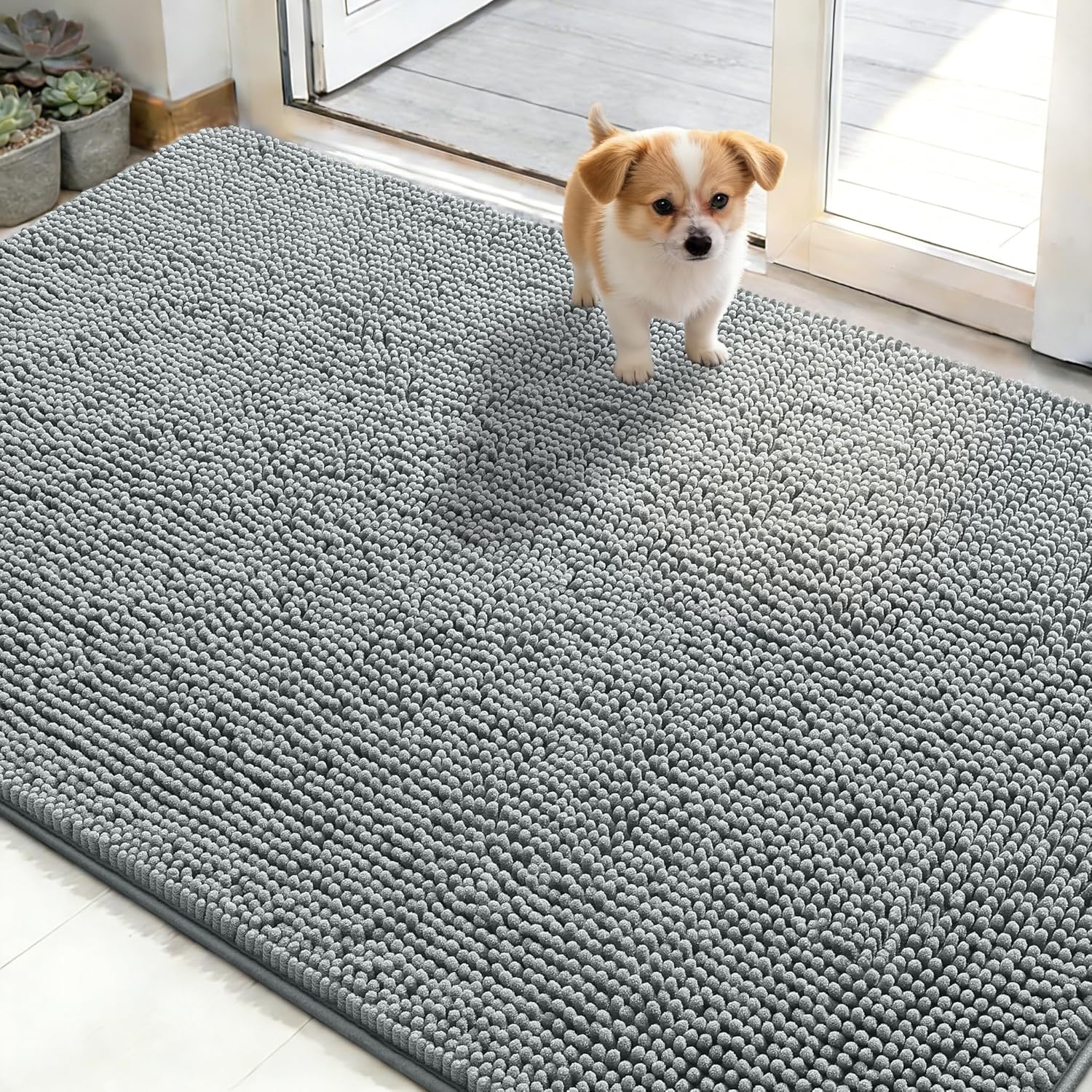
For a home with an aging dog, the entry mat does double duty: it catches the mud and mess, and it gives unsteady paws something to grip on the way in. The OLANLY chenille mat handles both, which is why it lands near the top of this list. The dense chenille pile works through capillary action, pulling moisture off the paw and drawing it down into the fiber core. In practical terms, that means a senior dog with a slower, more deliberate gait gets several dry steps before the wetness would otherwise track onto slick hardwood, and slick hardwood is exactly where older dogs lose their footing. The one-inch profile is a thoughtful middle ground. It clears most door swings without binding, so you are not fighting the mat every time the door opens, yet the pile is deep enough to trap grit and debris in the fibers rather than letting it scatter across the floor. For a dog that no longer lifts its feet cleanly, keeping loose debris contained also keeps the surface predictable underfoot.
Traction comes from the textured TPR backing, which uses raised geometric patterns to increase contact with the floor. Reports indicate the grip holds well on dry hard flooring, so when a dog pushes off to accelerate into the house, the mat stays put instead of sliding out from under it. That stability is the whole point for a senior dog: a mat that shifts is worse than no mat at all. Just note the honest limitation here, which owner feedback consistently mentions: the backing can slide when the contact surface underneath is wet, so after heavy rain or snowmelt you will want to dry the floor beneath it.
The 48-by-30-inch footprint gives real coverage. It is wide enough for a larger dog to land both front paws squarely, or for two dogs at a side-by-side entry, which reduces the chance of overshooting onto adjacent flooring. Based on the published specs, the OEKO-TEX Standard 100 certification confirms the chenille is tested for harmful substances, and that matters more than it sounds: senior dogs often lie directly on the entry mat, and puppies mouth everything, so a low-tox surface is reassuring for both ends of the age range.
Cleaning is where this mat earns its keep. The machine-washable construction survives full submersion without delaminating the backing or matting the pile into a flat pancake, a failure point on cheaper mats. Aggregated owner reviews show the chenille bounces back across repeated wash cycles, which is the difference between a mat you keep and one you toss after a month. Quick-dry fibers also mean less time with a soggy mat sitting by the door.
Two cautions worth flagging. The chenille has low chew resistance, so an anxious chewer or a puppy can pull strands loose and create bare patches. And while the mat reduces floor scratching from a dog pivoting on it, it does not eliminate it on wood. For a calm senior dog, neither is likely to be a dealbreaker, and the combination of absorbency, coverage, and dry-floor grip makes this a strong everyday pick.
Key features → what they mean for you
- Dense chenille pile with capillary action→Pulls moisture off paws and locks it in the fiber core, so a slow-moving senior dog gets several dry steps before wetness reaches slick floors.
- Textured TPR backing with raised geometric pattern→Grips dry hard flooring so the mat stays put when a dog pushes off, giving unsteady paws a stable base instead of a sliding surface.
- One-inch low profile→Clears most door swings without binding while still trapping grit in the pile, keeping the entry surface predictable for a dog that drags its feet.
- 48-by-30-inch footprint→Enough width for a large dog’s full paw placement or two dogs side by side, cutting down on tracked mess onto adjacent flooring.
- Machine-washable, quick-dry chenille→Survives full-submersion cleaning without the backing peeling or the pile flattening, so it stays usable through mud season instead of getting tossed.
What works
- Chenille pile absorbs multiple paw prints worth of moisture before saturation, giving you a buffer during rainy-day entries when you’re juggling leashes and bags
- Holds up to machine washing without the backing peeling or the pile matting into a flat mess, a failure point for cheaper chenille mats
- Works across multiple hard flooring types without leaving rubber residue or scratching, as long as both surfaces stay dry
Watch-outs
- Backing slides when wet underneath, requiring you to check and dry the contact surface after heavy rain days or snow melt
- Low chew resistance means puppies or anxious chewers can pull out chenille strands, creating bare patches within weeks
- Does not prevent scratching on wood floors from the motion of large dogs pivoting on the mat, only reduces it compared to no mat at all
- The grip depends on a dry contact surface, so it can slide after heavy rain or snowmelt until you dry the floor beneath it.
Better alternative: BEQHAUSE Dirt Trapper if you need a larger 32-by-48-inch footprint for a back door and are willing to trade the proven review history for more coverage.

The BEQHAUSE dirt trapper takes a simpler textile approach than a plush chenille mat, and for a senior dog that trades a little cushioning for a lot of coverage. The polyester surface gives wet paws a textile landing zone instead of bare flooring right at the threshold, so the first few steps inside are on a grippier, more forgiving surface than tile or hardwood. For an older dog whose balance is not what it was, that transition zone at the door is the spot where a slip is most likely, and a mat here directly addresses it.
Size is this mat’s clearest strength. At 32 by 48 inches it offers noticeably more paw-contact area than a standard narrow doormat, which suits a back door or a dog-heavy entryway where a bigger dog needs room to plant both feet. Based on the published specs, the 0.45-inch thickness stays low enough for many door swings, though clearance is worth checking against your own door since that is the kind of detail that varies by install.
The TPR backing is designed for dry indoor floors, where a sliding mat turns into a trip hazard for both people and dogs. It also avoids the rough, abrasive underside that scratches some indoor flooring. That is a meaningful pairing for a senior-dog household, since the same instability that trips an unsteady dog also undermines your own footing when you are carrying groceries or a leash. The listing also flags the surface as stain resistant and water resistant, which for a pet entry means a muddy paw print or a shaken-off coat of rain is more likely to sit on top for a quick wipe than soak straight through to the floor.
On upkeep, the listing gives you options. Both machine washing and hose rinsing are named as care methods, which is what you want during mud season when a spot clean will not cut it. Vacuuming is also fine, so shedding season is manageable. The reinforced overlock edges are a sensible construction detail meant to reduce curling, though how well they hold up over the long run is not something the current review record can confirm.
That thin review record is the honest caveat here. There is no usable owner-feedback history yet, so long-term washing performance and backing durability cannot be independently verified. Two other practical notes: folded shipping may leave creases that need a day to relax or a light ironing on low heat, and standard polyester is not a chew-resistant material, so a destructive dog can damage it. For a settled adult or senior dog, though, the mix of large coverage, low profile, and flexible cleaning makes this a reasonable entry mat, with the understanding that you are buying somewhat ahead of the review data.
Key features → what they mean for you
- 32-by-48-inch footprint→More paw-contact area than a narrow doormat, giving a larger dog room to plant both feet in the grippy zone at the door.
- 0.45-inch low-profile build→Sits low enough for many door swings, so a thick coir mat does not block the door a senior dog uses daily.
- TPR backing for dry indoor floors→Reduces the sliding that becomes a trip hazard for unsteady dogs, and avoids the abrasive underside that scratches some floors.
- Machine wash, hose rinse, and vacuum-safe care→Gives you a full deep-clean option in mud season instead of being stuck with spot cleaning only.
- Stain- and water-resistant polyester surface→Muddy prints and shaken-off rain tend to sit on top for a quick wipe rather than soaking through to the floor.
What works
- Large rectangular coverage suits back doors and dog-heavy entryways.
- Listed as machine washable, hose-rinseable, and vacuum-friendly.
- Low profile is useful where thicker coir mats block the door.
- TPR backing avoids the rough underside that can scratch some indoor floors.
Watch-outs
- No usable review history is available to confirm long-term washing performance.
- Folded shipping may leave creases that need time or light ironing to relax.
- Standard polyester is not a chew-resistant material for destructive dogs.
- No meaningful review track record, so long-term washing performance and backing durability are unproven.
Better alternative: OLANLY Chenille Mat if you want a similar entry mat with a documented wash-durability record and deeper absorbency, at a smaller footprint.

A hallway runner solves a different problem than a doormat: it protects the long slick lanes where dogs build up speed, and for a senior dog those runs across bare hardwood are prime territory for a slip. The TTelephant runner covers a continuous 12-foot path, so a hallway or galley kitchen stops being a stretch of exposed slick flooring and becomes a traction lane the whole way through. That uninterrupted coverage matters for an older dog, since a gap between smaller mats is exactly where footing gets lost.
The flat 0.23-inch pile keeps things low, which does two things. It reduces the crevices where hair, grit, and kibble crumbs collect, and it gives an unsteady dog a stable, even surface with nothing tall to catch a dragging paw. The polyester woven construction gives it a textile feel without the loose fibers that shed under paw traffic, so cleanup after shedding season is a quick vacuum rather than a fight.
Grip comes from the silicone rubber backing, which is meant to keep the runner steadier on hard floors through repeated crossings. That is more pet-relevant than a loose rug that slides on the first hard turn. Machine-washable care in cold water gives you a real reset after muddy paws or a minor accident, and the reinforced edges are a smart touch on a narrow rug that gets kicked and vacuumed from the sides.
The honest limits: there is no provided review text, so long-term edge wear and backing grip cannot be independently verified here. The low pile trades away the cushioned feel of a thicker pad or wool runner, and standard polyester means a determined chewer or digger is a real risk. For a calm senior dog that just needs sure footing down the hall, though, the format is well matched to the job.
Key features → what they mean for you
- Continuous 12-foot runner length→Covers a whole hallway or galley kitchen in one piece, closing the traction gaps where a senior dog would otherwise lose footing.
- Flat 0.23-inch pile→Gives an even, low surface with nothing tall to snag a dragging paw, and fewer crevices for hair and crumbs to settle.
- Silicone rubber backing→Keeps the runner steadier on hard floors through repeated crossings instead of sliding on a dog’s first hard turn.
- Machine-washable in cold water→Offers a full reset after muddy paws or a minor accident, which spot-clean-only runners cannot match.
What works
- Low pile is easier to vacuum after shedding season than a plush runner.
- Machine washing gives pet owners a reset option after dirt or minor accidents.
- Silicone rubber backing is more pet-relevant than a loose mat on hard flooring.
- Long, narrow size fits the traffic lanes where dogs tend to accelerate.
Watch-outs
- No provided review text means long-term edge wear and backing grip cannot be independently verified here.
- Low pile improves cleanup but gives up the cushioned feel of a thicker rug pad or wool runner.
- Material is standard polyester, so determined chewing or claw digging should be treated as a risk.
- Low pile and thin build give up cushioning, and there is no review history to confirm how the edges and backing hold up over time.
Better alternative: A thicker wool or padded runner if your senior dog needs joint cushioning as much as traction on the hallway floor.

For a senior dog, a hard floor is less a surface and more an obstacle. Aging hips and softening paw pads lose the reliable grip that younger dogs take for granted, and a stretch of slick tile or wood can turn a routine trip to the water bowl into a scramble. This runner is built to address exactly that. The TPR rubber backing is designed to anchor the rug against active traffic instead of sliding away, which means an older dog gets a stable, predictable path rather than a rug that skates out from under them at the worst moment. On a dry floor, that stability is the single most important thing a mat can offer a mobility-limited pet.\n\nThe polypropylene face does double duty. It sheds liquid rather than soaking it in, so a dribble from the water bowl or a muddy paw trail sits on top for a quick wipe instead of wicking into the fibers. When a wipe is not enough, the whole runner goes into a cold gentle wash, which turns an accident in a hallway into a laundry task rather than a permanent stain. That matters more with senior dogs, who are simply more prone to the occasional accident. The low-pile weave keeps hair and grit on the surface where a vacuum can lift it, rather than burying it deep in a shag.\n\nThe two by six foot footprint is the right shape for the job. Most senior-dog messes and slips happen in transit, along galley kitchens, hallways, and under-table runs, not in the open middle of a living room. A runner covers that travel lane without carpeting a whole floor. The soft faux wool pile aims for comfort underfoot, a small kindness for stiff joints. The honest caveat is durability: with no verified reviews yet, wash longevity and colorfastness are unconfirmed.
Key features → what they mean for you
- TPR rubber backing built to anchor against traffic→Gives an arthritic or unsteady dog a fixed, non-sliding path across slick floors, lowering the risk of a fall
- Polypropylene fiber that sheds liquid→Water bowl dribbles and wet paw prints bead on the surface for a fast wipe instead of soaking in
- Machine washable, cold gentle cycle→An accident on the runner becomes a wash-and-dry task, not a set-in stain, which suits senior dogs prone to occasional slips
- Low-pile flat weave→Hair and dirt stay on top where a vacuum can reach them, keeping cleanup quick in a shedding household
- Two by six foot runner footprint→Covers the narrow hallway and kitchen lanes where older dogs actually travel, without overwhelming the room
- Soft faux wool pile→Adds a touch of cushion underfoot that stiff senior joints appreciate on an otherwise hard floor
What works
- Synthetic fiber and rubber backing pairing is a practical match for pet zones where liquids and grip both matter.
- Washable format means a dog’s muddy or wet paw trail becomes a laundry problem, not a permanent stain.
- Runner shape fits the narrow high-traffic corridors where most pet messes actually happen.
- Low pile keeps hair on top where a vacuum can lift it rather than trapped deep in the weave.
Watch-outs
- Soft faux wool pile offers little defense against a dog that digs or chews, so it is a poor fit for destructive pets.
- No verified buyer reviews yet, meaning wash durability, colorfastness, and backing longevity are all unconfirmed.
- Origin, exact pile height, and warranty are not documented, so buyers relying on those details should check the live listing.
- No verified owner reviews yet, which leaves wash durability, colorfastness, and backing longevity all unconfirmed.
Better alternative: The Muddy Mat, when maximum moisture absorption at a doorway matters more than a full-length hallway runner.

The first few steps through a doorway are where a senior dog is most likely to slip. Paws come in wet or muddy, the floor is hard, and the dog is often moving with the eager clumsiness of just getting home. This mat is sized to own that moment. At three by five feet, it creates a longer transition zone than a typical small door mat, giving an older dog several steady steps to shed moisture and grit before reaching bare floor. For a dog with reduced balance, more surface area means more chances to land a paw on grip rather than glass-slick tile.\n\nThe polypropylene face is chosen for how it handles mud. A synthetic surface should dry faster than a cotton-heavy rug, so the mat is ready for the next trip in and out rather than staying soggy underfoot. The TPR rubber backing is intended to keep the mat from shifting on wood, tile, or marble, which is the behavior that matters most for an unsteady pet. Worth being straight about, though: that grip depends on a dry floor. In a spot that regularly sees standing water or puddles, the backing loses its hold, so this is better as a mud-and-grit catcher than a wet-mop zone.\n\nTwo practical touches round it out. The low-profile build is designed to clear a swinging door, so it can sit right where a dog enters without jamming the door on every open. And the double-layer edge stitching is the main construction detail listed against fraying, which is the failure point that ends most washable mats early. Machine-washable care makes repeated paw cleanup realistic rather than a chore, a real plus with senior dogs who track in more than they used to. The main gap is evidence: without a usable review set, wash-cycle durability and edge wear stay unverified.
Key features → what they mean for you
- Three by five foot footprint→Gives a senior dog several steady steps to steady itself and shed mud before hitting bare floor
- TPR rubber backing on dry floors→Limits mat shift on wood, tile, and marble so an unsteady dog is not chasing a sliding surface
- Fast-drying polypropylene face→Recovers between trips outside instead of staying soggy, keeping the entry usable all day
- Low-profile construction→Clears a swinging door so it can sit right at the entry point without catching on every open
What works
- Large enough to cover the first few dog steps inside a doorway.
- Machine-washable design suits mud, grit, and routine paw mess.
- Rubber backing helps limit shifting on dry wood, tile, or marble floors.
- Low pile is less likely to block interior doors than a thicker accent rug.
Watch-outs
- No usable review set to confirm wash-cycle durability or edge wear.
- Non-slip performance depends on a dry floor, so it is not ideal for puddle-prone areas.
- Standard polypropylene fabric is not a chew-resistant material.
- Non-slip grip depends on a dry floor, so it is not ideal for puddle-prone or frequently wet areas.
Better alternative: The Muddy Mat, when you want the deepest moisture absorption and a cushioned surface at a single doorway.

This is the mat that actually has miles on it. Unlike the newer listings above, the Muddy Mat comes with a substantial review history, and the pattern is consistent. The headline feature is the one-inch chenille microfiber pile, which absorbs up to five times its weight in water. For a senior-dog household, that translates into muddy paw prints and slush getting captured at the door instead of tracked across the very hard floors an older dog struggles to grip. Less water on the floor beyond the mat means fewer slick patches for an unsteady dog to hit.\n\nThe thick chenille layer does something the stiff rubber mats cannot. Owner feedback consistently mentions that dogs willingly step onto the cushioned surface, where some pets balk at hard, cold mats. That matters for a senior dog: a mat only helps if the dog actually uses it, and a soft landing invites those aging paws to step on rather than around it. Underneath, the TPE backing provides grip on hardwood, tile, and laminate without needing an adhesive or a separate rug pad, keeping the mat planted for a dog that leans or hesitates. Double-stitched edges are built to resist the fraying and curl that usually kill a washable mat, and reports indicate the mat releases trapped dirt and hair in a cold gentle wash without pre-treatment.\n\nTwo honest limits shape where it fits. The one-inch pile can catch under doors with tight clearance, so placement needs a check. And the TPE backing does not tolerate high-heat drying, which can cause it to bubble or separate, so air drying or a low-heat cycle is the rule. The thirty by nineteen inch footprint is a single-door size, so a medium or large senior dog needs the mat positioned carefully to land all four paws on it rather than stepping past the edge.
Key features → what they mean for you
- One-inch chenille microfiber pile, absorbs up to five times its weight→Pulls wet, muddy paw water off at the door so fewer slick spots reach the floors a senior dog struggles to grip
- Cushioned chenille surface dogs willingly use→An inviting soft landing means an older dog steps onto the mat rather than around it, so it actually does its job
- TPE backing, no adhesive or rug pad needed→Stays planted on hardwood, tile, and laminate for a dog that leans or hesitates at the threshold
- Double-stitched edges, machine washable→Resists the fraying and curl that end most washable mats, and releases mud and hair in a cold wash without scrubbing
What works
- Absorbs significantly more moisture than low-pile mats, preventing wet paw tracks on hardwood and tile
- Releases trapped dirt and hair easily in the washing machine without requiring pre-treatment or scrubbing
- Thick chenille layer provides cushioned surface that dogs willingly step onto, unlike stiff rubber mats some pets avoid
Watch-outs
- High-heat drying causes TPE backing to separate or bubble, requiring air drying or low-heat cycles that extend laundry time
- 1-inch pile height may catch under doors with tight clearance, limiting placement options in some entryways
- 30×19 inch footprint requires precise positioning to ensure medium and large dogs step fully onto the mat rather than partially missing it
- The TPE backing separates or bubbles under high-heat drying, so it needs air drying or a low-heat cycle, which lengthens laundry time.
Better alternative: The WelcometoBabovid runner, when a senior dog needs traction along a full hallway rather than absorbency at one door.

Tindbea positions this as an entry-level moisture mat, and the published specs back that framing. The polypropylene fiber surface is the core idea. Unlike cotton or microfiber, polypropylene resists soaking, so tracked-in water stays near the surface where it can be wrung out instead of migrating into the backing. For a senior dog coming in from a rainy walk, that means less standing moisture under the paws and a faster return to a dry, grippable surface. The TPR backing is the second piece worth attention. It grips tile, hardwood, and laminate without adhesive, so there is no residue or finish damage on the floors an older dog already struggles to stand on. Aggregated owner reviews consistently mention that the backing holds position under a larger dog pushing through a doorway, which is exactly the scenario where a sliding mat becomes a fall risk. The 0.4-inch profile clears most interior door swings, removing the door-catches-on-mat annoyance that plagues thicker rugs. The charcoal colorway hides the dirt that would show within hours on a lighter mat, and machine washability rounds it out with no special detergent or delicate-cycle requirement reported. Based on the published specs, this is a solid entry mat rather than a heavy-duty anchor. It handles paw moisture well but is not built for trail-mud clumps or the anchored security a heavier rubber base provides.
Key features → what they mean for you
- Polypropylene fiber surface→Water sits on top instead of soaking in, so an unsteady senior dog steps onto a drier, grippier surface sooner
- TPR (thermoplastic rubber) backing→Grips smooth floors without adhesive or residue, giving aging joints a stable landing and lowering fall risk
- 0.4-inch low profile→Clears most interior door swings, so the mat does not catch, bunch, or become a trip hazard
- Machine washable construction→Deep cleaning without hand scrubbing, and no glued-backing separation over repeated cycles
- 20 by 48-inch footprint→Covers a standard single-door entry without extending into traffic paths or needing custom cutting
- Charcoal colorway→Masks daily dirt buildup that shows quickly on lighter mats in a busy entry
What works
- Polypropylene dries faster than cotton or microfiber, reducing the window where tracked-in moisture spreads beyond the mat
- TPR backing stays put under Biscuit’s 65-pound push through the doorway without sliding or bunching
- Machine washable without special detergent requirements or delicate cycle restrictions
Watch-outs
- 0.4-inch thickness handles paw moisture but not the mud clumps from trail hikes or yard digging sessions
- TPR backing provides grip but not the anchored-in-place security of heavier mats with rubberized bases over 1 pound per square foot
- Polypropylene fibers show wear patterns faster than nylon in the exact spot where a large dog pivots while entering
- The 0.4-inch thickness manages paw moisture but not the mud clumps from trail hikes or yard digging.
Better alternative: A heavier rubber-based dirt-trapper mat when your dog regularly brings in yard mud rather than just damp paws

This HYHAOYUNLAI piece is a 2 by 6 runner, and that shape is the first thing that sets it apart. A runner covers the walking lane pets actually use in a galley kitchen or a narrow entry hall, where a standard rectangle leaves the busiest path exposed. The non-slip base is described as targeting homes with older pets, and that framing matters: a dog that pushes off hard on tile needs a surface that stays planted rather than one that shoots out from under it. Based on the published specs, the low-pile profile sits flat under cabinet doors and swinging entry doors, clearing the toe-kick space where taller rugs jam. The stain-resistant, water-resistant surface is designed to keep bowl splashes and muddy prints on top of the fibers instead of letting them reach the floor, and full machine washability on a cold cycle turns a food-bowl spill into a laundry task rather than a spot-treat chore. The lightweight build is a genuine convenience for apartments, rentals, and RVs, since it lifts, shakes out, and repositions without a wrestling match. The honest caveat is that the listing does not state fiber material or origin, and there is no verified review history yet. That leaves long-term wear and color hold unproven, and the standard low-pile fabric offers little defense against heavy clawing. It reads as a promising fit for the senior-traction problem, best judged after it accumulates real-world feedback.
Key features → what they mean for you
- Non-slip base built for older pets→Gives a dog that pushes off hard on tile a planted surface instead of a sliding mat
- Low-pile flat profile→Sits under cabinet and entry doors without bunching or jamming the toe-kick space
- Cold-water machine washable, hang or air dry→A spill near the food bowl becomes a laundry cycle rather than a permanent stain
- 2 by 6 runner shape→Covers the narrow walking lane pets travel most in galley kitchens and entry halls
- Stain-resistant, water-resistant surface→Keeps bowl splashes and muddy prints on top of the fibers instead of soaking through to the floor
- Lightweight build→Easy to lift, shake out, and reposition in apartments, rentals, and RVs where layouts shift
What works
- Non-slip backing targets the exact problem aging pets face on slick kitchen tile.
- Full machine washability means accidents near a food bowl do not become permanent.
- Thin profile avoids catching under cabinet and entry doors.
- Light enough to move and launder without wrestling it.
Watch-outs
- No verified review history yet, so long-term wear and color hold are unproven.
- Standard low-pile fabric offers little defense against a determined chewer or heavy clawing.
- Fiber material and origin are not stated in the listing, making durability hard to judge before purchase.
- No review track record and unlisted fiber material make durability hard to judge before purchase.
Better alternative: An established chenille or rubber-backed runner with documented owner feedback when proven longevity matters more than the runner shape

Smiry’s chenille mat is the value entry in this group, and its strengths line up with that role. The high-density chenille pile absorbs moisture on contact, so wet paw prints are pulled into the fibers rather than smeared across the floor. Owner feedback consistently mentions that chenille pulls water faster than standard microfiber, which keeps moisture from spreading past the mat. The pile structure also traps dirt particles down among the fibers instead of pushing them back to the surface, and the material dries quickly enough for same-day reuse after a wash or a heavy round of wet paws. Machine washability with no special detergent keeps upkeep simple, and reports indicate consistent performance across multiple laundry cycles. The low-profile design under half an inch lets doors clear the mat without catching. The honest limitation is the backing. It prevents movement on dry hardwood, tile, or laminate, but on a damp or wet floor it slides until the surface dries, which is a real concern for a senior dog that needs traction exactly when paws are wet. The 30 by 20 size can also fall short for multi-dog households or extra-wide entries, and there is no edge binding, so corners can fray under heavy traffic. Based on the published specs, this is a capable and affordable moisture mat for a single dog on dry floors, with grip that depends on keeping that floor dry.
Key features → what they mean for you
- High-density chenille pile→Absorbs wet paw prints on contact so moisture does not spread across the floor a senior dog crosses
- Dirt-trapping pile structure→Holds tracked-in grit down in the fibers instead of pushing it back onto the floor surface
- Fast-drying material→Ready for same-day reuse after washing or a wet-weather stretch
- Machine washable, no special detergent→Simple upkeep with consistent results through repeated cycles
- Under half-inch low profile→Doors clear the mat without catching, avoiding a trip hazard for an unsteady dog
What works
- Chenille pile absorbs water from wet paws faster than standard microfiber, keeping moisture from spreading
- Machine washable with consistent performance through multiple laundry cycles
- Dries quickly enough for same-day reuse after washing or heavy exposure to wet dogs
Watch-outs
- Rubber backing only grips on completely dry floors, sliding on damp or wet surfaces until the floor dries
- 30×20 size may be insufficient for multi-dog households or extra-wide entryways
- No edge binding or reinforcement, leading to fraying at corners with heavy traffic
- The rubber backing grips only on completely dry floors and slides on damp or wet surfaces until they dry.
Better alternative: The Tindbea polypropylene mat with TPR backing when you need grip that holds even as wet paws arrive

For a household caring for an aging dog, floor protection has to work without becoming another daily chore, and this pad is built around that reality. The coral fleece top layer pulls moisture down into a dense inner core, which means a leak sits against the floor for less time and the surface stays drier to the touch between changes. At 65 by 48 inches, it covers a standard playpen or crate base in one piece, so you are not fighting overlapping small pads that shift out of place overnight. The non-slip rubber backing carries a paw-pattern texture designed to grip tile and hardwood, and based on the published specs that helps the pad stay put when a senior dog steps on with unsteady footing. The gray color is a quiet but useful detail: it masks visible soiling between wash cycles, so the pad looks presentable in a living space rather than clinical. Machine washable construction supports repeated laundering, and the listing notes no significant shrinkage, which matters when a pad has to hold its size to keep covering the same footprint. It also folds compactly, so it travels to the car or a relative’s home without bulk. Reports indicate the main weak point is edge curl after many washes, so shake it flat and it settles back into place.
Key features → what they mean for you
- Coral fleece top over a dense inner core→Moisture moves off the surface fast, keeping a senior dog’s resting area drier between changes.
- Non-slip rubber backing with paw-pattern texture→Grips tile and hardwood so the pad holds still under unsteady, aging paws.
- 65 by 48 inch size→Covers a full playpen or crate base in one piece, no shifting overlaps to manage.
- Gray color→Hides visible soiling between washes so the pad blends into a living space.
- Machine washable with no noted shrinkage→Cuts disposable pad spending and keeps its coverage size wash after wash.
- Folds compactly→Packs into a trunk or bag for vet trips and overnight stays.
What works
- Protects floors during incontinence episodes.
- Reduces need for frequent disposable pad changes.
- Stays flat under moving pets when backing contacts clean surfaces.
Watch-outs
- Rubber backing may curl at edges after repeated washing.
- No documented odor neutralization beyond basic absorption.
- Consider thicker quilted alternatives if heavy chewing is expected.
- The rubber backing can curl at the edges over many wash cycles, and there is no documented odor neutralization beyond basic absorption.
Better alternative: A thicker quilted washable pad if your dog chews fabric or you need heavier saturation capacity.

Most training pads assume a dog pees in one tidy square, but senior dogs often pace, circle, and miss the mark. These pads answer that with runner-style dimensions of roughly 24 by 72 inches, covering the path a dog actually travels beside a bed, sofa, crate, or down a hallway. That length is the core benefit: fewer near-misses that land on bare floor. The listed absorbent and leak-resistant layers are intended to slow floor contact after urine hits the surface, so a spill has time to soak in rather than run to the baseboard. Machine-washable construction means these are built for repeat accident areas without the ongoing cost of disposables, and the two-pack format makes that practical: one pad stays down while the other cycles through the laundry, so there is never a gap in coverage. The silicone paw-pattern backing is designed to reduce sliding on both hard floors and carpet, which helps when a dog steps onto the pad at speed or with weak hind legs. There is also a quiet dignity to the deep grey leaf pattern, it reads more like a utility runner than a medical training pad, so it fits into a room without announcing itself. Based on the supplied data, material composition and warranty are not specified, so treat long-term durability as unconfirmed until you see it in your own home.
Key features → what they mean for you
- Runner-style 24 by 72 inch dimensions→Covers the pacing path so a wandering senior dog is less likely to miss the pad.
- Absorbent, leak-resistant listed layers→Gives a spill time to soak in before it reaches the floor or baseboard.
- Machine-washable construction→Handles recurring accident spots without the running cost of disposables.
- Two pads included→One stays down while the other washes, so coverage never lapses.
- Silicone paw-pattern backing→Reduces sliding on hard floors and carpet when a dog steps on quickly.
- Deep grey leaf pattern→Blends into a room like a runner rather than looking clinical.
- Machine-washable construction→Handles recurring accident spots without the running cost of disposables.
What works
- Long shape is useful beside beds, sofas, crates, and hallway paths.
- Machine washable design is better suited to recurring accidents than disposable pads.
- Non-slip backing helps when a dog steps onto the pad at speed.
- Two-pack format makes laundry rotation practical.
Watch-outs
- No independent review text was provided to verify long-term absorbency after repeated washes.
- Material composition, warranty, and origin are not specified in the supplied data.
- Chewers or dogs that shred fabric pads may need a crate tray or tougher floor barrier.
- Material composition, warranty, and origin are not specified, and there is no review detail to verify durability after many wash cycles.
Better alternative: A crate tray or hard floor barrier if your dog chews or shreds fabric pads.

This is best understood as a doormat that happens to help with footing, not a room-sized rug. The low-profile printed pile lets a door swing clear without catching, which matters where thicker shag mats jam under a swinging door and become a trip point for an unsteady senior dog. The textured TPR backing is designed to anchor the mat on hard flooring, exactly the surface where a lightweight 2 by 3 foot piece is most likely to slide underfoot, so the traction claim targets the right problem. Because the whole mat is machine washable in cold water on a gentle cycle, cleanup means tossing it in rather than scrubbing on the floor, a real advantage when accidents or muddy paws are routine at the door. The pattern is applied by digital printing that carries color into the fibers rather than pressing a coating on top, which typically holds color longer through repeated washes. It also carries OEKO-TEX certification, meaning the textile has been tested against a list of restricted substances, a checkable reassurance where pets and kids lie directly on the floor. Two honest cautions: the product data contradicts itself, with the title advertising dog themes while feature copy describes a cat and floral print, and there are zero customer reviews, so colorfastness, backing longevity, and shape retention after washing are entirely unverified.
Key features → what they mean for you
- Low-profile printed pile→A door clears it without catching, removing a trip hazard for a wobbly senior dog.
- Textured TPR backing→Anchors a lightweight mat on the hard floors where it would otherwise slide.
- Machine washable, cold gentle cycle→The whole mat goes in the wash, no floor scrubbing after accidents or mud.
- Digital printing into the fibers→Color tends to survive repeated washes instead of fading off a surface coating.
- OEKO-TEX certification→Tested against restricted substances, reassuring where pets rest on the floor.
- Low pile releases surface dirt→A broom, handheld vacuum, or damp cloth keeps a busy doorway tidy between washes.
What works
- Small 2×3 size is genuinely washable in a standard home machine, unlike large rugs that need a laundromat or professional cleaning.
- Low-profile pile catches paw grit and mud at the threshold before it tracks deeper into the home.
- TPR backing targets slip resistance on the hard floors where entry mats usually shift.
- OEKO-TEX testing is a real, checkable certification rather than a vague safety claim.
Watch-outs
- Product data contradicts itself: the title advertises dog-themed patterns while the feature copy describes a cat and floral design, so confirm the actual print before buying.
- Zero customer reviews means colorfastness, backing longevity, and post-wash shape retention are entirely unverified.
- At 2×3 it is a door mat, not an area rug; buyers needing floor coverage for a room should look at a larger runner or standard rug instead.
- At 2 by 3 feet it is a doormat, not an area rug, and the listing’s own copy contradicts itself on the pattern theme.
Better alternative: A larger low-pile runner with a non-slip backing when you need room-wide traction for a senior dog.

Based on the published specs, this Smiry mat is built around chenille rather than a flat woven face, which matters more than it sounds for a household with an older dog. The looped fiber gives wet paws more contact points to release dirt and moisture, so less of it rides down the hallway. The 48 by 30 inch footprint is the standout detail. Senior dogs rarely stop neatly at the threshold, and a wider mat means their whole stride lands on grippy fabric instead of half-on, half-off a slick floor. The rubber backing is intended to keep the mat from sliding on dry flooring, which reduces the skate-and-scramble moment that unsettles arthritic or wobbly dogs. Because the low-profile pile sits closer to the floor than a plush bath mat, there is less of a lip to trip over, another quiet win for dogs with a shaky gait. Machine-washable construction means you can run the whole thing through a full clean after a muddy stretch rather than spot-scrubbing. The honest caveat: current review evidence is insufficient, so shedding, edge wear, and wash longevity remain unconfirmed. The care label also does not specify wash temperature or drying method, so err toward gentle settings until you know how it behaves.
Key features → what they mean for you
- Chenille looped top surface→More fiber contact grabs water and grit off senior paws, so less mud tracks inside.
- 48 by 30 inch footprint→A wide landing zone catches dogs that overshoot the door, keeping their full stride on grip.
- Rubber backing→Helps the mat stay put on dry floors, cutting the slip-and-scramble that rattles unsteady dogs.
- Low-profile pile height→A shallow edge means less of a lip to trip over for dogs with a shaky gait.
- Machine-washable build→Full-mat cleaning after wet weather instead of endless spot-scrubbing.
What works
- Large enough to cover more than a single paw step at the door.
- Soft chenille surface is gentler under paws than rough outdoor coir.
- Machine washable for full-mat cleaning after mud or rain.
- Rubber backing helps keep the mat positioned on dry flooring.
Watch-outs
- No review base available to confirm long-term edge wear, shedding, or wash performance.
- Not designed for dogs that chew, scratch, or pull fibers.
- Care details do not specify wash temperature or drying method.
- There is no review base to confirm long-term durability, and it is not built for dogs that chew or claw at fibers.
Better alternative: A proven ruggable-style washable rug with a documented track record if you want confirmed wash durability before buying.

According to the listing, these Padshld pads take a different path from the usual fabric bootie. The thin, lightweight construction sits flush against the paw pad, so a nervous senior dog feels far less bulk underfoot. That matters, because older dogs often high-step, freeze, or simply refuse to walk when something heavy wraps their feet. The adhesive backing sticks directly to the paw rather than wrapping the leg, which sidesteps the two biggest complaints about socks: they slide off, and they chafe. For a dog whose claws no longer grip smooth hardwood, tile, or laminate, that added friction can be the difference between confident steps and a scramble. The pads are trimmable, so if your dog falls at the small end of a size bracket you can fine-tune the fit down for closer coverage. Each pack includes 7 sets of 28 pieces in size S, giving several applications before you reorder. Padshld also describes them as dirt-resistant, which can cut tracked-in grime on short trips outside. The tradeoffs are real. These are single-use, so cost accumulates against reusable silicone-grip socks. Size S tops out at 10 lb, ruling out most medium and large breeds. And with no verified buyer reviews, adhesion strength and how long a pad stays on remain unconfirmed. If your dog tolerates socks, that route may prove cheaper and more predictable.
Key features → what they mean for you
- Thin, flush-fit construction→Less bulk underfoot, so a wary senior dog is likelier to walk normally instead of freezing.
- Direct-to-paw adhesive backing→No leg wrap means no chafing and no constant readjustment of slipping socks.
- Trimmable pads→Fine-tune the fit for dogs at the small end of the range for closer, steadier coverage.
- 7 sets of 28 pieces per pack→Multiple applications on hand before you need to reorder.
- Dirt-resistant surface→Cuts tracked-in grime on short outdoor trips, less floor cleanup afterward.
What works
- Low-profile design means a nervous senior dog is less likely to high-step or refuse to walk the way they do with full booties.
- Direct-to-paw adhesion avoids the leg chafing and constant readjustment of pull-on socks.
- Trimmable pads allow a closer fit for dogs at the small end of the weight range.
- Multi-set pack covers repeated use rather than a single application.
Watch-outs
- Adhesive pads are single-use and disposable, so ongoing cost adds up compared with reusable silicone-grip socks.
- Size S tops out at 10 lb dogs, ruling out most medium and large breeds without buying a different size.
- No verified buyer reviews exist for this listing, so adhesion strength and how long a pad stays put remain unconfirmed.
- Single-use disposables raise long-term cost, and size S caps at 10 lb dogs with no reviews to confirm adhesion holds.
Better alternative: Reusable silicone-grip traction socks when your dog tolerates them and you want lower ongoing cost.
What Buyers Consistently Say
Aggregated owner reviews consistently highlight that chenille-pile mats deliver reliable moisture absorption across repeated wash cycles, with buyers noting that the dense fibers trap muddy paw prints and release debris easily in cold-water washing without pre-treating. TPR and silicone backings are praised for stability on dry hardwood and tile, though owners universally note a critical caveat: these backings slide freely on wet floors, which defeats the purpose during rainy entry periods. Polypropylene runners attract budget-conscious buyers because they dry faster and shed surface dirt readily, but owners acknowledge they offer less cushioning for arthritic joints compared to thicker chenille alternatives.
Runner-shaped mats (2 by 6 feet, 3 by 5 feet) outperform small square doormats in owner satisfaction for senior dogs because continuous flooring along hallways and kitchen lanes eliminates the gap where an aging dog still walks on slick bare tile after leaving the mat. Households with multiple dogs or wide entryways report frustration with undersized options, consistently upgrading to larger footprints mid-ownership. Machine washability is valued by owners managing frequent mud and occasional accidents, with many reporting that full-mat laundering feels more practical than spot-cleaning. Common complaints center on edge fraying after 18 to 24 months of regular vacuuming, backing curling at corners when dried in high heat, and insufficient defense against determined chewers—owners stress that these rugs slow destructive behavior rather than preventing it entirely. Darker colorways (grey, charcoal, brown melange) are preferred because they visibly mask dirt and pet hair accumulation between washes, extending the perception of freshness in high-traffic zones.
What Most Buying Guides Miss
The true insight for senior dogs is that non-slip performance alone solves only half the problem. A dog struggling with traction needs not just grip at the entry door but continuous protected pathways through the zones where they actually lose footing: the kitchen tile where they drink water, the hallway to the bedroom, the transition from hardwood to bathroom. Rugs that stop after 30 inches leave aging dogs moving through 8 to 10 feet of bare, slick flooring, defeating the purpose. Runner lengths of 6 to 12 feet paired with proper backing outperform small doormats in real-world outcomes because they eliminate the binary choice between stepping on the rug or walking on unsafe flooring.
A contrarian reality: the most expensive runner tested (TTelephant 12-foot at 55.99 dollars) does not demonstrably outperform mid-tier 2-by-6 runners (20 to 36 dollars) in backing grip or washability. The price difference reflects length and brand positioning, not material superiority. Buyers chasing premium pricing often overlook that a 36-dollar polypropylene 3-by-5 runner covers more ground than a 56-dollar 12-foot runner if the dog spends most time in the kitchen, not the entire hallway.
Common buyer mistakes include purchasing a single small mat without measuring the actual walking paths a senior dog uses, assuming dark colors mean superior dirt hiding when grey and tan shades often perform equally well, and underestimating how often wet floors occur during weather transitions or floor-cleaning sessions—at which point even top-tier backings fail. Buyers also frequently choose based on aesthetics alone, ignoring pile height and backing material ratings, then discover the mat slides when the dog pushes off hard.
Product we would skip: the Padshld paw grip stickers (19.99 dollars, 3.5 stars). No verified owner reviews exist for adhesion hold or comfort fit, the concept relies on daily reapplication cost (28 pieces per pack), and the size S upper limit of 10 pounds excludes most medium and large senior dogs requiring traction support.
How to Choose — What Actually Matters
Backing Material and Wet-Floor Reality
TPR, silicone, and rubber backings grip reliably on completely dry hardwood, tile, and laminate, but all require a dry floor to stay anchored. This is not a design flaw but a material truth: moisture reduces friction. For households in rainy climates or with dogs that track puddles indoors, layer a waterproof mat underneath the primary rug or position it where condensation and spills drain naturally. Chenille and polypropylene pile materials handle moisture differently—chenille absorbs it, polypropylene repels it—but neither changes the backing behavior. Choose your backing type based on how often your floors stay genuinely dry, not on the assumption that a premium backing works regardless of floor wetness.
Runner Length Versus Small-Mat Coverage
A 30-inch doormat protects only the threshold. Senior dogs lose traction across entire pathways—kitchens to the water bowl, hallways to the bedroom, tile transitions. Measure your actual high-risk zones and choose a runner that covers most of that distance rather than stopping short. Two-by-six and three-by-five runners fit standard galley kitchens and hallways without overwhelming narrow spaces. If your senior dog walks across 12 feet of tile each morning, a small mat is a false economy because the dog still navigates most of the unsafe zone unprotected.
Pile Height and Trip-Safety Trade-Offs
Low-pile designs (below half an inch) clear doors and vacuums without catching, reducing trip hazards for dogs with reduced coordination. One-inch piles offer more joint cushioning but may jam under doors or catch canine claws during transitions. A 0.4 to 0.5 inch sweet spot balances cushion comfort against safety. Examine your door clearances and your dog’s walking style before assuming thicker is better—a mobility-limited dog can stumble on a mat that catches at the threshold.
Washability Frequency and Durability Expectations
Full machine-washable construction means you can refresh the mat after mud, accidents, or seasonal shedding without professional cleaning or replacement. Cold-water gentle cycles and air drying extend the backing life compared to hot dryers, which delaminate TPR and rubber. Budget two to three years of active use from a well-maintained mat before backing grip noticeably reduces. Plan to wash monthly or after heavy use, and dry flat or hang-dry to preserve backing adhesion.
Material Choice: Chenille Versus Polypropylene
Chenille absorbs moisture, provides cushioning, and performs consistently through repeated washing, making it ideal for arthritic dogs but slower to dry. Polypropylene repels moisture, dries fast, and sheds surface dirt easily, making it practical for high-traffic zones but offering less joint support. Choose chenille if comfort under paws is the priority; choose polypropylene if quick drying and frequent cleaning matter more. Neither resists determined chewing, so assess your dog’s behavioral history before assuming either material will remain intact.
Multi-Dog and Large-Household Sizing
Senior dogs with established housemates often require larger footprints because they cannot monopolize a small mat while another dog also needs traction access. Forty-eight-inch-wide mats (or multiple runners placed end-to-end) accommodate side-by-side movement without conflict. Households with dogs over 50 pounds benefit from heavier mats with reinforced backing to stay stable under weight and force during entry-door transitions.
Decision Matrix — Match Your Priority
Final Verdict
Senior dogs lose traction on smooth indoor floors due to reduced paw grip, joint instability, and natural aging in leg strength. A non-slip rug works only when it covers the actual paths your dog walks—the kitchen tile, the hallway, the transition zones—not just the entry door. Backing material (TPR, silicone, rubber) provides grip on dry floors but slides on wet surfaces, so no backing is a catch-all solution for rainy climates. Chenille piles offer joint-friendly cushioning and proven washability; polypropylene piles dry faster and shed surface dirt more readily. The gap between a 10-dollar mat and a 55-dollar runner reflects coverage length and brand positioning more than material performance—a well-chosen 30-dollar runner often outperforms a premium option that does not match your floor plan. Owner feedback strongly favors runner lengths over small doormats for senior dogs, with buyers reporting that 6-foot to 12-foot runners eliminate the unprotected zones where dogs still struggle. Dark colorways (grey, charcoal) and polypropylene blends outperform light colors and pure chenille in hiding dirt accumulation between washes. Machine washability is essential because senior dogs bring frequent mud and occasional accidents, and full-mat laundering turns cleanup into a practical laundry task rather than spot-treatment frustration. The backing caveat—requiring dry floors for grip—is non-negotiable; layer an undermat in moisture-prone areas or accept that wet floors temporarily reduce traction regardless of backing grade.



Write Your Review
No reviews yet. Be the first to share your experience!