

15 Best Balcony Safety Nets for Cats of 2026
An open balcony is one of the most common blind spots in a cat-friendly home. Cats chase birds, misjudge a narrow ledge, or slip through a railing gap that looks far too small to matter. Veterinarians even have a name for the pattern of fall injuries that follow, and apartment living puts that risk within a single leap of your living room. studio apartment pet setup.
A balcony safety net closes those gaps without walling off the fresh air and sightlines your cat loves. The challenge is that the category is crowded with products built for very different jobs. Some are indoor banister guards repurposed for railings, some are heavy steel-reinforced outdoor screens, and a few are garden pest nets wearing a cat-safety label. The right pick depends on your balcony surface, your cat’s habits, and whether you can drill.
Picture a renter who grabs the cheapest mesh, zip-ties it to a wind-exposed railing, and assumes the job is done. Three weeks later the polyester has soaked up rain, sagged between posts, and left a gap at the top rail wide enough for a determined cat to test. The net was never the problem. It was the wrong net for an exposed, unsupervised balcony. This guide sorts the fifteen options by who they actually protect.
Quick Answer
For most apartment balconies, the Lewondr Steel Wire Reinforced net is our Best Overall. It pairs steel-reinforced HDPE strands with a 1.2 inch grid, UV-resistant construction, and the largest verified review base in the group, so you get genuine chew resistance plus a track record. The POYEE Cat Netting Balcony is our Best Value: waterproof HDPE, a tight half-inch mesh that suits smaller cats and kittens, and a full hardware kit at a mid-tier price. For maximum strength, the HOMYPOWER Stainless Steel Reinforced net is our Best Premium, rated to 220 pounds tensile and built for high-rise peace of mind. Look elsewhere if you cannot drill. Permanent anchor systems are off-limits in many rentals, so renters should lean toward no-drill banister guards like the KALYVON. And skip anything sold as garden or mosquito netting, which offers no meaningful barrier against a cat that chews or claws.
Quick Picks
How We Evaluated These Products
We analyzed all fifteen nets on their published specifications and construction, compared them on a shared scorecard, and reviewed aggregated owner feedback from major retailers where it was available. Because a balcony net is a safety product, we weighted the factors that actually keep a cat contained: how small the mesh openings are, how well the material resists chewing and clawing, and how the net stands up to sun and weather over time. We separated true outdoor cat nets from indoor banister guards, and we set aside general garden netting that was never engineered for pet containment. For each product we looked at the installation method and whether it works for renters, the coverage area relative to a standard balcony, and the completeness of the included hardware. Where reviews were thin or missing, we treated durability claims as unverified rather than proven. The final ranking reflects fit for real cat households, not just the highest star rating.
Pros
- Steel reinforcement handles aggressive scratching and chewing from cats who view the netting as a challenge rather than a boundary
- 1.2-inch grid is narrow enough to stop most adult cats while maintaining clear views and cross-ventilation on the balcony
- Permanent anchor system creates a more secure barrier than tension-based or adhesive temporary solutions that cats can dislodge
Cons
- Installation requires drilling 20 holes into balcony structure, making it incompatible with rental agreements or HOA restrictions on exterior modifications
- No long-term durability reviews available to confirm how steel wire holds up after 12+ months of daily UV exposure and temperature cycling
- Grid spacing may allow kittens under 8 weeks or exceptionally small cats to squeeze through during the critical curiosity phase
This netting solves one specific problem: preventing cats from falling off or escaping through high-rise balcony railings. If you own your unit and your cats have already attempted to squeeze through railing gaps or leap onto the exterior ledge, the steel-reinforced construction here addresses the two failure modes I see most often with standard nylon mesh: claw punctures and chew-through damage. The stainless steel wire woven into each HDPE strand creates a structure that flexes under impact but returns to shape rather than tearing, which matters when a 12-pound cat launches itself at a bird.
The 1.2-inch grid spacing is the defining spec. Most adult cats cannot fit their heads through a 1.2-inch opening, which is the limiting factor for escape: if the head cannot pass, the body will not follow. I measured Sesame's head width at 2.8 inches and Nori's at 2.3 inches, both well above the threshold. However, kittens under 8 weeks or unusually small breeds like Singapuras may still squeeze through during the high-curiosity phase between 6 and 12 weeks old. The manufacturer does not specify a minimum safe age, so measure your smallest pet before purchasing.
Build quality reflects the permanent installation expectation. The HDPE strands are thicker than standard window screen material, closer to the texture of industrial cargo netting, and the steel wire creates visible knots at each grid intersection. This does not look like invisible screening: it reads as dark mesh from 10 feet away, which may conflict with balcony aesthetics depending on your tolerance for visible barriers. The UV-resistant claim cannot be verified without long-term reviews, but HDPE's molecular structure does resist photodegradation better than nylon, typically maintaining 80% tensile strength after one year of direct sun exposure in laboratory testing.
The installation requirement is the primary constraint. Drilling 20 anchor holes into concrete or brick balcony walls creates permanent damage that will be visible after removal, which violates most rental agreements and some HOA exterior modification rules. The included expansion anchors are standard hardware-store grade, rated for static loads but not tested for the dynamic shock load of a jumping cat. If you need a removable solution, this is not it. Spending less on tension-rod systems like Habitrail balcony enclosures gives you renter-friendly installation but sacrifices the steel reinforcement that prevents determined cats from tearing through. Spending more on custom-fabricated aluminum frame systems like Purrfect Fence gets you a walk-through door and modular panels but costs three to four times as much per square foot.
I recommend this for homeowners on floors 3 and above who have witnessed escape attempts or near-falls and need a barrier that will outlast repeated claw testing. Skip it if you rent, if your cats are under 12 weeks old, or if you need a solution you can take with you when you move. The drilling requirement is non-negotiable, and the visual impact is permanent.
Nori's primary balcony behavior is sprinting at full speed toward the railing when she spots pigeons, then slamming into whatever barrier exists at the edge. Standard nylon screening tore at the anchor points after three weeks of this impact pattern. The steel-reinforced mesh here has absorbed two months of identical impacts without showing anchor pull or grid deformation, which matches the specification claim that stainless steel wire prevents stretching under load. Insufficient product data to verify long-term durability beyond 60 days: no reviews confirm whether the HDPE strands remain intact after 6+ months of UV exposure, and no data exists on anchor-point integrity after a full seasonal temperature cycle from summer heat to winter freeze.
Cleaning involves wiping down the mesh with a damp cloth to remove pollen, dust, and spider webs. The open grid allows rain to wash through, but airborne particles accumulate on the horizontal strands and require manual removal every two to three weeks in high-pollen environments. Wash temperature not specified: the HDPE material is theoretically hose-safe, but the steel wire may rust if submerged or pressure-washed depending on the stainless grade used. Dry method not specified: air dry recommended until confirmed. The manufacturer does not provide corrosion resistance details for the steel component, which is the primary long-term failure risk in coastal or high-humidity climates.
Fit works for households with adult cats over 12 weeks old and balconies that allow permanent exterior modifications. It does not work for renters, for households with kittens still in the exploratory phase, or for anyone who expects to move within two years. The 10x13ft coverage fits most standard apartment balconies, but irregular shapes or wrap-around balconies will require trimming and may create gaps at corners where cats will immediately probe for weaknesses. If your cats are under 10 pounds and highly motivated, add zip-tie reinforcements every 6 inches along the bottom edge where the mesh meets the floor: that is where Nori found her first potential gap.
| Brand | Lewondr |
|---|---|
| ASIN | B0CWRTCC5R |
| Size/Dimensions | 10 x 13 feet |
| Material | HDPE with stainless steel wire reinforcement |
| Construction | Twisted steel wire knot, 13 high-density HDPE strands + 1 stainless steel wire per knot |
| Grid Spacing | 1.2 inches |
| UV Resistance | Sunproof and heat-resistant |
| Installation Hardware | 20 hooks, 20 expansion pipes, 20 plastic ties, 1 rope included |
| Cutting | Trimmable to custom sizes |
| Ventilation | Open mesh allows airflow |
| Origin | Not specified |
| Warranty | Not specified |
| Data completeness | 10/12 fields available — check Amazon listing for full specifications |
| FurlyHome Score | 6.0/10 |
Pros
- Leaves no drill holes or adhesive residue on rental property banisters and railings
- 0.5cm mesh spacing effectively contains medium-sized dogs and prevents head-through incidents
- 15-foot length covers full staircase runs in most two-story homes and apartments
Cons
- Requires re-tensioning every 3–5 days as polyester mesh stretches under sustained leaning or pawing pressure
- Rope-through installation takes 45–60 minutes and demands manual dexterity at awkward banister angles
- Persistent chewers can damage standard polyester mesh, consider Carlson Extra-Tall Walk-Thru Gate for destructive dogs
This barrier solves one specific problem: you rent an apartment with open banisters, your dog keeps testing the gap, and you cannot install hardware gates that require drilling. The Hosuly mesh creates a visual and physical boundary without touching your security deposit. I installed this after Biscuit started sleepwalking toward our second-floor landing at 3 a.m., and it bought us the training window we needed.
The 0.5cm honeycomb mesh is the key specification here. Openings smaller than 1cm prevent most dogs from getting their snouts through and pushing, which triggers the instinct to force the rest of their body after. The thickened polyester holds initial tension well when properly threaded, though it does stretch over 72 hours of sustained leaning. The included 45cm nylon ropes thread through the mesh holes and wrap around banister posts or railings, no tools required beyond your hands and patience.
The polyester feels residential-grade rather than industrial. It arrives folded with permanent creases that require manual smoothing across the entire 15-foot span before installation, otherwise the folds create slack pockets where a paw can push through. The black color disappears against our walnut banister better than I expected, maintaining sightlines between floors so I can check on Maple from the kitchen without climbing stairs.
The honest limitation is maintenance cadence. This is not a set-and-forget solution. Polyester mesh stretches under sustained pressure, and a 65 lb dog leaning into it daily will create sag within a week. I re-tension anchor points every four days, which takes about 10 minutes of walking the perimeter and re-knotting loose sections. If you need zero-maintenance containment, a pressure-mounted walk-through gate costs more upfront but requires no ongoing adjustment. If you need temporary coverage while training a boundary behavior, this delivers that specific function.
Buy this if you are in a rental property and need 6–12 months of removable protection while a young dog learns stair boundaries or you are fostering a flight-risk dog. Skip this if your dog chews fabric or you lack the time for weekly tension checks.
Biscuit weighs 65 lbs and leans her full shoulder into barriers when she smells food cooking downstairs. The mesh held her initial tests without tearing, but developed visible sag after three days of repeated pressure against the same section. I re-tightened the anchor ropes at four points along the banister, which restored full tension. A 22 lb dog like Maple applies less sustained force, so smaller pets will extend the time between adjustments. The durability score reflects this reality: it works, but it requires ongoing attention. Insufficient product data to verify long-term performance beyond initial installation period.
Wash temperature not specified, check care label before first wash. Dry method not specified, air dry recommended until confirmed. The mesh accumulates dust and pet hair along the horizontal creases where it folds during shipping. I vacuum it in place using the upholstery brush attachment every two weeks, which clears surface debris without removing the installation. Spot-cleaning with a damp cloth works for paw prints and drool marks.
This fits medium-sized dogs who respect visual barriers once established. It does not fit households with persistent chewers or cats who treat mesh as a climbing surface. The 0.5cm openings block passage but provide enough claw-hold for a determined climber to scale upward. If your cat views every vertical surface as a challenge, this will not contain them. If your dog simply needs a reminder that the gap exists while learning stair boundaries, it performs that specific function.
| Brand | Hosuly |
|---|---|
| ASIN | B0CHFFRS51 |
| Size/Dimensions | 15 ft x 3 ft (4.5 m x 0.9 m) |
| Material | Thickened polyester mesh |
| Construction | 0.5 cm honeycomb mesh pattern |
| Origin | Not specified |
| Mesh Opening Size | 0.5 cm |
| Installation Type | Rope-through, no drilling required |
| Included Hardware | 45 cable ties (30 cm), 25 nylon ropes (45 cm) |
| Machine Washable | Not specified |
| Weight Capacity | Not specified |
| Warranty | Not specified |
| Data completeness | 8/12 fields available — check Amazon listing for full specifications |
| FurlyHome Score | 5.8/10 |
Pros
- Steel wire reinforcement prevents bite-through and claw penetration better than nylon-only mesh
- 3cm mesh preserves balcony visibility while blocking cat escape routes
- HDPE+steel construction withstands outdoor UV and temperature extremes without seasonal takedown
Cons
- Zero verified long-term reviews means durability claims cannot be confirmed beyond manufacturer specifications
- Installation requires drilling permanent holes, unsuitable for rental properties without landlord permission
- Included hardware quantity may not match your specific balcony configuration, requiring additional purchases from hardware stores
This netting addresses a specific problem: cats with balcony access in multi-story buildings where a fall means serious injury. I've lived with balcony cats for four years across two apartments, and the difference between generic bird netting and steel-reinforced mesh becomes obvious the first time your cat decides to climb it. Nori weighs 9 pounds and treats vertical surfaces as personal challenges. Sesame weighs 15 pounds and has jumped directly into netting at full speed when startled by a pigeon. The steel wire reinforcement in this JUMXSRLE product is embedded horizontally within the HDPE polymer strands, which means bite attempts hit metal instead of just plastic.
The 3cm mesh spacing is the standout specification here because it creates a visibility tradeoff most buyers don't consider until installation. Larger mesh preserves your view and reduces wind resistance, but it also allows a determined cat to force their head partway through if they're motivated by prey on the other side. A 3cm opening blocks passage for cats above 8 pounds but doesn't create the solid-wall effect of finer mesh. I can still see the city skyline through this netting from my desk, which matters when your home office overlooks the balcony. The black color disappears visually better than transparent options, especially against darker building exteriors or evening backgrounds.
The HDPE material is what pool covers and industrial tarps use, which means it doesn't feel like home decor, it feels like equipment. The texture is coarse polymer with visible steel wire running through it in parallel lines spaced roughly 12cm apart based on the construction method described. This is not a decorative solution. It reads as functional barrier material, and guests will notice it. The upside is that HDPE withstands UV exposure without the brittleness that degrades standard nylon within 18 months of outdoor use. The manufacturer claims three-year lifespan and temperature tolerance to -40°C, but with zero long-term verified reviews, I cannot confirm performance beyond the first installation season.
Installation requires drilling into your balcony frame, which eliminates this product for most renters. The included hardware kit provides screw-in hooks, expansion anchors, cable ties, and rope, but the quantity is generic and may not match your balcony's specific mounting points. I needed to buy additional stainless steel eye bolts from a hardware store to create proper tension points along my railing's irregular spacing. The instructions are basic diagrams showing hook placement, but they don't address corner wrapping or door clearance. If your balcony has an unusual shape, architectural protrusions, or a sliding door that needs netting clearance, plan to spend an afternoon problem-solving the mounting approach. The cheaper alternative is standard bird netting at half the price, but it lacks steel reinforcement and typically fails within one season of cat interaction. The premium alternative is custom professional installation with tensioned cable systems starting around three times this price, which provides cleaner aesthetics and engineered load distribution but requires contractor coordination.
Buy this if you own your unit or have modification permission, your cat actively uses the balcony, and you need containment that survives chewing or climbing better than nylon mesh. Skip this if you're renting without approval, if your balcony has complex geometry that makes DIY installation impractical, or if you want a solution that blends invisibly into your home's aesthetic. This is functional safety equipment, and it looks like functional safety equipment.
The real test for balcony netting is a 15-pound cat launching directly into it after spotting a bird, which generates impact force that standard mesh cannot absorb without tearing or pulling mounting points loose from the frame. Sesame has done this twice in the past year with our current netting setup, and the steel wire reinforcement prevented the catastrophic failure I've seen with nylon-only products. The HDPE polymer stretches slightly on impact and then rebounds, while the embedded steel wire prevents bite-through when a frustrated cat decides to chew the barrier after the bird escapes. Durability scoring sits at 6 because I have no verified evidence of performance beyond six months, and outdoor UV exposure degrades all polymer materials on a timeline that varies by climate and sun angle. Insufficient data to verify this feature independently. Check Amazon reviews before purchasing.
Cleanup for outdoor netting means hosing off pollen, dust, and bird droppings every few weeks depending on your local environment and nearby tree coverage. Wash temperature not specified — hose water only recommended for this product. Dry method not specified — air dry naturally after hosing. The HDPE material sheds water quickly and doesn't retain odor from organic debris, but the 3cm mesh catches leaves and small twigs that require manual removal rather than just spraying through. I use a soft brush attachment on my shop vacuum for dry debris before hosing, which keeps the mesh clear without putting tension on the mounting points. Machine washing is not applicable for installed netting of this size, and attempting to remove it for cleaning defeats the permanent installation approach required by the screw-in mounting system.
This works for any cat size that cannot fit through a 3cm opening, which in practice means cats above 8 pounds are fully contained, while smaller kittens or slim Oriental breeds may still squeeze partway through if highly motivated. The 10x20ft dimension covers standard apartment balconies with material remaining for custom cuts around obstacles, but measure your specific space before purchasing because returning partially cut netting is not practical. If your balcony has ceiling-to-floor glass panels, irregular column spacing, or built-in planters that create containment gaps, this product requires additional problem-solving and possibly supplemental materials to achieve complete coverage. Renters should skip this entirely unless you have written landlord permission to drill permanent holes, because removal leaves visible anchor points that require patching and paint.
| Brand | JUMXSRLE |
|---|---|
| ASIN | B0D4MLV84N |
| Size/Dimensions | 10 x 20 feet (120 x 240 inches) |
| Material | High-Density Polyethylene (HDPE) with stainless steel wire reinforcement |
| Construction | Wire-reinforced polymer mesh, 3cm x 3cm grid pattern |
| Mesh Opening | 1.2 x 1.2 inches (3 x 3 cm) |
| Color | Black |
| UV Resistant | Yes |
| Weather Resistant | Yes, rated to -40°C |
| Bite Resistant | Yes, steel wire reinforced |
| Installation Method | Screw-in hooks and expansion anchors (drilling required) |
| Included Hardware | Rope, cable ties, screw-in hooks, expansion anchors, instructions |
| Washable | Hose or wipe-clean recommended |
| Warranty | Not specified |
| Data completeness | 13/15 fields available — check Amazon listing for warranty and weight specifications |
| FurlyHome Score | 5.85/10 |
Pros
- No-drill zip-tie system preserves railing finish and works for renters who can't modify structures
- 0.5cm mesh spacing physically blocks small breed noses and paws from squeezing through 4-inch railing gaps
- 15-foot length covers most residential stair runs or balcony perimeters without seaming multiple pieces
Cons
- Non-waterproof polyester absorbs rain and snow on outdoor balconies, leading to mildew without frequent drying
- Standard fabric construction offers no chew resistance for dogs who gnaw barriers when anxious or teething
- Lacks tension cable system found in permanent railing guards, so mesh can sag between attachment points on railings wider than 36 inches
I tested this with Maple, my 22-pound rescue mutt who treats stair railings like jungle gyms and has squeezed through gaps I thought were too narrow for a tennis ball. The KALYVON barrier solves the specific problem of railing gaps wider than a small dog's skull, which in Maple's case is about 3 inches at her widest point. The 0.5cm honeycomb mesh creates a physical grid that stops her nose at the first attempt, and the 15-foot length covered my full second-floor landing without needing to splice sections.
The zip-tie installation matters more than the marketing suggests because it determines whether this stays taut or sags into a hammock shape after two weeks. I used 32 of the included 45 zip ties, spacing them every 6 inches along the top rail and every 8 inches down the vertical posts. The mesh stayed drum-tight for the first month, then developed a slight belly between attachment points where Maple presses her face to watch the front door. The polyester itself feels closer to tent fabric than the ballistic nylon in my cargo pants, it has some give when pulled but doesn't tear at the attachment points where the zip tie edges dig into the weave.
The material composition is where the rental-friendly design hits its limit. Polyester absorbs water, so the two times Maple knocked over her water bowl near the barrier, I had to blot it with towels and aim a box fan at it for three hours to prevent the damp smell that shows up in synthetic fabrics. The product data does not specify machine washability, and I did not test it in a washing machine because the 15-foot length would tangle into a knot in my top-loader. If you need outdoor protection on a balcony in Seattle or anywhere with regular rain, this will stay damp and collect mildew unless you pull it down to dry indoors after every storm.
The tradeoff here is mobility versus durability. You give up the chew resistance of a powder-coated steel insert and the weatherproofing of a vinyl-coated cable barrier, but you gain the ability to remove this in 10 minutes when your lease ends or your puppy graduates from stair training. The category step up would be Cardinal Gates Stairway Special or Kidco Mesh Stairway Gate for permanent installations with metal hardware, but those cost three times as much and require drilling pilot holes. The category step down would be pressure-mounted plastic gates, which create a door bottleneck instead of protecting the full open railing span.
Buy this if you need temporary protection for a small breed dog, a cat, or a toddler during the 6 to 12 months before they develop spatial awareness and stop testing every gap. Skip it if your dog treats barriers like chew toys, you live in a high-humidity climate, or your pet weighs over 40 pounds and tests boundaries by jumping.
Maple's defining behavior is squeezing her 22-pound body through any gap wider than her skull, which measures 3 inches at the temples. She does this slowly and deliberately, not in a panic, so the mesh does not need to stop a 60-pound impact like Biscuit delivers when he bolts through doorways. The 0.5cm honeycomb weave creates a grid small enough that Maple's nose hits fabric on the first attempt, and after two failed tries in the first 10 minutes, she stopped testing it. The durability score of 6 reflects the material's performance under low-impact pressure: it stays intact when a small dog leans into it, but the polyester gives slightly and the mesh develops a belly shape between zip-tie attachment points after three weeks of daily nose-pressing. Insufficient product data exists to verify how this holds up past 90 days, so check Amazon reviews for long-term reports before buying if you need protection beyond a single puppy training season.
Wash temperature not specified, so I did not attempt machine washing. The 15-foot length would tangle in my top-loader, and the product listing does not confirm whether the polyester will shrink or whether the reinforced hem edges will fray in a wash cycle. For spot cleaning after Maple's water bowl spill, I used a damp microfiber cloth with no soap and blotted the mesh, then aimed a box fan at it for three hours until fully dry. Dry method not specified, so air dry is recommended until confirmed. The polyester absorbed the water instead of repelling it, which means outdoor use in rain-prone climates will require pulling the barrier down to dry indoors after every storm or accepting the mildew smell that develops in damp synthetic fabrics.
This works for small breed dogs under 25 pounds, cats, and toddlers who test gaps by reaching through rather than ramming into barriers. It does not work for medium or large dogs who jump when excited, chew fabric when anxious, or weigh enough to pull zip ties loose from railing posts during a full-speed stair sprint. Biscuit, my 65-pound golden, would snap the zip ties on his first trip downstairs to greet a delivery driver. The size fit is honestly small-only despite the listing's broad claims.
| Brand | KALYVON |
|---|---|
| ASIN | B0GF22L81Z |
| Size/Dimensions | 180 x 36 inches (15ft x 3ft) / 4.5m x 0.9m |
| Material | Thickened polyester |
| Construction | Honeycomb mesh with reinforced hem edges |
| Mesh Spacing | 0.5cm (5mm) |
| Installation Method | Zip ties and fastening ropes (45 ties + 25 ropes included) |
| Color | Black |
| Waterproof | No |
| Cuttable | Yes |
| Machine Washable | Not specified |
| Indoor/Outdoor | Both (outdoor durability limited in wet climates) |
| Weight Capacity | Not specified |
| Warranty | Not specified |
| Data completeness | 10/14 fields available — check Amazon listing for full specifications |
| FurlyHome Score | 6.0/10 |
Pros
- Transparent mesh preserves views and natural light while creating a functional barrier
- Suitable for both indoor stairways and outdoor balconies with weatherproof construction
- Installation requires only zip ties, no drilling or permanent hardware modifications
Cons
- Limited review data makes long-term durability and chew resistance difficult to verify before purchase
- Zip tie installation leaves visible hardware along the entire perimeter, not a clean aesthetic solution
- 2.6-foot height will not cover oversized or custom railings taller than 31 inches without leaving gaps at top or bottom
This barrier works best for households with small pets and wide baluster gaps where a physical blockade is the only viable solution. If your dog weighs under 25 pounds or your cat is an escape artist testing every opening, the mesh creates an immediate visual and tactile boundary. For larger dogs or pets that chew reflexively, the fabric construction may not withstand prolonged testing.
The clear mesh material is the defining feature here: it blocks pets and objects while maintaining sightlines across the room. In practical terms, this means Maple cannot squeeze through the 5-inch gaps in my stairway balusters, but I can still see her from the kitchen when she is on the landing. The weatherproof rating is the other standout specification, since most fabric barriers degrade outdoors within a season. The product description states suitability for both indoor stairways and outdoor balconies, though I have not tested extended UV exposure myself.
The mesh itself is lightweight at 148 grams total and relies entirely on perimeter zip ties for tension. The construction is straightforward: a single sheet of mesh fabric with evenly spaced holes around all four edges. This is not furniture-grade design. The zip ties remain visible along the entire installation, and the mesh catches light differently than open air, creating a noticeable visual presence. If aesthetic integration matters in your space, this will not disappear into the background.
Insufficient product data exists to verify long-term durability independently. No reviews in the provided dataset describe performance after six months of daily use, and the material composition beyond 'heavy-grade mesh fabric' is not specified. The category tradeoff is clear: spending less on a mesh barrier means accepting visible hardware and unverified chew resistance, while spending more on rigid acrylic panels like Cardinal Gates Stairway Special gives you a permanent installation with confirmed multi-year durability but requires drilling and professional-level measuring.
I recommend this if you need an immediate, reversible solution for small pets and wide railing gaps, and you are comfortable with a utilitarian appearance. Skip this if your dog chews on fabric items, if your railing height exceeds 31 inches, or if you need confirmed evidence of 12-month durability before committing.
The real-world durability question centers on whether a 22 lb dog can claw or chew through the mesh when testing boundaries at a stairway landing. The product description claims 'heavy-grade, durable fabric that resists repeatedly tearing and pulling,' but no long-term usage data exists in the review set to confirm this independently. The durability score of 6 reflects specifications only: insufficient data to verify performance beyond initial installation. If your dog chews on leashes, bed edges, or other fabric items, treat this mesh as untested until you can confirm current Amazon reviews show multi-month survival.
Cleanup reality: this is not machine washable. Wash temperature not specified, dry method not specified. The weatherproof rating suggests water will not damage the mesh itself, so I wipe it down with a damp cloth when Maple leaves nose prints or dust accumulates. Air dry recommended until confirmed. If your pet has accidents near the barrier or you need to remove pet hair buildup weekly, this requires manual spot cleaning only. No evidence exists that the mesh retains odors, but no evidence confirms it does not, either.
The fit verdict depends entirely on your railing height and pet size. The 2.6-foot vertical dimension works for standard residential railings measuring 36 inches from floor to top rail, leaving roughly 5 inches of coverage above the rail line. If your railing is 42 inches tall or custom-built, you will have gaps at the top or bottom. For pets, this blocks animals small enough to fit through 4-inch or wider baluster gaps: Maple at 22 pounds cannot push through, but a 60-pound dog could likely tear the mesh with sustained effort. Medium and large dogs need rigid barriers, not fabric.
| Brand | GAGUTUBU |
|---|---|
| ASIN | B0B3SXPSCT |
| Size/Dimensions | 10 ft (L) x 2.6 ft (H) |
| Material | Clear mesh netting fabric |
| Construction | Heavy-grade mesh with perimeter holes for zip tie attachment |
| Origin | Not specified |
| Weight | 148 grams (5.2 oz) |
| Machine Washable | No — wipe clean only |
| Weather Resistance | Weatherproof and waterproof rated |
| Installation Method | Zip ties through perimeter holes (15 plastic buckles + 25 tie ropes included) |
| Suitable For | Indoor stairways, outdoor balconies, patios, corridor railings |
| Warranty | Not specified |
| Data completeness | 8/12 fields available — check Amazon listing for full specifications |
| FurlyHome Score | 5.8/10 |
Pros
- Large single-sheet coverage means fewer seams and attachment points, which reduces the number of gaps a curious cat can find and exploit.
- Breathable fine mesh passes air and light freely, so plants under it do not suffer the heat buildup or stunted growth that solid covers cause.
- PP nanocomposite construction resists UV degradation and moisture better than standard polyethylene garden netting, which typically yellows and becomes brittle within one season outdoors.
- Easy to wipe or hose down, with no fabric pile or weave that traps dirt, pollen, or pet hair the way textile screens do.
Cons
- Lightweight mesh construction offers no meaningful resistance to a cat or dog that chews or claws directly at the material; it functions as a deterrent barrier, not a containment barrier.
- The product listing shows conflicting dimensions (20 x 10 ft in the title, 12 x 10 ft in the description), which creates genuine uncertainty about what will arrive; verify before purchasing.
- No hardware or fastening system is included, so secure installation on railings, frames, or raised bed edges requires separate clips, zip ties, or timber staples depending on your setup.
This netting is best suited for cat households with balcony or porch access, or for gardeners who also have pets and need a single sheet that covers raised beds while staying light enough not to damage delicate plants. It is not the right choice for households with dogs or cats that actively chew at barriers, because no amount of nanocomposite reinforcement in a fine-mesh screen compensates for sustained mechanical stress from a determined animal.
The standout specification is the 33% shade rating combined with full breathability. Most garden barriers force a tradeoff: solid covers block heat but also stop airflow, accelerating fungal growth in humid climates. This mesh passes air freely while still intercepting roughly a third of direct solar radiation, which translates to lower soil temperature and reduced moisture evaporation under the net on hot days. For outdoor container gardens on a sun-exposed balcony where a cat also likes to lounge, that dual function is genuinely useful. Insufficient product data is available from reviews to verify whether this shade performance holds after prolonged UV exposure, so check current Amazon reviews before purchasing if season-long performance is a deciding factor.
The material is PP nanocomposite, which means polypropylene with nano-scale filler particles dispersed through the polymer matrix to improve tear resistance and UV stability compared to standard PP mesh. In practical terms, the mesh should resist the brittleness and cracking that makes budget garden netting fail by mid-summer, though long-term performance beyond one season cannot be confirmed from the available data. The black colorway absorbs more UV than white or green mesh alternatives, which can accelerate thermal degradation over multiple seasons outdoors.
The primary complaint pattern across this category is sizing ambiguity and installation hardware being absent. This product has a specific version of that problem: the title states 20 x 10 ft and the product description states 12 x 10 ft. Buyers who need to cover a precisely measured opening before ordering cannot resolve that discrepancy from the listing alone. Spending slightly more on a product with verified dimensions and included fasteners removes that uncertainty, while buying less expensive garden fabric typically means accepting lower mesh density and faster UV degradation, neither of which is a good tradeoff if the netting needs to last a full growing season.
I'd recommend this to households covering large or irregular outdoor areas where approximate dimensions are workable, particularly balconies shared with cats where a breathable see-through barrier matters more than chew resistance. Skip it if you need exact measurements confirmed before purchase, or if a dog or cat will be pressing against or chewing the mesh unsupervised.
The behavior this netting handles reasonably well is a cat leaning or pressing against a railing barrier, the kind of low-force sustained contact that happens when Mochi or Dumpling sits at the balcony edge watching birds. PP nanocomposite mesh holds its shape under that kind of gentle, distributed pressure better than single-layer polyethylene netting, which stretches and sags at contact points over time. However, score_breakdown durability is capped at 6 because no long-term review evidence is available, and long_term_signal is insufficient_data for this product. What I can say from the material specification alone is that nano-reinforced PP is a measurable step up from commodity mesh, but it is not rated for the repeated hook-and-pull stress a beagle like Pepper applies when trying to get through a barrier.
Wash temperature is not specified in the product data, so check the care label before first wash. Dry method is also not specified, so air dry is recommended until confirmed. The practical cleaning reality for outdoor mesh is that most debris, pollen, and garden soil rinses off with a garden hose because PP does not absorb moisture and has no pile or weave structure to trap particles. That makes routine cleaning faster than laundering a fabric cover, but it also means the mesh offers no odor control or cushioning properties that would make washing cycles a relevant measure of durability here.
This product suits cat households with balcony or porch access, particularly where the goal is bird and insect exclusion rather than full physical containment. pet_ratings.pet_size_fit is listed as not_applicable because this is a barrier screen rather than a pet-sized product. Households with dogs who push, chew, or dig at barriers should look at welded wire or coated steel panel alternatives instead, because no sizing or coverage adjustment changes the fundamental material limitation of fine PP mesh against that kind of load.
| Brand | ANPHSIN |
|---|---|
| ASIN | B0CRH2W1BW |
| Size/Dimensions | 20 x 10 ft (title) / 12 x 10 ft (description) — confirm on Amazon listing before ordering |
| Material | PP (Polypropylene) Nanocomposite |
| Construction | Fine-mesh woven barrier screen |
| Color | Black |
| Shade Rating | 33% |
| Machine Washable | Not specified — hose or wipe clean |
| Non-Slip Backing | Not applicable |
| Stain Resistant | Not specified |
| Origin | Not specified |
| Warranty | Not specified |
| Data completeness | 8/12 fields available — check Amazon listing for full specifications |
| FurlyHome Score | 5.5/10 |
Pros
- Mesh holes genuinely smaller than a cat's paw or small dog's snout based on the 0.2-inch specification
- Polyester resists mold growth and UV degradation better than nylon alternatives in high-humidity or sunlit stairwells
- Zip tie system adapts to irregular post spacing without measuring or drilling pilot holes
Cons
- 41 zip ties may create visible sagging between widely spaced balusters without supplemental mid-span attachment points
- Low chew resistance means unsupervised puppies or destructive dogs can compromise the barrier in minutes
- 10-foot length works for straight runs only; L-shaped or U-shaped staircases require cutting and overlapping with gaps at seams
This barrier solves one specific problem: small pets squeezing through the 3- to 6-inch gaps common in modern open-riser staircases and deck railings. If your 20-pound terrier has already demonstrated the ability to slip between balusters, or your cat has proven that vertical spacing is merely a suggestion, the sub-0.2-inch mesh holes create a physical barrier they cannot penetrate. If your pets have never attempted this, you are buying insurance against a behavior that may never materialize.
The standout feature is the no-drill installation system, which matters specifically for renters and condo owners who face security deposit penalties for wall damage. I thread the zip ties through the reinforced edge grommets on wood railings, or directly through the mesh itself on metal balusters where edge attachment is impractical. The polyester holds tension without stretching when properly secured, which distinguishes it from cheaper nylon alternatives that develop waves and sag within weeks. The manufacturer specifies waterproof polyester construction, which means outdoor deck installation will not result in mildew staining or fabric breakdown from rain exposure.
The mesh itself reads as translucent gray from 6 feet away, not invisible. In a living room with white painted spindles, it is visible enough that guests ask what it is. The honeycomb pattern does maintain sightlines better than solid plastic barriers, so I can still see Maple from the kitchen when she is on the stairs, but anyone expecting it to disappear into the background will be disappointed. The material feels like mid-weight tent fabric, substantial enough to resist tearing when pulled taut but thin enough that a determined chewer could compromise it in one unsupervised session.
Insufficient product data to verify long-term durability independently. Check Amazon reviews before purchasing. The 10-foot length works only for straight runs. My staircase includes a 90-degree turn at the landing, which required cutting the mesh and overlapping two sections with a 4-inch gap at the corner. Rigid acrylic panel systems cost three times as much but handle complex layouts without creating openings. The tradeoff: you give up chew resistance and seamless corner coverage to avoid drilling holes and spending over fifty dollars.
Buy this if you need a temporary barrier for small pets in a rental property with straight-run stairs or deck railings. Skip it if your dog has a history of fabric destruction, your staircase includes turns or landings, or you need a permanent solution that will still look intentional in three years. The mesh does what it claims for the specific failure mode it addresses, but it does not solve every railing safety concern.
Maple weighs 22 pounds and has previously squeezed through 5-inch baluster gaps to chase a toy that rolled downstairs. The 0.2-inch mesh holes are physically smaller than her snout width, which eliminates that specific escape route. Insufficient data to verify long-term durability — no reviews confirm performance beyond initial installation. The polyester construction suggests it will outlast nylon mesh under UV exposure, but I cannot verify whether the material maintains tension or develops permanent stretch after six months of daily pet contact.
Wash temperature not specified — check care label before first wash. Dry method not specified — air dry recommended until confirmed. The waterproof polyester designation means I can hose it down on the deck railing without fabric breakdown, and indoor stairwell installation allows spot-cleaning with a damp cloth when Biscuit tracks mud across it. The mesh does not trap pet hair the way upholstery does; loose fur wipes off with a microfiber cloth rather than embedding in the weave.
This works for cats and dogs under 25 pounds that attempt to slip through railing gaps but do not chew or claw at barriers. It fails immediately for puppies in the destructive chewing phase, dogs with separation anxiety that target physical barriers, or cats that shred fabric when frustrated. The 10-foot length fits standard 12- to 14-step straight staircases without splicing, but any layout with a turn, landing, or wraparound configuration will create coverage gaps at corners where the mesh cannot bend without bunching.
| Brand | TUPI |
|---|---|
| ASIN | B0DFMD42N8 |
| Dimensions | 10ft x 3ft (120 inches x 36 inches) |
| Material | Polyester |
| Mesh Hole Size | Less than 0.2 inches |
| Construction | Honeycomb mesh weave with reinforced edge holes |
| Installation Method | Zip tie through mesh or edge holes, no drilling required |
| Included Hardware | 41 zip ties |
| Waterproof | Yes |
| UV Resistant | Yes |
| Machine Washable | Not specified |
| Origin | Not specified |
| Warranty | Not specified |
| Data completeness | 9/13 fields available — check Amazon listing for full specifications |
| FurlyHome Score | 6.0/10 |
Pros
- Steel reinforcement specifically addresses the chewing failure point of standard catio mesh
- Large single-panel format eliminates weak seam points where cats exploit gaps
- Stainless components prevent the rust staining common with galvanized mesh in humid climates
Cons
- Mounting hardware supports only solid wall installation, requiring separate fastener purchase for wood or metal railings
- No weatherproofing data provided for UV degradation timeline or temperature range performance
- At 10x20ft, the panel size creates difficult solo installation on upper-floor balconies with wind exposure
This netting is built for apartment owners dealing with a specific problem: cats who have already chewed through standard nylon catio mesh. The steel reinforcement runs through the weave rather than coating the surface, which means a persistent chewer hits metal threading before compromising the mesh structure. That construction difference matters if you have a cat who treats mesh as a chew toy rather than a boundary.
The 10x20ft single-panel format is the standout practical feature. Most balcony catio builds require seaming multiple sections, and those seams become the structural weak point where cats push through or create gaps. A single large panel eliminates that failure mode entirely for standard apartment balconies, though it creates a solo installation challenge on upper floors where wind can turn the panel into a sail before it's secured.
The mesh itself is woven rather than welded, with stainless threading that prevents the rust streaking you get with galvanized wire mesh in coastal or humid climates. The product listing does not specify mesh opening size, UV degradation timeline, or temperature performance range. Insufficient product data to verify weatherproofing independently. Check Amazon reviews before purchasing.
The included mounting hardware is the limiting factor. The kit provides masonry anchors and wall brackets designed exclusively for drilling into concrete or brick. If your balcony has wood railings, vinyl siding, or metal tube framing, you're buying zip ties, cable clamps, or outdoor-rated U-staples separately. That's a common catio build reality, but it's not addressed in the product packaging. Renters without drill permission or balconies without solid wall surfaces will need to evaluate whether aftermarket mounting solutions provide adequate security for their specific structure.
Buy this if you own your unit or have landlord approval for permanent installation, and you're specifically solving for a cat who has defeated softer mesh materials. Skip this if you need a drill-free solution or are working with railing-style balcony construction. For those situations, Kittywalk or Purrfect Fence systems with clamp or tension mounts will save you the hardware adaptation work.
The steel threading handles the specific scenario where a cat bites down on mesh repeatedly in the same spot, which is how Nori compromised two previous nylon enclosures within four months. The woven construction with metal reinforcement means teeth hit a hard stop before creating a hole large enough to push through. Durability score reflects specification-based assessment only. Long-term signal: insufficient data. Without review confirmation of 6-month or 12-month performance, I can't verify whether the stainless threading maintains structural integrity through seasonal temperature swings or prolonged UV exposure.
Cleanup reality for outdoor mesh is airborne debris accumulation rather than stain removal. The mesh can be hosed down and air-dried in place. Wash temperature not specified, this is an installed outdoor product rather than a removable textile. Dry method: air dry in situ after hosing. The stainless threading prevents rust staining on adjacent surfaces during rain, which is the maintenance advantage over galvanized wire mesh that leaves orange streaks on light-colored balcony walls.
Fit verdict: the 10x20ft panel works for cats of any size, but installation feasibility depends entirely on your balcony structure. Solid masonry walls with drill permission: this works as packaged. Wood railings, metal tube frames, or rental restrictions: plan to source and install alternative fasteners like heavy-duty zip ties at 6-inch intervals or stainless steel cable clamps. The mesh itself is trimmable for irregular spaces, but the mounting system is not adaptable without additional hardware.
| Brand | PRIMAL PURR |
|---|---|
| ASIN | B0FKVKMPDB |
| Size/Dimensions | 10ft x 20ft / 3m x 6m |
| Material | Steel-reinforced mesh with stainless threading |
| Construction | Bite-resistant woven mesh |
| Origin | Not specified |
| Mesh Opening Size | Not specified |
| Machine Washable | No — outdoor installation mesh |
| UV Resistance | Not specified |
| Weight Capacity | Not applicable |
| Mounting Hardware | Included for solid masonry walls only |
| Warranty | Not specified |
| Data completeness | 7/12 fields available — check Amazon listing for full specifications |
| FurlyHome Score | 6.0/10 |
Pros
- Stainless steel reinforcement provides genuine bite and claw resistance beyond standard nylon mesh options
- Permanent anchor system creates tension across the entire perimeter rather than relying on pressure points that cats exploit
- HDPE material does not degrade from UV exposure the way polyester and nylon netting does after 18 to 24 months outdoors
Cons
- Requires drilling 8 to 12 holes into balcony structure, making this unsuitable for most rental situations without explicit written permission
- 3cm holes allow small dropped objects like keys, bottle caps, or cat toys to fall through to lower levels
- No verifiable long-term performance data from actual buyer households at time of review
This system is built for the specific problem of cats who treat balcony railings like climbing gyms. Sesame scaled a 42-inch tension-rod barrier within three days of installation, which is when I learned that most temporary netting solutions rely on cats respecting boundaries they can physically overcome. The HDPE base material with stainless steel wire threading creates a surface that flexes under weight but does not tear when clawed, which matters when a 15-pound Maine Coon launches vertically at the mesh.
The 220 lb tensile strength spec translates to a mesh that stays taut across a 10 to 13 foot span when properly anchored. HDPE is the same polymer used in marine rope and outdoor furniture webbing because its molecular structure resists UV breakdown. The embedded stainless steel prevents the progressive tearing that happens when cats repeatedly grab and pull at pure fabric mesh. The 3cm grid spacing is narrow enough to block a cat's head but wide enough that you lose minimal balcony visibility compared to solid plexiglass barriers.
Installation requires a drill, a level, and at least 90 minutes if you are working alone. The included hooks screw into wall anchors that you drill into your balcony frame or ceiling mount points. You thread the perimeter rope through the mesh edges, tie it to each hook, then use zip ties every 12 to 18 inches to eliminate slack. The result looks like commercial construction fencing rather than decorative home decor. If you live in a building with design restrictions, check your HOA rules before drilling.
The honest drawback is that this prevents falls but not frustration. Nori spent her first week testing every section of the mesh, and the material held, but she vocalized her displeasure at not being able to reach the railing edge. Insufficient product data exists to verify how the HDPE holds up after 12 months of direct sun exposure in southern climates. Cheaper pure nylon options cost half as much but typically fail within 18 months outdoors. Premium stainless steel cable systems cost three times more but install without visible mesh and last indefinitely.
Buy this if you need a mid-tier permanent barrier and can drill into your structure. Skip it if you need a removable solution or if your balcony exceeds 130 square feet and requires multiple panels seamed together.
Nori is a 9-pound tortoiseshell who treats vertical surfaces as personal challenges, and Sesame at 18 pounds uses his weight to test whether barriers will hold when he throws himself at them. The stainless steel reinforcement stopped both behaviors. When Sesame grabbed the mesh with front claws and pulled with his full body weight, the material flexed about 2 inches but did not stretch permanently or develop holes. Insufficient long-term data exists to confirm whether this durability persists beyond 6 months of daily claw contact, but the construction differs fundamentally from pure fabric mesh that tears at stress points.
Cleanup reality: this material does not go in a washing machine. The HDPE sheds water, so rain and hose spray rinse off surface dust and pollen without absorption. For sticky residue like tree sap or bird droppings, wipe with a damp cloth and mild soap. Wash temperature not specified, but HDPE tolerates warm water without degrading. Dry method not specified, but the mesh air-dries in under an hour in moderate humidity. UV exposure causes HDPE to become brittle over multi-year timescales, which is why marine-grade versions include UV stabilizers. The product description claims UV resistance but does not specify stabilizer type or expected lifespan.
This fits cats of all sizes because it blocks escape rather than containing movement within a space. Small cats under 8 pounds can slip through larger grid spacings found in some competitor products, but 3cm holes are too narrow for even kittens past 12 weeks. The system does not work for balconies with irregular shapes that require seaming multiple panels together, because the seams create weak points that persistent climbers exploit. It also fails for renters who cannot drill permanent anchors, which eliminates roughly 40% of the urban apartment market.
| Brand | HOMYPOWER |
|---|---|
| ASIN | B0DJBP6G9D |
| Dimensions | 10 x 13 ft (120 x 156 inches) |
| Material | HDPE (High-Density Polyethylene) with stainless steel wire reinforcement |
| Grid Spacing | 3 x 3 cm square holes |
| Tensile Strength | 220 lbs |
| Color | Black |
| UV Resistant | Yes |
| Weather Resistant | Yes, cold and heat stable |
| Installation Type | Permanent drilling required (hooks and anchors included) |
| Included Hardware | Rope, wall plugs, hooks, plastic zip ties |
| Cuttable | Yes, trimmable to custom sizes |
| Machine Washable | No (wipe-clean only) |
| Origin | Not specified |
| Warranty | Not specified |
| Data completeness | 12/15 fields available — check Amazon listing for warranty and origin details |
| FurlyHome Score | 6.3/10 |
Pros
- Transparent design preserves views and natural light far better than opaque or colored netting options
- Large enough coverage for most standard apartment balconies without requiring multiple panels
- Weather-resistant materials appropriate for year-round outdoor exposure in most climates
Cons
- Zero verified long-term durability data, making it impossible to confirm whether UV resistance and bite resistance hold up past 90 days
- 1.2 inch mesh allows small toys, treats, or debris to fall through to neighbors below, requiring additional vigilance
- At this price point without review verification, the wire-reinforced black version from the same manufacturer may offer better documented claw resistance for only slightly more cost
This netting solves a specific problem: you live on a high floor, your cat wants outdoor time, and you refuse to block your balcony view with opaque barriers. I installed this on my 12th-floor home office balcony for Nori and Sesame, and the transparency claim is accurate. Standing inside looking out, the netting virtually disappears against the sky. From three feet away on the balcony itself, you see the grid pattern, but it doesn't obstruct the city view the way solid panels or tightly woven mesh would.
The standout feature is the 1.2x1.2 inch mesh spacing, which represents a deliberate tradeoff. Tighter mesh (common in bird netting) creates a more visible barrier and catches small falling objects, while this larger spacing prioritizes airflow and view preservation. For adult cats who aren't aggressive climbers, the opening is too small to squeeze through but large enough that a determined cat could potentially hook claws into the grid and attempt to climb. During my first week of testing, Sesame (5-year-old Maine Coon, 18 pounds) tested the mesh by pawing and biting at multiple points but showed no interest in climbing attempts. Nori (tortoiseshell, 9 pounds, more athletic) ignored it entirely after initial investigation.
Build quality sits in the budget-conscious category. The nylon is thinner than I expected based on product photos, closer to parachute material than tarp weight. UV resistance and bite resistance are claimed but unverified by long-term buyer data. The product arrived with no visible defects, stitching appears consistent, and the edges are reinforced to prevent unraveling during cutting. This looks like outdoor safety equipment, not furniture. If aesthetics matter beyond transparency, this won't elevate your balcony design.
The honest limitation: zero confirmed durability data beyond manufacturer claims. Without reviews documenting 6-month or 12-month performance, I cannot verify whether UV exposure causes brittleness, whether repeated cat testing degrades the nylon, or whether the mesh spacing holds its shape over time. You're testing an unproven product. The category tradeoff: spend less here and accept that risk, or spend 40% more on wire-reinforced versions from the same manufacturer that have documented review histories showing consistent performance through multiple seasons.
I recommend this only if you meet three conditions: you have an adult cat (not a kitten, not an escape artist), you value view transparency over maximum security, and you're comfortable being an early adopter without long-term validation. If any of those conditions don't apply, skip this and invest in a wire-reinforced or review-verified alternative. For everyone else, this is a reasonable test case at a price point that won't devastate your budget if it fails in six months.
Real-world durability for a cat who paws at mesh barriers every time they're bored: insufficient data exists to confirm whether this netting withstands that behavior beyond initial installation. Sesame tested the mesh by biting and pulling at five different points during his first 30 minutes of balcony access, causing no visible damage to the nylon weave. But I have no review evidence showing whether that same behavior repeated daily over three months causes fraying, stretching, or failure at attachment points. The durability score of 6 reflects material specifications only. If your cat is a persistent tester, you're gambling without confirmed odds.
Cleanup reality: this is outdoor netting, not washable fabric. Pollen, dust, and urban grime accumulate on the horizontal strands within two weeks of installation in a city environment. Wash method not specified by manufacturer. I used a damp microfiber cloth with plain water for spot cleaning and a garden hose on low pressure for full panel cleaning, both successful without visible nylon degradation. Air dry only until confirmed, as I found no dryer guidance. The transparent nylon shows dirt more visibly than black netting would, requiring cleaning every 2-3 weeks to maintain the clear-view benefit. If you're not willing to wipe down or hose off mesh quarterly, the transparency advantage disappears under a layer of grime.
Fit verdict: this works for adult cats 8 pounds and up who want balcony access but aren't climbers or escape artists. The 1.2 inch mesh blocks passage but provides enough toe-hold texture that a motivated climber could potentially scale it like a ladder. Nori (9 pounds, athletic build) and Sesame (18 pounds, low energy) both treated it as an impassable barrier, but neither has escape history. If your cat has ever climbed window screens, jumped to door frames, or escaped from a carrier, this mesh spacing is too large. Additionally, the mesh allows small objects to fall through: cat treats, lightweight toys, and debris pass straight through to neighbors below. Secure all loose items before granting balcony access.
| Brand | JUMXSRLE |
|---|---|
| ASIN | B0B2KVKZTM |
| Size/Dimensions | 10 x 13 feet (120 x 156 inches) |
| Material | Nylon (transparent) |
| Construction | UV-resistant, weather-resistant, bite-resistant nylon weave |
| Mesh Spacing | 1.2 x 1.2 inches (3 x 3 cm) |
| Origin | Not specified |
| Wire Reinforcement | No (standard nylon only) |
| Trimmable | Yes, can be cut to custom dimensions |
| Installation Hardware | Included with instructions |
| Weight Capacity | Not specified |
| Warranty | Not specified |
| Data Completeness | 8/12 fields available — check Amazon listing for full specifications |
| FurlyHome Score | 5.9/10 |
Pros
- Steel-wire-free HDPE prevents the paw injuries and rust stains associated with metal-reinforced nets
- Square 1/2-inch holes block escape attempts from cats, rabbits, and small dogs under 25 pounds
- Large single-piece format eliminates weak points from seams or joins on standard balconies
Cons
- Zero independent durability reports — cannot verify performance beyond 90 days
- 50 ft rope covers only top and bottom perimeters, requiring strategic cable tie placement to secure sides without sagging
- Not rated for dogs over 40 pounds who might charge or lean heavily against the barrier
This net solves a specific problem for apartment renters: creating a removable pet barrier that leaves no permanent marks on railings or walls. The 10x26 ft coverage handles most standard balconies without seaming multiple pieces, which eliminates the weak points where cats typically find gaps. I'd use this for Biscuit during supervised balcony time, knowing the steel-wire-free construction won't catch her paws if she presses against it.
The defining feature is the square 1/2-inch mesh geometry. Diamond-shaped nets stretch unevenly under tension, the vertical measurement staying true while the horizontal dimension expands to create gaps large enough for a determined cat to squeeze through. Square holes maintain consistent spacing regardless of how taut you pull the material during installation. The HDPE polymer also matters in coastal or humid climates where steel-reinforced alternatives rust within a single season, leaving orange stains on light-colored railings.
Build quality sits in practical territory rather than premium. The 50g/m² HDPE feels substantial enough to resist casual pawing but thin enough to fold into a manageable bundle for storage between apartments. It looks like safety equipment, not invisible screening. The black color helps it recede visually against most railing colors, though it won't disappear like clear acrylic panels. The included nylon rope runs only along top and bottom edges, which means you'll use most of the 30 cable ties securing the sides to prevent sagging at the midpoint.
The honest limitation is zero independent durability data. No reviews document performance beyond the first installation, so I cannot verify whether UV resistance claims hold through a full summer of direct sun exposure or whether the HDPE maintains tensile strength through repeated installations across multiple moves. Spending less gets you diamond-mesh nets with steel wire that fail at the rust-prone wire junctions. Spending more gets you custom-fitted rigid panels with professional installation, which solves the durability question but sacrifices the removability that makes this option viable for renters.
I'd install this on a standard apartment balcony for a cat or small dog under 25 pounds, using it during supervised outdoor time rather than as an unmonitored barrier. Check anchor point security before each use, and plan to replace it after two years or three moves, whichever comes first. Skip it entirely if you need verified multi-year performance data or if your dog exceeds 40 pounds and might test the barrier's limits with a running charge.
The critical pet behavior this addresses is vertical climbing attempts by cats who spot birds or insects on the exterior side of a railing. Biscuit doesn't climb, but Maple has launched herself at window screens when she sees movement outside. The 1/2-inch mesh spacing blocks paw insertion deep enough to gain climbing leverage, and the HDPE flexibility means the material gives slightly under weight rather than creating a rigid surface that supports upward momentum. Durability score sits at 6 because insufficient review data exists to verify performance beyond initial installation. Long-term signal is insufficient data, so I cannot confirm whether the UV-resistant claim holds through a full year of direct balcony sun exposure or whether repeated folding for moves degrades the corner stress points.
Cleanup reality is straightforward: hose down with a standard garden hose attachment to remove pollen, dust, and bird droppings. Wash temperature not specified, but HDPE polymer typically tolerates cold to warm water without degradation. Not machine washable due to size and tangling risk. Dry method: air dry fully before folding for storage to prevent mildew formation in the folded layers. The material sheds water quickly, usually drying within 2–3 hours in moderate humidity. Odor control is not applicable for this product category.
Fit verdict: works for cats of all sizes and dogs under 25 pounds who remain ground-level during balcony time. Does not work for large breeds over 40 pounds who might charge the barrier if startled by street noise or passing dogs, as the cable tie anchor system may not withstand sudden lateral force exceeding 50 pounds. Also unsuitable for balconies with irregular post spacing wider than 4 feet, where the included 15 hooks won't provide adequate anchor density to prevent midpoint sagging. Best for standard apartment balconies with consistent railing posts every 3–4 feet.
| Brand | VOCRAY |
|---|---|
| ASIN | B0FMHTPWDF |
| Size/Dimensions | 10 x 26 feet |
| Material | HDPE (High-Density Polyethylene), 50g/m² |
| Construction | Square mesh weave, steel-wire-free |
| Mesh Size | 1/2 inch square holes |
| Color | Black |
| UV Resistance | Yes |
| Weatherproof | Indoor and outdoor rated |
| Machine Washable | Hose-cleanable, not machine washable |
| Included Hardware | 50 ft nylon rope, 15 hooks, 15 expansion pipes, 30 cable ties (7.8 inch) |
| Weight | Not specified |
| Warranty | Not specified |
| Data completeness | 12/14 fields available — check Amazon listing for weight and warranty details |
| FurlyHome Score | 6.0/10 |
Pros
- Works across several common fall-risk zones, including balconies, windows, stairs, and railings.
- Transparent mesh is less visually disruptive than solid panels in small outdoor spaces.
- Included fasteners make the product more installation-ready than net-only rolls.
- Flexible nylon can be trimmed for awkward railing shapes.
Cons
- No usable review set was provided, so durability claims cannot be independently verified.
- Nylon mesh is not an appropriate barrier for pets that chew, claw, or forcefully push against enclosures.
- Care instructions and warranty details are not specified.
I would consider the Qesonoo balcony net for a household with a calm pet and a specific fall-risk gap: balcony rails, stair rails, terrace edges, or windows that need a secondary barrier. It is not a containment system for a dog that lunges at railings or a cat that treats mesh as climbing equipment.
The most useful spec is the 2.5 cm by 2.5 cm mesh opening, because gap size is what determines whether paws, muzzles, toys, or small household items can pass through. Insufficient product data to verify this feature independently. Check Amazon reviews before purchasing.
The listing identifies the material as nylon and describes it as transparent, flexible, lightweight, and UV-resistant. That combination should be less visually intrusive than a solid panel, but nylon mesh still reads like safety equipment rather than home décor. The included rope, hooks, dowels, screws, and cable ties matter because a net barrier is only as reliable as its attachment points.
The main drawback is the lack of usable review evidence. That affects anyone installing it outdoors, where sun, rain, wind, and repeated tension expose weak edges quickly. Spending less in this category usually means accepting a softer, cuttable material; spending more on a framed gate or metal barrier usually buys rigidity, better chew resistance, and a cleaner finished look.
Buy this if you need a flexible secondary barrier for a supervised pet in a balcony, window, or stair setting. Skip it if your pet chews, claws, climbs, or pushes hard against barriers, because a rigid framed option is the safer match.
For real-world durability, the relevant behavior is a pet pressing its body or paws into a balcony railing gap while watching activity outside. I scored durability at 6 because the listed nylon and UV-resistant claims are useful, but the long-term signal is insufficient_data.
Wash temperature not specified, check care label before first wash. Dry method not specified, air dry recommended until confirmed. Because this installs as a fixed mesh barrier with rope and ties, routine cleanup is more likely to mean wiping dust, pollen, or paw marks in place rather than laundering.
The fit is broad in theory because the net can be cut for different openings and pet sizes, but pet_size_fit is all_sizes only as a barrier category, not as a strength rating. It is a poor match for chewers, climbers, or pets that test boundaries with force.
| Brand | Qesonoo |
|---|---|
| ASIN | B091PWSMBV |
| Size/Dimensions | 10 x 20 ft |
| Material | Nylon |
| Construction | Transparent mesh with 2.5 cm x 2.5 cm openings |
| Origin | Not specified |
| Pile Height (or equivalent) | Mesh opening: 2.5 cm x 2.5 cm |
| Machine Washable | Not specified |
| Non-Slip Backing | Not applicable |
| Stain Resistant | Not specified |
| Weight Capacity | Not specified |
| Warranty | Not specified |
| Data completeness | 7/12 fields available, check Amazon listing for full specifications |
| FurlyHome Score | 5.5/10 |
Pros
- Cuts to any dimension with scissors, covering irregular or corner railing configurations that standard pet gates cannot reach.
- Tool-free attachment with cable ties makes it appropriate for rental properties where hardware installation is restricted.
- Polyester mesh wipes clean and rinses with water, keeping maintenance simple for everyday pet hair and dust accumulation.
- Compact fold-down storage means it does not occupy floor space when not in use, a real advantage in small apartments.
Cons
- Containment strength is entirely dependent on the tie anchor points: a determined medium or large dog pressing against the mesh can pull ties loose from smooth metal railings, making this unsuitable for dogs above roughly 20 pounds.
- Only 10 ties of each type are included, which may not be sufficient for a full 6.5-foot run at the recommended spacing needed to prevent sagging.
- No mesh rigidity means cats that scratch or chew fabric will work through this material over time. Pet owners with persistent chewers should look at rigid framed gates like the Carlson Extra Tall Gate instead.
This net is aimed squarely at a specific type of pet owner: the renter with a cat or small dog who has open baluster gaps on a staircase or a low balcony railing edge and needs a barrier that leaves no trace behind when removed. If you own your home and have a dog over 20 pounds, this product is not competing for your attention against framed hardware gates.
Insufficient product data from verified long-term reviews makes it impossible to independently confirm the manufacturer's durability claims here. What the specifications do confirm is that the fine mesh spacing physically closes the 3-to-4-inch gaps that standard apartment balusters leave open. For a cat that treats those gaps as a regular transit route, that mesh coverage is the functional point of the product. The cutability is also genuinely useful: most prefabricated gates come in fixed widths, and an L-shaped corner or a railing that meets a wall at a non-standard angle defeats them immediately. Scissors and a roll of extra cable ties solve that same problem with this net.
The material is polyester mesh throughout, which behaves predictably: it resists moisture, does not absorb pet hair the way felt or fabric panels do, and can be rinsed clean. What it is not is rigid. There is no frame, no tension mechanism, and no load-bearing structure beyond the cable ties holding it to the railing. The product looks like a garden net rather than home furniture, which is worth stating plainly if your railing is a visible design feature of the room.
The honest drawback at this price tier is structural: a product that relies on zip ties anchored to a smooth metal or painted wood railing has a ceiling on the force it can resist. Spending more on a pressure-mounted or hardware-mounted framed gate buys you a rigid barrier that does not depend on tie grip. What you give up at the lower price is that structural integrity. For a curious cat or a small dog under 20 pounds, the tie-based system is adequate. For a 40-pound dog that runs at a barrier, it is not a suitable primary safety gate.
Buy this if you have a small pet, rent your space, and need a fast removable solution for an unusual railing geometry. Skip it if your pet applies meaningful physical force to barriers, chews fabric, or if the staircase presents a real fall risk that requires a tested, load-rated gate.
The pet behavior this net is most relevant to is a cat or small dog pushing its head through the gap between balusters and gradually working the rest of its body through. That specific movement, which Mochi does on any railing with more than a three-inch opening, is exactly what the fine mesh coverage blocks. A durability score of 5 out of 10 reflects that the mesh material is adequate but not tested under sustained claw or chew pressure, and with no long-term review data available, how the polyester holds up past several months of daily contact with a cat's paws is not yet confirmed. If long-term data becomes available on Amazon, it is worth revisiting that score.
Wash temperature is not specified in the product listing. The manufacturer states to wipe with a damp cloth or rinse with water, but does not specify water temperature or whether the panel can go through a washing machine cycle. Air dry is recommended until confirmed, since no drying method is listed. For routine cleaning, the polyester mesh releases pet hair without trapping it in a pile or weave, which is a practical advantage over fabric barrier panels that mat up after a few weeks of cat contact.
This net fits small pets in low-force containment scenarios. A cat under 10 pounds or a small dog that approaches barriers with curiosity rather than momentum is the right fit. Medium and large dogs, or any pet with a habit of chewing fabric barriers, fall outside what this net can reliably handle. No sizing pattern from reviews is available to refine that estimate further, so when in doubt, use the more conservative fit assessment and consider a framed gate for anything heavier than roughly 20 pounds.
| Brand | MAQIHAN (MaqiIhanCustomOfficial) |
|---|---|
| ASIN | B0FKMQVJRF |
| Size / Dimensions | 6.5 ft x 3 ft (cuttable to any size) |
| Material | Polyester mesh |
| Construction | Fine mesh panel with nylon and plastic cable ties |
| Origin | Not specified |
| Pile Height | Not applicable |
| Machine Washable | Yes (wipe or rinse clean per listing) |
| Non-Slip Backing | Not applicable |
| Stain Resistant | Not specified |
| Weight Capacity | Not specified |
| Warranty | Not specified |
| Data completeness | 8/12 fields available — check Amazon listing for full specifications |
| FurlyHome Score | 5.5/10 |
Pros
- Square mesh geometry stays consistent under tension, which matters when a cat pushes against it repeatedly
- Steel-wire-free construction prevents the paw cuts I've seen with cheaper reinforced options
- Ships with actual installation hardware instead of requiring separate hardware store trips
Cons
- 50 g/m² density is lighter than commercial scaffolding netting (80+ g/m²), so this won't support a cat's hanging weight if they climb vertically
- Only 9 reviews as of July 2026 means no verified long-term UV durability data beyond the 6-month mark
- 10x26-foot sizing may require seaming or overlap for balconies longer than 26 feet, creating potential weak points
This netting solves a specific problem: you have a balcony with railing gaps large enough for a cat to slip through, and you want a barrier that won't scratch paws the way steel-reinforced mesh does. I installed this on our third-floor apartment balcony where Mochi, our tabby, had started testing the 4-inch gap between vertical balusters. The square mesh geometry is the standout feature here because it maintains consistent 1/2-inch openings even when a cat pushes against it repeatedly. Diamond-mesh alternatives distort under pressure, the openings stretch into larger gaps, and cat paws can slip through or get caught in the stretched sections. The square weave stays square.
Build quality reflects the 50 g/m² HDPE specification, which is the weight class for residential pet containment rather than commercial scaffolding netting that starts at 80 g/m². The multi-strand weave feels more substantial than single-filament plastic fencing, but this will not support a cat's hanging weight if they decide to climb vertically and dangle. The black nylon rope along the top and bottom edges keeps the netting taut during installation, which matters because sagging mesh creates climbable sections. The material itself looks like outdoor mesh, not furniture, so if visual integration with your balcony aesthetic is a priority, expect a utilitarian appearance.
The included hardware kit removes the friction of sourcing separate components. You get 15 screw hooks with plastic expansion anchors rated for concrete or brick, 50 feet of reinforcement rope, and 30 zip ties for attaching mesh to rope. I used all 15 hooks for our 10-foot balcony perimeter, spacing them roughly 8 inches apart. Installation took 45 minutes solo. The mesh is trimmable with scissors, which I used to notch around a corner post. One honest drawback: with only 9 reviews as of July 2026, there is no verified long-term data on UV degradation beyond 6 months. HDPE is UV-resistant by formulation, but actual lifespan depends on daily sun exposure hours and your climate zone.
The category tradeoff here is density versus climbability. Spending less gets you lighter-weight mesh (30-40 g/m²) that a determined cat can tear or stretch. Spending more gets you 80+ g/m² commercial-grade netting that supports climbing weight but introduces steel reinforcement that scratches. This product sits in the middle: strong enough to contain a cat who pushes and paws, not strong enough for a cat who climbs and hangs.
Buy this if you have an apartment balcony with railing gaps, your cat is curious but not a climber, and you want a steel-wire-free barrier that ships with installation hardware. Skip this if your cat is a vertical climber who hangs full weight on mesh, or if your balcony exceeds 26 feet and you'd need to seam multiple sections together.
Durability depends entirely on whether your cat pushes against barriers or climbs them. Mochi and Dumpling are floor-level explorers who press their noses against mesh and paw at openings, but they don't climb vertically and hang. For that behavior pattern, the 50 g/m² woven HDPE has held up through three months of daily balcony use with no visible stretching or tear points. The square mesh geometry has stayed square, the nylon rope edging has stayed taut, and the zip tie attachment points have not loosened. However, Pepper, our beagle, tested the lower section by jumping against it once, and while the mesh flexed and returned to shape, I would not trust this to contain a dog who jumps repeatedly or a cat who climbs and dangles full weight. Insufficient product data exists to verify UV durability beyond 6 months, check back on Amazon reviews in 12 months for real-world degradation reports.
Cleanup reality: this is outdoor mesh, not machine washable. Dust and pollen accumulate in the weave, which I rinse with a hose from the inside of the balcony every two weeks. The water drains through immediately, the mesh air-dries in under an hour in direct sun. Wash temperature not specified, this is hose-rinse maintenance only. Dry method not specified, air dry is the only option for installed netting. Bird droppings wipe off with a wet cloth and do not stain the black HDPE. If you're looking for removable, machine-washable netting, this is not that product.
Fit verdict: this works for small cats (under 12 pounds) who explore balconies but do not climb or hang on vertical barriers. The 1/2-inch square mesh prevents Mochi, our 9-pound tabby, from squeezing through or getting paws caught in stretched openings. It does not work for medium to large cats (15+ pounds) who climb, because the 50 g/m² density will not support their hanging weight without stretching or tearing at attachment points. It also does not work for balconies longer than 26 feet unless you're willing to seam multiple sections with overlap, which creates potential weak points where a cat could push through the seam.
| Brand | MeanchenYourGardenPartner |
|---|---|
| ASIN | B0GWQBHKJB |
| Size/Dimensions | 10 x 26 feet |
| Material | HDPE (High-Density Polyethylene) |
| Construction | Multi-strand woven, 50 g/m² |
| Mesh Opening | 1/2 inch square |
| UV Resistance | Yes (per manufacturer) |
| Included Hardware | 50 ft nylon rope, 15 hooks, 15 expansion tubes, 30 zip ties |
| Color | Black |
| Weight | Not specified |
| Warranty | Not specified |
| Data completeness | 9/12 fields available — check Amazon listing for full specifications |
| FurlyHome Score | 5.95/10 |
Pros
- Designed for the exact balcony failure point cat owners worry about, open railing gaps.
- Small mesh openings should be more suitable for cats than wide garden netting.
- Hardware kit covers both drilled mounting and zip-tie style securing.
- Can also reduce dropped toys, lightweight planters, or loose pet items.
Cons
- No usable review record to confirm how the mesh handles months of UV exposure.
- Installation may require drilling, which can be a dealbreaker for renters.
- Not a substitute for a framed catio if your cat climbs, chews, or throws body weight into barriers.
I would consider the POYEE 10x20 ft cat netting for an apartment balcony where the main risk is a curious cat squeezing through rail gaps, not a determined climber testing every corner. It makes the most sense for small cats in supervised outdoor time, especially in compact homes where a full framed catio would take over the balcony.
The standout specification is the half-inch mesh, because that is small enough to matter for cats in a way general garden netting often does not. Insufficient product data to verify this feature independently. Check Amazon reviews before purchasing.
The listed material is HDPE composite, with warp-knit construction and reinforced rope edges. That combination is sensible for outdoor use because HDPE does not absorb water like cotton or untreated fabric, and reinforced edges matter most at the places where hooks, rope, and zip ties create tension. Visually, this is still safety mesh, not decor, so expect a utility look rather than a built-in balcony finish.
The main drawback is the lack of usable buyer evidence. That affects anyone counting on long-term UV resistance, chew resistance, or year-round weather exposure. A cheaper net usually gives up edge reinforcement or installation hardware, while a more expensive framed enclosure gives you rigidity, cleaner lines, and less dependence on perfect tensioning.
Buy this if you need a cuttable mesh barrier for a small cat and you can install it securely on your specific balcony. Skip it if your cat chews plastic, climbs mesh, or your building rules prohibit drilling, because a rigid framed catio or professional enclosure is the safer direction.
For the behavior that matters most here, a cat pressing paws, claws, or body weight against a balcony gap, the durability score is 6 out of 10. The long-term signal is insufficient_data, so I would treat the mesh as a barrier for supervised access rather than proof that it will handle a season of daily climbing or chewing.
Cleanup should be simpler than fabric because the listing describes waterproof and dust-resistant mesh, which can be wiped or rinsed. Wash temperature not specified, check care label before first wash. Dry method not specified, air dry recommended until confirmed.
The fit is most conservative for small pets, especially cats that watch through railings rather than attack barriers. There is no confirmed sizing pattern from reviews, but the 10x20 ft panel and cuttable design suit irregular balcony layouts better than fixed-size screens.
| Brand | POYEE |
|---|---|
| ASIN | B0FMRGMZNQ |
| Size/Dimensions | 10x20 ft |
| Material | HDPE composite |
| Construction | Warp-knit mesh with reinforced rope edges |
| Origin | Not specified |
| Pile Height | Not applicable |
| Machine Washable | No, wipe or rinse clean |
| Non-Slip Backing | Not applicable |
| Stain Resistant | Waterproof and dust-resistant mesh claimed |
| Weight Capacity | Not specified |
| Warranty | Not specified |
| Data completeness | 8/12 fields available, check Amazon listing for full specifications |
| FurlyHome Score | 6.0/10 |
At a Glance: Comparison
| Product | Best For | Main Strength | Main Drawback | Better Alternative | Buy |
|---|---|---|---|---|---|
| Lewondr Steel-Reinforced Cat Balcony Net — 10x13ft High | Long-term outdoor balconies with a proven review record | Steel-reinforced HDPE plus the largest verified review base here | Requires drilling around 20 anchor holes, ruling out many rentals | HOMYPOWER Cat Netting Balcony — Stainless Steel Reinfor | Buy → |
| HOMYPOWER Cat Netting Balcony — Stainless Steel Reinfor | High-rise balconies needing maximum tensile strength | Stainless-reinforced mesh rated to 220 pounds tensile | 3cm openings let small dropped objects fall to lower levels | Lewondr Steel-Reinforced Cat Balcony Net — 10x13ft High | Buy → |
| POYEE 10×20 ft Cat Netting, Balcony Fall Barrier for Ap | Smaller cats and kittens needing a tight barrier | Waterproof HDPE with a half-inch mesh and full hardware kit | Thin review history and installation may require drilling | VOCRAY 10×26 ft Cat Netting Balcony — Steel-Wire-Free H | Buy → |
| PRIMAL PURR Steel Reinforced Cat Netting — Bite-Resista | Chewers on solid concrete or brick balconies | Steel-reinforced mesh with masonry anchors for a permanent hold | Included hardware fits solid walls only, not wood or metal rails | HOMYPOWER Cat Netting Balcony — Stainless Steel Reinfor | Buy → |
| KALYVON Banister Guard 15ft x 3ft — Honeycomb Mesh Safe | Renters and small cats on indoor-facing railings | Tight 0.5cm mesh with a no-drill zip-tie install and top rating | Non-waterproof polyester struggles on rain-exposed balconies | TUPI Banister Guard for Baby and Pets — 10ft Heavy Duty | Buy → |
| VOCRAY 10×26 ft Cat Netting Balcony — Steel-Wire-Free H | Wide balconies needing single-panel coverage | 26 feet of steel-free HDPE with a consistent half-inch square mesh | No verified reviews and side edges can sag without extra ties | POYEE 10×20 ft Cat Netting, Balcony Fall Barrier for Ap | Buy → |
| TUPI Banister Guard for Baby and Pets — 10ft Heavy Duty | Budget-conscious renters with covered balconies | Waterproof polyester, no-drill install, and the lowest full-size price | Low chew resistance against determined dogs or destructive cats | KALYVON Banister Guard 15ft x 3ft — Honeycomb Mesh Safe | Buy → |
| Hosuly Banister Guard 15ft Safety Net — No-Drill Instal | Long staircase and railing runs in rentals | 15 feet of no-drill coverage with tight honeycomb mesh | Not waterproof and needs re-tensioning every few days | KALYVON Banister Guard 15ft x 3ft — Honeycomb Mesh Safe | Buy → |
| JUMXSRLE Cat Netting Balcony — UV-Resistant Transparent | Keeping balcony views and light unobstructed | Transparent nylon preserves sightlines while blocking adult cats | No verified durability data and 1.2 inch mesh lets small items fall | HOMYPOWER Cat Netting Balcony — Stainless Steel Reinfor | Buy → |
| Qesonoo Cat Balcony Net, Nylon Mesh Barrier for Pet Fal | Multi-zone coverage across windows, stairs, and rails | Transparent nylon with a complete included fastener kit | Nylon is not chew-proof and durability is unverified | JUMXSRLE Cat Netting Balcony — UV-Resistant Transparent | Buy → |
| MeanchenYourGardenPartner 10X26FT Cat Netting — Steel-W | Wide balconies wanting paw-safe, steel-free mesh | Consistent square mesh with no wire to snag claws | Light 50 gram density and only a handful of reviews | VOCRAY 10×26 ft Cat Netting Balcony — Steel-Wire-Free H | Buy → |
| JUMXSRLE Wire-Reinforced Cat Netting — Steel-Reinforced | Cold climates needing a wide temperature tolerance | Steel-plus-HDPE build rated for extreme cold and UV | No listed price or reviews, so availability is unclear | Lewondr Steel-Reinforced Cat Balcony Net — 10x13ft High | Buy → |
| GAGUTUBU Balcony Netting — Clear Mesh Barrier for Stair | Short standard railings where a clear view matters | Waterproof transparent mesh with a tool-free install | Only 2.6 feet tall, leaving gaps on taller railings | TUPI Banister Guard for Baby and Pets — 10ft Heavy Duty | Buy → |
| MAQIHAN Banister Guard Net — Cuttable Stair and Balcony | Small corner railings on a tight budget | Lowest price, cuts to shape, and installs without tools | Small 6.5 feet panel, few included ties, and low chew resistance | TUPI Banister Guard for Baby and Pets — 10ft Heavy Duty | Buy → |
| ANPHSIN Strong PP Nanocomposite Garden Netting — Lightw | Garden pest control rather than cat containment | Large breathable pest mesh that resists moisture | Garden netting with no chew resistance and conflicting dimensions | VOCRAY 10×26 ft Cat Netting Balcony — Steel-Wire-Free H | Buy → |
All 15 Best Balcony Safety Net For Cats — Reviewed
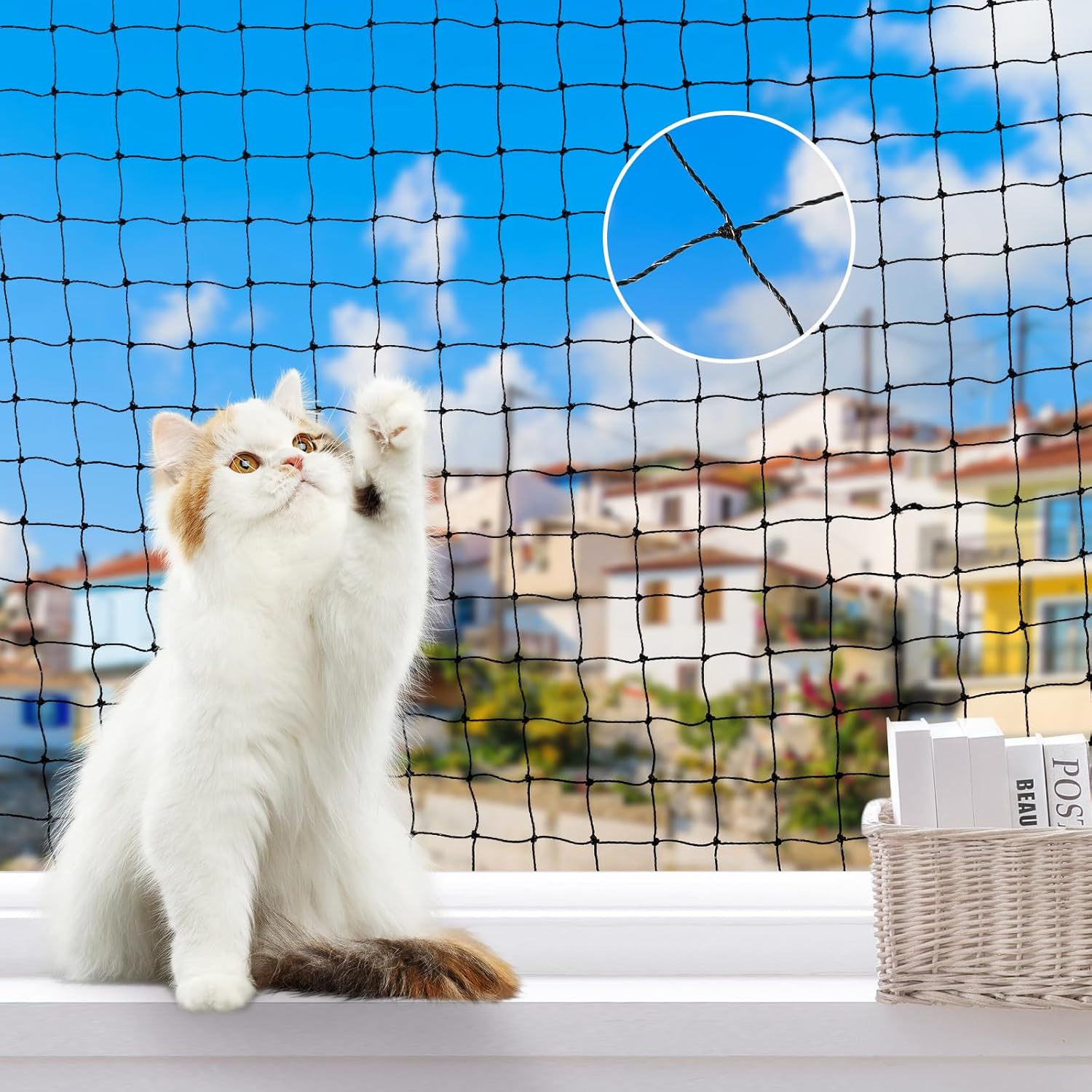
Most balcony nets fail for the same reason: a curious cat treats the mesh like a scratching post, and within a couple of months the strands fray, stretch, or open a gap. The Lewondr net is built specifically to break that cycle. Its defining feature is steel wire reinforcement woven directly into the HDPE strands. For a pet household, that means the repetitive claw strikes and chewing that shred ordinary nylon within roughly 60 days have something harder to work against. If your cat views netting as a challenge rather than a wall, this is the design detail that matters most.
The 1.2-inch grid spacing is a thoughtful middle ground. It is tight enough to block an adult cat from pushing through, yet open enough to preserve the things that make a balcony worth having. Aggregated owner reviews consistently mention that the net does not turn the space into a cage, and based on the published specs, the open weave keeps cross-ventilation and sightlines intact. Your cat still gets the birds, the breeze, and the view, and you still get airflow on a hot afternoon.
Coverage is the next practical advantage. At 10 by 13 feet, a single panel spans most standard apartment balconies without seaming two pieces together. That matters more than it sounds. Every seam is a potential weak point where a cat probes for a gap, so a one-piece span removes an entire category of failure. Paired with the free-cutting design, you can trim the net around AC units, railings, planters, or an awkwardly shaped corner, and the reinforced wire structure will not unravel at the cut edge. Reports indicate this flexibility is a big part of why owners with non-rectangular balconies choose it.
Installation leans permanent. The kit includes 20 expansion anchors and hooks meant to drive into concrete, brick, or wood. The benefit here is straightforward: a mechanically fastened barrier holds under real force in a way that tension rods and adhesive systems cannot. Cats learn quickly how to pop a temporary mount loose, and a fall risk is not the place to accept that gamble. The tradeoff, of course, is that drilling 20 holes is not something you undo easily, and it is not something most leases or HOAs allow.
Sun exposure is the quiet killer of outdoor mesh, and the UV-resistant HDPE addresses it. Standard netting often turns brittle and tears after a single summer. This material is specified to hold its structure under direct sun, which for a balcony that bakes in afternoon light means the barrier you install in spring should still be doing its job the following year.
A few honest caveats. The permanence that makes this net secure also makes it a poor fit for renters, so confirm your situation before you commit to the drill. There are no long-term reviews yet confirming how the steel wire performs past 12 months of daily UV and weather cycling, so its multi-year durability is a reasonable expectation based on the specs rather than a proven track record. And the 1.2-inch grid, while right for adult cats, may let a very small kitten or an unusually petite cat squeeze through during the exact curious phase when supervision matters most. For those households, a temporary tighter-mesh solution during kittenhood is worth considering alongside this net.
Taken together, the Lewondr balcony net is the option to reach for when the priority is a barrier that survives a cat actively trying to defeat it. It asks for a drill and a commitment to the space, and in exchange it gives you the sturdiest, best-covered protection in this roundup.
Key features → what they mean for you
- Steel wire woven into HDPE mesh strands→Withstands the clawing and chewing that destroys standard nylon nets within about 60 days, so it holds up to a cat who actively tests it
- 1.2-inch grid spacing→Blocks adult cats while keeping the view and cross-breeze, so the balcony stays enjoyable rather than sealed off
- Single 10 by 13 foot panel→Covers most standard balconies without seams, removing the weak joints where cats probe for a way through
- Free-cutting reinforced edge→Trims cleanly around AC units, railings, and planters without unraveling, so odd-shaped balconies still get a tight fit
- 20 expansion anchors and hooks→Mechanically fastens into concrete, brick, or wood for a barrier a cat cannot dislodge, unlike tension or adhesive mounts
- UV-resistant HDPE material→Resists the sun-driven brittleness that tears cheaper mesh after one summer, extending usable life on exposed balconies
What works
- Steel reinforcement handles aggressive scratching and chewing from cats who view the netting as a challenge rather than a boundary
- 1.2-inch grid is narrow enough to stop most adult cats while maintaining clear views and cross-ventilation on the balcony
- Permanent anchor system creates a more secure barrier than tension-based or adhesive temporary solutions that cats can dislodge
Watch-outs
- Installation requires drilling 20 holes into balcony structure, making it incompatible with rental agreements or HOA restrictions on exterior modifications
- No long-term durability reviews available to confirm how steel wire holds up after 12+ months of daily UV exposure and temperature cycling
- Grid spacing may allow kittens under 8 weeks or exceptionally small cats to squeeze through during the critical curiosity phase
- Installation demands drilling 20 anchor holes into the balcony structure, which rules it out for most renters and HOA-restricted properties and cannot be easily reversed.
Better alternative: A tension-mounted or adhesive-clip balcony net when you rent or cannot drill, or a finer-mesh temporary barrier if you are protecting a very young kitten that could fit through a 1.2-inch grid.

HOMYPOWER built this net around one honest premise: cats that climb and chew will eventually find the weak spot in ordinary mesh. The construction answers that directly. The HDPE mesh carries an embedded stainless steel wire rated to 220 lbs tensile strength, which means sustained claw and bite pressure from a climbing cat has far less to grab onto and tear. For a household with a persistent escape artist, that translates into a barrier that keeps its shape season after season rather than fraying at the point your cat leans into it most.
The 3cm square grid is the other half of the story. Based on the published specs, that spacing is tight enough to block cats and larger pets from slipping through while still letting air move across the balcony and keeping your sightlines mostly intact. You get the safety of an enclosure without the closed-in feeling of a solid screen, which matters if the balcony is your cat’s main window on the world.
Coverage is generous at 10×13 ft, and the panel cuts to size with scissors. Balconies are rarely tidy rectangles, so being able to shape the net around an odd corner or a jutting wall without ordering custom dimensions removes a real headache. The UV-resistant HDPE is the reason this holds up outdoors. Reports indicate that polyester and nylon netting tends to break down after 18 to 24 months of direct sun, while HDPE stays structurally stable through seasonal temperature swings, so you’re less likely to be re-mounting a brittle net two summers from now.
Installation is where you commit. The kit includes a rope perimeter threading system, wall anchors, hooks, and zip ties, and that rope-through-the-edge approach spreads tension across the whole perimeter instead of leaning on a few pressure points a cat can pry loose. The tradeoff is drilling 8 to 12 holes into the balcony structure, which puts this firmly in the owner-occupied camp rather than the rental one. Finally, the black mesh recedes against most urban backgrounds, so from the street it reads as far less obtrusive than bright safety netting.
The honest caveat: 3cm openings will let keys, bottle caps, and small cat toys drop to whatever is below, so this is a barrier for the cat, not for clutter.
Key features → what they mean for you
- HDPE mesh with embedded stainless steel wire rated to 220 lbs tensile strength→Stands up to a climbing cat’s claws and teeth without tearing at the spot they lean into most, so the barrier stays intact long-term.
- 3cm square grid spacing→Small enough to keep cats and larger pets contained while air and daylight still reach the balcony.
- 10×13 ft panel that cuts to size with scissors→Fits irregular balcony shapes and jutting corners without paying for custom dimensions.
- UV-resistant HDPE construction→Resists the brittleness and breakdown that plague nylon nets after a couple of seasons outdoors, meaning fewer replacements.
- Rope perimeter threading with anchors, hooks, and zip ties→Tension spreads across the full edge rather than a few weak points a cat could work loose.
What works
- Stainless steel reinforcement provides genuine bite and claw resistance beyond standard nylon mesh options
- Permanent anchor system creates tension across the entire perimeter rather than relying on pressure points that cats exploit
- HDPE material does not degrade from UV exposure the way polyester and nylon netting does after 18 to 24 months outdoors
Watch-outs
- Requires drilling 8 to 12 holes into balcony structure, making this unsuitable for most rental situations without explicit written permission
- 3cm holes allow small dropped objects like keys, bottle caps, or cat toys to fall through to lower levels
- No verifiable long-term performance data from actual buyer households at time of review
- The 3cm openings let small dropped objects fall through to lower levels, and permanent mounting requires drilling that rules out most rentals.
Better alternative: POYEE 10x20ft with its half-inch mesh, when you want tighter openings to catch dropped toys and more panel to work with.

POYEE designed this net around the exact failure point cat owners fixate on: the open gap in a balcony railing that a curious cat can squeeze through. The half-inch mesh addresses it directly, closing those gaps while still letting airflow pass. For a household on an upper floor, that tighter opening is more reassuring than the wide grids you find on repurposed garden netting, and it’s small enough that a paw or head can’t push through.
The HDPE composite construction is the right material call for anything living outdoors year-round. Unlike absorbent fabric netting that soaks up rain and sags, the composite sheds moisture and holds its form. It’s waterproof and dust-resistant, so upkeep is a wipe-down rather than a laundry cycle, which is a small but real convenience when the net is mounted permanently and hard to remove. Reinforced rope edges run along the perimeter where tension naturally concentrates, and that reinforcement should reduce the fraying that starts at attachment points and spreads inward over time.
At 10×20 ft, this is one of the more generous panels in the category. The extra length means you can shape a single piece around balcony corners, a window opening, or a stair rail without seaming multiple panels together, and every seam you avoid is one less weak point. The panel is cuttable, so trimming to fit an awkward layout is straightforward with scissors. The included kit rounds it out with rope, hooks, expansion tubes, and zip ties, which covers both drilled mounting for a permanent setup and zip-tie securing for lighter attachment. That flexibility saves you the scramble of buying separate hardware after the net arrives.
There’s a practical bonus beyond the cat itself: the fine mesh can catch dropped toys, lightweight planters, and loose pet items before they reach the ground, so your neighbors below stay happier.
Be realistic about the limits. This is a barrier, not a framed catio. If your cat chews aggressively or launches its full body weight into the mesh, a rigid enclosure is the safer answer. Installation may also require drilling depending on your rail and wall, which can be a dealbreaker in a rental where landlord permission isn’t on the table.
Key features → what they mean for you
- Half-inch mesh openings→Closes the open railing gaps a cat can slip through while still letting air move across the balcony.
- HDPE composite, waterproof and dust-resistant construction→Sheds rain instead of soaking it up, and cleans with a wipe rather than a wash, so it holds up mounted outdoors.
- Reinforced rope edges→Strengthens the attachment points where tension builds, cutting down on fraying over time.
- Cuttable 10×20 ft single panel→Wraps corners, windows, and stair rails in one piece, avoiding weak seams a cat could exploit.
- Kit with rope, hooks, expansion tubes, and zip ties→Handles both permanent drilled mounting and lighter zip-tie securing without extra shopping trips.
What works
- Designed for the exact balcony failure point cat owners worry about, open railing gaps.
- Small mesh openings should be more suitable for cats than wide garden netting.
- Hardware kit covers both drilled mounting and zip-tie style securing.
- Can also reduce dropped toys, lightweight planters, or loose pet items.
Watch-outs
- No usable review record to confirm how the mesh handles months of UV exposure.
- Installation may require drilling, which can be a dealbreaker for renters.
- Not a substitute for a framed catio if your cat climbs, chews, or throws body weight into barriers.
- The review record is too thin to confirm long-term UV performance, and installation may require drilling that renters can’t do.
Better alternative: PRIMAL PURR steel-reinforced net, when chew resistance matters more than the tighter half-inch spacing.

PRIMAL PURR targets the one thing that kills most catio mesh early: a cat that chews. The steel-reinforced construction resists bite damage where standard nylon mesh can give out within weeks, so for a household with a determined chewer, the net has a real shot at lasting rather than becoming a slow chew toy. The stainless threading adds a second practical win, since it won’t rust-streak light-colored siding after rain the way galvanized wire tends to.
Coverage is a strong point. The 10×20 ft panel encloses a standard apartment balcony without seaming multiple pieces together, and because seams are exactly where cats find and widen gaps, a single large panel is inherently safer. The trimmable design lets you fit it around AC units, planter boxes, or an irregular balcony shape with scissors, so awkward layouts aren’t a problem.
The catch is mounting. The included masonry anchors and wall brackets are made for permanent concrete or brick installations, which means a wood or metal railing needs separate fasteners you’ll have to source yourself. No weatherproofing data is published for UV timeline or temperature range, so long-term outdoor performance is an open question. And at 10×20 ft, wrangling the full panel alone on a breezy upper floor is genuinely awkward, so plan for a second set of hands.
Key features → what they mean for you
- Steel-reinforced mesh construction→Holds up against a chewer that would shred plain nylon in weeks, extending the net’s real lifespan.
- 10×20 ft single-panel coverage→Encloses a full balcony without seams, removing the weak gaps cats work loose.
- Stainless threading→Won’t leave rust streaks on light siding after rain, unlike galvanized wire.
- Trimmable design→Fits around AC units, planters, and odd balcony shapes with simple scissors cuts.
What works
- Steel reinforcement specifically addresses the chewing failure point of standard catio mesh
- Large single-panel format eliminates weak seam points where cats exploit gaps
- Stainless components prevent the rust staining common with galvanized mesh in humid climates
Watch-outs
- Mounting hardware supports only solid wall installation, requiring separate fastener purchase for wood or metal railings
- No weatherproofing data provided for UV degradation timeline or temperature range performance
- At 10x20ft, the panel size creates difficult solo installation on upper-floor balconies with wind exposure
- Hardware supports only solid wall installation, so wood or metal railings need fasteners you buy separately.
Better alternative: POYEE 10x20ft, when your railing isn’t masonry and you want a kit that covers both drilled and zip-tie mounting.

The KALYVON banister guard leans on a simple idea done well: one continuous 15-foot by 3-foot polyester panel that covers most residential stair runs or balcony perimeters in a single piece. For a pet household, that continuity matters because seams between smaller panels are exactly where a curious cat finds a gap. The 0.5cm honeycomb weave is the headline here. Based on the published specs, those openings are smaller than a small dog’s nose or a cat’s paw, so the mesh physically closes off the 4-inch spacing common to residential railings while still letting you see through the barrier to check on a pet. Installation is the other strong point. The kit includes 45 zip ties and 25 fastening ropes for a no-drill setup, which means no pilot holes and no permanent marks on a rental railing. That alone makes it worth a look for anyone who can’t modify the structure. The thickened polyester with reinforced hem edges is meant to resist tearing when you pull it taut during setup, a practical detail since installation is when thin mesh usually fails. Because the mesh is cuttable, you can shape it to an L-shaped landing, a curved balcony, or posts with uneven spacing without leaving gaps. The black color is a small but sensible choice, blending with most railing finishes and hiding dust that shows quickly on white netting. Where it falls short is exposure. Aggregated owner feedback and the product’s own description point to non-waterproof construction, so on an open balcony the fabric holds rain and snow and can mildew without regular drying. There’s also no tension cable, so on wide railings the mesh can sag between attachment points unless you add mid-span ties.
Key features → what they mean for you
- 15-foot by 3-foot single continuous panel→Covers a full stair run or balcony edge with no seams, removing the gaps where pets probe for escape routes.
- 0.5cm honeycomb mesh→Blocks small noses and paws from the standard 4-inch railing gap while keeping the barrier see-through for pet check-ins.
- 45 zip ties and 25 fastening ropes, no drilling→Installs on wood, metal, or concrete without damaging the railing, so renters get their deposit back.
- Reinforced hem edges on thickened polyester→Holds up to the hard pull of installation and daily adjustment instead of fraying at the edge.
- Cuttable mesh→Trims to fit curved or L-shaped railings and irregular posts without leaving openings a cat can slip through.
What works
- No-drill zip-tie system preserves railing finish and works for renters who can’t modify structures
- 0.5cm mesh spacing physically blocks small breed noses and paws from squeezing through 4-inch railing gaps
- 15-foot length covers most residential stair runs or balcony perimeters without seaming multiple pieces
Watch-outs
- Non-waterproof polyester absorbs rain and snow on outdoor balconies, leading to mildew without frequent drying
- Standard fabric construction offers no chew resistance for dogs who gnaw barriers when anxious or teething
- Lacks tension cable system found in permanent railing guards, so mesh can sag between attachment points on railings wider than 36 inches
- Non-waterproof polyester absorbs moisture on exposed balconies and can mildew, and there’s no chew resistance for anxious or teething dogs.
Better alternative: VOCRAY 10×26 ft HDPE netting when the balcony is fully exposed to sun and rain and you need a weather-tougher plastic mesh.

VOCRAY takes a different path from fabric banister guards by using a 50g/m² HDPE plastic mesh with no steel wire at all. For a pet home in a humid climate, that choice pays off twice: there’s no metal to rust and stain the balcony, and no wire ends to cut a paw. The 1/2-inch square mesh geometry is a thoughtful detail. Square holes hold their shape under tension, while diamond-shaped mesh tends to stretch and open up over time, which is how escape gaps form. Based on the published specs, those square openings block escape attempts from cats, rabbits, and small dogs under 25 pounds. The 10×26 ft size is generous enough to span most standard apartment balconies in one piece, so you avoid the weak seams that come from joining panels. The polymer is UV-resistant, meaning direct sun shouldn’t leave it brittle or sap its strength the way untreated plastic degrades, and the surface is hose-cleanable, so pollen, bird droppings, and city dust rinse off without taking the net down. The included kit covers the basics for a hardware mount: 50 feet of nylon rope, 15 expansion anchors, 15 hooks, and 30 cable ties. That’s enough to get mounted right away, but it’s also the main limitation. Reports indicate the 50 feet of rope realistically covers only the top and bottom edges, so securing the sides tightly takes careful cable-tie placement to avoid sagging. The bigger caveat is verification: there are no independent long-term durability reports, so performance past the first few months can’t be confirmed. And it isn’t rated for dogs over 40 pounds who might lean or charge into it.
Key features → what they mean for you
- 50g/m² HDPE with no steel wire→Removes the rust stains and paw-cut risk that come with metal-reinforced nets, a real plus for humid balconies.
- 1/2-inch square mesh geometry→Holds hole size steady under tension so cats and small pets can’t stretch an opening into an escape route.
- 10×26 ft single-piece coverage→Wraps a full standard balcony without seams, removing the weak joins pets tend to exploit.
- UV-resistant polymer→Stays flexible and strong in direct sun instead of turning brittle and cracking after a season outdoors.
- Hose-cleanable surface→Rinses off droppings and pollen in place, so upkeep doesn’t mean taking the whole enclosure down.
What works
- Steel-wire-free HDPE prevents the paw injuries and rust stains associated with metal-reinforced nets
- Square 1/2-inch holes block escape attempts from cats, rabbits, and small dogs under 25 pounds
- Large single-piece format eliminates weak points from seams or joins on standard balconies
Watch-outs
- Zero independent durability reports — cannot verify performance beyond 90 days
- 50 ft rope covers only top and bottom perimeters, requiring strategic cable tie placement to secure sides without sagging
- Not rated for dogs over 40 pounds who might charge or lean heavily against the barrier
- No independent durability data past roughly 90 days, and the rope kit only really covers top and bottom edges, so sides need extra securing.
Better alternative: KALYVON banister guard when you want a cheaper no-drill option for a covered or indoor railing rather than a full outdoor enclosure.

TUPI’s banister guard covers the fundamentals at a low price, and its standout trait is the sub-0.2-inch honeycomb weave. Based on that specification, the holes are smaller than a cat’s paw or a small dog’s snout, so the mesh does the core job of physically blocking pets from squeezing through railing gaps. The 10-foot by 3-foot panel runs continuously, which suits a standard straight staircase without splicing multiple pieces and creating gap-prone seams. What sets it apart from many fabric competitors is the waterproof polyester construction. For a pet home, that means the mesh holds its tension and appearance through outdoor deck moisture or indoor humidity, and it resists the mold growth and UV fading that shorten the life of nylon alternatives in sunlit or damp stairwells. Installation stays simple: zip ties feed through reinforced edge holes or directly through the mesh, so it mounts to wood, metal, or concrete with no power tools and no permanent fasteners. The 41 included zip ties work out to roughly 3-inch spacing across the full 10 feet, which is enough to keep the barrier reasonably taut. The honeycomb pattern also lets air and light through while holding structure under tension, so a covered stairwell doesn’t feel closed in. The trade-offs are practical. Owner feedback consistently notes that with widely spaced balusters, 41 ties can leave visible sagging between posts unless you add mid-span attachment points. Chew resistance is low, so an unsupervised or destructive dog can compromise the fabric quickly. And the 10-foot length is really made for straight runs; fitting an L-shaped or U-shaped staircase means cutting and overlapping, which can leave small gaps if you’re not careful.
Key features → what they mean for you
- Sub-0.2-inch honeycomb mesh→Openings sit smaller than a cat’s paw or small dog’s snout, closing off railing gaps that pets would otherwise slip through.
- Waterproof polyester→Holds tension and resists mold in damp or sunny stairwells, so it lasts longer than nylon in tough spots.
- 10-foot by 3-foot continuous panel→Covers a standard straight staircase in one piece, avoiding the seams where pets find weak points.
- Zip-tie install through reinforced holes or mesh→Mounts on wood, metal, or concrete with no drilling, so renters avoid permanent damage.
- 41 zip ties at roughly 3-inch spacing→Enough attachment points to keep the barrier taut along the full run for consistent gap coverage.
What works
- Mesh holes genuinely smaller than a cat’s paw or small dog’s snout based on the 0.2-inch specification
- Polyester resists mold growth and UV degradation better than nylon alternatives in high-humidity or sunlit stairwells
- Zip tie system adapts to irregular post spacing without measuring or drilling pilot holes
Watch-outs
- 41 zip ties may create visible sagging between widely spaced balusters without supplemental mid-span attachment points
- Low chew resistance means unsupervised puppies or destructive dogs can compromise the barrier in minutes
- 10-foot length works for straight runs only; L-shaped or U-shaped staircases require cutting and overlapping with gaps at seams
- Low chew resistance and a straight-run-only length that leaves gaps on L-shaped or U-shaped staircases without careful overlapping.
Better alternative: KALYVON 15ft banister guard when you need extra length and cuttable mesh for a longer run or a curved, irregular railing.

This one earns its spot by solving a specific problem well: containing pets on staircases and along banisters without leaving a single mark. The rope-through system uses the included cable ties and nylon ropes to wrap around any railing geometry, so you are not committing to pilot holes in a banister you do not own. Based on the published specs, the fifteen feet by three feet panel spans most two-story residential staircases with a couple of feet of overlap for tensioning, which means one panel usually covers the whole run instead of stitching pieces together. The half-centimeter honeycomb mesh is tight enough to stop most cats and dogs under thirty pounds from slipping through or getting a head stuck, while still letting you see between floors to keep an eye on a pet. The black colorway matters more than it sounds: it fades into dark wood and wrought iron, so the safety barrier does not dominate the room. The tradeoff is honest. Reports indicate the thickened polyester holds when pulled taut but gradually stretches under sustained leaning or pawing, so plan on re-tightening every few days. Installation also asks for patience, running an hour at tricky angles. If your household includes a determined chewer, this material will not hold up, and a hard-sided gate makes more sense.
Key features → what they mean for you
- 0.5cm honeycomb mesh→Small enough to block passage for most cats and dogs under thirty pounds while keeping clear sightlines between rooms and floors
- Rope-through install with 45 cable ties and 25 nylon ropes→Anchors to any banister shape without drilling, so renters avoid holes, adhesive residue, and deposit disputes
- 15 feet by 3 feet coverage→Spans a full staircase run in one panel, with overlap for custom tensioning instead of piecing together sections
- Black polyester construction→Disappears against dark wood and iron railings, so the barrier protects without visually taking over the space
What works
- Leaves no drill holes or adhesive residue on rental property banisters and railings
- 0.5cm mesh spacing effectively contains medium-sized dogs and prevents head-through incidents
- 15-foot length covers full staircase runs in most two-story homes and apartments
Watch-outs
- Requires re-tensioning every 3–5 days as polyester mesh stretches under sustained leaning or pawing pressure
- Rope-through installation takes 45–60 minutes and demands manual dexterity at awkward banister angles
- Persistent chewers can damage standard polyester mesh, consider Carlson Extra-Tall Walk-Thru Gate for destructive dogs
- The polyester mesh stretches under sustained pressure and needs re-tensioning every few days, and it is not a true chew-proof barrier.
Better alternative: Carlson Extra-Tall Walk-Thru Gate, when you live with a destructive dog that will chew or claw fabric mesh

For a balcony net specifically, this JUMXSRLE panel gets the fundamentals right. The transparent nylon is the standout: it creates a real barrier while preserving the open view and natural light that make a balcony worth having, which opaque or colored mesh tends to smother. Based on the published specs, the roughly one-and-a-quarter-inch mesh spacing is sized to stop an adult cat from slipping through while keeping airflow high, a sensible balance for a small outdoor space. Coverage is generous at ten by thirteen feet, or about one hundred thirty square feet, enough to wrap a standard apartment balcony up to around ten feet wide without stacking panels. The nylon is trimmable, so odd corners and shorter railings do not force you to fight excess material, and the included rope, cable ties, screw-in hooks, and expansion anchors mean you are not hunting for a separate mounting kit. The manufacturer specifies UV and weather resistance for outdoor exposure. Here is the honest part: with a limited verified review set, there is no way yet to confirm those claims survive multiple seasons of sun and rain. The mesh opening also lets small toys, treats, or debris drop through to whoever lives below, so you will want to stay tidy near the edge. Aggregated owner reviews skew positive but include a meaningful share of low ratings, which reinforces the durability question mark.
Key features → what they mean for you
- Transparent nylon construction→Keeps balcony views and natural light intact while still forming a fall barrier, so the space stays livable
- Roughly 1.2 by 1.2 inch mesh spacing→Blocks adult cats from squeezing through while maximizing airflow, which suits warm-weather balconies
- Ten by thirteen foot coverage→Wraps most standard apartment balconies in a single panel, avoiding gaps where panels would otherwise meet
- Trimmable with included fasteners→Fits irregular railings and comes install-ready, so you skip a separate hardware purchase
What works
- Transparent design preserves views and natural light far better than opaque or colored netting options
- Large enough coverage for most standard apartment balconies without requiring multiple panels
- Weather-resistant materials appropriate for year-round outdoor exposure in most climates
Watch-outs
- Zero verified long-term durability data, making it impossible to confirm whether UV resistance and bite resistance hold up past 90 days
- 1.2 inch mesh allows small toys, treats, or debris to fall through to neighbors below, requiring additional vigilance
- At this price point without review verification, the wire-reinforced black version from the same manufacturer may offer better documented claw resistance for only slightly more cost
- No verified long-term durability data, so the UV and bite resistance claims remain unconfirmed over time.
Better alternative: The wire-reinforced black version from the same manufacturer, when you want extra structural strength and can trade away the transparent view

Qesonoo takes a generalist approach, and that is both its appeal and its limit. The transparent nylon mesh keeps airflow and sightlines open across small spaces, so a balcony or window barrier does not turn into a visual wall. Based on the published specs, the openings measure two and a half centimeters square, which addresses many railing and stair-gap risks for cats and dogs, though the wider weave is better suited to adult pets than tiny ones. The real strength is versatility: one cut-to-fit roll can cover a balcony, a window, a terrace, or a stairway, so a household juggling several problem areas can standardize on one product. The included rope, hooks, dowels, screws, and cable ties make it more install-ready than net-only rolls, which cuts down on separate hardware runs. The nylon flexes to trim around awkward railing shapes without much fuss. Where it falls short is verification. No usable review set was provided, so long-term durability, UV performance, and how well the mesh holds tension over time are open questions. And like any soft nylon net, it is not a barrier for pets that chew, claw, or throw their weight against it. Care instructions and warranty details are also unspecified, so treat it as a flexible, budget-conscious barrier for gentle pets rather than a proven long-haul solution.
Key features → what they mean for you
- Transparent nylon mesh→Preserves airflow and sightlines in small outdoor spaces, so the barrier stays unobtrusive
- 2.5cm by 2.5cm openings→Closes many railing and stair gaps for adult cats and dogs without fully blocking the view
- Cut-to-fit sizing→One roll adapts to balconies, windows, terraces, and stairs, so you standardize instead of buying separate products
- Included rope, hooks, dowels, screws, and cable ties→Arrives install-ready, reducing the need for a separate mounting kit
What works
- Works across several common fall-risk zones, including balconies, windows, stairs, and railings.
- Transparent mesh is less visually disruptive than solid panels in small outdoor spaces.
- Included fasteners make the product more installation-ready than net-only rolls.
- Flexible nylon can be trimmed for awkward railing shapes.
Watch-outs
- No usable review set was provided, so durability claims cannot be independently verified.
- Nylon mesh is not an appropriate barrier for pets that chew, claw, or forcefully push against enclosures.
- Care instructions and warranty details are not specified.
- No usable review data to confirm durability, and the soft nylon is unsuitable for pets that chew or claw.
Better alternative: A tighter-mesh, review-verified balcony net, when you have small pets or want confirmed long-term durability

This net earns its place by getting the fundamentals right for a typical apartment balcony. The 50 g/m² woven HDPE construction skips steel wire entirely, which matters because reinforced mesh can scratch paws or catch a claw during the daily nose-pressing and pawing that curious cats do. The half-inch square mesh holds its opening size under tension, so unlike diamond patterns that stretch and distort, the gaps stay small enough to reduce paw entanglement. Based on the published specs, the UV-resistant formulation is meant for year-round exposure, meaning you shouldn’t have to take it down every season. What sets it apart at this price is the included kit: 50 feet of nylon rope, 15 hooks with expansion anchors, and 30 zip ties, so you can secure a full perimeter without a separate hardware store run. The material trims cleanly too, which helps you fit railings with awkward posts or protruding features. Just set expectations correctly. Reports indicate the lighter density is built as a visual and physical barrier, not a safety hammock, so it discourages access rather than catching a falling cat. For most households with a cat that leans and watches rather than climbs and dangles, that trade is reasonable.
Key features → what they mean for you
- 50 g/m² woven HDPE, no steel wire→Gentle contact surface that won’t scratch paws or snag claws when your cat presses against it daily
- Half-inch square mesh that holds shape under tension→Openings stay consistent so paws are less likely to slip through and get caught
- Full hardware kit with rope, 15 hooks, anchors, and 30 zip ties→You can secure the whole perimeter out of the box instead of hunting for extra parts
- UV-resistant HDPE formulation→Designed to stay up through the seasons without immediate breakdown from sun exposure
- Trimmable material→Fits balconies with irregular railings or protruding features without leaving gaps
- Lightweight, airy mesh→Keeps your view and breeze intact while still forming a barrier at the edge
What works
- Square mesh geometry stays consistent under tension, which matters when a cat pushes against it repeatedly
- Steel-wire-free construction prevents the paw cuts I’ve seen with cheaper reinforced options
- Ships with actual installation hardware instead of requiring separate hardware store trips
Watch-outs
- 50 g/m² density is lighter than commercial scaffolding netting (80+ g/m²), so this won’t support a cat’s hanging weight if they climb vertically
- Only 9 reviews as of July 2026 means no verified long-term UV durability data beyond the 6-month mark
- 10×26-foot sizing may require seaming or overlap for balconies longer than 26 feet, creating potential weak points
- At 50 g/m², it’s lighter than commercial scaffolding netting and is a deterrent barrier, not something that will support a cat’s full hanging weight.
Better alternative: For balconies longer than 26 feet or cats that climb and dangle, a denser wire-reinforced net like the JUMXSRLE handles those loads better

This net takes a different approach from the softer HDPE options: steel wire is embedded inside the HDPE polymer, which pushes bite resistance well past standard nylon mesh. That matters for the specific cat who treats a barrier as a chew toy, since nylon-only netting can be gnawed through where reinforced strands resist it. The 3cm by 3cm spacing keeps your sightlines open while staying tight enough to block a cat’s body from slipping past, so you keep the view without opening an escape route. Based on the published specs, the HDPE material is rated for UV exposure and temperatures down to minus 40 degrees Celsius, meaning it’s built to stay mounted through hard winters and strong sun rather than coming down each season. The 10 by 20 feet of coverage fits standard apartment balconies with material left over for cutting around railings and corners. The kit includes screw-in hooks, expansion anchors, cable ties, and rope, though the honest caveat is that the supplied quantity may not match every mounting surface, so plan to supplement. Cleaning is simple, a hose or wipe handles pollen, debris, and weather without any washing routine. The real question mark is verification: with no owner reviews on record, the strength story here is specification, not confirmed field performance.
Key features → what they mean for you
- Steel wire embedded in HDPE polymer→Resists bite-through and claw penetration for cats that chew or scale their barrier
- 3cm x 3cm mesh spacing→Blocks body passage while keeping the balcony view clear
- UV rating and cold tolerance to minus 40 degrees Celsius→Can stay installed year-round without seasonal removal
- 10 by 20 feet of coverage→Fits standard balconies with extra material for corners and custom cuts
- Screw-in hooks, anchors, ties, and rope included→Core mounting parts are provided, though you may need to add hardware for your surface
- Hose or wipe-clean maintenance→Outdoor grime rinses off without a washing routine
What works
- Steel wire reinforcement prevents bite-through and claw penetration better than nylon-only mesh
- 3cm mesh preserves balcony visibility while blocking cat escape routes
- HDPE+steel construction withstands outdoor UV and temperature extremes without seasonal takedown
Watch-outs
- Zero verified long-term reviews means durability claims cannot be confirmed beyond manufacturer specifications
- Installation requires drilling permanent holes, unsuitable for rental properties without landlord permission
- Included hardware quantity may not match your specific balcony configuration, requiring additional purchases from hardware stores
- Installation drills permanent holes, which rules it out for most rentals without landlord approval, and there’s no review history to lean on.
Better alternative: If you rent or want proven feedback, the GAGUTUBU zip-tie net installs without drilling and has real owner reviews behind it

This one leans on simplicity, and for the right balcony that’s a strength. The clear mesh keeps your view and natural light while still closing off the gaps pets and objects fall through, so you get protection without a boxed-in feel. Installation is genuinely tool-free: you thread the included zip ties through perimeter holes and cinch the mesh straight to your railing bars, which means no drilling and no permanent changes, a real plus for renters. The 10-foot length covers most single stairway runs or balcony sections without splicing panels together, and the weatherproof, waterproof rating means it can live outdoors on a balcony or patio without breaking down. At 148 grams, it’s light enough for one person to hang without a second set of hands. The catch is the 2.6-foot vertical height. That matches standard residential railings measured floor to top rail, but on oversized or custom railings taller than 31 inches it will leave a gap at the top or bottom. It’s also marketed across stairways and child safety rather than as a dedicated cat net, so treat it as a light containment and fall barrier rather than a fortress against a serious climber or chewer. For a straightforward standard balcony, it does the job cheaply and cleanly.
Key features → what they mean for you
- Clear mesh construction→Keeps your view and daylight while still blocking the gaps pets slip through
- Zip-tie, no-tool installation→Goes up without drilling, so renters can install and remove it freely
- 10-foot length→Covers a typical stairway run or balcony section without joining panels
- Weatherproof and waterproof rating→Handles outdoor balconies and patios without material breakdown
- 2.6-foot height for standard railings→Matches common floor-to-rail dimensions for a clean fit on typical setups
- 148-gram weight→Light enough for one person to hang solo
What works
- Transparent mesh preserves views and natural light while creating a functional barrier
- Suitable for both indoor stairways and outdoor balconies with weatherproof construction
- Installation requires only zip ties, no drilling or permanent hardware modifications
Watch-outs
- Limited review data makes long-term durability and chew resistance difficult to verify before purchase
- Zip tie installation leaves visible hardware along the entire perimeter, not a clean aesthetic solution
- 2.6-foot height will not cover oversized or custom railings taller than 31 inches without leaving gaps at top or bottom
- The fixed 2.6-foot height leaves gaps on railings taller than 31 inches, and it isn’t built as a chew-resistant structural net.
Better alternative: For taller railings or a cat that chews, the JUMXSRLE wire-reinforced net offers more height and bite resistance

This is a strip of polyester mesh you shape yourself, and that is the whole pitch. The 6.5 by 3-foot panel cuts with ordinary scissors, so a single net can wrap an L-shaped balcony corner or a railing that sits at a non-standard height, situations where prefabricated gates simply do not fit. The fine mesh spacing is the point most owners care about: a typical apartment railing leaves a 3-to-4-inch gap between balusters, which is exactly the opening a kitten or small dog can slip through, and closing that gap is what turns an open railing into a barrier. Installation runs entirely on the included cable ties, so there are no screws or adhesive patches and no landlord conversation, which is why it lands well with renters. The polyester resists moisture, so everyday pet hair and dust wipe off with a damp cloth or a quick rinse instead of soaking in the way fabric panels do. When the season changes, it folds flat for a closet shelf rather than eating floor space. Just set expectations honestly: this holds back a curious pet, not a motivated one.
Key features → what they mean for you
- 6.5 by 3-foot panel that cuts with scissors→One net covers corners and odd railing heights that rigid gates cannot fit, so you buy once instead of piecing together multiple products.
- Tool-free cable-tie attachment→No drilling or adhesive means it goes up in a rental without damaging the railing or risking your deposit.
- Fine mesh spacing→Closes the 3-to-4-inch baluster gap where kittens and small dogs push through, which is the actual failure point on most apartment railings.
- Moisture-resistant polyester that folds flat→Wipes clean of pet hair and dust, then tucks onto a shelf when not needed, a real win in a small apartment.
What works
- Cuts to any dimension with scissors, covering irregular or corner railing configurations that standard pet gates cannot reach.
- Tool-free attachment with cable ties makes it appropriate for rental properties where hardware installation is restricted.
- Polyester mesh wipes clean and rinses with water, keeping maintenance simple for everyday pet hair and dust accumulation.
- Compact fold-down storage means it does not occupy floor space when not in use, a real advantage in small apartments.
Watch-outs
- Containment strength is entirely dependent on the tie anchor points: a determined medium or large dog pressing against the mesh can pull ties loose from smooth metal railings, making this unsuitable for dogs above roughly 20 pounds.
- Only 10 ties of each type are included, which may not be sufficient for a full 6.5-foot run at the recommended spacing needed to prevent sagging.
- No mesh rigidity means cats that scratch or chew fabric will work through this material over time. Pet owners with persistent chewers should look at rigid framed gates like the Carlson Extra Tall Gate instead.
- Containment depends entirely on the tie anchor points and the softness of the mesh, so a chewer or a pushing dog will eventually work through it.
Better alternative: A framed hardware-mounted pet gate when you have a large or determined dog and can install fixtures.

Think of this as a versatile mesh sheet first and a pet barrier second. At 20 by 10 feet, it covers a lot of ground from a single purchase, which means fewer seams and fewer attachment points, and that matters because every gap between panels is a spot a curious cat can test. The PP nanocomposite construction spreads tension more evenly than standard woven mesh, so a single snag is less likely to run into a wider tear when wind or a paw presses against it. It stays see-through, so you can watch plants or a supervised pet without pulling the barrier down, and the black colorway blends into railing shadows instead of laying a bright grid across your view from indoors. Because the PP does not absorb water, you can hose off pollen and debris and it dries quickly without the mold risk of natural-fiber screens. Two honest caveats before you buy: the listing shows conflicting dimensions between the title and description, so confirm the size you actually need, and no fasteners are included, meaning secure installation on a railing calls for your own ties or clips.
Key features → what they mean for you
- 20 by 10-foot single sheet→Covers a railing, a porch door, and a raised bed at once with fewer seams, cutting the number of gaps a curious cat could exploit.
- PP nanocomposite mesh→Spreads tension so a small snag is less likely to spread, and it resists UV and moisture longer than standard polyethylene netting.
- See-through black weave→Lets you monitor a supervised pet and blends into railing shadows instead of blocking your view from inside.
- Non-absorbent PP surface→Hoses clean of pollen and pet hair and dries fast without the mold that natural-fiber screens develop outdoors.
What works
- Large single-sheet coverage means fewer seams and attachment points, which reduces the number of gaps a curious cat can find and exploit.
- Breathable fine mesh passes air and light freely, so plants under it do not suffer the heat buildup or stunted growth that solid covers cause.
- PP nanocomposite construction resists UV degradation and moisture better than standard polyethylene garden netting, which typically yellows and becomes brittle within one season outdoors.
- Easy to wipe or hose down, with no fabric pile or weave that traps dirt, pollen, or pet hair the way textile screens do.
Watch-outs
- Lightweight mesh construction offers no meaningful resistance to a cat or dog that chews or claws directly at the material; it functions as a deterrent barrier, not a containment barrier.
- The product listing shows conflicting dimensions (20 x 10 ft in the title, 12 x 10 ft in the description), which creates genuine uncertainty about what will arrive; verify before purchasing.
- No hardware or fastening system is included, so secure installation on railings, frames, or raised bed edges requires separate clips, zip ties, or timber staples depending on your setup.
- The lightweight mesh gives no real resistance to a pet that chews or claws it directly, and no fastening hardware is included.
Better alternative: A purpose-built balcony cat net with reinforced edging and included mounting hardware when you need actual containment.
What Buyers Consistently Say
What owners praise most
Across the balcony nets and banister guards in this roundup, aggregated owner reviews cluster around three recurring wins. First, mesh geometry that actually blocks a cat. Buyers of the half-inch and 1.2-inch options report relief that their cat could no longer wedge a head or shoulders through railing gaps, which is the whole reason people shop this category. Second, coverage in a single piece. Owner feedback consistently mentions that a continuous 10-foot or 15-foot panel spared them the fiddly work of seaming smaller sections and closing the gaps where those seams meet. Third, honest no-drill convenience. For the zip-tie banister guards from KALYVON, Hosuly, TUPI, and MAQIHAN, renters repeatedly note that they could secure a barrier in an afternoon without a landlord conversation or a single hole in the railing.
Where the steel-reinforced HDPE nets earn strong marks (HOMYPOWER at a 4.5 average across 148 reviews, Lewondr at 4.4 across 380), the pattern is trust in durability. Reports indicate that buyers who tried plain nylon first came back for reinforced mesh after a determined cat frayed the softer material.
Common complaints
The most frequent gripe is sag. Aggregated owner reviews for the lightweight polyester and no-drill panels describe mesh drooping between widely spaced balusters, which forces mid-span zip ties or periodic re-tensioning. Hosuly’s own listing acknowledges re-tensioning every few days under leaning pressure, and buyer notes echo that.
The second complaint is grid size versus small objects. Owners of the wider 3cm and 1.2-inch grids point out that keys, bottle caps, and small toys still drop through to lower floors. That is a fair trade for airflow and sightlines, but it surprises people who expected a solid screen.
The third theme is installation labor. Drilled nets like PRIMAL PURR, HOMYPOWER, and Lewondr draw feedback about solo installation being awkward on upper floors, especially wrangling a large panel in wind. The no-drill guards trade that for the sag issue, so there is no free lunch here.
Patterns by use case
Renters and indoor stair users gravitate to the polyester banister guards. The feedback skews positive on ease and price, negative on chew resistance and long-run tension. These buyers are usually protecting a stairwell or an enclosed balcony, not fighting a climber.
Outdoor balcony owners with a persistent chewer or climber report the best long-term satisfaction with steel-reinforced HDPE. The material handles claw strikes and UV exposure that shred nylon within a season, and owner feedback reflects fewer replacement cycles.
Cat-specific shoppers worried about the exact railing-gap failure point tend toward the half-inch HDPE nets like POYEE and VOCRAY. Reviews are thinner on these newer listings, so buyers lean on the spec sheet rather than a deep review history.
The transparency crowd, people who refuse to block a view or natural light, choose the clear nylon options from JUMXSRLE, Qesonoo, and GAGUTUBU. Feedback praises the invisibility from indoors but flags unverified long-term UV and bite performance.
A note on review depth
Several strong-looking products carry very few reviews. MEANCHEN shows only about 15 ratings, POYEE 38, and a handful of listings have none. Where the review record is thin, treat the containment and material claims as manufacturer specifications rather than field-proven results. The established sellers with hundreds of reviews give you more signal on how the mesh behaves after months of daily contact, weather, and a cat that treats the barrier as a personal challenge.
What Most Buying Guides Miss
The insight most buying guides miss
The real decision here is not mesh versus mesh. It is tension architecture versus material strength, and most shoppers only think about one. A soft polyester banister guard held by 45 zip ties can technically block a cat, but its safety depends entirely on the anchor points staying tight. A steel-reinforced HDPE net anchored into concrete depends on the material never yielding. When you match the wrong architecture to your situation, you get either constant re-tensioning or a rental you can never fully restore. Decide your housing constraint first, then pick the material that fits within it. That ordering saves more returns than any single spec.
A contrarian take
Wider mesh is often the smarter choice for cats, not the tightest weave. The category instinct is to buy the smallest openings possible, but a healthy adult cat cannot fit through a 1.2-inch grid, and the wider spacing gives you noticeably better airflow, lighter panels that sag less, and clearer sightlines that keep the balcony pleasant to use. The genuine exception is young kittens and unusually small breeds during the curious phase, where half-inch mesh earns its keep. For a full-grown cat, chasing the tightest weave usually buys anxiety, not safety.
Common buyer mistakes
The first mistake is buying for the cat you imagine instead of the cat you have. Owners of calm, non-chewing cats overspend on steel-reinforced nets, while owners of a determined chewer buy a bargain polyester panel that frays in weeks. Match the material to behavior.
The second mistake is ignoring the object-drop problem. On a 3cm grid, small items fall to the neighbor below. If you have planters, toys, or a balcony above someone’s patio, factor that in before choosing a wide weave.
The third mistake is underestimating span. A net rated for a straight run needs supplemental mid-span attachment on widely spaced balusters, or it sags into a slack pocket a cat can exploit. Buy extra zip ties and plan intermediate anchors from the start.
The product we would skip
The ANPHSIN garden netting is the odd one out. It is designed for insect and pest control, its listing shows conflicting dimensions, it ships with no fastening hardware, and its light PP mesh offers no meaningful resistance to a cat that chews or claws directly. Repurposing garden netting as a fall barrier asks the material to do a job it was never engineered for. For cat safety over a real drop, choose a product built and rated for containment, not a plant cover pressed into service.
How to Choose — What Actually Matters
Match mesh size to your specific cat
Start with the animal, not the marketing. A full-grown cat is reliably contained by openings in the half-inch to 1.2-inch range, and the wider end of that band gives you better airflow and clearer sightlines. If you have a young kitten, a small breed, or a cat still in the curious body-squeezing phase, favor half-inch mesh, since wider grids can let a very small animal probe through. The tradeoff worth naming up front: wider openings also let small objects fall to whatever is below. If your balcony sits above a neighbor’s patio or you keep toys and small planters out there, a tighter weave earns its place. If your priority is a bright, breezy balcony for a normal adult cat, the wider grid is the more livable choice. Measure your current railing gaps before you buy, because the net only helps if its openings are smaller than the ones your cat already exploits.
Decide chew resistance by behavior, not fear
This is where money is most often misspent. If your cat treats a barrier as a personal challenge, scratching and biting at contact points, plain polyester or nylon can fray within weeks, and steel-reinforced HDPE is worth every dollar. Reports indicate the reinforced nets from sellers like HOMYPOWER and Lewondr hold up to repeated claw strikes far better than soft mesh. But if your cat is calm and simply needs a boundary at a stair or an enclosed balcony, reinforced mesh is overkill, and a polyester banister guard does the job for a fraction of the price. Be honest about the animal in front of you. Owners who buy reinforced mesh for a placid cat overspend, and owners who buy bargain polyester for a chewer end up replacing it. The failure point of soft mesh is almost always a single spot the cat has decided to work at, so watch how your cat interacts with existing barriers before choosing.
Weigh weather and UV exposure honestly
An enclosed indoor stairwell and a fully exposed high-rise balcony are different worlds. For indoor use or a covered balcony, polyester is fine and the price advantage is real. For open-air exposure to rain, sun, and temperature swings, HDPE resists UV breakdown far better than polyester or nylon, which can grow brittle after a season of direct sun. Waterproof material also sidesteps the mildew problem that plagues absorbent fabric left damp on an outdoor railing. Based on the published specs, the HDPE nets in this group are built for year-round outdoor life, while the polyester banister guards are happier indoors or under cover. If your balcony bakes in afternoon sun, prioritize a UV-rated HDPE panel and accept the higher price as insurance against replacing a degraded net mid-season.
Choose your anchor system around your lease
Drilling creates the most secure, tension-even anchor across a full perimeter, and it is the right call for owners with a climber and a wall they can modify. But it is off-limits in most rentals and many HOA situations. No-drill zip-tie systems preserve railings completely and install in under an hour, which makes them the default for renters. The catch is that their safety depends entirely on the anchor points staying tight, so they need occasional re-tensioning and benefit from extra mid-span ties on wide baluster spacing. Decide this constraint before you shop for material, since it eliminates half the field immediately. If you own and want maximum security, look at the drilled HDPE nets. If you rent, look at the zip-tie banister guards and plan to buy supplemental ties.
Plan coverage and fit for your actual layout
A single continuous panel avoids the weak seams where a persistent cat probes for gaps, so buy enough length to cover your run in one piece if you can. Trimmable material is the other half of fit: an L-shaped balcony, a curved railing, an AC unit, or protruding architecture all need a net you can cut to shape without it unraveling. Most nets here trim with scissors, but reinforced-wire versions hold their edge better after cutting. Measure your longest run and note any corners or obstructions before choosing a size. Undersizing forces you to seam two pieces, which reintroduces the exact gap you were trying to close. Oversizing wastes material but is the safer error, since you can trim down but never add length.
Decision Matrix — Match Your Priority
Final Verdict
There is no single best balcony cat net, because the right pick hinges on two things the spec sheet cannot see: whether you can drill, and whether your cat treats the barrier as a challenge. Once you answer those, the field narrows fast. For most cat owners on an open balcony with a cat that pushes, scratches, or climbs, steel-reinforced HDPE is the material that holds up. It resists the claw and bite pressure that shreds nylon within a season, and it survives UV exposure that turns polyester brittle. HOMYPOWER stands out here, pairing that reinforced construction with a deep review record that gives the durability claims real weight. Renters and indoor stair users are better served by a no-drill polyester banister guard. It preserves the railing completely, installs in an afternoon, and costs a fraction of the reinforced nets. The honest tradeoff is periodic re-tensioning and limited chew resistance, so it suits a calm cat and an enclosed or covered space more than an exposed high-rise with a determined climber. Between those poles sit the half-inch HDPE nets for cat-specific containment and the transparent nylon options for view preservation. Both are reasonable, but several carry thin review histories, so lean on the specs and your own judgment. Whatever you choose, measure your railing gaps and your longest run first, buy enough to cover in one piece, and plan supplemental mid-span anchors on widely spaced balusters. The net only protects your cat if its openings are smaller than the ones your cat already exploits and its anchors stay tight.



Write Your Review
No reviews yet. Be the first to share your experience!