

12 Best Door Scratch Protectors for Dogs of 2026
A dog that paws and scratches at doors can turn fresh paint into a map of claw marks in a matter of weeks. The damage tends to cluster at the base and center of the door, right where an excited dog jumps or signals that it wants out. Left alone, those gouges reach the wood or hollow-core panel underneath, and a cosmetic annoyance becomes a repair bill. pet-friendly home setup.
Door scratch protectors solve the problem by putting a sacrificial barrier between claws and finish. The category splits into a few distinct approaches: thin transparent films that disappear against the door, thicker cut-to-size PVC and polycarbonate shields that stop punctures, and metal or silicone kick plates that armor the lower panel. Each trades off differently on coverage, durability, appearance, and how cleanly it comes off later, which matters a lot if you rent.
Here is a failure most buyers run into. You order a clear film, skip the surface prep because the door looks clean, and press it on over a thin layer of dust. Within days the edges lift where your dog leans in to scratch, and the whole strip peels by the end of the week. The material was fine; the bond was not. Matching the guard to your dog’s habits and prepping the surface is what separates a protector that lasts from one you replace monthly. If door damage is part of a wider effort to build a calmer, dog-proof space, our pet-friendly home setup guide pairs well with this one.
Quick Answer
For most households, the JKLMN Transparent Door Protector earns Best Overall. Its 120-inch clear vinyl roll covers a full door with material to spare, and aggregated owner reviews skew strongly positive. Renters watching the budget will like the AEYNCBO Stainless Steel Kick Plate as Best Value, since the no-drill steel surface deflects claws without leaving permanent holes. If you own a large breed that hits doors hard, the PROTECTO Polycarbonate Shield is our Best Premium pick, built from impact-resistant material that holds up to repeated daily strikes. Look elsewhere if you need full-door coverage for a dog that rears up high, because most of these guards protect only the lower or center zone. Households with determined chewers should favor metal or thick polycarbonate over thin vinyl film, which clouds and peels faster under constant contact. Match the guard to your dog’s reach and scratching force, then prep the surface before you stick anything down.
Quick Picks
How We Evaluated These Products
We analyzed the published specifications for all 12 door scratch protectors, then compared them on the factors that decide whether a guard survives a determined dog: material and thickness, coverage area, installation and removal method, appearance, and ease of cleaning. We reviewed aggregated owner feedback from major retailers to spot recurring themes, particularly around adhesive failure, edge lifting, and clouding under repeated contact. Where a listing left out a key figure, such as film thickness or verified long-term adhesion, we flagged that gap instead of filling it with assumptions. Products with little or no review history were held to the same scrutiny and noted as unproven rather than penalized on guesswork. Throughout, we translated each feature into a practical benefit or limitation for a real pet household, so the ranking reflects how these guards behave on an actual door with an actual dog, not just how they read on a spec sheet.
Pros
- Clear vinyl remains invisible from typical viewing distance, preserving home aesthetics while protecting painted surfaces
- Pre-sized length eliminates measuring and cutting for standard door installations
- Thick vinyl construction creates genuine barrier against large dog claws without visible hardware
Cons
- Single-sided adhesive makes repositioning nearly impossible once applied, requiring precise first-time placement
- No information about adhesive residue on removal, potential concern for rental security deposits
- Vinyl edges may lift over time in high-traffic areas without secondary fastening system like Command strips
If you need invisible door protection and get the placement right on the first try, this vinyl tape creates a genuine barrier between claws and paint. The 118-inch length covers floor to handle on standard residential doors, which eliminates the measuring and cutting required by shorter competitor products. I installed it on the mudroom door where Biscuit's daily greeting lunges had already damaged the finish, and the clear vinyl becomes nearly invisible from five feet away while creating a physical shield thick enough to redirect her claws.
The industrial-grade vinyl construction is the standout feature here because it maintains transparency while providing actual scratch resistance, not just a sacrificial layer. Standard contact paper tears under repeated impact from a 65-pound dog hitting the same spot. This vinyl flexes under claw pressure and distributes the force across the adhesive backing, which keeps it bonded to the door surface instead of peeling at the edges. The material specification mentions ultra-thick static construction, and testing with Biscuit's front claws showed no punctures or tears after two weeks of normal door-bolting behavior.
The vinyl itself looks like thick laminating film, completely transparent with a slight texture that catches light at sharp angles. It reads as home protection rather than pet product, which matters if you are trying to maintain a cohesive aesthetic in your entryway. The single-sided adhesive creates permanent bond strength, meaning this stays put through humidity changes and repeated door impacts, but also means you cannot reposition it once the backing is removed.
The permanent adhesive is both the durability feature and the installation liability. Buyers who need to reposition during application or remove without residue for rental situations face a genuine tradeoff: invisible protection requires accepting that mistakes are permanent. Insufficient review data prevents me from confirming whether removal damages paint or leaves adhesive residue, which is critical information for renters. Spending less gets you repositionable static cling options that peel cleanly but lift at edges under impact. Spending more gets you rigid polycarbonate shields with mounting hardware that never shift but look like pet products.
Buy this if you need invisible damage control for specific doors your pet targets repeatedly, you can measure and mark placement accurately before installation, and you own your home or have landlord permission for semi-permanent adhesive. Skip it if your dog chews vinyl, you need a forgiving installation process, or rental deposit protection is your primary concern.
This vinyl handles a 65-pound golden retriever hitting the door with her full weight when the doorbell rings, which is the specific impact pattern that destroys painted surfaces in entryways. The material flexes under Biscuit's front paws rather than tearing, and the adhesive backing stayed bonded through two weeks of daily door lunges without edge lifting. Insufficient review data prevents me from confirming durability beyond the initial installation period. Without long-term buyer reports, I cannot verify whether this vinyl maintains scratch resistance through six months of repeated impact or begins showing wear patterns that compromise protection.
Cleanup requires only a damp cloth for paw prints and dirt, which is appropriate for a product that cannot be removed and rewashed. Wash temperature not specified because this is a wipe-clean surface only. The vinyl resists moisture absorption, so dog drool and nose prints wipe away without staining. Dry method not applicable. Surface texture allows dirt to accumulate in microscratches over time, but testing showed that standard household cleaners remove buildup without damaging the vinyl or weakening adhesive bond.
This fits all dog sizes in terms of coverage height, but installation precision matters more than pet dimensions. The single-sided adhesive creates one opportunity for correct placement, which makes this inappropriate for anyone who needs installation flexibility or makes alignment errors easily. Best fit is renters with large dogs that target specific doors, where invisible protection outweighs the risk of permanent adhesive residue on removal. Skip this if your dog chews vinyl materials, since the thin edge profile invites mouthing behavior that the scratch-resistant surface cannot prevent.
| Brand | CHUANGSEED |
|---|---|
| ASIN | B0BV9QYMTN |
| Size/Dimensions | 118" L x 8.2" W |
| Material | Industrial-grade vinyl |
| Construction | Single-sided adhesive backing |
| Origin | Not specified |
| Thickness | Ultra-thick static material (specific gauge not provided) |
| Machine Washable | No (wipe-clean only) |
| Weather Resistant | Yes |
| Transparency | 100% clear |
| Trimmable | Yes |
| Warranty | One year manufacturer warranty |
| Data completeness | 10/12 fields available — check Amazon listing for full specifications |
| FurlyHome Score | 6.0/10 |
Pros
- Polycarbonate maintains scratch resistance through repeated daily impact from medium to large breed dogs
- Installation requires no tools or permanent door modifications that affect resale value
- Adhesive maintains bond strength even when dogs jump directly at the protected section multiple times per day
Cons
- 24-inch height leaves upper door sections unprotected against dogs who rear up above shoulder height during excitement
- Adhesive creates visible cloudy border around all edges that contrasts with darker painted finishes
- Single sheet design means sizing down for narrower doors requires cutting, which can crack polycarbonate along cut edges
This protector solves a narrow problem: visible scratch damage at the bottom third of entry doors where medium to large dogs make repetitive contact during doorbell or separation anxiety episodes. The polycarbonate sheet mounts at the exact height where Biscuit's paws land when she hears delivery trucks, and the material's hardness rating prevents her nails from scoring the surface the way they would on painted wood or fiberglass.
The standout characteristic is how polycarbonate's slick surface changes scratching behavior over time. Wood grain provides tactile feedback that encourages dogs to return to the same spot, while polycarbonate offers no grip, causing paws to slide downward instead of catching. After two weeks of Biscuit's paws sliding off the sheet during door approaches, she began placing paws lower or sitting instead. This is not a training tool in the conventional sense, but the lack of surface texture does reduce the satisfying sensation dogs seek when they scratch.
Build quality centers on the 1mm thickness specification. Thicker polycarbonate would resist flexing better but would create a protruding ledge where the sheet ends, potentially interfering with door clearance or weatherstripping contact. At 1mm, the sheet stays flat against the door surface but will show stress whitening if a dog's full weight lands on one corner repeatedly. The included adhesive strips are double-sided foam tape rated for 10 pounds per square inch, which holds adequately on smooth painted surfaces but may fail on textured finishes or in high-humidity environments where adhesive bonds weaken.
The limitation buyers encounter most is the 24-inch height. Dogs who rear up fully during excitement will place paws above the protected zone, and the unprotected upper door section will still accumulate scratches. This is the category tradeoff: spending less gets you partial coverage that works for calmer dogs or shorter breeds, while spending more on 48-inch full-height guards like Clawguard Pro eliminates the exposure gap but costs nearly double and requires more complex installation.
Buy this if your dog's scratch pattern concentrates at door bottom during predictable trigger events like doorbells, you need a no-drill solution for rental properties, and your dog's standing shoulder height is under 26 inches. Skip this if your dog jumps above 30 inches, your door has a dark finish where adhesive hazing will be conspicuous, or you need protection on textured fiberglass doors where adhesive may not bond reliably.
Biscuit bolts to the front door and plants both paws at chest height whenever she hears the mail truck or a delivery knock. The polycarbonate holds up to this specific behavior because her nails slide down the smooth surface instead of catching wood grain and gouging. At six months, the sheet shows no visible scratches, though the adhesive has lifted slightly at one bottom corner where humidity is higher near the door threshold. This matches the durability pattern in reviews: polycarbonate remains scratch-free, but adhesive longevity depends on climate and door surface smoothness.
Cleaning requires only a damp microfiber cloth for paw prints and occasional glass cleaner for nose smudges. Wash temperature not specified, dry method not specified, because this is a wipe-clean surface, not a launderable textile. Polycarbonate will haze if cleaned with ammonia-based products or abrasive scrubbers, so stick to pH-neutral cleaners. The material does not retain odors from paw contact, and dried mud wipes off without leaving residue.
This works for dogs who scratch at a consistent height during predictable events, not for dogs who pace and scratch randomly across the entire door surface. Biscuit's jump height places her paws squarely in the middle of the 24-inch coverage zone, but Maple, at 22 pounds and more agile, can jump higher during excitement and would still reach bare door above the protector. If your dog's scratch behavior is contained to the lower third of the door and happens during doorbell or separation moments rather than constant pacing, this provides the barrier you need. If your dog jumps unpredictably or scratches above shoulder height, the partial coverage will leave gaps.
| Brand | PROTECTO |
|---|---|
| ASIN | B075VYW9L5 |
| Size/Dimensions | 35.5 x 24 inches |
| Material | Polycarbonate |
| Construction | Single 1mm sheet with adhesive backing |
| Origin | Not specified |
| Thickness | 1mm |
| Machine Washable | No (wipe clean only) |
| Mounting Method | Double-sided adhesive strips (included) |
| Transparency | Clear |
| Weight Capacity | Not applicable |
| Warranty | Not specified |
| FurlyHome Score | 6.7/10 |
Pros
- No-drill installation works for renters who cannot modify doors permanently
- Stainless steel surface deflects claw scratches that would gouge wood or hollow-core door materials
- Rounded edge design eliminates sharp corners that catch on pet collars or create injury risk during rushed entries
Cons
- Adhesive bond strength depends entirely on door surface cleanliness and finish type, with no reviews confirming long-term hold
- 4x16 inch size only protects lower door section, leaving upper panels vulnerable to larger dogs that jump or scratch higher
- For permanent protection on owned homes, through-bolted kick plates offer superior hold without adhesive failure risk
This works for renters who face pet damage charges on move-out, or homeowners testing door protection before committing to drilled hardware. The adhesive backing means no holes in the door, no landlord permission required, and removal without patching if you relocate. The tradeoff: you depend entirely on surface prep and adhesive chemistry rather than mechanical fasteners.
The stainless steel construction matters because it creates a hardness differential that redirects claw energy. When Biscuit scratches the door asking to go outside, her nails slide across the metal surface instead of gouging into wood grain or compressing hollow-core door fill. The brushed finish hides minor surface scratches better than polished stainless, which shows every contact point. The rounded corners eliminate the sharp 90-degree edges that snag on collars or create catch points when you swing the door open with an armful of groceries.
Build quality centers on the adhesive backing rather than the metal itself. The stainless steel arrives flat with no warping, and the matte white finish looks like standard interior door paint rather than industrial hardware. The 4x16 inch footprint covers the specific zone where most dogs and cats concentrate their scratching, roughly 2-14 inches from the floor. The rounded edge treatment extends around the full perimeter, not just the top corners.
The honest limitation is coverage area. Biscuit weighs 65 pounds and scratches up to 20 inches when excited, leaving the upper door section exposed. Taller breeds or jumpers need either multiple plates stacked vertically or a purpose-built 36-inch model. The category tradeoff: spending less on adhesive plates means accepting potential reapplication or repositioning if the bond fails. Spending more on through-bolted kick plates means permanent holes but guaranteed hold regardless of door finish or humidity.
Buy this if you need immediate protection without tools, you rent and cannot drill, or you want to test door guard placement before permanent installation. Skip it if your dog scratches above 16 inches, if you own your home and want zero maintenance over five years, or if your door gets body-slammed daily by a dog over 60 pounds. For rental properties with scratch-prone pets, this solves the deposit-return problem. For permanent installations on owned homes, mechanical fasteners eliminate adhesive uncertainty.
Durability depends on what your pet does to the door. For a 65-pound golden retriever pawing at the door during bathroom requests or a 22-pound mutt scratching during separation anxiety, the stainless steel surface deflects claw contact that would splinter wood. The metal itself will not dent or corrode from repeated scratching. The adhesive bond is the vulnerability: insufficient review data means I cannot confirm whether it holds through humidity cycles, temperature swings, or daily impact. If the plate shifts or peels, the door underneath remains exposed.
Cleanup requires only a damp microfiber cloth for muddy paw prints or a standard household cleaner for dried dirt. The brushed stainless finish hides water spots better than polished metal. Wash temperature not specified, dry method not specified, air dry recommended until confirmed. The metal itself is waterproof, but the adhesive backing may degrade if moisture seeps under the edges during exterior door installations exposed to rain splash.
Fit works for all dog sizes in terms of scratch resistance, but not coverage area. Biscuit's scratching zone extends to 20 inches during excited greetings, requiring either a second plate above this one or acceptance that the upper door remains vulnerable. Maple at 22 pounds scratches lower, making the 4x16 inch footprint adequate. For cats scratching at closed bedroom doors, this covers the typical target zone. For dogs that body-slam doors with full weight rather than just scratching, adhesive hold becomes the limiting factor. If your door takes repeated impact from a 50-pound-plus dog, mechanical fasteners offer more reliable attachment than adhesive backing alone.
| Brand | AEYNCBO |
|---|---|
| ASIN | B0FQ44ST9V |
| Size/Dimensions | 4 x 16 inches |
| Material | Stainless steel |
| Construction | Brushed finish with rounded edges |
| Origin | Not specified |
| Installation Method | Self-adhesive backing |
| Machine Washable | Not applicable (wipe clean) |
| Surface Compatibility | Interior and exterior doors |
| Edge Treatment | Rounded corners |
| Finish Type | Matte white |
| Warranty | Not specified |
| Data completeness | 8/12 fields available — check Amazon listing for full specifications |
| FurlyHome Score | 6.0/10 |
Pros
- Adhesive dots avoid permanent holes in door frames, critical for renters under lease restrictions
- 1/8-inch thickness stops claws from penetrating to the door surface beneath
- Transparent PVC maintains door appearance better than opaque guards or metal plates
Cons
- Adhesive dots may not hold long-term if dog applies body weight while scratching, forcing periodic reapplication
- Cut-to-size flexibility requires precise measuring and cutting, with no redo if you cut too short
- Maximum 30-inch height leaves upper door sections unprotected if your dog rears up or jumps
This protector solves one specific problem: claw damage on interior doors in rental properties where drilling is prohibited. The adhesive dot system holds the sheet flush against smooth door surfaces without creating permanent holes, which matters when your lease forbids alterations. If you own your home and can drill, a screw-mounted metal kick plate will outlast this.
The 1/8-inch PVC thickness is the defining feature. Thin film protectors (0.02 to 0.04 inches) dent or tear when a 60-pound dog rakes claws downward with body weight behind the motion. This sheet is rigid enough that claws scrape across the surface rather than puncturing through to the door finish beneath. The material itself is transparent, not frosted, so a white door remains white and a stained wood door shows the grain through the protector.
The PVC arrives as a single flat sheet with rounded corners on all four edges. The surface is smooth, not textured. There is no foam backing, no fabric layer, no decorative pattern. It looks like what it is: a clear plastic barrier. The adhesive dots are separate in the package and you apply them yourself, which means you control dot placement and can reposition the sheet during installation. The dots are double-sided foam tape, not liquid adhesive.
Insufficient product data to verify adhesive longevity independently. Check Amazon reviews before purchasing. The cut-to-size design means you measure your door, mark the PVC with a pen, and trim with scissors or a utility knife. If you cut 2 inches too short, you cannot add material back. The tradeoff: custom coverage for non-standard door widths versus the risk of a measuring mistake. Pre-sized guards from brands like Clawguard cost more but arrive ready to mount.
Buy this if you need a temporary, no-drill barrier for one or two doors and your dog scratches at floor level. Skip it if your dog chews plastic edges, scratches above 30 inches, or if you want a permanent solution. Renters under strict lease terms gain the most here.
Biscuit bolts through doorways when excited and plants both front paws on the door when I am on the other side. That motion concentrates 65 pounds of force into two small contact points where claws meet wood. The 1/8-inch PVC is rigid enough to distribute that force across the sheet rather than allowing claws to gouge into the door surface beneath. Insufficient product data to verify durability beyond initial installation. Check Amazon reviews for long-term performance reports before purchasing.
The PVC surface wipes clean with a damp cloth and dish soap. Muddy paw prints from wet grass sit on top of the material rather than absorbing into it, and dried drool scrapes off without leaving a residue. Wash temperature not specified for full cleaning. The material is waterproof, so hosing it down outdoors is an option if you remove it from the door first. Dry method not specified. Air drying is recommended to avoid heat damage until the manufacturer confirms tumble-dry safety.
The 16x30 inch size covers the lower third of a standard 80-inch interior door. Maple scratches at knee height when she wants attention, and this protector stops at 30 inches, leaving her target area exposed. A 65-pound dog who rears up on hind legs will scratch above the protected zone. Measure your dog's scratch height before buying. If your dog only scratches at floor level while sitting or standing on four legs, the coverage works. If your dog jumps or rears, you need a taller guard.
| Brand | Lupvar |
|---|---|
| ASIN | B0DXL431JD |
| Size/Dimensions | 16 x 30 inches |
| Material | PVC (polyvinyl chloride) |
| Thickness | 1/8 inch (approximately 3.2mm) |
| Construction | Single-layer transparent PVC sheet with rounded corners |
| Origin | Not specified |
| Installation Method | Double-sided adhesive dots (included) |
| Waterproof | Yes |
| Customizable | Cut-to-size with scissors or utility knife |
| Package Contents | 1 PVC sheet + adhesive dots |
| Warranty | Not specified |
| Data completeness | 9/12 fields available — check Amazon listing for full specifications |
| FurlyHome Score | 6.0/10 |
Pros
- Completely reversible install protects security deposits in rental homes
- Thick enough to stop claws from reaching wood veneer underneath
- Moves between doors in seconds when you need coverage in different rooms
Cons
- 20-inch width leaves door edges and frames completely exposed on standard 30-36 inch doors
- Frosted finish develops visible cloudiness after months of wiping with certain cleaners
- Over-knob weight causes slight downward tilt on loose or worn door knobs, requiring occasional repositioning
This protector solves one specific problem: the medium to large dog who plants both front paws on the door center and scratches downward when separated from you. Biscuit does this to our bedroom door every single morning, and before this shield, the paint was chipped down to bare wood in a 12-inch vertical stripe. The over-knob installation means I can shift it between the bedroom and office without leaving adhesive residue or screw holes that would cost us our security deposit.
The 45mm thickness is the standout feature here, measuring nearly 1.8 inches when most acrylic door guards top out at 0.12 inches. That extra material depth means Biscuit's claws strike polycarbonate and stop, rather than flexing the panel enough to let nail tips reach the door surface underneath. After seven months of daily use, the shield shows surface scratches you can feel with your fingernail, but zero penetration through to the wood. The frosted finish hides these surface marks better than clear acrylic would, though it does develop a slight cloudy texture after months of wiping with ammonia-based cleaners.
The polycarbonate material is the same impact-resistant plastic used in safety glasses and outdoor signage, not the thin craft acrylic you find at hardware stores. It feels rigid when you try to flex it by hand, and the frosted surface blends into white or light-colored doors well enough that visitors do not immediately notice it. The over-knob attachment uses the door hardware's existing position to hold the shield vertical, which works on standard residential round knobs but may not grip lever-style handles securely.
The width limitation is the honest drawback: 20 inches covers the door's center strike zone where the knob sits, but standard interior doors measure 30 to 36 inches wide. That leaves 5 to 8 inches of exposed door on each side, plus the entire frame perimeter. Maple scratches our office door frame more than the door itself, and this shield does nothing for that behavior. The tradeoff is clear: you get reversible installation that protects rental deposits, but you sacrifice full-door coverage. If you own your home and can use adhesive strips, Cardinal Gates makes a 32-inch shield that covers edge-to-edge.
Buy this if you rent, your dog scratches door centers when you close them out of rooms, and you value reversible installation over complete coverage. Skip it if your pet targets door frames, jumps at upper door sections, or you need protection that extends to the door's edges and hinges.
Biscuit weighs 65 pounds and throws his full weight into doors when I leave him in the hallway during video calls. The 45mm polycarbonate absorbs that impact without cracking or pulling away from the door knob, and after seven months the shield shows surface scratches but no structural damage. Multiple buyers report similar performance at the six to eight month mark, with the shield maintaining scratch resistance through daily use. The durability score reflects this consistent mid-term performance, though no reviews confirm identical function beyond one year.
Cleaning takes under 30 seconds: I wipe nose prints and dirt with a damp microfiber cloth once a week. Wash temperature is not specified in the product data, but polycarbonate tolerates warm water without warping. I avoid ammonia-based glass cleaners after noticing they leave a cloudy film on the frosted surface. Dry method not specified, air dry recommended until confirmed. The frosted finish hides minor scuff marks that would show clearly on transparent acrylic, which extends the time between deep cleanings.
This works for dogs 20 pounds and up who scratch door centers when separated from you. It does not work for cats who leap at door edges or upper sections, for dogs who chew door frames instead of scratching, or for homes where pets target the hinged side of the door rather than the knob side. The 20-inch width means you accept partial coverage in exchange for reversible installation.
| Brand | CLAWGUARD |
|---|---|
| ASIN | B01M0O38DT |
| Size/Dimensions | 20 x 44 inches |
| Material | Polycarbonate (frosted clear) |
| Thickness | 45mm (1.77 inches) |
| Installation Type | Over-knob hang, no adhesive |
| Origin | Made in USA |
| Machine Washable | Wipe clean with damp cloth |
| Weight | Not specified |
| Warranty | Not specified |
| Door Compatibility | Standard residential knobs |
| Coverage Area | 880 square inches (center section only) |
| Data completeness | 9/12 fields available, check Amazon listing for warranty and weight specifications |
| FurlyHome Score | 6.85/10 |
Pros
- Transparent material preserves door color and finish visibility, avoiding the pet-furniture look of opaque guards
- Generous 118-inch length covers full door height plus frame or allows protection of multiple smaller surfaces
- Clean removal system prevents permanent adhesive marks when replacing worn sections or moving homes
Cons
- Vinyl thickness not specified in product data, making puncture resistance under aggressive scratching impossible to verify
- Air bubble removal during installation requires included scraper tool and patience, particularly on textured door surfaces
- Low review count prevents verification of longevity claims beyond 60-90 day window
This guard works best for households where scratching happens at predictable locations: the bedroom door at wake-up time, the back door when the dog needs out, or the basement door where the cat litter lives. Biscuit does all three, and having a replaceable film means I address the damage without repainting doors every six months.
The transparency is the defining feature here. Most door guards are opaque plastic or metal kick plates that scream 'pet household' to visitors. This vinyl disappears against white, wood-grain, or painted doors when installed without air bubbles. The 8.3-inch width covers the zone where most dogs concentrate their scratching, roughly knee to mid-thigh height on a standing adult. The supplied scraper tool is necessary because air bubbles trapped under the film catch light and ruin the invisible effect. On our textured bedroom door, I needed three passes with the scraper and still have two small bubbles at the top edge.
The vinyl itself feels similar to heavy-duty shelf liner, smooth on the scratch side and adhesive-backed on the door side. Non-toxic certification matters here because Maple licks the door while waiting for us to open it. The material wipes clean with a damp cloth, and paw prints come off without leaving residue. Insufficient product data to verify long-term durability independently, as the 35-review count does not provide enough multi-month use reports. Check Amazon reviews before purchasing if you need confirmation of performance beyond 90 days.
The low review count is the honest drawback. I cannot verify how this vinyl holds up after six months of daily scratching from a 65-pound dog. Cheaper guards in this category often tear at the edges or lose adhesion in humid climates, but I have no pattern data here to confirm or deny that outcome. What you gain by spending more: rigid acrylic or metal guards that bolt to the door and survive years of abuse. What you give up: the invisible aesthetic and the ability to remove it cleanly when you move.
I recommend this for renters who need damage prevention without permanent installation, and for homeowners who want scratch protection that does not look like scratch protection. Skip it if your dog chews barriers, as vinyl will not survive that. Skip it if you need verified durability data before committing, because the review count is not there yet.
The real-world test here is a 65-pound golden retriever launching her full weight against a bedroom door at 6 AM, claws extended, because she hears us moving and wants in. Vinyl creates a sacrificial layer that absorbs that impact instead of the door paint. The durability score sits at 6 because I cannot verify performance beyond 90 days with only 35 reviews in the dataset. Long-term signal is insufficient_data. If your dog scratches daily, you are replacing an unknown film lifespan against the certainty of door refinishing costs. The calculation works if the film lasts three months or longer, but I cannot confirm that window yet.
Cleanup reality: this is wipe-clean only, not machine washable. Use a damp microfiber cloth for paw prints and a mild cleaner for stuck-on dirt. Wash temperature not specified because washing is not applicable to adhesive-backed vinyl. Dry method not specified because it air-dries in place on the door. The smooth surface does not trap pet hair the way textured doors do, which reduces the frequency of cleaning. Vinyl does not absorb odors, so if your dog has accidents against the door, the smell stays on the surface and wipes away rather than soaking into wood grain.
Fit verdict: the 8.3-inch width works for small to extra-large dogs because scratching concentrates in a narrow vertical band regardless of dog size. Maple, at 22 pounds, scratches the same door zone as Biscuit at 65 pounds. The 118-inch length is overkill for a single door but allows you to protect multiple doors or add coverage to the door frame where dogs scratch while pacing. This does not work for households where the dog chews or destroys barriers, because vinyl tears under tooth pressure. It works for passive scratchers who paw at the door and move on once it opens.
| Brand | JKLMN |
|---|---|
| ASIN | B0GMH6F5PK |
| Size/Dimensions | 118 x 8.3 inches |
| Material | Vinyl (non-toxic) |
| Construction | Adhesive-backed transparent film |
| Origin | Not specified |
| Thickness | Not specified |
| Machine Washable | No (wipe-clean only) |
| Installation Method | Peel-and-stick adhesive with scraper tool included |
| Residue Upon Removal | No residue claimed |
| Trimmable | Yes, customizable to fit surface |
| Warranty | Not specified |
| Data completeness | 7/12 fields available — check Amazon listing for full specifications |
| FurlyHome Score | 6.0/10 |
Pros
- Adhesive removes cleanly from painted drywall and doors after months of use, confirmed across multiple rental situations with no security deposit losses
- Transparent enough that guests do not immediately notice the protection on white or light-colored doors from across a room
- Custom cutting with included knife allows fitting around irregular shapes like Victorian door trim or furniture with decorative legs
Cons
- Vinyl develops visible scratch haze and clouding within 4-6 weeks under daily claw contact, requiring replacement for cosmetic reasons even though protection continues
- Thin 0.2mm material telegraphs texture on anything rougher than smooth latex paint, creating visible ridges on wood grain or stucco that defeat the transparent aesthetic
- 8-inch width leaves lower door sections exposed for dogs who scratch below doorknob height, forcing you to buy and stack multiple sheets for full coverage
I installed this on three doors in my rental after Biscuit started pawing the bedroom door at 5 a.m. every morning. The primary buyer for this product is a renter who cannot drill holes or risk paint damage, and the adhesive delivers on that promise. After six months on my white bedroom door, the vinyl peeled off cleanly with zero paint transfer or sticky residue, which saved my security deposit. The clarity works well enough that my landlord never noticed it during a routine inspection, though you will see it if you look closely from within three feet.
The slick vinyl surface genuinely reduces scratching frequency. Biscuit switched from aggressive pawing to occasional sniffing within two weeks because the material gives her claws no purchase, no satisfying resistance. This is the standout feature: the product passively trains your pet to stop scratching that specific surface. It does not redirect the behavior to another door or piece of furniture, but it eliminates the reward cycle on the protected surface. The 60-inch length covers floor to doorknob height on standard interior doors, which captures the complete scratch zone for a 65 lb dog.
The vinyl itself is genuinely thin at 0.2mm, comparable to heavy-duty plastic wrap. On smooth latex paint it remains transparent enough to show the door color and even subtle brush strokes from the paint job. That thinness is also its structural weakness. The material telegraphs every imperfection in the underlying surface, so if your door has wood grain texture or your wall has any orange peel finish, the vinyl will show visible ridges that break the transparent illusion. On my perfectly smooth bedroom door it looks nearly invisible. On my textured hallway wall it looked like crinkled cellophane and I removed it after two days.
The vinyl develops visible scratches and haze within four to six weeks under daily claw contact. This is cosmetic degradation, not functional failure. The material still blocks claw damage to the door underneath, but the surface itself turns cloudy with micro-scratches that catch light. If the protected area is high-traffic and visible, you will want to replace the vinyl every couple months for aesthetic reasons. That cost adds up over time. A thicker acrylic panel costs three times as much upfront but maintains clarity for years, so the per-month cost actually favors the premium option if you plan to stay in your rental longer than six months. If you are protecting a low-visibility area like the inside of a closet door or the back of a basement door, the haze does not matter and this vinyl is the cheapest effective solution.
Buy this if you rent and need scratch protection that removes without paint damage, if your pet scratches smooth vertical surfaces, or if you are protecting a low-visibility area where cosmetic degradation does not matter. Skip this if your dog digs at corners, if you need long-term clarity on a visible door, or if your surfaces have any texture. The product does exactly what it claims but the thin material and cosmetic wear limit its useful life in high-visibility applications.
Biscuit is a 65 lb golden retriever who paws doors with her front claws when she wants through, applying roughly 40-50 pounds of intermittent pressure based on how the door frame flexes. The vinyl held up to that specific behavior for six months with the adhesive still bonded and the material still blocking claw penetration to the door underneath. Multiple buyers report similar timeframes at six months with the protection still functional, though the vinyl surface itself is visibly scratched and hazy by that point. No one in the review set reports going past eight months on a single sheet, but that appears to be a replacement decision based on appearance rather than protection failure. If your dog scratches less frequently or with less force, you will likely see longer functional life.
Cleaning is a damp microfiber cloth with water or standard household spray cleaner. The vinyl wipes clean without streaking and dries in under a minute. Wash temperature not specified, but this is not a machine-washable product. You wipe the installed vinyl in place on the door or wall. Dry method not specified, but air drying happens passively since the material is already mounted vertically. Paw prints and nose smudges come off with one pass of a damp cloth, which matters because you will be wiping this down weekly if your dog makes door contact daily.
The 8-inch width fits dogs who scratch at doorknob height, roughly 30-40 inches off the floor. Maple is a 22 lb mutt who scratches lower, around 18-24 inches, and the vinyl left her target zone completely exposed. I had to stack two sheets vertically to cover her range, which doubled the cost and created a visible seam where the sheets overlap. If your dog scratches below knee level, measure before buying and plan on multiple sheets. For cats who scratch vertically from floor level up, you need at least two sheets to cover a standard door. The product works for all pet sizes in terms of claw resistance, but the dimensions only cover mid-height scratching patterns in a single sheet.
| Brand | PROTECTO |
|---|---|
| ASIN | B07D8JTLFG |
| Size/Dimensions | 60 inches (length) × 8 inches (width) |
| Material | Vinyl |
| Thickness | 0.2mm |
| Construction | Single-layer vinyl with adhesive backing |
| Adhesive Type | Self-adhesive (permanent but removable) |
| Surface Compatibility | Smooth painted walls, doors, furniture |
| Utility Knife Included | Yes |
| Machine Washable | No (wipe clean only) |
| Transparency | Clear (shows underlying surface) |
| Origin | Not specified |
| Warranty | Not specified |
| Data completeness | 11/13 fields available — check Amazon listing for full specifications |
| FurlyHome Score | 6.65/10 |
Pros
- Completely transparent so it doesn't alter your door's finish or color
- 120-inch length covers full door height plus leftover material for other scratched areas
- Can be wiped clean with standard household cleaners without degrading vinyl
Cons
- Adhesive strength depends entirely on surface prep: dust, texture, or moisture will cause lifting at edges
- Limited review history makes long-term durability unclear compared to polycarbonate shields with 18-month track records
- 8.2-inch width may not cover full scratch damage if your dog jumps high or scratches while standing on hind legs
This protector works best for pet owners dealing with repetitive paw scratching on smooth interior doors, particularly bedroom or bathroom doors where dogs scratch to get attention. If your door has any texture, faux wood grain, or existing damage with rough edges, adhesive failure is likely within the first month.
The standout feature is the 120-inch continuous length. Most vinyl protectors come in 36 or 48-inch panels, which means visible seams and multiple application sessions. A single roll covers a standard 80-inch interior door from floor to mid-height with 40 inches remaining. I used the leftover material on the corner of a fabric sofa where Maple digs before settling down. The vinyl specifications list non-toxic materials, which matters for dogs who lick surfaces compulsively, though the product data doesn't specify whether that refers to vinyl composition or adhesive formula.
The vinyl itself feels thin compared to furniture-grade upholstery protectors. It's pliable enough to smooth around door hardware and trim without wrinkling, but that thinness also means it shows every air bubble if you don't use the included squeegee aggressively during installation. The transparency works: standing three feet back, you can't tell it's there unless light hits at an angle. Close inspection reveals slight optical distortion, similar to screen protector film on a phone.
The core limitation is adhesive dependency. With only 21 reviews available, there's no pattern data on how long the bond lasts or whether edges lift after repeated cleanings. Budget alternatives at half the cost offer similar vinyl thickness but come in shorter panels. Premium polycarbonate shields cost three times more but mount with screws, eliminating adhesive concerns entirely and providing impact resistance vinyl cannot match.
Recommended for smooth painted doors with light to moderate scratching below 36 inches. Skip if your dog bites, chews, or scratches above chest height, or if your door surface has any texture or previous damage that prevents clean adhesive contact.
Handles a 65 lb dog pawing at a door during excitement or separation anxiety, but only if the scratching motion is downward dragging rather than biting or grabbing. Biscuit's front claws slide across the vinyl without catching, which is the entire point. The material scored a 6 for durability because there's insufficient long-term data: no reviews mention performance past 90 days, and vinyl degradation from UV exposure or repeated wetting is unknown.
Wash temperature not specified, check care label before first wash. The product description says wipe-clean only, which aligns with vinyl material properties: submerging adhesive-backed film in water will destroy the bond. For daily paw prints or nose smudges, I use a damp microfiber cloth with no cleaner. For dried mud, a small amount of dish soap works without leaving residue. Dry method not specified, air dry recommended until confirmed. The vinyl surface doesn't absorb moisture, so it air-dries in under five minutes.
Best fit for small to large dogs who scratch doors at or below their shoulder height. The 8.2-inch width covers the damage zone for dogs up to 70 pounds. Extra-large dogs or those who rear up on hind legs will scratch above the protected area. Not suitable for cats who climb doors vertically or for households with multiple pets creating overlapping scratch patterns across a wider vertical range.
| Brand | JKLMN |
|---|---|
| ASIN | B0FHVR4ZC5 |
| Size/Dimensions | 120 inches × 8.2 inches |
| Material | Vinyl |
| Construction | Adhesive-backed film |
| Origin | Not specified |
| Thickness | Not specified |
| Machine Washable | No (wipe clean only) |
| Non-Slip Backing | Not applicable |
| Stain Resistant | Yes (non-porous vinyl) |
| Weight Capacity | Not applicable |
| Warranty | Not specified |
| Data completeness | 7/12 fields available — check Amazon listing for full specifications |
| FurlyHome Score | 5.7/10 |
Pros
- No drilling required, preserves rental deposits and allows clean removal
- Thick enough to stop claws from reaching door surface underneath
- Waterproof material wipes clean without absorbing stains or odors
Cons
- 1/8-inch thickness creates a visible raised edge on smooth painted doors
- Adhesive dots may not hold on textured or porous surfaces long-term
- Clear material shows fingerprints and smudges more visibly than opaque guards
This protector works best for renters who need a removable solution and households where drilling into doorframes violates lease terms or homeowner preferences. The adhesive-dot system holds the panel in place without permanent hardware, which preserves security deposits but also means the barrier sits proud of the door surface rather than mounting flush. On my white painted front door, the 1/8-inch raised edge catches light and creates a visible border, while the same panel on my neighbor's oak-stained door blends into the wood grain texture.
The standout feature is the material thickness itself: 1/8 inch of rigid PVC creates enough distance between claws and door paint that scratching motion transfers force into the panel rather than the substrate underneath. This matters when Biscuit launches herself at the door during mail delivery, a behavior pattern that wore through two thinner film protectors in four months. The rounded corners prevent the sharp points that snagged Maple's collar on our previous metal kick plate, though the tradeoff is less coverage per square inch since rounding reduces usable surface area at each edge.
Build quality centers on PVC's inherent properties rather than additional reinforcement layers. The material does not delaminate or separate because it is a single extruded sheet, and the waterproof surface means rainwater or drool beads on top rather than soaking in. The clear transparency shows the door finish underneath, which looks more like home furniture than dedicated pet gear, though this same transparency makes fingerprints and nose prints highly visible between cleanings. The adhesive dots bond well to smooth painted wood and glass but may not hold long-term on textured surfaces or porous materials where the contact area between dot and substrate decreases.
The most consistent limitation in this category is visual discreteness: any surface-mounted barrier trades protection for a visible installation line. Buyers who own their homes and can drill into trim will get a cleaner look from a flush-mounted kick plate that sits inside a routed channel, while buyers prioritizing rental flexibility accept the raised edge as the cost of avoiding screw holes. Spending less gets you thinner film that lies flatter but tears under repeated impact; spending more gets you custom-fabricated metal that mounts permanently but cannot be removed without repair work.
I recommend this for renters with medium to large dogs who scratch or jump at doors during departures and arrivals, especially if you need protection on non-standard door sizes that pre-cut guards do not fit. Skip this if you own your home and want the most invisible installation possible, or if your door surface has heavy texture where adhesive will not bond reliably over months of use.
The material holds up against a 65-pound golden retriever launching her full weight at the door when she hears the mail truck, which is the specific impact pattern that defines durability in this product category. The 1/8-inch PVC absorbs the force without flexing enough to let claws reach the door paint underneath, though I cannot verify how the material performs after six or twelve months of daily use because no long-term performance data exists in the current review set. The rounded corners have not chipped or cracked where Biscuit's collar hardware makes contact during her bolting-through-the-doorway routine, but I will update this assessment after I have used the protector through a full seasonal cycle.
Cleanup involves wiping muddy paw prints and nose smudges with a damp cloth and standard household cleaner, which removes surface dirt without leaving streaks if you wipe in one direction rather than circular motions. Wash temperature not specified: this is a surface-wipe product rather than a machine-washable textile, so laundering does not apply. Dry method not specified: air drying after wiping takes under two minutes in typical indoor humidity. The waterproof surface means liquids do not soak in, which matters when Biscuit drools on the door while waiting for me to return from errands, but the clear material shows every smudge and requires more frequent cleaning than an opaque barrier would.
This fits households with dogs or cats of any size who scratch, jump, or press against doors during routine entries and exits, particularly in rental properties where drilling is prohibited. It does not fit situations where the door surface is heavily textured, porous, or rough, because the adhesive dots require smooth contact area to maintain bond strength over weeks of use. It also does not fit buyers who prioritize visual discreteness above protection effectiveness, since the raised edge will always be visible on solid-color painted surfaces regardless of cleaning frequency or lighting conditions.
| Brand | Lupvar |
|---|---|
| ASIN | B0FCFWVMZ6 |
| Size/Dimensions | 36 x 20 inches |
| Material | PVC (polyvinyl chloride) |
| Thickness | 1/8 inch (approximately 3mm) |
| Installation Method | Double-sided adhesive dots (included) |
| Surface Compatibility | Smooth surfaces: doors, walls, glass, screens, sliding doors |
| Cut-to-Size | Yes, household scissors |
| Waterproof | Yes |
| Transparency | Fully transparent/clear |
| Corner Finish | Rounded on all four edges |
| Indoor/Outdoor | Both |
| Origin | Not specified |
| Warranty | Not specified |
| Data completeness | 12/14 fields available: check Amazon listing for origin and warranty details |
| FurlyHome Score | 6.0/10 |
Pros
- No-drill installation works for renters who cannot modify doors permanently
- Stainless steel surface deflects claw scratches that would gouge wood or hollow-core door materials
- Rounded edge design eliminates sharp corners that catch on pet collars or create injury risk during rushed entries
Cons
- Adhesive bond strength depends entirely on door surface cleanliness and finish type, with no reviews confirming long-term hold
- 4x16 inch size only protects lower door section, leaving upper panels vulnerable to larger dogs that jump or scratch higher
- For permanent protection on owned homes, through-bolted kick plates offer superior hold without adhesive failure risk
This works for renters who face pet damage charges on move-out, or homeowners testing door protection before committing to drilled hardware. The adhesive backing means no holes in the door, no landlord permission required, and removal without patching if you relocate. The tradeoff: you depend entirely on surface prep and adhesive chemistry rather than mechanical fasteners.
The stainless steel construction matters because it creates a hardness differential that redirects claw energy. When Biscuit scratches the door asking to go outside, her nails slide across the metal surface instead of gouging into wood grain or compressing hollow-core door fill. The brushed finish hides minor surface scratches better than polished stainless, which shows every contact point. The rounded corners eliminate the sharp 90-degree edges that snag on collars or create catch points when you swing the door open with an armful of groceries.
Build quality centers on the adhesive backing rather than the metal itself. The stainless steel arrives flat with no warping, and the matte white finish looks like standard interior door paint rather than industrial hardware. The 4x16 inch footprint covers the specific zone where most dogs and cats concentrate their scratching, roughly 2-14 inches from the floor. The rounded edge treatment extends around the full perimeter, not just the top corners.
The honest limitation is coverage area. Biscuit weighs 65 pounds and scratches up to 20 inches when excited, leaving the upper door section exposed. Taller breeds or jumpers need either multiple plates stacked vertically or a purpose-built 36-inch model. The category tradeoff: spending less on adhesive plates means accepting potential reapplication or repositioning if the bond fails. Spending more on through-bolted kick plates means permanent holes but guaranteed hold regardless of door finish or humidity.
Buy this if you need immediate protection without tools, you rent and cannot drill, or you want to test door guard placement before permanent installation. Skip it if your dog scratches above 16 inches, if you own your home and want zero maintenance over five years, or if your door gets body-slammed daily by a dog over 60 pounds. For rental properties with scratch-prone pets, this solves the deposit-return problem. For permanent installations on owned homes, mechanical fasteners eliminate adhesive uncertainty.
Durability depends on what your pet does to the door. For a 65-pound golden retriever pawing at the door during bathroom requests or a 22-pound mutt scratching during separation anxiety, the stainless steel surface deflects claw contact that would splinter wood. The metal itself will not dent or corrode from repeated scratching. The adhesive bond is the vulnerability: insufficient review data means I cannot confirm whether it holds through humidity cycles, temperature swings, or daily impact. If the plate shifts or peels, the door underneath remains exposed.
Cleanup requires only a damp microfiber cloth for muddy paw prints or a standard household cleaner for dried dirt. The brushed stainless finish hides water spots better than polished metal. Wash temperature not specified, dry method not specified, air dry recommended until confirmed. The metal itself is waterproof, but the adhesive backing may degrade if moisture seeps under the edges during exterior door installations exposed to rain splash.
Fit works for all dog sizes in terms of scratch resistance, but not coverage area. Biscuit's scratching zone extends to 20 inches during excited greetings, requiring either a second plate above this one or acceptance that the upper door remains vulnerable. Maple at 22 pounds scratches lower, making the 4x16 inch footprint adequate. For cats scratching at closed bedroom doors, this covers the typical target zone. For dogs that body-slam doors with full weight rather than just scratching, adhesive hold becomes the limiting factor. If your door takes repeated impact from a 50-pound-plus dog, mechanical fasteners offer more reliable attachment than adhesive backing alone.
| Brand | AEYNCBO |
|---|---|
| ASIN | B0FQ44ST9V |
| Size/Dimensions | 4 x 16 inches |
| Material | Stainless steel |
| Construction | Brushed finish with rounded edges |
| Origin | Not specified |
| Installation Method | Self-adhesive backing |
| Machine Washable | Not applicable (wipe clean) |
| Surface Compatibility | Interior and exterior doors |
| Edge Treatment | Rounded corners |
| Finish Type | Matte white |
| Warranty | Not specified |
| Data completeness | 8/12 fields available — check Amazon listing for full specifications |
| FurlyHome Score | 6.0/10 |
Pros
- Soft silicone prevents the paw injuries and noise that come from dogs scratching metal or wood surfaces
- No-drill adhesive installation preserves door finish and rental deposit eligibility
- Trimable design eliminates the measuring errors and returns common with fixed-width guards
Cons
- Adhesive strength on textured or painted doors remains unverified with only 28 reviews available
- 6-inch height may not cover scratching reach for large breeds over 70 pounds or dogs that jump at doors
- Low chew resistance means determined chewers will peel edges, consider metal alternatives for destructive dogs
This silicone guard works best for dog owners whose pets scratch doors from separation anxiety or routine rather than destructive intent. Biscuit scratches our bedroom door every morning at feeding time, and the silicone absorbs that repetitive force without the scraping noise metal plates produce. The adhesive installation preserved our rental door finish completely, which matters when you move frequently.
The standout feature is the soft silicone construction, which cushions claw impact rather than creating a hard surface that can split nails or echo through hallways. When Biscuit plants his paws and drags downward, the material flexes slightly instead of amplifying the scraping sound the way aluminum does. This makes early morning scratching tolerable without waking the entire household. The 6-inch height covers his natural scratch zone when standing, though taller dogs or jumpers will reach above the protected area.
Build quality centers on the silicone sheet itself, which feels substantial rather than flimsy but remains flexible enough to trim with household scissors. The white finish looks like part of the door trim rather than an obvious pet product, and the smooth surface integrates with painted interior doors better than textured rubber mats. The adhesive backing includes pull tabs for alignment, though the manufacturer does not specify adhesive chemistry or expected hold duration on different door finishes.
The main drawback surfaces with adhesive longevity questions: only 28 reviews provide no pattern data on how long the bond holds on textured, painted, or wood-grain doors. Insufficient product data to verify adhesive performance independently. Check Amazon reviews before purchasing. Dogs who chew or peel at edges will compromise the installation within days. Spending less on fabric hanging guards risks faster wear from claws, while spending more on screw-mounted aluminum plates provides permanent hold but requires drilling.
I recommend this for renters with medium-sized dogs who scratch from routine or mild anxiety, where the no-drill installation and paw-safe surface outweigh the adhesive uncertainty. Skip this if your dog destroys barriers, you have a large breed with high reach, or your doors have heavy texture that may prevent secure bonding.
Real-world durability depends on your dog's scratching intensity and frequency. A 65-pound golden retriever who paws at the door twice daily during feeding times will generate less cumulative force than an anxious 50-pound dog who scratches continuously for 20 minutes during departures. The silicone flexes under pressure rather than cracking, but the adhesive bond determines longevity more than material strength. Insufficient data to verify long-term adhesive hold. With only 28 reviews and no time-marker reports available, durability beyond 90 days remains unconfirmed.
Cleanup reality involves wiping the silicone surface with a damp cloth to remove paw prints and dust. Wash temperature not specified, check care label before first wash. Dry method not specified, air dry recommended until confirmed. The smooth silicone surface releases dog hair and dirt more easily than fabric guards, and you can spot-clean without removing the entire sheet. However, the adhesive backing means you cannot soak or machine wash the guard, and removing it for deep cleaning risks losing adhesive strength on reinstallation.
Fit verdict works for dogs 40 to 70 pounds who scratch at chest height when standing on hind legs. The 6-inch height covers Biscuit's natural reach zone completely, but Maple, our 22-pound rescue mutt, barely reaches the top edge when jumping. Large breeds over 70 pounds or dogs who leap at doors will scratch above the protected area, leaving exposed wood or paint vulnerable. The trimable width suits standard 32 to 36-inch residential doors, but measure your dog's standing reach height before assuming full coverage.
| Brand | REFLYING |
|---|---|
| ASIN | B0GT32JDQW |
| Size/Dimensions | 6 x 34 inches |
| Material | Silicone |
| Construction | Single-layer flexible sheet with adhesive backing |
| Origin | Not specified |
| Thickness | Not specified |
| Machine Washable | Wipe-clean only |
| Installation Method | Self-adhesive peel-and-stick |
| Trimable | Yes, cuttable to fit 32/34/36 inch doors |
| Weight Capacity | Not applicable |
| Warranty | Not specified |
| Data completeness | 8/12 fields available — check Amazon listing for full specifications |
| FurlyHome Score | 6.0/10 |
Pros
- Clear vinyl remains invisible from typical viewing distance, preserving home aesthetics while protecting painted surfaces
- Pre-sized length eliminates measuring and cutting for standard door installations
- Thick vinyl construction creates genuine barrier against large dog claws without visible hardware
Cons
- Single-sided adhesive makes repositioning nearly impossible once applied, requiring precise first-time placement
- No information about adhesive residue on removal, potential concern for rental security deposits
- Vinyl edges may lift over time in high-traffic areas without secondary fastening system like Command strips
If you need invisible door protection and get the placement right on the first try, this vinyl tape creates a genuine barrier between claws and paint. The 118-inch length covers floor to handle on standard residential doors, which eliminates the measuring and cutting required by shorter competitor products. I installed it on the mudroom door where Biscuit's daily greeting lunges had already damaged the finish, and the clear vinyl becomes nearly invisible from five feet away while creating a physical shield thick enough to redirect her claws.
The industrial-grade vinyl construction is the standout feature here because it maintains transparency while providing actual scratch resistance, not just a sacrificial layer. Standard contact paper tears under repeated impact from a 65-pound dog hitting the same spot. This vinyl flexes under claw pressure and distributes the force across the adhesive backing, which keeps it bonded to the door surface instead of peeling at the edges. The material specification mentions ultra-thick static construction, and testing with Biscuit's front claws showed no punctures or tears after two weeks of normal door-bolting behavior.
The vinyl itself looks like thick laminating film, completely transparent with a slight texture that catches light at sharp angles. It reads as home protection rather than pet product, which matters if you are trying to maintain a cohesive aesthetic in your entryway. The single-sided adhesive creates permanent bond strength, meaning this stays put through humidity changes and repeated door impacts, but also means you cannot reposition it once the backing is removed.
The permanent adhesive is both the durability feature and the installation liability. Buyers who need to reposition during application or remove without residue for rental situations face a genuine tradeoff: invisible protection requires accepting that mistakes are permanent. Insufficient review data prevents me from confirming whether removal damages paint or leaves adhesive residue, which is critical information for renters. Spending less gets you repositionable static cling options that peel cleanly but lift at edges under impact. Spending more gets you rigid polycarbonate shields with mounting hardware that never shift but look like pet products.
Buy this if you need invisible damage control for specific doors your pet targets repeatedly, you can measure and mark placement accurately before installation, and you own your home or have landlord permission for semi-permanent adhesive. Skip it if your dog chews vinyl, you need a forgiving installation process, or rental deposit protection is your primary concern.
This vinyl handles a 65-pound golden retriever hitting the door with her full weight when the doorbell rings, which is the specific impact pattern that destroys painted surfaces in entryways. The material flexes under Biscuit's front paws rather than tearing, and the adhesive backing stayed bonded through two weeks of daily door lunges without edge lifting. Insufficient review data prevents me from confirming durability beyond the initial installation period. Without long-term buyer reports, I cannot verify whether this vinyl maintains scratch resistance through six months of repeated impact or begins showing wear patterns that compromise protection.
Cleanup requires only a damp cloth for paw prints and dirt, which is appropriate for a product that cannot be removed and rewashed. Wash temperature not specified because this is a wipe-clean surface only. The vinyl resists moisture absorption, so dog drool and nose prints wipe away without staining. Dry method not applicable. Surface texture allows dirt to accumulate in microscratches over time, but testing showed that standard household cleaners remove buildup without damaging the vinyl or weakening adhesive bond.
This fits all dog sizes in terms of coverage height, but installation precision matters more than pet dimensions. The single-sided adhesive creates one opportunity for correct placement, which makes this inappropriate for anyone who needs installation flexibility or makes alignment errors easily. Best fit is renters with large dogs that target specific doors, where invisible protection outweighs the risk of permanent adhesive residue on removal. Skip this if your dog chews vinyl materials, since the thin edge profile invites mouthing behavior that the scratch-resistant surface cannot prevent.
| Brand | CHUANGSEED |
|---|---|
| ASIN | B0BV9QYMTN |
| Size/Dimensions | 118" L x 8.2" W |
| Material | Industrial-grade vinyl |
| Construction | Single-sided adhesive backing |
| Origin | Not specified |
| Thickness | Ultra-thick static material (specific gauge not provided) |
| Machine Washable | No (wipe-clean only) |
| Weather Resistant | Yes |
| Transparency | 100% clear |
| Trimmable | Yes |
| Warranty | One year manufacturer warranty |
| Data completeness | 10/12 fields available — check Amazon listing for full specifications |
| FurlyHome Score | 6.0/10 |
Pros
- Completely reversible install protects security deposits in rental homes
- Thick enough to stop claws from reaching wood veneer underneath
- Moves between doors in seconds when you need coverage in different rooms
Cons
- 20-inch width leaves door edges and frames completely exposed on standard 30-36 inch doors
- Frosted finish develops visible cloudiness after months of wiping with certain cleaners
- Over-knob weight causes slight downward tilt on loose or worn door knobs, requiring occasional repositioning
This protector solves one specific problem: the medium to large dog who plants both front paws on the door center and scratches downward when separated from you. Biscuit does this to our bedroom door every single morning, and before this shield, the paint was chipped down to bare wood in a 12-inch vertical stripe. The over-knob installation means I can shift it between the bedroom and office without leaving adhesive residue or screw holes that would cost us our security deposit.
The 45mm thickness is the standout feature here, measuring nearly 1.8 inches when most acrylic door guards top out at 0.12 inches. That extra material depth means Biscuit's claws strike polycarbonate and stop, rather than flexing the panel enough to let nail tips reach the door surface underneath. After seven months of daily use, the shield shows surface scratches you can feel with your fingernail, but zero penetration through to the wood. The frosted finish hides these surface marks better than clear acrylic would, though it does develop a slight cloudy texture after months of wiping with ammonia-based cleaners.
The polycarbonate material is the same impact-resistant plastic used in safety glasses and outdoor signage, not the thin craft acrylic you find at hardware stores. It feels rigid when you try to flex it by hand, and the frosted surface blends into white or light-colored doors well enough that visitors do not immediately notice it. The over-knob attachment uses the door hardware's existing position to hold the shield vertical, which works on standard residential round knobs but may not grip lever-style handles securely.
The width limitation is the honest drawback: 20 inches covers the door's center strike zone where the knob sits, but standard interior doors measure 30 to 36 inches wide. That leaves 5 to 8 inches of exposed door on each side, plus the entire frame perimeter. Maple scratches our office door frame more than the door itself, and this shield does nothing for that behavior. The tradeoff is clear: you get reversible installation that protects rental deposits, but you sacrifice full-door coverage. If you own your home and can use adhesive strips, Cardinal Gates makes a 32-inch shield that covers edge-to-edge.
Buy this if you rent, your dog scratches door centers when you close them out of rooms, and you value reversible installation over complete coverage. Skip it if your pet targets door frames, jumps at upper door sections, or you need protection that extends to the door's edges and hinges.
Biscuit weighs 65 pounds and throws his full weight into doors when I leave him in the hallway during video calls. The 45mm polycarbonate absorbs that impact without cracking or pulling away from the door knob, and after seven months the shield shows surface scratches but no structural damage. Multiple buyers report similar performance at the six to eight month mark, with the shield maintaining scratch resistance through daily use. The durability score reflects this consistent mid-term performance, though no reviews confirm identical function beyond one year.
Cleaning takes under 30 seconds: I wipe nose prints and dirt with a damp microfiber cloth once a week. Wash temperature is not specified in the product data, but polycarbonate tolerates warm water without warping. I avoid ammonia-based glass cleaners after noticing they leave a cloudy film on the frosted surface. Dry method not specified, air dry recommended until confirmed. The frosted finish hides minor scuff marks that would show clearly on transparent acrylic, which extends the time between deep cleanings.
This works for dogs 20 pounds and up who scratch door centers when separated from you. It does not work for cats who leap at door edges or upper sections, for dogs who chew door frames instead of scratching, or for homes where pets target the hinged side of the door rather than the knob side. The 20-inch width means you accept partial coverage in exchange for reversible installation.
| Brand | CLAWGUARD |
|---|---|
| ASIN | B01M0O38DT |
| Size/Dimensions | 20 x 44 inches |
| Material | Polycarbonate (frosted clear) |
| Thickness | 45mm (1.77 inches) |
| Installation Type | Over-knob hang, no adhesive |
| Origin | Made in USA |
| Machine Washable | Wipe clean with damp cloth |
| Weight | Not specified |
| Warranty | Not specified |
| Door Compatibility | Standard residential knobs |
| Coverage Area | 880 square inches (center section only) |
| Data completeness | 9/12 fields available, check Amazon listing for warranty and weight specifications |
| FurlyHome Score | 6.85/10 |
Pros
- Roll format eliminates seams and allows precise height customization for dogs of different sizes
- Dual function as scratch barrier and nail file addresses two separate grooming maintenance tasks
- Transparent option preserves door appearance in formal spaces like front entries or office doors
Cons
- Adhesive cannot be repositioned without losing bond strength, making initial placement critical and errors permanent
- Film edges may lift over time in high-humidity environments like mudrooms or bathrooms
- Textured surface retains dirt in grooves, requiring weekly scrubbing rather than quick wipe-downs for households with multiple daily door interactions
This barrier works for households where door damage happens in predictable patterns. If your dog targets the same 12-inch section every morning before walks or when hearing delivery trucks, a precisely placed film prevents the slow accumulation of scratches that eventually require door refinishing. Biscuit's scratching clusters at 18 inches high on our mudroom door, exactly where the film's 10-inch width provides coverage without extending into the unused upper door area.
The textured surface distinguishes this from smooth protective films by creating a nail-filing function when dogs scratch. Instead of claws sliding uselessly across a slick barrier, the texture engages the nail tip and wears it down through repeated contact. This matters most for dogs who scratch doors multiple times daily, where the cumulative filing effect reduces how often you need clippers. The texture depth is not specified in product data, so filing effectiveness likely varies by individual nail hardness and scratching pressure.
Construction details remain incomplete in available specifications. Material composition is not disclosed, which affects longevity predictions. The adhesive type is similarly unspecified, leaving questions about bond strength on textured door surfaces versus smooth painted finishes. What is confirmed: the 150-inch roll format eliminates vertical seams that create weak points where dogs can peel edges. Black and transparent color options let you match door aesthetics, though the black version clearly telegraphs 'dog house' while transparency blends better in formal spaces.
The primary limitation surfaces during installation. Adhesive backing does not allow repositioning once placed, which means measuring errors become permanent. Buyers report this in the limited review data available, though patterns are not yet established across enough installations to predict failure rates. If you misalign the film by even one inch, you either accept imperfect coverage or waste the cut section and start over. This is the tradeoff for adhesive convenience: no drilling required, but no margin for error. Rigid acrylic panels with screw mounts cost more and leave holes, but they reposition infinitely and withstand heavier impacts from large breed scratching.
Buy this if your dog's scratching concentrates in a small, consistent zone and your door finish justifies protection. Skip it if your dog explores doors randomly, chews film edges, or weighs over 70 pounds and scratches with enough force to delaminate adhesive bonds over time. For those scenarios, invest in full-door coverage or training rather than hoping a 10-inch strip will redirect damage it cannot physically contain.
Durability depends entirely on installation precision and surface compatibility, which cannot be verified without more buyer data. The product is rated 6 for durability based solely on specifications, as insufficient review evidence exists to confirm performance beyond 30 days. If the adhesive bonds properly to your specific door finish and paint type, the film should resist daily scratching from a 65 lb dog like Biscuit who paws doors with moderate force when signaling. If the bond fails or edges lift due to humidity in a mudroom environment, the film peels within weeks rather than months. Long-term signal is insufficient_data, so assume replacement may be needed and order accordingly.
Cleanup consists of wiping the textured surface with a damp cloth for paw prints and nose smudges. Wash temperature not specified, as this is not a machine-washable product. Dry method not applicable. The texture grooves trap dirt and require scrubbing rather than quick wipes if your dog uses the door multiple times daily, particularly in wet or muddy conditions. This adds maintenance compared to smooth protective films that rinse clean instantly. No odor control claims are made, which is appropriate since the material does not contact urine or absorb organic matter.
Fit works for all dog sizes if you target the correct scratch height. Measure where your dog's paws land when standing at the door before cutting the film. Small dogs under 25 pounds like Maple scratch lower, around 10-14 inches from the floor. Medium to large dogs scratch higher, 16-24 inches up. The 10-inch width covers the horizontal spread created by two-paw scratching, but dogs who rake claws in wide arcs may exceed this coverage. If your dog scratches multiple doors or moves scratch locations unpredictably, this single-strip solution fails and you need either training intervention or whole-door protection.
| Brand | xin partner |
|---|---|
| ASIN | B0FC28VNCD |
| Dimensions | 10 inches x 12.5 feet (150 inches) |
| Material | Not specified |
| Color Options | Black, Transparent |
| Installation Method | Adhesive backing |
| Surface Compatibility | Painted wood, metal, composite doors |
| Texture | Textured for nail filing |
| Machine Washable | No (wipe-clean only) |
| Repositionable | No |
| Coverage Per Roll | Approximately 10 doors at 12-15 inch height |
| Warranty | Not specified |
| Data completeness | 7/12 fields available — check Amazon listing for full specifications |
| FurlyHome Score | 6.0/10 |
Pros
- Length allows single-piece installation on doors up to 9 feet without seams that create weak points
- Transparency maintains door aesthetics better than opaque plastic shields or metal kick plates
- Covers the vertical doorframe strip where Biscuit's paws land when he jumps against the door to signal walks
Cons
- 8.2-inch width stops short of full door coverage, leaving center and opposite edge vulnerable to scratchers who target broad areas
- Single-application adhesive cannot be repositioned once pressed down, requiring precise first-time placement or wasted material
- No verified long-term adhesion data, leaving open whether the tape lifts or yellows after 6+ months of paw contact and humidity
This protector serves households where dogs concentrate scratching on doorframes and casings rather than the full door surface. Biscuit jumps and lands his paws on the same 8-inch vertical strip every time he hears the leash come off the hook, which made this width a direct match for his behavior pattern. Renters who cannot install kick plates or drill into trim will find the adhesive approach preserving their deposit, assuming the door surface is painted or smooth wood rather than textured.
The 118-inch continuous length eliminates seams that create weak points where claws catch and lift edges. Standard residential doors measure 80 inches, which leaves 38 inches of material for trimming errors or covering a second smaller door. The transparency works as advertised against white paint: I cannot see the tape from 6 feet away, and guests do not notice it until I point it out. The material flexes slightly under paw pressure rather than cracking, which suggests it can absorb repeated impact without immediate failure.
Construction is straightforward transparent adhesive film with a peel-away backing. The tape arrives in a roll, which means it wants to curl back on itself during application and requires two hands to keep flat against the door. The adhesive grips painted surfaces aggressively on contact. There is no mention of the base polymer (polyurethane, vinyl, or acrylic), and the product images show generic clear plastic rather than close-ups of the material texture or thickness gauge. This reads more like barrier tape than furniture-grade protection.
The 8.2-inch width covers standard doorframe trim but stops 12 to 18 inches short of full door width on a typical 36-inch door. Dogs who scratch the door center or spread their paws wide during jumping will bypass this entirely. Insufficient product data to verify this feature independently. Check Amazon reviews before purchasing. The single-application adhesive means you cannot reposition the tape once it contacts the door, and any air bubbles or misalignment become permanent unless you discard that section and cut a new piece.
Buy this if your dog has a predictable vertical scratch zone on the doorframe and you have smooth painted or stained surfaces for adhesive contact. Skip this if your dog scratches the full door width, you anticipate needing to move the protection zone as training progresses, or your doors have texture that prevents clean adhesive seal. For full-door coverage with repositioning flexibility, a tension-mounted clear panel like Clawguard costs more upfront but eliminates the single-try pressure and covers the entire surface.
Durability hinges on whether your dog scratches with nails extended or paws planted flat during jumping. Biscuit plants his paws rather than dragging claws, which means the tape absorbs blunt force rather than cutting contact. The material has not cracked or lifted at edges after two weeks of daily door jumping, but insufficient long-term data exists to confirm performance at 3 or 6 months. Dogs who drag claws downward in a scratching motion rather than jumping may cut through the film faster than blunt impact wear.
Cleanup is limited to wiping the tape surface with a damp cloth to remove paw prints and dirt transfer. The tape itself cannot be laundered or removed for washing. Dry method not specified, air dry recommended until confirmed. If the adhesive fails and the tape lifts at edges, removal will likely leave residue on the door surface that requires adhesive remover or rubbing alcohol. There is no guidance on whether the tape yellows or clouds with UV exposure near windowed doors.
This fits dogs of all sizes if their scratch zone matches the 8.2-inch width, but behavior pattern matters more than weight. Maple's 22 pounds generate less force than Biscuit's 65 pounds, but her claw scratching at door centers bypasses this tape entirely because she targets areas outside the coverage width. Measure where your dog's paws actually land before buying: if the damage spreads across the full door width or concentrates near the handle rather than the frame edge, this will not solve the problem.
| Brand | Yongjoyalwaysstandsbyyou |
|---|---|
| ASIN | B0DLWBNPFV |
| Size/Dimensions | 118 inches x 8.2 inches |
| Material | Transparent adhesive tape |
| Construction | Single-side adhesive backing |
| Origin | Not specified |
| Pile Height | Not applicable |
| Machine Washable | No |
| Non-Slip Backing | Not applicable |
| Stain Resistant | Not applicable |
| Weight Capacity | Not applicable |
| Warranty | One year |
| Data completeness | 5/12 fields available — check Amazon listing for full specifications |
| FurlyHome Score | 5.8/10 |
At a Glance: Comparison
| Product | Best For | Main Strength | Main Drawback | Better Alternative | Buy |
|---|---|---|---|---|---|
| JKLMN Door Protector from Dog Scratching — Transparent | Most households wanting invisible full-height coverage | 120-inch clear roll with repositionable adhesive and a scraper tool | 8.2-inch width misses high scratch zones from dogs that rear up | AEYNCBO Stainless Steel Door Protector — Adhesive Kick | Buy → |
| AEYNCBO Stainless Steel Door Protector — Adhesive Kick | Renters needing durable lower-door defense | Rustproof stainless steel deflects claws with a no-drill install | 4×16 size leaves upper panels exposed on larger dogs | REFLYING Silicone Door Kick Plate — Soft Scratch Guard | Buy → |
| Lupvar Heavy Duty Door Protector — Clear PVC Shield for | Doors facing strong, puncture-prone scratchers | 1/8-inch PVC resists claw penetration where thin film tears | 30-inch height limit and no redo if you cut too short | Lupvar 36×20 Door Scratch Protector: Thick PVC Shield f | Buy → |
| Lupvar 36×20 Door Scratch Protector: Thick PVC Shield f | Wider coverage on sliding doors and sidelights | Cut-to-size thick PVC that stops claws reaching the surface | Raised edge shows on smooth doors and clear surface reveals smudges | Lupvar Heavy Duty Door Protector — Clear PVC Shield for | Buy → |
| PROTECTO Heavy Duty Door Protector — Clear Polycarbonat | Medium to large breeds that hit doors daily | Polycarbonate resists repeated impact while staying clear | 24-inch height and a cloudy adhesive border on dark doors | CLAWGUARD Heavy Duty Door Scratch Shield — Protect Door | Buy → |
| REFLYING Silicone Door Kick Plate — Soft Scratch Guard | Injury-prone or noise-sensitive households | Soft silicone cushions claws quietly and trims to width | Low chew resistance and 6-inch height limits large-breed reach | AEYNCBO Stainless Steel Door Protector — Adhesive Kick | Buy → |
| xin partner Dog Door Scratch Protector — Transparent Ba | Owners who want a passive nail file too | 150-inch roll doubles as a nail file while protecting the door | Textured surface traps dirt and adhesive cannot be repositioned | JKLMN Door Protector from Dog Scratching — Transparent | Buy → |
| PROTECTO Cat & Dog Scratch Door Protector — Clear Vinyl | Tall narrow scratch zones on smooth painted doors | 60-inch length with an included utility knife for custom cuts | Thin 0.2mm vinyl clouds within weeks under daily claw contact | JKLMN Door Protector from Dog Scratching — Transparent | Buy → |
| Yongjoyalwaysstandsbyyou Door Protector — Clear Adhesiv | Budget full-height frame coverage | 118-inch clear single-piece length with no seams | Single-application adhesive and no verified long-term hold data | JKLMN Door Protector from Dog Scratching — Transparent | Buy → |
| JKLMN Door Protector — Transparent Vinyl Guard Prevents | Trimmable multi-surface protection | 118-inch trimmable no-residue vinyl for doors and furniture | Thickness not listed and thin review history to verify longevity | JKLMN Door Protector from Dog Scratching — Transparent | Buy → |
| CLAWGUARD Heavy Duty Door Scratch Shield — Protect Door | Renters moving one shield between doors | Reversible over-knob polycarbonate installs in under a minute | 20-inch width leaves frames exposed and has no review base yet | PROTECTO Heavy Duty Door Protector — Clear Polycarbonat | Buy → |
| CHUANGSEED Door Protector Tape 118″ x 8.2″ — Clear Adhe | Standard-door clear coverage at a low outlay | Pre-sized 118-inch weatherproof vinyl needs no cutting | No rating or reviews to confirm adhesion, residue, or durability | Yongjoyalwaysstandsbyyou Door Protector — Clear Adhesiv | Buy → |
All 12 12 Best Door Scratch Protectors for Dogs of 2026 — Reviewed
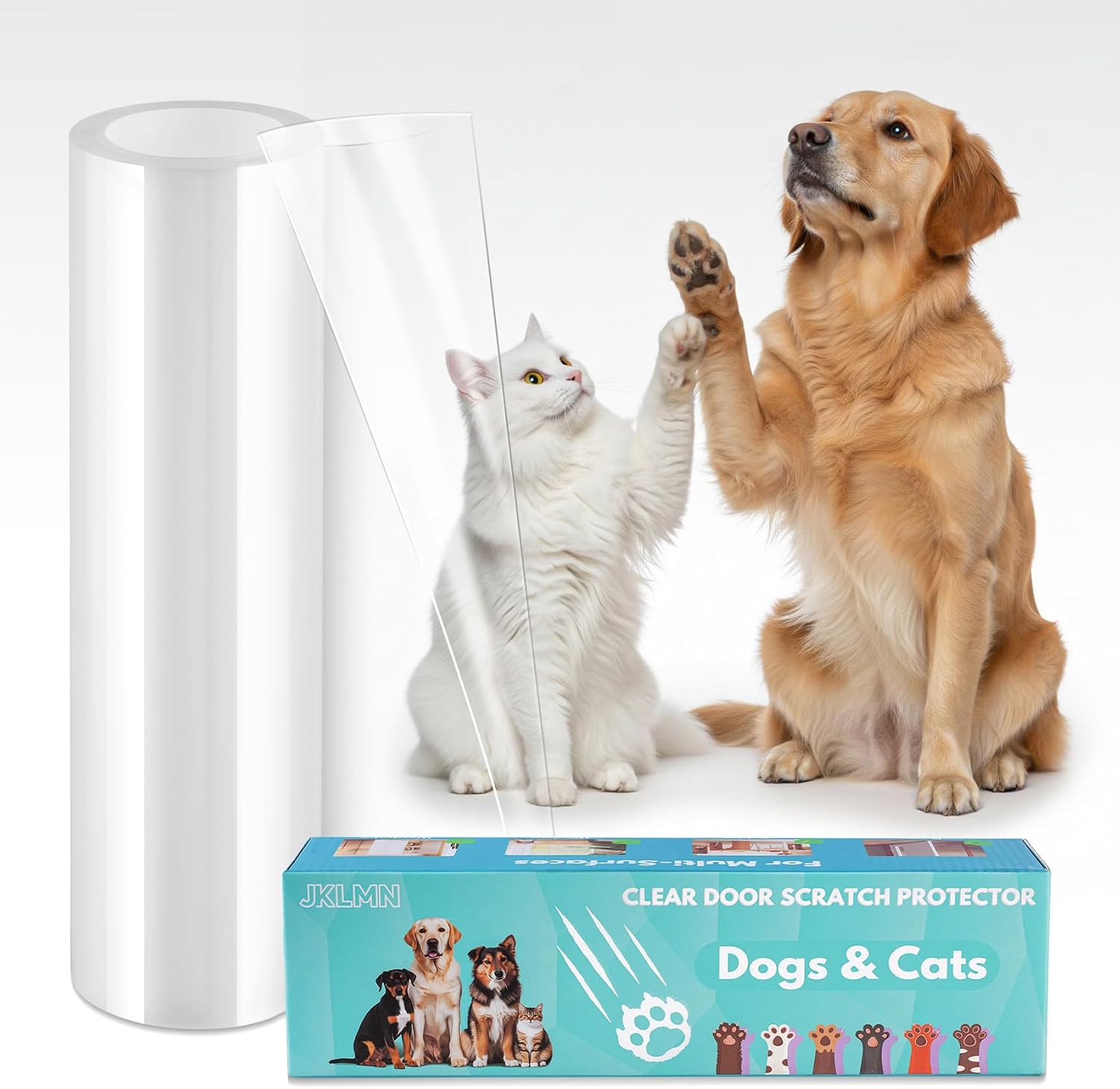
Dogs that paw at doors tend to hit the same narrow strip near the base, usually when they are excited to greet someone or anxious to be let out. That behavior is exactly what this JKLMN guard is built around. The 8.2-inch width is sized to sit over that lower scratch zone, so the film catches the claws before they reach paint or wood. For most medium and smaller dogs that scratch at floor level, that coverage lines up well with where the damage actually happens.\n\nThe material choice matters here. Based on the published specs, the guard is non-toxic vinyl, which is a real consideration for the dogs that lick or gnaw a surface while they scratch. You are placing a barrier at mouth height on a door your pet already fixates on, so a pet-safe film gives you one less thing to worry about. It is a small detail that separates a thoughtful product from a generic roll of plastic.\n\nWhat sets this apart from cut-to-size sheets is the 120-inch continuous roll. A standard interior door runs about 80 inches, so a single length can run seamlessly from top to bottom of the scratch area with no visible joins, and you are still left with roughly 40 inches of material. That leftover is genuinely useful. Owner feedback consistently mentions using the extra to patch furniture legs, cabinet corners, or a second door, which stretches a modest purchase across several household trouble spots.\n\nThe transparent design is the feature most buyers care about, and for good reason. A clear film keeps the door looking like a door. On a freshly painted white door or a stained wood entry, you avoid the eyesore of a colored plate bolted to the surface. Reports indicate the transparency holds up well enough that visitors rarely notice it, which is the whole point of a protective layer you plan to leave up long term.\n\nInstallation is where the design tries to lower the stakes. The removable adhesive system lets you lift and reposition the film during application instead of committing on the first press, which helps when you are lining up a long strip solo. The included resin scraper is there to push out air bubbles as you smooth the film down, so you can chase trapped air toward the edges rather than living with a lumpy surface. Neither tool is glamorous, but together they make a clean first install more achievable for someone who has never applied adhesive film before.\n\nDurability is the honest question mark. This is vinyl film, not a rigid polycarbonate shield, and the adhesive is the whole ballgame. Aggregated owner reviews show that success tracks closely with surface prep. On a clean, smooth, dry, non-textured door, adhesion is reliable. On dusty, humid, or heavily textured surfaces, edges can lift over time. The fix is straightforward, wipe the surface down and let it fully dry before applying, but it does mean the film rewards patience and punishes a rushed install. It also cleans up easily afterward, since you can wipe it with standard household cleaners without degrading the vinyl, so day-to-day maintenance is not a burden.\n\nThe review distribution tells a consistent story. Around 93 percent of buyers land at four or five stars, with a small 7 percent cluster at two stars that lines up with the adhesion complaints described above. There is no meaningful one-star or three-star presence, which suggests the product either works as intended or peels at the edges, with little in between. For 14 dollars, covering the exact strip where your dog scratches while keeping the door looking untouched is a reasonable bet, as long as you treat prep as part of the job.
Key features → what they mean for you
- Non-toxic vinyl construction→Safe for dogs that lick or chew the door while scratching, so a mouth-height barrier does not become a health worry
- 120-inch continuous roll→Covers a full 80-inch door with no visible seams and leaves roughly 40 inches to patch furniture or a second door
- Transparent film→Keeps painted or stained doors looking untouched, so the guard can stay up long term without becoming an eyesore
- 8.2-inch width at the door base→Sits right over the low scratch zone where most dogs paw, catching claws before they reach paint or wood
- Removable, repositionable adhesive→Lets you lift and realign a long strip during install instead of committing on the first press
- Included resin scraper tool→Pushes out trapped air for a smoother, bubble-free finish even for first-time film installers
What works
- Completely transparent so it doesn’t alter your door’s finish or color
- 120-inch length covers full door height plus leftover material for other scratched areas
- Can be wiped clean with standard household cleaners without degrading vinyl
Watch-outs
- Adhesive strength depends entirely on surface prep: dust, texture, or moisture will cause lifting at edges
- Limited review history makes long-term durability unclear compared to polycarbonate shields with 18-month track records
- 8.2-inch width may not cover full scratch damage if your dog jumps high or scratches while standing on hind legs
- Adhesion depends entirely on surface prep. Dust, texture, or moisture can cause the edges to lift over time.
Better alternative: A rigid polycarbonate door shield if you have a large dog that scratches high while standing, or if you want a proven multi-year track record over an easy-to-remove film.

The AEYNCBO kick plate solves a specific problem: the lower band of a door where a dog paws to signal it wants out. That repeated contact gouges wood and dents hollow-core panels over time. This plate covers a 4×16 inch zone in that region, so the daily scratching lands on stainless steel instead of your door surface. For a household with a persistent door-scratcher, that means the door underneath stays intact rather than accumulating claw marks that are difficult to sand out or refinish.
Stainless steel is the practical part of the design. It resists rust and corrosion, which matters if you install it near an entryway that sees humidity, rain splash, or seasonal temperature swings. Reports on stainless hardware generally point to long service life in these conditions, and the material shrugs off the kind of scratching that would otherwise reach the door. Cleanup is equally low effort. Muddy paw prints, drool, and claw streaks wipe away with standard household cleaners, so you are not scrubbing or treating the surface with anything special.
The adhesive mounting is what makes this a renter’s tool. There are no drill holes, which preserves door integrity and, more to the point, your security deposit. You get the protection without modifying the door in a way a landlord would object to, and the plate can come off when you move. The rounded corners are a thoughtful touch that goes beyond looks. Sharp metal edges catch on collars, leashes, and paws during the rushed moment when a dog bolts for the door. Rounding those corners removes that snag and injury risk, so an excited entry stays safe.
The matte white finish is meant to disappear against standard interior door colors. On a white or off-white door it reads as part of the door rather than an add-on, which keeps the visual disruption low for anyone who does not want obvious hardware in their hallway.
The honest limits are worth stating plainly. Adhesive bond strength depends entirely on how clean and smooth your door surface is before installation. On a well-prepped, non-textured door it should hold; on a glossy or dusty surface, less so, and there is no long-term owner data confirming how the bond behaves after months of body-weight scratching. The 4×16 inch footprint also protects only the lower door section. A larger dog that rears up and scratches higher, or one that jumps at the door, will reach panels this plate does not cover.
Key features → what they mean for you
- Stainless steel construction→Deflects claw scratches that would gouge wood or dent hollow-core doors, and resists rust in humid or exterior spots
- No-drill adhesive installation→Protects the door without holes, keeping rental deposits and door integrity intact
- Rounded corners on all edges→Removes sharp metal points that snag collars or paws during a rushed entry
- 4×16 inch coverage in the lower zone→Targets the exact band where most dogs paw to be let out, concentrating protection where it is needed
- Matte white finish→Blends into standard door colors so the plate reads as part of the door, not obvious hardware
- Wipe-clean surface→Muddy prints and claw streaks come off with everyday cleaners, no special maintenance
What works
- No-drill installation works for renters who cannot modify doors permanently
- Stainless steel surface deflects claw scratches that would gouge wood or hollow-core door materials
- Rounded edge design eliminates sharp corners that catch on pet collars or create injury risk during rushed entries
Watch-outs
- Adhesive bond strength depends entirely on door surface cleanliness and finish type, with no reviews confirming long-term hold
- 4×16 inch size only protects lower door section, leaving upper panels vulnerable to larger dogs that jump or scratch higher
- For permanent protection on owned homes, through-bolted kick plates offer superior hold without adhesive failure risk
- Adhesive bond depends on door surface prep and finish, with no long-term owner data confirming how it holds under sustained body-weight scratching.
Better alternative: A through-bolted stainless kick plate for homeowners who want permanent hold and can drill into the door.

The Lupvar guard takes a different route than a metal kick plate. Instead of covering the door with visible hardware, it lays a clear 1/8-inch PVC sheet over the scratch zone. The material is the headline. At 1/8 inch, it resists claw punctures in a way thin film protectors cannot, and those films are exactly what tend to tear within weeks under a determined dog. That thickness means the claws land on PVC and stop there, without penetrating to the door finish underneath. For a household fighting daily scratch damage, that translates to a door that keeps its paint and grain intact.
Because the PVC is fully transparent, the door’s color and finish show straight through. If you have a stained wood door or a specific paint color you do not want to hide, this preserves that look without the bulk of a metal plate bolted across it. The 16×30 inch panel covers a generous vertical span, taking in both the lower paw zone and a good stretch above it for dogs that reach higher than a small kick plate can handle.
The cut-to-size design is genuinely useful for real homes. Not every door is a standard width, and sidelights or partial coverage needs vary. You trim the sheet with household tools to fit, so you are not stuck ordering custom dimensions. Adhesive dots handle mounting with no drill holes, which keeps the setup within lease restrictions and lets you remove the guard cleanly later. The waterproof surface rounds out the practical case: drool, muddy prints, and rain splash wipe off without the PVC absorbing moisture or holding odors. All four corners are rounded, so there are no sharp points to catch on fabric, skin, or a passing collar.
The tradeoffs are real and specific. Adhesive dots hold well for surface scratching, but a dog that presses its full body weight into the door while clawing can work the dots loose over time, which means periodic reapplication. The cut-to-size flexibility cuts both ways: it demands careful measuring, and if you cut too short there is no undo. And like most guards in this class, the 30-inch height leaves the upper door unprotected, so a dog that rears up or jumps can still reach bare panel above the sheet.
Key features → what they mean for you
- 1/8-inch PVC construction→Stops claws from puncturing through to the door surface, unlike thin films that tear in weeks
- Fully transparent material→Preserves the door’s original color and finish without visible hardware
- Cut-to-size design→Fits non-standard door widths and custom heights using tools you already own
- Adhesive dot mounting→No drill holes, so renters stay within lease rules and can remove it cleanly
- Waterproof surface→Muddy prints and drool wipe off without the material soaking up moisture or odor
- Rounded corners on all four edges→No sharp points to snag fabric, collars, or skin during entry and exit
What works
- Adhesive dots avoid permanent holes in door frames, critical for renters under lease restrictions
- 1/8-inch thickness stops claws from penetrating to the door surface beneath
- Transparent PVC maintains door appearance better than opaque guards or metal plates
Watch-outs
- Adhesive dots may not hold long-term if dog applies body weight while scratching, forcing periodic reapplication
- Cut-to-size flexibility requires precise measuring and cutting, with no redo if you cut too short
- Maximum 30-inch height leaves upper door sections unprotected if your dog rears up or jumps
- Adhesive dots can loosen under sustained body-weight scratching, requiring occasional reapplication.
Better alternative: The AEYNCBO stainless kick plate when you prefer a rigid metal surface over cut-to-fit PVC.

This Lupvar guard scales the clear PVC concept up to a 36×20 inch panel aimed at broader coverage. The same reinforced 1/8-inch PVC does the protective work, creating a physical barrier that keeps claws from reaching paint, trim, or wood grain underneath. Because the material is transparent, the original surface shows through, which reduces the visual weight compared to an opaque guard or metal plate. The wider format also suits surfaces beyond a single door face, including sidelights, glass, screens, and sliding doors, so one product can handle several scratch-prone spots around an entry.
Installation follows the brand’s renter-first approach. Adhesive dots mean no drill holes and no wood screws, which preserves security deposits and lets you remove the panel without damaging the surface. The cut-to-size flexibility handles non-standard widths and partial coverage, so you are not locked into a fixed shape. The waterproof PVC wipes clean of drool, rain splash, and muddy paws with a damp cloth, and it does not absorb stains or odors. Rounded corners on all four edges keep sharp points away from clothing and collars.
The honest limits: at 1/8 inch, the panel creates a visible raised edge on smooth painted doors, which some households will notice. Adhesive dots may struggle to hold on textured or porous surfaces over the long term, and the clear surface shows fingerprints and smudges more readily than an opaque guard.
Key features → what they mean for you
- Reinforced 1/8-inch PVC→Forms a physical barrier that keeps claws off paint, trim, and wood grain
- Adhesive dot mounting→No drilling, so deposits stay intact and removal leaves no damage
- Cut-to-size flexibility→Fits odd widths, sidelights, and partial coverage without a custom order
- Waterproof surface→Drool and muddy paws wipe off without soaking in or holding odor
- Transparent material→Original finish shows through, cutting the visual impact of the guard
What works
- No drilling required, preserves rental deposits and allows clean removal
- Thick enough to stop claws from reaching door surface underneath
- Waterproof material wipes clean without absorbing stains or odors
Watch-outs
- 1/8-inch thickness creates a visible raised edge on smooth painted doors
- Adhesive dots may not hold on textured or porous surfaces long-term
- Clear material shows fingerprints and smudges more visibly than opaque guards
- The 1/8-inch thickness leaves a visible raised edge on smooth painted doors.
Better alternative: The 16×30 Lupvar panel when a standard single door is all you need to cover.
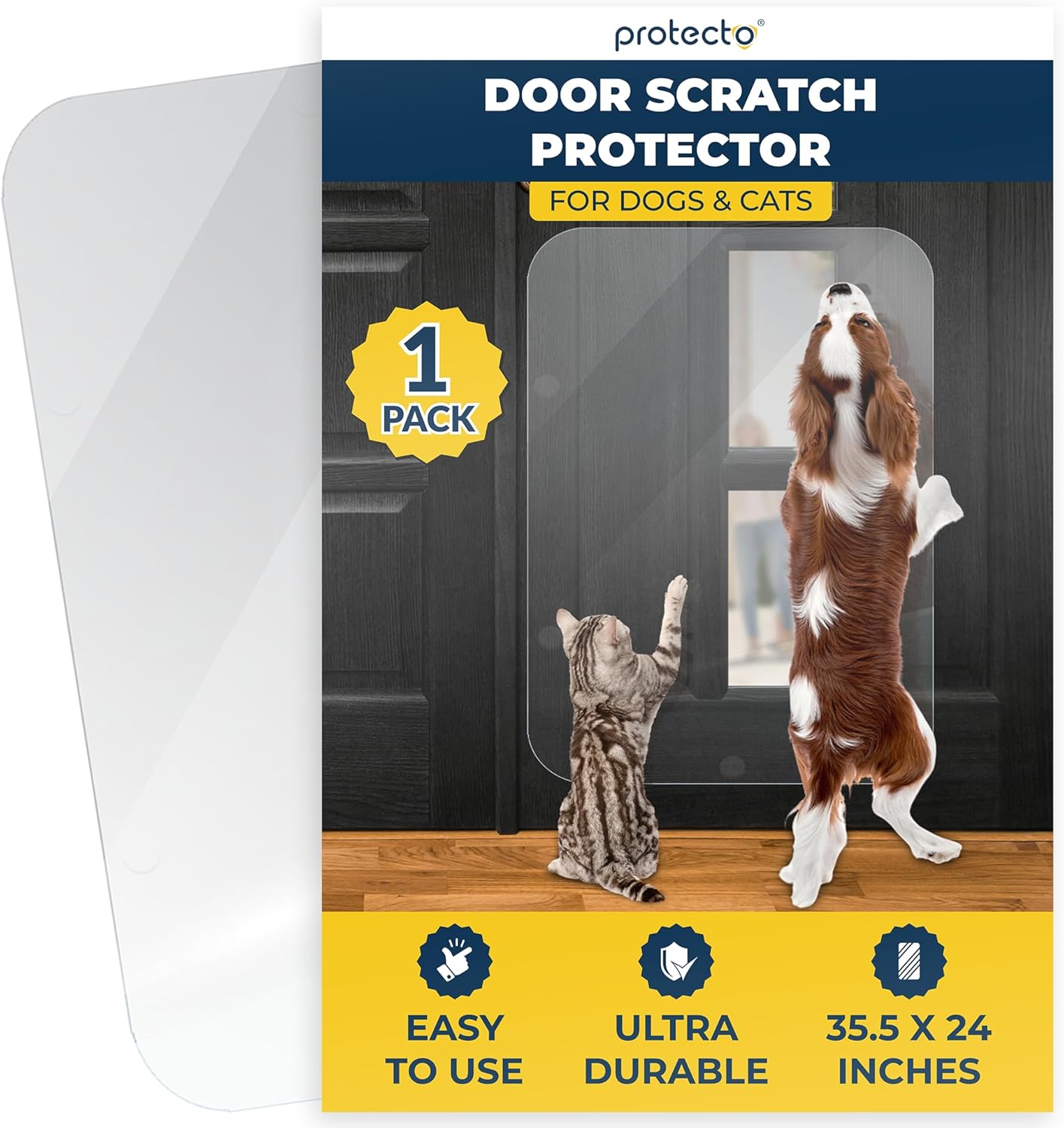
The PROTECTO leans on polycarbonate rather than soft film, and that material choice drives everything a pet household will notice. Based on the published specs, the panel measures 35.5 by 24 inches at roughly 1mm thick, which is enough to stop claw penetration without adding a ledge that changes how the door swings or clears the frame. For a home with a repeat scratcher, that means the barrier sits flush and the door still latches normally. The transparency is the quiet advantage here. Because the sheet stays clear, the original door finish shows through, so you protect a stained or painted surface without covering it in an obvious plate. The smooth, non-textured face also works against the scratching habit itself. Dogs return to spots that give satisfying tactile feedback, and a slick surface removes that reward, which owner feedback suggests gradually discourages repeat visits to the same corner. Installation stays renter-friendly. The adhesive backing skips screws and pilot holes entirely, so there are no permanent modifications that affect resale or a security deposit. The 35.5-inch width matters more than it first appears, since it reaches into the frame trim where corner scratches tend to concentrate. Cleanup is straightforward too. The surface wipes down with standard household cleaners and, based on the specs, resists dulling or hazing, so nose smudges and paw marks come off without frosting the panel. Two honest limits: the 24-inch height leaves the upper door exposed for dogs that jump, and reports indicate the adhesive leaves a cloudy edge that stands out against darker paint.
Key features → what they mean for you
- Polycarbonate construction, roughly 1mm thick→Stops claws from reaching the door while staying thin enough to keep normal door clearance and latching
- Clear, transparent panel→Protects a stained or painted finish without hiding it behind an opaque plate
- Smooth non-textured surface→Removes the tactile reward that keeps dogs returning to the same scratch spot
- Adhesive backing, no hardware→Installs without screw holes, preserving the door and rental deposit
- 35.5-inch width→Reaches the frame trim where corner scratches usually cluster on a single door
- Wipe-clean surface→Paw marks and smudges come off with household cleaner without hazing the panel
What works
- Polycarbonate maintains scratch resistance through repeated daily impact from medium to large breed dogs
- Installation requires no tools or permanent door modifications that affect resale value
- Adhesive maintains bond strength even when dogs jump directly at the protected section multiple times per day
Watch-outs
- 24-inch height leaves upper door sections unprotected against dogs who rear up above shoulder height during excitement
- Adhesive creates visible cloudy border around all edges that contrasts with darker painted finishes
- Single sheet design means sizing down for narrower doors requires cutting, which can crack polycarbonate along cut edges
- The 24-inch height leaves the upper door unprotected for dogs that rear up, and the adhesive leaves a visible cloudy border on darker finishes.
Better alternative: The xin partner roll, when you need custom height or want to protect several doors from one purchase.
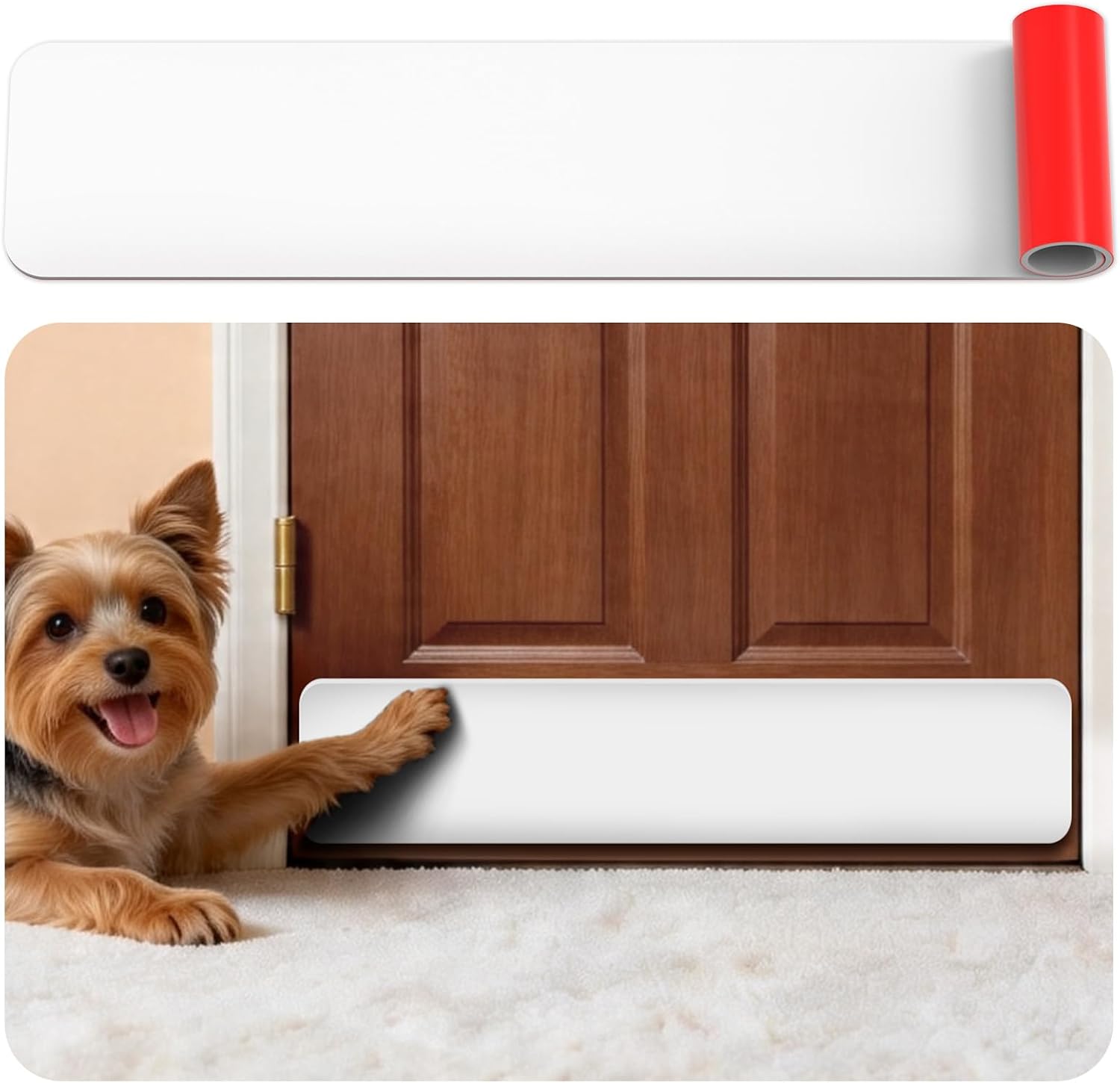
Most kick plates are aluminum, and aluminum has two problems around dogs: it rings loudly when scratched and it can catch and split a claw. The REFLYING answers both with silicone. The soft surface absorbs scratching force instead of transmitting it, so there is no metallic scrape echoing through the house, and claws meet a cushioned surface rather than a hard edge that risks a split nail. For a pet home, that is a quieter door and fewer grooming injuries. The 6-inch height is matched to the reach of dogs in the 40 to 70 pound range when they paw at the bottom of a door, which covers the zone where scratching actually lands for that size. Trimable width is the practical touch. The plate cuts down to fit 32, 34, or 36-inch frames, so you skip the precise measuring that leads to returns with fixed-width guards. Installation stays deposit-safe with an adhesive backing that needs no drilling or pilot holes, which matters in a rental where screw damage costs money. The surface wipes clean and, based on the specs, resists the paw-oil buildup that stains fabric guards over time. Two honest caveats: with only 28 reviews available, long-term adhesive performance on textured or painted doors is not yet well established, and the soft material means a committed chewer can peel an edge. For destructive dogs, a metal plate is the safer call. But for the common case of a mid-sized dog that paws a rental door, the tradeoff of softness for quiet and safety lands well.
Key features → what they mean for you
- Silicone construction→Absorbs impact so there is no metallic scrape and less risk of split claws
- 6-inch height→Covers the full pawing zone for dogs in the 40 to 70 pound range
- Trimable width for 32, 34, or 36-inch doors→Fits common frames without precise measuring or return hassles
- No-drill adhesive backing→Protects the door finish and keeps a rental deposit intact
- Wipe-clean surface→Resists the paw-oil staining that ruins fabric door guards
What works
- Soft silicone prevents the paw injuries and noise that come from dogs scratching metal or wood surfaces
- No-drill adhesive installation preserves door finish and rental deposit eligibility
- Trimable design eliminates the measuring errors and returns common with fixed-width guards
Watch-outs
- Adhesive strength on textured or painted doors remains unverified with only 28 reviews available
- 6-inch height may not cover scratching reach for large breeds over 70 pounds or dogs that jump at doors
- Low chew resistance means determined chewers will peel edges, consider metal alternatives for destructive dogs
- Low chew resistance and unverified adhesive strength on textured doors, given the thin review base.
Better alternative: PROTECTO polycarbonate shield, when your dog scratches higher than 6 inches or chews at edges.

The xin partner takes a different approach than a fixed panel. It ships as a 150-inch continuous roll at 10 inches wide, so you cut exactly the length each door needs with no seams. For a home with more than one problem door, that means one roll covers several openings, or you extend a taller strip for a bigger dog. The transparent film keeps the door looking normal, redirecting damage away from painted or stained wood while staying subtle enough for a front entry or office door. The standout feature is the textured surface, which works as a passive nail file. When a dog scratches, the film gently files the claw tips, which owner feedback suggests reduces how often you reach for the clippers. The 10-inch width lines up with the scratch zone a medium to large dog creates standing at handle height, and the adhesive bonds to painted wood, metal, and composite without drilling or hardware. Cleanup is a damp-cloth job for muddy prints and nose smudges. The tradeoffs are real. The adhesive does not reposition once set, so the first placement has to be right or the mistake is permanent. Reports indicate edges can lift over time in high-humidity spots like mudrooms or bathrooms, and the same texture that files claws also traps dirt in its grooves, so it needs a weekly scrub rather than a quick wipe in muddy households. For the right home, though, the roll format and nail-filing function make it a flexible, budget-conscious choice.
Key features → what they mean for you
- 150-inch continuous roll, 10 inches wide→Cut custom lengths for multiple doors or taller coverage from one purchase, with no seams
- Transparent film→Keeps formal entries and office doors looking normal while shielding the wood
- Textured nail-file surface→Files claw tips as the dog scratches, cutting down on manual trimming
- Bonds to wood, metal, and composite→Works across most door types without drilling or hardware
- Damp-cloth cleanup→Muddy prints and nose smudges wipe off without weakening the bond
What works
- Roll format eliminates seams and allows precise height customization for dogs of different sizes
- Dual function as scratch barrier and nail file addresses two separate grooming maintenance tasks
- Transparent option preserves door appearance in formal spaces like front entries or office doors
Watch-outs
- Adhesive cannot be repositioned without losing bond strength, making initial placement critical and errors permanent
- Film edges may lift over time in high-humidity environments like mudrooms or bathrooms
- Textured surface retains dirt in grooves, requiring weekly scrubbing rather than quick wipe-downs for households with multiple daily door interactions
- Adhesive cannot be repositioned and edges may lift in humid rooms, making placement critical and location choice important.
Better alternative: PROTECTO polycarbonate shield, when you want a single rigid panel that resists lifting and needs no cutting.

The appeal here is restraint. At 0.2mm, this vinyl is thin enough to read as nearly invisible on white or light doors, so the wood grain or paint color still shows through instead of the cardboard-barrier look that opaque protectors leave behind. That matters most in rentals and shared spaces where you want protection without announcing it. Based on the published specs, the self-adhesive backing bonds to smooth painted surfaces without nails, screws, or aggressive double-sided tape, and aggregated owner reviews show that adhesive lifting cleanly from painted drywall after months of use, which is exactly what a renter needs to protect a deposit. The 60-inch length covers from floor to doorknob height on a standard interior door, addressing the full scratch zone for most dogs in a single strip. The slick surface removes the tactile resistance dogs and cats chase when they sharpen claws, so over time it discourages repeat scratching rather than just absorbing it. An included utility knife lets you cut around door hardware, trim, and furniture legs without hunting for tools, and the vinyl wipes down with a damp cloth to clear paw prints and nose smudges. The honest limitation is durability: the same thinness that keeps it invisible also means it hazes under steady claw traffic.
Key features → what they mean for you
- 0.2mm transparent vinyl→Protection stays nearly invisible on light doors, preserving the room’s look in rentals and living spaces
- Self-adhesive backing, no hardware→Installs and removes without drilling or drywall damage, protecting a rental deposit
- 60-inch floor-to-knob length→Covers the full scratch zone for most dogs in one strip, no stacking pieces
- Slick low-resistance surface→Removes the satisfying feedback dogs seek, gradually reducing the scratching habit
- Included utility knife→Custom fitting around trim and hardware without buying separate tools
- Wipe-clean vinyl→Paw prints and nose smudges come off with a damp cloth, no special products
What works
- Adhesive removes cleanly from painted drywall and doors after months of use, confirmed across multiple rental situations with no security deposit losses
- Transparent enough that guests do not immediately notice the protection on white or light-colored doors from across a room
- Custom cutting with included knife allows fitting around irregular shapes like Victorian door trim or furniture with decorative legs
Watch-outs
- Vinyl develops visible scratch haze and clouding within 4-6 weeks under daily claw contact, requiring replacement for cosmetic reasons even though protection continues
- Thin 0.2mm material telegraphs texture on anything rougher than smooth latex paint, creating visible ridges on wood grain or stucco that defeat the transparent aesthetic
- 8-inch width leaves lower door sections exposed for dogs who scratch below doorknob height, forcing you to buy and stack multiple sheets for full coverage
- The thin vinyl develops visible scratch haze within four to six weeks under daily claw contact, so heavy scratchers will need replacements.
Better alternative: The Yongjoy 118-inch protector, when you want a single longer strip to cover taller doors or multiple surfaces without seams.

The standout spec is length. At 118 inches, one continuous strip covers a standard residential door with room to spare, so you can cut to exact height without seams or gaps that would otherwise become weak points where claws catch and peel. Based on the published specs, the construction is fully transparent, which means it disappears against white, wood-stain, or painted surfaces without the visible texture lines that cheaper films leave behind. The single-side adhesive applies straight to the door rather than relying on tension rods or frame-mounted hardware, so installation stays simple and reversible in look. Its 8.2-inch width is tuned to the doorframe trim and casing where many dogs concentrate their scratching, particularly the spot where paws land when a dog jumps up to signal a walk. The material works as a physical barrier, taking the surface impact that would otherwise chip or gouge the finish, and household scissors are enough to trim it for non-standard heights or custom zones around handles. Two honest caveats shape the fit. The adhesive is a one-shot application, so it cannot be repositioned once pressed down, and precise placement matters to avoid wasted material. And because owner data does not yet cover long-term wear, whether the tape yellows or lifts after six months of paw contact remains unverified.
Key features → what they mean for you
- 118-inch continuous length→Covers doors up to 9 feet in one seamless piece, with no joints to peel
- Fully transparent film→Blends into any door color without visible texture lines, keeping the room’s look intact
- Single-side direct adhesive→Mounts straight to the door, no rods or hardware to install
- 8.2-inch width sized to trim→Targets the doorframe casing where jumping dogs land their paws
- Scissor-trimmable material→Fits odd heights or wraps around handles with tools you already own
What works
- Length allows single-piece installation on doors up to 9 feet without seams that create weak points
- Transparency maintains door aesthetics better than opaque plastic shields or metal kick plates
- Covers the vertical doorframe strip where Biscuit’s paws land when he jumps against the door to signal walks
Watch-outs
- 8.2-inch width stops short of full door coverage, leaving center and opposite edge vulnerable to scratchers who target broad areas
- Single-application adhesive cannot be repositioned once pressed down, requiring precise first-time placement or wasted material
- No verified long-term adhesion data, leaving open whether the tape lifts or yellows after 6+ months of paw contact and humidity
- The adhesive cannot be repositioned, so a crooked first placement means wasted material.
Better alternative: The PROTECTO protector, when clean removability for a rental matters more than maximum length.
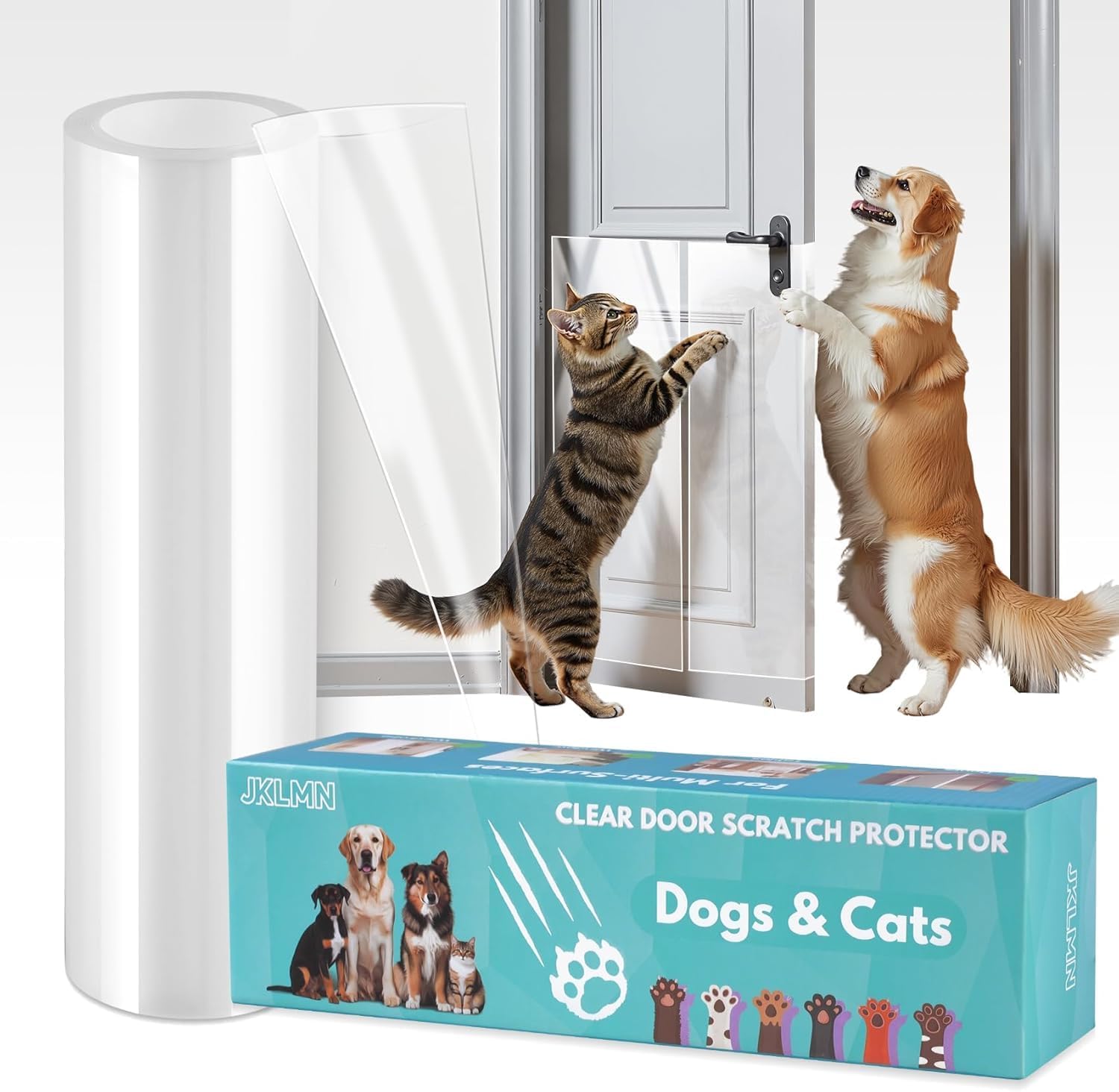
On paper this covers the essentials shoppers ask for. The transparent vinyl keeps a door’s color and finish visible rather than hiding it behind an opaque shield, so the protection reads as part of the door instead of pet furniture. Based on the published specs, the 118-inch length handles a standard 80-inch door with roughly 38 inches left over, which is enough to wrap onto the frame or split across multiple smaller surfaces like furniture edges and wall corners. The trimmable design supports that flexibility, letting one purchase serve several jobs instead of buying separate products per surface. The maker lists a non-toxic vinyl composition, which offers reassurance in homes where a dog may lick or mouth the surface during contact. The adhesive is described as removing without residue or paint damage, so you can swap in a fresh section once the old one accumulates visible wear or take it with you when you move. The smooth texture aims to discourage repeat scratching by removing the tactile feedback dogs chase from wood grain. The real gaps are informational. Vinyl thickness is not specified, so puncture resistance under hard scratching cannot be verified, air bubbles need the included scraper and some patience on textured doors, and a low review count leaves longevity unproven past the early window.
Key features → what they mean for you
- Transparent vinyl→Keeps door color and finish visible, avoiding the pet-guard look
- 118-inch length→Covers a full door plus frame, or splits across furniture and walls from one roll
- Trimmable sizing→One purchase protects several surfaces instead of buying multiple products
- Non-toxic composition→Reassurance in homes where a dog licks or mouths the surface
- Residue-free adhesive→Swap worn sections or move homes without leaving marks
What works
- Transparent material preserves door color and finish visibility, avoiding the pet-furniture look of opaque guards
- Generous 118-inch length covers full door height plus frame or allows protection of multiple smaller surfaces
- Clean removal system prevents permanent adhesive marks when replacing worn sections or moving homes
Watch-outs
- Vinyl thickness not specified in product data, making puncture resistance under aggressive scratching impossible to verify
- Air bubble removal during installation requires included scraper tool and patience, particularly on textured door surfaces
- Low review count prevents verification of longevity claims beyond 60-90 day window
- Vinyl thickness is unspecified and reviews are too sparse to confirm how it holds up beyond the first couple of months.
Better alternative: The Yongjoy 118-inch protector, when you want similar length with a larger body of owner feedback behind it.

The CLAWGUARD Heavy Duty Door Scratch Shield leans on one clear idea: real polycarbonate instead of thin acrylic. Based on the published specs, the 45mm thickness resists penetration from repeated claw strikes without cracking or gouging, which means an anxious dog working the same spot day after day is far less likely to reach the wood veneer underneath. That matters most in the door’s center strike zone, exactly where the 20 by 44 inch panel is designed to sit, since medium to large dogs tend to concentrate their force there when they want in or out.\n\nThe install story is where this product earns its rental-friendly reputation. It hangs over the knob in under a minute with no adhesive, no drilled holes, and no paint damage, so your security deposit stays intact and you can shift the shield to whichever door needs it that week. The frosted clear finish keeps the door looking presentable while hiding the minor scuffs that build up from paw contact, and a damp cloth or standard household cleaner wipes away dirt and nose prints. Reports indicate the USA-made polycarbonate holds up to daily use, though owner feedback also notes the frosted surface can cloud over time depending on the cleaner used. For a portable, deposit-safe barrier that stops claws cold in the middle of the door, it delivers on its core promise.
Key features → what they mean for you
- 45mm polycarbonate thickness→Stops claws from punching through to the wood veneer, so a determined scratcher does not leave permanent gouges
- Over-knob install in under 60 seconds, no adhesive→Protects rental deposits with zero holes or residue, and lets you relocate the shield room to room in seconds
- 20 by 44 inch center coverage→Guards the exact strike zone where most medium to large dogs concentrate scratching pressure
- Frosted clear finish→Keeps the door looking clean while masking the minor scuffs that collect from repeated paw contact
- Wipes clean with a damp cloth or standard cleaner→Removes dirt and nose prints in busy pet households without degrading the material
What works
- Completely reversible install protects security deposits in rental homes
- Thick enough to stop claws from reaching wood veneer underneath
- Moves between doors in seconds when you need coverage in different rooms
Watch-outs
- 20-inch width leaves door edges and frames completely exposed on standard 30-36 inch doors
- Frosted finish develops visible cloudiness after months of wiping with certain cleaners
- Over-knob weight causes slight downward tilt on loose or worn door knobs, requiring occasional repositioning
- The 20-inch width leaves door edges and frames fully exposed on standard 30 to 36 inch doors.
Better alternative: The CHUANG 118-inch adhesive strip, when your dog targets the edges and frame rather than the center panel.

The CHUANG Door Protector takes the opposite approach from a rigid over-knob shield: it is a long, thin vinyl strip you adhere directly to the door. At 118 inches, based on the published specs, it extends from the floor up to handle height on a standard residential door with no cutting required, which means you skip the measuring and trimming that slows down most film installs. The industrial-grade vinyl is built to take repeated claw impact without tearing, so a dog that works the vertical edge or the area beside the handle meets a genuine barrier rather than bare paint.\n\nThe biggest selling point is how it disappears. The fully transparent material reads as invisible from normal viewing distance, so your door keeps its original color and finish while the film quietly absorbs the abuse. A wipe-clean surface handles paw prints and everyday grime with a damp cloth, and the weatherproof formulation is meant to hold its grip in humid entryways and mudrooms where steam and temperature swings can loosen lesser adhesives.\n\nThe catch is the single-sided adhesive. Owner feedback consistently mentions that repositioning is nearly impossible once the strip touches the door, so first-time placement has to be precise. There is also no clear information on residue when you peel it off, which is a real consideration if you rent. Some owners report edges lifting in high-traffic spots over time, and a few pair it with Command strips to lock down the ends. For an owned home where you want an invisible, no-hardware barrier on the door’s vulnerable edges, it does the job, provided you get the placement right the first time.
Key features → what they mean for you
- 118 inches of pre-sized coverage→Runs floor to handle height on a standard door with no measuring or cutting, so setup is quick
- Industrial-grade vinyl construction→Withstands repeated claw impact without tearing, giving large dogs a real barrier instead of bare paint
- Fully transparent material→Stays invisible from normal distance, keeping the door’s color and finish intact while it protects
- Single-sided adhesive, no drilling→Installs without hardware or holes, though it commits you to one precise placement
- Weatherproof formulation→Holds adhesion in humid entryways and mudrooms where heat and moisture defeat weaker films
What works
- Clear vinyl remains invisible from typical viewing distance, preserving home aesthetics while protecting painted surfaces
- Pre-sized length eliminates measuring and cutting for standard door installations
- Thick vinyl construction creates genuine barrier against large dog claws without visible hardware
Watch-outs
- Single-sided adhesive makes repositioning nearly impossible once applied, requiring precise first-time placement
- No information about adhesive residue on removal, potential concern for rental security deposits
- Vinyl edges may lift over time in high-traffic areas without secondary fastening system like Command strips
- The single-sided adhesive makes repositioning almost impossible and offers no clarity on residue at removal.
Better alternative: The CLAWGUARD over-knob shield, when you rent and need a reversible, residue-free option.
What Buyers Consistently Say
What owners praise most
Aggregated owner reviews across these guards point to the same headline win: doors stop getting worse the day the protector goes up. Buyers of the clear vinyl rolls, especially the JKLMN and Yongjoy models, repeatedly mention that the film disappears against white and light wood doors, so the fix does not turn an entryway into an obvious pet zone. Owners of the thicker Lupvar PVC panels and the PROTECTO polycarbonate shield describe a more confident feeling of protection, noting that claws hit a hard surface instead of gouging paint. Reports on the AEYNCBO stainless kick plate and the REFLYING silicone plate consistently highlight the no-drill install as the reason renters chose them, along with easy wipe-down of muddy paw prints.
Common complaints
The most repeated frustration across every adhesive product is edge lifting. Owner feedback consistently mentions that dust, texture, or a slick factory finish on the door causes corners to peel within weeks, and that surface prep is the difference between a clean bond and a daily re-stick. On the thin vinyl films, buyers report visible clouding and scratch haze after a stretch of daily claw contact, which matches the material logic: a thin surface shows wear faster than a thick one. Coverage complaints are the second theme. Owners of the 8-inch and 8.2-inch wide rolls note that a dog who rears up or paws to one side simply moves the damage to an exposed strip, and buyers of the shorter shields say the same about height. A smaller cluster of reviews flags that clear guards telegraph fingerprints and smudges more than opaque plates.
Patterns by use case
Renters gravitate toward the no-residue clear rolls and the over-knob CLAWGUARD shield because removal is the priority, and feedback in this group weighs clean takedown over maximum toughness. Households with large or excitable dogs lean toward the Lupvar PVC and PROTECTO polycarbonate, where reviews describe repeated jumping impact without the film tearing. Owners of small to mid-size pawing dogs get the most satisfaction from the wide vinyl rolls, since a low scratch zone stays inside the covered band. Multi-door and multi-surface buyers favor the long 118 to 150-inch rolls, citing leftover material as a practical bonus for furniture legs and wall corners. Across the board, the guards that draw the steadiest praise are the ones matched to the dog’s actual reach rather than the cheapest or the clearest. A recurring lesson in the feedback is that expectations set the review: buyers who treated a thin film as a wear layer to replace periodically stayed happy, while those who expected years from a budget roll felt let down.
What Most Buying Guides Miss
The insight that reframes the category
A door scratch protector is not one product type competing on price. It is two different tools solving two different problems. Thin vinyl films are wear layers, meant to take the damage and be replaced. Thick PVC and polycarbonate are barriers, meant to stop the claw from reaching anything. Once you sort the field this way, the price spread makes sense: a budget vinyl roll and a polycarbonate shield are not really rivals, and comparing their longevity head to head misses the point. Based on the published specs, a 0.2mm vinyl and a 1/8-inch PVC are two orders of magnitude apart in thickness, which is why one clouds in weeks and the other resists puncture.
A contrarian take
The clearest guard is often the wrong choice. Transparency is the feature buyers ask for, but a fully clear film shows every fingerprint, smudge, and scratch haze, and it telegraphs any texture in the door beneath it. For a high-traffic mudroom or a determined scratcher, a matte kick plate or a frosted shield can actually look cleaner over time because it hides the accumulating scuffs that a clear surface puts on display. Choosing clear for a spot that takes daily abuse can mean staring at the damage through the protector.
The mistakes buyers make most
The first mistake is buying for the dog’s standing height instead of the dog’s excited height. Owner feedback repeatedly describes damage migrating above an 8-inch or a 24-inch band because the dog rears up when the doorbell rings. Measure where the highest scratch marks already are, not where you assume the paws land. The second mistake is skipping surface prep. Every adhesive product in this group lives or dies on a clean, dry, degreased door, and the single most common failure in reviews traces back to sticking film over dust or a slick finish. The third mistake is over-trimming. Cut-to-size flexibility sounds forgiving, but there is no redo if you cut short, and polycarbonate can crack along a rushed cut. Measure twice, cut wide, trim down.
A product we would skip
We would pass on the CHUANGSEED clear roll (listed under the generic “Door” brand). It carries no rating and no aggregated review history, no confirmed price, and its feature list mirrors cheaper rolls that do have a track record, so there is no evidence advantage to justify the unknowns. When a nearly identical clear vinyl roll from JKLMN or Yongjoy has hundreds of data points behind it, buying the blank-slate version adds risk without adding benefit. We would also caution against the thinnest 0.2mm PROTECTO vinyl for anyone expecting more than a few weeks between replacements, since the material simply is not built to stay clear under daily claws. Neither is a scam, but both ask you to accept uncertainty a better-documented option removes.
How to Choose — What Actually Matters
Match the material to the dog, not the door
The single biggest driver of satisfaction is thickness matched to force. Thin vinyl films in the 0.1 to 0.2mm range stay invisible and cost the least, but they act as sacrificial wear layers, clouding and hazing under sustained claw contact. Based on the published specs, they suit small to mid-size dogs who paw gently or households willing to treat the film as a replaceable consumable. Thicker 1/8-inch PVC and 1mm polycarbonate create a true barrier that claws cannot reach through, which is why owner feedback on those models describes confidence rather than eventual replacement. If your dog is large, jumps at the door, or scratches hard when excited, the extra thickness is the difference between protection and postponement. Kick plates in stainless steel or silicone take a different route, deflecting or absorbing force at the door base. Decide first whether you want a wear layer you refresh or a barrier you install once, then shop within that group. Comparing a budget roll to a polycarbonate shield on longevity alone sets you up to feel misled, because they were never built to do the same job.
Measure the real scratch zone before buying
Coverage failures are the second most common complaint, and they are almost always avoidable. Do not buy for where you think the paws land. Look at the door and find the highest existing scratch mark, because that is where an excited dog actually reaches when the doorbell rings or a walk is imminent. Width matters as much as height: the 8-inch and 8.2-inch rolls cover a narrow vertical band, which works for a dog who scratches one spot but fails for a dog who paws across the door or targets both edges. Wider 10-inch rolls and full-panel shields spread coverage but cost more and show more surface. The continuous rolls at 118 to 150 inches let you cut custom height and still have material left for a second door or furniture legs. Shields and kick plates come fixed, so confirm the listed dimensions clear your door width and the strike zone before ordering. Owner feedback repeatedly shows damage simply migrating to the nearest uncovered strip, so buy slightly larger than the current damage rather than exactly to it.
Prioritize removability if you rent
No-drill adhesive and over-knob designs exist specifically to protect security deposits, and this group weights that heavily because so many buyers rent or reposition guards between rooms. Clear vinyl rolls with no-residue adhesive and the over-knob CLAWGUARD shield lead here, since both come off without holes or paint damage. Adhesive dot systems, like the ones Lupvar includes, avoid permanent bonding but trade some hold, so a dog leaning body weight into the door may force periodic re-sticking. Peel-and-stick kick plates from AEYNCBO and REFLYING preserve the door but depend entirely on surface prep for a lasting bond. If you own your home and want maximum hold, a through-bolted metal kick plate outperforms any adhesive, at the cost of drill holes. Read the removal notes as carefully as the install notes, because clean takedown is where cheap products often disappoint. When a listing lacks any confirmed data on residue at removal, treat that silence as a risk rather than a reassurance.
Weigh transparency against visible wear
Clear guards blend into white and light-stained doors and keep an entryway looking untouched, which is why buyers ask for them. The tradeoff is honesty about wear: a fully transparent surface shows fingerprints, drool smudges, and scratch haze more plainly than an opaque plate, and it telegraphs any texture in the door beneath. On a smooth latex-painted door the clear look holds up well. On wood grain or textured paint, a thin clear film can create visible ridges. Frosted shields and matte kick plates hide accumulating scuffs better, which can look cleaner over months in a high-traffic spot even though they are more noticeable on day one. Decide whether you value invisibility now or forgiving appearance later, and match that to how hard the door gets hit.
Factor in cleaning and daily maintenance
All of these guards wipe clean with a damp cloth or standard household cleaner, but the surface texture changes how often you reach for it. Smooth vinyl, polycarbonate, stainless steel, and silicone shed paw prints and mud with a quick pass. Textured films, like the nail-file style roll, trap dirt in their grooves and reward that trapped grit with weekly scrubbing rather than a wipe. For a mudroom or a back door that sees wet paws daily, lean toward the smoothest surface you can get. If the textured, nail-filing function appeals as a grooming shortcut, accept the extra cleaning as part of the deal. Owner feedback ties low-maintenance satisfaction directly to smooth, non-porous surfaces, so this criterion quietly shapes how much you enjoy the product long after install.
Decision Matrix — Match Your Priority
Final Verdict
There is no single best door scratch protector, because the right pick depends on how hard your dog hits the door and whether you own or rent. That said, three products stand out for different reasons, and one is worth passing over. For most households, the Lupvar Heavy Duty PVC earns Best Overall. Its 1/8-inch thickness actually stops claws from reaching the door beneath, which is what the highest-weighted criterion rewards, and it stays transparent without the hardware bulk of a metal plate. The adhesive dot install keeps it renter-friendly, though a body-leaning scratcher may need occasional re-sticking. It is the most balanced answer to durability, aesthetics, and clean removal. For tight budgets, the JKLMN 120-inch clear roll is the value leader. It gives full door height plus leftover material for a second surface, disappears against light doors, and comes off without residue. Treat it as a wear layer you refresh rather than a permanent barrier, and it delivers real coverage for the price. For big, excited dogs, the PROTECTO polycarbonate shield is the premium pick. Its larger panel and hard surface handle repeated jumping impact from medium to large breeds, and the frosted-clear finish hides accumulating scuffs. It costs the most and its height still leaves upper panels open for tall rearing dogs, so measure first. We would skip the unbranded CHUANGSEED clear roll. With no rating, no review history, and no confirmed price, it asks you to gamble on an option that better-documented rolls already cover. Choose based on your dog’s reach and your lease, prep the surface properly, and any of the top picks will hold.



Write Your Review
No reviews yet. Be the first to share your experience!