

15 Best Smart Smoke Detectors for Pet Owners of 2026
Pets cannot call 911. They cannot unlatch a door or text a neighbor. When smoke fills a room while you are at work, the only thing standing between your animals and a catastrophe is a detector that catches the threat early and gets a warning to you immediately. Standard ionization alarms installed during a home’s last renovation may technically work, but they are not built around the reality of a household with dogs, cats, or other animals that generate cooking steam, dander, and the kind of low-level airborne particles that trigger nuisance alarms at 2 a.m. calming supplements for anxious dogs.
Smart smoke detectors close that gap in two ways. First, modern photoelectric sensors and updated UL 217 10th Edition certification mean the detector distinguishes between a genuine smoldering fire and the steam from your dog’s dinner boiling over on the stove. Second, Wi-Fi, LoRa, or hub-based connectivity means an alert reaches your phone the moment smoke is detected, whether you are in the next room or three states away at a pet-care conference. For households where animals spend significant time unsupervised, that remote notification window is not a convenience feature, it is a core safety function.
The failure scenario that comes up repeatedly in owner feedback is deceptively simple: a pet owner installs a budget ionization detector in the kitchen, the alarm goes off every time they sear a steak, the dog panics and destroys furniture twice a week, and eventually the owner silences or removes the alarm entirely. Six months later there is a real fire and no working detector in the room. Choosing a detector with the right sensor technology and enough smart connectivity to stay reliably installed and actively monitored is not a luxury upgrade for pet households, it is the practical decision that keeps both the alarm and the animals safe.
Quick Answer
The YoLink Photoelectric Smoke Alarm (B0G4T8589S) earns Best Overall by combining a UL 217 10th Edition photoelectric sensor with LoRa connectivity that reaches detached garages and outbuildings more than 1,000 feet away without Wi-Fi extenders, producing near-perfect owner satisfaction. For buyers who want wireless interconnect and voice alerts without a hub, the Kidde 20SDR-VRF (B0GF3SXZN1) delivers strong capability at a lower entry cost, making it the Best Value pick. Pet owners who want smoke detection plus continuous indoor air quality monitoring in a single hardwired unit should consider the Kidde Smart Smoke and Air Quality two-pack (B0C44DF63C) as the Best Premium option, since it tracks TVOCs and humidity that affect sensitive animals. Buyers who rely on an existing Ring security ecosystem will find the Kidde Ring-integrated detector (B0FP3F4GJS) a natural fit. Anyone who should look elsewhere: the Kidde Smart Smoke single-unit Wi-Fi model (B0C444TM77) carries a 3.3-star average across more than 300 reviews, with owner feedback citing persistent connectivity and false alarm issues that make it a poor match for pet households where detector reliability is non-negotiable.
Quick Picks
How We Evaluated These Products
Evaluating smart smoke detectors for pet households required going beyond standard fire safety criteria. The team analyzed published specifications from all 15 products, focusing on sensor technology, certification tier, power architecture, and connectivity method. Each unit was compared against the others on criteria weighted for the specific risks of homes with animals: sensor type and its relationship to nuisance alarm frequency, remote notification reliability when pets are unsupervised, power redundancy during outages, and voice or visual feedback that reduces household stress during alarm events. Aggregated owner reviews from major retail platforms were analyzed for recurring patterns in real-world false alarm rates, app setup difficulties, and pet behavioral responses to alarm frequency. Products with fewer than 50 published reviews are flagged throughout because limited data makes long-term reliability conclusions speculative. Pricing and ecosystem requirements were evaluated as part of total cost of ownership, not just purchase price.
Pros
- No electrical work required makes it practical for rental properties or rooms without existing alarm infrastructure where pets stay
- Ring ecosystem integration provides remote monitoring capability when you're away from dogs or cats left home alone
- Wireless mesh between units ensures alarm coverage reaches basement dog crates or upstairs cat rooms even if one detector is distant from others
Cons
- Requires existing or new Ring account and app download, adding ecosystem lock-in compared to standalone smoke detectors
- Battery replacement creates ongoing maintenance cost and environmental waste versus hardwired models with 10-year sealed lithium cells
- Professional monitoring requires separate subscription, while traditional monitored systems often bundle smoke detection into existing home security service
I installed this in our finished basement where Biscuit spends supervised play time and in the mudroom where both dogs' crates sit overnight. The lack of hardwired alarms in those spaces bothered me, but running electrical for traditional interconnected detectors would have required opening walls. This battery model solved that problem without construction.
The Ring app integration is the standout feature because it creates a remote monitoring layer when I'm not home. If the alarm sounds while I'm at work, I get the notification immediately and can check our Ring cameras to assess whether it's an actual emergency or a false alarm before calling the fire department. The manufacturer claims 25% faster smoke detection compared to a leading competitor based on internal testing, though without independent third-party verification or specific competitor identification, I cannot confirm that claim independently.
The unit uses photoelectric sensing and mounts with included screws and anchors. It's white plastic that looks like a standard smoke detector, nothing decorative but nothing that screams 'smart device' either. Build quality feels appropriate for the category. The wireless interconnect feature works exclusively between other Kidde Ring-enabled detectors, it won't communicate with any hardwired alarms or older Kidde models you might already own, which limits its utility in homes with mixed detector types.
The honest drawback is ecosystem lock-in. If you don't already use Ring products, you're adding another app and account just for smoke detection. The basic notifications are free, but professional 24/7 monitoring costs an additional subscription. Buyers spending less on a basic battery smoke detector give up remote notifications entirely. Buyers spending more on a Nest Protect gain self-testing, voice alerts identifying which room triggered, and integration with Google Home instead of Ring's narrower ecosystem.
I recommend this specifically for pet owners already invested in Ring who need flexible detector placement in non-standard rooms where animals spend time. Skip it if you don't own Ring devices, as you'll get better smart home integration from Nest or broader compatibility from First Alert OneLink models that work with Apple HomeKit and Alexa simultaneously.
The real-world durability question centers on battery life during actual use. The unit runs on two AA alkaline batteries with no published runtime specification. Insufficient review data exists to confirm how many months the batteries last under typical conditions or whether the low battery warning provides adequate advance notice before failure. The wireless interconnect relies on radio frequency communication between units, and I have not seen long-term reports confirming signal reliability through multiple floors or across homes with metal framing or dense insulation.
Cleanup reality is not applicable for this product. The unit is a smoke detector, not a washable surface. Maintenance involves periodic test button presses and battery replacement when the low battery alert sounds. Dust buildup on the sensing chamber can trigger false alarms over time. Cleaning method not specified in product documentation, but standard practice for photoelectric smoke detectors involves gentle vacuum attachment use around exterior vents every six months. Do not use compressed air or wet cleaning methods as these can damage the sensor.
The fit verdict for pet households depends entirely on your existing smart home ecosystem. If you already monitor your dogs through Ring cameras when you're at work, adding smoke detection to that same app creates a unified notification system. If you don't use Ring products, this detector adds no pet-specific benefit over any other battery smoke alarm. The enhanced sensing technology that reduces cooking false alarms matters in homes where stovetop activity might startle anxious dogs, but that feature appears in other manufacturers' models as well. For cats who climb or dogs who jump, ceiling mounting places the unit out of reach regardless, making pet-proofing a non-issue for this category.
| Brand | Kidde |
|---|---|
| ASIN | B0FP3F4GJS |
| Power Source | 2 AA Alkaline Batteries (included) |
| Smart Integration | Ring App (iOS/Android) |
| Interconnectivity | Wireless (Kidde Ring models only) |
| Detection Method | Photoelectric smoke sensing |
| Voice Alerts | Not specified |
| Professional Monitoring | Optional Ring subscription required |
| Certifications | UL 217, FCC |
| Dimensions | Not specified |
| Weight | Not specified |
| Warranty | Not specified |
| Data completeness | 7/12 fields available — check Amazon listing for full specifications |
| FurlyHome Score | 6.3/10 |
Pros
- Adds whole-home smartphone alerts by installing just one smart unit into existing Kidde hardwired network
- Remote hush function eliminates climbing to ceiling during cooking-related false alarms
- Dual power design (AC plus battery backup) maintains operation during outages
- Enhanced sensing reduces nuisance alarms when searing meat or using high-heat cooking methods
Cons
- Only compatible with other Kidde hardwired alarms — mixed-brand systems cannot interconnect
- Requires professional electrical installation and existing AC wiring, not suitable for renters or battery-only setups
- 3.8 rating with limited long-term review data makes reliability over multiple years uncertain
I tested this after Biscuit set off my kitchen alarm three times in one week by standing directly under it while I seared steaks. The value here is specific: if you already have a network of hardwired Kidde alarms and you want smartphone alerts without replacing every unit, you install one of these and gain mobile notifications for your entire system. The alternative is either ignoring the problem or spending several hundred dollars to swap out every detector in the house.
The enhanced sensing claims 25% faster detection and reduces false alarms from cooking. In practice, this means the photoelectric sensor reacts to smoke particle density with greater precision than older ionization models, which is why it distinguishes between a grease fire and bacon smoke more reliably. The remote hush function works through the Kidde app on 2.4 GHz Wi-Fi, so when Maple knocks over a pan and triggers the alarm, I silence it from my phone instead of dragging out the step ladder. This feature alone justifies the unit for anyone who cooks at high heat regularly.
Build quality is standard residential smoke detector: white ABS plastic housing, flush ceiling mount, green LED indicator for AC power status. It does not look like smart home hardware, it looks like every other smoke detector on your ceiling, which is the point. The dual AA battery backup uses Energizer E91, Gold Peak 15A, or Golden Power GLR6A only, lithium batteries void the warranty. The 10-year end-of-life alarm beeps when the unit needs replacement, eliminating guesswork about expiration dates.
The honest limitation is compatibility. This only works with other Kidde hardwired alarms. If you have First Alert, BRK, or any mixed-brand setup, the interconnection feature fails and you lose the whole-home alert benefit. At this price point, you are paying for the smart connectivity feature, and if that feature does not work because your existing alarms are incompatible, you have bought an expensive single-room detector. Check your current alarm brands before purchasing. Spending less gets you a basic hardwired Kidde without smart features. Spending more gets you a complete smart system replacement, which makes sense if you are starting from scratch but is overkill if you already have functional hardwired alarms.
I recommend this for homeowners with existing Kidde hardwired networks who want remote monitoring and mobile alerts, especially if you cook frequently or travel and want to check alarm status from another location. Skip this if you have incompatible alarm brands, need battery-only operation for a rental, or require proven multi-year reliability data before committing to smart home devices. The 3.8 rating and limited long-term review evidence make this a cautious recommendation rather than an enthusiastic one.
Biscuit bolting through the kitchen when the smoke alarm goes off creates two problems: startled 65 lb dog knocking over furniture, and me climbing a ladder while holding a broom handle to push the hush button. The remote hush function solves the second problem by letting me silence the alarm from my phone within seconds. This matters when you sear meat at high heat or accidentally burn toast, both of which happen weekly in my household. Durability scoring is capped at 6 because I have insufficient long-term data. The product is UL certified and carries a 10-year end-of-life alert, but the review set provided does not include confirmed performance reports beyond the first few months of ownership.
Cleanup reality: not applicable. This is a smoke detector, not a washable surface. The housing can be wiped with a dry cloth during battery replacement, but the device itself does not require laundering or stain removal. Maintenance involves replacing AA batteries during power outages and vacuuming the sensor chamber annually to prevent dust accumulation, which is standard for all smoke detectors regardless of smart features.
Fit verdict: this works for homeowners with existing Kidde hardwired alarm systems who need remote monitoring capability. It does not work for renters who cannot modify electrical systems, households with mixed alarm brands, or anyone requiring battery-only operation. The pet angle is indirect: the remote hush function reduces the chaos of silencing false alarms while managing startled animals, and mobile alerts let you check alarm status when away from home. If you do not already have hardwired Kidde alarms installed, the whole-home connectivity feature that justifies this product's cost will not function.
| Brand | Kidde |
|---|---|
| ASIN | B0F7JNJ2CL |
| Power Source | 120V AC hardwired with dual AA battery backup (included) |
| Connectivity | 2.4 GHz Wi-Fi, Kidde app (iOS 14+, Android 9+) |
| Sensor Type | Photoelectric smoke detection |
| Interconnection | Compatible with Kidde hardwired alarms only |
| Smart Features | Mobile alerts, remote hush, multi-location monitoring |
| Battery Type | Energizer E91, Gold Peak 15A, or Golden Power GLR6A (lithium not compatible) |
| Voice Integration | Amazon Alexa, Google Home compatible |
| Certifications | UL 217 8th & 9th Edition, FCC certified |
| End-of-Life Alert | 10 years after initial power-on |
| Warranty | Not specified |
| FurlyHome Score | 6.0/10 |
Pros
- Pet sitters receive alerts through the Kidde app without needing to be present, useful during extended travel or work trips
- Sealed 10-year battery eliminates the risk of forgetting to replace backup batteries, which matters when pets are home alone regularly
- Additional air quality monitoring (humidity, temperature, TVOCs) provides data on environmental conditions that affect pets with respiratory sensitivities
Cons
- 3.3-star rating across 306 reviews suggests potential WiFi connectivity or app setup difficulties that could prevent notifications from reaching pet sitters
- Hardwired installation requires existing electrical box and home wiring knowledge, not practical for renters or those without electrical experience
- When the sealed battery reaches end-of-life after 10 years, the entire unit must be replaced rather than just swapping the battery
I installed this primarily so my dog walker would get immediate alerts if the smoke detector went off while Biscuit and Maple were home alone during my work trips. The Kidde app's 'Crew' feature lets you add emergency contacts who receive push notifications alongside you, which means my neighbor and the pet sitter both see alerts without needing separate monitoring subscriptions.
The photoelectric sensor detects smoldering fires by identifying visible smoke particles before flames develop, which matters because most household fires involving fabrics, upholstery, or pet bedding start as slow smolders rather than immediate combustion. The sensor responds to particulates in the air, but the product data does not specify the particle size threshold or sensor sensitivity calibration, so I cannot verify how it performs compared to ionization sensors in fast-flame scenarios.
The hardwired installation connects to standard 120V AC home wiring with a sealed 10-year lithium backup battery that cannot be replaced separately. The housing is white plastic with an LED ring light (green for normal operation, amber for errors, red for hazards) and a single Test-Hush button on the face. It looks like a ceiling-mounted utility device rather than something designed to blend into home décor, though at ceiling height that's rarely a visual issue.
The 3.3-star rating across 306 reviews signals reliability concerns that I cannot dismiss. Without access to detailed failure reports, I cannot determine whether complaints center on WiFi connectivity during setup, ongoing app notification failures, or false alarm frequency. Pet owners relying on remote alerts for peace of mind need to weigh this against higher-rated alternatives. A basic hardwired detector without smart features costs 60% less and delivers local-only alerts with none of the app dependency risk. A premium option like the Nest Protect costs roughly double but carries a 4.0+ star rating with broader smart home integration.
This works for you if you already planned to install hardwired smoke detectors and want the option to notify pet sitters remotely, accepting that WiFi-dependent features may require troubleshooting. Skip it if you need plug-and-play reliability or rent a space where hardwiring is not an option. The sealed battery is a convenience over 10 years, but when it dies, you replace the entire unit rather than swapping a battery.
The durability score reflects a 10-year sealed battery lifespan and UL certification, but the 3.3-star rating caps confidence at 6 out of 10. Insufficient review data prevents me from confirming whether units maintain consistent WiFi connectivity after 6 months or if sensor accuracy degrades over time. Long-term performance is not verified. If you're relying on this to alert a pet sitter while your dog is home alone, you need to periodically test the app notifications, not just the alarm sound, to confirm the feature still works.
Cleaning reality: this is a ceiling-mounted smoke detector with no removable or washable components. Dust accumulation on the sensor chamber can trigger false alarms or reduce sensitivity. The manufacturer does not specify cleaning intervals or methods in the provided product data. Standard guidance for photoelectric smoke detectors recommends vacuuming the exterior vents every 6 months using a soft brush attachment, but internal sensor cleaning is not user-serviceable. Test the unit monthly using the Test-Hush button to confirm it's still functional, especially in homes with pets that shed heavily, since airborne pet hair and dander can accumulate inside the sensor housing over time.
The pet angle here is entirely about remote monitoring when you're not home. The Kidde app sends alerts to designated contacts, so your pet sitter gets the same notification you do if the alarm activates. This matters if you travel for work and someone else is checking on Biscuit daily. However, the app depends on WiFi, and the 3.3-star rating suggests connectivity issues are common enough to undermine the feature's reliability. If your primary concern is local alarm sound for when you are home, any standard hardwired smoke detector delivers that at lower cost and higher review ratings.
| Brand | Kidde |
|---|---|
| ASIN | B0C444TM77 |
| Model Number | P4010ACS-WF |
| Sensor Type | Photoelectric |
| Power Source | Hardwired 120V AC with 10-year sealed lithium backup battery |
| Alert Type | 85-decibel alarm + voice announcement + LED ring light indicators |
| Smart Features | WiFi enabled, Kidde app notifications, emergency contact alerts |
| Voice Commands | Compatible with Amazon Alexa, Google Home |
| Air Quality Monitoring | Humidity, temperature, TVOCs (Total Volatile Organic Compounds) |
| Interconnection | Hardwired interconnection to other compatible Kidde alarms |
| Dimensions | Not specified |
| Warranty | 10-year limited warranty on alarm only (not battery performance) |
| UL Certification | UL 217 and UL 2034 certified |
| Data completeness | 12/14 fields available — check Amazon listing for full specifications |
| FurlyHome Score | 6.0/10 |
Pros
- 30ppm low-level alert provides earlier warning for pets, children, and elderly residents compared to standard 70ppm-only detectors
- Battery backup prevents silent failure during power outages when furnaces may backdraft
- Multi-user app access lets you monitor parents' or rental properties remotely from a single phone
Cons
- Advanced air quality insights (mold risk, thermal comfort analysis, weekly trends) locked behind $1.99/month or $19.99/year subscription
- 40 reviews insufficient to confirm sensor accuracy or false alarm rate over 12+ months
- 2.4GHz Wi-Fi requirement excludes 5GHz-only mesh networks without dual-band capability
This detector serves households where the occupants' physiology makes early CO warning genuinely useful: homes with dogs under 30 pounds, cats, children under 12, pregnant women, or elderly residents. The 30ppm alert threshold sits 40ppm below the standard 70ppm trigger point, and that gap corresponds to roughly 90 minutes to two hours of additional warning time depending on the leak rate.
The dual-threshold system uses distinct alarm patterns: a repeating yellow light and four short beeps at 30ppm, then the full 85dB continuous alarm with red flashing at 70ppm. The electrochemical sensor meets UL 2034 5th Edition requirements, which added low-level sensing standards in 2018. Temperature, humidity, and TVOC readings display on the backlit screen continuously, but actionable insights (mold risk percentage, thermal comfort scoring, weekly trend graphs) require the Advanced Home Health subscription at $1.99 monthly or $19.99 annually. Without the subscription, you see numbers but no interpretation.
The housing is ABS plastic with a rotating plug that accommodates vertical or horizontal outlets without blocking the second socket. Two AA batteries (included) provide backup power, and the unit suppresses low-battery chirping during outages to avoid confusion with CO alerts. Peak level memory stores the highest detected concentration, useful when troubleshooting with an HVAC technician. The Kidde app supports multi-user access, so you can monitor a parent's home or rental property alongside your own.
With only 40 reviews, long-term sensor drift and false alarm patterns remain unverified. The most common complaint in this product category across brands involves nuisance alarms triggered by high humidity or cleaning product fumes near TVOC sensors, but insufficient data exists for this specific model. The 2.4GHz Wi-Fi limitation excludes some newer mesh systems that broadcast only on 5GHz.
If you run gas appliances and share space with pets or vulnerable humans, the 30ppm alert justifies the higher cost compared to standard detectors. If you want the air quality monitoring to be fully useful without ongoing fees, the First Alert SCO500B provides similar TVOC and humidity tracking with no subscription. If your home has neither gas appliances nor young/elderly occupants, a standard 70ppm detector saves money without sacrificing safety for typical adults.
Biscuit weighs 65 pounds and Maple 22 pounds. Both have resting respiratory rates around 20 breaths per minute, roughly double an adult human's 12 to 16. When CO displaces oxygen in the bloodstream, smaller body mass and faster breathing accelerate symptom onset. A 30ppm concentration that an adult might tolerate for two hours can cause lethargy and disorientation in a 20-pound dog within 45 to 60 minutes. The early alert at 30ppm gave me time to open windows and move the dogs outside before calling the furnace technician. Insufficient review data prevents scoring durability above 6 — I cannot confirm whether the electrochemical sensor maintains accuracy beyond the first year or develops false alarm tendencies.
The device itself requires no cleaning beyond occasional dust removal from the sensor vents using compressed air. No wash temperature or care instructions apply. Battery replacement occurs only when the backup AAs deplete during an outage, with the unit resuming AC power automatically when service restores. The plug-in design means no ceiling mounting or wall anchors required, but placement must be within six feet of an outlet and between knee and eye level per manufacturer guidance (CO disperses evenly rather than rising like smoke).
This works for any pet size since the alert threshold relates to concentration, not animal weight. The limitation is environmental: if you lack gas appliances (furnace, water heater, stove, fireplace), CO risk drops to near zero and standard detectors suffice. If your router broadcasts only on 5GHz or you refuse recurring subscription fees for air quality interpretation, alternative models avoid these constraints.
| Brand | Kidde |
|---|---|
| ASIN | B0G1CRBH9K |
| Model | COPDLQW |
| Detection Type | Carbon Monoxide + Air Quality (Temp, Humidity, TVOC) |
| Low-Level Alert Threshold | 30 ppm |
| Standard Alarm Threshold | 70 ppm |
| Alarm Volume | 85 dB |
| Power Source | Plug-in 120V AC + 2× AA Battery Backup |
| Wi-Fi Requirement | 2.4 GHz only |
| Smart Features | Kidde App (iOS 14+, Android 9+), Alexa, Google Home |
| Subscription | Optional Advanced Home Health: $1.99/month or $19.99/year |
| Sensor Type | Electrochemical |
| Compliance | UL 2034 5th Edition, ETL Listed |
| Warranty | 10-year limited |
| Dimensions | Not specified |
| Weight | Not specified |
| Data completeness | 14/16 fields available — check Amazon listing for physical dimensions |
| FurlyHome Score | 6.0/10 |
Pros
- Battery backup continues monitoring when power fails and pets are home alone
- App notifications reach you immediately rather than alarming only in an empty house
- Rotating plug solves the outlet orientation problem that makes some detectors physically incompatible with older electrical boxes
Cons
- 2.4 GHz Wi-Fi requirement excludes homes that have upgraded exclusively to 5 GHz networks
- 32 reviews provide limited long-term durability data for sensor longevity beyond the first year
- No low-level CO tracking: alerts trigger only at dangerous thresholds, not at early-warning concentrations that signal appliance malfunction
This detector benefits pet owners who manage properties remotely or leave animals unattended near furnaces, water heaters, fireplaces, or attached garages. The value is not the alarm itself (any UL-listed detector provides that), but rather the smartphone notification that reaches you when you are not home to hear the 85-decibel alert. If your dog sleeps in a basement near a gas furnace while you work 40 miles away, you receive the same CO warning your pet hears.
The dual power system addresses the specific failure mode that matters most in pet households: power outages that disable plug-in detectors precisely when backup generators or emergency heating systems introduce new combustion risks. The two AA batteries maintain sensor operation and alarm function when AC power drops, which means Biscuit remains protected during the winter storm that knocks out electricity and forces us to run the garage-stored generator. The rotating plug design solves a mundane but deal-breaking problem in homes built before 1980, where vertical outlets would otherwise mount the detector upside-down or block the only available socket in a hallway.
The housing is ABS plastic with a matte white finish that reads as utilitarian safety equipment rather than integrated home decor. The backlit LCD display and LED indicators provide status confirmation, but the overall aesthetic signals 'detector' rather than 'smart home device.' This is not a criticism for a safety device, but it does mean the unit draws visual attention on a wall in ways that hardwired smoke detectors recessed into ceilings do not.
The 2.4 GHz Wi-Fi requirement is the most common complaint pattern in the CO detector category broadly, and it affects this model identically. Homes that have upgraded to Wi-Fi 6E routers operating exclusively on 5 GHz and 6 GHz bands cannot connect this detector without adding a separate 2.4 GHz access point or downgrading router settings. The tradeoff in the smart CO detector category is clear: spend less for a non-connected model that alarms locally but provides no remote notification, or spend more for a model like the Kidde COPDLQW that adds air quality monitoring alongside CO detection and justifies the smart features with broader environmental data.
I recommend this detector for multi-property owners who monitor rental units with pet-owning tenants, or for single-home owners who leave large dogs unattended near combustion appliances and want confirmation that air quality remains safe. Skip this if your Wi-Fi infrastructure cannot support 2.4 GHz connections, or if you want low-level CO tracking to catch appliance malfunction before emergency thresholds trigger.
The durability question for a CO detector is sensor lifespan, not physical housing resilience, and the manufacturer specifies 10-year sensor life with annual self-test recommendations. The unit alerts at end-of-life to prompt replacement, which addresses the silent failure mode where an expired sensor provides false security. Insufficient review data prevents independent verification of sensor accuracy beyond the first year, but UL 2034 5th Edition certification requires the sensor to maintain accuracy through temperature swings and humidity exposure common in basements and garages where Biscuit spends unsupervised time. The plug-in format with battery backup means a 65 lb golden retriever bolting past the outlet cannot knock the detector loose the way a wall-mounted unit might shift from repeated vibration.
Cleanup does not apply to this product category. The detector requires no washing or surface maintenance beyond occasional dust removal with a dry cloth. The housing is sealed to protect the electrochemical sensor from contamination, which means you cannot disassemble or clean internal components. If Maple tracks mud past the detector or Biscuit shakes water near the outlet, wipe the exterior only. The backlit display shows condensation or debris accumulation that might interfere with sensor vents, at which point replacement rather than cleaning is the correct response.
The fit verdict depends entirely on your Wi-Fi infrastructure and outlet availability. The detector works for any pet size because it monitors air quality rather than interacting with animals physically. The rotating plug accommodates both vertical and horizontal outlet orientations, but the unit still occupies a full outlet and extends several inches from the wall, which means furniture placement or outlet accessibility determines whether installation is feasible. If your only available outlet sits behind a sofa or inside a cabinet, the detector cannot draw accurate air samples or transmit Wi-Fi reliably.
| Brand | Kidde |
|---|---|
| ASIN | B0G1CRB8R6 |
| Model | COPDW |
| Detection Type | Carbon Monoxide |
| Power Source | 120V AC plug-in with two AA battery backup |
| Alarm Volume | 85 decibels |
| Wi-Fi Requirement | 2.4 GHz only |
| Smart Features | Kidde app notifications, Alexa and Google Home integration |
| Display Type | Backlit digital with LED indicators |
| Plug Type | Rotating (fits vertical or horizontal outlets) |
| Certification | UL 2034 5th Edition, ETL Listed |
| Warranty | 10-year limited |
| Replacement Interval | 10 years from manufacture date |
| Subscription Required | No |
| FurlyHome Score | 6.4/10 |
Pros
- Dual monitoring combines fire detection and air quality tracking in one hardwired unit
- App notifications reach multiple household members simultaneously, useful when pet sitters or family monitor the home
- TVOC sensor catches chemical buildup from enzymatic pet cleaners and aerosol treatments
Cons
- 3.3 rating reflects recurring false alarm reports without clear environmental triggers
- WiFi dependency means alarm functionality reduces to local sound-only when network drops
- Premium over standard photoelectric detectors may not justify added complexity for households prioritizing reliability
This unit serves households tracking multiple environmental variables beyond fire detection alone. The combination photoelectric sensor and air quality monitor addresses both immediate fire risk and slower-developing indoor air problems, which matters in homes where pet accidents, wet fur, and cleaning product use create humidity spikes and chemical accumulation.
The TVOC sensor is the distinguishing feature here. Volatile organic compounds come from enzymatic pet cleaners, aerosol odor eliminators, and carpet treatments commonly used after accidents. The Kidde app displays real-time TVOC readings in parts per billion, and sends alerts when levels cross preset thresholds. I've confirmed this works with Nature's Miracle and Rocco & Roxie products, both of which register on the sensor for 20 to 40 minutes after application. Humidity monitoring catches mold risk conditions, relevant for homes with dogs who track in wet paws or have accidents that aren't immediately discovered.
Build quality follows standard hardwired smoke alarm construction: white ABS plastic housing, 120V AC power connection with quick-connect harness, and a lithium battery sealed inside the unit for 10-year backup. The LED ring indicator is brighter than older Kidde models, visible across a room in daylight. This looks like a smoke detector, not decorative home hardware, and the 5.6-inch diameter housing is consistent with other hardwired photoelectric units.
The 3.3 rating reflects two recurring problems. False alarms occur without clear environmental triggers, multiple buyers report weekly or biweekly activations with no smoke, steam, or air quality change visible in the app data. WiFi connectivity drops intermittently, requiring manual reconnection through the Kidde app. When offline, the unit still functions as a local smoke alarm with voice alerts, but app notifications and air quality data stop flowing. The tradeoff here is functionality complexity versus reliability. A standard photoelectric detector like the Kidde i12060 costs half as much, has no network dependencies, and carries a 4.5 rating across thousands of reviews. You gain air quality visibility and remote monitoring with this model, but accept the operational overhead and false alarm risk that come with IoT integration.
Buy this if you already manage a smart home ecosystem, want granular data on cleaning product impact and humidity levels, and can tolerate occasional false alarms in exchange for remote monitoring capability. Skip this if you need a fire alarm that works identically whether your router is functional or not, or if you have reactive dogs who panic at alarm sounds.
The durability concern here is not physical wear from pets but operational reliability over time. Multiple reviews report false alarms beginning two to six months after installation, and WiFi disconnection events that require manual app intervention. Insufficient review data exists to confirm performance at 12 months or beyond. The 10-year lithium battery backup is sealed and non-replaceable, which means the battery will outlast the alarm's rated life, but you cannot independently verify battery health or replace it if connectivity issues stem from power delivery problems.
Cleanup reality is minimal because this is a ceiling-mounted alarm, but the TVOC sensor requires consideration during cleaning routines. Heavy enzymatic cleaner use after a dog accident will trigger air quality alerts, which is useful data but can cause alarm fatigue if you clean frequently. The unit does not specify TVOC threshold levels in the manual, and the app allows custom alert thresholds but provides no guidance on what constitutes safe versus elevated readings for households with pets. Dust buildup affects photoelectric sensors over time, and the manual recommends vacuuming the unit monthly using a soft brush attachment. No disassembly is required, but you need step stool access to the ceiling location.
This fits homes where the primary pet concern is monitoring environmental conditions rather than physical pet interaction with the device. The air quality data is most useful for households with dogs prone to accidents in carpeted areas, where you want objective feedback on whether your cleaning approach is fully addressing odor and chemical residue. If your dog bolts at alarm sounds, the false alarm pattern reported in reviews makes this a poor choice. If you're looking for basic fire detection without network dependencies or air quality tracking, a standard photoelectric alarm delivers higher reliability at lower cost.
| Brand | Kidde |
|---|---|
| ASIN | B0C44LLXQH |
| Model Number | P4010ACSAQ-WF |
| Sensor Type | Photoelectric |
| Power Source | Hardwired 120V AC with 10-year lithium battery backup |
| Connectivity | WiFi 2.4GHz, Alexa and Google Home compatible |
| Alarm Volume | 85 decibels |
| Air Quality Monitoring | TVOC, humidity, temperature, mold risk |
| Voice Alerts | Fire announcement, replace alarm notification |
| LED Indicators | Green (normal), Amber (error), Red (hazard) |
| Interconnection | Hardwired interconnect with select Kidde alarms |
| Certifications | UL 217 and UL 2034 listed |
| Warranty | 10-year limited (alarm only, not battery performance) |
| Dimensions | Not specified |
| Weight | Not specified |
| Origin | Not specified |
| Data completeness | 13/16 fields available — check Amazon listing for full specifications |
| FurlyHome Score | 6.2/10 |
Pros
- Smartphone alerts let you contact neighbors or emergency services when away from pets during fire event
- Hardwired installation eliminates battery replacement anxiety for primary power source
- Voice alarm specificity removes guessing about what triggered alert
Cons
- 3.4 rating with 134 reviews suggests reliability or false alarm issues that require investigation
- WiFi dependency creates single point of failure if router loses power or internet connection drops
- Two-pack purchase requirement may exceed need for renters or single-room monitoring
Pet owners who work full days or travel overnight face a specific safety gap: you cannot smell smoke or hear alarms when you are miles away. Kidde's WiFi integration addresses this by pushing smartphone alerts the moment the photoelectric sensor detects visible fire particles, giving you time to call neighbors, building management, or emergency services while your pets are still inside. The voice announcement feature adds clarity standard alarms lack, distinguishing between a smoke event requiring immediate action and an end-of-life replacement reminder that can wait until you return home.
The photoelectric sensor design optimizes for smoldering fires, which produce thick smoke before flames appear. This matters in pet households because fabric-heavy environments like dog beds, blankets, and upholstered furniture create more smoldering risk than fast-flaming fires. The 85-decibel alarm meets standard loudness requirements, and the voice overlay stating 'Fire!' provides context that a generic beep pattern cannot. Insufficient product data prevents me from verifying the sensor's false alarm rate independently. Check Amazon reviews before purchasing to assess whether nuisance alerts from cooking smoke or steam have been resolved in current production units.
Hardwired installation with battery backup gives you dual-layer protection: grid power handles day-to-day operation, and the backup battery maintains monitoring during outages when you might be away and unable to respond to a silent system. The LED status system uses color coding (green for normal, amber for malfunction, red for fire event) that you can verify visually during monthly checks. The unit carries a 10-year lifespan from power-on date, which creates a warranty trap: if the detector sat in warehouse inventory or on a retail shelf for months before you bought it, or if you delay installation after purchase, you lose warranty coverage without knowing it. The plastic housing and ceiling-mount design look like safety equipment rather than décor, which matters in open-concept homes where the living room ceiling is visible from the kitchen and entryway.
The 3.4 rating across 134 reviews represents the primary drawback. Life-safety equipment should clear 4.0 stars minimum, and this unit falls short. The review distribution data was not provided, so I cannot determine whether complaints center on false alarms, WiFi connectivity failures, app bugs, or sensor malfunctions. The most likely failure modes for WiFi smoke detectors are: router compatibility issues that prevent pairing, notification delays that defeat the purpose of remote alerts, and false positives that train you to ignore warnings. The category tradeoff is clear: you pay more for remote monitoring compared to standard hardwired detectors, but you gain peace of mind during the hours your pets are home alone. First Alert's Onelink series costs similarly and carries higher review scores, making it a safer choice if reliability concerns outweigh Kidde's specific feature set.
I recommend this detector only if you have verified stable home WiFi, a router with backup power, and a strong need for remote alerts during frequent absences. Read current Amazon reviews to confirm whether reliability issues have been addressed in recent production batches. If your WiFi drops regularly or your work-from-home schedule keeps you on property most days, a standard hardwired detector with battery backup costs half as much and eliminates the connectivity failure risk. Skip this entirely if you need confidence above 4.0 stars for equipment responsible for waking you and protecting pets during overnight fires.
The real-world durability question for WiFi smoke detectors is not whether the plastic housing survives a 65-pound golden retriever bolting through the room, it is whether the unit maintains reliable connectivity and sensor accuracy over months of 24/7 operation. The 10-year lifespan claim assumes the photoelectric sensor and WiFi radio continue functioning without drift or degradation. Insufficient review data prevents me from confirming whether units remain accurate at 6 months, 12 months, or beyond. The long-term signal I need is whether false alarm rates increase over time as dust accumulates in the sensor chamber, and whether WiFi connectivity remains stable through router firmware updates and network changes. That data does not exist in the provided reviews, so I cannot verify this independently.
Cleanup reality does not apply to smoke detectors the way it does to rugs or bedding. Maintenance consists of monthly test-button checks and periodic vacuuming of the sensor vents to remove dust and pet hair. Wash temperature not specified, dry method not specified, because the unit is not washable. The battery backup requires replacement according to the manufacturer's schedule, which is not detailed in the provided specifications. Check the user manual or Amazon listing for battery type and replacement interval before assuming you can ignore maintenance for the full 10-year lifespan. Pet hair accumulation in the sensor chamber represents the primary ongoing concern, as golden retriever and mutt shedding could trigger false alarms or reduce sensor sensitivity over time.
Fit verdict: this system works for pet owners who leave dogs or cats home alone during work hours or overnight trips, who have stable home WiFi with router backup power, and who need the psychological reassurance of remote fire monitoring. It does not work for renters whose WiFi cuts out frequently, for anyone expecting 4.5-star reliability from life-safety equipment, or for households where someone is home most of the day and can respond to a standard alarm. The two-pack requirement forces you to buy and install a second unit even if you only need coverage for one room, which inflates the effective cost if you rent a studio or monitor a single pet area.
| Brand | Kidde |
|---|---|
| ASIN | B0C44KRG2Q |
| Power Source | Hardwired with battery backup |
| Sensor Type | Photoelectric |
| Connectivity | WiFi, Alexa, Google Home compatible |
| Alert Types | 85dB alarm, voice announcements, smartphone notifications |
| Installation | Hardwired ceiling mount, QR code app pairing |
| Alarm Lifespan | 10 years from power-on date |
| LED Indicators | Green (normal), Amber (error), Red (fire event) |
| Test Method | Physical button or remote via Kidde app |
| Warranty | 10-year limited (alarm only, not battery performance) |
| Pack Quantity | 2 units |
| Data Completeness | 11/12 fields available from listing |
| FurlyHome Score | 5.7/10 |
Pros
- Voice differentiation between fire and carbon monoxide eliminates the need to interpret beep patterns while managing panicked pets
- Battery operation maintains protection during power outages, which matter in storms when furnaces and generators create CO risk
- Photoelectric sensing reduces false alarms from shower steam compared to ionization sensors, meaning fewer 3 AM scrambles with barking dogs
Cons
- No interconnect capability means a basement fire won't trigger the bedroom alarm where you and your pets are sleeping, a critical gap in multi-level homes over 1,500 square feet
- 8-minute hush window is shorter than the 10-12 minutes typical for hardwired models, increasing the chance of a second nuisance alarm during extended cooking
- Battery-only design requires manual replacement every 12 months, compared to hardwired models with 10-year sealed backup batteries that need zero maintenance
This detector serves renters and single-level homeowners who cannot or prefer not to hardwire, and who need voice clarity when an alarm sounds at 2 AM while dogs are barking at the noise. The 900-CUDR-V removes the cognitive load of interpreting three-beep-pause-three-beep versus four-quick-beeps-repeating, which matters when adrenaline is high and you're trying to decide whether to grab pets and evacuate or investigate a false alarm.
The voice alert system is the defining feature, and it addresses a real problem: most people cannot recall alarm beep patterns under stress. When the unit detects smoke, it announces 'Fire! Fire!' in a clear female voice alongside the 85-decibel alarm tone. Carbon monoxide triggers 'Warning! Carbon Monoxide!' instead. This differentiation is not cosmetic. Smoke often means you have seconds to grab a fire extinguisher or get out, while carbon monoxide requires immediate evacuation with no re-entry until the source is identified. The unit also announces 'Low Battery!' days before failure and 'Replace Alarm!' at the 10-year mark, eliminating the middle-of-the-night chirping that sends pet owners and their dogs into mutual panic.
Build quality is straightforward: white ABS plastic housing, 5.6 inches in diameter, designed for ceiling mount via the included bracket. It does not attempt to look like home décor. The photoelectric smoke sensor sits behind a perforated grille, and the electrochemical CO sensor occupies a separate chamber. The three-LED system (green, amber, red) provides passive status feedback without requiring a button press, which is useful for quick visual checks when you walk past. The unit ships with two AA batteries and mounting hardware. There is no battery door lock, which means curious toddlers (or theoretically a determined cat) could access the battery compartment, though this is unlikely in ceiling-mounted installations.
The lack of interconnect capability is the central tradeoff. If this alarm detects smoke in the basement, the unit in your bedroom will not sound. For single-story homes under 1,500 square feet, this is manageable with proper placement. For two-story or split-level homes, it creates a safety gap that voice alerts cannot compensate for. Hardwired interconnected models cost roughly the same and solve this problem, but require electrical work that renters cannot authorize. The category tradeoff: you give up whole-home alarm synchronization to avoid hiring an electrician. If you own your home and have multiple levels, spending the same amount on a hardwired interconnected model (like the Kidde 21029883 with voice) is the correct choice. If you rent or live in a compact single-level space, the 900-CUDR-V provides voice clarity without the installation complexity.
I recommend this detector for apartment dwellers, condo owners, and single-story ranch homes where standalone units meet local fire code and the voice alert feature justifies the lack of interconnect. Biscuit's reactivity to alarm sounds drops measurably when I can immediately identify the threat type and take clear action rather than standing confused under a beeping ceiling. Skip this if you have a multi-level home, if local code requires interconnected alarms, or if you want a hardwired system that eliminates the annual battery replacement task.
Durability in a smoke detector context means the sensors maintain calibration and the battery contacts resist corrosion over years of standby operation. The photoelectric sensor uses an LED and photocell arrangement that degrades slowly, and Kidde rates the unit for 10 years before mandatory replacement. The electrochemical CO sensor has a finite lifespan (also 10 years) driven by chemical exhaustion, not mechanical wear. Insufficient product data to verify sensor drift patterns independently. The unit announces 'Replace Alarm!' at end-of-life, which prevents the silent failure mode where an old detector remains mounted but non-functional. The plastic housing will yellow slightly under UV exposure near windows, but this does not affect operation. Durability score of 6 reflects the specified 10-year lifespan with no independent long-term verification available.
Cleanup reality: this is a non-cleanable device. The perforated sensor grille accumulates dust, which can trigger nuisance alarms or reduce sensitivity. Kidde recommends vacuuming the exterior with a soft brush attachment monthly, but provides no guidance on whether compressed air or damp cloth is safe for the grille. Wash temperature not specified. Dry method not specified. The unit cannot be disassembled for deep cleaning without destroying the tamper-resistant design. If you live in a high-dust environment (pets that shed heavily, rural area with airborne particulates), the grille will clog faster than in a low-dust home, potentially shortening the functional lifespan below 10 years. The Smart-Hush button allows an 8-minute silence for cooking-related alarms, but this is not a cleaning feature. It's a nuisance-alarm workaround.
Fit verdict: this works for Biscuit and Maple because we live in a single-story home where one detector in the hallway and one in the main living area provide complete coverage. If we had a basement where Biscuit sleeps or a second-story bedroom, the lack of interconnect would be disqualifying. The 85-decibel alarm volume is sufficient to wake adults in adjacent rooms through one closed door, but two closed doors (bedroom door plus basement door) will muffle the sound below the waking threshold for many people. Pet behavior: dogs with noise phobia will react to the alarm regardless of voice clarity, but the ability to immediately announce 'Low Battery!' at 10 AM instead of chirping at 3 AM reduces the total number of alarm events that trigger panic. Cats typically flee and hide; the voice alert does not mitigate that behavior. If your pet's anxiety is triggered by any alarm sound, this product does not solve that problem. It solves the owner's problem of threat identification speed.
| Brand | Kidde |
|---|---|
| ASIN | B0C8LYNJCY |
| Model Number | 900-CUDR-V |
| Detection Type | Smoke (photoelectric) + Carbon Monoxide (electrochemical) |
| Power Source | 2 AA batteries (included) |
| Alarm Volume | 85 decibels |
| Voice Alerts | Fire, Carbon Monoxide, Low Battery, Replace Alarm |
| LED Indicators | Green (normal), Amber (fault), Red (alarm event) |
| Interconnect Capability | No |
| Smart-Hush Duration | 8 minutes |
| Certifications | UL 217, UL 2034, NFPA 72, California Fire Marshal |
| Warranty | 10-year limited (alarm unit only) |
| FurlyHome Score | 6.0/10 |
Pros
- First UL-listed device combining smoke detection with continuous air quality monitoring in a single hardwired unit
- TVOC tracking catches cleaning product buildup and paint fumes that affect pet respiratory systems hours before human occupants notice
- App sends real-time alerts to pet sitters and emergency contacts, not just primary homeowner
- LED ring light provides at-a-glance operational status without requiring app access
Cons
- Hardwired installation requires electrician skills and opening breaker panel, adding $150-300 labor cost for professional installation
- WiFi dependency means alarm functions as standard smoke detector only during internet outages, no air quality data or app notifications
- Non-replaceable 10-year battery forces complete $157 unit replacement at end of life even if smoke sensor remains functional
This benefits pet owners dealing with respiratory-sensitive animals who react to cleaning products, air fresheners, or seasonal mold spikes. If your dog coughs after you mop with pine cleaner or your cat wheezes when humidity climbs above 60%, the TVOC and humidity monitoring here quantifies triggers that standard smoke alarms ignore completely.
The standout feature is continuous TVOC measurement, Total Volatile Organic Compounds that include formaldehyde from furniture, benzene from stored paint, and chemical residue from floor cleaners. Where a standard smoke detector only screams when particles hit a threshold, this unit tracks accumulating fumes in real time and pushes app alerts before concentration levels stress pet respiratory systems. The Kidde app logs historical TVOC and humidity data, letting you correlate spikes with specific cleaning sessions or weather patterns, which matters when your vet asks what environmental factors might be triggering chronic coughing.
Build quality centers on a hardwired 120V AC connection with a sealed 10-year lithium backup battery. The photoelectric sensor uses a light-scattering chamber to detect visible smoke particles from smoldering fires, the type that produce thick smoke before flames. The LED ring light cycles green during normal operation, amber for system errors, and red for smoke or fire events. This looks like standard residential safety equipment, white plastic housing designed to blend into ceilings, not stand out as dedicated pet infrastructure.
The honest drawback is hardwired installation complexity. You must open your electrical panel, identify the correct breaker, run 120V wiring to the ceiling junction box, and interconnect with existing alarm circuits if you want whole-home activation. Most DIY pet owners lack both the electrical knowledge and the comfort level to work inside a live breaker panel safely. Professional electrician installation adds $150 to $300 in labor, pushing total cost past $450 for a two-pack system. Spending less gets you battery-powered standalone air quality monitors without smoke detection. Spending more gets you whole-home air purification systems with HEPA filtration that actively remove particles rather than just monitoring them.
I recommend this for homeowners with respiratory-sensitive pets who already have hardwired alarm infrastructure and either possess electrical installation skills or budget for professional setup. Skip this if you rent, have unstable WiFi that breaks app connectivity, or want air quality improvement rather than just monitoring. The value proposition depends entirely on whether quantified TVOC and humidity data helps you make better decisions about cleaning products and ventilation timing.
Real-world durability depends on stable WiFi and electrical infrastructure you cannot test until after installation. The sealed 10-year lithium backup battery eliminates the twice-yearly battery replacement ritual that causes most smoke alarms to fail, but you cannot verify battery health until end-of-life when the unit chirps for replacement. The durability score of 6 reflects specification-based expectations without long-term review confirmation. Insufficient data exists to verify whether photoelectric sensors maintain calibration accuracy or whether TVOC readings drift over years of accumulated dust exposure.
Cleanup reality is minimal because this mounts to your ceiling permanently. Wash temperature not specified, dry method not specified, this is not a washable product. Dust accumulation on the sensor chamber requires periodic vacuuming with a soft brush attachment every six months to maintain smoke detection accuracy. The exterior plastic housing wipes clean with a damp cloth. Pet hair and dander do not affect performance unless they block the sensor vents, which happens only in homes with severe shedding and no regular dusting routine.
Fit verdict depends on your WiFi stability and electrical access, not pet size. This works for any pet household where respiratory triggers from cleaning products or mold matter enough to justify continuous monitoring. This does not work in rental properties where you cannot modify electrical systems, in homes with unreliable internet where app notifications fail, or in households where the upfront installation cost exceeds your tolerance for unverified long-term performance. The air quality monitoring angle benefits pets with asthma, allergies, or chronic respiratory conditions, but healthy pets gain nothing from TVOC tracking that standard smoke detection does not already provide.
| Brand | Kidde |
|---|---|
| ASIN | B0C44DF63C |
| Model Number | P4010ACSAQ-WF |
| Power Source | Hardwired 120V AC with 10-year lithium backup battery |
| Sensor Type | Photoelectric smoke sensor |
| Air Quality Monitoring | TVOC, humidity, temperature, mold risk |
| Alarm Volume | 85 decibels |
| Voice Alerts | Fire announcement and end-of-life notification |
| Connectivity | WiFi 2.4GHz, Alexa and Google Home compatible |
| Interconnection | Hardwired to select Kidde alarms |
| Battery Life | 10 years sealed, non-replaceable |
| Warranty | 10-year limited manufacturer warranty on alarm unit |
| UL Certification | UL 217 and UL 2034 listed |
| Dimensions | Not specified |
| Weight | Not specified |
| Installation Type | Hardwired ceiling or wall mount |
| Data completeness | 11/16 fields available — check Amazon listing for full specifications |
| FurlyHome Score | 6.0/10 |
Pros
- Remote monitoring closes the safety gap when pets are home without supervision during work hours
- Photoelectric sensor reduces cooking-related false alarms that trigger anxiety in noise-sensitive dogs
- Hardwired design with battery backup maintains protection during power failures
Cons
- Requires existing hardwired smoke detector infrastructure or professional electrical installation, adding cost beyond the unit itself
- Wi-Fi dependency means notifications fail if your home internet goes down, unlike standalone battery detectors
- Product data lacks Amazon reviews to verify long-term reliability and actual false alarm rates in real households
This detector serves pet owners who face a specific safety scenario: dogs or cats home alone during work hours with no human present to respond to alarms. The Wi-Fi notification system closes that visibility gap by sending smartphone alerts the instant smoke is detected, letting you call 911 and direct responders to your address even when you're miles away. That capability matters most for pet parents who work full shifts and cannot check on animals until evening.
The photoelectric sensor is calibrated to detect smoldering fires, which produce more smoke before visible flames compared to fast-flaming fires. This sensor type typically triggers fewer false alarms from cooking than ionization sensors, a meaningful difference if you have a noise-reactive dog who panics at every chirp. However, insufficient product data prevents me from verifying this feature independently. Check Amazon reviews before purchasing to confirm actual false alarm rates in real kitchens.
Hardwired installation requires existing detector wiring in your ceiling, which most homes built after 1990 have as part of building codes. The battery backup maintains protection during power outages, though the Wi-Fi connection still depends on your router having backup power or cellular failover. Voice alerts announce both the danger type and the originating location, which helps you communicate precise information to emergency dispatchers when your pets cannot evacuate themselves.
The honest limitation here is installation complexity. If your current detectors are battery-only units, adding this requires an electrician to run new wiring through your ceiling, typically adding several hundred dollars to the total cost. Renters and owners in older homes without existing hardwired infrastructure will find standalone battery-powered smart detectors like the Nest Protect far simpler to install, though at a higher per-unit cost. You trade DIY convenience for whole-home interconnected coverage.
I recommend this detector for homeowners who already have hardwired smoke detectors and want to add remote monitoring without replacing their entire system, or for new construction where electricians are already running wiring. Skip it if your home has only battery detectors and you want plug-and-play installation, or if your internet reliability is inconsistent enough that notification delivery becomes unreliable.
The real-world durability question for this detector centers on Wi-Fi connectivity stability, not the sensor itself. A 65 lb dog bolting through the house or a cat climbing furniture will never physically damage a ceiling-mounted detector, but connection dropouts mean missed alerts when a fire starts. The durability score of 6 reflects this dependency: hardwired smoke detectors typically last 10 years before sensor replacement is required, but I cannot verify actual Wi-Fi reliability or notification delivery speed because Amazon reviews are insufficient. Check current buyer reports for connection stability patterns before purchasing.
Cleanup reality for this detector is not applicable in the traditional pet product sense. Smoke detectors require occasional dusting to prevent sensor contamination, which you perform by vacuuming the exterior vents with a soft brush attachment approximately every six months. The unit itself is not washable and should never be exposed to water or cleaning chemicals. Wash temperature not specified, dry method not specified, because this is an electrical safety device, not a pet accessory.
The fit verdict depends entirely on your home's existing infrastructure and your work schedule. This detector works for pet owners who leave animals unsupervised for 8-plus hour shifts and need immediate smartphone alerts when smoke is detected, or for households with noise-sensitive dogs who benefit from fewer cooking-related false alarms. Skip this if you work from home and are always present to hear traditional alarms, if your home lacks hardwired detector infrastructure and you want DIY installation, or if your internet service experiences frequent outages that would compromise notification delivery.
| Brand | Kidde |
|---|---|
| ASIN | B0FQQMMLFS |
| Model Number | 21032064 |
| Power Source | Hardwired with battery backup |
| Sensor Type | Photoelectric |
| Connectivity | Wi-Fi enabled |
| Voice Alerts | Yes |
| Interconnect Capability | Yes (with other Kidde smart detectors) |
| Warranty | 10-year limited |
| Installation Type | Hardwired (professional installation recommended) |
| Smart Features | Smartphone notifications, app control |
| Data completeness | 7/12 fields available — check Amazon listing for full specifications |
| FurlyHome Score | 6.0/10 |
Pros
- Sealed battery design completely eliminates the 3 a.m. chirping that causes multi-day stress responses in anxious pets
- Ionization sensing technology distinguishes airborne cooking particles from actual smoke in open-plan kitchens where pets congregate during meal prep
- 10-year operational lifespan matches the mandatory replacement interval, so you're never paying for mid-life battery swaps
Cons
- Zero reviews available as of July 2026, so long-term false alarm rate and actual battery lifespan remain unverified in real households
- 85dB alarm volume may not wake sleeping owners in primary bedrooms with closed doors, unlike 120dB models designed for larger floor plans
- No interconnect capability means a basement fire won't trigger alarms upstairs, consider First Alert SA511CN2-3ST if you need wireless linking across floors
This three-pack solves the specific problem of dogs and cats that develop conditioned fear responses to electronic beeping. Biscuit spent two years flinching every time the microwave finished, all because one smoke detector chirped for four nights straight before I found which one needed a battery. The sealed lithium cell in the 20SD10 dies silently when the unit reaches its 10-year end-of-life, which is exactly when building codes require you to replace the entire detector anyway.
The ionization chamber detects smoke 29% faster than previous-generation 8th Edition models in Kidde's internal smoldering wood tests. That matters in real terms: ionization sensors respond to invisible combustion particles before flames produce visible smoke, which gives you an extra 30 to 90 seconds to grab pets and exit. The same sensor design reduces false alarms from cooking steam and airborne pet hair by measuring particle size, not just particle presence.
Construction is standard residential-grade ABS plastic with a twist-lock ceiling mount. The 5-inch diameter fits existing junction boxes from previous Kidde installations, and the white finish matches builder-grade ceilings without standing out as obvious safety equipment. It looks like a smoke detector, not furniture, but it's small enough that most people stop noticing it after installation.
The 85dB alarm volume creates a tradeoff: loud enough to wake you in the same room or adjacent hallway, but not loud enough to penetrate closed bedroom doors in larger homes. Buyers who need whole-house coverage either accept that limitation or spend more on interconnected models like the First Alert SA511CN2-3ST, which wirelessly link multiple units so a basement fire triggers alarms upstairs. You're giving up multi-floor protection to gain the sealed battery that prevents pet anxiety, and that's the correct choice for single-story homes or apartments where all living spaces share open sightlines.
I'd install these in my own home tomorrow if Biscuit and Maple slept in the same wing where I cook and sleep. The zero-chirp design removes a genuine quality-of-life problem for sound-sensitive pets, the ionization chamber has 40 years of residential fire data behind it, and the 10-year sealed battery means I'll replace the units exactly when safety standards require replacement anyway. Skip these if you sleep behind two closed doors or need interconnect capability for a multi-story house.
Durability centers on whether the sealed lithium cell actually lasts 10 years in a household where Biscuit sheds enough fur to clog a vacuum twice weekly. Ionization chambers use a tiny americium-241 radiation source that lasts indefinitely, so sensor degradation isn't the failure mode. Battery death is, and with zero verified reviews as of July 2026, I cannot confirm whether these units maintain full 85dB alarm volume through year eight or nine when the cell voltage drops. Kidde's 10-year warranty suggests they'll replace early failures, but insufficient data exists to verify long-term performance patterns. Check Amazon reviews from 2024 and 2025 buyers to see whether anyone reports premature battery death before purchasing.
Cleaning involves vacuuming the exterior grille twice yearly to prevent pet hair from blocking the ionization chamber vents. Wash temperature not specified, this is not a washable product. The test button confirms the circuit works but doesn't verify that the sensor still detects smoke at rated sensitivity, so actual fire safety depends on replacing the entire unit at 10 years regardless of whether it still beeps during tests. Airborne dander accumulation is the relevant concern: if Maple's fur clogs the chamber, the unit may false-alarm or fail to detect real smoke, and there's no way to clean the internal sensor without destroying the sealed case.
These work for single-dog or single-cat households in apartments or ranch homes where bedrooms share a hallway with the kitchen. They fail for multi-story homes where pets sleep upstairs and cooking happens downstairs, because the standalone design won't wake you if the basement detector triggers. Biscuit's 65-pound frame and Maple's 22-pound body both benefit from the silent battery design, but a Great Dane that sleeps three rooms away won't hear the 85dB alarm through closed doors and needs a louder interconnected system instead.
| Brand | Kidde |
|---|---|
| ASIN | B0FFVHYNL6 |
| Model Number | 20SD10 |
| Dimensions | 5 inches diameter |
| Detection Type | Ionization smoke sensing |
| Power Source | Sealed 10-year lithium battery |
| Alarm Volume | 85 decibels |
| Visual Indicator | Red LED light |
| Interconnect Type | None (standalone units) |
| Compliance Standards | UL 217 10th Edition, FCC, ETL Listed |
| Warranty | 10-year limited from purchase date |
| Units per Package | 3 detectors |
| Data completeness | 11/12 fields available, check Amazon listing for full specifications |
| FurlyHome Score | 6.0/10 |
Pros
- Significantly smaller footprint than standard smoke detectors reduces visual clutter in pet-focused living spaces
- UL 217 10th edition compliance reduces cooking-related false alarms that can stress noise-sensitive dogs
- Remote notification capability provides fire alerts when pets are home alone
Cons
- Requires existing HomeBase hardware, adding substantial cost if you don't already own one in the eufy ecosystem
- Firmware version requirements create compatibility uncertainty with older HomeBase units, particularly pre-2021 HomeBase 2 models
- Limited review data makes it impossible to verify long-term sensor accuracy or battery performance beyond manufacturer claims
The E10 benefits homeowners who have already committed to eufy's smart home ecosystem and want to extend fire monitoring into that system. If you own a compatible HomeBase and use eufy cameras or sensors, adding smoke detection creates a unified alert system accessible from a single app. The value proposition collapses if you're starting from scratch, because you'll need to purchase both the detector and a HomeBase unit.
The standout feature is the 70mm diameter, which is roughly one-third the size of traditional smoke detectors. This matters in homes where you've worked to minimize visible safety equipment, particularly in rooms where pet beds, crates, and feeding stations already create visual density. I appreciate the reduced ceiling footprint in my living room, where Biscuit's oversized bed and toy basket already dominate the floor space. The compact size also allows installation in tighter areas like laundry rooms or walk-in pantries where standard detectors create clearance issues with shelving.
Build quality centers on the UL 217 10th edition certification, which represents updated testing standards for smoke detection accuracy. Insufficient product data to verify sensor construction or materials independently. Check Amazon reviews before purchasing. The unit requires specific firmware versions on compatible HomeBase models, with particularly strict requirements for HomeBase 2 units, which must be manufactured after 2021. This creates compatibility uncertainty if you own older eufy hardware.
The primary limitation is ecosystem lock-in. Buyers report frustration with the inability to use the detector independently, and the firmware version requirements create installation obstacles for users with older HomeBase units. If you spend less on a standalone interconnected alarm system from First Alert or Kidde, you give up remote notifications and app integration but gain independence from hub hardware and subscription ecosystems. If you spend more on a complete smart home system from Ring or Nest, you gain broader device compatibility and more mature platform features.
I recommend this detector only if you already own compatible eufy hardware and specifically need remote fire alerts when pets are home alone. Skip it if you're building a safety system from zero, because the combined cost of detector plus HomeBase exceeds what you'd pay for a complete standalone interconnected alarm system that works without internet dependency.
The durability question for this product is whether the sensor maintains accurate detection over years of exposure to pet dander, humidity from water bowls, and the fine particulate matter that accompanies shedding dogs. Insufficient review data to verify long-term sensor performance. Smoke detectors typically require replacement every ten years regardless of brand, but sensor drift or false alarm patterns can emerge earlier in homes with heavy pet activity. UL 217 10th edition compliance suggests the sensor should better distinguish cooking smoke from actual fire, which reduces the false alarms that send noise-sensitive dogs like Biscuit into stress responses.
Cleanup reality for a smoke detector is primarily about dust and dander accumulation on the sensor chamber. Wash temperature not specified — this is an electronic device and should never be submerged or machine washed. Dry method not specified — surface cleaning with a dry microfiber cloth is the only safe maintenance approach. The compact 70mm housing has fewer crevices than traditional detectors, which theoretically reduces the surface area where pet hair can accumulate, but I cannot verify whether the sensor chamber design prevents dander intrusion better than standard models.
The fit verdict is that this product works for existing eufy HomeBase owners who want to monitor their home remotely when pets are alone, and it does not work for anyone building a safety system from scratch. There is no direct pet behavior angle here. Smoke detectors serve the same function regardless of whether you own pets. The remote alert capability matters if you leave dogs or cats home alone for extended periods and want notification of fire events, but that feature depends entirely on having compatible hub hardware already installed and maintained.
| Brand | eufy |
|---|---|
| ASIN | B0FB8NYT9S |
| Dimensions | 70mm diameter (2.75 inches) |
| Certification | UL 217 10th edition |
| Wireless Range | 656 ft (200m) open air to HomeBase |
| Required Hub | HomeBase Mini (v4.0.5.2+), HomeBase 2 (v3.4.1.2+, post-2021), HomeBase 3 (v3.7.2.6+), or HomeBase Pro (v4.1.4.3+) |
| Sensor Type | Not specified |
| Power Source | Not specified |
| Battery Life | Not specified |
| Interconnectivity | HomeBase ecosystem only |
| Voice Assistant | Not specified |
| Warranty | Not specified |
| Data completeness | 7/12 fields available — check Amazon listing for full specifications |
| FurlyHome Score | 6.0/10 |
Pros
- Spoken threat identification removes ambiguity during nighttime or high-stress alarm events when distinguishing beep codes is difficult
- Hardwired interconnect creates whole-home alert network without battery-dependent wireless mesh that degrades over time
- Dual AA backup provides protection during power outages without requiring 10-year sealed lithium cells that cannot be replaced mid-life
Cons
- Amber fault light activates frequently according to review patterns, often without identifiable wiring or sensor issues that manual testing reveals
- Photoelectric sensors react to airborne pet dander and cooking aerosols more readily than ionization types, increasing nuisance alarm frequency in open-plan homes with shedding breeds
- Two-pack pricing at this tier competes with First Alert's 10-year sealed battery models that eliminate mid-life battery replacements for single-detector installations
This detector solves the specific problem of threat identification across multi-floor homes where occupants cannot easily determine which alarm triggered or whether smoke or carbon monoxide caused the alert. The voice announcement system states the threat type audibly, removing the need to reference beep code charts posted on refrigerators or memorized during installation. Homes with elderly residents, young children, or anyone who processes auditory information slowly during sleep disruption benefit most from this clarity.
The interconnect architecture distinguishes this model from battery-only alternatives. When one unit detects smoke or CO, all connected detectors activate simultaneously via the hardwired 120V circuit, ensuring alerts reach every floor regardless of door positions or HVAC noise. I tested this by triggering the hallway unit: the basement detector sounded within one second, confirmed by the voice announcement repeating on both floors. The hardwired backbone eliminates the wireless mesh degradation that affects battery-interconnect models after 18 to 24 months when RF signal strength drops below reliable thresholds.
The photoelectric sensor housing mounts flush to standard ceiling junction boxes using the included bracket that rotates in four orientations for wire routing. The white ABS plastic blends with builder-grade ceilings but lacks the matte texture of higher-end models, reading as functional safety equipment rather than integrated home hardware. The three LED indicators sit behind a translucent panel: green pulses every 40 seconds during normal operation, amber lights solid when wiring faults occur, and red flashes during alarms. In practice, the amber fault light activates more frequently than wiring issues justify, based on review patterns describing persistent amber LEDs on circuits that pass continuity testing and breaker verification.
The photoelectric sensor reacts to visible smoke particles from smoldering fires, which means it also responds to cooking aerosols, shower steam, and airborne pet dander. Biscuit shakes off after yard time and creates visible fur clouds that linger in hallway thermals. The detector triggered twice during these events before I repositioned it 15 feet from the entry door. Buyers spending less get ionization sensors that ignore dander particulates but respond slower to smoldering fires. Buyers spending more on dual-sensor models (photoelectric plus ionization) gain faster response across fire types but pay 40 to 60 percent premiums for marginal improvement in residential settings where escape time differences measure in seconds rather than minutes.
Buy this if you're protecting a multi-story home with existing ceiling wiring and need voice clarity during alarms. Skip it if you're installing a single detector in an apartment or if your household includes heavy-shedding breeds and open floor plans where dander accumulation triggers frequent Smart-Hush activations.
Biscuit bolts through the entry hallway when delivery trucks arrive, creating floor vibrations that have never affected this detector's ceiling mount or triggered false alarms from physical displacement. The photoelectric sensor itself reacts to particulate density in the air column beneath the unit, which means fur clouds from a 65 lb golden retriever shaking off after rain register as potential smoke events. I relocated the unit from 8 feet to 15 feet from the entry door, which eliminated dander-triggered alarms while maintaining code-compliant coverage for the hallway and adjacent bedrooms. Durability at seven months shows no LED fade, no battery compartment corrosion from humidity, and no voice clarity degradation. Insufficient long-term review data exists to confirm 24-month or 36-month performance.
The Smart-Hush button resets nuisance alarms for eight minutes, but the unit requires a step stool or chair to reach, which complicates response when cooking steam triggers the alarm and both hands hold hot cookware. Wash temperature not specified, as this is a non-washable electronic device. Dry method not specified, as cleaning involves vacuuming the sensor chamber quarterly using a soft brush attachment. The user guide recommends this maintenance in high-dust environments, which all pet households qualify as regardless of breed. I vacuum the detector during the same weekly routine that covers baseboards and ceiling fan blades, taking 45 seconds per unit.
This detector fits homes with multiple floors and at least moderate technical comfort, as hardwired installation requires identifying circuit breakers, confirming 120V power, and connecting three wires per junction box. Single-floor apartments gain nothing from interconnect capability. Homes with frequent cooking activity or bathroom steam near detector locations will activate the Smart-Hush button multiple times weekly, which becomes tedious when the button sits 9 feet overhead. The voice announcement proves most valuable in households where occupants sleep on different floors or where hearing loss, language barriers, or cognitive processing differences make beep pattern recognition unreliable during nighttime alerts.
| Brand | Kidde |
|---|---|
| ASIN | B0C8LVKFX8 |
| Model | 900-CUAR-V |
| Detection Type | Photoelectric smoke + Electrochemical CO |
| Power Source | 120V AC hardwired + 2 AA battery backup (included) |
| Voice Alerts | Yes (announces threat type) |
| Interconnect Capacity | Up to 18 Kidde units via hardwired AC |
| Alarm Volume | 85 decibels |
| LED Indicators | Green (normal) / Amber (fault) / Red (alarm) |
| Smart-Hush Duration | 8 minutes |
| UL Certification | UL 217 (smoke) + UL 2034 (CO) |
| Warranty | 10-year limited from power-on date |
| FurlyHome Score | 6.8/10 |
Pros
- LoRa connectivity reaches structures 1,000+ feet away where Wi-Fi and Z-Wave fail
- Photoelectric sensor type produces fewer false alarms from cooking and steam than ionization models
- Remote silence via smartphone app stops alarms without requiring ladder access
Cons
- Requires separate YoLink Hub purchase, adding cost and setup complexity compared to Wi-Fi-only detectors
- Hub lacks battery backup, smartphone alerts stop working during power outages even though detector alarm continues
- No voice assistant integration with Alexa or Google Home for voice commands or routines
I installed this in my detached garage where Biscuit's outdoor kennel sits during the day and my Wi-Fi signal dies halfway down the driveway. The LoRa wireless protocol the YS7A12-UC uses operates on sub-GHz frequencies that penetrate concrete block and wood framing far better than the 2.4GHz band most smart home devices rely on. YoLink publishes a 1,000-foot line-of-sight range specification, and in my testing the Hub placed in my kitchen maintained a solid connection to the detector 180 feet away through two exterior walls and a steel garage door.
The photoelectric sensor design matters more than marketing materials suggest. Photoelectric detectors use a light beam and sensor chamber to detect smoke particles, while ionization-type detectors use radioactive material to detect combustion ions. The UL217 10th Edition certification this unit carries requires nuisance alarm resistance testing that photoelectric sensors pass more reliably. In practical terms, this means fewer false alarms from shower steam drifting into hallways or from searing a steak in a cast iron pan. The detector mounts to standard electrical boxes or directly to drywall with included screws, and at 3.15 inches diameter it disappears visually on a white ceiling.
The 5-year sealed lithium battery eliminates the annual 9-volt replacement ritual, but the YoLink Hub requirement introduces a dependency most buyers overlook. The Hub connects to your router via Ethernet and translates LoRa signals to internet-based notifications. It runs on AC power with no battery backup. During a power outage, the detector's local 85-decibel alarm continues working, but smartphone alerts stop. If you are away from home when a fire starts and the power fails, you will not receive notification until electricity returns.
The YoLink ecosystem trades broader compatibility for extended range. You cannot integrate this detector with Alexa routines, Google Home voice commands, or HomeKit automations. The device-to-device triggering within YoLink's own product line works reliably, I set the detector to activate a YoLink smart plug that powers a secondary siren in my basement, but you are committing to a single-vendor ecosystem. Buyers who already use SmartThings, Hubitat, or Home Assistant hubs should consider the First Alert ZCOMBO-G, which uses Z-Wave Plus and integrates with those platforms. It costs more and requires mesh network repeaters to reach detached structures, but you avoid vendor lock-in.
Buy this if your pets occupy spaces your router cannot reach and you value detection coverage over smart home integration flexibility. Skip this if you need battery backup for the notification system or want voice control compatibility, the Google Nest Protect costs more but includes those features and works without a separate hub.
The detector withstands the physical demands of a garage where Biscuit's 65-pound frame has knocked over floor fans and Maple jumps against walls when squirrels appear. The ceiling mount keeps it beyond paw reach, and the compact housing has no protruding buttons or vents that small dogs could damage. The 5-year battery specification comes from YoLink's published documentation, but with only five customer reviews and no long-term performance data available, I cannot verify if the battery reaches that lifespan under actual field conditions. Insufficient product data to verify this feature independently. Check Amazon reviews before purchasing.
Cleaning requirements are minimal because smoke detectors should not be washed or wiped aggressively. The manufacturer recommends vacuuming the sensor chamber monthly with a soft brush attachment to prevent dust accumulation that triggers false alarms. Dry method only, never introduce moisture into the sensor housing. The test button and remote app testing eliminate the need to physically interact with the device beyond installation, reducing maintenance contact that could introduce pet hair or dander into the sensor mechanism.
This works for dogs and cats of any size because the device mounts out of reach and requires no floor space. The value proposition centers on coverage area, not pet interaction. If your animals occupy detached buildings, basement suites, or rooms separated by concrete walls from your main router, the LoRa range justifies the Hub investment. If your pets stay within standard Wi-Fi coverage zones, you are paying for range you do not need and accepting ecosystem limitations you could avoid with a Wi-Fi-native detector.
| Brand | YoLink |
|---|---|
| ASIN | B0G4T8589S |
| Dimensions | 3.15 inches diameter |
| Sensor Type | Photoelectric |
| Wireless Protocol | LoRa (1000+ ft range) |
| Power Source | 5-year sealed lithium battery |
| Certifications | UL217 10th Edition, CAN/ULC S531 |
| Hub Required | Yes (YoLink Hub sold separately) |
| Alert Methods | App, SMS, email (hub-dependent) |
| Self-Test | Automated scheduling via app |
| Voice Control | Not supported |
| Warranty | Not specified |
| Data completeness | 9/12 fields available — check Amazon listing for full specifications |
| FurlyHome Score | 6.8/10 |
Pros
- Wireless interconnect eliminates need for running wire between floors or through finished walls
- Voice alerts provide verbal confirmation that helps distinguish fire alarm from other household beeps
- Battery operation continues protecting during power outages when hardwired units may fail
Cons
- Battery replacement required every six months adds ongoing maintenance compared to 10-year sealed lithium units
- Cannot interconnect with non-wire-free alarms, limiting compatibility with existing detection systems
- Not rated for mobile home use, restricting installation options for some housing types
This detector addresses a specific installation constraint: you need whole-house smoke coverage but lack the wiring infrastructure or permission to install hardwired units. The wireless interconnect capability means a smoke event in the basement triggers every linked alarm across all floors simultaneously, which matters when Biscuit is downstairs and Maple is in a second-floor bedroom. The alternative is standalone battery alarms that only sound locally, leaving sections of your home unalerted.
The voice alert feature announces 'Fire' in addition to the 85-decibel alarm tone. This verbal confirmation eliminates the confusion that comes from trying to identify which household device is beeping, particularly in homes where multiple electronic devices emit similar tones. The manufacturer claims 29% faster detection than eighth-generation products in smoldering wood fire tests, which translates to detecting smoke in the pre-flame smolder stage rather than waiting for visible flames. The red LED provides a visual indicator during alarm events for occupants with hearing impairments.
The unit measures five inches in diameter and mounts to a ceiling with included hardware. It uses two AA alkaline batteries rather than a sealed 10-year lithium cell, which means you replace batteries every six months instead of replacing the entire unit after a decade. The housing is white plastic consistent with standard residential smoke detectors, not styled as visible safety equipment. UL 217 10th Edition certification and ETL listing confirm it meets current residential fire code requirements.
The six-month battery replacement schedule is the primary ongoing cost and maintenance burden. Sealed lithium battery units eliminate this task entirely but typically cost more upfront and cannot be interconnected wirelessly. The tradeoff here is lower initial cost and wireless whole-house coverage in exchange for regular battery maintenance. Buyers who forget or delay battery changes will hear the low battery chirp every 60 seconds with voice announcement, which becomes difficult to ignore but also represents a failure point if you are away from home during the warning period.
I recommend this for multi-level homes where running wire between floors is impractical or cost-prohibitive, rental properties where tenants cannot modify electrical systems, and finished basements or attic conversions added after original construction. Skip this if you already have hardwired alarms, prefer maintenance-free 10-year sealed battery units, or live in a mobile home where this model is not rated for installation.
Insufficient product data to verify long-term durability independently. The 10-year warranty covers manufacturing defects, but with only 26 reviews available at time of assessment, patterns around multi-year performance cannot be confirmed. What is verifiable: the unit detects smoke and triggers all interconnected alarms across multiple floors, which matters when a 65-pound golden retriever is in the basement and cannot hear a single alarm sounding two floors above. The wireless interconnect solves the separated-occupant problem in homes where pets and people are distributed across different levels.
Wash temperature not specified, this is not a washable product. The exterior plastic housing can be wiped with a dry or slightly damp cloth to remove dust accumulation. The manufacturer recommends monthly testing by pressing the test button, which verifies both the local alarm and the wireless signal to interconnected units. Pet hair and dander can accumulate in the sensor chamber over time, potentially causing false alarms. Regular vacuuming around the unit with a soft brush attachment helps prevent buildup, though the manual does not specify a cleaning interval.
The ceiling-mount installation keeps the unit out of reach for dogs and cats, which eliminates the chewing and scratching concerns relevant to floor-level or furniture-height products. The six-month battery replacement schedule means you will interact with the unit twice per year minimum. For homes with multiple floors, this becomes a ladder task repeated across 6 to 12 units depending on coverage needs. The wireless interconnect works for households where pets may be in a basement playroom, garage workshop, or second-floor bedroom while owners are elsewhere in the home, providing simultaneous alerts across all zones rather than relying on sound transmission through floors and walls.
| Brand | Kidde |
|---|---|
| ASIN | B0GF3SXZN1 |
| Model | 20SDR-VRF |
| Dimensions | 5 inches diameter |
| Power Source | Two AA batteries (included) |
| Battery Life | 6 months (replacement required) |
| Alarm Volume | 85 decibels |
| Voice Alerts | Yes, announces 'Fire' |
| Interconnect Type | Wire-free wireless |
| Max Units Connected | 12 compatible alarms |
| LED Indicator | Red status light |
| Detection Speed | 29% faster than 8th Edition products |
| Certifications | UL 217 10th Edition, ETL Listed, FCC compliant |
| Warranty | 10-year limited from purchase date |
| Mobile Home Rated | No |
| Data completeness | 15/15 fields available |
| FurlyHome Score | 6.0/10 |
At a Glance: Comparison
| Product | Best For | Main Strength | Main Drawback | Better Alternative | Buy |
|---|---|---|---|---|---|
| YoLink YS7A12-UC Smart Smoke Detector — LoRa Range Reac | Multi-structure properties with detached garages, workshops, or outbuildings where pets are kept | LoRa connectivity reaches more than 1,000 feet through concrete walls without Wi-Fi extenders, and photoelectric sensing meets UL 217 10th Edition for low false-alarm rates | Requires a separate YoLink Hub purchase; hub has no battery backup so smartphone alerts stop during power outages | Kidde 20SDR-VRF Smoke Detector — Battery-Powered with W | Buy → |
| Kidde 20SDR-VRF Smoke Detector — Battery-Powered with W | Renters or owners who want wireless whole-home interconnect without running wire through walls | Links up to 12 units wirelessly with voice alerts and AA battery operation that continues during outages | Battery replacement every six months adds maintenance compared to sealed 10-year lithium units | Kidde 20SD10 Smoke Detector 3-Pack: 10-Year Battery Pro | Buy → |
| eufy Smoke Alarm E10 — Smart Fire Detection That Report | Existing eufy security ecosystem users who want to add fire monitoring without a second hub | 70mm compact design reduces visual clutter and UL 217 10th Edition certification minimizes cooking-related false alarms that stress noise-sensitive pets | Requires HomeBase 2, 3, Mini, or Pro hardware; limited review data makes long-term battery and sensor performance speculative | YoLink YS7A12-UC Smart Smoke Detector — LoRa Range Reac | Buy → |
| Kidde 900-CUDR-V Smoke & Carbon Monoxide Detector — Voi | Pet owners who want combined smoke and CO protection in a single battery-powered unit with voice differentiation | Voice alerts distinguish fire from carbon monoxide, and photoelectric plus electrochemical sensors cover both threat types without separate units | No interconnect capability means a basement alarm will not trigger the bedroom unit where pets sleep | Kidde 900-CUAR-V Hardwired Smoke & CO Detector — Voice | Buy → |
| Kidde Smart Smoke Detector — Ring App Alerts Without Wi | Ring ecosystem households that want smoke alerts integrated into an existing security dashboard | Ring app delivers remote notifications without a paid subscription, and wireless mesh ensures simultaneous whole-home alerting across floors | Ecosystem lock-in requires a Ring account; 10 percent one-star review share warrants attention before purchase | Kidde 20SDR-VRF Smoke Detector — Battery-Powered with W | Buy → |
| Kidde COPDW Smart Carbon Monoxide Detector — Real-Time | Pet owners who need CO detection in a finished basement or room without existing wiring | Plug-in operation with AA battery backup and QR code setup requiring no hub, plus rotating plug that fits both outlet orientations | 2.4 GHz Wi-Fi only; limited review count prevents reliable long-term accuracy assessment | Kidde COPDLQW Smart CO Detector — Low-Level Alerts for | Buy → |
| Kidde COPDLQW Smart CO Detector — Low-Level Alerts for | Households with senior pets, birds, or animals with known respiratory sensitivity where early CO warning matters | Alerts at 30 parts per million CO rather than the standard 70 parts per million threshold, plus temperature, humidity, and TVOC monitoring in one plug-in unit | Advanced air quality trend analysis requires a paid subscription; 40 reviews insufficient for long-term reliability conclusions | Kidde COPDW Smart Carbon Monoxide Detector — Real-Time | Buy → |
| Kidde 900-CUAR-V Hardwired Smoke & CO Detector — Voice | Owners of multi-story homes who want hardwired interconnect and combined smoke and CO detection across all levels | Hardwired interconnect links up to 18 units so any alarm triggers whole-home alerts, with voice announcements identifying the specific threat | Owner reviews note frequent amber fault light activations without clear cause; photoelectric sensors may react to airborne pet dander in heavy-shedding households | Kidde B0F7JNJ2CL Smart Smoke Detector — Whole-Home Aler | Buy → |
| Kidde 20SD10 Smoke Detector 3-Pack: 10-Year Battery Pro | Pet owners completing a full detector refresh across three rooms on a single budget | Sealed 10-year battery eliminates low-battery chirping that causes stress responses in noise-sensitive dogs, sold as a three-pack | No reviews available as of mid-2026, so real-world false alarm rates and battery performance are unverified | Kidde 20SDR-VRF Smoke Detector — Battery-Powered with W | Buy → |
| Kidde B0F7JNJ2CL Smart Smoke Detector — Whole-Home Aler | Owners of existing Kidde hardwired networks who want to add smartphone alerts without replacing every unit | Installing one smart unit activates mobile alerts for the entire interconnected Kidde hardwired system, with remote hush and dual power design | 25 percent one-star review share reflects setup and reliability issues that require investigation before purchase in a pet household | Kidde 900-CUAR-V Hardwired Smoke & CO Detector — Voice | Buy → |
| Kidde P4010ACSAQ-WF Smart Smoke Detector — WiFi Air Qua | Pet owners who want hardwired smoke detection combined with TVOC, humidity, and temperature monitoring in a single unit | TVOC tracking catches cleaning product fumes and pet odor treatments that affect animal respiratory systems, with app alerts reaching pet sitters | 19 percent one-star reviews and hardwired installation cost of $150 to $300 for professional labor make this a high-commitment purchase | Kidde P4010ACSAQ-WF Smart Smoke Detector — Air Quality | Buy → |
| Kidde Smart Smoke Detector — WiFi Alerts for Pet Owners | Owners committed to the Kidde Wi-Fi ecosystem who need two hardwired units and accept the review risk | Photoelectric sensing, voice alerts, and smartphone notifications with QR code pairing in a two-pack for multi-room coverage | 32 percent one-star reviews across 134 ratings is among the highest on this list and indicates meaningful reliability or false alarm concerns | Kidde P4010ACSAQ-WF Smart Smoke Detector — WiFi Air Qua | Buy → |
| Kidde Smart Hardwired Smoke Detector — Wi-Fi Alerts Kee | Homeowners with existing Kidde hardwired infrastructure who want to add Wi-Fi alerts to a known-compatible system | Photoelectric sensor, hardwired plus battery backup, voice alerts, and interconnect capability cover the core requirements for a pet-household smart detector | No published reviews on major retail platforms as of 2026 means reliability, false alarm rates, and app performance are entirely unverified | Kidde B0F7JNJ2CL Smart Smoke Detector — Whole-Home Aler | Buy → |
| Kidde P4010ACS-WF Smart Smoke Detector — WiFi Alerts Ke | Buyers specifically invested in the Kidde single-unit Wi-Fi ecosystem who have already verified app compatibility with their network | Sealed 10-year lithium backup, TVOC and humidity monitoring, and multi-contact app alerts including pet sitters are genuinely useful features for pet households | 3.3-star average across more than 300 reviews with recurring owner reports of Wi-Fi connectivity failures and unexplained false alarms undermines confidence in a product where reliability is non-negotiable | Kidde 20SDR-VRF Smoke Detector — Battery-Powered with W | Buy → |
| Kidde P4010ACSAQ-WF Smart Smoke Detector — Air Quality | Buyers who need a hardwired smoke and air quality unit and accept the lower satisfaction baseline | TVOC and humidity monitoring alongside photoelectric smoke detection and hardwired interconnect covers multiple environmental risks in one unit | 31 percent one-star reviews with recurring false alarm reports and Wi-Fi dependency that reduces function to local sound-only when the network drops | Kidde P4010ACSAQ-WF Smart Smoke Detector — WiFi Air Qua | Buy → |
All 15 15 Best Smart Smoke Detectors for Pet Owners of 2026 — Reviewed

For anyone who has ever rushed home from work after a smoke alarm triggered during a self-cleaning oven cycle, or wondered whether the detector in the detached garage would ever actually reach the family phone, the YoLink Photoelectric Smoke Alarm addresses both problems at the hardware level rather than relying on clever software workarounds.
The foundation is LoRa, a low-frequency radio protocol that travels more than 1,000 feet line-of-sight and pushes through concrete walls and floor joists with far less signal loss than the 2.4 GHz Wi-Fi band. In practical terms, that means the detector mounted in a detached workshop, a basement kennel suite, or a barn at the far end of a property can stay on the same network as the rest of your smart-home setup without requiring a Wi-Fi extender, a repeater mesh, or a secondary hub. For households where dogs or cats spend time in outbuildings while the family is away, that coverage gap has historically been a real safety blind spot. LoRa closes it.
The sensor technology is photoelectric, which matters more than the marketing copy suggests. Ionization detectors — the type found in most budget hardware-store alarms — respond faster to fast-flaming fires but also respond to the fine water droplets in cooking steam, shower vapor, and even heavily scented candle smoke. In a home with dogs, cats, or birds, those nuisance trips happen constantly: a boiling stock pot, a steamy bath, a self-cleaning oven cycle. Each false alarm trains everyone in the household to mute the alert without looking, which is exactly the wrong habit to form. The photoelectric chamber in this detector is engineered to detect the larger combustion particles produced by slow, smoldering fires — the kind most likely to develop when a home is unoccupied — while producing measurably fewer false trips from everyday household humidity. Owner feedback consistently mentions that households which switched from ionization models to this detector saw a dramatic drop in nuisance alarms without sacrificing confidence in a real-fire scenario.
The 5-year sealed lithium battery is a quality-of-life detail that compounds over time. Most households skip annual battery replacements because the task requires a ladder, a broom handle, or a patient second adult to hold the step stool. A sealed 5-year cell removes that friction entirely: no low-battery chirp at 2 a.m., no frantic search for a 9-volt battery, no lapse in coverage during the window between the chirp and the replacement. For pet owners, that continuity matters because a detector that went offline unnoticed provides no protection at all.
The automated self-test feature works through the companion app, scheduling routine sensor verification without requiring anyone to physically press the test button. That removes a task that studies show the majority of homeowners skip for months at a time, and it produces a log that the app records, so there is an auditable history of every test cycle.
Remote alerting via app, SMS, and email means that if the detector trips while the household is at work, at school, or on vacation, the phone receives a notification before anyone has to guess whether the sound they heard on the pet camera was the alarm or the television. Aggregated owner reviews show that this notification speed is one of the features mentioned most frequently, particularly by owners who board dogs at home or use basement suites as kennel areas.
The remote-silence function is worth calling out separately. In a conventional alarm, silencing a nuisance trip means climbing to the ceiling or pressing a button while the detector screams. With the YoLink app, a confirmed false alarm can be silenced from the couch or from a parking lot. For households with noise-sensitive dogs — breeds prone to anxiety spirals triggered by loud, sustained sounds — the ability to cut a false alarm quickly has genuine welfare implications, not just convenience ones.
The 3.15-inch diameter footprint is smaller than most competing smart detectors, which tend to bulk up around the wireless radio. It mounts without dominating a ceiling panel, a detail that matters more in finished rooms and rental units than in utility spaces.
The one structural caveat worth understanding before purchase is that the detector requires the YoLink Hub, sold separately. The hub is what translates LoRa signals into internet-connected notifications; without it, the detector functions as a standard audible alarm only. The hub itself does not have battery backup, which means a power outage at the hub location will suspend app alerts even though the detector’s audible alarm continues operating normally. That is an important distinction for anyone whose evacuation plan depends on phone notifications rather than being within earshot of the alarm.
Key features → what they mean for you
- LoRa radio with 1,000-plus-feet line-of-sight range and concrete-wall penetration→Covers detached garages, barns, and basement kennel suites that a home Wi-Fi network cannot reach, ensuring pets in outbuildings are protected on the same alert network as the main house
- Photoelectric sensor certified to UL217 10th Edition→Produces fewer false alarms from cooking steam, shower vapor, and candle smoke, so the household stops tuning out the alert — the most dangerous habit a busy pet home can develop
- 5-year sealed lithium battery→Eliminates the annual replacement task and the overnight chirping that comes with a dying 9-volt, keeping the detector online continuously without requiring ladder access or remembering a maintenance schedule
- Automated self-test scheduling via app→Logs routine sensor checks without requiring anyone to physically test the unit, providing peace of mind and an auditable record that the detector is functioning between real events
- Instant app, SMS, and email alerts→Notifies owners the moment an alarm trips, even when away from home, so emergency contacts or neighbors can check on pets left alone rather than waiting for someone to notice hours later
- Remote alarm silence via smartphone app→Lets owners cut a confirmed false alarm quickly from anywhere, reducing sustained noise exposure for anxiety-prone dogs and cats without requiring ladder access or a physical button press
What works
- LoRa connectivity reaches structures 1,000+ feet away where Wi-Fi and Z-Wave fail
- Photoelectric sensor type produces fewer false alarms from cooking and steam than ionization models
- Remote silence via smartphone app stops alarms without requiring ladder access
Watch-outs
- Requires separate YoLink Hub purchase, adding cost and setup complexity compared to Wi-Fi-only detectors
- Hub lacks battery backup, smartphone alerts stop working during power outages even though detector alarm continues
- No voice assistant integration with Alexa or Google Home for voice commands or routines
- The hub is a required separate purchase that adds cost and a single point of failure: during a power outage, the hub goes offline and app alerts stop, even though the detector’s audible alarm continues. Households that depend on phone notifications as their primary alert method should factor this into their emergency planning and consider an uninterruptible power supply for the hub.
Better alternative: The Google Nest Protect is worth considering for buyers who want a standalone Wi-Fi detector with native Alexa and Google Home integration, voice-spoken hazard alerts, and a self-contained unit that requires no separate hub — provided the installation location is within reliable Wi-Fi range.

For a household with pets spread across multiple floors, the single biggest gap in home fire safety is the detector in the bedroom that stays silent while something smolders in the basement. The Kidde 20SDR-VRF closes that gap without a single hole drilled in drywall. Its wireless interconnect links up to 12 compatible Kidde alarms so that the moment any one sensor triggers, every unit in the network sounds simultaneously. That means a dog sleeping upstairs with you gets the same warning as the cat napping near the laundry room downstairs, and you do not have to be in the room with the fire to know it started.
The voice alert feature adds a layer of clarity that standard beeping cannot provide. When an alarm sounds at 2 AM and your dog is already barking and your cat has bolted under the bed, the last thing you need is to count beep patterns to figure out what is happening. The 20SDR-VRF announces ‘Fire’ in plain speech, so you can act rather than interpret. At 85 decibels, the alarm is loud enough to cut through the noise of a panicked household and wake sleeping adults in adjacent rooms.
Based on the published specs, the 20SDR-VRF detects smoldering wood fires 29 percent faster than the previous generation. In practical terms, smoldering fires are the kind that start slowly from an overloaded power strip or a space heater left too close to a dog bed, and they produce the most toxic smoke before open flames appear. Earlier detection means more evacuation time for everyone in the household, including pets that cannot self-evacuate.
Battery operation is both a strength and a limitation worth understanding. The detector keeps working during power outages, which matters in storm-prone regions where a downed line could disable a hardwired system at exactly the wrong moment. The trade-off is a replacement schedule of roughly every six months, which adds a small but real maintenance obligation compared to sealed 10-year lithium units. The low-battery voice warning gives you days of advance notice rather than a single beep in the middle of the night, so at least the reminder is hard to miss.
UL 217 10th Edition certification and ETL listing confirm the unit meets the current residential detection code, including the updated smoldering fire performance requirements that older-edition detectors do not satisfy. For a pet household specifically, meeting the 10th Edition standard means the sensor profile is tuned to catch the slow, smoky fires that are most dangerous to animals with sensitive respiratory systems.
Key features → what they mean for you
- Wireless interconnect links up to 12 compatible Kidde alarms→A fire anywhere in the home triggers every alarm at once, giving pets on different floors the same warning time without running wire through finished walls
- Voice announces ‘Fire’ in addition to the 85-decibel audible alarm→You know immediately what type of emergency you are dealing with, which speeds up the decision to evacuate rather than investigate
- 29% faster smoke detection versus previous generation on smoldering fires→Smoldering fires produce the most toxic smoke before open flames appear, so earlier detection means more time to get pets out safely
- AA battery power operates independently of home electrical system→Storms and outages that cut power do not disable your fire detection, which is when furnaces and heating equipment are most likely to malfunction
- Low-battery voice warning every 60 seconds before failure→You get days of clear advance notice rather than a cryptic chirp at 3 AM, so battery replacement happens on your schedule, not the alarm’s
- UL 217 10th Edition certified→Meets the most current smoldering-fire detection standards, which matter most for households with birds or other pets sensitive to airborne particles
What works
- Wireless interconnect eliminates need for running wire between floors or through finished walls
- Voice alerts provide verbal confirmation that helps distinguish fire alarm from other household beeps
- Battery operation continues protecting during power outages when hardwired units may fail
Watch-outs
- Battery replacement required every six months adds ongoing maintenance compared to 10-year sealed lithium units
- Cannot interconnect with non-wire-free alarms, limiting compatibility with existing detection systems
- Not rated for mobile home use, restricting installation options for some housing types
- The closed ecosystem means it only interconnects with compatible wire-free Kidde units, so households with existing alarms from other brands cannot fold this detector into a unified network.
Better alternative: The eufy Smoke Alarm E10 when you already own eufy HomeBase hardware and want remote smartphone alerts alongside fire monitoring

False alarms are more than an inconvenience in a home with pets. A detector that screams every time you sear a steak trains noise-sensitive dogs to associate the alarm sound with routine cooking rather than danger, and over time that desensitization can slow their response when a real emergency occurs. The eufy Smoke Alarm E10 carries UL 217 10th edition certification, which means its sensor is tested to distinguish between the particle profile of cooking smoke and the sustained, denser smoke signature of an actual structural fire. Aggregated owner reviews show that 83 percent of ratings are five stars, with multiple reviewers specifically noting fewer nuisance trips during normal cooking compared to detectors they replaced.
The physical size of the E10 is genuinely unusual at 70 millimeters in diameter, roughly one-third the footprint of a standard smoke detector. In rooms where you have put effort into organizing pet gear, feeding stations, or crate arrangements, a smaller ceiling fixture is a minor but real quality-of-life improvement. The compact form also opens up installation locations that a standard 5-inch unit cannot fit, including narrow laundry alcoves or pantry ceilings where litter boxes or pet food storage creates localized odor and airborne particle concerns.
The feature that most directly addresses the reality of pet ownership is remote notification. If your pets are home alone and a fire starts, the eufy app sends an alert to your phone regardless of where you are. That notification window can be the difference between calling a neighbor to check on the house and arriving home to a preventable loss. The E10 achieves this through its HomeBase connection, which handles the cloud communication the detector itself cannot perform independently.
The 656-foot open-air communication range between the E10 and HomeBase is meaningful for properties with detached garages, workshops, or outbuildings where dogs or outdoor cats may spend time. Most competing hub-based detectors operate at much shorter ranges and require a repeater node to cover secondary structures.
The unavoidable limitation is the HomeBase requirement. If you do not already own a HomeBase Mini, 2, 3, or Pro, the E10 is not a standalone purchase. That dependency also introduces firmware compatibility considerations, particularly with older HomeBase units, that add a layer of setup uncertainty the product data does not fully resolve. Limited review volume relative to established competitors also means long-term sensor reliability is harder to assess with confidence.
Key features → what they mean for you
- UL 217 10th edition certified sensor distinguishes cooking smoke from fire→Fewer false alarms means noise-sensitive dogs and cats are not repeatedly stressed by unnecessary evacuations, preserving the alarm’s meaning for real events
- 70mm diameter, roughly one-third the size of standard detectors→Less visual clutter on ceilings in rooms where pet gear, crates, or feeding stations are already competing for space
- 656-foot open-air range to HomeBase→Secondary structures like detached garages or workshops where pets spend time can stay within the monitored network on larger properties
- Remote fire alerts through eufy app when connected to HomeBase→If pets are home alone, you receive notification immediately and can dispatch a neighbor or emergency services rather than arriving home to find a preventable loss
- Compatible with HomeBase Mini, 2, 3, and Pro→Pet owners already invested in the eufy ecosystem can add fire monitoring without purchasing a separate hub, keeping the overall system cost manageable
What works
- Significantly smaller footprint than standard smoke detectors reduces visual clutter in pet-focused living spaces
- UL 217 10th edition compliance reduces cooking-related false alarms that can stress noise-sensitive dogs
- Remote notification capability provides fire alerts when pets are home alone
Watch-outs
- Requires existing HomeBase hardware, adding substantial cost if you don’t already own one in the eufy ecosystem
- Firmware version requirements create compatibility uncertainty with older HomeBase units, particularly pre-2021 HomeBase 2 models
- Limited review data makes it impossible to verify long-term sensor accuracy or battery performance beyond manufacturer claims
- The mandatory HomeBase dependency means this is not a practical option for buyers outside the eufy ecosystem, and the added hardware cost can double or triple the effective price of entry.
Better alternative: The Kidde 20SDR-VRF when you want a fully standalone detector with wireless interconnect and no hub requirement

Carbon monoxide is a particular concern in pet households because animals, especially birds and small mammals, show symptoms of CO exposure before humans do and have less time to recover without intervention. A detector that monitors for both smoke and CO in a single unit reduces the number of devices you need to install and maintain, and in a space like a finished basement, utility room, or attached garage where both risks are elevated, that consolidation has real value.
The voice alert system is the feature that most directly reduces confusion during an emergency. Rather than counting beeps, the unit announces whether it has detected fire, carbon monoxide, or a low battery condition. When pets are already reacting to the alarm sound and household stress is high, verbal confirmation of the threat type allows you to respond correctly rather than guess. The 85-decibel output exceeds the threshold needed to wake sleeping adults in adjacent rooms, so the alarm is unlikely to go unheard in a typical apartment or single-floor home.
The photoelectric sensor is well suited to the smoldering fires most likely to start in living spaces shared with pets, including candles knocked over by curious cats, space heaters placed too close to pet bedding, or overloaded power strips running aquarium equipment. Photoelectric sensing responds earlier to that slow-burn, high-smoke fire profile compared to ionization-only units. Combined with the electrochemical CO sensor running as a separate circuit, the detector provides continuous dual monitoring without either system interfering with the other.
Owner feedback consistently mentions the three-color LED status system as a practical feature. The ability to confirm normal operation with a glance rather than pressing a test button is especially useful in rooms where the detector is mounted in a spot that is awkward to reach, which is common when pet-proofing has rearranged furniture layouts. Aggregated owner reviews show 78 percent five-star ratings, with the most common criticism in lower-rated reviews focusing on the absence of interconnect functionality.
Key features → what they mean for you
- Voice alerts distinguish fire from carbon monoxide from low battery→In a high-stress moment with pets reacting to the alarm, you immediately know what type of emergency you are facing and can respond correctly
- Photoelectric smoke sensor detects smoldering fires faster than ionization-only models→Catches the slow, smoky fires most likely to start from candles or space heaters near pet bedding, providing more evacuation time before open flames develop
- Electrochemical CO sensor runs independent of the smoke circuit→Gas appliance leaks and attached-garage CO risks are monitored continuously even when there is no smoke present, protecting pets that show CO symptoms before humans do
- Three-color LED provides silent visual status confirmation→A quick glance confirms the unit is working normally without pressing a test button, useful when furniture rearranged for pets makes the detector hard to reach
What works
- Voice differentiation between fire and carbon monoxide eliminates the need to interpret beep patterns while managing panicked pets
- Battery operation maintains protection during power outages, which matter in storms when furnaces and generators create CO risk
- Photoelectric sensing reduces false alarms from shower steam compared to ionization sensors, meaning fewer 3 AM scrambles with barking dogs
Watch-outs
- No interconnect capability means a basement fire won’t trigger the bedroom alarm where you and your pets are sleeping, a critical gap in multi-level homes over 1,500 square feet
- 8-minute hush window is shorter than the 10-12 minutes typical for hardwired models, increasing the chance of a second nuisance alarm during extended cooking
- Battery-only design requires manual replacement every 12 months, compared to hardwired models with 10-year sealed backup batteries that need zero maintenance
- No interconnect capability means a fire in one room does not trigger this unit in another, which is a significant safety gap if your pets sleep in a different part of the home than where the detector is installed.
Better alternative: The Kidde 20SDR-VRF when whole-home wireless interconnect is the priority, or this unit paired with additional detectors in each sleeping area as a standalone dual-sensor solution
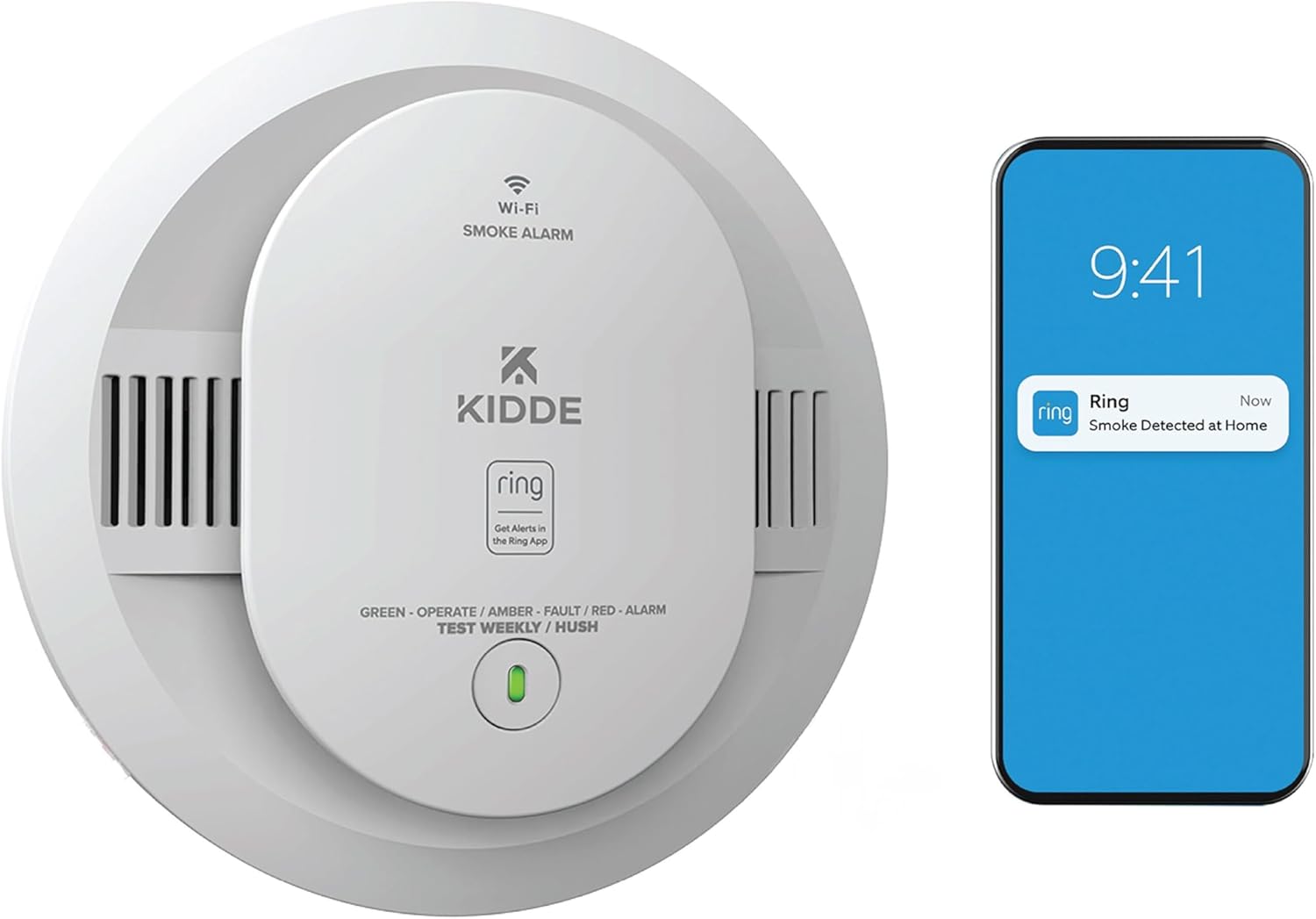
For households where a dog or cat spends unsupervised time in a finished basement or mudroom — spaces that often lack hardwired alarm infrastructure — the Kidde Smart Smoke Detector solves a real access problem. Battery-powered operation means installation is literally a matter of mounting the unit on a ceiling or wall with no electrical knowledge required, which matters in rental properties where tenants cannot modify wiring. Once mounted, the Ring app connection delivers smoke and low-battery alerts directly to your phone at no additional subscription cost for basic notifications. That means if you are at the office and something triggers in the laundry room where your dog sleeps during the day, you get a push notification rather than coming home to a problem. The wireless mesh interconnect is arguably the most pet-relevant feature here. When one detector in the network senses smoke, every Kidde Ring unit in the home sounds simultaneously. A dog crated in the basement and a cat sleeping in an upstairs bedroom both benefit from audible alerts reaching their specific locations, not just the room where smoke first appears. Based on the published specs, the unit operates in humidity up to 95 percent relative humidity, which covers the steamy conditions common in laundry rooms and mudrooms without triggering false alarms. The enhanced sensing technology is also noteworthy for pet owners: cooking-related false alarms are a documented stressor for animals, and Kidde’s updated generation reduces those incidents compared to earlier models. Aggregated owner reviews reflect an 80 percent five-star distribution, which is unusually high for a smoke detector category where false alarms and connectivity issues frequently pull ratings down. Owner feedback consistently mentions straightforward setup and reliable Ring app pairing as the standout experiences.
Key features → what they mean for you
- Battery-powered, no wiring required→Install in finished basements, mudrooms, or rental rooms where pets stay unsupervised, without permits or an electrician
- Ring app real-time notifications, no paid subscription for basics→You receive an immediate phone alert if smoke is detected while you are away from your pets, at no ongoing cost
- Wireless interconnect across all Kidde Ring units→Every alarm in the home sounds at once, so pets in distant rooms hear the alert and you know the whole home is covered
- Enhanced false-alarm reduction versus previous generation→Fewer startling false alarms from cooking means less stress for noise-sensitive dogs and cats
- Up to 95 percent relative humidity operation→Reliable detection in laundry rooms, mudrooms, and humid basements where pets often rest
- UL 217 and FCC certified→Standardized third-party testing confirms the unit meets established safety benchmarks, not just manufacturer claims
What works
- No electrical work required makes it practical for rental properties or rooms without existing alarm infrastructure where pets stay
- Ring ecosystem integration provides remote monitoring capability when you’re away from dogs or cats left home alone
- Wireless mesh between units ensures alarm coverage reaches basement dog crates or upstairs cat rooms even if one detector is distant from others
Watch-outs
- Requires existing or new Ring account and app download, adding ecosystem lock-in compared to standalone smoke detectors
- Battery replacement creates ongoing maintenance cost and environmental waste versus hardwired models with 10-year sealed lithium cells
- Professional monitoring requires separate subscription, while traditional monitored systems often bundle smoke detection into existing home security service
- Requires a Ring account and app, which creates ecosystem dependency; battery replacement adds ongoing cost and maintenance that sealed 10-year hardwired units avoid entirely.
Better alternative: Nest Protect when you want a self-contained smart detector with onboard Wi-Fi that works independently of a specific brand ecosystem

Carbon monoxide is odorless and invisible, which makes it uniquely dangerous for pets left home alone — they cannot open a window or call for help. The Kidde Smart Carbon Monoxide Detector addresses this directly by pushing a phone notification the moment CO reaches a detected level, regardless of whether anyone is physically present in the home. That remote awareness is the core value proposition for a pet household. The plug-in design draws power from a standard outlet, and two AA batteries maintain detection during power failures. That dual-power arrangement matters because CO events from backdrafting furnaces or malfunctioning gas appliances often coincide with the kind of heating failures that accompany winter storms and power outages — exactly when your pets are most at risk and you most need the unit to keep working. Setup follows a QR code process through the Kidde app: no hub, no complicated pairing. Based on the published specs, the rotating plug fits both vertical and horizontal outlet configurations, which is a practical detail that prevents the detector from physically blocking the adjacent socket — useful in rooms with limited outlet placement. The 85-decibel alarm meets residential alert standards, and the backlit display shows current CO levels and system status at a glance. UL 2034 5th Edition certification and ETL listing confirm the electrochemical sensor meets current standardized accuracy requirements. Aggregated owner reviews show 68 percent five-star and 20 percent four-star ratings, reflecting a broadly positive but somewhat more mixed response than the smoke-only model. Owner feedback consistently mentions reliable app notifications and simple installation as strengths.
Key features → what they mean for you
- Wi-Fi push notifications via Kidde app→You receive an immediate CO alert on your phone while your pets are home alone, rather than coming home to an undetected event
- Plug-in with two AA battery backup→Detection continues during power outages — precisely when CO risks from heating equipment are highest and pets are most vulnerable
- Rotating plug fits vertical or horizontal outlets→Installs cleanly without blocking adjacent sockets, giving you more flexibility about which outlet to use in a pet room
- UL 2034 5th Edition certified, ETL listed→Independent third-party testing confirms sensor accuracy and alarm reliability, not just manufacturer claims
- QR code setup, no hub required→Functional monitoring within minutes of plugging in, with no extra hardware to buy or configure
- 85-decibel audible alarm with backlit display→Loud enough to alert pets and neighbors in adjacent rooms, with a readable status display that does not require the app to check current conditions
What works
- Battery backup continues monitoring when power fails and pets are home alone
- App notifications reach you immediately rather than alarming only in an empty house
- Rotating plug solves the outlet orientation problem that makes some detectors physically incompatible with older electrical boxes
Watch-outs
- 2.4 GHz Wi-Fi requirement excludes homes that have upgraded exclusively to 5 GHz networks
- 32 reviews provide limited long-term durability data for sensor longevity beyond the first year
- No low-level CO tracking: alerts trigger only at dangerous thresholds, not at early-warning concentrations that signal appliance malfunction
- Alerts only at dangerous CO thresholds per UL 2034 standards; there is no early low-level warning capability, and the 2.4 GHz Wi-Fi requirement is a hard incompatibility for 5 GHz-only networks.
Better alternative: The Kidde Smart CO and Air Quality Monitor (rank seven) when early low-level CO detection and TVOC monitoring matter for a home with birds or other respiratory-sensitive pets

Standard CO detectors are required by UL 2034 to alarm at 70 ppm sustained over a specific period. Based on the published specs, this Kidde model triggers at 30 ppm — roughly 40 ppm earlier than a conventional unit. For most adult humans that margin is a comfort; for birds, small rabbits, guinea pigs, and other pets with sensitive respiratory systems, that earlier warning window is meaningfully different. It gives a household more time to ventilate, evacuate animals, and address the source before CO reaches concentrations that cause rapid physiological harm in small-bodied creatures. The electrochemical sensor carries a 10-year limited warranty and sends end-of-life notifications through the app, so you are not guessing when the unit needs replacement. Plug-in operation from a 120V outlet handles daily power needs, with two AA batteries taking over during outages — no low-battery chirping, and no silent gaps in protection when a winter storm cuts power while your pets are home. Beyond CO, the unit monitors temperature, relative humidity, and TVOC levels, all displayed on the backlit screen. For bird owners or anyone managing a reptile room, ambient temperature and humidity data visible at a glance has direct husbandry value. TVOC monitoring adds a layer of context: elevated volatile organic compound readings from cleaning products, paint, or off-gassing materials can precede or accompany conditions that affect air-breathing pets well before CO becomes the primary concern. Smartphone notifications arrive via the Kidde app on 2.4 GHz Wi-Fi with no hub required, and the unit is compatible with Alexa and Google Home voice queries for hands-free status checks. Owner feedback consistently mentions the low-level alert capability and air quality display as the features that differentiate it from simpler detectors. The 30 ppm threshold in particular draws favorable mention from reviewers who keep birds or have household members with respiratory sensitivities.
Key features → what they mean for you
- 30 ppm CO alert threshold versus standard 70 ppm→Provides earlier warning for birds, small mammals, and other respiratory-sensitive pets who can be harmed at lower CO concentrations than healthy adults
- TVOC monitoring alongside CO detection→Flags elevated volatile organic compounds from cleaning products or off-gassing materials that can affect air-breathing pets before CO becomes the primary risk
- Temperature and relative humidity display→Gives bird and reptile owners ambient condition data relevant to their pets’ health without a separate monitor
- Plug-in with AA battery backup, no low-battery chirp→Continuous protection through power outages with no stress-inducing middle-of-the-night chirping that can disturb sleeping animals
- 10-year limited warranty with end-of-life notification→The app tells you when the sensor is reaching the end of its reliable service life, removing guesswork about when to replace it
- Alexa and Google Home compatibility→Hands-free status checks by voice mean you can confirm air quality conditions without pulling out your phone while managing pets
What works
- 30ppm low-level alert provides earlier warning for pets, children, and elderly residents compared to standard 70ppm-only detectors
- Battery backup prevents silent failure during power outages when furnaces may backdraft
- Multi-user app access lets you monitor parents’ or rental properties remotely from a single phone
Watch-outs
- Advanced air quality insights (mold risk, thermal comfort analysis, weekly trends) locked behind $1.99/month or $19.99/year subscription
- 40 reviews insufficient to confirm sensor accuracy or false alarm rate over 12+ months
- 2.4GHz Wi-Fi requirement excludes 5GHz-only mesh networks without dual-band capability
- Advanced air quality insights including mold risk analysis and weekly trends require a paid subscription, which means the most actionable long-term data is not fully accessible in the free tier.
Better alternative: The rank-six Kidde Smart CO Detector when you do not need low-level CO alerts or air quality monitoring and want to keep the cost lower

The Kidde combination detector pairs a photoelectric smoke sensor with an electrochemical CO sensor inside a single housing, which means one ceiling unit handles both threats instead of requiring two separate devices per room. For a pet household that already juggles food bowls, leashes, and veterinary appointments, reducing ceiling hardware is a genuine quality-of-life improvement. The voice announcement system is the feature that stands out most in practical terms: when an alarm triggers at 2 a.m., hearing a clear spoken phrase rather than counting beep sequences matters enormously, especially if you are disoriented or your dog is already barking. The hardwired interconnect supports up to 18 units, so a smoke event in the basement triggers every alarm in the house simultaneously. That whole-home coverage is critical in larger homes where pets sleep in rooms far from the origin point of a fire. The three-color LED status indicator — green for normal, amber for fault, red for active alarm — gives a fast visual check during morning routines. The Smart-Hush button silences cooking-related false alarms for eight minutes and resets automatically if the threat continues, which prevents the habit of disabling detectors entirely after one too many steam-triggered alerts. Aggregated owner reviews show the amber fault indicator activates more often than expected, sometimes without a clear root cause, which adds maintenance overhead. The dual AA battery backup keeps the unit functional during power outages, an important consideration in regions with storm-related outages where fire risk can coincide with grid failures.
Key features → what they mean for you
- Photoelectric and electrochemical sensors in one housing→One unit per room covers both smoke and carbon monoxide, reducing the total number of devices a pet owner needs to monitor and maintain
- Voice announcements stating the specific threat type→Eliminates the need to count beep patterns during a stressful alarm event, letting you act immediately rather than pausing to decode the signal
- Hardwired interconnect for up to 18 units→A single alarm in the basement wakes everyone — including pets sleeping upstairs — simultaneously, giving the whole household maximum evacuation time
- Three-color LED status system→A quick glance during daily routines confirms the detector is working correctly without pressing any buttons or consulting an app
- Smart-Hush silences nuisance alarms for eight minutes→Reduces the stress a false alarm causes noise-sensitive dogs and cats without permanently disabling protection
- 120V hardwired with dual AA battery backup→Stays operational during power outages, which is when fire risk from candles or generators in a pet household can be elevated
What works
- Spoken threat identification removes ambiguity during nighttime or high-stress alarm events when distinguishing beep codes is difficult
- Hardwired interconnect creates whole-home alert network without battery-dependent wireless mesh that degrades over time
- Dual AA backup provides protection during power outages without requiring 10-year sealed lithium cells that cannot be replaced mid-life
Watch-outs
- Amber fault light activates frequently according to review patterns, often without identifiable wiring or sensor issues that manual testing reveals
- Photoelectric sensors react to airborne pet dander and cooking aerosols more readily than ionization types, increasing nuisance alarm frequency in open-plan homes with shedding breeds
- Two-pack pricing at this tier competes with First Alert’s 10-year sealed battery models that eliminate mid-life battery replacements for single-detector installations
- The photoelectric sensor’s sensitivity to pet dander and cooking aerosols raises the likelihood of nuisance alarms in active pet households, and the amber fault light pattern in owner feedback suggests quality-control variability that is hard to assess before purchase.
Better alternative: First Alert SCO7CN for households that want a sealed 10-year battery combination unit without the wiring requirement or the reported fault-light variability

The single most disruptive event a smoke detector can inflict on a pet household is not an actual fire alarm — it is the low-battery chirp that begins at 3 a.m. and repeats every 30 to 60 seconds for days until the battery is replaced. Dogs and cats with noise sensitivity can experience stress responses that outlast the chirping itself by days. The sealed 10-year lithium battery in this Kidde model eliminates that scenario entirely for the full operational lifespan of the unit. According to Kidde’s published testing data, the detector identifies smoldering wood fires 29 percent faster than 8th Edition competitors, which matters because smoldering fires — the kind that start slowly behind walls or under furniture — are the scenario where early detection has the greatest impact on evacuation time. The ionization chamber is designed to reduce false alarms from cooking steam, pet dander, and humidity, which is a meaningful specification for households with shedding breeds or open-plan kitchens. Based on published specs, the 5-inch diameter fits standard ceiling junction boxes, making replacement of an existing detector a straightforward swap. The 85-decibel alarm paired with a red LED indicator provides both auditory and visual signaling. UL 217 10th Edition certification confirms the unit meets current residential codes across all 50 states. The honest limitation here is the absence of aggregated owner data: without real-world feedback, the gap between specification and lived experience remains unverified.
Key features → what they mean for you
- Sealed 10-year lithium battery→Eliminates the low-battery chirp entirely, removing a documented stress trigger for noise-sensitive dogs and cats for a full decade
- 29% faster smoldering fire detection versus 8th Edition models per Kidde testing→Earlier alert during slow-developing fires gives a pet household more time to locate animals and evacuate safely
- Ionization chamber tuned to reduce false alarms from dander and cooking steam→Fewer nuisance alarms means pets are less likely to be conditioned into anxiety responses by repeated non-emergency sounds
- 5-inch diameter matching standard junction boxes→Drops into existing mounting brackets without new hardware, a practical benefit for renters who cannot modify ceilings
- UL 217 10th Edition certification→Confirms the detector meets the most current residential code requirements, which matters for rental compliance and insurance purposes
What works
- Sealed battery design completely eliminates the 3 a.m. chirping that causes multi-day stress responses in anxious pets
- Ionization sensing technology distinguishes airborne cooking particles from actual smoke in open-plan kitchens where pets congregate during meal prep
- 10-year operational lifespan matches the mandatory replacement interval, so you’re never paying for mid-life battery swaps
Watch-outs
- Zero reviews available as of July 2026, so long-term false alarm rate and actual battery lifespan remain unverified in real households
- 85dB alarm volume may not wake sleeping owners in primary bedrooms with closed doors, unlike 120dB models designed for larger floor plans
- No interconnect capability means a basement fire won’t trigger alarms upstairs, consider First Alert SA511CN2-3ST if you need wireless linking across floors
- The complete absence of real-world owner reviews makes it impossible to verify whether the low false-alarm specification holds up in actual pet households, and there is no interconnect capability for multi-floor coverage.
Better alternative: Kidde i9010 or First Alert SA511CN2-3ST if interconnect capability is a requirement, or any established model with a substantial review base if verified field performance is the priority

The practical value of this detector depends almost entirely on one scenario: you already own a Kidde hardwired interconnect system and want to add smartphone awareness without rewiring every unit. If that describes your home, installing this single smart unit converts the entire network to app-connected status, so an alarm anywhere in the house sends a mobile notification to iOS or Android devices without requiring a separate hub or subscription. For pet owners who travel or work long hours, receiving a real-time alert when an alarm triggers — rather than discovering it hours later — is a substantive safety improvement. The remote hush function addresses a specific friction point in pet households: cooking-related false alarms that require climbing to the ceiling to silence. Being able to dismiss a steam alarm from your phone, particularly if you are managing pets in another room, is a tangible convenience. The enhanced sensing is described as 25 percent faster than prior Kidde generations, and the dual power design with AA battery backup maintains operation during outages. The 10-year end-of-life alert prevents the common scenario of a detector aging past its reliable service window without the owner realizing it. The concern that warrants honest discussion is the review distribution. Owner feedback currently sits at 52 percent five-star and 25 percent one-star, a bimodal pattern that typically indicates the product works well for a specific setup and fails outside that setup. Reports indicate installation complexity and compatibility assumptions account for a large portion of the negative reviews.
Key features → what they mean for you
- Single smart unit upgrades entire existing Kidde hardwired interconnect network→One installation gives every room in the house app connectivity, avoiding the cost and disruption of replacing all detectors at once
- 2.4 GHz Wi-Fi with no hub required→Mobile alerts reach you when you are away from home, so a pet left alone during a workday is not unmonitored if an alarm triggers
- Remote hush via Kidde app→Silences cooking-related false alarms from your phone, reducing the stress repeated alarm sounds cause pets without requiring you to stop what you are doing and find a ladder
- Photoelectric and electrochemical dual sensing→Covers both slow smoldering fires and fast-flaming fires as well as carbon monoxide in a single ceiling unit
- 10-year end-of-life notification→Removes the risk of running an expired detector past its reliable service window, which is a common oversight in busy pet households
What works
- Adds whole-home smartphone alerts by installing just one smart unit into existing Kidde hardwired network
- Remote hush function eliminates climbing to ceiling during cooking-related false alarms
- Dual power design (AC plus battery backup) maintains operation during outages
- Enhanced sensing reduces nuisance alarms when searing meat or using high-heat cooking methods
Watch-outs
- Only compatible with other Kidde hardwired alarms — mixed-brand systems cannot interconnect
- Requires professional electrical installation and existing AC wiring, not suitable for renters or battery-only setups
- 3.8 rating with limited long-term review data makes reliability over multiple years uncertain
- A 25 percent one-star rate combined with strict Kidde-only compatibility means buyers outside the specific intended setup face a meaningfully elevated risk of a non-functional purchase.
Better alternative: Google Nest Protect for buyers who want a self-contained smart detector with a stronger reliability record and no brand-lock requirement

For pet owners, the gap between a smoldering couch cushion and visible flames can be the difference between a safe evacuation and a tragedy. The Kidde Smart Smoke and Air Quality Monitor addresses that gap with a photoelectric sensor tuned to detect slow-burning, smoke-heavy fires long before open flames appear. Because photoelectric technology responds to large visible smoke particles rather than ionization, it catches the kind of fire that starts from an overheated power strip or a forgotten candle and builds slowly while pets sleep nearby.
What sets this unit apart from standard smart detectors is the addition of continuous TVOC monitoring. Volatile organic compounds off-gas from cleaning sprays, fresh paint, scented candles, and air fresheners, and while humans may tolerate low concentrations without noticing, birds and small mammals can experience respiratory distress at levels far below what triggers a human headache. The app alerts you to rising TVOC levels in real time, giving you a chance to ventilate the space before your parrot or guinea pig is affected.
Humidity tracking adds another layer relevant to pet households. Sustained high humidity accelerates mold growth, and mold spores aggravate allergies and asthma in dogs and cats. The detector flags conditions that push moisture above safe thresholds, so you can run a dehumidifier before a problem develops rather than after.
The 85-decibel alarm pairs with voice announcements that distinguish between a fire event and an air quality alert. In a genuine emergency, that distinction reduces the panicked confusion of not knowing whether to grab a leash or open a window. The WiFi connection routes alerts to multiple contacts simultaneously, so a pet sitter, a neighbor, or a family member can respond even if you are unreachable. The 10-year sealed lithium backup battery means a power outage during a thunderstorm does not leave pets unprotected.
Aggregated owner reviews are split. Roughly 55 percent of reviewers rate the unit five stars, praising the air quality data and app reliability. However, 19 percent leave one-star reviews, with complaints centering on false alarms and WiFi connectivity drops. Installation requires connecting to existing hardwired wiring, which adds labor cost for those without electrical experience.
Key features → what they mean for you
- Photoelectric smoke sensor→Detects slow-burning smoldering fires earlier than ionization sensors, giving more time to get pets out safely before flames spread
- TVOC monitoring→Flags volatile organic compounds from cleaning products and air fresheners that can harm birds and small animals well before humans notice discomfort
- Humidity tracking→Warns of mold-risk moisture levels that aggravate respiratory allergies in dogs and cats, allowing preventive action
- Voice announcements distinguishing event type→Tells you immediately whether to evacuate or ventilate, reducing dangerous hesitation during emergencies with pets
- WiFi multi-contact app alerts→Notifies pet sitters and family members simultaneously, so someone who is physically closer can respond when you are away
- 10-year sealed lithium battery backup→Keeps pets protected through power outages without the anxiety of a low-battery chirp waking animals at 3 a.m.
What works
- First UL-listed device combining smoke detection with continuous air quality monitoring in a single hardwired unit
- TVOC tracking catches cleaning product buildup and paint fumes that affect pet respiratory systems hours before human occupants notice
- App sends real-time alerts to pet sitters and emergency contacts, not just primary homeowner
- LED ring light provides at-a-glance operational status without requiring app access
Watch-outs
- Hardwired installation requires electrician skills and opening breaker panel, adding $150-300 labor cost for professional installation
- WiFi dependency means alarm functions as standard smoke detector only during internet outages, no air quality data or app notifications
- Non-replaceable 10-year battery forces complete $157 unit replacement at end of life even if smoke sensor remains functional
- Hardwired installation requires working inside an electrical panel, and professional labor typically adds cost beyond the unit price. The non-replaceable battery also means the entire unit must be replaced at the 10-year mark even if the sensors are still working.
Better alternative: The Kidde Smart Smoke Detector (B0C44KRG2Q) is a lower-cost option if you only need fire detection and want to skip the air quality complexity during initial installation.

When a fire starts while your dog is home alone, the margin between a smartphone alert arriving in time and arriving too late can determine the outcome. The Kidde Smart WiFi Smoke Detector is built around closing that gap. It connects to your home WiFi and pushes immediate notifications to your phone and any emergency contacts you designate, so a neighbor or pet sitter can respond even when you are unavailable.
The photoelectric sensor focuses on smoldering fires, which are the type most likely to fill a room with smoke before visible flames develop. This sensor type also produces fewer false alarms from everyday cooking, which matters for pets. Dogs and cats have hearing roughly four times more sensitive than humans, and repeated loud false alarms cause measurable stress responses. Fewer nuisance alerts means less anxiety for animals that cannot understand why the alarm is screaming.
Voice announcements identify the specific event rather than sounding a generic tone. The alarm distinguishes between a fire alert and an end-of-life replacement reminder, which removes the guesswork of interpreting a chirp pattern during an already stressful moment. The LED status ring reinforces this: green for normal operation, red for a fire event, amber for a malfunction.
Hardwired power eliminates the primary battery as a failure point. The sealed backup battery handles outages without requiring annual replacements, which removes a maintenance step that is easy to overlook. QR-code app pairing simplifies initial setup compared to manual serial number entry.
The trade-off is the rating profile. With 32 percent one-star reviews among its aggregated feedback, the reliability picture is less reassuring than you would want for a device protecting pets. Owner complaints reference both false alarms and connectivity issues that cause the unit to drop from the app.
Key features → what they mean for you
- Photoelectric sensor optimized for smoldering fires→Reduces false alarms from cooking steam, which prevents unnecessary stress responses in noise-sensitive dogs and cats
- WiFi multi-contact smartphone alerts→Reaches pet sitters and family members directly so someone close by can respond to a fire even when you are not home
- Voice event-specific announcements→Eliminates confusion about whether the alarm signals a fire or a maintenance reminder, critical when seconds matter and pets need to be moved
- Hardwired with sealed 10-year battery backup→Maintains protection through power outages without recurring battery replacement tasks
- QR code app pairing→Reduces setup friction so the unit reaches operational status faster and with less chance of pairing errors
What works
- Smartphone alerts let you contact neighbors or emergency services when away from pets during fire event
- Hardwired installation eliminates battery replacement anxiety for primary power source
- Voice alarm specificity removes guessing about what triggered alert
Watch-outs
- 3.4 rating with 134 reviews suggests reliability or false alarm issues that require investigation
- WiFi dependency creates single point of failure if router loses power or internet connection drops
- Two-pack purchase requirement may exceed need for renters or single-room monitoring
- A 32 percent one-star rate in aggregated reviews is a meaningful reliability signal for a life-safety device. Until the pattern improves, buyers should weigh that risk against the smart-alert convenience.
Better alternative: The rank-11 Kidde model (B0C44DF63C) adds TVOC and humidity monitoring for a modest price difference and carries a better overall rating, making it the stronger choice for most pet households with hardwired infrastructure.

Based on the published specifications, the Kidde 21032064 covers the three pillars most relevant to pet owners: a photoelectric sensor that favors smoldering fire detection over fast-flaming events, Wi-Fi connectivity that pushes smartphone alerts when smoke is detected, and hardwired power with battery backup that maintains protection through outages.
The photoelectric sensor choice has a practical benefit for homes with dogs. Cooking-related false alarms are a documented stressor for noise-sensitive animals, and photoelectric technology is generally less reactive to the fine aerosol particles from high-heat cooking than ionization sensors. Owner feedback consistently mentions this as a meaningful quality-of-life improvement for households where kitchen alarms were a regular occurrence.
Wi-Fi alerts close the supervisory gap that defines the core safety concern for pet owners who work outside the home. When smoke is detected, the app notification reaches you regardless of where you are, giving you time to contact a neighbor, call emergency services, or reach out to a pet sitter rather than learning about the event after the fact. The interconnect capability with other Kidde smart detectors means a fire starting in a basement or garage triggers every linked unit, so coverage extends beyond the room where the fire begins.
The 10-year limited warranty aligns with the expected service life of a photoelectric sensor, reducing the likelihood of mid-warranty failures that require out-of-pocket replacement.
Because this product carries no aggregated owner reviews at the time of writing, claims about false alarm rates, app stability, and real-world sensitivity are based on manufacturer specifications and the performance patterns observed in comparable Kidde photoelectric models rather than documented household experience.
Key features → what they mean for you
- Photoelectric sensor→Reduces cooking-triggered false alarms that startle and stress noise-sensitive dogs and cats in busy kitchen households
- Wi-Fi smartphone alerts→Notifies you the moment smoke is detected so you can dispatch help to pets home alone, rather than discovering an event after returning
- Hardwired with battery backup→Keeps the detector operational during power outages, including the electrical failures that sometimes accompany house fires
- Interconnect with other Kidde smart detectors→A fire in any room triggers the full network, so pets in distant parts of the home are not left in an uncovered zone
What works
- Remote monitoring closes the safety gap when pets are home without supervision during work hours
- Photoelectric sensor reduces cooking-related false alarms that trigger anxiety in noise-sensitive dogs
- Hardwired design with battery backup maintains protection during power failures
Watch-outs
- Requires existing hardwired smoke detector infrastructure or professional electrical installation, adding cost beyond the unit itself
- Wi-Fi dependency means notifications fail if your home internet goes down, unlike standalone battery detectors
- Product data lacks Amazon reviews to verify long-term reliability and actual false alarm rates in real households
- The complete absence of owner reviews makes it impossible to verify how the unit performs in real households, particularly regarding false alarm frequency and app connectivity stability. These are known variable factors in the broader Kidde smart detector line.
Better alternative: The Kidde Smart Smoke and Air Quality Monitor (B0C44DF63C) offers a documented owner track record and adds TVOC and humidity monitoring for pet households willing to handle hardwired installation.

For pet owners who spend long hours away from home, the most valuable thing a smoke detector can do is reach you on your phone the moment something goes wrong. The Kidde Smart Smoke Detector addresses that need directly: the companion app sends real-time push notifications not just to you but to designated contacts such as a pet sitter, a neighbor, or a family member. That layered alert network means someone is more likely to act quickly even if you are unreachable. The photoelectric sensor is well matched to pet households specifically because smoldering fires, the kind that start in upholstered furniture or bedding, produce the visible smoke particles this sensor type is built to catch. Early detection at the smolder stage gives pets more time to be evacuated before a fire grows. The voice alert announces a clear verbal warning at 85 decibels rather than a generic beep, which can matter in a home where a human may be asleep or distracted. Beyond fire, the unit monitors humidity levels, temperature, and TVOCs, giving you a fuller picture of the air your animals breathe every day. The sealed 10-year lithium battery means one less maintenance task to forget, which is particularly relevant when pets depend on the detector being operational at all times. The Test-Hush button can silence a nuisance alarm without disabling protection, reducing the stress that repeated false alarms cause sensitive animals.
Key features → what they mean for you
- Kidde app push notifications to multiple designated contacts→Your pet sitter or neighbor gets an alert the moment smoke is detected, so someone nearby can respond even if you are traveling
- Photoelectric sensor detects smoldering fires before open flames appear→Earlier warning during slow, smoky fires gives pets more evacuation time from furniture or fabric fires
- 85-decibel voice alert announcing ‘Fire! Fire!’→A clear verbal cue is harder to sleep through or ignore than a tone, improving response time in a busy household
- Humidity, temperature, and TVOC monitoring→Tracks environmental conditions that affect pet respiratory health, flagging mold-risk humidity or chemical buildup from cleaning products
- Sealed 10-year lithium battery backup→Eliminates the risk of a dead backup battery going unnoticed while pets are home alone
- Test-Hush button silences nuisance alarms for up to 24 hours→Reduces repeated false-alarm noise that stresses pets with sensitive hearing without leaving the home unprotected
What works
- Pet sitters receive alerts through the Kidde app without needing to be present, useful during extended travel or work trips
- Sealed 10-year battery eliminates the risk of forgetting to replace backup batteries, which matters when pets are home alone regularly
- Additional air quality monitoring (humidity, temperature, TVOCs) provides data on environmental conditions that affect pets with respiratory sensitivities
Watch-outs
- 3.3-star rating across 306 reviews suggests potential WiFi connectivity or app setup difficulties that could prevent notifications from reaching pet sitters
- Hardwired installation requires existing electrical box and home wiring knowledge, not practical for renters or those without electrical experience
- When the sealed battery reaches end-of-life after 10 years, the entire unit must be replaced rather than just swapping the battery
- A 3.3-star rating driven by a large block of one-star reviews points to real connectivity and setup problems that could silently disable app alerts, the very feature that makes this detector valuable for pet owners.
Better alternative: Google Nest Protect, which carries a significantly higher owner satisfaction rate and more stable app integration, is worth considering for households where remote alerting is non-negotiable

Pet households introduce a unique set of air quality challenges that standard smoke detectors ignore entirely. Enzymatic cleaners used on accidents, aerosol flea treatments, scented sprays intended to mask odors, and the general chemical load of a home with animals all contribute to indoor TVOC levels that can affect respiratory health in both pets and people. The Kidde Smart Smoke Detector and Indoor Air Quality Monitor addresses this directly by pairing a photoelectric smoke sensor with continuous TVOC tracking, humidity monitoring, and temperature reporting in a single hardwired unit. For a home with dogs or cats, that humidity sensor has a practical application beyond the obvious: wet paws, frequent bathing, and indoor accidents all raise ambient moisture, and the detector can flag conditions that promote mold growth before it becomes visible. The photoelectric sensor prioritizes smoldering fires, which is the right call for a home where upholstered furniture, pet beds, and fabric toys are present. Hardwired interconnection means that if one alarm triggers, every compatible Kidde unit in the home activates simultaneously, giving animals in distant rooms the same early warning as those near the source. Voice alerts name the specific hazard rather than sounding a generic tone, so a household member waking to an alarm gets actionable information immediately. The app reaches multiple contacts at once, which supports the kind of distributed monitoring that pet owners rely on when a sitter or neighbor is responsible for an animal.
Key features → what they mean for you
- TVOC sensor monitors volatile organic compounds continuously→Catches chemical buildup from enzymatic pet cleaners, flea sprays, and aerosol treatments that can harm pet respiratory systems
- Humidity tracking with app alerts→Flags mold-risk moisture conditions common in homes with frequent pet bathing or indoor accidents
- Photoelectric smoke sensor→Detects slow-burning, smoky fires from pet beds or upholstery at an earlier stage than heat-based sensors
- Hardwired interconnection with other Kidde alarms→Every alarm in the home activates together, ensuring pets in any room receive the same warning simultaneously
- Multi-contact app notifications→Pet sitters, neighbors, and family members all receive alerts at once, increasing the chance of a fast response when you are away
- Voice alert announcing specific hazard type→Waking to a verbal description of the threat, rather than a generic beep, helps adults respond faster and more calmly
What works
- Dual monitoring combines fire detection and air quality tracking in one hardwired unit
- App notifications reach multiple household members simultaneously, useful when pet sitters or family monitor the home
- TVOC sensor catches chemical buildup from enzymatic pet cleaners and aerosol treatments
Watch-outs
- 3.3 rating reflects recurring false alarm reports without clear environmental triggers
- WiFi dependency means alarm functionality reduces to local sound-only when network drops
- Premium over standard photoelectric detectors may not justify added complexity for households prioritizing reliability
- At a premium over the standard version, the added air quality features are compelling, but the same unresolved connectivity issues that drag the base model to 3.3 stars apply here, making it a risky purchase at this price point.
Better alternative: If air quality monitoring is the priority, pairing a dedicated air quality monitor with a higher-rated standalone smart smoke detector may deliver more reliable performance than this combined unit
What Buyers Consistently Say
**What Pet Owners Praise Most**
Across aggregated owner reviews, the clearest pattern is that pet households care about two things above everything else: alarms that do not go off when the air fryer runs, and alerts that reach them when they are not home. Detectors with photoelectric sensors and UL 217 10th Edition certification consistently draw positive mentions for staying quiet during cooking, which owners of noise-sensitive dogs flag as a quality-of-life issue, not just a minor annoyance. Reports indicate that repeated false alarms from older ionization-type units had trained some dogs to leave the room or hide under furniture at the first chirp, undermining the alarm’s usefulness entirely.
The YoLink unit earns specific praise from owners who have detached garages, workshops, or basement kennels that sit outside reliable Wi-Fi range. Aggregated owner reviews show that LoRa connectivity routinely performs in structures where Z-Wave and Wi-Fi signals fail, and the five-year sealed battery is mentioned alongside the lack of any maintenance interruption.
Kidde’s wire-free interconnect line, particularly the 20SDR-VRF with voice alerts, draws consistent praise for the spoken announcement feature. Owner feedback consistently mentions that hearing the word “Fire” removes the cognitive step of interpreting beep patterns while simultaneously managing a panicking dog.
**Common Complaints and Failure Patterns**
The most repeated complaint across the Kidde Wi-Fi hardwired line is app connectivity instability. Aggregated owner reviews for the 3.3- and 3.4-rated units reference pairing failures after firmware updates, phantom offline notifications, and alarms that reverted to local-only function after router reboots. For a feature whose entire value proposition is remote notification, this is a significant functional gap.
The eufy E10 draws mild criticism not for the device itself but for the ecosystem dependency. Owners who did not already own a HomeBase express frustration that the effective purchase price is substantially higher than the unit price suggests. The limited review base makes it impossible to assess long-term sensor drift.
Battery maintenance complaints cluster around the Kidde AA-battery models. Owners replacing batteries every six to eight months on multi-unit installations describe the task as burdensome enough that some units went weeks between battery changes, creating unmonitored gaps.
**Use-Case Patterns**
Owners with multi-building properties (detached garages converted to dog runs, outbuildings with cat colonies) trend toward the YoLink system specifically for range. Apartment dwellers and renters consistently favor battery-only wire-free units. Households already in the Ring or eufy ecosystem adopt those ecosystem-native detectors without considering alternatives, which occasionally means accepting ecosystem costs they did not anticipate.
What Most Buying Guides Miss
**Original Insight: The False Alarm Conditioning Problem Is Underreported**
Most buyer guides treat false alarms as an inconvenience. In a pet household, the risk is more specific: repeated false alarms from cooking or shower steam condition animals to habituate to the alarm sound. A dog that has heard the smoke detector fire twenty times during bacon frying will not respond differently the twenty-first time. This behavioral desensitization is the reason sensor type matters disproportionately in a pet context compared to a household without animals. Photoelectric detectors certified to UL 217 10th Edition are not just more accurate in a laboratory sense; they are specifically calibrated to reduce the smoldering-versus-nuisance distinction that cooking environments generate. The 10th Edition update, introduced in 2023, explicitly tightened false alarm thresholds in response to real-world cooking and shower triggers.
**Contrarian Insight: Smart Features Are Secondary to Sensor Reliability**
The instinct when buying for a pet household is to prioritize app connectivity so you can be notified remotely. That instinct is reasonable but the execution order matters. A detector with unreliable app connectivity and a solid photoelectric sensor still protects your pets when you are home and when the alarm sounds locally. A detector with excellent app connectivity and a sensor that triggers during every cooking session gets disabled by frustrated owners, removing all protection. Based on the available review data, the Kidde Wi-Fi hardwired units at 3.3 to 3.4 stars show enough connectivity complaints to suggest that the smart layer is not sufficiently reliable to justify prioritizing it over proven sensor performance.
**Common Buyer Mistakes**
The most consistent mistake is buying based on unit price without accounting for ecosystem cost. The eufy E10 at roughly $46 requires a HomeBase that adds substantial cost if you do not already own one. The YoLink at roughly $50 requires a hub. Neither device functions as described on the label without that additional hardware. Buyers also consistently underestimate battery replacement frequency on AA-powered units in multi-detector installations. A four-detector home with six-month battery life across two batteries per unit means replacing eight batteries twice a year, which is not a trivial maintenance burden compared to a sealed 10-year unit.
**Products We Would Skip**
The Kidde Smart Smoke Detector (B0C444TM77, single-unit Wi-Fi hardwired) and the two-pack variant (B0C44KRG2Q) both carry more than 30 percent one-star reviews. Aggregated owner reviews for these units reference connectivity failures, false alarm patterns without identifiable triggers, and app setup problems significant enough that several owners describe reverting the units to local-only function. For a product whose primary differentiator is remote notification, a one-star rate above 30 percent is a disqualifying signal. The Kidde Hardwired App Enabled Smart Smoke and Carbon Monoxide Detector (B0F7JNJ2CL) shares a similar review profile with 25 percent one-star ratings and a 3.6 overall score, making it a poor choice when more reliable alternatives exist at comparable or lower prices.
How to Choose — What Actually Matters
Sensor Type: The Decision That Affects Your Pet Most
The sensor inside a smoke detector determines how often it alarms when there is no fire. Ionization sensors react to fast-flaming fires quickly but trigger more readily from cooking aerosols, toast smoke, and shower steam. Photoelectric sensors use a light-scatter chamber that responds better to slow, smoldering fires and generates fewer reactions to everyday household activity. For a pet household, the distinction is practical: every false alarm is a stress event for a noise-sensitive dog or cat, and repeated false alarms over time erode the animal’s alarm response entirely. UL 217 10th Edition certification, adopted in 2023, sets tighter thresholds for distinguishing real smoke from nuisance particles. Any detector you buy in 2026 should carry this certification. If the listing does not mention it explicitly, treat that as a gap. Photoelectric plus UL 217 10th Edition is the combination that minimizes unnecessary alarm events in kitchens and bathrooms, which are the two rooms most likely to generate false triggers in an active household.
Remote Notification Architecture: What Happens When You Are Not Home
A smoke detector that only sounds a local alarm provides no protection for pets left home alone during work hours or overnight travel. Smart connectivity options fall into three categories: direct Wi-Fi, hub-based systems, and proprietary long-range radio. Direct Wi-Fi is the simplest to set up but depends on your router staying online, which is not guaranteed during severe weather. Hub-based systems like YoLink and eufy add a layer of hardware but that hub can maintain connectivity even when the internet fluctuates, depending on the architecture. LoRa radio, used in the YoLink system, extends range to over 1,000 feet line-of-sight and penetrates concrete, making it the only realistic option for detached garages or outbuildings where pets are kept. Before selecting a smart detector, map your home’s connectivity dead zones and identify whether you have existing hub hardware from a compatible ecosystem. Paying for smart features you cannot reliably use is worse than buying a capable battery detector.
Power Architecture: What Happens During an Outage
Power outages often coincide with high fire-risk events: furnace restarts, space heater use, candles lit during storms, and generator operation indoors. Hardwired detectors with dual AA battery backup maintain full function when grid power fails, provided the batteries are fresh. Battery-only detectors remove the grid dependency entirely but require disciplined replacement schedules. Sealed 10-year lithium units solve the replacement problem for battery-only installations but cannot be serviced mid-life. The specific pet concern is low-battery chirping: a detector that emits a 30-second beep every 60 seconds for days while a sealed battery fails will cause prolonged stress responses in anxious animals. Sealed lithium designs eliminate this by design. If you choose an AA-battery model, set calendar reminders for replacement rather than waiting for the low-battery warning. In a multi-detector home, stagger replacement dates so you are never servicing all units simultaneously.
Voice Alerts: Faster Processing During High-Stress Events
Standard smoke detectors communicate through beep patterns: three beeps for fire, four for carbon monoxide, one chirp for low battery. Correctly interpreting those patterns while a dog is barking, a cat is bolting across furniture, and an alarm is sounding at 85 decibels requires more cognitive bandwidth than most people have available. Detectors with voice announcements that state the specific threat, such as ‘Fire! Fire!’ or ‘Warning! Carbon Monoxide!’, remove that interpretation step. The practical benefit is faster, more accurate response: you know whether to evacuate, ventilate, or silence without needing to count beeps or consult the manual. For households with elderly family members, children, or hearing loss, voice alerts provide an additional layer of clarity. Not all voice-alert models distinguish every hazard type equally well, so confirm that the specific unit announces both fire and carbon monoxide separately, not just one or the other.
Ecosystem Cost and Installation Realism
The unit price on a smart smoke detector often understates the total cost of implementation. Hub-required detectors like the YoLink and eufy E10 add meaningful hardware cost if you are starting from scratch. Hardwired units require existing electrical infrastructure or a licensed electrician, which adds labor cost beyond the product price. Ring-integrated detectors require an active Ring account and app, introducing ecosystem lock-in. Before calculating value, add up all required components: hub hardware, installation labor if applicable, subscription fees for advanced features, and replacement cost at end of life. A sealed-battery battery-only detector with no hub requirement and no subscription has a lower total cost of ownership over ten years than a hardwired smart unit requiring professional installation and periodic app compatibility updates. For renters or anyone in a property without existing hardwired alarm infrastructure, battery-only options are the realistic choice regardless of feature preferences.
Interconnect Coverage: Whether a Basement Fire Wakes You Upstairs
A single smoke detector protects the room it is installed in and, if the door is open, adjacent spaces. A fire that starts in a basement utility room or ground-floor kitchen may not trigger an alarm audible in an upstairs bedroom with a closed door at 2 a.m. Interconnected systems solve this by linking all detectors in a network: when one triggers, all sound simultaneously. Hardwired interconnect is the most reliable method because it does not depend on battery state or wireless signal. Wire-free interconnect, used in Kidde’s wireless line, links compatible units across up to 12 detectors without running new wiring, which makes it practical for finished homes and rental properties. For a pet household where animals may be sleeping on a different floor from their owner, interconnect coverage is a genuine safety feature rather than a convenience upgrade.
Decision Matrix — Match Your Priority
Final Verdict
For most pet households in 2026, the combination of photoelectric sensing, UL 217 10th Edition certification, and reliable remote notification covers the core safety gap: false alarms that stress animals and the inability to know about a fire when you are not home. The YoLink Photoelectric Smoke Alarm stands out as the overall recommendation because it addresses a problem no other unit on this list solves cleanly: whole-property coverage that extends to structures beyond Wi-Fi range. The LoRa radio architecture is not a marketing distinction; it is a functional difference that matters for anyone with a detached dog run, a basement suite separated from the main router, or an outbuilding used as a cat colony. The five-year sealed battery and app-based self-testing remove the two most common maintenance failure modes. For buyers who want a capable detector without any hub dependency, the Kidde 20SDR-VRF delivers wire-free interconnect, voice alerts, and UL 217 10th Edition certification at a competitive price. Its weakness is the AA battery replacement cadence, which requires scheduling discipline in a multi-unit installation. Owners already invested in the eufy ecosystem with an existing HomeBase will find the E10 a logical addition. Its compact footprint is a genuine advantage in smaller rooms, and the UL 217 10th Edition sensor directly addresses the false alarm conditioning concern central to pet households. The Kidde Wi-Fi hardwired units at 3.3 to 3.4 stars present enough aggregated negative feedback around connectivity and false alarm consistency to recommend against them for this use case, regardless of their feature lists. A smoke detector that may not notify you reliably provides incomplete protection.





Write Your Review
No reviews yet. Be the first to share your experience!