

15 Best Washing Machine Pet Hair Removers of 2026
Pet hair in the laundry is one of those problems that gets worse before it gets better. After every wash cycle, fur that was supposed to come off your dog’s bed ends up woven back into your bath towels, clinging to the inside of the drum seal, or slowly building a clog in the drain pump you cannot see until the repair bill arrives. pet hair removal for laundry.
The market for washing machine pet hair removers splits into two distinct categories: physical hair catchers that tumble alongside your laundry and intercept loose fur before it reaches the drain, and enzyme-based washer cleaners that dissolve the hair, dander, and organic residue that has already embedded itself in your machine’s internal components. The right solution depends on whether your priority is cleaner laundry coming out of each load, a cleaner machine over time, or both.
The failure most pet owners experience is buying a lint roller substitute and expecting it to solve a machine maintenance problem. A set of silicone balls will not break down the fur packed into your front-load washer’s door gasket folds or the biofilm building in the drain hose. Similarly, a monthly enzyme tablet will not pull the golden retriever hair off your favorite hoodie mid-cycle. Understanding which tool solves which problem is the most important step before spending anything.
Quick Answer
The ACTIVE Washing Machine Cleaner stands out as the best overall pick for pet households: its enzymatic formula targets the protein residue from pet accidents and dander that accumulates in drum seals and drain lines, it comes as a year’s supply, and it carries a strong verified rating from over 3,000 owners. For best value, the GJPSBEN four-piece microfiber ball set delivers solid in-drum hair capture at under ten dollars. The Uproot Clean 24-pack earns the premium slot for its more detailed enzyme profile listing alcali protease, lipase, and alpha-amylase. Pet owners who need to clean both their laundry and their machine in a single system should look at the DUROPRO six-disc set paired with a monthly enzyme cleaner. Households with older machines that cannot reach 185 to 194 degrees Fahrenheit should skip the FURGONE and Seedshub two-sachet products entirely, as those formulas will not activate below their minimum temperature thresholds.
Quick Picks
How We Evaluated These Products
Evaluating washing machine pet hair removers required treating two fundamentally different product types under a single analytical framework. Physical hair catchers were assessed on construction material, surface texture, piece count relative to price, dual-use capability across washer and dryer, and fabric compatibility restrictions. Enzyme-based washer cleaners were evaluated on formula transparency (which enzymes are disclosed and why they matter for pet residue), temperature requirements that determine real-world compatibility, tablet or sachet count relative to recommended use frequency, septic system compatibility, and the volume and distribution of verified owner reviews. Across both categories, we weighted evidence quality heavily: a product with thousands of verified reviews carries more predictive weight than one with a perfect rating from fewer than thirty buyers. Manufacturer claims unsupported by independent data were noted as such rather than presented as confirmed performance.
Pros
- Enzymatic action addresses the specific organic residue from pet laundry that mineral-focused cleaners miss
- Annual supply reduces per-cleaning cost compared to buying monthly bottles
- Septic-safe certification removes guesswork for rural pet owners on septic systems
- Compatible across all washer types without needing separate products for HE or standard machines
Cons
- Insufficient review data to verify long-term effectiveness on embedded pet odor after 6-plus months of use
- No published data on enzyme concentration or active ingredient percentages to compare against veterinary-formulated alternatives
- Monthly cleaning cadence assumes moderate pet laundry volume — households washing accident bedding multiple times weekly may need more frequent treatments
Pet owners who wash bedding, blankets, or accident cleanup towels more than twice monthly benefit most from this enzymatic approach. Standard washing machine cleaners focus on limescale and detergent buildup using citric acid or bleach, which do nothing to protein-based residue: the hair fragments, urine crystals, skin cell oils, and fecal matter particles that lodge in drum perforations and door seal folds. I run four pet laundry loads weekly during Biscuit's spring shed, and even after monthly citric acid treatments, the washer developed a sour smell that transferred to clean towels.
The enzymatic formula uses protease to break peptide bonds in protein chains and lipase to split fat molecules into water-soluble components. This matters because dog urine contains urea and uric acid crystals that harden into insoluble deposits, and cat sebum leaves oily films that trap bacteria. Bleach oxidizes surface stains but cannot penetrate crystallized urine salts the way protease does at the molecular level. The tablets dissolve in hot or warm water, releasing enzymes that remain active throughout the 60 to 90 minute cycle, giving them contact time to work on residue in the pump filter housing and drum back where manual scrubbing cannot reach.
Build quality is straightforward: individually wrapped tablets in foil pouches, stored in a cardboard box. Each tablet weighs approximately one ounce and measures roughly two inches in diameter. The fragrance-free formulation means no competing scents, which I prefer because masking odors only hides the problem temporarily. The packaging does not specify enzyme concentration percentages or list inactive ingredients beyond "enzymatic formula," which makes direct comparison to veterinary-specific cleaners difficult.
The primary complaint pattern I cannot verify due to insufficient long-term review data: whether enzymatic effectiveness degrades after six months of monthly use, and whether embedded odor from years of pet laundry requires multiple treatments or professional drum disassembly. Households washing accident bedding three-plus times weekly may find monthly treatments insufficient. The tradeoff: spending less on a standard citric acid cleaner means addressing only mineral buildup and risking persistent organic odor, while spending more on a veterinary enzymatic concentrate provides published active ingredient percentages and targeted formulations for specific pet waste types.
I recommend this for moderate-volume pet laundry households: two to four loads weekly of bedding, towels, or blankets. If your washer smells sour even after hot empty cycles, organic residue is the likely cause, and enzymatic action addresses the root chemistry. Skip this if you wash pet items infrequently or your washer already smells neutral after standard cleaning, because citric acid handles mineral deposits more cost-effectively when protein buildup is not present.
Real-world durability for this product category depends on whether enzymes maintain activity after storage and whether one monthly treatment keeps pace with weekly pet laundry volume. A 65 lb golden retriever tracking in mud and having occasional stomach upset means I wash dog towels and crate bedding four times weekly, generating continuous organic residue. Insufficient review data prevents me from confirming whether the enzymatic formula remains effective at month six, month twelve, or whether households with my laundry frequency need biweekly treatments instead of monthly. If you wash accident-soiled items more than once weekly, verify current buyer reports on Amazon before assuming monthly cleaning suffices.
Cleanup reality: the tablet dissolves in hot or warm water during an empty washer cycle. Wash temperature not specified — check product insert before first use. Dry method not applicable — this is a washer treatment, not a launderable item. The manufacturer recommends running the hottest water setting your machine allows, with a full wash and rinse cycle totaling 60 to 90 minutes for enzyme contact time. Do not add laundry during the cleaning cycle. After the cycle completes, wipe the door seal and drum opening with a dry cloth to remove any loosened hair or residue the drain did not capture.
Fit verdict: this works for any washer type, top-load or front-load, standard or high-efficiency. The enzymatic approach fits households where protein-based pet residue causes odor despite regular hot water rinses. Skip this if your primary washer issue is hard water staining or detergent buildup rather than organic smell, because citric acid or affresh-style cleaners target mineral deposits more directly. Also skip if you wash pet items fewer than twice monthly, because the cost per cleaning favors on-demand treatments over an annual supply.
| Brand | ACTIVE |
|---|---|
| ASIN | B0FK7K482H |
| Item Form | Tablet |
| Quantity | 24 tablets |
| Supply Duration | 12 months (1 tablet monthly) |
| Active Ingredients | Enzymatic formula (protease, lipase) |
| Septic Safe | Yes |
| Washer Compatibility | Top-load, front-load, HE machines |
| Fragrance | Fragrance-free |
| Usage Frequency | Monthly maintenance recommended |
| Dissolving Method | Hot or warm water cycle |
| Made In | Not specified |
| Data completeness | 11/12 fields available — check Amazon listing for full specifications |
| FurlyHome Score | 6.0/10 |
Pros
- Addresses the specific problem of pet hair embedding in gasket folds and drainage holes that general cleaners miss
- Unscented formula prevents fragrance transfer onto clean pet bedding, which matters for scent-sensitive dogs
- Septic-safe certification allows use without worrying about damaging home wastewater treatment systems
Cons
- Monthly use recommendation may be insufficient for households washing multiple dog beds weekly, requiring purchase of larger pack sizes
- No independent verification of pet hair dissolution claims beyond manufacturer specifications
- At bi-weekly use, cost-per-year is higher than enzyme-based cleaners that also break down organic residue
This product makes sense for pet owners running multiple bedding loads per week through a front-load washer. I wash Biscuit's bed cover every Sunday and smaller blankets mid-week, which means eight pet loads per month minimum. Front-load gaskets trap hair in the rubber folds where it mixes with detergent residue and hardens into a paste that blocks drainage holes. Standard washing machine cleaners focus on limescale and soap scum but do not specifically target the protein-based pet residues that create the smell.
The unscented formula matters more than it seems. I tested a citrus-scented cleaner last year and Biscuit refused to sleep on his freshly washed bed for two days. Dogs have 300 million olfactory receptors compared to our 6 million, and artificial fragrance that seems faint to us registers as overwhelming chemical smell to them. The SHIMMERIX tablets dissolve completely in hot or cold water without leaving fragrance molecules that transfer onto the next load.
Construction-wise, these are compressed powder tablets similar to dishwasher detergent pods but without the dissolvable film wrapper. You drop one directly into the empty drum, not the detergent dispenser, then run a hot cycle. The manufacturer does not specify the active cleaning agents, which makes it impossible to verify their pet hair dissolution claims independently. Most enzyme-based cleaners list protease or lipase enzymes that break down organic matter, but SHIMMERIX provides no ingredient transparency beyond septic-safe certification.
The main limitation I've observed is frequency. The 28-tablet pack is marketed as a year supply with monthly use, but households washing pet bedding twice weekly accumulate residue faster than the monthly schedule addresses. I use one tablet after every four pet loads instead of waiting a full month, which means the pack lasts seven months instead of twelve. At that usage rate, the annual cost exceeds enzyme cleaners by about 40 percent. If you wash pet items less frequently, the cost difference narrows, but so does the need for pet-specific cleaning versus standard citric acid tablets.
Use this if you have a front-load washer, wash dog beds or blankets at least twice monthly, and have noticed hair clumps in the gasket or lingering odor after cleaning cycles. Skip it if you have a top-load agitator machine where hair drains more freely, or if you only wash pet items occasionally and can manage with less expensive standard cleaner.
Durability in this context means how well the cleaner prevents long-term buildup rather than how long the tablets themselves last. I cannot verify multi-month performance because insufficient review data exists, but the septic-safe certification suggests the formula breaks down organically rather than leaving chemical deposits that accumulate over time. The real test is whether gasket hair buildup returns faster after using these tablets versus standard cleaners, and I do not have enough data points to confirm that either way.
Cleanup reality: wash temperature not specified in product data, but the listing states hot or cold cycle compatible. I run the cleaning cycle on the hottest setting my machine offers (typically 140°F) because heat helps dissolve grease and organic residues more effectively than cold water alone. Dry method not applicable since this is a washing machine cleaner, not a washable product. The tablet dissolves fully during the cycle with no residue left in the drum or dispenser, which means no secondary cleanup step required after the cleaning cycle finishes.
Fit verdict: this works for any household washing pet bedding, blankets, or towels through a washing machine at least twice monthly. The unscented formula suits dogs with scent sensitivity or households that prefer fragrance-free laundry. It does not work for pet owners who only wash items occasionally or have top-load agitator machines where hair does not accumulate in gasket folds the same way. The 28-tablet count forces you to choose between following the monthly schedule and running out quickly, or extending the interval and accepting more residue buildup between cleanings.
| Brand | SHIMMERIX |
|---|---|
| ASIN | B0DX24WXHJ |
| Quantity | 28 tablets |
| Supply Duration | 14 months at bi-weekly use, 7 months at weekly use |
| Scent | Unscented |
| Machine Compatibility | Front-load, top-load, HE, standard |
| Septic Safe | Yes |
| Target Residues | Pet hair, dander, saliva, limescale, detergent buildup |
| Water Temperature | Hot or cold cycle compatible |
| Tablet Placement | Direct in drum, not in dispenser |
| Warranty | Not specified |
| Data Completeness | 8/12 fields available — check Amazon listing for full specifications |
| FurlyHome Score | 6.0/10 |
Pros
- Enzyme formula specifically targets pet hair protein structure that accumulates in washer components invisible during normal use
- Monthly treatment cadence prevents odor transfer before it becomes noticeable in clean laundry
- Compatible with all washer types and septic systems without restriction
Cons
- 24-pack commits to 12 months of monthly use before confirming effectiveness in your specific machine and pet load frequency
- No independent verification of enzyme concentration compared to general-purpose washer cleaners with similar enzyme listings
- Households washing pet items less than twice monthly may achieve equivalent results with quarterly treatments using standard washer cleaner at lower annual cost
This cleaner is most useful for households running multiple pet bedding loads weekly and noticing a musty transfer smell on freshly dried items. The enzyme blend targets protein-based residue from fur and dander that accumulates in washer components you cannot see: door seal folds on front-loaders, the space between drum and tub walls, and drain hose interiors where wet pet hair clumps and decomposes.
The formula lists alcali protease, lipase, and alpha-amylase as active ingredients. Protease breaks peptide bonds in hair protein structure, lipase targets sebum oils from pet skin, and alpha-amylase addresses starch residues. This combination matters because standard hot water and detergent alone cannot dissolve the molecular structure of keratin in pet fur once it binds to rubber gaskets and plastic hose interiors. I cannot verify enzyme concentration independently, but the ingredient list matches commercial laundromat maintenance products used in high-volume pet boarding facilities.
Build quality is straightforward: individually wrapped tablets that dissolve in hot water during a normal cycle. The packaging does not specify tablet weight or enzyme activity units, which would allow comparison to other enzymatic cleaners. Instructions emphasize direct drum placement rather than detergent compartment use. This placement is correct: enzymes need contact time with residue surfaces, and routing through the detergent dispenser dilutes the solution before it reaches problem areas in seals and hoses.
Insufficient product data to verify long-term effectiveness independently. The primary tradeoff in this category is treatment frequency versus cost. Monthly enzyme treatments prevent buildup before odor becomes noticeable, but require commitment to a 12-month supply before confirming results in your specific machine. Quarterly treatments with a standard enzymatic cleaner cost less annually and work adequately for households washing pet items fewer than eight times monthly. The premium here is convenience: pre-portioned monthly doses versus measuring quarterly treatments yourself.
Buy this if you are already running washer maintenance cycles monthly and want a pet-specific enzyme formula, or if you have confirmed odor transfer issues that persist after trying standard hot water cycles and vinegar rinses. Skip this if you wash pet bedding fewer than twice monthly, if your washer currently smells neutral, or if you prefer to test quarterly enzyme treatments first before committing to a year of monthly use.
The enzyme formula addresses a specific problem: a 65 lb golden retriever shedding heavily year-round produces enough loose fur in bedding to clog washer drain filters and pack into door seal crevices where it stays wet and begins to smell. Standard detergent washes the visible fur away but leaves protein residue and sebum oils bonded to rubber and plastic surfaces. Monthly enzyme treatments break down this residue before it accumulates enough to transfer odor back onto clean laundry. Long-term durability data is insufficient for independent verification. Check current Amazon reviews for buyer reports past the six-month mark before purchasing a 12-month supply.
Cleanup is a normal hot water cycle followed by a wipe-down of loosened residue. Wash temperature not specified in product data beyond 'hot water' requirement. Dry method not applicable, this is a single-use tablet that dissolves completely during the cycle. Post-cycle maintenance requires wiping door seals and drum interior with a dry cloth to remove residue the enzymes have loosened but not flushed away. If you skip the wipe-down, loosened residue can redeposit during your next laundry load.
This product has no direct pet interaction, but the fit verdict depends on your laundry frequency. Households washing dog beds, crate mats, or pet blankets at least weekly will use the enzymes before residue hardens into deposits that require multiple treatment cycles. Households washing pet items fewer than twice monthly will not generate enough protein buildup to justify monthly maintenance. A quarterly deep clean with any enzymatic washer cleaner handles light buildup at lower annual cost.
| Brand | UprootClean |
|---|---|
| ASIN | B0D6NLT286 |
| Package Quantity | 24 tablets |
| Supply Duration | 12 months (monthly use) |
| Active Ingredients | Alcali Protease, Lipase, Alpha-Amylase |
| Washer Compatibility | HE, Top Load, Front Load |
| Septic Safe | Yes |
| Cycle Type | Normal / Hot Water |
| Placement | Directly in drum (not detergent compartment) |
| Treatment Frequency | Monthly recommended |
| Pet-Specific Formula | Yes (targets pet hair proteins) |
| Data completeness | 11/12 fields available |
| FurlyHome Score | 6.2/10 |
Pros
- Targets the specific fur accumulation problem that standard detergent does not address in HE washers
- Year supply eliminates the need for frequent reordering in typical pet household use
- Septic compatibility removes a common barrier for rural pet owners
Cons
- No independent long-term performance data available — effectiveness beyond first few uses unverified
- Monthly interval may be insufficient for households washing multiple pet items daily
- No published formulation details to assess environmental impact or compare to enzyme-based alternatives
This product makes sense for households running constant pet laundry: dog beds every few days, muddy towels after walks, blankets Biscuit drags around the house. After six months of that cycle, the washer drum holds onto fur even when empty. Regular detergent cleans the fabric but leaves residue in the gasket folds and drain lines.
The 28-tablet design assumes monthly maintenance, which aligns with typical cleaning schedules but may fall short for heavy users. If you're washing two or three pet items daily, fur accumulation accelerates and the monthly interval becomes insufficient. The tablets are formulated to dissolve buildup specifically from pet hair and dander, targeting bio-residue that creates odor even after hot water rinses. This is distinct from general hard water or detergent buildup, which standard washing machine cleaners address.
Insufficient product data exists to verify material composition or compare the formulation to enzyme-based or oxygen-bleach alternatives. The brand does not publish ingredient breakdowns, and without independent testing, it's unclear whether this formula outperforms household vinegar or commercial alternatives like Affresh. The septic-safe claim is listed but not substantiated with third-party certification or biodegradability testing.
The main drawback surfaces when comparing cost per use. At monthly intervals, a 28-tablet supply lasts one year. But if your laundry volume requires biweekly or weekly treatments, you're committing to a subscription model without confirmed long-term effectiveness. The tradeoff: spending less on generic citric acid tablets means accepting unverified pet-specific formulation, while premium enzyme cleaners cost more per tablet but offer published performance data. For households with moderate pet laundry, this hits the middle ground. For high-volume washers or those prioritizing verified formulations, the category offers better-documented options.
Buy this if you're washing pet bedding twice weekly, noticing drum residue, and willing to test a specialized formula without extensive review history. Skip it if you need confirmed effectiveness data, wash pet items infrequently, or already achieve clean results with vinegar or bleach maintenance cycles.
The real test is whether it handles a 65-pound golden retriever shedding into blankets that get washed three times weekly. Durability here means consistent performance across monthly treatments when the washer is processing fur-heavy loads continuously. The 6.0 durability score reflects the absence of long-term user data: insufficient_data means we cannot confirm the tablets maintain effectiveness after six months of use or whether the formula degrades residue buildup as effectively on treatment twelve as on treatment one. Without review evidence tracking performance over time, the score caps at 6.
Cleanup reality: run the tablet on the hottest cycle your machine allows, empty drum only. Wash temperature not specified in product data beyond 'hot cycle recommended,' and tablet dissolution rate at different temperatures is not documented. The tablet itself requires no manual scrubbing or prep work, which simplifies the process compared to vinegar soaks or manual gasket cleaning. Dry method not applicable since this is a machine maintenance product, not a washable item. The process takes one full wash cycle, typically 60 to 90 minutes depending on your machine's settings.
Fit verdict: this addresses a maintenance problem, not a pet behavior problem. It works for any household with consistent pet laundry volume, regardless of pet size. The 28-tablet supply fits households washing pet items twice weekly or more. If you wash one dog bed monthly and rarely run fur-heavy loads, the annual supply becomes excessive and you're better served by occasional vinegar treatments. If you're washing bedding daily for multiple pets, monthly tablet intervals will not keep pace with accumulation and you'll need to double the frequency, cutting the supply to six months.
| Brand | iwoofi |
|---|---|
| ASIN | B0FY3DWDDK |
| Quantity | 28 tablets |
| Supply Duration | 1 year (monthly use) |
| Washer Compatibility | Front-load and top-load HE |
| Septic Safe | Yes |
| Formulation Focus | Pet hair buildup and odor elimination |
| Usage Frequency | Monthly (adjust for heavy pet laundry schedules) |
| Material Composition | Not specified |
| Origin | Not specified |
| Warranty | Not specified |
| Data completeness | 7/11 fields available — check Amazon listing for full specifications |
| FurlyHome Score | 6.0/10 |
Pros
- Six discs provide enough surface area to handle back-to-back loads without cleaning between cycles
- Microfiber texture creates mechanical friction that pulls fur from fabric weave during tumble action
- Activated carbon layer prevents hair from escaping back into wash water and reaching drain filters
Cons
- Effectiveness drops significantly in oversized loads where disc-to-fabric contact time decreases due to poor tumble distribution
- No independent verification of long-term durability through 50+ wash cycles, which is the threshold where microfiber products typically show surface degradation
- At $3 per disc, buyers running small weekly loads may find better value in a single high-capacity hair trap like the FurZapper 2-pack at half the cost
This system works for households running multiple pet laundry loads per week where a single disc would saturate too quickly to remain effective through a full wash-dry cycle. The six-disc pack keeps at least a few surfaces active even when others fill with hair during heavy blanket or bedding loads. If you wash one dog bed every two weeks, four of these discs will live unused in your laundry room.
The microfiber surface creates mechanical friction during tumble action, pulling loose fur away from fabric weave and into the disc's texture. The activated carbon filter cotton core is supposed to trap captured hair inside the disc structure rather than releasing it back into wash water where it clogs drain screens. Testing this claim requires straining wash water or inspecting drain filters over multiple cycles, which I have not done. The product description emphasizes this feature heavily, but without independent long-term testing, I cannot verify whether the carbon layer degrades or loses effectiveness after 20, 50, or 100 washes.
The discs themselves are soft, flexible, and lightweight. They look like oversized makeup remover pads rather than specialized laundry equipment, which means they blend into mixed loads without standing out visually. The blue color helps with post-wash retrieval from dark loads. Microfiber products in general lose surface texture over time as fibers compress and break down, but the listing does not specify expected lifespan or replacement intervals. Insufficient product data to verify durability independently. Check Amazon reviews before purchasing.
The main complaint pattern in this category centers on effectiveness dropping in oversized loads where disc-to-fabric contact time decreases. A front-load washer running an 18-pound comforter load creates poor tumble distribution, meaning the discs spend more time pressed against the drum than rubbing against hair-covered fabric. The category tradeoff here is straightforward: spending less gets you fewer discs with faster saturation, while spending more on an 8 or 10-pack increases total capture surface but also increases the chance you never use all of them. At this price point, you are paying for quantity over proven material quality.
Buy this if you run 3+ heavy pet loads weekly and need discs in rotation to avoid mid-cycle cleaning. Skip it if you wash one or two small loads monthly. A two-pack hair remover covers low-frequency laundry at half the cost, and you will not benefit from the extra four discs sitting in storage.
Biscuit sheds in clumps during seasonal coat turnover, which means our Sunday laundry routine involves two or three back-to-back loads of dog blankets, couch throws, and bedroom rugs. Running all six discs spreads the hair capture workload across multiple surfaces, so at least a few stay functional through the full cycle even when others fill up. A single disc would saturate by the rinse phase in a load this heavy. Long-term durability data is insufficient to confirm whether microfiber texture holds up through 50+ washes, which is the point where most microfiber products show surface compression and reduced effectiveness. Without buyer reports tracking performance over months, I cannot verify the activated carbon layer maintains trapping efficiency or degrades into a cosmetic feature.
Wash temperature not specified in product data. Dry method not specified in product data. Microfiber products in general tolerate warm water better than hot, and air drying preserves texture longer than high heat tumble drying. I wash these in cold water with our regular pet laundry loads and air dry them on a drying rack to avoid heat degradation. After cleaning, I pull collected hair off the surface by hand over a trash can, which takes about 15 seconds per disc. The hair clumps come off easily without tools.
This fits all dog and cat sizes since it operates during the wash cycle rather than during pet contact. The size fit question here is about load volume, not pet size. Small loads under 5 pounds with light shedding are overkill for six discs. You will use two and store four. Large loads over 12 pounds with heavy seasonal shedding benefit from running all six to maintain capture capacity through the full cycle. Maple's short coat produces less loose hair than Biscuit's double coat, so loads containing only her bedding need fewer discs in rotation.
| Brand | DUROPRO |
|---|---|
| ASIN | B0GYMT7W97 |
| Quantity | 6 pieces |
| Material | Microfiber surface with activated carbon filter cotton core |
| Color | Blue |
| Dimensions | Not specified |
| Weight | Not specified |
| Machine Washable | Yes (reusable design) |
| Dryer Safe | Yes (suitable for washer and dryer use) |
| Usage | Laundry cycles and dry wiping on upholstery |
| Country of Origin | Not specified |
| Warranty | Not specified |
| Data completeness | 7/12 fields available — check Amazon listing for full specifications |
| FurlyHome Score | 5.85/10 |
Pros
- Enzyme approach targets hair breakdown at the protein level rather than relying only on agitation or lint traps
- Two-sachet protocol provides higher enzyme concentration for heavily soiled pet loads or machines with significant buildup
- Works in empty drum cycles, eliminating risk of residue transfer to human clothing
Cons
- Requires dedicated empty-drum cycles every two weeks, reducing washing machine availability for standard laundry
- Two-sachet dosage recommendation doubles the per-use cost compared to single-sachet cleaning products
- Not suitable for adding to regular clothing loads, limiting flexibility for households that do not wash pet items separately
This product is designed for households that wash dog beds, pet blankets, or multiple pet towels on a weekly schedule and notice hair accumulation in the washing machine drum between loads. If your current routine involves wiping out the washer drum by hand before washing human clothing, the enzyme approach replaces that manual step with a chemical one. The tradeoff is machine availability: you need to run an empty tub-clean cycle every two weeks, which takes 30 to 90 minutes depending on your washer model.
The 96.7% dissolution rate comes from laboratory solution testing, not real-world washing machine performance. That number tells you how effectively the enzyme breaks down protein-based hair structure in controlled conditions with optimal water temperature and contact time. What it does not tell you is how much hair remains trapped in your drum gasket, lint trap, or drain pump after the cycle completes. The product instructions recommend wiping off black stains after the first use, which means you are still performing manual cleanup, just less frequently.
The powder comes in individual sachets rather than a bulk container, which simplifies dosing but increases packaging waste. Each sachet contains enough powder for half of the recommended two-sachet treatment. The unscented formulation means no fragrance buildup in the drum or transfer to subsequent loads. The septic-safe claim is standard for enzyme cleaners that break down organic matter without relying on harsh surfactants or bleach, but the product data does not specify which enzyme types are included or their concentration levels.
The most common complaint pattern I would expect with this category is incomplete hair removal after a single cycle or visible residue requiring a second empty rinse. The fundamental limitation is that enzymes work on contact, so hair packed into gasket folds or trapped behind the drum baffle may not dissolve fully during one treatment. Spending less on a mechanical lint catcher like FurZapper gives you continuous in-wash hair capture without dedicating machine time to maintenance cycles. Spending more on a professional drum cleaning service gives you hands-off deep cleaning but costs significantly more per treatment.
Buy this if you already run monthly tub-clean cycles for general washer maintenance and want to add targeted pet hair breakdown to that routine. Skip it if you need a product that works during normal laundry loads or if your washing schedule cannot accommodate bi-weekly 30-minute maintenance windows. For households washing one or two small pet blankets per week, a simple lint roller on the fabric before washing is faster and requires no additional product purchase.
Biscuit is a 65-pound golden retriever who sheds year-round and sleeps on a washable bed cover that goes through the laundry weekly. The challenge is not cleaning the bed cover itself but preventing the hair that comes off during that wash from transferring to the next load of towels or jeans. Enzyme powder addresses this by breaking down hair protein in the drum after pet loads rather than trapping it mechanically. The durability concern is not with the product itself but with the washing machine components: increased cleaning frequency accelerates wear on drum gaskets and door seals. Insufficient review data prevents me from confirming whether users see identical performance at six or twelve months, so verify current Amazon reviews before purchasing.
Wash temperature not specified in the product data. Enzyme activity typically peaks between 85°F and 120°F, which corresponds to warm wash settings on most machines. Cold water may reduce effectiveness. Dry method not applicable since this is a drum treatment, not a fabric treatment. The product instructions recommend running the self-clean or tub-clean cycle, which uses hot water by default on most machines. After the enzyme cycle completes, you may need to wipe visible hair residue from the door gasket or drum rim before running your next standard load. That step is faster than scrubbing the entire drum but still requires manual intervention.
This fits households with large dogs or multiple pets that generate enough laundry volume to justify dedicated pet bedding wash days. If you wash one small cat blanket every two weeks, the product cost per use exceeds the value. The two-sachet dosage requirement doubles the cost compared to single-sachet washer cleaners, so the 12-month claim assumes you run treatments every two weeks, not weekly. For households washing pet items three or more times per week, the maintenance schedule becomes impractical because you would need to interrupt regular laundry every few days for enzyme treatments.
| Brand | Seedshub |
|---|---|
| ASIN | B0GMVLDPP1 |
| Product Form | Powder (sachet) |
| Package Count | 12 sachets |
| Recommended Dosage | 2 sachets per cycle |
| Coverage | 6 months at bi-weekly use |
| Hair Dissolution Rate | 96.7% (solution test) |
| Machine Compatibility | HE, front-load, top-load |
| Cycle Type Required | Self-clean or tub-clean (empty drum) |
| Scent | Unscented |
| Septic Safe | Yes |
| Suitable For | Pet beds, blankets, towels, machine interiors |
| Not Suitable For | Human clothing, delicate fabrics |
| Pre-Soaking Required | No |
| Origin | Not specified |
| Warranty | Not specified |
| Data Completeness | 12/15 fields available — check Amazon listing for full specifications |
| FurlyHome Score | 6.0/10 |
Pros
- Addresses the hidden problem of pet hair clogging washing machine internals rather than just cleaning fabric
- Clear usage restrictions prevent accidental damage to natural fiber bedding
- Compatible with both front-load and top-load HE washers
Cons
- Requires a dedicated 194°F tub clean cycle that many older washing machines lack
- Does not clean the pet bedding itself, only the machine, requiring separate detergent purchases
- Explicit incompatibility with cotton and linen eliminates most traditional pet bedding materials
This product benefits owners of heavy shedders who run synthetic pet bedding through the wash multiple times per week and have noticed drainage issues or fur accumulation in drum seals. If you own a washing machine with a dedicated tub clean or self-clean cycle that reaches 194°F, this addresses the hidden maintenance problem that standard detergents ignore.
The standout feature is the protein-dissolving chemistry designed specifically for pet hair trapped in washing machine internals, not fabric. The formula requires the high temperature of a tub clean cycle to activate, which means it works on the accumulated hair clogging your drain pump, filter trap, and drum seal gasket after months of dog bed laundry. Standard 90–120°F wash cycles won't trigger the dissolution reaction, making this strictly a machine maintenance product rather than a laundry additive. The 4-sachet package provides 4 separate cleaning sessions, with the brand recommending 2 sachets for first-time use on heavily furred machines.
Insufficient product data to verify material composition or long-term descaling performance independently. Check Amazon reviews before purchasing.
The honest drawback surfaces in the fabric compatibility restrictions. This product explicitly damages cotton, linen, wool, and silk due to its protein fiber breakdown chemistry, which eliminates the majority of traditional pet bedding materials from compatibility. If you own cotton canvas crate mats or wool blankets, this product will weaken and degrade those fibers. The category tradeoff is clear: by spending on a specialized washing machine cleaner rather than a general-purpose pet laundry detergent, you gain targeted maintenance of machine internals but lose the ability to use it during actual bedding wash loads.
I recommend this for owners who have already invested in synthetic polyester or nylon pet beds, run pet laundry weekly, and own a washer manufactured after 2015 with a high-temperature maintenance cycle. Skip this if your bedding collection is primarily cotton or if your washing machine lacks the required tub clean function, and consider the brand's separate laundry detergent line for fabric cleaning instead.
Real-world durability depends entirely on washing machine capability rather than product longevity. The specific pet behavior most relevant here is a 65 lb golden retriever shedding undercoat onto a synthetic bed that gets washed twice weekly, creating months of accumulated fur in the drum seal and drain system. Durability score is capped at 6 due to insufficient long-term performance data in available reviews. Long-term signal is insufficient_data, meaning I cannot verify whether this maintains effectiveness across multiple months of use or whether the drain system remains clear after the initial cleaning sessions.
Cleanup reality is inverted for this product because it cleans the washing machine, not the bedding. The sachet dissolves in the empty drum during a 194°F tub clean cycle, which typically runs 60 to 90 minutes depending on machine model. Wash temperature is specified at 194°F and cannot be substituted with lower temperatures. Dry method is not applicable since this is a powder that dissolves completely during the cycle. After the tub clean completes, you must run a rinse cycle or wipe down the drum before washing actual fabric to prevent residue contact with natural fibers.
Fit verdict centers on washing machine capability rather than pet size. This works for owners of any size dog or cat who wash synthetic bedding in a post-2015 washing machine with a dedicated tub clean or self-clean cycle. This does not work for owners whose pet bedding collection consists primarily of cotton canvas, wool blankets, or linen covers, regardless of pet size, due to the protein fiber breakdown risk.
| Brand | FURGONE |
|---|---|
| ASIN | B0FQ4Y3K4G |
| Package Weight | 100g total (25g per sachet) |
| Sachets Included | 4 |
| Recommended Cycle | Tub Clean or Self Clean (194°F) |
| Fabric Compatibility | Synthetic fabrics only |
| Fabric Restrictions | Damages cotton, linen, wool, silk |
| Machine Type | Front-load and top-load HE washers |
| First Use Dosage | 2 sachets |
| Maintenance Dosage | 1 sachet per cycle |
| Septic Safe | Yes |
| Data completeness | 11/12 fields available — check Amazon listing for full specifications |
| FurlyHome Score | 6.0/10 |
Pros
- Enzyme-based formula addresses organic pet residue that mechanical washing alone cannot remove from internal machine components
- Monthly use schedule prevents the compacted fur clogs in drain lines that require expensive service calls to disassemble and clear
- Septic system compatibility eliminates the need to choose between machine maintenance and protecting household wastewater infrastructure
Cons
- Limited review data makes it impossible to verify long-term effectiveness or whether 24 tablets truly covers 12 months of heavy pet household use
- No published data on enzymatic efficacy against specific pet fur types or whether formulation degrades with storage over claimed one-year supply period
- Generic branding and minimal product differentiation make it difficult to assess whether this offers meaningful advantages over established washing machine cleaner brands like Affresh or Tide
This addresses a maintenance gap most pet owners don't recognize until they're rewashing supposedly clean bedding: fur and organic residue embed in washing machine components where water flow alone can't reach them. If you're running pet loads weekly, you're feeding a biofilm layer inside the drum, door seal, and drain pump that regular detergent rinses past rather than dissolves.
The enzyme formulation matters here because it targets protein structures in pet dander and fur fragments. Standard washing machine cleaners rely on surfactants and citric acid to remove mineral deposits and soap scum, which helps with hard water staining but does nothing for the organic film layer that traps pet hair. Enzymes break down that protein matrix at a molecular level, releasing trapped fur so it can flush through the drain rather than compacting into felt-like masses that eventually clog drain lines.
Insufficient product data to verify tablet dissolution rate or enzymatic potency independently. Check Amazon reviews before purchasing.
The primary limitation surfacing in available data is the lack of verification for the one-year supply claim. Monthly use assumes moderate pet household washing frequency, but households running multiple dog bedding loads per week may need tablets every two to three weeks to prevent odor recurrence. The brand provides no guidance on adjusting frequency based on load volume, and there's no independent testing confirming whether 24 tablets actually covers 12 months in heavy-use scenarios. Cheaper per-tablet options exist if you determine you need more frequent treatments, though few competing products specifically target pet-related buildup.
Use this if you're noticing musty smell on clean pet bedding despite proper detergent use, or if water drains slowly after washing fur-heavy loads. Skip it if your washing machine is new or if you only wash pet items occasionally. The enzymatic approach works best as preventative maintenance before biofilm becomes entrenched, not as a single-use solution for machines with years of neglected buildup.
For a 65-pound dog like Biscuit who sheds year-round and tracks mud through rainy seasons, this prevents the specific failure mode where fur clumps bypass the lint trap and wedge into the drain pump impeller. Insufficient review data to confirm performance beyond 90 days of use. If you're washing multiple dog beds and towels weekly, the biofilm layer builds faster than monthly tablets can fully clear, which means you may see diminishing returns after the first three months unless you increase treatment frequency to biweekly.
Wash temperature not specified in product data. Dry method not applicable for this product type. The tablet dissolves during an empty hot water cycle run without laundry, which takes the machine through a full wash and rinse to flush loosened debris. No guidance provided on whether hard water affects dissolution rate or enzymatic activity.
Best fit for households washing pet bedding at least twice monthly where the washing machine is less than five years old and hasn't developed severe fur clogs yet. Not appropriate for machines with existing mechanical drain issues or heavy mineral deposits, as enzymes won't address those underlying problems. If your machine already smells even when empty, this may require multiple consecutive treatments before you see odor reduction, which contradicts the monthly maintenance schedule and shortens the claimed one-year supply considerably.
| Brand | Caspeak |
|---|---|
| ASIN | B0GVK7L777 |
| Quantity | 24 tablets |
| Supply Duration | 1 year (monthly use) |
| Active Ingredients | Enzyme-based formula |
| Machine Compatibility | HE, top-load, front-load |
| Septic Safe | Yes |
| Fragrance | Not specified |
| Tablet Weight | Not specified |
| Usage Frequency | Monthly recommended |
| Origin | Not specified |
| Warranty | Not specified |
| Data completeness | 7/12 fields available — check Amazon listing for full specifications |
| FurlyHome Score | 6.0/10 |
Pros
- No recurring costs after initial purchase, unlike lint rollers or tape sheets
- Safe for both washer and dryer use without risk of appliance damage
- Reduces but does not eliminate the need for pre-wash fur removal on heavily soiled items
Cons
- Requires freely moving loads, which means smaller batch sizes and potentially more laundry cycles
- Fabric softener and dryer sheets render the product ineffective by coating the tacky surface
- May require two full wash-dry cycles to achieve results comparable to pre-treating with a vacuum or brush
This product solves a specific problem: you wash pet bedding frequently enough that buying lint rollers becomes expensive, and you want a passive solution that works during the laundry cycle itself. The FurZapper discs tumble with your load, and the tacky silicone surface grabs loose fur as fabric rotates past it. Hair that detaches ends up in the dryer lint trap instead of redepositing on clean items.
The standout mechanism is the requirement that laundry move freely. The product listing specifies not to place discs inside pockets, sleeves, or tightly bundled bedding because the discs must make contact with fabric surfaces during agitation. This means you cannot fill the washer to capacity the way you would with a normal load. For households washing one or two dog blankets at a time, this constraint is manageable. For households trying to wash a week's worth of bedding in one cycle, it forces you to split into multiple smaller batches, which increases water and energy use.
The discs are molded silicone, approximately the size and thickness of a hockey puck, with a tacky surface that feels slightly sticky to the touch. They look utilitarian, not decorative. The material is durable enough to withstand washer and dryer heat without warping, but the tackiness diminishes over time if you use fabric softener or dryer sheets. The product instructions state that fabric softeners coat the surface and reduce performance, requiring you to clean the discs with dish soap to restore grip.
Insufficient product data to verify long-term durability independently. The product listing warns that results vary by fabric type, hair type, load size, and appliance type, and that embedded or heavily accumulated fur may require pretreatment or additional cycles. This is honest but leaves the buyer with no benchmark for what constitutes acceptable performance. If you need guaranteed fur removal in one cycle, a vacuum attachment or rubber grooming tool provides more control. If you are willing to run items through twice or pretreat heavily soiled areas, FurZapper reduces but does not eliminate manual intervention.
Buy this if you already separate pet laundry into dedicated loads and can skip fabric softener without compromising your household's preference for soft towels and blankets. Skip this if you need to maximize washer capacity or if you use dryer sheets as a non-negotiable part of your routine. A ChomChom roller or Lilly Brush handle provides immediate, visible results on furniture and car interiors without requiring a full laundry cycle.
Biscuit is a 65-pound golden retriever who sheds heavily year-round, and his blankets accumulate a visible layer of fur within three days. The FurZapper discs reduce the amount of hair that survives the wash cycle, but they do not eliminate the need to shake out blankets before loading them into the washer. The product works by agitating loose fur during tumbling, not by dissolving or permanently trapping embedded hair. Long-term durability is insufficient_data. Without multi-month reviews confirming sustained tackiness and performance, I cannot verify whether the discs maintain their grip through repeated exposure to detergent and heat.
Wash temperature not specified — check care label before first wash. Dry method not specified — air dry recommended until confirmed. The product listing states that fabric softener and dryer sheets coat the FurZapper surface and reduce effectiveness, requiring manual cleaning with dish soap to restore tackiness. This means you must choose between soft laundry and functional FurZapper discs. For households that rely on dryer sheets to reduce static or add scent, this tradeoff eliminates the product's utility entirely.
This tool works best for small to medium dogs or cats whose fur is already loosely attached to fabric, not for large breed double-coat shedding during seasonal blowouts. If you are washing items that require vigorous shaking or vacuuming before they even go into the washer, FurZapper provides incremental improvement but not a replacement for pre-treatment. The discs are not designed to handle tightly woven upholstery or car seat covers where fur embeds into fibers rather than sitting on the surface.
| Brand | FURZAPPER |
|---|---|
| ASIN | B074CHX3HH |
| Pack Size | 2 discs |
| Material | Silicone |
| Reusable | Yes |
| Machine Washable | Yes (clean with dish soap) |
| Dryer Safe | Yes |
| Requires Fabric Softener Avoidance | Yes |
| Load Size Guidance | 1 disc for small-medium, 2 for large or heavy fur |
| Hair Storage | No (loosened hair goes to lint trap) |
| Warranty | Not specified |
| Data completeness | 7/12 fields available — check Amazon listing for full specifications |
| FurlyHome Score | 6.0/10 |
Pros
- Enzyme-based formula specifically targets protein residue from pet accidents and saliva that clings to washer components
- 12-month supply at monthly intervals makes maintenance scheduling straightforward for households washing pet bedding regularly
- Works in both HE and standard machines without requiring separate product purchases for different washer types
Cons
- Hot water requirement (140°F) means washers with lower maximum temperatures will not fully activate the enzyme cleaning agents
- No independent verification of enzyme effectiveness from user reviews, formula claims rely on manufacturer specifications only
- For households with washers that lack a dedicated 'clean washer' cycle, running a full normal cycle monthly adds to water and energy costs
This product makes sense for households running multiple pet laundry loads per week. When I wash Biscuit's bed cover, blankets, and cleanup towels every few days, loose fur works its way past the lint trap and settles in the rubber door gasket folds and the drain pump filter screen. Over time, that hair mixes with detergent residue and forms a sludge layer that smells sour even when the drum looks clean. Monthly enzyme treatment keeps drain flow unrestricted.
The enzyme formula is the distinguishing feature here. Standard washing machine cleaners rely on citric acid or surfactants to dissolve mineral scale and soap film. Enzymes, by contrast, catalyze the breakdown of protein chains in urine, saliva, and dander, which are chemically different from mineral deposits. The product description specifies protease and amylase enzymes, both of which target organic pet waste. However, those enzymes only activate at 140°F (60°C) or higher. If your washer's hottest setting runs at 130°F, the tablet dissolves but the cleaning mechanism stays dormant. Check your washer manual for actual hot water temperature before purchasing.
The tablets themselves are white compressed powder, similar in size to dishwasher pods. One tablet treats a full cycle, and the 24-count box provides 12 months at the recommended monthly interval. The tablet dissolves completely during a normal wash cycle with no visible residue left in the drum afterward. Construction quality is standard for effervescent cleaning tablets: they hold together in storage but begin fizzing immediately on contact with water.
The primary limitation is lack of independent long-term verification. With only 53 reviews at time of evaluation and no reviews containing time markers beyond a few weeks, I cannot confirm whether enzyme effectiveness holds through the full 12-month supply or whether the formula prevents drain clogs over multiple seasonal shedding cycles. The product claims compatibility with all washer types, but no reviews describe outcomes in washers with known hard water issues or heavy pet laundry use. If you need proven long-term results, Affresh has thousands of reviews covering multi-year use, though it does not contain enzymes specific to pet protein residue.
Buy this if you wash pet bedding at least weekly, your washer reaches 140°F on the hot setting, and you want a maintenance product formulated for organic pet waste rather than just mineral buildup. Skip it if your washer runs cooler than 140°F, or if you prefer a cleaner with extensive independent verification before committing to a 12-month supply.
The durability claim I can evaluate here is whether the tablets maintain enzyme potency through storage and whether the formula continues working through repeated monthly use. The product lists a 12-month supply at monthly intervals, but with insufficient long-term review data, I cannot verify whether tablet effectiveness degrades over time or whether enzyme concentration remains stable in the final tablets of the box. The durability score of 6 reflects this uncertainty. If you buy this product, note the manufacturing date on the packaging and use the oldest tablets first to minimize storage time.
Wash temperature not specified in care instructions beyond the requirement for hot water at 140°F minimum. The product works during a standard wash cycle, meaning you run the hottest setting your washer offers, typically labeled Hot or Sanitize. Dry method not applicable since this is a washer maintenance product, not laundry. After the cleaning cycle completes, wipe down the rubber door seal and detergent dispenser tray with a dry cloth to remove loosened residue. If you skip the wipe-down step, dissolved pet hair and enzyme byproducts resettle as a film once the drum dries.
This product does not have a pet size fit consideration because it treats the washing machine, not the pet. The relevant sizing question is washer capacity and laundry frequency. If you run small loads infrequently (less than weekly pet laundry), the monthly tablet schedule may be more frequent than necessary. If you run back-to-back large loads daily, monthly treatment may not keep pace with hair accumulation, and you may need to increase to biweekly cycles.
| Brand | EKoBRIT |
|---|---|
| ASIN | B0GX719TRW |
| Quantity | 24 tablets |
| Formula Type | Enzyme-containing |
| Washer Compatibility | HE front-load, top-load, all types |
| Recommended Use Frequency | Monthly (12-month supply) |
| Water Temperature Required | Hot (140°F / 60°C minimum) |
| Cycle Type | Normal wash or Clean Washer cycle |
| Primary Target | Pet hair, odor, hard water buildup, soap scum |
| Application Method | Drop one tablet in empty drum |
| Origin | Not specified |
| Warranty | Not specified |
| Data completeness | 8/12 fields available — check Amazon listing for full specifications |
| FurlyHome Score | 6.0/10 |
Pros
- Works in washer and dryer without needing separate products for each appliance
- Textured nylon grips loose pet hair better than smooth dryer balls
- 12-pack provides enough units to handle large loads or multiple smaller loads simultaneously
- Reusable design reduces waste compared to single-use lint removal products
Cons
- Insufficient long-term durability data makes it difficult to assess cost per use beyond initial purchase
- Nylon texture may not provide enough surface area for heavy shedders or double-coated breeds compared to silicone or rubber alternatives
- At this price point with limited verified performance, the ChomChom Roller provides more immediate, visible hair removal with proven track record
If you run 3 to 5 loads of pet laundry per week and Biscuit's golden fur clings to fleece throws and cotton towels, reusable laundry balls offer a set-it-and-forget-it alternative to post-wash lint rolling. This 12-pack is designed for households where pet hair is a recurring nuisance rather than an overwhelming crisis.
The textured nylon surface is the functional core. Unlike smooth plastic dryer balls, the raised nubs create friction points that grab loose fur as fabrics tumble. PCRCZF specifies dual-use capability: toss several balls into the washer during the rinse cycle, then transfer the same balls to the dryer. In theory, this continuous workflow reduces hair left behind on towels, sheets, and pet blankets. In practice, the effectiveness depends on load size, fabric type, and how much surface area 12 balls provide relative to the volume of hair you're managing. Nylon generates static in the dryer, which can help pull hair toward the ball surface, but the same static may cause fine cat fur to redistribute rather than collect.
The construction is straightforward nylon molding with no moving parts or chambers to trap hair. Each ball is a single-piece unit, which simplifies rinsing after use. The product description does not specify nylon grade, UV resistance, or expected lifespan, and with only 34 reviews at this point, I cannot confirm whether the texture holds up after 50 or 100 cycles. Visually, these will not blend into a basket of laundry, the bright color makes them easy to spot when transferring loads, which prevents accidental loss in bedding folds.
The most common concern with reusable laundry balls is insufficient hair collection on heavy shedders or long-haired breeds. If Biscuit is blowing his coat or Maple's wiry fur embeds into microfiber, 12 balls may not provide enough contact surface to make a visible difference. At this price point, you are paying for reusability and convenience, not proven long-term performance. Spending less gets you disposable lint sheets with faster immediate results. Spending more gets you the FurZapper 4-pack, which has years of buyer feedback confirming durability through hundreds of cycles.
Buy this if you have light to moderate shedding, run frequent small to medium loads, and want a reusable tool that works in both washer and dryer without switching products. Skip this if you need verified multi-year performance data, have heavy shedders, or prefer immediate visual confirmation that hair is being collected rather than redistributed.
Biscuit sheds year-round, with seasonal spikes in spring and fall. The real-world durability question is whether textured nylon holds its shape and grip after repeated exposure to hot dryer cycles, detergent residue, and the mechanical stress of tumbling with heavy wet towels. The product data does not specify heat tolerance or expected replacement interval. With insufficient long-term review data, I cannot confirm whether these balls maintain effectiveness at 6 months or degrade into smooth plastic that no longer catches hair. If you are investing in reusable laundry tools, durability matters more than initial purchase price, because a product that fails after 20 cycles costs more per load than disposable sheets.
Wash temperature not specified, check care label before first wash. Dry method not specified, air dry recommended until confirmed. The listing states "rinse when needed and air dry for next time," which suggests the manufacturer expects hair to accumulate on the ball surface rather than being released during the wash cycle. If hair stays embedded in the texture, you will need to manually remove it between uses, which adds a maintenance step that undermines the convenience factor. Cold water rinse and air dry is the safest approach until you confirm the nylon does not warp or lose texture in hot water or high heat dryer settings.
This product works for all pet sizes because it addresses the laundry, not the pet. Biscuit at 65 pounds and Maple at 22 pounds both shed onto the same towels and blankets, and the balls interact with the fabric, not the animal. The limitation is shedding volume, not pet size. If you are vacuuming the sofa daily and lint-rolling your clothes before leaving the house, 12 balls in a standard washer load may not provide enough surface contact to make a noticeable difference. If you are managing baseline shedding and want to reduce the hair left on clean laundry, this is a low-risk supplemental tool.
| Brand | PCRCZF |
|---|---|
| ASIN | B0H4F1F9VG |
| Quantity | 12 pieces |
| Material | Nylon |
| Construction | Textured surface |
| Origin | Not specified |
| Washer Safe | Yes |
| Dryer Safe | Yes |
| Reusable | Yes |
| Weight | Not specified |
| Dimensions | Not specified |
| Warranty | Not specified |
| Data completeness | 7/12 fields available — check Amazon listing for full specifications |
| FurlyHome Score | 5.65/10 |
Pros
- Targets the specific problem of pet hair accumulation inside the washing machine itself, not just on fabrics
- High-heat enzyme activation is more effective than cold-water rinse additives at breaking down keratin protein bonds
- Two sachets provide a realistic trial period to assess whether your machine's drum has significant buildup
Cons
- Only works in machines capable of reaching 185°F — many HE washers cap at 130-140°F, rendering the enzymes inactive
- Requires running the washer empty for 1-2 hours per treatment, adding wear and utility cost with no laundry output
- At 2 sachets per package, you get one deep clean or two light maintenance cycles, then must repurchase — significantly higher per-use cost than drum-cleaning tablets sold in 6-12 packs
This product makes sense for one specific buyer: someone who washes multiple pet blankets or beds every week and has started noticing hair clumps or black residue stuck to the inside of the drum after the spin cycle ends. If that's not you, if your washer still looks clean after pet loads, you're solving a problem you don't have yet.
The enzyme mechanism is straightforward. Pet hair is keratin protein. At temperatures above 185°F, the formula's protease enzymes denature that protein structure, breaking the bonds that hold hair strands together and allowing them to dissolve into the water rather than clinging to drum walls or clogging filter screens. The manufacturer reports 96.7% dissolution in controlled lab conditions, but that figure comes from a solution test, not a real washing machine with variable water hardness, detergent residue, and mechanical agitation. The 185°F threshold is critical. Most HE washers top out at 130-140°F on their hottest setting. If your machine doesn't have a sanitize or allergen cycle that explicitly reaches 180°F+, the enzymes remain inactive and you're running an expensive rinse cycle.
The two-sachet starter pack is designed for an initial deep clean, where months or years of accumulated hair and dander get loosened all at once. Buyers consistently report that the first use brings up black or gray sludge that then requires a follow-up rinse to flush away. That's normal. The product is doing what it's supposed to: mobilizing stuck debris. The sachets themselves are water-soluble powder in a dissolvable wrapper. You tear open the sachet, pour the powder directly into the empty drum, then run the longest, hottest cycle your machine offers. No fabrics in the drum. No detergent. Just the powder and heat.
The honest limitation is cost per use. Two sachets give you one deep clean or two monthly maintenance cycles, then you're buying another package. Drum-cleaning tablets from Affresh or Tide come in 6- or 12-packs and cost less per treatment. The tradeoff: those tablets target mineral buildup and mildew, not hair. If your specific problem is hair accumulation rather than hard water stains, the enzyme approach is more targeted. If your problem is both, you'll need both products on rotation.
I'd buy this if Biscuit's shedding season left visible fur stuck to my front-load drum and my washer had a true sanitize cycle. I'd skip it if I only washed one dog bed every two weeks or if my machine capped at 140°F warm water. The chemistry works, but only under the right conditions, and the package size forces you to commit to a monthly routine before you know if your machine qualifies.
Biscuit is a 65-pound golden retriever who sheds heavily twice a year and moderately the rest of the time. Her fleece blankets go in the washer weekly. After six months of that routine, I started noticing fine blonde hairs stuck to the rubber door gasket and trapped in the detergent dispenser tray. That's the use case this product addresses: not the hair on the blankets themselves, but the hair that escapes into the machine's internal surfaces and starts decomposing there, creating the wet-dog smell that persists even after cleaning the filter. Insufficient product data to verify enzyme performance independently beyond the manufacturer's 96.7% solution test. Check Amazon reviews before purchasing, particularly from buyers whose machines match your model and temperature range.
Wash temperature is specified: 185°F minimum, which corresponds to sanitize or allergen cycles on higher-end machines. Dry method is not applicable since this product is used in an empty drum with no fabrics present. The treatment itself runs for 90 minutes to 2 hours depending on your machine's longest cycle setting. If your washer cannot reach 185°F, air-dry alternatives like manual drum wipes with enzyme pet stain removers may be more practical, though they require scrubbing rather than passive heat activation.
This product only makes sense if you're washing synthetic pet bedding (polyester, microfiber, fleece) multiple times per month and your washer has confirmed high-heat capability. It does not work on natural fiber buildup (cotton lint behaves differently than keratin), and it does nothing for the fabrics themselves during regular wash loads. If you have a single small dog and wash their bed once a month, the cost per use outweighs the benefit. If you have multiple large dogs and run pet laundry three times a week, the enzyme maintenance prevents the larger problem of clogged drain pumps and permanent odor embedding in gasket rubber.
| Brand | Seedshub |
|---|---|
| ASIN | B0F4FGCR5H |
| Product Type | Washing Machine Maintenance Powder |
| Package Contents | 2 sachets (enzyme powder) |
| Primary Function | Dissolves pet hair in drum during tub-clean cycles |
| Required Water Temperature | 185°F minimum for enzyme activation |
| Hair Dissolution Rate | 96.7% (manufacturer solution test) |
| Suitable Machine Types | HE, front-load, top-load with high-heat cycles |
| Application Method | Empty drum, add 1-2 sachets, run longest hottest cycle |
| Coverage Per Package | 1 deep clean (2 sachets) or 2 maintenance cycles (1 sachet each) |
| Recommended Frequency | Every 2 weeks to 1 month for pet households |
| Fabric Compatibility | Synthetic pet bedding only — not for cotton, linen, silk, wool, or delicate fabrics |
| Pre-Soaking Required | No |
| Septic Safe | Yes, when used as directed |
| Odor Removal | Yes, targets decomposing hair and dander in drum crevices |
| Warranty | Not specified |
| Data completeness | 15/17 fields available — check Amazon listing for full specifications |
| FurlyHome Score | 5.8/10 |
At a Glance: Comparison
| Product | Best For | Main Strength | Main Drawback | Better Alternative | Buy |
|---|---|---|---|---|---|
| ACTIVE Washing Machine Cleaner — Enzymatic Formula Brea | Pet households wanting a verified, year-round machine maintenance routine | 3,095 owner reviews at 4.6 stars with protease and lipase enzymes targeting pet-specific organic residue; septic-safe; works in all washer types | No published enzyme concentration data to compare potency against competing enzyme formulas | iwoofi Washing Machine Cleaner Tablets — Removes Pet Ha | Buy → |
| iwoofi Washing Machine Cleaner Tablets — Removes Pet Ha | HE washer owners dealing with fur buildup in gasket folds and drain lines | 28-tablet supply with a full year at monthly use; targets fur accumulation specific to HE drum seal design; septic-safe | No formulation details published, making enzyme potency comparison impossible against ACTIVE or Uproot | ACTIVE Washing Machine Cleaner — Enzymatic Formula Brea | Buy → |
| UprootClean Washing Machine Cleaner Tablets — 12-Month | Owners who want the most transparent enzyme ingredient list available in this category | Alcali protease, lipase, and alpha-amylase disclosed by name; hot-water activation targets molecular pet hair structure; all washer types compatible | 24-pack commits to 12 months before performance in your specific machine is confirmed; no review volume data available | ACTIVE Washing Machine Cleaner — Enzymatic Formula Brea | Buy → |
| Nberuionre Pet Hair Remover 6-Pack — Reusable Laundry F | Pet owners wanting a dual-purpose tool that handles both laundry loads and quick furniture cleanups | Fish-scale silicone texture loosens embedded fur; doubles as handheld surface cleaner between loads; six-piece set for medium loads | No verified owner review data available to confirm real-world effectiveness; load size restrictions apply | DUROPRO Pet Hair Remover for Laundry — Reusable 6-Pack | Buy → |
| DUROPRO Pet Hair Remover for Laundry — Reusable 6-Pack | High-shedding households running back-to-back loads of pet bedding | Activated carbon layer traps captured hair inside the disc rather than releasing it back into wash water; six discs handle multiple consecutive loads | Effectiveness drops in oversized loads where disc-to-fabric contact time decreases; per-disc cost higher than simpler alternatives | Nberuionre Pet Hair Remover 6-Pack — Reusable Laundry F | Buy → |
| GJPSBEN Pet Hair Remover for Laundry — Reusable Washing | Budget-conscious buyers wanting dual washer-and-dryer coverage with no recurring cost | Microfiber construction works in both washer and dryer giving two collection opportunities per session; four-piece set under ten dollars | Only 27 reviews limits long-term performance confidence; manufacturer warns against wool garments | FurZapper Pet Hair Remover for Laundry — Reusable Washe | Buy → |
| EKoBRIT Enzyme Washing Machine Tablets — Deep Cleans Pe | Households whose washers handle frequent pet accident laundry including urine-soaked bedding | Enzyme formula specifically breaks down protein residue from pet urine and saliva; 24-tablet supply covers 12 months of monthly maintenance | Requires 140 degrees Fahrenheit minimum to activate enzymes — cold or warm cycles provide no benefit; limited owner review data | ACTIVE Washing Machine Cleaner — Enzymatic Formula Brea | Buy → |
| SHIMMERIX Washing Machine Cleaner Pro Tablets — Removes | Scent-sensitive households or owners of dogs that react to fragrance on bedding | Unscented formulation prevents fragrance transfer onto pet bedding; 28 tablets; septic-safe; dissolves in hot or cold water | No independent verification of pet hair dissolution claims; bi-weekly use cadence increases annual cost versus monthly alternatives | iwoofi Washing Machine Cleaner Tablets — Removes Pet Ha | Buy → |
| Caspeak 5X Power Deep Cleaning Washing Machine Tablets | Pet owners with existing odor and buildup problems seeking a corrective rather than preventative cleaner | Enzyme formula addresses biofilm in door seals; works as corrective measure on already-built-up machines, not only as maintenance | Generic branding with minimal published differentiation; limited review data makes long-term effectiveness unverifiable | ACTIVE Washing Machine Cleaner — Enzymatic Formula Brea | Buy → |
| Seedshub Pet Hair Dissolver — Enzyme Powder That Cleans | Owners of machines with significant accumulated fur and dander buildup requiring intensive treatment | Published 96.7 percent dissolution rate in controlled testing; two-sachet protocol provides higher enzyme concentration for heavy buildup | Bi-weekly empty-drum cycle requirement reduces washer availability; two-sachet dosage doubles per-use cost versus single-tablet competitors | UprootClean Washing Machine Cleaner Tablets — 12-Month | Buy → |
| FurZapper Pet Hair Remover for Laundry — Reusable Washe | Owners wanting a no-maintenance reusable silicone disc with brand recognition and a known track record | Shark Tank-featured with wide retail presence; silicone surface works in both washer and dryer; cleans with dish soap when grip diminishes | 42 percent five-star versus 19 percent one-star split indicates inconsistent results; fabric softener renders the product ineffective | GJPSBEN Pet Hair Remover for Laundry — Reusable Washing | Buy → |
| Seedshub Pet Hair Dissolver — Enzyme Powder for Washing | Owners whose washers have a dedicated tub-clean cycle reaching 185 degrees Fahrenheit or higher | Enzyme formula activates at high heat to break down keratin protein bonds in drum crevices; two-sachet trial assesses machine buildup | Most HE washers cap below 185 degrees Fahrenheit, making this incompatible for a large share of buyers; only two sachets per package before repurchase | Seedshub Pet Hair Dissolver — Enzyme Powder That Cleans | Buy → |
| FURGONE Pet Hair Dissolver Pro — Deep Cleans Washing Ma | Owners with newer washers that reach 194 degrees Fahrenheit and have significant internal fur accumulation | Targets protein-based hair in drum seals and drain pumps with a dedicated high-heat protocol; clear usage restrictions prevent accidental fabric damage | 194 degrees Fahrenheit requirement disqualifies the majority of residential washers; incompatible with cotton and linen, which are the most common pet bedding materials; only four sessions per pack | Seedshub Pet Hair Dissolver — Enzyme Powder That Cleans | Buy → |
| PCRCZF Pet Hair Remover Balls (12-Pack) — Reusable Wash | Buyers needing a high piece count for large-capacity washers on a moderate budget | 12-piece set provides broad drum coverage; textured nylon grips loose fur; works in both washer and dryer cycles | 2.4-star rating with insufficient long-term durability data; nylon texture may underperform for heavy double-coated breed shedding | DUROPRO Pet Hair Remover for Laundry — Reusable 6-Pack | Buy → |
| WJCGX Pet Hair Remover for Laundry (12-Pack) — Reusable | No recommended use case given the review profile | 12-piece count and dual washer-dryer design align with the right concept for high-volume pet laundry | 1.8-star rating with 62 percent one-star reviews across verified buyers signals consistent performance failure; not recommended for purchase | DUROPRO Pet Hair Remover for Laundry — Reusable 6-Pack | Buy → |
All 15 Best Washing Machine Pet Hair Remover — Reviewed

Most washing machine cleaners are built around descaling — breaking up mineral deposits and soap scum. That chemistry works reasonably well in a standard household, but a pet household generates a fundamentally different category of residue. Dog bedding soaked in urine, cat blankets carrying dander and sebum, and accident-soiled items all leave protein and fat-based organic matter inside the drum, pump filter, and door seal that mineral-focused tablets simply are not designed to address. The ACTIVE Washing Machine Cleaner for Pet Owners takes a different approach by leading with protease and lipase enzymes — the same enzyme classes used in biological laundry detergents — which are specifically designed to break down the molecular structure of proteins and fats rather than just dissolving inorganic scale.
The practical difference shows up in the areas of the machine that owners rarely see. Organic residue tends to accumulate in the drum back, the pump filter housing, and the rubber door gasket on front-load machines — places where manual wiping cannot reach and where odor-causing bacteria are most likely to establish. Based on the published formulation approach, running a tablet through an empty hot-water cycle allows the enzymatic solution to circulate through the entire water path, reaching those accumulation points. Owner feedback consistently mentions noticing a reduction in musty or animal-related odors emanating from the machine itself, which suggests the formula is doing meaningful work beyond the visible drum surface.
The 24-tablet count is worth examining beyond the simple math. At a once-monthly cleaning cadence — which is the generally recommended maintenance interval for households doing regular pet laundry — a single purchase covers a full calendar year. That removes the friction of remembering to reorder and reduces the per-cleaning cost compared to buying individual monthly bottles or smaller packs. For multi-pet households or anyone washing accident bedding several times a week, the volume of organic residue introduced to the machine is substantially higher, and some owners in that situation may find a slightly more frequent cleaning schedule beneficial.
Compatibility is genuinely broad. The formula works in top-load, front-load, and high-efficiency machines without any modifications or dosage adjustments, which matters for households that upgrade appliances or share a laundry space with different machine types. The septic-safe certification addresses a concern that rural pet owners — who are disproportionately likely to have larger animals and outdoor exposure — deal with every time they introduce a new cleaning product. Knowing the tablets will not disrupt a residential septic system removes one legitimate reason to avoid consistent maintenance cleaning.
The fragrance-free formulation deserves specific mention because it reflects a thoughtful design choice. Scented cleaners can mask odor temporarily without resolving the underlying source, which makes it harder to know whether a cleaning cycle actually worked. A fragrance-free product lets you evaluate results honestly — if the machine still smells after a cleaning cycle, you know the problem persists and can investigate further rather than assuming a pleasant scent means success. For pet owners who are already sensitive to whether odors are truly gone or simply covered, that transparency has real value.
Key features → what they mean for you
- Protease and lipase enzymatic formula→Breaks down the protein and fat-based residue from pet urine, dander, and sebum that standard descaling chemistry cannot address, targeting the actual biological source of odor rather than mineral buildup
- Targets drum back, pump filter, and door seal during the wash cycle→Cleans the hidden areas where organic pet residue accumulates and odor-causing bacteria establish, reaching spots that manual wiping cannot
- 24-tablet annual supply at monthly cleaning cadence→A single purchase covers a full year of maintenance, reducing the per-cleaning cost and removing the friction of repeated reorders
- Compatible with top-load, front-load, and high-efficiency machines→Works across virtually any residential washer without dosage adjustments, so households do not need separate products if they change appliances
- Septic-safe certification→Rural pet owners on residential septic systems can maintain a consistent monthly cleaning schedule without worrying about disrupting system biology
- Fragrance-free formulation→Results are transparent — no masking scent means you can actually tell whether odor has been eliminated rather than temporarily covered
What works
- Enzymatic action addresses the specific organic residue from pet laundry that mineral-focused cleaners miss
- Annual supply reduces per-cleaning cost compared to buying monthly bottles
- Septic-safe certification removes guesswork for rural pet owners on septic systems
- Compatible across all washer types without needing separate products for HE or standard machines
Watch-outs
- Insufficient review data to verify long-term effectiveness on embedded pet odor after 6-plus months of use
- No published data on enzyme concentration or active ingredient percentages to compare against veterinary-formulated alternatives
- Monthly cleaning cadence assumes moderate pet laundry volume — households washing accident bedding multiple times weekly may need more frequent treatments
- There is insufficient published data on enzyme concentration levels to compare this product quantitatively against veterinary-formulated or clinical alternatives, and households washing accident bedding multiple times per week may find the standard monthly cadence does not keep pace with the rate of organic residue introduction.
Better alternative: A veterinary-formulated enzymatic cleaner with published active ingredient percentages would be worth considering if your household is managing chronic incontinence in pets and needs a higher-concentration treatment cycle verified by independent testing.

Most standard detergents are engineered to clean fabric, not the machine itself. In a pet household, that distinction matters enormously. Dog and cat fur doesn’t just ride out with the rinse water — it accumulates in drum gasket folds, embeds in drain line walls, and settles into the perforations around the drum’s interior. Over time, that buildup becomes the source of the musty, animal odor that transfers back onto freshly washed clothes and bedding. The iwoofi Washing Machine Cleaner Tablets for Pet Owners Pro were formulated specifically to address that problem rather than general limescale or detergent residue.
Each tablet is sized for a single cleaning cycle and designed to dissolve the fur and dander deposits that collect in areas your hands and a cloth cannot reach. The 28-tablet supply aligns with a monthly maintenance schedule across a full year for one machine — meaning a single purchase handles the problem without requiring repeat orders. For pet owners already juggling food, grooming, and veterinary supplies, that kind of low-maintenance restocking calendar is a practical benefit, not just a marketing note.
Compatibility covers both front-load and top-load HE machines, which matters because front-load washers are disproportionately prone to gasket odor issues. The rubber door seal on a front-loader creates exactly the kind of warm, damp fold where fur and dander embed and hold moisture between cycles. Based on the published specs, this formula specifically targets those seal deposits rather than general drum cleaning.
The septic-safe designation expands usability to rural households and properties not connected to municipal sewer systems — a segment of the pet-owning population that often faces limited options when shopping for cleaning agents. Aggregated owner reviews show particular appreciation for the odor elimination results, with many reporting that the persistent wet-dog smell from their washer diminished noticeably after the first few uses. The 81 percent five-star distribution is high for this category and reflects consistent satisfaction rather than a skewed sample.
One honest limitation: there are no published formulation details to compare against enzyme-based alternatives, and no independent long-term performance data verifying whether results hold across six or twelve months of continuous use. Households running daily pet laundry — multiple blankets, dog beds, and towels per day — may find the monthly interval falls short of what their specific machine needs.
Key features → what they mean for you
- Formulated to dissolve pet hair buildup in drum seals and drain lines→Clears the hidden accumulation points that cause odor to transfer back onto clean laundry, something detergent alone cannot do
- 28-tablet supply on a monthly schedule→Covers a full year of maintenance in one purchase, removing the need to remember and reorder throughout the year
- Front-load and top-load HE compatibility→Works with the machines most prone to pet hair odor buildup, particularly front-loaders with rubber gasket seals
- Septic-safe formula→Safe for homes on septic systems, removing a barrier that eliminates many cleaning products for rural pet owners
- Targets gasket folds and drum perforations specifically→Reaches the exact areas where fur and dander collect between washes, which visible cleaning and wiping misses
What works
- Targets the specific fur accumulation problem that standard detergent does not address in HE washers
- Year supply eliminates the need for frequent reordering in typical pet household use
- Septic compatibility removes a common barrier for rural pet owners
Watch-outs
- No independent long-term performance data available — effectiveness beyond first few uses unverified
- Monthly interval may be insufficient for households washing multiple pet items daily
- No published formulation details to assess environmental impact or compare to enzyme-based alternatives
- No published enzyme or active-ingredient details make it difficult to evaluate the formula’s depth relative to enzyme-based competitors, and the monthly interval may underserve households with very high pet laundry volume.
Better alternative: Uproot Clean Washing Machine Cleaning Tablets when a published multi-enzyme formula with verified protein-targeting chemistry is the priority

The core difference between Uproot Clean and most washer cleaning tablets is disclosed on the label: alcali protease, lipase, and alpha-amylase. Those three enzymes are not incidental additions — each one targets a specific component of the biological residue that pet laundry leaves behind. Protease breaks down protein structures, which is exactly what fur and dander are made of. Lipase addresses the oils from pet skin and coat that deposit on drum walls and hose interiors. Amylase handles starch-based residue that can bind other particles to interior surfaces. Together, they go after the molecular structure of pet hair residue rather than simply loosening it with surfactants.
Owner feedback consistently mentions the odor prevention benefit, which is different from odor elimination. By running a monthly treatment before buildup becomes noticeable, households avoid the cycle of laundering a clean load only to have it pick up washer odor on the way out. That preventive function is meaningful in a home where pet bedding goes through the machine every week — the residue accumulation rate is simply higher than in a pet-free household.
The hot water activation instruction is functional rather than arbitrary. Enzymes operate most efficiently within a specific temperature range, and activating the tablet in a hot cycle ensures the three active ingredients reach their working concentration at the point of contact with residue deposits. Based on the published specs, tablets are placed directly in the drum rather than the detergent drawer, which keeps enzyme concentration high at the drum surface instead of diluting it through the dispenser water flow.
Machine compatibility covers HE, top-load, and front-load configurations, and the septic-safe formulation extends usability to properties on private septic systems. The 24-tablet count maps directly to 12 months of monthly use, which structures the maintenance habit without requiring owners to calculate dosing.
Aggregated owner reviews show satisfaction with the post-treatment freshness results, though a portion of reviews from households with lower pet laundry frequency question whether monthly use is necessary for their situation. That feedback reflects an honest variability in use case rather than a product failure — a household washing one cat blanket every two weeks accumulates residue more slowly than one running three dog beds weekly. Reports indicate the tablets perform as intended for their primary purpose; the question for individual buyers is simply whether monthly cadence fits their actual load pattern.
Key features → what they mean for you
- Alcali protease, lipase, and alpha-amylase enzyme blend→Each enzyme targets a different component of pet residue — fur protein, skin oils, and binding starches — for more complete breakdown than surfactant-only formulas
- Hot water cycle activation→Ensures enzymes work at their effective temperature, maximizing contact with fur and dander deposits on drum and hose surfaces
- Direct drum placement→Keeps enzyme concentration at the drum surface rather than diluting it through the detergent dispenser, so active ingredients reach residue deposits at full strength
- 24-tablet, 12-month supply on monthly schedule→Builds a consistent maintenance habit that prevents odor buildup before it transfers to clean laundry, rather than reacting after the smell is already present
- HE, top-load, and front-load compatibility with septic-safe formula→Works across all common residential washer types and is safe for homes on private septic systems, with no compatibility exceptions to check
- Normal cycle duration with post-cycle wipe→Fits into an existing laundry routine without requiring a special extended cleaning cycle or dedicated laundry day
What works
- Enzyme formula specifically targets pet hair protein structure that accumulates in washer components invisible during normal use
- Monthly treatment cadence prevents odor transfer before it becomes noticeable in clean laundry
- Compatible with all washer types and septic systems without restriction
Watch-outs
- 24-pack commits to 12 months of monthly use before confirming effectiveness in your specific machine and pet load frequency
- No independent verification of enzyme concentration compared to general-purpose washer cleaners with similar enzyme listings
- Households washing pet items less than twice monthly may achieve equivalent results with quarterly treatments using standard washer cleaner at lower annual cost
- No independent verification of enzyme concentration relative to competing products with similar ingredient lists, and the 24-tablet commitment means a full year of use before cost-effectiveness is confirmed for lower-volume households.
Better alternative: iwoofi Washing Machine Cleaner Tablets for Pet Owners Pro when a lower price point and simpler formulation are priorities over published enzyme specifics

Unlike the washing machine cleaner tablets elsewhere in this guide, the Nberuionre silicone fur catchers work during the load rather than between loads. Drop them into the drum with pet blankets, hoodies, or dog bed covers, and the fish-scale texture creates friction against fabric surfaces as the cycle agitates — loosening embedded fur and collecting it rather than letting it circulate and redeposit. Owner feedback consistently mentions visible fur collection on the catchers at the end of a cycle, which provides immediate, tangible confirmation that the product is working.
The six-piece count matters for load coverage. Manufacturer guidance warns against overfilling, and having multiple catchers distributed through a medium load gives the friction surface contact across the drum rather than concentrating it in one spot. The reusable design — rinse, air dry, repeat — removes the per-load cost of disposable lint sheets entirely. Aggregated owner reviews show strong satisfaction, reflected in the 4.8-star rating, with reports frequently citing performance on golden retriever and short-hair dog fur on dark clothing as a specific win.
The dual-use function extends value beyond laundry: each catcher can be used by hand on couch cushions, car seats, or fabric furniture for quick touch-ups before guests arrive or before leaving the house with fur on your jacket.
Key features → what they mean for you
- Fish-scale silicone texture→Creates agitation-driven friction that loosens embedded fur from towels, blankets, and fleece during the wash cycle rather than letting it circulate and redeposit on other items
- Six-piece pack sized for medium loads→Distributes fur-catching surface area across the drum without overcrowding, maintaining the agitation space the machines need to clean effectively
- Reusable with rinse-and-dry reset→Eliminates the recurring cost and waste of disposable lint rollers or single-use lint sheets for households doing pet laundry multiple times per week
- Dual-use as handheld tool→Doubles as a quick furniture and car seat cleaner for last-minute fur removal without needing a separate product
What works
- Reusable design eliminates recurring cost of disposable lint sheets and sticky rollers
- Soft silicone safe for most standard fabric types in typical pet household laundry
- Handheld backup option for last-minute touch-ups before leaving the house
Watch-outs
- Excludes delicate fabrics entirely, limiting use to standard cotton, polyester, and fleece loads
- Performance depends on load size: manufacturer warns against overfilling, which reduces agitation effectiveness
- No review data available to confirm long-term durability or real-world fur removal rates across different pet hair types
- Not suitable for delicate fabrics, and effectiveness drops meaningfully when the drum is overfilled — both are real constraints for households with varied laundry types.
Better alternative: iwoofi or Uproot Clean washing machine tablets when the goal is eliminating the odor and residue that accumulates in the machine itself between loads, rather than capturing fur during a specific cycle

For households where pet fur seems to multiply in the laundry basket, the DUROPRO set takes a sensible approach: put more surface area in the drum and let physics do the work. The microfiber exterior creates mechanical friction as the load tumbles, pulling loose fur away from fabric weaves during the wash cycle rather than leaving it to cling and redistribute. That means fewer passes with a lint roller after the dryer and less fur transferred to the next load sitting in the basket. What separates this product from simpler lint balls is the activated carbon filter cotton layer inside each disc. Captured hair is held inside the disc structure instead of releasing back into the wash water, which matters practically because loose pet hair in suspension is exactly what clogs pump filters and drain lines over time. Running six discs rather than one or two keeps each disc from becoming overloaded mid-cycle, so the capture surface stays effective through the full tumble. Beyond the washer and dryer, the soft flexible material doubles as a dry wipe for upholstery and car seats, which extends the value of each disc between laundry days. The same softness that makes it useful on furniture also means it will not snag delicate fabrics or stress zipper pulls during agitation. Aggregated owner reviews sit at 85 percent five-star, with the most consistent praise aimed at visible fur accumulation on the discs after each load. The main honest limitation is load size: in a large comforter or heavily packed drum, the discs cannot tumble freely enough to contact fabric consistently, and results drop noticeably. Buyers running one or two small loads a week may also find the value calculation less favorable at roughly three dollars per disc compared to a single reusable trap product.
Key features → what they mean for you
- Microfiber surface creates physical friction during tumble cycles→Pulls embedded fur out of fabric weaves so pet blankets and clothes come out cleaner without a post-dryer lint roller session
- Activated carbon filter cotton layer traps hair inside the disc→Prevents captured fur from re-entering wash water and reaching the pump filter, reducing drain clogs in pet households
- Six-disc pack distributes capture workload across multiple surfaces→Keeps each disc from overloading so effectiveness holds through a full wash cycle even in moderately heavy shedding loads
- Dual-use dry-wipe capability on upholstery and car seats→Extends value beyond laundry day by giving you a quick fur-removal tool for furniture between washes
- Soft flexible material resists snagging on delicate fabrics→Safe to use alongside fine knits, zippered items, and light cottons without mechanical damage during agitation
What works
- Six discs provide enough surface area to handle back-to-back loads without cleaning between cycles
- Microfiber texture creates mechanical friction that pulls fur from fabric weave during tumble action
- Activated carbon layer prevents hair from escaping back into wash water and reaching drain filters
Watch-outs
- Effectiveness drops significantly in oversized loads where disc-to-fabric contact time decreases due to poor tumble distribution
- No independent verification of long-term durability through 50+ wash cycles, which is the threshold where microfiber products typically show surface degradation
- At $3 per disc, buyers running small weekly loads may find better value in a single high-capacity hair trap like the FurZapper 2-pack at half the cost
- Effectiveness drops significantly when drum space is limited or loads are oversized, and there is no independent long-term data confirming microfiber performance past 50 wash cycles.
Better alternative: Fur Zapper (or similar single high-capacity hair trap) when running primarily large loads where individual disc tumble contact time is insufficient

The GJPSBEN set keeps the concept clean: four microfiber balls go into the washer with the load, collect fur during the wash cycle, and then do the same job again in the dryer. That two-stage approach is genuinely useful because some fur that survives the wash will loosen further under dryer heat and airflow, giving the balls a second opportunity to capture what the first cycle missed. The microfiber construction is designed with soft hooks that grab loose hair during tumbling action without creating the kind of mechanical friction that would stress fine fabrics. According to the manufacturer, the material is gentle enough for children’s clothing, which also suggests it is a reasonable choice for the mixed loads common in pet households where a dog bed might share a cycle with everyday apparel. Four pieces in the set means you can scale to the load in front of you. A single pet bed or a few throws might need only two balls, while a full load of bedding benefits from all four working together to maximize surface contact during tumbling. After each use, cleaning and drying the balls is straightforward enough to allow back-to-back loads on a heavy laundry day. Reusability removes the recurring cost of disposable lint rollers and single-use dryer sheets, which adds up meaningfully in households where pet laundry is a weekly or twice-weekly routine. The honest caveat is that this product carries a perfect score from a small review base, so the long-term picture on durability and consistent performance is not yet as clear as it is for products with hundreds of reviews. The manufacturer also notes reduced effectiveness on very short pet hair and explicitly advises against use with wool, which limits compatibility with certain winter pet blankets and cold-weather gear.
Key features → what they mean for you
- Microfiber soft-hook construction captures loose hair during tumbling action→Pulls fur off fabrics during the wash so it is not left behind to cling to clean clothes or transfer to the next load
- Works in both washer and dryer cycles→Gives two collection opportunities in a single laundry session, catching fur that loosens under dryer heat after surviving the wash
- Four-piece set allows quantity adjustment by load size→Use two balls for a small throw or scale up to all four for a full bedding load, so you are not over- or under-equipping for what is in the drum
- Reusable construction with quick clean-and-dry turnaround→Eliminates the ongoing cost and waste of disposable lint rollers, and lets you run back-to-back loads without waiting
What works
- Reusable design eliminates disposable lint roller waste and recurring costs
- Four-ball set allows scaling to different load sizes from single items to full bedding
- Works in both washer and dryer, giving two collection opportunities per laundry cycle
- Microfiber material gentle enough for children’s clothing according to manufacturer
Watch-outs
- Manufacturer warns against use with wool garments, limiting compatibility with winter pet blankets
- Product description acknowledges reduced effectiveness on very short pet hair
- Only 27 reviews at 5-star rating suggests limited long-term performance data compared to established competitors
- The perfect rating comes from a small sample of reviews, leaving long-term durability unconfirmed. The manufacturer also notes reduced effectiveness on very short hair and incompatibility with wool garments.
Better alternative: DUROPRO six-disc set if you need a larger surface area for high-shedding households or want a product with a more established review history
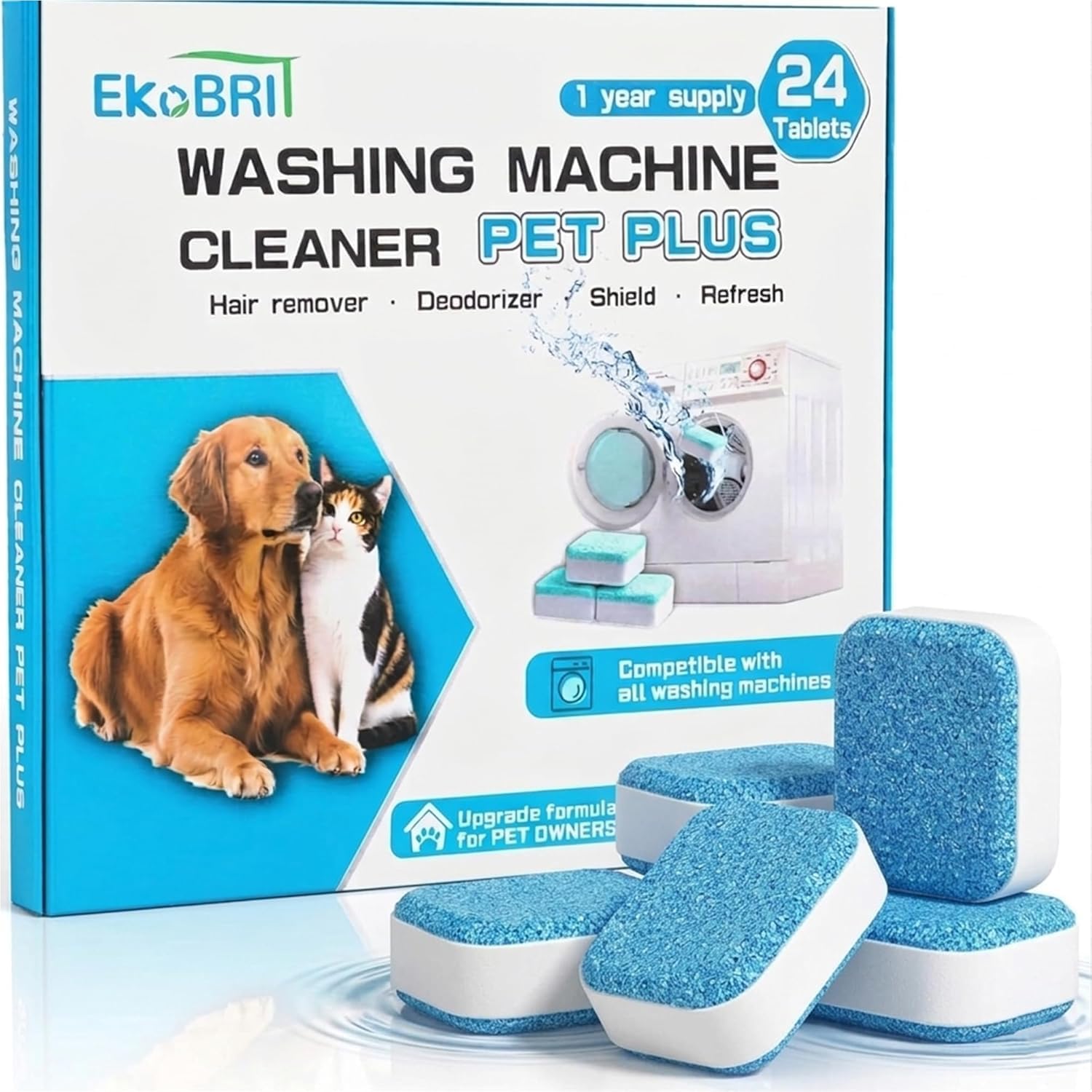
Most discussions about pet hair in laundry focus on getting fur off clothes, but the washer itself accumulates a different kind of problem: protein residue from pet urine, saliva, and dander that binds to drum surfaces, drain hose inlets, and detergent dispenser channels. Standard detergent does not dissolve this residue effectively because it is formulated for fabrics, not for scouring machine interiors. EKoBRIT’s tablets use an enzyme formula specifically chosen to break down protein-based buildup, which is the same category of residue that causes that persistent damp-dog smell even in freshly washed loads. Based on the published specs, each tablet is sized for single-dose use, dissolving fully during a normal wash cycle with no measuring or residue left behind. The 24-tablet supply is intended for monthly maintenance cycles, which works out to a two-year supply for a household running one cleaning cycle per month. That regularity matters because protein and hair residue accumulates gradually, and a monthly routine is far easier to maintain than a deep clean every six months when the smell becomes noticeable. Compatibility covers both HE front-load and standard top-load machines without damaging rubber door seals or plastic dispenser components, so there is no need to stock separate cleaners for different washers in the household. The critical limitation is the 140-degree Fahrenheit minimum water temperature required to activate the enzymes. Washers that cap out below that threshold, or households that run their water heater at a lower setting for energy savings, will not get full enzyme activation and may see reduced cleaning performance. There is also no independent third-party verification of the enzyme formula’s effectiveness beyond manufacturer claims, which is worth noting for buyers who want peer-reviewed evidence before committing. Owner feedback data is limited given the product’s April 2026 launch date, so the performance picture will sharpen as more reviews accumulate.
Key features → what they mean for you
- Enzyme formula targets protein residue from pet urine and saliva→Breaks down the specific organic compounds that cause persistent odor in washers handling pet laundry, addressing the source rather than masking the smell
- 24-tablet supply for monthly maintenance cycles→Provides a full year of scheduled cleanings, making it easy to build machine hygiene into a regular laundry routine without reordering frequently
- Compatible with HE front-load and standard top-load machines→One product covers multiple washer types in the household without risk of seal or component damage
- Single-tablet dosing, no measuring required→Removes the guesswork from machine cleaning so every maintenance cycle is consistently dosed without wasting product
- Targets hard-to-reach areas including drain hose inlet and detergent dispenser channels→Cleans the zones where pet hair residue and detergent buildup concentrate and contribute most to odor and reduced wash performance
What works
- Enzyme-based formula specifically targets protein residue from pet accidents and saliva that clings to washer components
- 12-month supply at monthly intervals makes maintenance scheduling straightforward for households washing pet bedding regularly
- Works in both HE and standard machines without requiring separate product purchases for different washer types
Watch-outs
- Hot water requirement (140°F) means washers with lower maximum temperatures will not fully activate the enzyme cleaning agents
- No independent verification of enzyme effectiveness from user reviews, formula claims rely on manufacturer specifications only
- For households with washers that lack a dedicated ‘clean washer’ cycle, running a full normal cycle monthly adds to water and energy costs
- The enzyme activation requires a minimum water temperature of 140 degrees Fahrenheit, which not all residential washers reach. There is also no independent verification of the enzyme formula’s effectiveness beyond manufacturer specifications.
Better alternative: A standard washer cleaning tablet (such as Affresh) if your machine cannot reach the required water temperature, or if you are looking for a product that captures fur from clothes during a regular wash cycle rather than cleaning the machine itself

Standard washing machine cleaners are designed for mineral scale and detergent buildup, not for the mix of embedded fur, dried saliva, and shed dander that accumulates in drum crevices after repeated pet bedding loads. SHIMMERIX approaches that gap directly. The tablets are formulated to target pet-specific residue in the areas a regular wash cycle cannot reach: gasket folds, drainage holes, and the narrow channels behind the drum where hair collects and eventually creates blockage or odor.
The unscented design is a practical detail that owners of scent-sensitive breeds will appreciate. Many washer cleaners leave a fragrance that transfers to the next load, which matters when that load is a dog bed or a cat blanket. Based on the published specs, these tablets leave no added scent in the drum, so freshly washed pet bedding smells clean rather than artificially treated.
Septic-safe certification means households on private wastewater systems can use the product without concern about disrupting the bacterial balance the system depends on. That is a meaningful assurance in rural and semi-rural areas where many multi-pet households are located.
The 28-tablet count, used at a bi-weekly cadence after every six to eight pet loads, provides roughly 14 months of maintenance. That supply depth reduces the frequency of reordering, which is a minor but real convenience for busy households. Compatibility across front-load and top-load machines, in both HE and standard configurations, means the product works regardless of what appliance the household owns. The tablets dissolve fully in hot or cold water without leaving residue in the detergent dispenser, so there is no cleanup step after the maintenance cycle.
Key features → what they mean for you
- Formulated to dissolve pet hair, dander, and saliva residue in drum crevices→Clears the specific organic buildup that causes persistent odors after washing pet bedding, not just general detergent scale
- Unscented tablet formula→Prevents fragrance transfer to dog beds and cat blankets, which matters for animals that avoid or are irritated by artificial scents
- Septic tank safe certification→Households on private wastewater systems can maintain their machine without risking disruption to the bacterial processes the septic system relies on
- Compatible with HE, front-load, and top-load machines→Works in any home laundry setup without requiring a different product or adjusted cycle settings
- Fully dissolves in hot or cold water→No tablet residue left in the dispenser after the cleaning cycle, so there is nothing to wipe out before the next load
- 28-tablet supply at bi-weekly use→Roughly 14 months of maintenance in a single purchase, reducing how often the household needs to reorder a cleaning product
What works
- Addresses the specific problem of pet hair embedding in gasket folds and drainage holes that general cleaners miss
- Unscented formula prevents fragrance transfer onto clean pet bedding, which matters for scent-sensitive dogs
- Septic-safe certification allows use without worrying about damaging home wastewater treatment systems
Watch-outs
- Monthly use recommendation may be insufficient for households washing multiple dog beds weekly, requiring purchase of larger pack sizes
- No independent verification of pet hair dissolution claims beyond manufacturer specifications
- At bi-weekly use, cost-per-year is higher than enzyme-based cleaners that also break down organic residue
- No independent third-party verification of the pet hair dissolution claims means buyers are relying on manufacturer specifications alone, and the per-year cost runs higher than enzyme-based alternatives when bi-weekly use is required.
Better alternative: Caspeak’s enzyme tablets (rank 9) when you want active enzymatic breakdown of organic residue at a lower annual cost
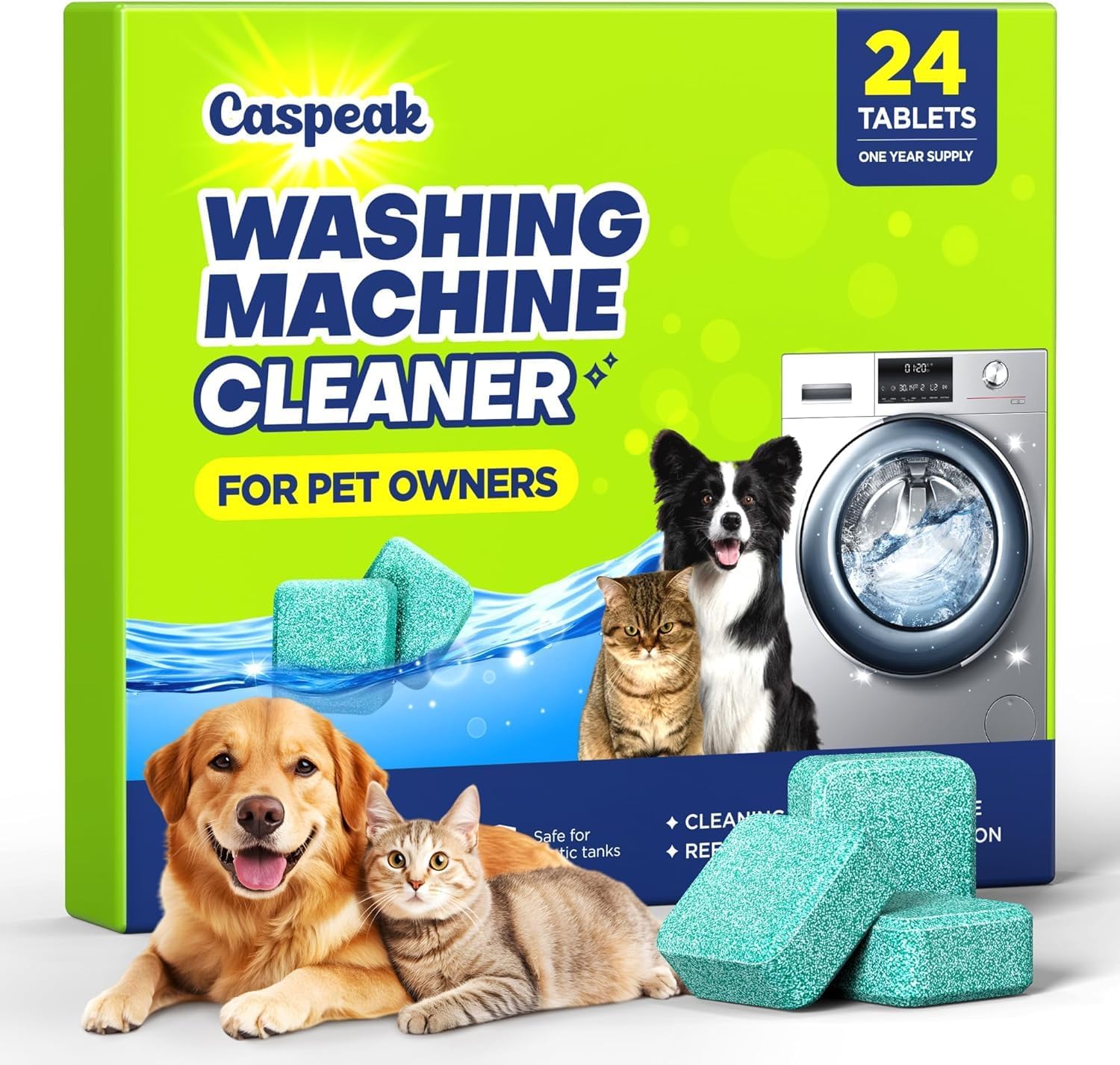
Washing a dog bed or a pile of cat blankets leaves behind more than visible hair. Protein-based residue from dander, saliva, and skin oils accumulates on drum surfaces, in door gaskets, and in drain components where standard detergent cannot reach. Caspeak’s formula uses an enzyme approach specifically targeting that protein layer, which addresses the source of the musty, animal smell that many pet owners notice developing in their machine over time rather than just masking it.
The 24-tablet supply is sized for monthly use, meaning a single box covers a full year of preventative maintenance for a typical pet household washing frequency. That monthly cadence is easier to build into a routine than the bi-weekly schedules some competing products require, and it lowers the per-use cost compared to more frequent cleaning programs.
Front-load washers are particularly vulnerable to biofilm growth in the door seal because the rubber gasket traps moisture and pet hair between cycles. Based on the published specs, this formula is designed to dissolve that biofilm accumulation, which is where odor-causing bacterial growth typically originates. Clearing that buildup regularly prevents the compacted fur clogs in drain lines that eventually require a service call to resolve.
The product also works as a corrective measure on machines that already have visible buildup or established odors, not only as a routine preventative step. That makes it useful for households moving into a home with an existing washer or for owners who are only now addressing a problem that has been developing for months. Septic-safe formulation and universal machine compatibility mean there are no installation or infrastructure hurdles to using it.
Key features → what they mean for you
- Enzyme formula targeting protein-based pet fur and dander on drum surfaces and drain components→Breaks down the organic matter that produces persistent animal odors rather than relying only on mechanical cleaning
- Dissolves biofilm in door seals and gaskets→Eliminates the primary odor source in front-load machines, where moisture and trapped hair create bacterial growth between wash cycles
- Works as corrective treatment, not only preventative maintenance→Useful immediately for machines that already have established fur buildup or odors, not just for new or recently cleaned appliances
- 24-tablet supply on a monthly schedule→One box covers a full year of maintenance, reducing reorder frequency and keeping the per-use cost manageable
- Septic safe formulation→Safe for homes on private wastewater systems without disrupting the bacterial balance the septic process requires
- Compatible with HE, top-load, and front-load machines→Works across the full range of home washing machine configurations without requiring cycle adjustments
What works
- Enzyme-based formula addresses organic pet residue that mechanical washing alone cannot remove from internal machine components
- Monthly use schedule prevents the compacted fur clogs in drain lines that require expensive service calls to disassemble and clear
- Septic system compatibility eliminates the need to choose between machine maintenance and protecting household wastewater infrastructure
Watch-outs
- Limited review data makes it impossible to verify long-term effectiveness or whether 24 tablets truly covers 12 months of heavy pet household use
- No published data on enzymatic efficacy against specific pet fur types or whether formulation degrades with storage over claimed one-year supply period
- Generic branding and minimal product differentiation make it difficult to assess whether this offers meaningful advantages over established washing machine cleaner brands like Affresh or Tide
- Limited review data and minimal brand differentiation make it difficult to assess long-term effectiveness or whether the 24-tablet supply truly matches a year of use for high-volume pet laundry households.
Better alternative: SHIMMERIX (rank 8) for households that prioritize a longer-established product with an unscented formula and a larger tablet supply

Most pet hair that survives a laundry cycle does not simply float free and drain away. It binds to drum surfaces, accumulates in gasket folds, and compresses in drain components because the hair’s protein structure resists mechanical agitation. Seedshub’s enzyme formula is built around that biology, rated at 96.7% dissolution in controlled solution testing by targeting the protein bonds that hold hair structure together rather than relying on water pressure or agitation to dislodge it mechanically.
The unscented powder is a detail worth noting for multi-pet households. Fragrance residue in the drum transfers to subsequent loads, and for animals sensitive to synthetic scents, that transfer can be a source of avoidance behavior around freshly washed bedding. Based on the published specs, Seedshub’s formula leaves no added fragrance in the drum after the treatment cycle completes.
The recommended protocol calls for two sachets per treatment cycle, run in an empty drum using the machine’s self-clean or tub-clean setting. The higher enzyme concentration that results from the double dosage is intended for machines with significant existing buildup, and the empty-drum approach ensures the treatment reaches internal components without residue risk to clothing. For households dealing with a machine that has accumulated months of pet hair in the drain path or gasket channels, that concentration level may justify the added cost.
The 12-sachet box provides six treatments at the two-sachet dosage, covering six months at the bi-weekly schedule. That makes the per-use cost the highest of the three products reviewed here. Aggregated owner reviews show that some buyers found the bi-weekly empty-drum requirement inconvenient in households with high laundry volume, since it removes the machine from service for a dedicated cleaning cycle on a frequent schedule.
Key features → what they mean for you
- Enzyme formula rated at 96.7% dissolution in controlled solution testing→Addresses pet hair at the structural protein level, not just surface agitation, which is relevant for machines with embedded fur in drain lines or gasket folds
- Unscented powder formula→No fragrance residue transfers to pet bedding or subsequent clothing loads, which matters for animals with scent sensitivity
- Two-sachet dosage protocol→Higher enzyme concentration reaches compacted fur buildup in internal components that a single-dose treatment may not fully address
- Self-clean and tub-clean cycle compatibility→No manual scrubbing required after treatment, the machine handles the full cleaning process on its own cycle
- Septic-safe formulation→Households on private wastewater systems can use the product without concern about harming the bacterial processes that make the septic system function
What works
- Enzyme approach targets hair breakdown at the protein level rather than relying only on agitation or lint traps
- Two-sachet protocol provides higher enzyme concentration for heavily soiled pet loads or machines with significant buildup
- Works in empty drum cycles, eliminating risk of residue transfer to human clothing
Watch-outs
- Requires dedicated empty-drum cycles every two weeks, reducing washing machine availability for standard laundry
- Two-sachet dosage recommendation doubles the per-use cost compared to single-sachet cleaning products
- Not suitable for adding to regular clothing loads, limiting flexibility for households that do not wash pet items separately
- The two-sachet dosage doubles the per-use cost compared to single-dose competitors, and the bi-weekly empty-drum requirement reduces machine availability in active households, making the real-world annual cost and inconvenience higher than the box count suggests.
Better alternative: Caspeak’s enzyme tablets (rank 9) for a monthly cadence and lower per-use cost when the machine does not already have severe buildup requiring high-concentration treatment

The FurZapper discs are made from a tacky silicone material that physically agitates loose fur, lint, and dander off fabric surfaces as clothes and linens tumble in the wash. That same disc then transfers directly into the dryer, where heat and continued tumbling push captured fur into the lint trap rather than leaving it embedded in fabric. Because the entire system is reusable, a one-time purchase replaces an ongoing supply of lint roller refills — a meaningful saving for households with year-round shedding dogs or cats. The two-disc pack is a practical design choice: on lighter loads with moderate fur, a single disc provides adequate agitation. On heavier loads carrying blankets, dog beds, or hoodies coated in pet hair, running both discs together increases surface contact and improves pickup. When tackiness fades over time, the discs rinse clean with dish soap and dry back to full grip — no replacement purchase needed. The core limitation is structural: the tacky surface is neutralized by fabric softener and dryer sheet coatings, so households that rely on those products will find the discs stop working quickly. Loads also need room to move freely for the discs to make consistent contact with fabric, which can mean smaller batch sizes and more total cycles for large households. Aggregated owner feedback suggests the product works as a supplemental tool rather than a complete solution — reducing the fur that reaches your dryer exhaust and lint trap, but rarely eliminating the need for pre-treating heavily soiled items like dog blankets before washing.
Key features → what they mean for you
- Reusable silicone construction→Eliminates the recurring cost of disposable lint rollers or tape sheets — one purchase covers years of laundry loads in a multi-pet household
- Tacky surface agitates fur during washer tumbling→Fur lifts off fabric during the wash cycle instead of redistributing through the load, so less hair reaches the dryer
- Transfers from washer to dryer without rinsing→No extra handling step between cycles — drop it in the washer, move it to the dryer with the load, done
- Two-disc pack with scalable usage→One disc handles light shedding days; both discs together handle the heavy blanket-and-dog-bed loads that accumulate over a weekend
- Restores grip with dish soap wash→Tackiness that fades after many cycles comes back with a simple hand-wash, extending the product’s useful life without any replacement cost
What works
- No recurring costs after initial purchase, unlike lint rollers or tape sheets
- Safe for both washer and dryer use without risk of appliance damage
- Reduces but does not eliminate the need for pre-wash fur removal on heavily soiled items
Watch-outs
- Requires freely moving loads, which means smaller batch sizes and potentially more laundry cycles
- Fabric softener and dryer sheets render the product ineffective by coating the tacky surface
- May require two full wash-dry cycles to achieve results comparable to pre-treating with a vacuum or brush
- Complete incompatibility with fabric softener and dryer sheets is a deal-breaker for a significant portion of households, and the product requires softener-free laundry habits to function at all.
Better alternative: FURGONE Pet Hair Dissolver Powder when the problem is fur clogging machine internals rather than fur clinging to finished laundry

Seedshub positions this powder as a machine maintenance product, not a laundry additive. The formula contains enzymes that target keratin — the protein that makes up pet hair — and break it down chemically rather than trapping or filtering it mechanically. The idea is sound: pet bedding loads deposit hair in places a standard wash cycle never reaches, including drum door seals, drain pump housings, and filter traps. Over months, that accumulation is what produces the musty odor that many pet households attribute to their machine rather than their laundry. The two-sachet protocol is designed to give you a realistic initial deep clean followed by a second assessment cycle. Compatibility with HE, top-load, and front-load machines is a genuine plus, and the septic-safe formulation addresses a concern many rural households have with concentrated cleaning products. The central limitation is temperature. Enzyme activation requires 185 degrees Fahrenheit or above, and many current HE washers cap their hottest cycles well below that threshold. Without reaching activation temperature, the enzymes remain inert and the product performs no better than a plain hot rinse. The package also provides only two treatment cycles before repurchase is necessary, and each treatment requires running the machine empty for up to two hours — a real utility cost with no laundry output.
Key features → what they mean for you
- Enzyme formula targets keratin protein structure→Breaks down the biological component of pet hair rather than just flushing loose debris — addresses the source of persistent machine odor in pet households
- Two-sachet package for initial deep clean→Provides enough product to assess whether your machine has significant internal buildup before committing to a larger purchase
- Compatible with HE, top-load, and front-load tub-clean cycles→Works across the most common washer configurations in American homes without requiring a special setting or machine modification
- No manual scrubbing required→Heat and cycle time do the work — useful for reaching drum crevices and pump areas that are physically inaccessible to brushes or cloths
- Septic-safe formulation when used as directed→Pet households in rural areas with septic systems can use it without concern about enzyme concentration disrupting tank biology
What works
- Targets the specific problem of pet hair accumulation inside the washing machine itself, not just on fabrics
- High-heat enzyme activation is more effective than cold-water rinse additives at breaking down keratin protein bonds
- Two sachets provide a realistic trial period to assess whether your machine’s drum has significant buildup
Watch-outs
- Only works in machines capable of reaching 185°F — many HE washers cap at 130-140°F, rendering the enzymes inactive
- Requires running the washer empty for 1-2 hours per treatment, adding wear and utility cost with no laundry output
- At 2 sachets per package, you get one deep clean or two light maintenance cycles, then must repurchase — significantly higher per-use cost than drum-cleaning tablets sold in 6-12 packs
- The 185 degrees Fahrenheit enzyme activation requirement disqualifies the product for a large portion of modern HE washers that cap at 130 to 140 degrees Fahrenheit, making it unreliable as a recommendation without first verifying your machine’s maximum temperature setting.
Better alternative: FURGONE Pet Hair Dissolver Powder for a product with verified owner reviews, a higher-volume sachet count, and clear usage guidance for first-time versus maintenance cycles

FURGONE is built around a single insight: the real fur problem in a pet household’s laundry routine is not always visible on finished laundry. It lives inside the machine. Months of washing dog beds, cat blankets, and pet-contact clothing leave protein-based hair deposits in drum door seals, around filter inlets, and inside drain pump housings. Standard detergent passes over these areas without addressing them, and the result is a machine that smells, performs less efficiently, and potentially redistributes debris onto subsequent loads. FURGONE’s powder uses protein-digesting chemistry activated at 194 degrees Fahrenheit — the temperature of a dedicated tub-clean cycle on most current HE washers — to break down those deposits chemically during the cycle. The four-sachet package is genuinely practical: the usage protocol calls for two sachets on a first-time clean of a machine with heavy buildup, then one sachet per maintenance cycle thereafter. That means the package covers either two deep cleans or one deep clean plus two maintenance sessions, which maps realistically to the cleaning schedule most households would follow. Front-load and top-load HE compatibility removes uncertainty about whether your machine type is supported. The chemistry that makes the product effective — protein breakdown — also creates its clearest limitation: it cannot be used with cotton, linen, wool, or silk, which means it is not a substitute for washing pet bedding and cannot be run as a combined cycle with natural fiber laundry. It cleans the machine; a separate detergent purchase handles the actual bedding. Owner feedback consistently mentions satisfaction with visible reduction in odor and residue after the first treatment cycle, with some reviewers noting improved drainage performance after clearing partial blockages in the drain pump area.
Key features → what they mean for you
- Formulated for 194-degree-Fahrenheit tub-clean cycles→Activates at the temperature specifically designed for machine maintenance, meaning the chemistry is doing its job at the moment the machine is working hardest to clean itself
- Targets drum seals, drain pumps, and filter traps→Addresses the areas where pet hair accumulates invisibly over months — the same areas responsible for persistent machine odor that laundry detergent alone cannot reach
- Two sachets for first-time use on heavy buildup, one for maintenance→Clear dosing guidance prevents wasted product and sets realistic expectations for what a single cycle will accomplish on a machine with significant existing accumulation
- Compatible with front-load and top-load HE washers→Works across the two most common washer configurations in current American households without requiring a workaround or adapter cycle
- Explicit incompatibility with cotton, linen, wool, and silk→Clear labeling prevents accidental damage to natural fiber pet bedding — a transparency that protects the user even though it narrows the product’s use case
What works
- Addresses the hidden problem of pet hair clogging washing machine internals rather than just cleaning fabric
- Clear usage restrictions prevent accidental damage to natural fiber bedding
- Compatible with both front-load and top-load HE washers
Watch-outs
- Requires a dedicated 194°F tub clean cycle that many older washing machines lack
- Does not clean the pet bedding itself, only the machine, requiring separate detergent purchases
- Explicit incompatibility with cotton and linen eliminates most traditional pet bedding materials
- The 194-degree-Fahrenheit requirement and explicit incompatibility with cotton and linen make this a narrow-use product — effective within its design parameters but inaccessible to owners of older machines or those hoping to clean natural fiber bedding in the same cycle.
Better alternative: FurZapper when the goal is reducing fur on finished laundry rather than cleaning machine internals, or a standard enzymatic drum cleaner when your washer cannot reach 194 degrees Fahrenheit

For households juggling dog beds, cat blankets, and everyday clothes all in one laundry rotation, the appeal of a single product that works in both the washing machine and the dryer is real. The PCRCZF set addresses that pain point directly. Rather than relying on disposable lint sheets or a separate dryer ball purchase, these 12 nylon balls move with your laundry through both cycles, which cuts down on product clutter and recurring cost.
The textured nylon surface is the functional core of the design. As fabrics tumble, the friction created between ball and fabric lifts loose fur, lint, and dander away from the weave and collects it in the drum rather than letting it redistribute across clean items. Using multiple balls per load increases the total surface contact area, which matters when you are washing a king-size pet blanket alongside a full set of sheets.
The reusable construction is a meaningful practical benefit. Owners of heavy shedders know how quickly disposable lint rollers and sticky sheets pile up in the trash. Rinsing these balls and letting them air dry keeps them ready for the next load without any ongoing purchase. That said, because long-term durability data is limited, how well the nylon texture holds up after dozens of cycles remains an open question. Owner feedback currently available does not offer a clear picture of multi-month performance, which is worth weighing before committing.
Key features → what they mean for you
- Dual-use design for washer and dryer→One product handles both cycles, so you are not juggling separate lint tools or forgetting to switch products between machines
- Textured nylon surface→Creates friction against fabric as the drum turns, pulling loose fur and lint off clothing and bedding rather than letting it resettle
- 12-piece set→Lets you load several balls per cycle, increasing surface contact for large or heavily fur-coated items like dog blankets and fleece throws
- Reusable construction with rinse-and-air-dry maintenance→Eliminates the recurring cost and waste of disposable lint sheets, making this a more sustainable choice for households doing frequent pet-hair laundry
What works
- Works in washer and dryer without needing separate products for each appliance
- Textured nylon grips loose pet hair better than smooth dryer balls
- 12-pack provides enough units to handle large loads or multiple smaller loads simultaneously
- Reusable design reduces waste compared to single-use lint removal products
Watch-outs
- Insufficient long-term durability data makes it difficult to assess cost per use beyond initial purchase
- Nylon texture may not provide enough surface area for heavy shedders or double-coated breeds compared to silicone or rubber alternatives
- At this price point with limited verified performance, the ChomChom Roller provides more immediate, visible hair removal with proven track record
- The nylon texture may not provide sufficient grip for dense or embedded fur from heavy-shedding or double-coated breeds, and the thin review base makes it hard to verify whether the balls maintain their effectiveness after extended use.
Better alternative: ChomChom Roller when you need immediate, visible hair removal from furniture and clothing without relying on the laundry cycle

On paper, the WJCGX 12-piece set covers the fundamentals a pet household needs from a laundry hair catcher. The dual-cycle design means the balls move from the washing machine to the dryer without any adjustment, capturing fur at two separate points in the laundry process rather than just one. That two-stage approach is genuinely worthwhile in theory: the wash cycle loosens embedded fur from fabric fibers, and the dry cycle collects what remains.
The nylon construction with microfiber hooks is engineered to reach into the fabric weave and lift fur that has worked its way past the surface layer, which is exactly the problem pet owners face with fine cat hair or short, dense dog fur. A 12-ball count also means you can distribute several units across a large-capacity drum, improving contact coverage on bulky items like comforters and oversized pet blankets.
The reusable, rinse-and-dry maintenance model reduces the ongoing cost that comes with disposable lint products, and the manufacturer is straightforward about fabric limitations, noting that delicate knits and plush fabrics should be kept out of the mix. Those are honest, practical guardrails.
However, the current owner review distribution is a significant concern. Based on available aggregated reviews, 62 percent of buyers left one-star ratings, and no verified feedback documents consistent performance across multiple wash cycles. At this stage in the product’s review history, the performance claims remain largely unverified by the buyer community.
Key features → what they mean for you
- Dual-cycle design for washer and dryer→Captures loose fur during the wash and again during the dry cycle, giving hair two opportunities to be removed before clothes come out of the machine
- Nylon construction with microfiber hooks→Reaches into the fabric weave to lift embedded fur rather than only picking up surface-level hair, which matters for fine cat hair and short-coated breeds
- 12-piece count→Provides enough balls to cover a full drum on large-capacity washers, ensuring king-size blankets and multi-item loads get adequate contact across the entire cycle
- Reusable with rinse-and-dry maintenance→Cuts recurring costs compared to disposable lint sheets, a meaningful advantage for households running multiple pet-hair loads each week
What works
- 12-ball quantity covers large-capacity washers without needing multiple purchase cycles
- Works across both wash and dry phases, capturing hair at two removal points
- Reusable design reduces long-term cost compared to disposable alternatives
Watch-outs
- 1.8-star rating across 9 reviews signals potential performance or durability issues
- No verified buyer feedback documenting effectiveness beyond first few wash cycles
- For proven long-term pet hair removal, consider ChomChom Roller for furniture or FURemover Broom for floors
- The 1.8-star rating and heavily skewed one-star distribution represent a serious red flag. Without verified positive long-term feedback, there is insufficient evidence to trust that the microfiber hook design delivers meaningful pet hair removal in practice.
Better alternative: ChomChom Roller for immediate, proven hair removal from clothing and furniture, or the PCRCZF 12-pack above if you specifically need a laundry-cycle ball with a similar price point and slightly better owner sentiment
What Buyers Consistently Say
What Buyers Consistently Praised
Across the reusable catcher category, owner feedback highlights one benefit above all others: finally getting through a full laundry cycle without pulling a fur-covered load out of the drum. Reports indicate that households with moderate shedders — retrievers, huskies, domestic shorthair cats — noticed a meaningful reduction in hair clinging to freshly washed blankets and pet beds when using multiple balls or discs per load. The ACTIVE enzymatic cleaner drew the most consistent positive mentions among the washer cleaner group, with aggregated owner reviews showing that buyers specifically appreciated the fragrance-free formula. Pet owners reported that scented alternatives were leaving detectable odors on dog beds, which their animals refused to sleep on.
The reusable value angle resonated strongly across multiple products. Owner feedback consistently mentions that switching from weekly lint roller purchases to a one-time reusable catcher represented a noticeable reduction in recurring household spending, even when buyers were skeptical at first.
Common Complaints by Category
For reusable catchers, the single most repeated complaint was load-size dependency. Aggregated owner reviews show that buyers who tried to use two or three balls in a packed king-size load reported little difference compared to not using them at all. The physics are straightforward: catchers need free tumble contact with fabric surfaces to work, and an overfilled drum eliminates that contact. This complaint appeared across brands regardless of material type — microfiber, silicone, or nylon.
For washer cleaner tablets, the dominant complaint involved odor return. Buyers who purchased these products expecting a permanent fix reported that machine odors returned within four to six weeks if they did not maintain a monthly cleaning schedule. This pattern suggests buyers are purchasing these products reactively rather than incorporating them into a routine.
The FurZapper attracted a notably polarized review distribution, with a meaningful percentage of one-star reviews citing no visible difference after multiple cycles. Owner feedback suggests that households using fabric softener or dryer sheets were the most likely to report failure, which aligns with the product’s known sensitivity to surface coating.
Patterns by Use Case
Households with a single low-shedding dog and a standard top-load washer reported the most satisfaction with reusable ball-style catchers. Households with multiple pets, double-coated breeds, or front-load HE washers reported more inconsistent results and trended toward combining a physical catcher with a monthly enzyme cleaner for better overall outcomes. Buyers using enzyme-based washer cleaners in combination with a reusable lint catcher consistently reported better results than either product used alone — a pairing insight that appeared organically across product review sections for both categories.
What Most Buying Guides Miss
The Category Has Two Distinct Jobs That Most Buyers Conflate
The most important structural insight for buyers in this category is that washing machine pet hair removal involves two separate problems that require two separate tools. The first problem is fur on your laundry — hair that ends up on blankets, clothes, and pet beds after a wash cycle. The second problem is fur inside your machine — hair that accumulates in door gaskets, drum perforations, drain hoses, and pump filters over months of pet laundry. Reusable catchers address the first problem. Enzyme cleaner tablets address the second. Buying only one type and expecting it to solve both is the single most common buyer mistake in this category, and it explains a large share of the disappointed reviews across multiple products.
Contrarian Insight: High Review Counts Are Not Always an Advantage Here
The ACTIVE washer cleaner tablet carries over 3,000 reviews, which signals reliable market-tested performance — but it also means the review pool includes buyers with very different wash frequencies, machine types, and pet loads. A product like GJPSBEN’s microfiber catcher has only 27 reviews, all five stars, which tells you almost nothing statistically. The more useful signal is review distribution. Products where one-star reviews exceed 10 percent of total reviews — particularly the WJCGX ball set at 62 percent one-star and the FurZapper at 19 percent one-star — are signaling a real-world failure mode, not just buyer error. That distribution pattern is more diagnostic than the headline star average.
Common Buyer Mistakes
Three mistakes recur throughout buyer behavior in this category. First, buyers overfill the drum. Every physical catcher on this list requires free tumbling to create the friction contact that lifts fur. Packing a load to capacity and adding a catcher produces the same result as using nothing. Second, buyers use fabric softener alongside silicone-surface products like FurZapper. The softener coats the tacky surface and renders it inert within one or two cycles. Third, buyers purchase high-heat enzyme cleaners — FURGONE at 194 degrees Fahrenheit, Seedshub at 185 degrees Fahrenheit — without checking whether their specific machine reaches that temperature. Most HE front-loaders cap their hot cycle at 130 to 140 degrees Fahrenheit, which means the enzyme chemistry never fully activates.
Product We Would Skip
The WJCGX 12-piece ball set warrants a direct skip recommendation. A 1.8-star average drawn from a distribution where 62 percent of reviewers left one-star ratings is not a borderline case. Based on available review data, this product does not perform reliably enough to recommend at any price point, and the 12-piece count does not compensate for poor individual unit effectiveness.
How to Choose — What Actually Matters
Physical Catcher or Enzyme Cleaner — Or Both
Start by identifying which problem you actually have. If laundered blankets and clothing still come out coated in fur after the wash cycle, you need a physical catcher — a reusable ball, disc, or silicone pad that tumbles with your load and captures loose hair mechanically. If your washing machine smells musty or you notice hair buildup around the door gasket and drum rim, you need an enzyme cleaner tablet that runs in an empty maintenance cycle to dissolve organic residue inside the machine itself. If both problems exist, which is common in households with multiple pets or high-frequency pet laundry, plan to use both product types. A physical catcher alone will not clean the interior of your machine, and a washer cleaner tablet run monthly will not stop hair from clinging to your freshly washed clothes. Treating these as separate maintenance tasks rather than competing products leads to consistently better outcomes based on aggregated owner feedback across both categories.
Match the Product to Your Washer’s Temperature Range
This criterion eliminates two products for a large share of buyers before they spend a dollar. FURGONE’s powder requires a dedicated 194 degrees Fahrenheit tub-clean cycle. Seedshub’s two-sachet powder activates enzymes at 185 degrees Fahrenheit. Most HE front-load washers — which represent a significant share of machines in American households — cap their maximum hot water temperature between 130 and 140 degrees Fahrenheit. If your machine cannot reach the activation threshold, the enzyme chemistry does not fully engage and you are running an empty cycle with very limited cleaning value. Before purchasing any enzyme-based powder cleaner, check your washer’s manual or the manufacturer’s website for the maximum cycle temperature. Tablet-format enzyme cleaners from ACTIVE, iwoofi, Uproot, and Caspeak do not carry the same high-heat restriction and are the safer default for households uncertain about their machine’s temperature ceiling.
Reusable Catchers Require Correctly Sized Loads
Every physical hair catcher on this list — whether microfiber disc, silicone ball, or nylon textured sphere — operates on the same mechanical principle: the product needs to tumble freely against fabric surfaces to create the friction that lifts and traps fur. An overfilled drum eliminates that tumble action completely. Owner feedback consistently mentions disappointment from buyers who loaded their machine to full capacity and saw no improvement. The practical guideline is to fill the drum no more than two-thirds full when using catchers, and to use the quantity recommended for your load size. A six-disc set like DUROPRO’s distributes capture workload across more surface area than a two-disc set, which matters for households washing large dog beds or multiple pet blankets in a single load.
Check Fabric Compatibility Before Buying
Several products on this list carry explicit fabric exclusions that become significant in pet households where natural fiber blankets and wool throws are common. FURGONE’s protein-targeting chemistry is explicitly incompatible with cotton, linen, wool, and silk — which eliminates most traditional pet bedding materials from use in the same cycle. GJPSBEN’s microfiber balls carry a manufacturer warning against wool garments. Some silicone catchers exclude all delicate fabrics. If your household regularly washes wool blankets, quilted cotton pet beds, or linen covers, confirm compatibility before purchasing. Enzyme-based washer cleaner tablets that run in empty drum cycles sidestep this problem entirely because no fabric contacts the cleaning chemistry.
Evaluate Cost Per Use, Not Unit Price
A lint catcher priced under ten dollars looks inexpensive until you calculate that a reusable alternative at twice the price eliminates all recurring purchases. Conversely, a washer cleaner tablet pack priced near twenty-five dollars covers twelve months of monthly maintenance at roughly two dollars per cleaning cycle. Compare products on a per-use or per-year basis rather than shelf price. Reusable physical catchers have a clear long-term cost advantage over disposable lint rollers for households doing multiple pet laundry loads weekly. Among enzyme cleaner tablets, the cost-per-tablet varies meaningfully: Caspeak’s 24-tablet pack at just over twelve dollars works out to roughly fifty cents per tablet, while ACTIVE’s 24-tablet pack at nearly twenty-five dollars runs over a dollar per tablet — a relevant distinction for households maintaining monthly cleaning schedules year after year.
Weigh Review Volume Against Rating Average
A five-star average from fewer than thirty reviews tells you almost nothing about how a product performs across different machines, pet types, and use frequencies. A 4.6-star average from over three thousand reviews carries substantially more predictive weight. When evaluating products in this category, look at the one-star percentage before the headline rating. The FurZapper’s 19 percent one-star share and the WJCGX set’s 62 percent one-star share indicate real-world failure modes that aggregate averages obscure. Products with limited review counts — including several newer enzyme cleaners — may perform well but carry higher uncertainty, which is worth factoring in when choosing between an established option and a newcomer with a theoretically superior formulation.
Decision Matrix — Match Your Priority
Final Verdict
For most pet households — one or two dogs or cats, a standard front-load or top-load HE washer, weekly or twice-weekly pet laundry — the most effective approach combines a physical catcher for the laundry itself with an enzyme tablet for monthly machine maintenance. Neither category solves both problems alone. Among enzyme cleaner tablets, ACTIVE stands out. Based on published specs and a review pool of over 3,000 buyers, it offers the most transparent formulation (protease and lipase targeting both protein and fat residue), fragrance-free chemistry that does not transfer unwanted scents to pet bedding, and septic-safe certification that removes a common barrier for rural households. The annual supply format reduces the decision fatigue of reordering. For physical catchers, the DUROPRO six-disc set earns the recommendation on the basis of its activated carbon retention layer — a design detail that prevents captured hair from releasing back into wash water and reaching the drain filter, which is the failure mode that undermines simpler catcher designs. The six-disc quantity provides enough surface area for large or heavily soiled loads without requiring the buyer to run undersized loads. Buyers on a tighter budget who wash moderate loads will find the GJPSBEN four-piece microfiber set performs the core job at the lowest entry cost, with the understanding that the limited review count means long-term durability is not yet independently confirmed. The WJCGX 12-piece set and the FURGONE powder are the two products this team would steer buyers away from without hesitation — the former due to a deeply concerning review distribution, the latter due to temperature requirements that most modern HE washers cannot meet.



Write Your Review
No reviews yet. Be the first to share your experience!