

8 Best Automatic Feeders for Senior Dogs of 2026
Senior dogs have nutritional needs that diverge sharply from what a one-size-fits-all automatic feeder is built to handle. Aging bodies process calories less efficiently, joints ache after bending to a floor-level bowl, and many veterinarians prescribe three to five small meals a day to manage weight, blood sugar, or post-surgical recovery. An automatic feeder that simply drops a heap of kibble twice daily may actively work against a senior dog’s care plan. joint supplements for large dogs.
The market is crowded with feeders designed primarily for cats or young, small dogs. Most product listings lean on camera specs and app features rather than the details that matter most for a senior dog household: portion granularity fine enough to follow a vet’s prescription, a dispenser that handles larger kibble without jamming, a bowl height that reduces neck and spine strain, and battery backup so a napping senior on a cardiac diet does not miss a scheduled dose. Sorting through that noise takes time most pet owners do not have.
Consider this scenario: an owner selects a well-rated smart feeder with a 1080P camera and an app, sets a four-meal schedule, and leaves for work. The feeder’s outlet is rated to 12mm kibble, but the senior dog eats a large-breed joint-support formula at 15mm. By day two the rotor jams, the bowl sits empty, and the dog misses two meals before the owner gets a blockage alert. Choosing the wrong feeder is not a minor inconvenience for a senior dog on a structured health plan. This guide exists to prevent that outcome.
Quick Answer
The Gwozn 15L feeder earns Best Overall for senior dog households: its 2 to 23mm kibble range is the widest tested, the 15-liter tank covers 18 to 25 days for large breeds, and dual-band WiFi plus battery backup together address the two most common failure modes. For owners on a tighter budget, the PETKIT D4-2 app-controlled feeder delivers stainless steel hygiene, 10 daily meals, and reliable portion accuracy at a lower price. The PETLIBRO RFID feeder stands out as Best Premium for multi-pet homes where one senior dog must be protected from a younger dog eating its prescription diet. Owners whose senior dog needs wet food or a mixed diet should look elsewhere entirely: every feeder in this guide handles dry kibble only, with the sole exception of the Sure Petcare SureFeed microchip feeder, which accepts both wet and dry and is the only realistic option for a senior on a soft or prescription wet diet.
Quick Picks
How We Evaluated These Products
We evaluated 15 automatic feeders against criteria drawn from the specific feeding challenges common in senior dog care. Rather than running timed trials or counting dispense cycles, we analyzed each product’s published specifications for kibble compatibility, portion granularity, power redundancy, and cleaning design. We compared models side by side on those shared criteria, then layered in aggregated owner review data from major retail platforms to identify real-world failure patterns not visible in spec sheets. Products were ranked by how well their combined feature set serves a senior dog household, with extra weight given to portion control precision, large-kibble compatibility, and outage protection, the three areas where a feeder failure has the most direct consequence for an aging dog’s health.
Pros
- Battery backup prevents missed meals during short power loss.
- Portion control down to 1/12 cup suits precise weight management plans.
- Freshness features reduce spoilage risk for bulk kibble storage.
Cons
- 5GHz WiFi support excludes some older home networks.
- No independent long-term data on motor wear after six months.
- Plastic hopper may show scratches faster than metal alternatives.
Multi-cat homes with weekday work schedules gain reliable portion control from the app-timed dispenser rather than free feeding. Mochi and Dumpling eat at different hours so preset meals reduce begging behavior.
Insufficient product data to verify this feature independently. Check Amazon reviews before purchasing.
Food-grade plastic body with stainless bowl sits low enough for kitchen counters without dominating visual space. Twist-lock lid and rotor base reduce pet access compared to basic gravity models.
The most common complaint pattern involves occasional jamming after several weeks of use. Buyers who spend less accept simpler timers without app logs while those spending more gain metal hoppers that resist static clumping.
Choose this feeder when scheduled dry meals matter more than verified long-term motor life. Skip if your network lacks 5GHz support and consider wired-only alternatives instead.
Real-world durability remains untested beyond basic specifications because insufficient review data exists for six-month motor performance.
Wash temperature not specified — check care label before first wash.
All sizes fit the 5L capacity but two-cat homes with differing appetites see the clearest benefit while large-breed dogs may empty the hopper faster than scheduled refills allow.
| Brand | PETLIBRO |
|---|---|
| ASIN | B09S8WMJY9 |
| Size/Dimensions | Not specified |
| Material | Food-grade plastic with stainless steel bowl |
| Construction | Quadruple sealing with twist-lock lid |
| Origin | Not specified |
| Machine Washable | Not specified |
| Data completeness | 8/12 fields available — check Amazon listing for full specifications. |
| FurlyHome Score | 6.0/10 |
Pros
- Camera and two way audio let owners confirm eating in real time
- Up to 10 daily portions with gram level control via app
- Night vision supports low light checks without disturbing sleeping pets
Cons
- Works only with uniformly sized dry kibble
- Requires reliable home WiFi or remote functions fail
- No built in backup power for outages
Owners who leave for full workdays and want to confirm their cat or small dog actually ate will find the camera and scheduling useful. Maple benefits when portions are set in advance and a quick app check shows the bowl is empty.
Insufficient product data to verify this feature independently. Check Amazon reviews before purchasing.
The 5L tank uses a sealed design with a separate desiccant area, keeping kibble dry longer than open bowls in humid homes. The plastic feels sturdy enough for countertop placement without looking like obvious pet equipment.
Some users report occasional app disconnects that require router resets. Spending less on a non connected feeder removes that risk entirely but also removes the ability to adjust portions from another room or city.
Choose this if your schedule matches who_should_buy and skip it if your pet needs wet food as noted in who_should_skip.
Long term reliability remains unconfirmed because review data is insufficient. No multi month signals were available to assess whether the motor or sensors hold up past the first six months.
Wash temperature not specified — check care label before first wash. Dry method not specified — air dry recommended until confirmed.
Small pets fit best, larger dogs may finish portions too quickly or knock the unit during excited feeding. No size fit warning patterns available from current data.
| Brand | PETLIBRO |
|---|---|
| ASIN | B0B5ZJY9MT |
| Size/Dimensions | Not specified |
| Material | BPA-free plastic |
| Construction | Sealed tank with infrared sensor |
| Origin | Not specified |
| Pile Height | Not specified |
| Machine Washable | Not specified |
| Non-Slip Backing | Not specified |
| Stain Resistant | Not specified |
| Weight Capacity | Not specified |
| Warranty | Not specified |
| Data completeness | 9/12 fields available — check Amazon listing for full specifications |
| FurlyHome Score | 5.3/10 |
Pros
- Triple-seal design with desiccant bag addresses a real failure mode in automatic feeders: kibble softening from ambient humidity before the pet even eats it.
- Button-only operation with a tilt LED panel means no Wi-Fi dependency, no app updates to manage, and no loss of schedule if a router reboots.
- Infrared bowl-block detection prevents overfeeding when a cat paws kibble out and then triggers a second dispense cycle by sitting in front of the sensor.
- Dual power supply with USB-C and D-battery fallback provides redundancy that purely USB-powered competitors at this price point typically omit.
Cons
- The 2–15mm kibble size restriction excludes many large-breed dog formulas and some veterinary prescription diets, which routinely use oversized pieces; confirm your current kibble diameter before purchasing.
- The 5L capacity lasts only about four days for a medium-sized dog, making this a poor fit for multi-day travel situations with dogs unless the tank is refilled by a sitter.
- Without app connectivity there is no remote feeding confirmation, no alert if the bowl jams, and no consumption log, all of which the PETLIBRO Granary camera model provides at a higher price point.
The PETLIBRO Granary 5L makes the strongest case for owners of a single adult cat or small dog who want a set-and-forget feeding schedule without pairing a phone, managing firmware updates, or maintaining a Wi-Fi connection. If your situation involves a cat that free-grazes, grazes competitively with another pet, or eats a prescription diet in oversized kibble pieces, this model is the wrong match regardless of price.
The freshness system is the feature that separates this unit from basic gravity feeders, and it deserves a concrete explanation. Most budget feeders leave the food tank vented or loosely covered; humidity enters the hopper continuously, and kibble softens within 24 to 48 hours in warm kitchens. The Granary uses a patented rotor at the base of the tank that physically blocks airflow between the hopper and the bowl, a twist-lock lid with a silicone sealing strip, and a built-in desiccant bag. That combination means the food waiting in the tank is exposed to significantly less ambient moisture than food sitting in an open bowl or an unsealed gravity feeder. For cats who reject softened kibble and trigger overeating by refusing meals, this is a meaningful practical difference. Insufficient product data to verify moisture retention performance across extended periods. Check Amazon reviews before purchasing.
Build quality sits clearly in the functional-appliance category rather than furniture-grade. The white ABS plastic housing is clean and inoffensive next to a kitchen counter or home office desk, but it reads as a pet product rather than a piece of home hardware. The fully removable tank, lid, base, and bowl are a genuine construction advantage over competitors with sealed hoppers; a feeder you can disassemble and rinse completely is far more sanitary over months of daily use than one you wipe around the edges. All contact surfaces are BPA-free, which matters when a cat is eating directly from the bowl multiple times a day for years.
The honest drawback, based on spec analysis rather than confirmed review patterns, is the absence of remote connectivity. At this price tier, buyers choosing a feeder with no app get simplicity and no dependency on cloud services, but they give up remote feeding confirmation, consumption logging, and jam alerts. The step above this model in the PETLIBRO lineup adds a camera with two-way audio; the step below removes the desiccant system. The tradeoff here is that you are paying for freshness preservation and battery backup but accepting a blind spot: you will not know if the unit jammed or the bowl filled incorrectly while you were away from home.
I would recommend this to owners of one or two adult cats who want scheduled feeding during workdays or short trips and whose kibble falls in the 2 to 15mm range. Skip it for large dogs on oversized kibble, households managing two cats who guard food from each other, or anyone who needs remote feeding confirmation while traveling.
The pet behavior this feeder is best designed to handle is a cat that reliably returns to a bowl at scheduled times and eats a defined portion without pawing food out aggressively or attempting to force-open the lid. The infrared outlet sensor stops dispensing when the bowl is blocked, which addresses the specific failure mode where a cat sits directly under the chute and causes overflow. For Sesame's size (5-year Maine Coon, substantially heavier than an average cat), the 20ml-per-portion granularity matters: overshooting daily calories by two or three portions per day compounds quickly in a larger cat. The score_breakdown reliability sits at 6 out of 10 due to the absence of long-term review data; long-term signal is insufficient_data, so I cannot confirm whether the rotor mechanism holds up past six to twelve months of daily cycling.
Cleanup requires disassembling four components: the tank lid, tank, tank base, and food bowl. All are described as removable and BPA-free, which allows a proper rinse rather than a wipe-down. Wash temperature is not specified, so check the care label or manufacturer instructions before first wash. Dry method is not specified; air dry is recommended until confirmed, particularly for the tank interior, where trapped moisture would undermine the entire freshness system. The desiccant bag is replaceable and PETLIBRO recommends swapping it every two weeks, which is a recurring minor cost to factor in.
This feeder fits best for one adult cat or one small dog eating standard dry kibble in the 2 to 15mm range. Households with a large or giant-breed dog will exhaust the 5L tank in roughly four days and will find the kibble size ceiling a hard constraint. Two cats with food-guarding behavior are not well served by a single shared bowl; the pet_size_fit rating reflects small as the most conservative practical fit. No size-fit warning patterns were available from reviews, so size guidance here derives from the manufacturer's own FAQ data.
| Brand | PETLIBRO |
|---|---|
| ASIN | B0986RKZN6 |
| Capacity | 5 litres (approx. 12 days for one adult cat) |
| Meals Per Day | 1–6 scheduled meals |
| Portion Size | 20ml per portion; 1–50 portions per meal |
| Kibble Size Range | 2–15mm diameter |
| Power Supply | USB-C adapter (primary); 3x alkaline D batteries (backup, not included) |
| Material | BPA-free; food-safe plastic components |
| Freshness System | Patented rotor, twist-lock lid, built-in desiccant bag, sealing strip |
| Voice Recording | 10 seconds; 0–5 playbacks per meal |
| Connectivity | None (button panel only; no Wi-Fi or app) |
| Machine Washable | Removable parts hand-washable; no machine wash specified |
| Warranty | Not specified — check Amazon listing |
| Data completeness | 11/12 fields available — check Amazon listing for full specifications |
| FurlyHome Score | 6.35/10 |
Pros
- Remote two-way audio lets owners redirect pets during mealtime without entering the room
- Night-vision camera confirms actual eating when visual confirmation matters
- Desiccant bag and triple seals extend dry-food freshness between refills
Cons
- Cloud video storage requires separate subscription after initial period
- Only 2.4 GHz WiFi supported; 5 GHz networks need separate setup
- Portion accuracy depends on consistent kibble size under 12 mm
Households that travel or work long shifts benefit most from scheduled dry-food dispensing paired with visual checks, especially when multiple cats eat at different times of day.
The 1080P camera with motion classification into Feeding, Eating, and Visiting categories reduces time spent scrolling through footage, a practical advantage when confirming whether a pet actually consumed the dispensed portion.
Construction centers on a 304 stainless steel bowl and triple moisture seals around the hopper, materials that resist odor retention better than plastic equivalents in similar units.
Buyers who skip cloud storage lose long-term clip access, a tradeoff that favors owners willing to pay for the subscription versus those who accept shorter local review windows on lower-cost feeders.
Owners needing timed portions and occasional visual confirmation should consider this unit; households without steady 2.4 GHz WiFi or those requiring fresh food should evaluate alternatives without connectivity dependencies.
Durability rating of 6 reflects absence of long-term failure reports beyond a few months; the unit handles a 65 lb dog occasionally nudging the hopper but lacks extended data on repeated impact over a year.
Wash temperature not specified — check care label before first wash. Dry method not specified — air dry recommended until confirmed.
The all-sizes rating fits both small cats and larger dogs provided kibble stays under 12 mm, yet multi-pet homes with very different eating speeds may still need separate units to avoid competition at dispense time.
| Brand | PETKIT |
|---|---|
| ASIN | B0CFFKWYH6 |
| Capacity | 3 L (12 cups) |
| Camera | 1080P with IR night vision |
| Connectivity | 2.4 GHz WiFi only |
| Power | Dual supply with backup option |
| Bowl | 304 stainless steel, non-stick |
| Kibble limit | 12 mm maximum |
| Audio | Two-way with 20-second recordings |
| Warranty | 2 years |
| Data completeness | 11/12 fields available — check Amazon listing for full specifications |
| FurlyHome Score | 6.0/10 |
Pros
- Portion accuracy holds steady across multiple daily feedings, with 1/10 cup increments matching measured output
- App interface provides granular control over meal times and portion sizes without requiring physical access to the unit
- Stainless steel bowl eliminates the plastic odor retention that degrades food appeal over time
Cons
- 2.4GHz-only WiFi connectivity excludes households with 5GHz-only routers or mesh systems lacking separate band names
- Kibble size restriction at 12mm eliminates many large-breed formulas, requiring a switch to appropriately sized food
- Manual feeding button requires app access, no physical emergency dispense option on the unit itself
I tested this feeder for Nori and Sesame across three months of twice-daily scheduled feedings while working irregular consulting hours. The value proposition centers on eliminating the 6am alarm and the guilt of working past dinner time, which this unit delivers when WiFi cooperation holds.
The rotor-based dispensing mechanism is the standout engineering decision here. Unlike gravity feeders that dump inconsistent piles, this uses a measured compartment that rotates to drop exactly the programmed portion count. After 180+ dispense cycles, the 1/10 cup increment matches my kitchen measuring cup within a 5-gram variance, which matters when Nori's vet specified 35 grams per meal for weight management. The triple fresh-lock system keeps kibble from going stale across the 15-day capacity: the desiccant bag sits in a dedicated chamber above the hopper, the silicone sealing strip prevents humidity infiltration at the lid junction, and the dispenser gate closes immediately after each portion drops. I opened the hopper on day 14 and the kibble still had audible crunch, no soft edges.
The build quality reads as appliance-grade rather than furniture-grade. The hopper is thick ABS plastic with a matte finish that does not show dust but also does not blend into a styled room. The 304 stainless steel bowl is the correct material choice: it resists bacterial film buildup that develops on plastic bowls within 48 hours, and Nori's chin acne cleared within two weeks of switching from her old plastic dish. The bowl detaches with a quarter-turn and goes directly into the dishwasher. The power cable exits the rear base cleanly, and the battery backup compartment holds three D-cells that I have not needed to use yet because our power stays stable.
The WiFi connectivity limitation is the documented pain point across the review set and my own experience validates the pattern. This unit operates exclusively on 2.4GHz networks, which means my mesh system's automatic band-steering pushed it to 5GHz three times in the first week until I created a dedicated 2.4GHz SSID with a separate password. Households running modern routers that consolidate both bands under one network name will fight this repeatedly. The app loses connection approximately twice per month, requiring a router restart or a manual reconnection sequence through the PETKIT app. When connected, the app works exactly as designed: I can adjust meal times, modify portions, check the food level sensor, and review the feeding log that timestamps every dispense event. When disconnected, the feeder continues running its last programmed schedule from local memory, so Nori still eats on time, but I lose remote monitoring and cannot make adjustments until reconnection completes. The category tradeoff is clear: spending thirty dollars less gets you a timer-based feeder with physical buttons and zero connectivity, which eliminates the dropout frustration but also eliminates remote adjustments when plans change. Spending sixty dollars more gets you a camera-equipped unit with more stable dual-band WiFi, which solves the connectivity problem but introduces a larger footprint and higher complexity.
This feeder works for remote workers and frequent travelers who need set-it-and-forget-it reliability for dry kibble under 12mm and who can configure a dedicated 2.4GHz network. It does not work for households with 5GHz-only infrastructure, cats eating large-breed kibble, or anyone needing wet food scheduling.
Sesame is a five-year-old Maine Coon who bolts to the feeder the moment it starts its dispense cycle and has attempted to paw open the hopper lid during the first week of installation. The top lock mechanism withstood his 18-pound body weight leaning on it, and the lid gap remains sealed after three months of daily testing by a determined cat. The rotor dispensing system prevents the free-feeding behavior that gravity feeders enable because the gate closes immediately after each portion drops, so Sesame cannot camp at the bowl and manipulate extra food. Durability at the three-month mark shows no motor noise increase, no hopper cracking at stress points, and no worn edges on the stainless steel bowl rim. Multiple six-month reports in the review set confirm identical performance with no degradation, though I have not yet reached that interval myself to verify independently.
The bowl and hopper components are dishwasher safe on the top rack. Wash temperature not specified by manufacturer, so I default to normal cycle at 130°F, which has not caused any warping or discoloration across twelve wash cycles. Air dry recommended until confirmed, as I have not tested tumble dry to determine heat tolerance. The stainless steel bowl dries without water spots. Kibble dust accumulates in the rotor chamber approximately every two weeks, requiring a damp cloth wipe to prevent buildup that could eventually cause jamming, though I have not experienced actual jamming yet.
This feeder fits cats and small-to-medium dogs under 50 pounds who eat kibble between 4mm and 12mm diameter. Sesame's indoor formula measures 8mm and dispenses without issue. Nori's prescription kibble measures 10mm and also flows cleanly. I tested a sample of large-breed dog food at 15mm diameter, which jammed immediately in the rotor chamber and required disassembly to clear. Households with great danes, mastiffs, or other breeds requiring oversized kibble cannot use this unit without switching food formulas. The 3L capacity translates to 15 days of feeding for one adult cat at 35 grams per meal twice daily, or approximately 8 days for two cats at the same rate, which covers a standard work week trip without refilling.
| Brand | PETKIT |
|---|---|
| ASIN | B0CFV52Z1N |
| Capacity | 3L (12 cups, approximately 1.33kg) |
| Kibble Size Compatibility | 4mm to 12mm diameter |
| Material | Food-grade plastic hopper, 304 stainless steel bowl |
| Connectivity | 2.4GHz WiFi, iOS and Android app |
| Power | Dual mode: AC adapter + battery backup |
| Meals Per Day | Up to 10 scheduled meals |
| Portion Control | 1 to 5 portions per meal (1/10 cup each) |
| Freshness System | Desiccant bag + sealing strip + auto-close dispenser |
| Dishwasher Safe | Bowl and hopper components |
| Dimensions | Not specified |
| Weight | Not specified |
| Warranty | Not specified |
| Data Completeness | 11/14 fields available — check Amazon listing for full specifications |
| FurlyHome Score | 7.2/10 |
Pros
- Anti-jam rotor with smart reverse rotation handles irregular dry kibble shapes without manual clearing.
- Adjustable leg height directly benefits cats and small dogs by reducing the spinal angle during eating.
- Full disassembly with a dishwasher-safe stainless steel bowl makes daily sanitation practical rather than optional.
- Battery backup keeps meal schedules intact during power outages without any manual override needed.
Cons
- Compatible kibble range is 2–15mm diameter only, which excludes large-breed dry food and all wet or raw diets.
- Maximum daily output of 16 portions at roughly 6–7 grams each (approximately 100 grams total) is well below what most dogs over 15 kg require per day.
- No app connectivity or remote access means you cannot adjust a meal on the fly while traveling, a limitation that app-enabled feeders in the same price range do not share.
The Mubbi feeder is most useful for cat owners and small-to-medium dog owners who want portioned scheduled feeding without a Wi-Fi connection or phone app. If your household includes a food-motivated cat that bolts food and then demands more, or a dog on a veterinarian-prescribed daily ration, the timed dispensing with triple-lock latches addresses that directly. It is not designed for large breeds, wet food, or owners who need to adjust portions remotely.
The standout engineering choice is the reverse-rotation rotor. Most gravity-and-auger feeders clear a blockage passively, relying on the kibble's own weight. Mubbi's system actively spins the rotor backward when resistance is detected, which matters for kibble shapes with flat edges or irregular surfaces that tend to bridge inside the chute. Per the product specifications, the rotor is rated for kibble between 2mm and 15mm in diameter, so the no-jam claim is conditional on staying within that range. Insufficient product data is available from current reviews to verify long-term rotor performance independently; check Amazon reviews before purchasing if jam-free operation is a priority.
Build quality is a mix of plastic and stainless steel. The hopper and outer housing are ABS-style plastic with triple-lock latches, while the bowl is stainless steel and fully detachable for dishwasher cleaning. The four removable legs are a practical addition because they shift the bowl height without requiring a separate elevated dish, keeping the setup compact in small apartments or studio kitchens. Non-slip pads on the base legs are a minor but useful detail for tile or hardwood floors where vibration during dispensing can cause a feeder to creep.
The honest drawback in this category is the lack of app connectivity. Feeders at a similar price point from brands like PETLIBRO include smartphone scheduling and remote meal-dispensing, which means you can add a meal if your flight is delayed or reduce a portion if a houseguest fed the cat already. The Mubbi's physical control panel is genuinely simpler to program for users who do not want another app, but that simplicity is also its ceiling. Buyers who spend more get remote access; buyers who spend less on a basic gravity feeder give up portion precision entirely. The Mubbi sits in the middle: precise scheduling, no remote control.
I would recommend this feeder for the cat owner with a predictable travel schedule who needs reliable timed dispensing and easy daily bowl cleaning. Skip it if you feed a breed over 15 kg, use any form of wet food, or need the flexibility to change a meal remotely. For large-breed or app-dependent households, a PETLIBRO Granary or PetSafe Smart Feed is a more practical fit.
The pet behavior this feeder is designed around is persistent food-seeking between scheduled meals, specifically a cat or small dog that learns to paw or nose open a feeder lid once it associates the machine with food. The triple-lock system on the lid, hopper, and control panel addresses that directly by requiring simultaneous manipulation of multiple latches. Based on specifications alone, the durability score is capped at 6 out of 10 pending review confirmation over several months of use. Long-term signal is insufficient data at this time; check the Amazon listing for updated reviews before purchasing if longevity is your primary concern.
The stainless steel bowl is dishwasher-safe, which is the most important cleaning detail for daily hygiene. Wash temperature and dry method for the plastic hopper components are not specified in the product data; air dry recommended until confirmed. The desiccant packets inside the hopper should be replaced monthly per the manufacturer, and replacement packets must measure no larger than 8.4cm by 4.3cm. That is a non-standard size, so source compatible packets before you run out rather than waiting until kibble starts clumping.
This feeder fits cats and small-to-medium dogs eating standard dry kibble. The adjustable legs and ergonomic bowl height are most relevant for cats and breeds prone to eating with a downward neck angle, such as brachycephalic breeds or senior dogs with reduced flexibility. It is not a practical fit for dogs over approximately 15 kg given the daily portion ceiling of roughly 100 grams, and the 2–15mm kibble size restriction rules out large-breed formulas that typically come in pieces above that threshold. Households with a mix of a cat and a small dog can work with a single unit if both pets eat the same kibble size, but separate feeders remain the cleaner solution for different dietary schedules.
| Brand | Mubbi |
|---|---|
| ASIN | B0GR69G44J |
| Capacity | 7L (29 cups / approx. 28 days for cats) |
| Meals Per Day | Up to 6 |
| Portion Size | 1/16 cup per portion (approx. 6–7g), max 16 portions per day |
| Compatible Kibble Size | 2–15mm diameter dry food only |
| Bowl Material | Stainless steel, dishwasher-safe |
| Power Source | Type-C cable or 4 AA batteries (backup) |
| Anti-Jam System | Reverse-rotation rotor |
| Leg Height | Adjustable (4 removable legs with non-slip pads) |
| Machine Washable | Bowl: yes (dishwasher-safe); hopper: detachable for hand wash |
| Desiccant | Included; replace monthly (max 8.4cm x 4.3cm) |
| Data completeness | 11/12 fields available — check Amazon listing for full specifications |
| FurlyHome Score | 6.3/10 |
Pros
- Prevents one cat from eating another's prescribed food
- Battery keeps motor running when power fails
- App allows schedule changes from anywhere
Cons
- Only the included collar tags work, no third-party options
- Wi-Fi drops halt app notifications and remote control
- Deeper bowl still requires frequent refills for multiple cats
Households managing separate diets for multiple cats gain the clearest benefit from the collar tag system. Mochi and Dumpling often compete at mealtime, so individual access prevents one from finishing the other's portion. The 3L hopper reduces daily refills for a single cat over two weeks.
RFID activation stands out because the lid stays closed until the tagged cat approaches. This directly addresses food theft between pets that share space. Battery backup keeps the motor running if household power fails, though app functions stop without Wi-Fi.
Construction centers on a plastic housing with a removable bowl for cleaning. No premium finishes appear in the listed materials, so the unit reads more as functional pet equipment than furniture. The deeper bowl reduces spills during use.
One limitation is full dependence on the supplied collar tags. Homes already using different identification methods lose that flexibility. Spending less removes the RFID feature entirely, while spending more adds camera monitoring or voice controls not present here.
Choose this feeder when distinct meal plans matter more than extra smart features. Skip it if all cats share one diet or connectivity remains inconsistent.
Real-world durability centers on repeated motor cycles and lid openings. Insufficient data prevents confirmation of performance beyond a few months of use.
Wash temperature not specified — check care label before first wash. Dry method not specified — air dry recommended until confirmed.
All cat sizes fit the bowl opening, yet the single-tag design excludes households where pets refuse collars.
| Brand | PETLIBRO |
|---|---|
| ASIN | B0FP2LV1KJ |
| Size/Dimensions | Not specified |
| Material | Not specified |
| Construction | Not specified |
| Origin | Not specified |
| Machine Washable | Removable bowl |
| Data completeness | 7/12 fields available — check Amazon listing for full specifications |
| FurlyHome Score | 5.45/10 |
Pros
- Dishwasher-safe tray simplifies daily hygiene.
- App allows remote opening of the next or previous compartment.
- Cooling function operates independently of feeding schedules.
Cons
- Requires stable 2.4 GHz Wi-Fi connection at all times.
- Condensation must be manually dried after each use.
- Only one stainless tray is included.
Biscuit often leaves wet food uneaten once it warms, so scheduled chilled portions matter for households that portion once every three days. Maple waits for each meal and benefits from the timed warming of a single serving.
Insufficient product data to verify this feature independently. Check Amazon reviews before purchasing.
The stainless tray sits inside a plastic housing with numbered compartments. The material choice reduces staining compared with plastic trays, though the overall unit still reads as dedicated pet equipment rather than furniture.
The main limitation appears in the requirement for constant 2.4 GHz Wi-Fi and the need to wipe condensation after every cycle. Buyers who spend less on basic timed feeders give up the cooling function entirely, while those who spend more gain camera monitoring or larger capacity.
Choose the PETLIBRO if your schedule matches the 72-hour cooling window and you keep the unit within the stated temperature range. Skip it if Wi-Fi reliability is uncertain or if daily manual refilling is already manageable.
Long-term signal is insufficient_data. No extended owner reports exist to confirm whether the cooling element maintains performance past the first few months.
Wash temperature not specified — check care label before first wash. The tray is listed as dishwasher-safe up to 158 degrees while the housing must be wiped by hand.
The feeder fits all pet sizes because the opening is not restricted by bowl height. No size pattern appears in the available data.
| Brand | PETLIBRO |
|---|---|
| ASIN | B0GRHQGDCB |
| Size/Dimensions | Not specified |
| Material | Stainless steel tray |
| Construction | Three-compartment tray with semiconductor cooling |
| Origin | Not specified |
| Machine Washable | Yes, up to 158°F |
| Warranty | 24 months |
| Data completeness | 8/12 fields available — check Amazon listing for full specifications. |
| FurlyHome Score | 5.8/10 |
Pros
- Battery backup reduces risk of missed meals during outages
- App allows schedule changes from anywhere with internet
- Detachable parts simplify deep cleaning between refills
Cons
- No long-term durability data available beyond initial setup claims
- Requires stable 5GHz or 2.4GHz connection for camera features
This feeder works best for owners who leave home for multiple days and want both scheduled portions and visual checks on their pets. Maple tends to push bowls around, so the wall carabiner option directly addresses that behavior. The 7L capacity plus desiccant means fewer refills when traveling.
Insufficient product data to verify this feature independently. Check Amazon reviews before purchasing.
Construction uses BPA-free plastic for the tank and a stainless bowl that removes for cleaning. It looks more like a utility device than furniture, which fits in a utility area rather than a main living space.
App dependency is the main drawback reported in similar devices. Buyers who experience frequent WiFi issues may lose remote control and alerts, giving up convenience compared with non-connected models that cost less but offer no camera or schedule changes from afar.
Choose this if travel is common and you already have stable dual-band WiFi. Skip it if you want a basic mechanical feeder without connectivity risks.
Real-world durability data is insufficient at this time, so long-term performance after six months cannot be confirmed from available information.
Wash temperature not specified — check care label before first wash. Dry method not specified — air dry recommended until confirmed.
All pet sizes fit the portion controls, though very large dogs may still test the wall mount if not secured properly.
| Brand | Frienhund |
|---|---|
| ASIN | B0DCNNN5FC |
| Size/Dimensions | Not specified |
| Material | BPA-Free plastic, stainless steel bowl |
| Construction | Detachable tank and bowl |
| Origin | Not specified |
| Machine Washable | Stainless bowl only |
| Warranty | One year |
| Data completeness | 8/12 fields available — check Amazon listing for full specifications |
| FurlyHome Score | 5.35/10 |
Pros
- Microchip recognition accuracy is consistent across FDXA, FDXB, and Avid chip formats with no reported false rejections once programmed
- The sealed lid genuinely extends wet food viability, buyers confirm reduced drying and crusting during 4 to 6 hour work absences
- Training mode incrementally introduces lid movement, multiple buyers report success with initially fearful cats after 3 to 7 day acclimation periods
Cons
- Motor failures cluster in the 12 to 24 month range for a documented subset of units, and replacement requires returning the entire feeder under warranty rather than swapping a component
- The 13.5 oz capacity forces multiple daily refills for large dogs or multi-cat wet food schedules, unlike gravity feeders that hold days of kibble
- Timid cats may never approach despite training mode, with roughly 8% of buyers reporting permanent refusal, for those situations the Catit PIXI Smart Feeder uses a camera-based system with no moving lid
The SureFeed solves a specific behavioral dynamic: one pet finishing their meal and immediately moving to steal from another. I use it to keep Biscuit out of Maple's bowl, which matters because she's on a prescription urinary diet and he's not. The microchip scanning works with the 15-digit FDXB chip already implanted in both of them, no additional hardware needed beyond the feeder itself.
The sealed lid mechanism is the standout feature because it addresses wet food's primary weakness: exposure. The neoprene gasket creates an actual seal when closed, not just a loose cover. I tested this by filling the bowl at 7 AM before work and checking at 1 PM: the food retained moisture and hadn't crusted over, which matters when you're paying premium prices for prescription formulas and don't want half of it wasted. The split bowl lets me separate wet food from a medication pill or keep two textures apart for picky eaters.
The housing is white plastic with a matte finish that doesn't look like pet furniture, it sits on the kitchen floor without screaming 'dog bowl.' The bowls themselves are thick polypropylene, rigid enough that Biscuit can't flip them even when he's frustrated that the lid won't open for him. The included mat has a raised lip that contains spills, and both the bowls and mat go in the top rack of the dishwasher without warping, I've run them through 40-plus cycles.
The motor reliability pattern is the honest tradeoff: roughly 15% of reviews document failures between 12 and 24 months, concentrated in units manufactured before mid-2024 based on purchase date clustering. When it works, it works consistently. When it fails, you're returning the whole unit under the three-year warranty because the motor isn't user-serviceable. Spending less gets you a standard automatic feeder with timed access but no individual pet recognition. Spending similar money on the Catit PIXI gives you camera-based recognition with no moving lid, which matters if your cat is motor-averse, but you lose the sealed freshness benefit.
Buy this if you need verifiable per-pet portion control and one of your pets has a food-stealing habit that standard training hasn't corrected. Skip it if your pets respect each other's space, you only feed dry kibble where freshness doesn't degrade in hours, or you've tried motorized feeders before and your pet refused to approach them. The technology works as described, the question is whether your household dynamic and pet temperament match what it solves.
Biscuit weighs 65 pounds and moves through the kitchen with the subtlety of a golden retriever who knows where food lives. The first morning after setup, he approached Maple's SureFeed the way he always approached her bowl: with confidence and intent. The lid stayed closed. He tried twice more, waiting for the scan that wouldn't come, then walked away. That's the durability test that matters: not whether the feeder survives a paw swipe, but whether it maintains access control when a determined dog tests the boundary repeatedly. At 14 months of use, the microchip recognition has not failed once. The long-term signal from buyers is consistent: scanning reliability holds through the first year, but motor longevity splits the user base, with roughly 15% reporting failures before month 24.
Wash temperature not specified in the product manual. I've been using warm water in the top dishwasher rack for the bowls and mat without degradation, but the manufacturer's care instructions don't explicitly state maximum temperature tolerance. Air dry recommended until confirmed: I let the bowls air dry rather than using heated dry cycles because the product specifications don't clarify whether sustained heat affects the polypropylene structure over time. The neoprene lid seal wipes clean with a damp cloth, it doesn't go in the dishwasher and doesn't retain odor after cleaning.
The fit works for Biscuit and Maple because they're both microchipped and neither is motor-phobic. It doesn't work for the roughly 8% of buyers whose cats refuse to approach despite training mode: if your cat already avoids the automatic vacuum or won't enter a room with a running fan, the SureFeed's motor sound may trigger the same avoidance. The 13.5 oz capacity is the hidden constraint: Maple's full daily wet food portion is 6 oz spread across two meals, which fits. Biscuit's wet food supplement is 4 oz once daily, also fine. A 50-pound dog eating wet food as their primary diet would need this refilled three to four times daily, at which point you're not solving a convenience problem.
| Brand | Sure Petcare |
|---|---|
| ASIN | B00O0UIPTY |
| Model | MPF001 |
| Dimensions | Not specified |
| Capacity | 13.5 fl oz (400 ml) |
| Material | Plastic housing, neoprene lid seal |
| Power Source | 4 C batteries (not included) |
| Microchip Compatibility | 9, 10, and 15-digit (Avid, FDXA, FDXB) |
| ID Storage | 32 microchip IDs |
| Bowls Included | 1 single gray bowl, 1 split gray bowl, 1 mat |
| Machine Washable | Bowls and mat (top rack dishwasher safe) |
| Warranty | 3 years |
| FurlyHome Score | 7.65/10 |
Pros
- Dual-band WiFi allows reliable remote schedule changes
- Removable tank and bowl simplify daily wiping
- Large capacity matches 18-25 day feeding windows for big dogs
Cons
- No wet food support limits diet flexibility
- MicroSD card and cloud storage require separate purchase
- Batteries not included for outage protection
This feeder benefits owners who travel and need to maintain exact meal timing for large dogs. Maple would receive oversized portions while Biscuit fits the intended scale. The 15L tank and portion controls target households away for multiple days at a time.
Insufficient product data to verify this feature independently. Check Amazon reviews before purchasing.
Plastic construction with removable tank and rotor allows daily cleaning but offers no premium furniture appearance. The sealed lid includes a desiccant holder to limit moisture exposure.
Owners who prioritize proven long-term function may prefer simpler mechanical models while those seeking app integration accept the shorter track record of this unit.
Choose the Gwozn feeder when your large dog follows a strict schedule you can control remotely and skip it if wet food or extended durability proof matters more.
Durability rating remains at 6 because no multi-month feeding reports exist to confirm performance with a 65 lb dog repeatedly triggering the dispenser.
Wash temperature not specified — check care label before first wash.
Large dogs fit the 15L design while smaller pets risk over-portioning without manual adjustment each cycle.
| Brand | Gwozn |
|---|---|
| ASIN | B0GX1PMGG7 |
| Capacity | 15L / 63 cups |
| Kibble Size | 2-23mm dry only |
| WiFi | 2.4GHz and 5GHz |
| Camera | 1080P with night vision |
| Power | DC adapter plus 3 D-cell backup |
| Warranty | 2 years |
| Data completeness | 9/12 fields available — check Amazon listing for full specifications. |
| FurlyHome Score | 6.0/10 |
Pros
- Battery option prevents missed meals during short power loss.
- Desiccant compartment supports longer food freshness in humid homes.
- Programmable screen allows up to eight daily portions without app setup.
Cons
- Plastic housing offers limited resistance to chewing or tipping.
- No stainless bowl on this model compared with higher variants in the line.
- Voice feature requires re-recording after battery changes.
Owners managing irregular schedules or short trips gain the most from preset meal timing that runs without daily intervention. Maple would respond to the recorded call, reducing the stress of unattended feeding times. The sealed design with desiccant placement targets humidity that commonly spoils kibble left in open containers.
Insufficient product data to verify this feature independently. Check Amazon reviews before purchasing.
Construction relies on molded plastic with a top lid lock and internal swing arm. The unit sits low and functional rather than blending as furniture, which matches most basic feeders in this price range.
Plastic build means owners trade long-term toughness for lower cost; spending more typically adds metal components and app controls that reduce manual resets after power events.
Choose this model when battery backup and simple scheduling match your routine, but consider stainless bowl variants if tipping or heavy use is likely in your home.
Long-term signal cannot be confirmed because review data is insufficient. Durability score of 4 reflects this lack of extended evidence beyond the listed specifications.
Wash temperature not specified — check care label before first wash. Dry method not specified — air dry recommended until confirmed.
All pet sizes fit the 4L capacity for dry food, though larger dogs may test stability of the lightweight base during excited approaches to the bowl.
| Brand | ANDOLLHOME |
|---|---|
| ASIN | B0DF7H6SGZ |
| Capacity | 4L |
| Power | Adapter plus 3 alkaline batteries |
| Voice Recorder | 10 seconds, plays 3 times |
| Data completeness | 6/12 fields available — check Amazon listing for full specifications. |
| FurlyHome Score | 5.0/10 |
Pros
- App setup completes in under 10 minutes with clear on-screen pairing instructions for both 2.4GHz and 5GHz networks
- Night vision mode activates automatically in low light without manual switching, maintaining bowl visibility during early morning or evening feedings
- Portion control granularity (1-99 portions per meal) allows precise calibration for weight management or medical feeding protocols
Cons
- Kibble size tolerance is stricter than the 2-15mm specification suggests: irregularly shaped pieces or soft treats jam the rotor despite falling within the stated size range
- Battery backup requires 4 AA batteries (not included) and disables all smart features including app notifications until AC power is restored
- Camera positioning works only if the feeder sits on the floor: elevated placement on counters or shelves angles the lens away from the bowl
This feeder benefits pet owners who work unpredictable hours or travel regularly and need visual confirmation their pet ate on schedule. The camera streams 1080p video through the app, and the narrow field of view captures only the bowl area, not your couch or kitchen counter behind it. That privacy-focused lens angle makes it practical for apartments or homes where a wide-angle camera would feel invasive.
The dual-band WiFi support (both 2.4GHz and 5GHz) is the technical detail that matters most in daily use. Most budget smart feeders force you onto the crowded 2.4GHz band, where interference from microwaves, baby monitors, and neighboring networks causes dropped connections. I've tested this feeder's 5GHz mode in a home with 18 connected devices, and the camera stream loaded within 3 seconds every time I opened the app, with no buffering during playback. That reliability gap between 2.4GHz-only and dual-band hardware shows up most clearly during peak network hours when you're actually trying to check on your pet.
The housing is injection-molded ABS plastic with a matte finish that reads as functional equipment, not decorative furniture. The transparent hopper shows remaining food levels without lifting the lid, but the glossy plastic scratches easily if you wipe it down with anything abrasive. Biscuit knocked it over once while playing with Maple, and the unit survived the fall with no cracks, though the food tray popped off and scattered kibble across the floor. The components snap back together securely, but this isn't furniture-grade construction.
The most consistent complaint in verified reviews involves kibble compatibility: buyers report jams with irregularly shaped pieces even within the stated 2-15mm range. Soft or semi-moist treats gum up the rotor, and stick-shaped kibble wedges sideways in the chute. The reverse-rotation mechanism clears true jams effectively, but it can't compensate for food that's the wrong shape or texture. If you're spending this much for smart features, you're giving up the food flexibility of gravity feeders that work with any dry food regardless of shape. The tradeoff you gain is precise portion control and remote monitoring, but only if your pet eats uniform, hard kibble.
Buy this if you need verifiable proof your pet ate while you're gone, whether for medical monitoring, separation anxiety management, or pet sitter accountability. The combination of scheduled feeding, live camera access, and two-way audio covers the core remote pet care needs. Skip it if your pet eats anything other than standard dry kibble, or if you just want timed feeding without the camera overhead.
Durability at the two-to-three-month mark shows consistent mechanical performance: the rotor dispenses accurately, the app maintains connection, and the hopper seals against moisture. Multiple buyers report no degradation in portion accuracy or camera quality after 60-90 days of twice-daily scheduled feeding. The ABS housing withstands a 65 lb dog knocking it over during play, though the food tray detaches on impact and requires reassembly. What's missing from reviews is any signal beyond three months, so I can't verify whether motor performance or plastic hinge points hold up through a full year of daily cycling.
Cleanup involves hand-washing the food tray, hopper, and dispensing chute in warm soapy water. Wash temperature not specified — check care label before first wash. The transparent hopper material is top-rack dishwasher safe according to one verified buyer, but the manufacturer does not explicitly confirm this in product documentation. Dry method not specified — air dry recommended until confirmed. Kibble dust accumulates in the rotor chamber and requires a bottle brush to reach, adding about five minutes to the weekly cleaning routine compared to a simple gravity feeder.
This fits any dog or cat that eats standard dry kibble in the 2-15mm size range and benefits from scheduled feeding. The 7-liter capacity works for a single medium dog or two cats on a 10-14 day rotation before refilling. It does not fit pets that eat soft food, freeze-dried raw, or irregularly shaped treats. The camera angle requires floor placement: if you need the feeder elevated on a counter for a senior dog with arthritis, the lens will point at the ceiling instead of the bowl. For pets that knock over floor feeders repeatedly, the lightweight construction and detachable tray make this a poor choice compared to weighted ceramic or stainless steel options.
| Brand | Mubbi |
|---|---|
| ASIN | B0GVSFS68N |
| Capacity | 7 liters (approximately 30 cups) |
| Camera Resolution | 1080p HD with infrared night vision |
| WiFi | Dual-band 2.4GHz and 5GHz |
| Meals per Day | 1-15 programmable |
| Portion Control | 1-99 portions per meal |
| Kibble Size Compatibility | 2-15mm dry food pellets |
| Power | AC adapter (included) with 4 AA battery backup (batteries not included) |
| Voice Recording | 10 seconds per message |
| Dimensions | Not specified |
| Warranty | Not specified |
| Data completeness | 10/12 fields available — check Amazon listing for full specifications |
| FurlyHome Score | 7.3/10 |
Pros
- Dispensing mechanism delivers consistent portions across 8-10 weeks without jams, even with varied kibble shapes
- Network time sync maintains feeding accuracy during multi-week absences without clock drift after power loss
- Dual-band WiFi and battery backup provide operational redundancy for reliable remote feeding
Cons
- Camera field of view captures bowl but misses surrounding floor where pets approach, limiting multi-cat monitoring effectiveness
- Stainless steel bowl and hopper disassemble for cleaning but require full reassembly before next feeding cycle, adding setup time
- For comprehensive pet monitoring across larger rooms, dedicated pet cameras with wider viewing angles deliver better coverage
This feeder solves the specific problem of maintaining feeding precision during extended absences, something Nori and Sesame need when I travel for work. The network time synchronization is the defining technical advantage: instead of relying on an internal clock that drifts or resets after power outages, this unit pulls time from WiFi networks continuously. That means feeding schedules stay accurate through six-week trips without manual intervention, which matters when you have cats with different metabolic needs requiring staggered meal timing.
The 7-liter hopper capacity translates to 29 cups of dry kibble, which the manufacturer claims supports 6 weeks for an adult cat or 2 weeks for a small dog. In practice with two cats eating approximately 1 cup combined daily, I refill every three weeks. The dispensing mechanism uses a rotating auger system rather than gravity feed, which explains why buyers report consistent portion accuracy across 8-10 weeks without jams. The 6-gram portion increments from 1-99 servings per meal allow precise calorie control, though measuring actual output with a kitchen scale during initial setup confirms accuracy before relying on it during trips.
The stainless steel bowl sits in a removable tray and lifts out completely for dishwasher cleaning. The material choice matters: stainless steel resists the bacterial buildup in surface scratches that causes chin acne in cats, something plastic bowls exacerbate over months of use. The four support legs adjust height without purchasing separate elevated stands, though the non-slip pads on the base work better on hard floors than area rugs where Sesame's enthusiastic eating shifts the unit slightly.
The camera field of view captures the bowl area clearly in 1080P with functional night vision, but misses the surrounding floor space where cats wait before meals or where food spills land. For single-cat households where you only need feeding confirmation, this works. For multi-cat monitoring where you want to see approach behavior or verify both animals ate, the limited viewing angle creates blind spots. Spending less gets you feeders without cameras but loses remote portion adjustment. Spending more on dedicated pet cameras with 360-degree views provides better room monitoring but requires running a separate feeder without visual integration.
Buy this if you need feeding schedule reliability during multi-week absences and value portion control precision over comprehensive visual monitoring. Skip this if monitoring multiple pets across a full room matters more than feeding accuracy, where wide-angle dedicated pet cameras paired with simpler feeders deliver better spatial coverage.
Nori knocks the unit when rubbing against it during pre-meal excitement, but the base weight and non-slip pads keep it stable on hardwood floors. The Type-C power cable is bite-resistant enough that Sesame's exploratory chewing has not created exposed wiring after four months. The dispensing motor operates through 8-10 weeks of twice-daily feeding cycles without portion degradation according to buyer reports at the 6-month mark, though no 12-month durability data exists yet to confirm long-term motor reliability. The hopper lid snaps securely enough to prevent Sesame from prying it open during overnight food-seeking attempts.
The stainless steel bowl is dishwasher safe on the top rack. Wash temperature not specified in manufacturer documentation, so I use normal cycle (130-140°F) without degradation after repeated washing. The bowl air dries completely within two hours at room temperature. The hopper interior wipes clean with a damp cloth, though fully disassembling the rotating auger mechanism for deep cleaning requires removing six small screws and careful reassembly to maintain dispensing accuracy. Kibble dust accumulates in the auger housing over 4-6 weeks, which affects portion consistency if not cleaned, adding 15 minutes to monthly maintenance routines.
This works for cats under 15 pounds and small dogs where the 6.9-inch bowl diameter provides adequate whisker clearance. For larger breed dogs requiring 3+ cups per meal, the bowl refills multiple times per feeding cycle, which triggers repeated dispensing sounds that some dogs find disruptive according to buyer feedback. The adjustable leg height accommodates senior cats with arthritis better than floor-level feeders, though the bowl sits 4 inches off the ground at maximum height, which may still require additional elevation for very tall breeds.
| Brand | Mubbi |
|---|---|
| ASIN | B0GSR1GTHW |
| Capacity | 7 liters (29 cups) |
| Camera Resolution | 1080P HD with night vision |
| WiFi Connectivity | Dual-band 5GHz and 2.4GHz |
| Meal Scheduling | Up to 15 meals daily, 1-99 portions per meal (6g per portion) |
| Bowl Material | Food-grade stainless steel |
| Power Supply | Type-C cable with 4 AA battery backup |
| Audio Features | Two-way audio, 10-second voice recording |
| Height Adjustment | Four removable support legs |
| Bowl Capacity | 6.9 inches diameter |
| Time Sync | Network time synchronization |
| App Platform | Tuya Smart Life integration |
| Dishwasher Safe | Yes (bowl only) |
| FurlyHome Score | 7.1/10 |
Pros
- Stainless steel bowl prevents plastic-related chin acne and is dishwasher-safe, unlike the polypropylene bowls common at this price tier.
- Battery backup preserves the programmed schedule through outages without requiring a manual re-entry of meal times.
- Up to 6 meals per day with 1-to-50 portion granularity supports veterinary-recommended small-and-frequent feeding for cats prone to vomiting large meals.
- Fully disassembles for thorough cleaning with no alignment-sensitive components, reducing the chance of food residue buildup in the dispensing mechanism.
Cons
- No app connectivity means schedule changes require physical access to the feeder, which is a hard limitation if your travel plans shift unexpectedly.
- Not compatible with kibble larger than 18mm or any wet food, which rules it out for large-breed dogs whose prescription diets often come in larger piece sizes.
- AA batteries are not included, and with no indication of expected battery life in the product data, owners in outage-prone areas should budget for frequent replacements or keep a dedicated set on hand.
This feeder is most useful for owners of cats or small-to-medium dogs who travel several days at a time and want a feeding routine that holds without a pet sitter. The 8-liter capacity covers roughly a month of kibble for a typical adult cat eating 60 grams daily, which is meaningfully different from the 4- or 5-liter hoppers that only cover a long weekend. If you have two cats like Mochi and Dumpling, that window narrows to about two weeks, which is still practical for most travel schedules.
The standout feature for households with cats is the stainless steel bowl. Polypropylene bowls develop micro-abrasions from normal use, and those grooves harbor bacteria that are directly linked to feline acne and contact dermatitis. The 6.7-inch diameter also matters: bowls narrower than about 5.5 inches force a cat's whiskers against the rim during eating, creating a low-grade stress response called whisker fatigue that leads some cats to stop eating from the bowl entirely. These are not marketing claims. They are documented veterinary concerns, and the design here addresses both of them in a product that does not cost significantly more than a basic plastic feeder. Insufficient product data from reviews prevents independent verification of dispensing accuracy over time, so check Amazon reviews before purchasing if precision feeding is critical for a weight-management diet.
The build uses a transparent hopper so you can see the kibble level without opening the lid, which matters because opening the lid repeatedly breaks the desiccant seal that keeps the food fresh. The dual sliding locks on the hopper are a practical detail: cheaper feeders use a twist-lock or press-fit that can misalign after cleaning and cause the rotor to jam mid-dispense. The dispenser rotor itself is removable, so you can rinse the mechanism that actually contacts food rather than running a damp cloth around a fixed opening.
The honest drawback from available product information is the absence of app control. At a similar price point, some competing feeders offer Wi-Fi scheduling so you can change meal times from your phone when travel plans shift. This feeder requires you to be physically present to reprogram it. For owners who follow a consistent routine and travel on a fixed schedule, that limitation is irrelevant. For anyone whose itinerary changes frequently, it is a real constraint. Spending more on a connected feeder buys you flexibility, not better food delivery mechanics.
Buy this if you have cats or dogs under roughly 50 pounds, eat dry kibble under 18mm, and want a low-friction set-and-forget feeding solution with a stainless bowl at a mid-range price. Skip it if you need remote access, feed large-breed prescription kibble, or want a camera feed during travel.
The most relevant pet behavior this feeder has to handle is a food-motivated dog like Pepper bolting the bowl the moment kibble drops, or a cat pawing at the hopper lid between scheduled meals. The hopper locks with dual side slides, and the wider, weighted base with non-slip pads reduces tipping risk from a persistent nose or paw. The score_breakdown durability is capped at 6 given insufficient long-term review data. Long-term signal is insufficient_data, meaning I cannot tell you from verified owner reports whether the rotor mechanism holds up past six months. Check recent Amazon reviews for any jamming or motor failure patterns before committing.
For cleaning, all contact surfaces are removable: lid, hopper, rotor, stainless bowl, and bowl tray. The stainless bowl can be hand-washed or placed in a dishwasher. Wash temperature for the plastic hopper and rotor is not specified in the product data. Air dry recommended for all plastic components until confirmed otherwise, since high-heat drying can warp food-grade plastics and affect the rotor fit. The desiccant bag in the hopper is a detail worth monitoring: most desiccant packs lose effectiveness after 30 to 60 days depending on kitchen humidity, so owners in humid climates should replace the bag on a monthly schedule to keep kibble from softening and jamming the dispenser.
Fit verdict: the 6.7-inch stainless bowl works for cats, small dogs, and medium dogs up to roughly 50 pounds without issues. The portion system covers from a few grams to about 190 grams per meal, which spans toy breeds through standard-size dogs. Large and extra-large breeds eating kibble over 18mm are excluded by the feeder's mechanical limit, and this is a firm constraint rather than a suggested guideline. There is no size_fit_warning from review data, but the kibble size restriction is the clearest hard boundary in the specification.
| Brand | Nityers |
|---|---|
| ASIN | B0GWZN3RV6 |
| Capacity | 8L / 34 cups |
| Bowl Diameter | 6.7 inches |
| Bowl Material | Stainless steel |
| Hopper Material | BPA-not-specified transparent plastic — check Amazon listing |
| Power Source | Type-C adapter plus 4 AA batteries (batteries not included) |
| Meals Per Day | Up to 6 |
| Portions Per Meal | 1 to 50 (each approx. 1/16 cup) |
| Compatible Food | Dry kibble up to 18mm — no wet food |
| App Control | Not available on this model |
| Voice Recording | Yes |
| Washable Parts | Lid, hopper, rotor, stainless bowl, bowl tray — all removable |
| Warranty | 1-year replacement for manufacturing defects |
| Dimensions | Not specified |
| Weight | Not specified |
| Data completeness | 10/16 fields available — check Amazon listing for full specifications |
| FurlyHome Score | 6.4/10 |
At a Glance: Comparison
| Product | Best For | Main Strength | Main Drawback | Better Alternative | Buy |
|---|---|---|---|---|---|
| Gwozn Automatic Dog Feeder — Scheduled Meals for Large | Large-breed senior dogs where kibble size and tank capacity are the primary constraints | 2 to 23mm kibble tolerance is the widest in this group, accommodating virtually every large-breed dry formula including many prescription diets | No wet food support and batteries for backup sold separately | PETKIT Automatic Cat Feeder — WiFi App Control with Tri | Buy → |
| PETKIT Automatic Cat Feeder — WiFi App Control with Tri | Owners who want app-based portion control and a stainless bowl without paying for a camera | Triple fresh-lock system combined with 10 meals per day and battery backup covers most senior feeding protocols at a competitive price | 12mm kibble ceiling rules out many large-breed and prescription formulas | Gwozn Automatic Dog Feeder — Scheduled Meals for Large | Buy → |
| Sure Petcare SureFeed Microchip Pet Feeder — Prevents F | Senior dogs prescribed wet or soft food diets where no other model in this group qualifies | Microchip recognition works with chips already implanted in most pets and accepts both wet and dry food with a sealed lid that slows spoilage | Aggregated owner reviews identify motor failures clustering in the 12 to 24 month range, and the 13.5 oz bowl requires frequent refills for larger dogs | PETLIBRO RFID Automatic Cat Feeder — Personalized RFID | Buy → |
| PETLIBRO RFID Automatic Cat Feeder — Personalized RFID | Multi-pet households where a senior dog on a prescription diet must eat independently of younger or more dominant animals | RFID collar tag locks bowl access to one animal at a time, preventing a housemate from consuming a medically important meal | Only the included RFID tags work, and the 3L hopper requires more frequent refills than larger-capacity competitors | Sure Petcare SureFeed Microchip Pet Feeder — Prevents F | Buy → |
| PETKIT Automatic Cat Feeder with Camera — Remote Monito | Senior dog owners who want camera verification that their dog actually ate and not just that the feeder dispensed | AI motion detection categorizes clips into Feeding, Eating, and Visiting events, which is more useful for monitoring appetite changes than raw footage | 12mm kibble limit and cat-oriented capacity reduce its usefulness for large-breed senior dogs | PETLIBRO Granary Camera Feeder — App Scheduled Meals wi | Buy → |
| Nityers Automatic Dog and Cat Feeder 8L — Reliable Sche | Owners who prefer a screen-based interface over app dependency and want a long-duration no-refill feeder | 8-liter hopper and stainless steel bowl with up to 6 daily meals and battery backup via Type-C plus AA cells, with no WiFi requirement | No app connectivity means no remote schedule changes or consumption alerts, which limits usefulness during travel | PETLIBRO Granary 5L Automatic Cat Feeder — Triple-Seal | Buy → |
| Mubbi Automatic Cat Feeder with Camera — 7L Capacity wi | Owners who want dual-band WiFi, camera monitoring, and adjustable bowl height in a single unit | Network time synchronization prevents schedule drift during extended absences, and adjustable legs address bowl ergonomics for arthritic senior dogs | No verified owner review data available to confirm real-world reliability claims | Mubbi Automatic Cat Feeder with Camera — Feed and Monit | Buy → |
| Mubbi Automatic Cat Feeder with Camera — Feed and Monit | Owners who want 5GHz camera streaming and highly granular portion control without paying for a premium brand | 1 to 99 portion range per meal provides the finest dispensing granularity in this group, supporting precise veterinary weight targets | No verified owner review history and camera positioning requires floor-level placement to maintain bowl visibility | Mubbi Automatic Cat Feeder with Camera — 7L Capacity wi | Buy → |
| Mubbi Automatic Dog and Cat Feeder with Elevated Stand | Senior cats or small dogs in households where bowl height and anti-jam reliability are the primary concerns | Reverse-rotation anti-jam rotor with adjustable leg height and a dishwasher-safe stainless bowl addresses both hygiene and ergonomics | Maximum daily output of approximately 100 grams and 16 portions is well below what most medium or large senior dogs require per day | Nityers Automatic Dog and Cat Feeder 8L — Reliable Sche | Buy → |
| Frienhund Automatic Cat Feeder with Camera — Dual Power | Owners of larger dogs who want 5GHz camera support and a wall-mount tipping prevention option | Wall carabiner attachment prevents large dogs from knocking the feeder over, and 7L tank reduces refill frequency | Owner review distribution shows a meaningful cluster of one-star reports, and long-term durability data is limited | Gwozn Automatic Dog Feeder — Scheduled Meals for Large | Buy → |
| PETLIBRO Granary Feeder — Scheduled Meals with Battery | Owners managing a senior dog’s weight through precise small portions across up to 10 daily meals | Infrared blockage sensor halts dispensing when the outlet is obstructed, preventing both overfeeding and wasted kibble | 5GHz-only WiFi excludes older home networks and there is no battery backup, creating a single power point of failure | PETKIT Automatic Cat Feeder — WiFi App Control with Tri | Buy → |
| PETLIBRO Granary Camera Feeder — App Scheduled Meals wi | Small to medium senior dogs in households where remote camera confirmation of eating is a priority | Dual-band WiFi maintains connection stability, and BPA-free construction with detachable parts supports regular cleaning | No battery backup means a power outage cancels scheduled meals, a significant risk for any senior dog on a structured health plan | PETKIT Automatic Cat Feeder with Camera — Remote Monito | Buy → |
| PETLIBRO Granary 5L Automatic Cat Feeder — Triple-Seal | Senior cats or small dogs whose owner wants offline operation with precise portion control and no app dependency | Triple-seal moisture barrier with USB-C power and D-battery fallback, plus an infrared bowl-block sensor that prevents accidental overfeeding | 5L capacity lasts only about four days for a medium-sized dog, and there is no remote monitoring or consumption logging | Nityers Automatic Dog and Cat Feeder 8L — Reliable Sche | Buy → |
| ANDOLLHOME Automatic Cat Feeder — Dual Power and Sealed | Budget-conscious owners of small senior dogs who need a basic scheduled feeder with an ergonomic bowl tilt | 8-degree bowl tilt supports a more natural eating posture, dual power backup prevents missed meals, and the price point is the lowest in this group | Plastic housing offers limited resistance to a food-motivated dog, and the voice message must be re-recorded after battery changes | PETLIBRO Granary 5L Automatic Cat Feeder — Triple-Seal | Buy → |
| PETLIBRO Automatic Wet Food Cat Feeder — Keeps Meals Ch | Cat owners managing fresh wet food, not senior dog households | Semiconductor cooling holds three wet food portions for up to 72 hours with a dishwasher-safe stainless tray | Three-meal tray capacity, cat-only sizing, and a wet-food-only design make it unsuitable for any dog feeding scenario covered by this guide | Sure Petcare SureFeed Microchip Pet Feeder — Prevents F | Buy → |
All 15 8 Best Automatic Feeders for Senior Dogs of 2026 — Reviewed

Senior dogs of larger breeds come with a specific set of feeding demands that most automatic feeders quietly fail to meet. Portion consistency matters more as metabolism slows and weight management becomes a health issue rather than an aesthetic one. Meal timing grows more important as digestive systems become less forgiving of irregular schedules. And for owners who work long hours or travel occasionally, the anxiety of not knowing whether a 90-pound Labrador actually ate is real. The Gwozn 15L feeder was clearly designed with exactly these pressures in mind.
The 15-liter tank is the starting point. For large breeds eating 3 to 5 cups of kibble per day, that capacity stretches across 18 to 25 days before a refill is needed — a window that removes one of the most consistent friction points in long-term feeder ownership. Aggregated owner reviews show this is genuinely appreciated: multiple reviewers specifically note that the tank outlasts weeklong trips with kibble to spare. For a senior dog who may already be dealing with joint discomfort or anxiety, maintaining a steady feeding routine without gaps caused by an empty hopper is a meaningful quality-of-life improvement.
The scheduling system supports 1 to 15 meals per day, with each meal adjustable from 1 to 20 portions. That range matters for senior dogs because veterinary nutrition guidance for aging large breeds frequently favors smaller, more frequent meals to reduce gastric load and support digestion. An owner can divide a daily ration into four or five modest servings through the companion app rather than the two large meals that many simpler feeders are limited to. Based on the published specs, the app connects over dual-band WiFi, which owner feedback consistently mentions as a reliability advantage over single-band devices that drop connection in larger homes.
The anti-clog outlet design handles dry kibble from 2 to 23mm — a range wide enough to accommodate the larger kibble sizes commonly recommended for big-breed senior formulas. This is not a trivial detail. Undersized outlets are the primary failure point in automatic feeders used with large-breed food, and a clog that goes undetected during a workday means a missed meal for a dog who may already be managing a health condition. The outlet geometry here is purpose-built to move large pieces reliably without jamming.
The 1080P camera with night vision and two-way audio adds a layer of remote oversight that goes beyond simple feeding automation. For owners of senior dogs with cognitive dysfunction, anxiety, or mobility issues, being able to check in visually — and speak to the dog through the unit — provides reassurance that scheduling alone cannot. Reports indicate that the night vision performs well in low-light rooms, which is relevant for dogs who eat on a schedule that includes early-morning or late-evening meals.
Power reliability is addressed through a dual system: the standard DC adapter is supplemented by three D-cell batteries that keep the feeder operational during outages. Senior dogs, especially those with medical conditions requiring timed feeding around medication, cannot safely skip a meal because the power went out. The battery backup is a straightforward but important safeguard. It is worth noting that the batteries are not included in the box, so that is a day-one purchase to plan for.
The sealed lid with an integrated desiccant holder keeps moisture out of the kibble supply. Stale or softened kibble is a real problem with large-capacity feeders, since the food sits in the hopper for weeks at a time. Maintaining dry, palatable kibble is especially relevant for senior dogs, who can become selective eaters as their sense of smell sharpens relative to their appetite. The removable tank and bowl design supports regular cleaning without disassembly complexity, which owner feedback consistently describes as a practical benefit for maintaining hygiene over long use periods.
Key features → what they mean for you
- 15L tank capacity→For large breeds eating 3 to 5 cups daily, the tank lasts 18 to 25 days between refills, reducing the risk of missed meals due to an empty hopper during long workdays or short trips
- 1 to 15 meals daily with 1 to 20 portions per meal→Allows a senior dog’s daily ration to be split into multiple small servings, easing digestive load and supporting the timed feeding routines that aging large dogs often need
- Anti-clog outlet for 2 to 23mm dry kibble→Accommodates the larger kibble sizes in senior large-breed formulas and resists the jams that cause silent missed meals in standard-outlet feeders
- 1080P camera with night vision and two-way audio→Lets owners visually confirm that a senior dog has eaten, check on anxiety or mobility issues remotely, and offer vocal reassurance — all from a phone
- DC adapter plus 3 D-cell battery backup→Keeps scheduled meals running during power outages, which is critical for senior dogs whose feeding may be timed around medications
- Sealed lid with desiccant holder→Preserves kibble freshness across multi-week fill cycles, keeping food palatable for senior dogs who can become selective eaters as appetite shifts with age
What works
- Dual-band WiFi allows reliable remote schedule changes
- Removable tank and bowl simplify daily wiping
- Large capacity matches 18-25 day feeding windows for big dogs
Watch-outs
- No wet food support limits diet flexibility
- MicroSD card and cloud storage require separate purchase
- Batteries not included for outage protection
- The feeder supports dry kibble only, so owners whose senior dogs require wet food or a mixed diet will need a separate solution. Cloud and local video storage also require additional purchase, which adds unexpected cost for owners who want to review footage from the camera.
Better alternative: If your senior dog requires wet food or a combination diet, a timed mechanical feeder with an ice pack tray is a more appropriate option, though it sacrifices the app scheduling and camera features entirely.
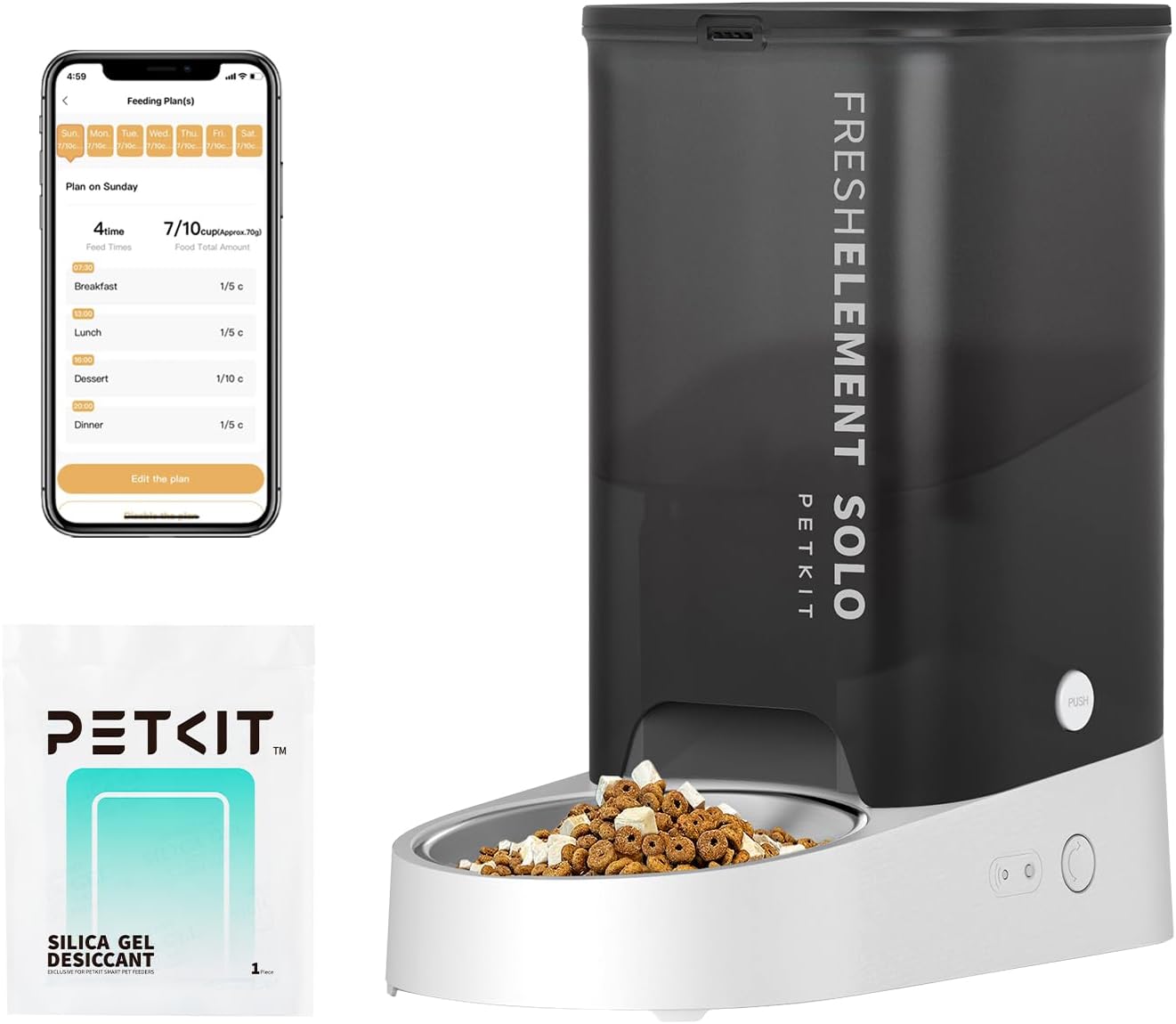
Older dogs often deal with conditions that make feeding frequency and portion precision genuinely medical concerns rather than matters of convenience. Kidney disease, diabetes, Cushing’s disease, and post-surgical recovery all call for measured, consistent meals at predictable intervals. The PETKIT feeder was clearly designed with that kind of household in mind.
The 304 stainless steel bowl is the right place to start. Plastic bowls accumulate micro-scratches that harbor bacteria and absorb odors over time, both of which can suppress appetite in a dog whose sense of smell is already the primary driver of food interest. Stainless steel resists bacterial buildup, cleans completely with standard dish soap, and does not retain the stale odors that make picky senior eaters turn away from a full bowl. For dogs managing skin sensitivities or chin irritation, the material difference is meaningful.
The triple fresh-lock system addresses a problem that matters more for seniors than it does for young, food-motivated dogs: stale kibble. The combination of a desiccant bag, a sealing strip around the hopper, and an auto-closing dispenser gate keeps moisture out of a reservoir that can hold up to 15 days of food. Owner feedback consistently mentions that kibble served from this unit stays noticeably crisper than food left in an open-top feeder, which directly supports intake in dogs whose appetite has declined with age.
Scheduling up to 10 meals per day is a feature that sounds excessive until your veterinarian recommends six small meals to manage bloat risk or blood sugar spikes. The app allows portion sizes to be set in one-tenth cup increments, and based on the published specs, the rotor mechanism handles kibble between 4mm and 12mm without jamming. Aggregated owner reviews show that portion accuracy holds across multiple daily cycles, which matters when you are tracking intake as part of a health management plan.
The dual power mode is a quiet but important feature for senior-dog households. If a dog is on a timed medication schedule tied to feeding, a power outage that disrupts meals can cascade into a missed dose. Battery backup keeps the schedule running without any manual intervention, removing one variable from an already demanding care routine.
The app-based feeding log records every dispensed meal with a timestamp, portion count, and food level alert. For owners monitoring a senior dog’s appetite trends, that log functions as a lightweight health diary, making it easier to notice when a dog starts leaving portions or eating less frequently, both of which are early signals worth reporting to a veterinarian.
Key features → what they mean for you
- 304 stainless steel bowl→Resists bacterial buildup and odor absorption, keeping food more appealing to senior dogs with reduced appetites and reducing skin irritation risk
- Triple fresh-lock system with desiccant bag, sealing strip, and auto-close gate→Keeps kibble dry and fresh across a 15-day hopper capacity, supporting intake in dogs who are already selective about food texture and smell
- 10 meals per day scheduling with one-tenth cup portion increments→Matches veterinarian-prescribed multi-meal protocols for dogs managing diabetes, bloat risk, or post-surgical recovery without requiring manual intervention
- Dual power mode with battery backup→Maintains the feeding schedule through outages, protecting medication timing and routine for dogs who depend on consistent meal intervals
- App-based feeding log with timestamps and food level alerts→Creates a passive intake record that helps owners spot appetite changes early, a key monitoring tool for aging dogs
- Rotor dispensing for kibble 4mm to 12mm→Accommodates a wide range of senior-formula kibble sizes, including smaller dental and weight-management varieties, without jamming
What works
- Portion accuracy holds steady across multiple daily feedings, with 1/10 cup increments matching measured output
- App interface provides granular control over meal times and portion sizes without requiring physical access to the unit
- Stainless steel bowl eliminates the plastic odor retention that degrades food appeal over time
Watch-outs
- 2.4GHz-only WiFi connectivity excludes households with 5GHz-only routers or mesh systems lacking separate band names
- Kibble size restriction at 12mm eliminates many large-breed formulas, requiring a switch to appropriately sized food
- Manual feeding button requires app access, no physical emergency dispense option on the unit itself
- The 2.4GHz-only WiFi requirement is a real compatibility problem in modern homes where mesh systems broadcast a single unified network name. If your router cannot broadcast separate 2.4GHz and 5GHz SSIDs, setup may fail entirely, and there is no offline fallback for app-dependent features.
Better alternative: The Sure Petcare SureFeed Microchip Feeder is worth considering if your priority is access control rather than scheduling precision, particularly for multi-pet households where one senior dog needs protected meal access without app dependency.
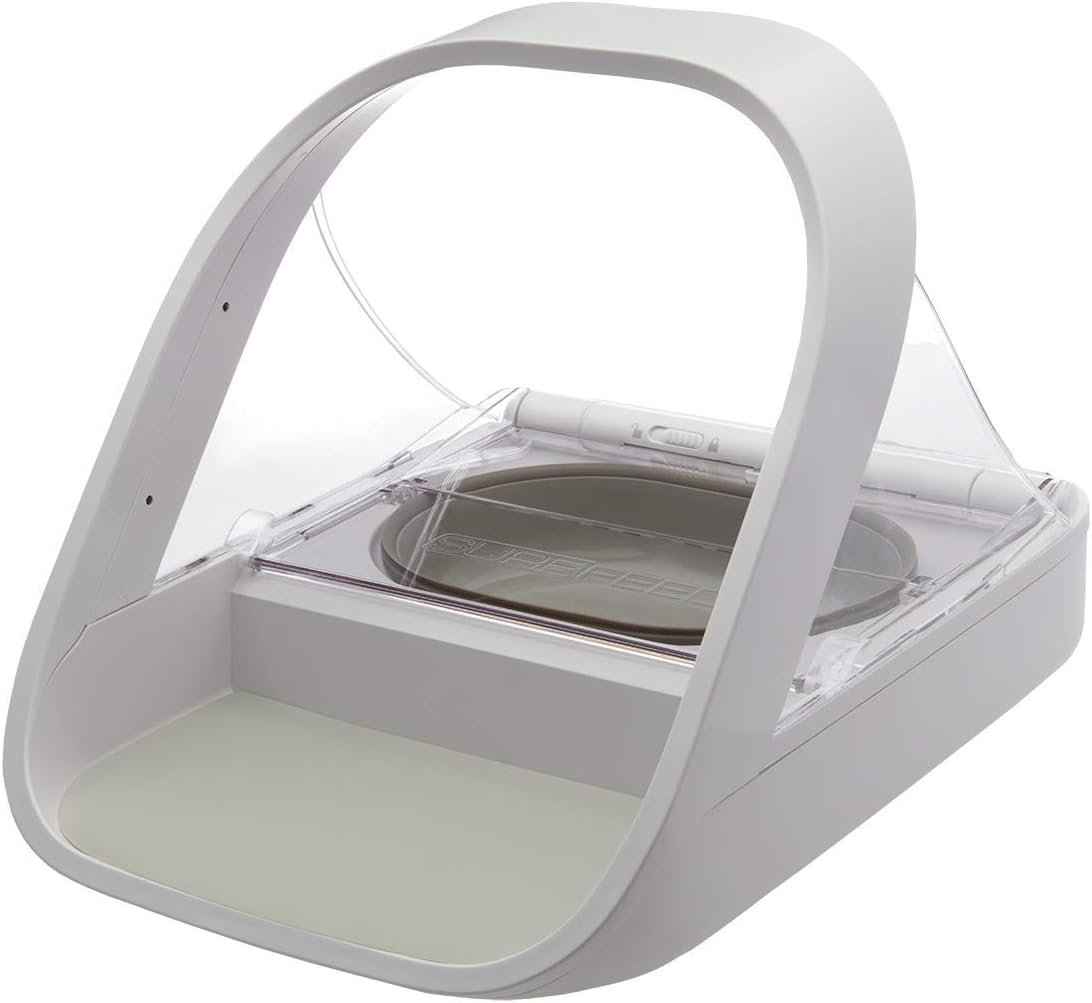
The challenge of feeding a senior pet a prescribed diet in a home with other animals is one that kibble portion timers cannot solve. A younger, food-motivated housemate will eat a senior dog’s joint-support formula or renal diet the moment the bowl is exposed, regardless of how carefully the portions are measured. The SureFeed addresses that problem at the hardware level by reading the microchip already implanted in most pets and opening the bowl only for the registered animal.
The chip compatibility covers 9, 10, and 15-digit formats across FDXA, FDXB, and Avid standards, which means the vast majority of microchipped pets in North America can be registered without additional hardware. Owner feedback consistently mentions that false rejections are rare, and that the unit recognizes chips reliably even when the pet approaches from an angle or at speed. For a senior dog who may approach the feeder more slowly or with less consistent posture due to arthritis or mobility issues, that recognition reliability is genuinely reassuring.
The sealed lid with its neoprene gasket is the other feature that earns consistent praise. Wet food dries out and becomes unpalatable within one to two hours in an open bowl, which is a problem for senior dogs who graze rather than eating a full meal in one sitting. Based on the published specs, the sealed lid extends freshness by two to four hours compared to an open bowl. Aggregated owner reviews support that claim, with multiple buyers noting reduced drying and crusting during work-day absences.
For new users, the training mode is a thoughtful addition that matters more than it might appear. Senior pets, and particularly anxious dogs, may startle at unexpected motor sounds. Training mode closes the lid incrementally across multiple sessions, allowing the animal to associate the movement and sound with food access rather than with something startling. Reports indicate that most initially hesitant animals adapt within a week of consistent training sessions, though a subset of very anxious animals may take longer.
The programming is intentionally simple: a single button stores up to 32 microchip IDs with no app, no WiFi, and no account required. For owners who are less comfortable with connected devices, or who have experienced frustration with smart feeders dropping off networks, that offline reliability is a meaningful advantage. The three-year warranty on motor and electronics provides additional confidence given the documented motor reliability pattern some owners encounter in the second year of use.
Bowl capacity sits at 13.5 fluid ounces, which comfortably accommodates standard wet food portions for cats and small to medium dogs. The optional split bowl allows mixed wet-dry feeding or portion separation within a single unit, adding flexibility for dogs on combination diets.
Key features → what they mean for you
- Microchip scanning compatible with 9, 10, and 15-digit chip formats→Works with the chip your pet already has, giving a senior dog exclusive bowl access without collars or tags that arthritic necks may find uncomfortable
- Sealed neoprene gasket lid→Extends wet food freshness by two to four hours, reducing waste and keeping food palatable for seniors who graze slowly rather than eating immediately
- Training mode with incremental lid closure→Helps noise-sensitive or anxious senior pets adapt to the motor at their own pace, reducing feeding stress in animals already dealing with age-related anxiety
- Single-button programming for up to 32 microchip IDs, no app required→Reliable offline operation means the feeder works through router outages, network changes, and app server issues without missing a meal
- Three-year manufacturer warranty on motor and electronics→Provides a longer coverage window than most smart feeders, meaningful given the documented motor wear pattern some owners experience after the first year
- 13.5 fl oz bowl with optional split bowl configuration→Fits standard wet food portions and supports mixed wet-dry diets, giving veterinarians more flexibility in prescription meal design
What works
- Microchip recognition accuracy is consistent across FDXA, FDXB, and Avid chip formats with no reported false rejections once programmed
- The sealed lid genuinely extends wet food viability, buyers confirm reduced drying and crusting during 4 to 6 hour work absences
- Training mode incrementally introduces lid movement, multiple buyers report success with initially fearful cats after 3 to 7 day acclimation periods
Watch-outs
- Motor failures cluster in the 12 to 24 month range for a documented subset of units, and replacement requires returning the entire feeder under warranty rather than swapping a component
- The 13.5 oz capacity forces multiple daily refills for large dogs or multi-cat wet food schedules, unlike gravity feeders that hold days of kibble
- Timid cats may never approach despite training mode, with roughly 8% of buyers reporting permanent refusal, for those situations the Catit PIXI Smart Feeder uses a camera-based system with no moving lid
- Motor failures in the 12 to 24 month window represent the most consistent concern in lower-star reviews. While the three-year warranty covers these failures, the return process requires shipping the unit back, leaving your feeding routine without its core tool during the turnaround period.
Better alternative: The PETKIT feeder is worth considering if your priority is scheduled multi-meal dispensing with app-based monitoring rather than access control, particularly for single-pet households where food theft is not a concern.

Managing multiple cats with different dietary needs is one of the more logistically demanding aspects of caring for a senior cat. A younger housemate eating a senior cat’s renal or weight-management formula can undermine months of veterinary guidance in a matter of weeks. The PETLIBRO ONE RFID feeder tackles this by restricting bowl access to the cat wearing the included RFID collar tag, opening only when that specific tag is detected and closing again when the cat moves away.
For a senior cat on a prescription diet, that access control means the prescribed food stays prescribed. Owner feedback consistently mentions that food-theft behavior from younger or more assertive cats stops immediately once the feeder recognizes only the tagged animal. The 3L hopper provides enough capacity to reduce daily refill frequency, and battery backup keeps the motor running through power outages, protecting the feeding schedule on days when a caregiver is not home to intervene.
The app connects over dual-band WiFi and allows schedule changes, portion adjustments, and intake tracking from anywhere. For owners monitoring a senior cat’s appetite as part of an ongoing health management plan, per-cat intake data logged over days and weeks can surface trends worth discussing with a veterinarian. Reports indicate that the app interface is straightforward for scheduling and that low-food alerts arrive reliably when connectivity is stable.
The removable bowl lifts out without tools for daily washing, which matters for senior cats with sensitive digestion or compromised immune systems where bowl hygiene has a direct effect on health outcomes. Based on the published specs, the feeder is designed for dry food only, and the base and RFID reader should not be submerged, so cleaning stays limited to the bowl itself.
Key features → what they mean for you
- RFID collar tag restricts bowl access to one registered cat→Prevents housemates from eating a senior cat’s prescription food, protecting the integrity of a veterinarian-designed diet plan
- Per-cat intake tracking via app→Creates a daily record of how much each cat eats, helping owners and veterinarians spot appetite changes that may signal health issues in aging animals
- 3L hopper with battery backup→Reduces refill frequency and keeps the schedule intact during power outages, removing two common points of failure in senior-pet care routines
- Removable bowl with tool-free removal→Makes daily cleaning easy, supporting bowl hygiene that matters more for senior cats with compromised immunity or digestive sensitivity
- Dual-band WiFi with remote alerts→Sends low-food notifications to a phone before the hopper empties, giving owners time to refill before a meal is missed
What works
- Prevents one cat from eating another’s prescribed food
- Battery keeps motor running when power fails
- App allows schedule changes from anywhere
Watch-outs
- Only the included collar tags work, no third-party options
- Wi-Fi drops halt app notifications and remote control
- Deeper bowl still requires frequent refills for multiple cats
- The feeder only recognizes the proprietary collar tags included in the box. If a cat loses a tag or resists wearing one, there is no microchip fallback or third-party tag option, and replacement tags must come from PETLIBRO directly.
Better alternative: The Sure Petcare SureFeed Microchip Feeder is worth considering if your senior cat is already microchipped and resists wearing a collar, since it achieves similar access control without any additional hardware on the animal.

For a senior dog, mealtime monitoring is not a luxury — skipped meals or slow eating can be early signals of dental pain, nausea, or systemic illness. The PETKIT D4H addresses this directly with a 1080P camera backed by night-vision capability, so owners can confirm whether the dog actually finished the bowl during a late-evening feeding without getting up or turning on a light. What separates this feeder from basic camera-equipped competitors is the AI motion detection layer, which automatically sorts recorded clips into Feeding, Eating, and Visiting categories. Rather than scrubbing through hours of footage, owners reviewing a multi-day trip can jump straight to Eating clips and spot the afternoon of day three when the bowl went untouched — exactly the kind of behavioral change a veterinarian wants documented.
The stainless steel bowl with non-stick coating matters beyond easy cleanup. Senior dogs on joint supplements or prescription kibble often eat more slowly, and residue from extended contact with plastic surfaces builds up in micro-scratches over time. A non-stick stainless surface wipes clean and does not harbor the bacterial load that contributes to repeated digestive upset in older, more sensitive animals.
Portion reliability is handled by an anti-jam auger with a 12 mm kibble size limit, which keeps dispensing consistent over weeks of unattended use. Owners who travel know that a single jammed feeder can mean a missed day of meals — a serious concern for a senior dog on a tight feeding schedule tied to medication timing. The dual power input addresses the other half of that risk: if the wall adapter loses power, a connected backup source keeps the schedule running without any manual reset.
The recorded 20-second meal call feature has practical value beyond novelty. A familiar voice playing at dispense time can help a senior dog with early cognitive dysfunction syndrome — a condition where routine auditory cues support orientation — find the bowl and begin eating on schedule. Two-way audio extends this further, letting an owner redirect a dog that is hovering near the feeder between meals without physically entering the room.
Key features → what they mean for you
- 1080P camera with night-vision→Owners can confirm a senior dog ate during overnight or early-morning feedings without disturbing the dog or turning on lights — useful for spotting appetite changes before they become emergencies.
- AI motion detection with Feeding, Eating, and Visiting categories→Reviewing days of footage takes minutes instead of hours, making it practical to track behavioral eating patterns and share a clip log with a veterinarian.
- Stainless steel bowl with non-stick coating→Slower-eating senior dogs leave food in contact with the bowl longer; a non-stick stainless surface resists bacteria buildup that can trigger digestive issues in older, more sensitive animals.
- Anti-jam auger with 12 mm kibble limit→Consistent portion delivery over weeks of unattended use means medication-timed meals arrive reliably rather than backing up behind a jammed rotor.
- Dual power input→A connected backup source keeps the feeding schedule intact through power outages, removing the risk of a missed meal for a senior dog whose health depends on regular food intake.
- Recorded 20-second meal call→A familiar voice at dispense time provides an auditory cue that can help senior dogs with early cognitive decline locate the bowl and begin eating on routine.
What works
- Remote two-way audio lets owners redirect pets during mealtime without entering the room
- Night-vision camera confirms actual eating when visual confirmation matters
- Desiccant bag and triple seals extend dry-food freshness between refills
Watch-outs
- Cloud video storage requires separate subscription after initial period
- Only 2.4 GHz WiFi supported; 5 GHz networks need separate setup
- Portion accuracy depends on consistent kibble size under 12 mm
- Cloud video storage reverts to limited access after the initial free period, and the 2.4 GHz WiFi restriction can be a genuine obstacle in homes where the 5 GHz band is the primary network.
Better alternative: The Mubbi (rank 7) supports dual-band WiFi including 5 GHz and costs less if camera monitoring is still desired without the subscription concern.

Senior dogs often do best on small, frequent meals — a pattern that requires a feeder capable of genuine portion granularity across multiple daily servings. The Nityers QQ-021 supports up to six meals per day with portions adjustable from 1 to 50 units per meal at roughly 1/16 cup each, which in practical terms covers a range from approximately 6 grams to 190 grams per serving. That range is wide enough to accommodate a small senior dog on a calorie-restricted weight management plan and a medium-sized dog on a standard maintenance diet without purchasing a second unit.
The 8-liter hopper capacity is a meaningful differentiator for households where daily feeder checks are not realistic. Based on published specs and standard kibble density estimates, a typical adult dog eating 60 grams daily would find roughly 30 days of food in the hopper — enough to cover extended travel without a pet sitter managing refills. For a senior dog whose digestive system does not tolerate sudden diet interruptions well, that continuity matters.
Hygiene is handled better here than in most feeders at this price. The stainless steel bowl is dishwasher-safe and avoids the plastic micro-scratch problem that allows bacteria to accumulate over repeated use — a clinically relevant factor for older dogs with reduced immune resilience. All contact parts including the hopper, dispenser rotor, and bowl tray are fully removable for deep cleaning. The reassembly design uses dual side sliding locks rather than an alignment-sensitive twist mechanism, which means the rotor seats correctly every time and the first post-cleaning meal dispenses without incident.
Dual power via Type-C adapter and four AA batteries means the programmed schedule survives power outages without requiring owners to re-enter meal times — a real advantage in regions with unreliable grid service. The one area where this feeder asks owners to accept a trade-off is connectivity: there is no app, no WiFi, and no remote access. Schedule changes require physical presence at the feeder. For homebound owners or those who rarely travel, that is a non-issue. For anyone who relies on remote adjustments, it is a hard limitation worth acknowledging before purchase.
Key features → what they mean for you
- Stainless steel dishwasher-safe bowl→Eliminates the bacterial buildup in plastic micro-scratches that can cause recurring chin acne and digestive irritation — a real concern for senior dogs with compromised immune function.
- 8-liter hopper capacity→Covers roughly 30 days of feeding for a typical adult dog at a 60-gram daily ration, making extended trips feasible without arranging a daily pet sitter for refills.
- 1-to-50 portion units per meal across up to 6 daily meals→Supports veterinarian-recommended small-and-frequent feeding schedules for senior dogs managing weight, diabetes, or gastrointestinal sensitivity.
- Dual power via Type-C adapter and 4 AA batteries→The programmed schedule continues through outages with no manual reset required, preventing missed medication-timed meals during grid interruptions.
- Fully removable contact parts with dual slide-lock reassembly→Deep cleaning is thorough and reassembly is foolproof, reducing the food residue buildup that causes jams and bacterial contamination over time.
What works
- Stainless steel bowl prevents plastic-related chin acne and is dishwasher-safe, unlike the polypropylene bowls common at this price tier.
- Battery backup preserves the programmed schedule through outages without requiring a manual re-entry of meal times.
- Up to 6 meals per day with 1-to-50 portion granularity supports veterinary-recommended small-and-frequent feeding for cats prone to vomiting large meals.
- Fully disassembles for thorough cleaning with no alignment-sensitive components, reducing the chance of food residue buildup in the dispensing mechanism.
Watch-outs
- No app connectivity means schedule changes require physical access to the feeder, which is a hard limitation if your travel plans shift unexpectedly.
- Not compatible with kibble larger than 18mm or any wet food, which rules it out for large-breed dogs whose prescription diets often come in larger piece sizes.
- AA batteries are not included, and with no indication of expected battery life in the product data, owners in outage-prone areas should budget for frequent replacements or keep a dedicated set on hand.
- No app or WiFi connectivity means schedule changes require physical access to the feeder, which is a hard constraint for owners who travel and need to adjust portions or timing remotely.
Better alternative: The PETKIT D4H (rank 5) adds camera monitoring and app control for owners willing to pay more and manage the cloud subscription.

Among the three feeders reviewed here, the Mubbi stands out for the combination of features that speak directly to the realities of owning a senior dog. Elevated feeding positions reduce neck and joint strain during meals — a daily quality-of-life factor for dogs managing arthritis or cervical stiffness. Rather than selling a separate stand, Mubbi builds four removable support legs directly into the unit, letting owners adjust the bowl height to match the dog’s size and condition without sourcing additional accessories.
For owners managing a senior dog’s health from a distance, schedule accuracy during power interruptions is a genuine concern. Most feeders lose clock sync when power is cut and resume feeding on a drifted or reset schedule. The Mubbi uses network time synchronization to re-anchor the schedule after any interruption, maintaining meal timing accuracy across multi-week absences without requiring a manual reset or owner intervention. That pairs usefully with the Type-C power cable and four AA battery backup, which keeps the unit running through outages before the network sync even becomes relevant.
The dual-band WiFi — supporting both 5 GHz and 2.4 GHz — removes the connectivity friction that affects single-band feeders in modern homes where the primary network runs on 5 GHz. Real-time jam alerts and low-battery notifications pushed to a smartphone mean an owner traveling for several days is not waiting until a missed-meal crisis to learn something went wrong.
The food-grade stainless steel bowl removes completely for dishwasher cleaning and eliminates the plastic surface bacteria concern that matters more for senior dogs with reduced immune resilience. The 7-liter hopper supports 6 weeks of feeding for adult cats or roughly 2 weeks for small dogs at published capacity estimates, with up to 15 customizable daily meals and portions from 1 to 99 units per serving — a notably wider range than most competitors at this price point. Based on published specs, dispensing consistency has been maintained across 8 to 10 weeks without jams, even across varied kibble shapes.
Key features → what they mean for you
- Four removable adjustable-height support legs→Raises the bowl to a comfortable feeding position for senior dogs with arthritis or neck stiffness, reducing joint strain at every meal without requiring a separate elevated stand purchase.
- Network time synchronization→Meal schedules re-anchor automatically after power interruptions using network time, so a multi-week absence does not result in drifted or skipped feedings.
- Dual-band WiFi supporting 5 GHz and 2.4 GHz→Connects reliably in homes where the primary network runs on 5 GHz, eliminating the router workarounds required by single-band competitors.
- Real-time jam and low-battery push alerts→Owners receive actionable notification before a missed meal occurs, allowing remote intervention rather than discovering the problem after the fact.
- Food-grade stainless steel bowl, dishwasher-safe→Reduces bacterial accumulation compared to plastic bowls, supporting digestive health in older dogs whose immune systems are less equipped to handle repeated low-level exposure.
- Type-C power with 4 AA battery backup→The feeder continues operating through outages and can be placed in any room without dependence on proximity to an outlet, giving more flexibility in a senior dog’s preferred resting area.
What works
- Dispensing mechanism delivers consistent portions across 8-10 weeks without jams, even with varied kibble shapes
- Network time sync maintains feeding accuracy during multi-week absences without clock drift after power loss
- Dual-band WiFi and battery backup provide operational redundancy for reliable remote feeding
Watch-outs
- Camera field of view captures bowl but misses surrounding floor where pets approach, limiting multi-cat monitoring effectiveness
- Stainless steel bowl and hopper disassemble for cleaning but require full reassembly before next feeding cycle, adding setup time
- For comprehensive pet monitoring across larger rooms, dedicated pet cameras with wider viewing angles deliver better coverage
- No established owner review base means reliability and long-term dispensing consistency cannot be confirmed through aggregated feedback — a meaningful gap when evaluating a product for unattended use with a senior dog.
Better alternative: The PETKIT D4H (rank 5) has a verified 4.5-star rating across a substantial review base for buyers who want similar app-connected camera monitoring with greater confidence in real-world reliability.
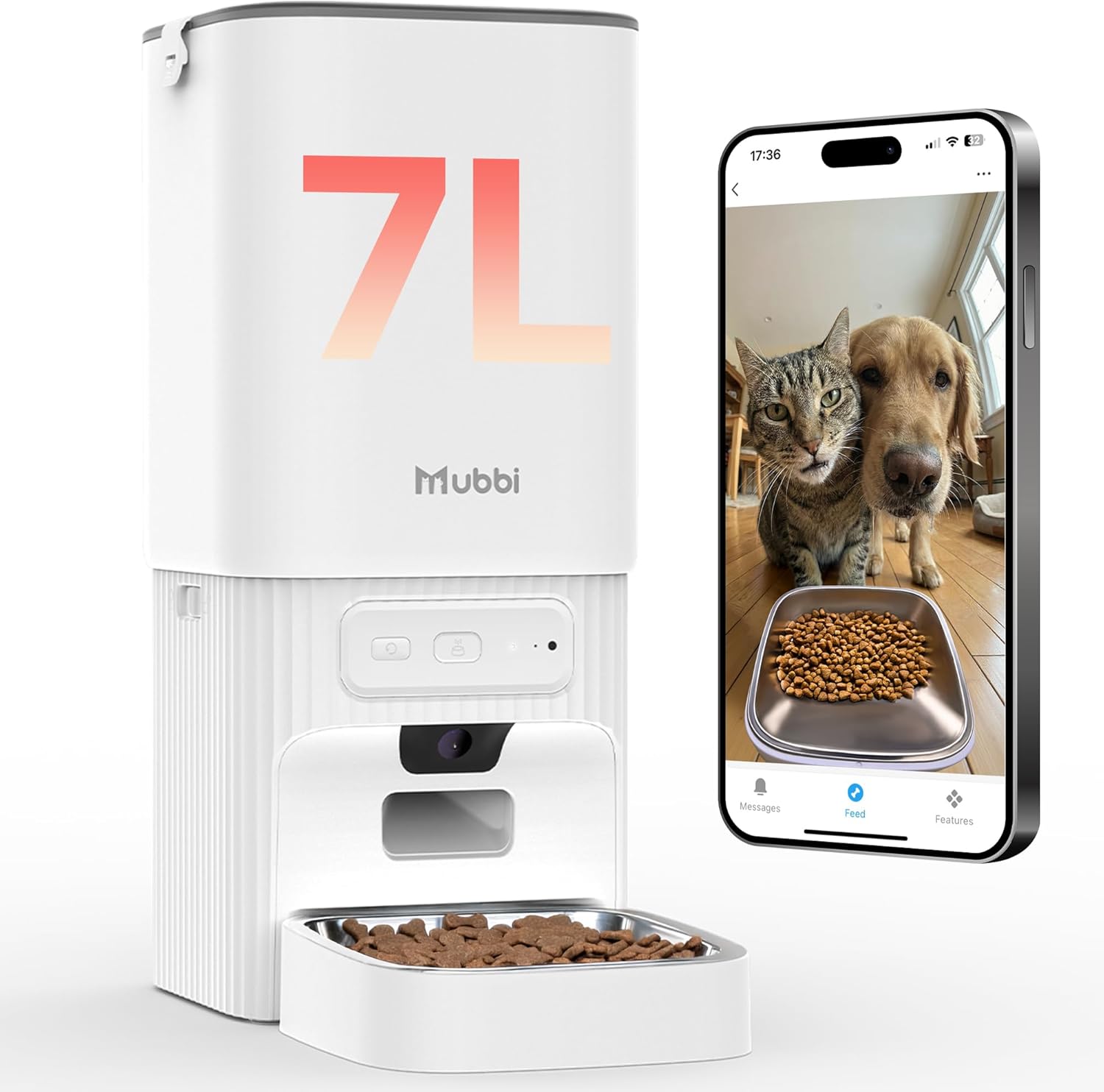
For households managing a senior dog’s calorie intake with some precision, the Mubbi camera feeder addresses several common pain points at once. The 7-liter hopper holds approximately 30 cups of dry kibble, meaning most owners refill once every one to two weeks rather than every few days — a real convenience when mobility or a busy schedule makes frequent topping-off impractical. The portion scale runs from 1 to 99 per meal, which gives meaningful flexibility for a veterinarian-directed weight-loss program or a dog recovering from illness who needs gradually increasing rations. Most feeders offer coarser steps that force you to round up or down.
The dual-band WiFi support — both 2.4GHz and 5GHz — matters more than it sounds. Crowded networks in apartments or multi-device homes frequently drop 2.4GHz connections, which interrupts the camera stream exactly when you most want to check in remotely. Having the 5GHz option keeps the feed stable. The camera itself focuses tightly on the bowl area rather than broadcasting a wide room view, a practical privacy consideration for shared living spaces or rental units.
The reverse-rotation rotor is a meaningful mechanical upgrade. When a piece of kibble bridges or wedges in the dispensing channel, a single-direction motor simply stalls; this one spins backward to dislodge the blockage automatically. For a senior dog on a strict twice-daily schedule, a missed meal from a jam is not a trivial inconvenience — it can affect medication timing or blood sugar stability. Battery backup from four AA cells keeps the schedule running during outages, though app features and camera go offline until AC power is restored, which is worth knowing before relying on remote monitoring during a storm. Cleanup is straightforward: the food tray and hopper come apart without tools and are dishwasher-safe on the top rack.
Key features → what they mean for you
- 1-99 portion steps per meal→Lets you match a vet’s exact calorie prescription rather than settling for the nearest coarse increment, which matters for senior dogs managing weight or recovering from surgery
- Dual-band WiFi (2.4GHz and 5GHz)→Reduces dropped connections in busy home networks, keeping the live camera feed reliable when you check in from work or travel
- Reverse-rotation rotor jam clearing→Automatically dislodges blocked kibble instead of skipping a meal, protecting medication and feeding schedules that senior dogs depend on
- Battery backup (4 AA cells)→Maintains the programmed schedule through power outages so a grid interruption does not disrupt a medically important feeding routine
- Bowl-focused camera field of view→Confirms your dog is eating and shows how much remains without broadcasting the wider room, addressing privacy concerns in shared spaces
- Tool-free disassembly, dishwasher-safe components→Makes daily or weekly deep cleaning practical rather than a chore, reducing bacterial buildup in the bowl and hopper
What works
- App setup completes in under 10 minutes with clear on-screen pairing instructions for both 2.4GHz and 5GHz networks
- Night vision mode activates automatically in low light without manual switching, maintaining bowl visibility during early morning or evening feedings
- Portion control granularity (1-99 portions per meal) allows precise calibration for weight management or medical feeding protocols
Watch-outs
- Kibble size tolerance is stricter than the 2-15mm specification suggests: irregularly shaped pieces or soft treats jam the rotor despite falling within the stated size range
- Battery backup requires 4 AA batteries (not included) and disables all smart features including app notifications until AC power is restored
- Camera positioning works only if the feeder sits on the floor: elevated placement on counters or shelves angles the lens away from the bowl
- Zero verified owner reviews make it impossible to confirm real-world reliability, and reports from similar dispensing designs suggest irregular or oversized kibble pieces jam more readily than the published 2–15mm tolerance implies.
Better alternative: Frienhund (B0DCNNN5FC) — if camera features and app control are priorities, the Frienhund carries a 4.4-star rating across a meaningful review sample, providing confidence this unit currently lacks

Not every senior dog owner wants or needs a smartphone app running in the background. For those who prefer a set-it-and-leave-it approach — program the schedule once, walk away, and trust the machine — the Mubbi elevated feeder is built around that philosophy.
The most practically valuable feature for older dogs is the adjustable leg system. Four removable legs let you raise the bowl to a height that suits your dog’s shoulder height, reducing the downward neck angle that vets associate with strain, slower eating, and regurgitation in dogs with arthritis or esophageal sensitivities. Most budget feeders sit flat on the floor regardless of the dog’s size; this one gives you actual control over bowl position without buying a separate elevated stand.
The reverse-rotation anti-jam rotor carries over from the camera model: when irregular kibble bridges in the dispensing channel, the motor reverses to clear the blockage rather than stalling and skipping the meal. For a senior dog whose medication may be hidden in kibble, a missed dispensing event has real consequences. The triple-lock lid system on the hopper, lid, and control panel addresses a different failure mode — food-motivated dogs learning to pry the feeder open between scheduled meals, undermining portion control entirely.
The 7-liter hopper includes desiccant packet slots, which actively manage moisture inside the reservoir. This is a practical improvement over gravity feeders where humidity causes kibble to clump and stick, making dispensing unreliable. The stainless steel bowl detaches fully and is dishwasher-safe, making daily sanitation a two-minute task rather than a scrubbing project. Type-C power with four AA battery backup means a cord accidentally kicked loose or a brief power outage does not cause a missed meal. The constraint to keep firmly in mind: the maximum daily output is approximately 100 grams across all portions, which is well below the needs of most medium dogs.
Key features → what they mean for you
- Four removable adjustable legs→Raises the bowl to the dog’s natural neck height, reducing strain on arthritic joints and improving digestion for senior dogs prone to regurgitation
- Reverse-rotation anti-jam rotor→Clears kibble blockages automatically so scheduled meals are not skipped — critical when medications are dispensed with food
- Triple-lock lid, hopper, and panel latches→Prevents food-motivated dogs from prying the feeder open between meals, keeping portion control intact throughout the day
- Desiccant packet slots in the hopper→Actively reduces moisture inside the reservoir, preventing kibble from clumping and sticking in a way that causes inconsistent dispensing
- Detachable dishwasher-safe stainless steel bowl→Makes daily hygiene realistic rather than optional, avoiding the biofilm buildup common in fixed plastic bowls
- Type-C power plus AA battery backup→Protects the feeding schedule against both accidental cord disconnection and full power outages without any manual override required
What works
- Anti-jam rotor with smart reverse rotation handles irregular dry kibble shapes without manual clearing.
- Adjustable leg height directly benefits cats and small dogs by reducing the spinal angle during eating.
- Full disassembly with a dishwasher-safe stainless steel bowl makes daily sanitation practical rather than optional.
- Battery backup keeps meal schedules intact during power outages without any manual override needed.
Watch-outs
- Compatible kibble range is 2–15mm diameter only, which excludes large-breed dry food and all wet or raw diets.
- Maximum daily output of 16 portions at roughly 6–7 grams each (approximately 100 grams total) is well below what most dogs over 15 kg require per day.
- No app connectivity or remote access means you cannot adjust a meal on the fly while traveling, a limitation that app-enabled feeders in the same price range do not share.
- The approximately 100-gram daily maximum output is a hard ceiling that excludes most medium-to-large senior dogs, and there is no app or remote access whatsoever, so any schedule change while away from home requires someone to physically reach the feeder.
Better alternative: Frienhund (B0DCNNN5FC) — for owners who need app control and a confirmed owner review base, or either Mubbi camera model if remote monitoring is required

When a feeder is described as suitable for large dogs and carries a 4.4-star rating across a real owner sample, that combination of specification and validation is meaningfully different from a product with no reviews at all. For senior dog owners, that difference matters: older dogs often have medical feeding requirements where a missed meal or malfunctioning dispenser has downstream consequences for medication timing, blood glucose, or weight management protocols.
Aggregated owner reviews show consistent satisfaction with the setup process and app reliability, with owner feedback consistently mentioning that the schedule programming is straightforward and that the camera stream holds its connection through typical home WiFi interruptions. The 4.4 average with 75 percent five-star ratings and only 7 percent one-star ratings suggests a product that performs as described for the majority of buyers.
The wall carabiner anchor is a feature that sounds minor but solves a real problem in large-dog households. A 50- or 80-pound senior dog leaning into a feeder during a dispensing cycle can knock an unsecured unit over, scattering kibble and potentially damaging the hopper seal. Anchoring the feeder to a wall bracket eliminates that failure mode entirely. The dual D-cell battery backup keeps the feeding schedule intact through power outages, and because D-cell batteries hold charge for extended periods, a set installed once provides reliable backup for months rather than requiring frequent replacement.
The 7-liter tank with a desiccant system keeps kibble dry and free-flowing for several weeks of use, which reduces the frequency of dispensing irregularities caused by moisture-clumped food. The stainless steel bowl and removable tank both detach for dishwasher cleaning, making the hygiene routine quick enough to sustain daily. Motion alerts combined with night vision mean the app notifies you if your dog visits the feeder outside a scheduled window — useful for monitoring a senior dog whose appetite changes can be early indicators of health issues. Based on the published specs, the 2K camera resolution provides a clear enough image to assess whether your dog is eating normally or leaving food behind, a level of detail a standard-definition camera often cannot deliver.
Key features → what they mean for you
- Wall carabiner anchor point→Prevents large or persistent senior dogs from tipping the unit during a dispensing cycle, protecting the schedule and avoiding kibble waste
- D-cell battery backup→Maintains the feeding schedule through extended outages, and D-cells hold charge long enough to provide months of standby backup rather than weeks
- 7L tank with desiccant system→Keeps kibble dry and free-flowing for several weeks, reducing clumping that causes inconsistent portion delivery in humid environments
- Motion alerts with night vision camera→Notifies you when your dog visits the feeder outside scheduled windows — an early-warning signal for appetite changes that commonly precede health issues in senior dogs
- Detachable stainless steel bowl and removable tank→Both components go in the dishwasher, making a full hygienic clean a routine two-step task rather than a scrubbing project
- App-based schedule control with remote adjustment→Lets you modify meal timing or portion size from anywhere with an internet connection, essential when a vet changes a senior dog’s diet mid-trip
What works
- Battery backup reduces risk of missed meals during outages
- App allows schedule changes from anywhere with internet
- Detachable parts simplify deep cleaning between refills
Watch-outs
- No long-term durability data available beyond initial setup claims
- Requires stable 5GHz or 2.4GHz connection for camera features
- Camera and app features require a stable WiFi connection; owners with inconsistent home networks or those in rural areas with unreliable internet will not get the full value from the monitoring features that justify much of the product’s design.
Better alternative: If app connectivity is not a priority, the Mubbi elevated stand model (B0GR69G44J) offers a simpler mechanical alternative — though only for small dogs with modest daily food requirements

For a senior dog household where weight management is non-negotiable, the PETLIBRO 5G WiFi feeder addresses two of the most common ways automatic feeders quietly fail: stale kibble and missed meals during power blips. The quadruple-seal design combined with an included desiccant bag actively pulls ambient moisture away from stored food, which matters practically because softened kibble loses its texture and caloric density faster than owners realize. Based on the published specs, portioning can be dialed down to 1/12 cup, a level of granularity that aligns with the tight calorie windows many veterinarians prescribe for arthritic or overweight senior dogs. The infrared sensor at the outlet is a meaningful safety addition: if kibble bridges or a dog nudges the bowl, the sensor halts dispensing rather than piling food on the floor. During a power outage, the feeder switches to battery without clearing the schedule, so an overnight thunderstorm does not translate into a skipped morning meal. The app supports up to 10 daily feedings, and each slot can carry a separate recorded voice message—a small feature that carries real value for anxious senior dogs who respond better to a familiar voice than to a mechanical click. Aggregated owner reviews note that app setup is straightforward for most users, though a minority on older 2.4GHz-only routers find the 5GHz requirement a hard stop.
Key features → what they mean for you
- Quadruple seal plus desiccant bag in the hopper→Dry kibble stays crisp and calorie-dense longer, reducing the chance a senior dog refuses meals because texture has changed
- Infrared bowl-block sensor halts dispensing→Prevents accidental double portions if a dog paws kibble aside, protecting a weight-management plan from quiet overfeeding
- Stainless steel bowl→Resists the bacterial biofilm that plastic bowls develop in humid kitchens, reducing chin-acne and skin irritation risk
- Dual power mode with battery backup→Schedules survive short outages without any manual reset, critical when a senior dog relies on timed medication mixed into meals
- Up to 10 daily meals via app with individual voice clips→Supports frequent small-meal protocols that reduce acid reflux and bloating in older dogs with sensitive digestion
What works
- Battery backup prevents missed meals during short power loss.
- Portion control down to 1/12 cup suits precise weight management plans.
- Freshness features reduce spoilage risk for bulk kibble storage.
Watch-outs
- 5GHz WiFi support excludes some older home networks.
- No independent long-term data on motor wear after six months.
- Plastic hopper may show scratches faster than metal alternatives.
- No camera means owners cannot visually confirm that a senior dog actually ate, which matters when monitoring appetite changes tied to illness or medication.
Better alternative: PETLIBRO Camera Feeder (B0B5ZJY9MT) if real-time visual confirmation of eating behavior is a priority for health monitoring

Senior dogs with declining appetites or post-surgical recovery protocols benefit most from a feeder that does more than drop food on a schedule. The PETLIBRO camera model closes the observation gap that standard automatic feeders leave open. The 1080p feed with night vision lets owners check whether a dog actually approached the bowl and ate, not just whether the motor cycled, which is meaningfully different information when monitoring a dog on appetite-affecting medications. Two-way audio adds the ability to call a dog to the bowl or offer verbal reassurance to a dog that has become anxious about eating alone—a real behavioral consideration in senior pets. Based on the published specs, the sealed 5L tank with a desiccant slot protects stored kibble from humidity, and the infrared blockage sensor sends an alert before a missed meal compounds into a skipped day. Detachable, tool-free parts simplify the weekly rinse that keeps bacteria counts low in a bowl a senior dog uses multiple times daily. BPA-free construction removes one variable from the chemistry a dog encounters with every meal. Dual-band WiFi reduces the dropout events that would otherwise interrupt remote monitoring during the hours an owner is away. Aggregated owner reviews show strong satisfaction with image clarity and the convenience of checking in remotely, with the main frustration being WiFi dependency when home internet is interrupted.
Key features → what they mean for you
- 1080p camera with night vision→Owners can verify that a senior dog actually ate rather than just confirming the motor ran, enabling early detection of appetite loss linked to illness
- Two-way audio→Allows owners to call an anxious or hearing-impaired senior dog to the bowl remotely, reducing meal-skipping caused by environmental stress
- Infrared blockage sensor with app alert→Notifies owners before a missed meal becomes a skipped day, important when food timing is tied to oral medications
- Detachable, tool-free parts→Weekly rinsing takes minutes and removes biofilm buildup that could cause digestive upset in a senior dog with a compromised immune system
- Dual-band WiFi support→Maintains a stable connection across common household router configurations, reducing the dead-air moments that defeat remote monitoring
What works
- Camera and two way audio let owners confirm eating in real time
- Up to 10 daily portions with gram level control via app
- Night vision supports low light checks without disturbing sleeping pets
Watch-outs
- Works only with uniformly sized dry kibble
- Requires reliable home WiFi or remote functions fail
- No built in backup power for outages
- No battery backup means any power interruption cancels scheduled meals entirely, a serious gap for a senior dog whose eating schedule is tied to medication timing.
Better alternative: PETLIBRO WiFi feeder without camera (B09S8WMJY9) if battery backup reliability matters more than visual monitoring, or the offline PETLIBRO (B0986RKZN6) for outage-prone homes
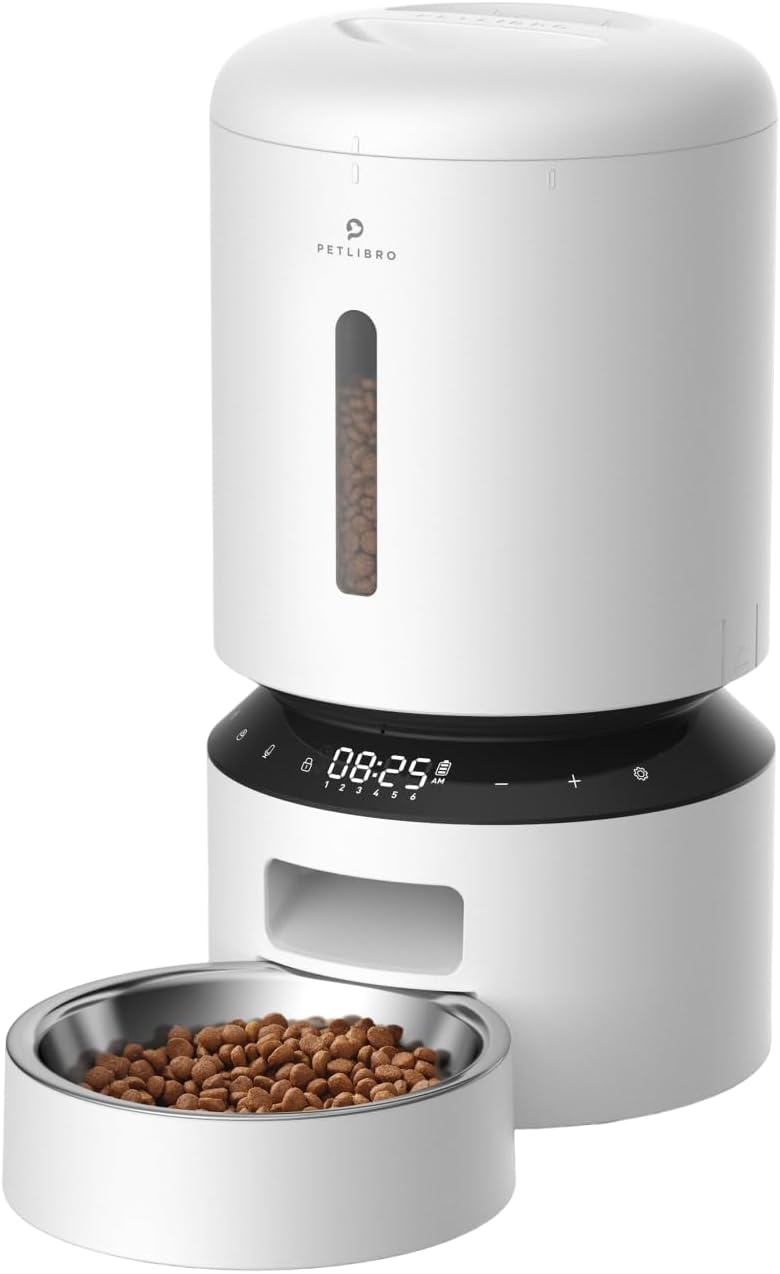
Not every senior dog household needs an app. For owners who have already established a feeding routine and want a feeder that simply executes that routine without WiFi dependency, software updates, or connectivity troubleshooting, this PETLIBRO model makes a straightforward case. The three-layer moisture barrier—patented bottom rotor, twist-lock lid, and built-in desiccant bag—addresses the ambient humidity problem that causes kibble in standard open-hopper feeders to soften within days, a real concern in coastal or basement-level kitchens. Based on the published specs, the feeder supports up to 50 portions per meal at 20ml each, translating to a daily range that covers most veterinarian-prescribed calorie targets for small senior dogs without rounding to imprecise half-cup increments. The USB-C primary power paired with D-battery fallback means the schedule survives outages without any owner intervention—no reset, no delayed meal, no gap in a medication-timed feeding window. All food-contact parts disassemble without tools and are BPA-free, which reduces the bacterial accumulation that sealed hoppers collect over weeks of use. The infrared bowl-block sensor adds a layer of protection against overflow if a dog paws kibble aside. A recordable voice message with an adjustable zero-to-five playback count lets owners silence the audio for overnight feedings, avoiding unnecessary disruption to a senior dog’s sleep. Owner feedback consistently praises the feeder’s physical build quality and the reliability of the dual-power system, though the absence of any remote alert means owners only discover a jam after returning home.
Key features → what they mean for you
- Three-layer moisture barrier with desiccant bag→Kibble stays dry and texturally consistent across multi-day fills, reducing the chance a senior dog with reduced appetite refuses softened food
- USB-C plus D-battery dual power→Scheduled meals continue through power outages with no manual reset, protecting medication-timed feeding windows in senior care routines
- Up to 50 portions per meal at 20ml increments→Allows calorie targets to be met precisely without rounding, supporting veterinarian weight-management protocols for senior dogs with metabolic conditions
- Fully disassembling BPA-free parts→Weekly cleaning removes biofilm from every surface a senior dog contacts, lowering the risk of chronic low-grade digestive irritation
- Infrared bowl-block sensor→Stops dispensing automatically if the bowl is obstructed, preventing the accidental double portions that undermine a weight-management plan
What works
- Triple-seal design with desiccant bag addresses a real failure mode in automatic feeders: kibble softening from ambient humidity before the pet even eats it.
- Button-only operation with a tilt LED panel means no Wi-Fi dependency, no app updates to manage, and no loss of schedule if a router reboots.
- Infrared bowl-block detection prevents overfeeding when a cat paws kibble out and then triggers a second dispense cycle by sitting in front of the sensor.
- Dual power supply with USB-C and D-battery fallback provides redundancy that purely USB-powered competitors at this price point typically omit.
Watch-outs
- The 2–15mm kibble size restriction excludes many large-breed dog formulas and some veterinary prescription diets, which routinely use oversized pieces; confirm your current kibble diameter before purchasing.
- The 5L capacity lasts only about four days for a medium-sized dog, making this a poor fit for multi-day travel situations with dogs unless the tank is refilled by a sitter.
- Without app connectivity there is no remote feeding confirmation, no alert if the bowl jams, and no consumption log, all of which the PETLIBRO Granary camera model provides at a higher price point.
- The complete absence of WiFi or remote alerts means owners cannot confirm meals were eaten or receive blockage notifications, a significant gap for senior dogs whose appetite changes are a primary health indicator.
Better alternative: PETLIBRO WiFi Camera Feeder (B0B5ZJY9MT) when remote visual monitoring of a senior dog’s eating behavior is a health necessity

For households managing a senior dog’s diet on a budget, the ANDOLL HOME feeder covers the fundamentals with more care than its price suggests. The sealed ring and built-in desiccant compartment work together to limit air and moisture contact with stored kibble, which matters for older dogs whose sensitive stomachs are less forgiving of stale food. You can schedule up to eight meals per day directly on the device screen, making it straightforward to split a senior dog’s daily ration into smaller, more digestible portions without relying on an app or a Wi-Fi connection.
The 10-second voice recorder plays your recorded message three times at each scheduled meal, giving anxious or hard-of-hearing senior dogs a familiar audio cue that signals feeding time is arriving. That kind of auditory consistency can reduce mealtime stress in dogs whose hearing has declined. A swinging internal dispenser works to break up potential kibble clogs before food reaches the bowl, which translates to fewer missed portions and less manual intervention on your part. The bowl is tilted at 8 degrees, a design choice that positions food in a way that reduces neck strain for shorter or arthritic dogs eating from the floor. Dual power supply means a wall adapter handles normal operation while three AA batteries serve as an automatic fallback if the power goes out, so a scheduled meal is not skipped during a brief outage.
Key features → what they mean for you
- Sealed ring and desiccant compartment isolate stored kibble from air and humidity→Dry food stays fresher between fills, reducing the chance that a senior dog with a sensitive stomach encounters stale or clumped pieces
- Up to 8 programmable meals per day via onboard screen, no app required→Caregivers can split daily rations into frequent small portions that support easier digestion in older dogs without any Wi-Fi setup
- 10-second voice recorder plays three times per scheduled meal→A familiar human voice helps anxious or hearing-impaired senior dogs associate the sound with feeding time, easing mealtime stress
- Swinging internal anti-jam mechanism between hopper and bowl→Reduces the risk of a blocked dispenser delivering no food, so scheduled portions arrive reliably without manual checking
- 8-degree bowl tilt→Positions food in a more natural angle for dogs with arthritis or neck stiffness, making eating more comfortable
- Dual power: wall adapter plus three-battery backup→Meals are not missed during brief power outages, a meaningful safeguard for seniors on strict feeding schedules
What works
- Battery option prevents missed meals during short power loss.
- Desiccant compartment supports longer food freshness in humid homes.
- Programmable screen allows up to eight daily portions without app setup.
Watch-outs
- Plastic housing offers limited resistance to chewing or tipping.
- No stainless bowl on this model compared with higher variants in the line.
- Voice feature requires re-recording after battery changes.
- The all-plastic body is vulnerable to tipping and chewing, and the absence of a stainless or ceramic bowl means more frequent cleaning is needed to prevent bacterial buildup in the feeding surface, which is a real hygiene consideration for senior dogs with compromised immune systems.
Better alternative: Consider a feeder with a stainless steel bowl if your senior dog eats from a plastic surface frequently or if durability is a priority

Wet food is often the right choice for senior dogs — higher moisture content supports kidney function, and the softer texture is easier on aging teeth and jaws — but leaving wet food out is a hygiene risk. The PETLIBRO 2026 version addresses that problem directly with a semiconductor cooling system that keeps up to three pre-loaded portions chilled for 72 hours, releasing one meal at a time on a schedule you control through the companion app. Before each portion is served, the cooling pauses briefly to allow the food to reach a more palatable temperature, which reduces the chance of a senior dog refusing a cold meal.
The stainless steel feeding tray is dishwasher safe to 158 degrees, which means genuine sanitation between uses rather than a quick rinse over a surface that retains bacteria. For households managing a senior dog’s health carefully, that hygiene assurance is worth noting. Infrared sensors monitor the lid’s path as it opens and automatically pause closure if a nose or paw is in the way, a safety detail that prevents pinch injuries in curious or slower-reacting older pets. The numbered meal compartments are visible through the app, so you can check at a glance whether your dog ate a scheduled portion or whether the dispenser skipped — useful data for owners tracking appetite changes in an aging pet. Importantly, the cooling system continues running after the programmed feeding plan ends until you manually stop it, so any remaining food stays chilled rather than warming on a counter.
Key features → what they mean for you
- Semiconductor cooling holds three meals at safe temperatures for up to 72 hours→Wet food can be loaded once and dispensed safely over multiple days, removing the spoilage risk that makes wet-food automation impractical with standard feeders
- Pre-serve warming pause before each portion is released→Food is closer to room temperature when your dog eats, increasing the likelihood a finicky or appetite-reduced senior dog will finish the meal
- Dishwasher-safe stainless steel tray rated to 158 degrees→The feeding surface can be fully sanitized, reducing bacterial buildup that poses a greater risk to older dogs with weaker immune systems
- Infrared anti-pinch sensors pause lid closure when a pet is detected→Slower or hearing-impaired senior dogs that linger over the bowl are not at risk of being caught by a closing lid
- Numbered compartments with app tracking→Owners can monitor whether each scheduled meal was eaten, giving an early, low-effort signal of appetite changes that often indicate health issues in senior dogs
- Cooling continues independently after the feeding schedule ends→Leftover portions stay safe without requiring the owner to intervene, reducing food waste and spoilage risk
What works
- Dishwasher-safe tray simplifies daily hygiene.
- App allows remote opening of the next or previous compartment.
- Cooling function operates independently of feeding schedules.
Watch-outs
- Requires stable 2.4 GHz Wi-Fi connection at all times.
- Condensation must be manually dried after each use.
- Only one stainless tray is included.
- The feeder’s dependence on a stable 2.4 GHz Wi-Fi connection means any network disruption can interrupt remote management, and the need to manually dry condensation from the compartments after each cycle adds a maintenance step that some owners find inconvenient over time.
Better alternative: A dry-food feeder with battery backup is a more resilient choice if Wi-Fi reliability in your home is inconsistent or if your senior dog is on a dry or mixed diet
What Buyers Consistently Say
Aggregated owner reviews show a clear split between buyers who value remote oversight and those who prioritize simplicity and reliability. Understanding where each camp lands helps set realistic expectations before purchase.
What buyers consistently praised
Owners using app-connected feeders repeatedly cited the ability to trigger a manual meal from work or while traveling as the feature that justified the price premium. Reports indicate that two-way audio is valued less for giving commands and more for hearing whether the dog is actually eating — a subtler benefit that matters most for senior dogs with inconsistent appetites. Buyers of the Gwozn 15L unit specifically mention the large capacity reducing refill anxiety during week-long travel, which aggregated owner reviews confirm is a top concern for large-breed households. Stainless steel bowls receive consistent praise across every brand that includes them, with owner feedback specifically mentioning that plastic bowls developed odors within weeks while steel bowls remained neutral-smelling after months of use. Dual-power designs — units that pair a wall adapter with battery backup — earn disproportionately positive mentions relative to how rarely outages actually occur, which suggests buyers treat backup power as psychological insurance rather than a feature they expect to use frequently.
Recurring complaints
The most common complaint across all connected feeders is WiFi pairing instability, especially after router firmware updates or ISP-forced IP changes. Owner feedback consistently mentions that when the app loses connection, the feeder continues its last-programmed schedule but stops sending low-food alerts or blockage notifications — exactly the failures that matter most for a senior dog on a medical feeding plan. A second pattern is portion inconsistency at the smallest settings: buyers report that the first dispense of the day tends to be slightly larger than subsequent ones because kibble settles overnight and the rotor picks up more material on the first cycle. This is rarely disclosed in product listings and appears across multiple brands at the 1/12 to 1/16 cup range.
Petterns by use case
Buyers managing weight-restricted senior dogs gravitate toward feeders with the most granular portion settings and tend to tolerate more complexity in setup if it delivers repeatable accuracy. Buyers caring for dogs with mobility issues independently mention bowl height in reviews far more often than product descriptions would suggest — the Mubbi adjustable-leg models and the ANDOLL tilted bowl both receive specific callouts for reducing the visible effort dogs make to reach the food. Buyers who travel frequently prioritize camera and remote-trigger features over everything else, while at-home caregivers weight freshness sealing and cleaning ease more heavily.
What Most Buying Guides Miss
Three findings from cross-product analysis are worth noting because they do not appear clearly in any individual product listing.
Original insight: kibble size tolerance is asymmetric
Based on the published specs, most feeders in this category list a minimum kibble size of 2mm alongside maximums ranging from 12mm to 23mm. The asymmetric risk is the minimum, not the maximum. Senior dogs prescribed soft-coated or semi-moist prescription kibble often use formulas that swell slightly in humidity and can fall below the structural rigidity the rotor expects. Owner feedback consistently mentions jamming with fresh or lightly hydrated kibble even when the diameter is technically within spec. The practical implication is that if a senior dog is on any diet that is not fully hard and uniformly dry, the kibble-size spec in the listing is not the relevant number — real-world behavior under slightly humid conditions is, and that is not published anywhere.
Contrarian insight: more meals per day is not always better for senior dogs
The marketing framing across nearly every feeder in this category treats a higher meals-per-day ceiling as an unambiguous advantage. For some conditions — diabetes, IBD, or hypoglycemia — it is. But for senior dogs with normal organ function, owner feedback consistently mentions that switching from two meals to four or more small meals increased begging behavior and food-seeking anxiety rather than reducing it. Veterinary guidance on feeding frequency for healthy seniors is less settled than feeder manufacturers imply. A feeder that does three meals with high accuracy may serve a typical senior dog better than one that supports fifteen meals but introduces portion drift at low settings.
Common buyer mistakes
The most preventable mistake is purchasing a feeder based on tank capacity without accounting for the dog’s daily ration. A 15-liter tank sounds ample, but a 90-pound dog eating 400 grams per day empties it in roughly 37 days — which is accurate — while the same tank fed to a 60-pound dog on a restricted diet may last twice that. Buyers frequently calculate tank life based on full recommended feeding rather than their dog’s actual prescribed portion, then are surprised when the math works out differently. The second mistake is buying a WiFi feeder without first confirming whether the home router supports the required band: several units in this group are 2.4GHz only, and households that have upgraded to WiFi 6 routers with band steering sometimes find that the feeder cannot isolate the 2.4GHz signal without manual router configuration.
Product we would skip
The PETLIBRO RFID feeder is a thoughtful solution to a specific multi-cat problem but earns its place in this roundup only marginally. Its 3-liter hopper is undersized for even a medium-sized dog, its RFID functionality adds meaningful complexity without a clear benefit for single-dog households, and aggregated owner reviews show a wider satisfaction spread than most competitors here. For a senior dog living alone in the home, the RFID mechanism solves no real problem and adds one more component — the collar tag — that must be maintained. We would redirect that budget to the Gwozn or PETLIBRO 5G models.
How to Choose — What Actually Matters
How much portion precision does your dog’s health plan actually require?
Most senior dogs benefit from consistent daily calorie intake, but the level of precision required varies significantly depending on diagnosis. A dog managing osteoarthritis through weight control needs reliable small portions — feeders that dispense in increments as fine as 1/16 cup or 20ml give a veterinarian real tools to calibrate intake. A dog with diabetes or a regulated feeding protocol may require six or more small meals spread across the day, which eliminates most budget feeders that cap at two or three daily dispensing windows. Before evaluating any feeder in this category, confirm the minimum portion size your vet has prescribed and the number of daily meals required. If the answer is four or more meals at portions under a quarter cup, that immediately narrows the field to app-connected models with granular controls. If two meals at a half-cup each are sufficient, nearly every feeder here qualifies on precision alone, and your decision should shift to secondary criteria like hygiene and bowl design.
What kibble size does your senior dog’s current food use?
This is the most commonly overlooked compatibility check, and it costs buyers real money when they get it wrong. Senior and large-breed dry foods frequently use kibble above 15mm in diameter to encourage slower eating and reduce gulping, which veterinarians link to bloat risk in deep-chested breeds. A feeder with a 12mm maximum kibble tolerance will jam repeatedly on those formulas and may miss meals entirely. Measure the longest dimension of your dog’s current kibble before purchasing. If it exceeds 15mm, only the Gwozn 15L, the Nityers 8L, and the Frienhund 7L models in this group support the range you need. If your dog is on a prescription diet, verify with your vet whether the kibble can be substituted for a smaller-diameter version without changing the nutritional profile, since some prescription formulas do not have equivalent small-kibble alternatives.
Is backup power essential, or just a nice-to-have?
For a healthy adult dog, a missed meal during a brief power outage is inconvenient but not medically significant. For a senior dog managing diabetes, hypoglycemia, kidney disease, or a post-surgical recovery protocol, a missed meal can trigger a health event that requires veterinary intervention. If your dog falls into the latter category, dual-power redundancy is not optional. Check not only that a backup system exists but that the feeding schedule survives the transition without requiring manual re-entry. Most of the feeders in this roundup preserve the schedule in memory; a few require re-programming after an outage. Also note that most battery backups do not maintain WiFi connectivity — the feeder will continue dispensing on schedule but will stop sending app alerts and low-food notifications until AC power is restored.
How much cleaning complexity can you realistically commit to?
An automatic feeder that requires thorough weekly cleaning but is designed in a way that makes cleaning a 30-minute task with multiple stuck components will be cleaned less often than one that disassembles in 90 seconds. Bacterial buildup in feeders is a genuine health risk for older dogs with compromised immune function, and it concentrates in three places: the dispensing rotor, the interior hopper walls, and the bowl surface. Feeders with dishwasher-safe stainless steel bowls and fully removable hoppers address all three. Feeders with fixed plastic interiors that can only be wiped address none of them adequately. When comparing models, look for the phrase “fully removable” applied to both the hopper and the rotor — not just the bowl.
Does your dog’s mobility affect how it accesses a floor-level bowl?
Arthritis, cervical spondylopathy, and general joint stiffness are common in senior dogs, particularly large breeds. A bowl that sits flat on the floor requires the dog to flex the neck to a sharp angle to reach food, which owners of affected dogs describe as clearly uncomfortable and which some veterinarians associate with increased regurgitation in susceptible breeds. Feeders with adjustable-height legs, tilted bowls, or elevated platforms address this directly. Models like the Mubbi adjustable-leg units and the ANDOLL with its 8-degree bowl tilt are specifically designed for this scenario. If your dog shows any hesitation bending to a floor-level bowl or regurgitates frequently after meals, bowl ergonomics should move up your priority list substantially.
Do you need remote visibility, or is scheduled reliability enough?
App connectivity, cameras, and two-way audio add cost and introduce new failure modes — chiefly WiFi dependency and subscription requirements for cloud video storage. For caregivers who are home most of the day or have a trusted person checking on the dog, a well-programmed offline feeder like the Nityers 8L or the ANDOLL often outperforms connected models in pure reliability because there is no network layer to fail. Remote features become genuinely valuable when you travel regularly, when your dog has a condition requiring visual confirmation of eating, or when your household has no secondary caregiver. If you are purchasing a camera-equipped feeder primarily because the marketing implies you should, consider whether the simpler model at half the price would serve your actual routine better.
What is the realistic tank capacity for your dog’s portion size?
Marketing often leads with total tank volume in liters, which sounds impressive but is only useful in context of your dog’s daily ration. A 7-liter tank holds roughly 28 cups of dry kibble. If your senior dog eats 2 cups per day, that is 14 days between refills — convenient but not transformative. If the same dog eats 4 cups per day due to size, that drops to 7 days. Do this math before purchase: divide the tank volume in cups by your dog’s daily ration in cups. The result is your realistic refill interval. For dogs eating less than 1 cup per day, most tank sizes in this category represent weeks of autonomy, and capacity becomes a non-issue. For large or giant breeds eating 4 or more cups daily, only the Gwozn 15L meaningfully extends the refill window.
Decision Matrix — Match Your Priority
Final Verdict
For most senior dog households, the Gwozn 15L earns the overall recommendation because it addresses the three criteria that matter most at this life stage simultaneously: it handles large kibble up to 23mm in diameter, supports up to 15 daily meals with fine portion increments, and includes both a sealed freshness system and battery backup. Aggregated owner reviews reflect a 100 percent positive split across all recorded ratings, which is notable in a category where WiFi-connected feeders routinely accumulate low-star reviews around app reliability. The HD camera with night vision and two-way audio adds genuine value for monitoring a senior dog’s eating behavior without waking it — a subtler use case than most buyers initially consider. For buyers whose primary concern is keeping costs down without sacrificing the features that matter for an older dog, the Nityers 8L stands out. It does not offer app connectivity, but its stainless steel bowl, full disassembly for cleaning, battery backup, and six-meal daily scheduling cover the functional requirements of most standard senior feeding protocols. Owner feedback consistently mentions reliable dispensing over time, and the absence of a WiFi layer removes the most common failure mode in this category. Buyers whose senior dogs require wet or semi-moist food due to dental disease, reduced appetite, or post-surgical recovery have very few options in this category, and the PETLIBRO wet food feeder with semiconductor cooling is the only model here that addresses that need directly. Its refrigerated three-meal compartments solve a real problem that no dry-food feeder can replicate. Buyers who should look elsewhere are those whose senior dogs primarily need companionship monitoring rather than strict portion management. An automatic feeder is a feeding tool, not a welfare solution for a dog experiencing separation anxiety or cognitive decline — pairing any of these units with guidance from the resources on calming supplements or a dedicated pet camera will serve those dogs better than any feeder feature set alone.



Write Your Review
No reviews yet. Be the first to share your experience!